CONDUCTOR: An LLM-Orchestrated Digital Twin for Uncertainty-Aware Distribution Grid Operations
Pith reviewed 2026-06-25 22:12 UTC · model grok-4.3
The pith
An open-weights LLM orchestrates uncertainty-aware power system studies on a real distribution network.
A machine-rendered reading of the paper's core claim, the machinery that carries it, and where it could break.
Core claim
CONDUCTOR demonstrates that an open-weights large language model can orchestrate multiple power system solvers to perform uncertainty-aware studies including probabilistic security assessment, robust corrective dispatch, and flexibility-envelope and hosting-capacity characterization on the real Bornholm 60 kV distribution network using one year of measurements, achieving 98.5 percent accuracy on a 68-prompt behavioral catalog that scores tool use, evidence consistency, state-mutation discipline, and refusal calibration.
What carries the argument
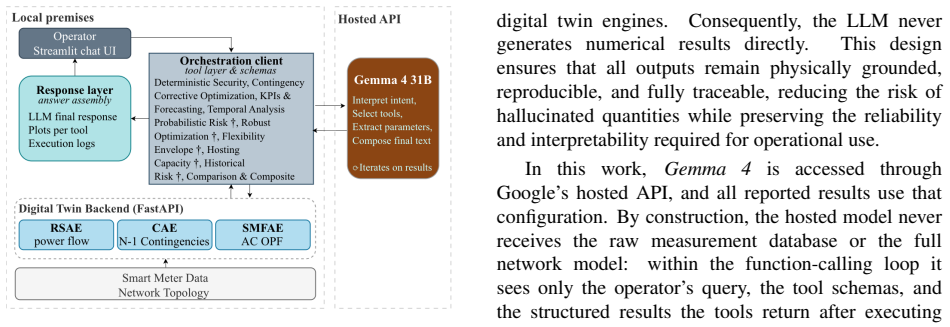
The LLM orchestrator that sequences solver calls, maintains operational state across steps, and enforces evidence consistency for uncertainty-aware analyses.
If this is right
- Grid operators can request probabilistic risk quantifications and robust dispatch plans through natural-language prompts.
- Flexibility envelopes and hosting-capacity limits become characterizable without manual scenario construction.
- The full pipeline supports open-source deployment for deterministic and uncertainty-aware studies on real networks.
- The orchestrator can handle multi-step workflows that combine analysis and optimization solvers while tracking evidence.
Where Pith is reading between the lines
- If the orchestrator maintains performance across varied networks, smaller utilities could run advanced uncertainty studies without specialized programming staff.
- Connecting the system to live data feeds could support ongoing uncertainty management rather than static case studies.
- Testing the same prompts on updated solver versions would clarify whether the observed calibration holds beyond the current tool set.
Load-bearing premise
The 68-prompt behavioral catalog and single real-network case study suffice to establish that the orchestrator will maintain state-mutation discipline, evidence consistency, and refusal calibration on unseen operating conditions or different solver versions.
What would settle it
A demonstration that the system generates inconsistent evidence, mutates state incorrectly, or fails to refuse invalid requests when run on a different network configuration or solver version would falsify the reliability claim.
Figures
read the original abstract
Large language models (LLMs) are proposed as natural-language interfaces to power system analysis, yet existing frameworks are validated almost exclusively on synthetic benchmarks and support only deterministic studies. We present CONDUCTOR, an LLM-orchestrated digital twin for distribution grid operations. An open-weights LLM orchestrates power system analysis and optimization solvers and, unlike prior systems, also performs uncertainty-aware studies: probabilistic security assessment, robust corrective dispatch, and flexibility-envelope and hosting-capacity characterization. We test it on the Bornholm 60 kV distribution network - a real Danish island power system - using one year of smart-meter measurements. An operator case study spans deterministic assessment, probabilistic risk quantification, and robust dispatch. Across a 68-prompt behavioral catalog scoring tool use, evidence consistency, state-mutation discipline, and refusal calibration, the orchestrator answers 98.5% of tasks correctly on the first attempt - the lone failure being a missing answer, not a wrong one. The full pipeline is released open source.
Editorial analysis
A structured set of objections, weighed in public.
Referee Report
Summary. The paper introduces CONDUCTOR, an open-weights LLM-orchestrated digital twin that interfaces with power-system analysis and optimization solvers to perform uncertainty-aware studies (probabilistic security assessment, robust corrective dispatch, flexibility-envelope and hosting-capacity characterization) on the real Bornholm 60 kV network using one year of smart-meter data. It reports 98.5% first-attempt success across a 68-prompt behavioral catalog that scores tool use, evidence consistency, state-mutation discipline, and refusal calibration, with the full pipeline released open source.
Significance. If the empirical result holds, the work supplies a concrete, reproducible demonstration that LLM orchestration can handle uncertainty-aware grid tasks on real data rather than synthetic deterministic benchmarks; the open-source release and use of actual Bornholm measurements constitute clear strengths that enable community follow-up.
major comments (1)
- [Evaluation] Evaluation section (behavioral catalog results): the 98.5% success rate is obtained on a single fixed 68-prompt catalog and one network topology; this does not test whether state-mutation discipline, evidence consistency, or refusal calibration persist under changed prompt distributions, different uncertainty parameterizations, altered network topology, or updated solver versions—the regime where the reliability claim is most likely to be challenged.
Simulated Author's Rebuttal
We thank the referee for the constructive comment on the evaluation and for recognizing the strengths of the open-source release and real Bornholm data. We address the major comment point by point below.
read point-by-point responses
-
Referee: [Evaluation] Evaluation section (behavioral catalog results): the 98.5% success rate is obtained on a single fixed 68-prompt catalog and one network topology; this does not test whether state-mutation discipline, evidence consistency, or refusal calibration persist under changed prompt distributions, different uncertainty parameterizations, altered network topology, or updated solver versions—the regime where the reliability claim is most likely to be challenged.
Authors: We agree that the 98.5% success rate is measured on one fixed 68-prompt catalog and the single Bornholm 60 kV topology. This constitutes a genuine limitation of the current evaluation, as the referee notes; the results do not yet demonstrate persistence of the reported behaviors under distribution shift, different uncertainty models, other networks, or solver updates. In the revised manuscript we will (i) explicitly qualify the scope of the reliability claim in the Evaluation and Conclusion sections, (ii) add a dedicated limitations paragraph that lists the untested regimes, and (iii) outline concrete directions for follow-up experiments (e.g., prompt perturbation suites, additional real or synthetic topologies, and solver-version sweeps). We maintain that the existing results still provide a reproducible, real-data demonstration of LLM-orchestrated uncertainty-aware grid tasks, but we will adjust the presentation to avoid overstating generalization. revision: yes
Circularity Check
Empirical performance metric on external real-world data exhibits no circularity
full rationale
The paper presents an empirical result: 98.5% first-attempt success on a fixed 68-prompt behavioral catalog evaluated against one year of real smart-meter data from the Bornholm 60 kV network. This performance number is obtained by direct measurement on external inputs and does not reduce, via any equation or self-citation chain in the provided text, to a fitted parameter, self-definitional loop, or load-bearing prior result from the same authors. The evaluation protocol (tool-use scoring, evidence consistency, state-mutation discipline, refusal calibration) is applied to an independent dataset and prompt set, rendering the central claim falsifiable outside the paper's own definitions. No derivation chain exists that equates the reported success rate to its inputs by construction.
Axiom & Free-Parameter Ledger
axioms (2)
- domain assumption Power-system solvers produce correct deterministic solutions when given correct inputs and network data.
- domain assumption One year of smart-meter measurements on Bornholm is representative of future operating conditions for uncertainty quantification.
Reference graph
Works this paper leans on
-
[1]
(2024).Building llm powered applications: Create intelligent apps and agents with large language models
Alto, V . (2024).Building llm powered applications: Create intelligent apps and agents with large language models. Packt Publishing Ltd
2024
-
[2]
Badmus, E. O., & Pandey, A. (2026). Powerdag: Reliable agentic ai system for automating distribution grid analysis.arXiv preprint arXiv:2603.17418. https://arxiv.org/abs/2603. 17418
Pith/arXiv arXiv 2026
-
[3]
C., & Campi, M
Calafiore, G. C., & Campi, M. C. (2006). The scenario approach to robust control design.IEEE Transactions on automatic control,51(5), 742–753
2006
-
[4]
Chen, X. (2025). X-gridagent: An llm-powered agentic ai system for assisting power grid analysis. arXiv preprint arXiv:2512.20789. https://arxiv. org/abs/2512.20789
arXiv 2025
-
[5]
Guo, Z., Tang, F., Luo, L., Zhao, M., & Kato, N. (2025). A survey on applications of large language model-driven digital twins for intelligent network optimization.IEEE Communications Surveys & Tutorials
2025
-
[6]
Jin, H., Kim, K., & Kwon, J. (2025). Gridmind: Llms-powered agents for power system analysis and operations.Proceedings of the SC’25 Workshops of the International Conference for High Performance Computing,
2025
-
[7]
Liu, B., Dong, J., & Lian, J. (2026). Grid-orch: An llm-powered orchestrator for distribution grid simulation and analytics.arXiv preprint arXiv:2605.12728. https://arxiv.org/abs/2605. 12728
Pith/arXiv arXiv 2026
-
[8]
L., & Dang, Z
Zhong, S. L., & Dang, Z. M. (2025). Repower: An llm-driven autonomous platform for power system data-guided research.Patterns,6(4)
2025
-
[9]
She, B., Chen, B., Guo, L., & Li, F. (2026). Pfagent: A tractable and self-evolving power-flow agent for interactive grid analysis.arXiv preprint arXiv:2604.10846. https://arxiv.org/abs/2604. 10846
Pith/arXiv arXiv 2026
-
[10]
Subramanian, N., & Stonier, A. A. (2026). Digital twin applications and case studies in modern power grid management.Energy Reports,15, 109218
2026
-
[11]
Dollichon, J., Meier, F., Meinecke, S., & Braun, M. (2018). Pandapower—an open-source python tool for convenient modeling, analysis, and optimization of electric power systems.IEEE Transactions on Power Systems,33(6), 6510–6521. https : //doi.org/10.1109/TPWRS.2018.2829021
-
[12]
Zhang, Q., & Xie, L. (2025). Poweragent: A road map toward agentic intelligence in power systems: Foundation model, model context protocol, and workflow.IEEE Power and Energy Magazine, 23(5), 93–101
2025
-
[13]
Zhang, Y . (2024). Application of large language models in power system operation and control.Journal of Computer Electronics and Information Management,15(3), 79–83
2024
-
[14]
Lu, Y ., & He, L. (2026). Digital twin ai: Opportunities and challenges from large language models to world models.arXiv preprint arXiv:2601.01321. https://arxiv.org/ abs/2601.01321
arXiv 2026
-
[15]
Zhou, X., Xu, Y ., Zhao, J., & Zhang, R. (2026). Large language model applications in power systems: A comprehensive review and outlook.Journal of Modern Power Systems and Clean Energy
2026
-
[16]
Du, X., & Guo, M. (2025). Research on a complex question-answering system for power knowledge based on llm and reinforcement learning.International Conference on Electrical Engineering and Smart Grid (EESG 2025),13972, 517–523
2025
discussion (0)
Sign in with ORCID, Apple, or X to comment. Anyone can read and Pith papers without signing in.