REVIEW 1 major objections 1 minor 15 references
Continuous-time state space analysis of d18O, d13C, and CO2 in the Cenozoic Era
T0 review · 1 major / 1 minor · reviewed 2026-06-25 · grok-4.3
Pith's one-line read A continuous-time state-space model shows Cenozoic isotope correlations reversing sign as climate shifts from greenhouse to icehouse conditions.
desk verdict The state-dependent innovation covariance turns the model nonlinear, so the Kalman ML estimates rest on an unexamined approximation. read the letter →
The pith
A machine-rendered reading of the paper's core claim, the machinery that carries it, and where it could break.
The reading
What carries the argument
The trivariate continuous-time random walk whose innovation covariance matrix and La2004 orbital forcing term are permitted to vary with climate state, observed through a measurement model that assigns site-specific error variances to the isotopes and proxy-group variances to CO2 together with bias intercepts, estimated by maximum likelihood via the Kalman filter with diffuse initialization.
What would settle it
New high-resolution CO2 data from an independent archive that place the Oligocene glaciation threshold outside the model's reported confidence bands would contradict the reconstructed path.
Extended reading notes
Core claim
The central claim is that a state-dependent continuous-time trivariate random walk fitted to the joint proxy record reveals sign-reversing correlations between d18O, d13C and CO2 across the Cenozoic greenhouse-to-icehouse transition, increasing orbital sensitivity of the isotopes as ice sheets grow, and a CO2 reconstruction that places the atmospheric thresholds of the major glaciations in calibrated relation to modern levels.
Load-bearing premise
The unobserved climate signals behave as a linear random walk in continuous time whose parameters are allowed to switch according to the prevailing climate regime.
Editorial extensions
If this is right
- The sign reversal implies that the statistical coupling between the carbon cycle and ice volume changed at the Eocene-Oligocene boundary.
- Increasing orbital sensitivity indicates that growing ice sheets amplify the response to Milankovitch forcing.
- The CO2 reconstruction supplies quantitative thresholds for the onset of major Cenozoic glaciations expressed relative to present-day concentrations.
- Joint modeling borrows strength across proxies to reduce uncertainty in each individual latent history.
Reading between the lines
- The same state-dependent structure could be applied to other proxy sets to test whether similar correlation reversals appear outside the Cenozoic.
- Relaxing the random-walk assumption to include regime-switching nonlinear terms would allow the model to capture abrupt transitions more explicitly.
- Direct comparison of the model's CO2 bands against independent boron-isotope or stomatal records would provide an external check on the calibrated thresholds.
Editorial analysis
A structured set of objections, weighed in public.
Referee Report
Summary. The manuscript develops a continuous-time state-space framework for joint reconstruction of Cenozoic d18O, d13C, and atmospheric CO2 from multi-site, multi-method proxy data. The latent signals are modeled as a trivariate random walk whose innovation covariance and deterministic La2004 Milankovitch forcing are permitted to depend on the prevailing climate state; all parameters are obtained by maximum likelihood via the Kalman filter with diffuse initialization. The reported results include sign reversal of cross-proxy correlations between greenhouse and icehouse regimes, strengthening orbital sensitivity with ice-sheet growth, and CO2 thresholds for major glaciations placed relative to modern concentrations.
Significance. If the modeling and estimation choices are valid, the work supplies a unified reconstruction with calibrated uncertainty bands and documents regime-dependent proxy relationships that bear on Cenozoic climate dynamics. The continuous-time formulation and explicit treatment of irregular sampling and multi-source biases constitute methodological strengths.
major comments (1)
- [Abstract] Abstract: the transition equation lets innovation covariance (and Milankovitch forcing) depend on the prevailing climate state. Because that state is a function of the latent variables themselves, the system is nonlinear. The standard Kalman filter supplies the exact likelihood only for linear Gaussian systems with known time-varying coefficients; the accuracy of the approximation underlying the reported ML estimates, the sign-reversal claim, and the CO2 thresholds is not addressed.
minor comments (1)
- [Abstract] Clarify the precise functional form by which the climate state enters the innovation covariance and forcing coefficients, including any discretization or approximation steps required for implementation.
Simulated Author's Rebuttal
We thank the referee for the careful and constructive review. The point on nonlinearity is well taken and we address it directly below.
read point-by-point responses
-
Referee: [Abstract] Abstract: the transition equation lets innovation covariance (and Milankovitch forcing) depend on the prevailing climate state. Because that state is a function of the latent variables themselves, the system is nonlinear. The standard Kalman filter supplies the exact likelihood only for linear Gaussian systems with known time-varying coefficients; the accuracy of the approximation underlying the reported ML estimates, the sign-reversal claim, and the CO2 thresholds is not addressed.
Authors: We agree that state dependence of the innovation covariance and Milankovitch forcing on the latent climate state renders the transition equation nonlinear. The manuscript applies the Kalman filter by evaluating the state-dependent coefficients at the one-step-ahead filtered estimates obtained in a previous iteration, which is an approximation analogous to the iterated extended Kalman filter. Because the paper does not quantify the resulting bias in the likelihood or in the reported regime-dependent correlations and CO2 thresholds, the concern is valid. We will revise the methods and discussion sections to (i) state the approximation explicitly, (ii) report a simulation study that compares the approximate ML estimates against those obtained from a particle filter on the same data-generating process, and (iii) add a brief sensitivity analysis showing how the sign-reversal and threshold results change under modest perturbations of the state-dependent coefficients. These additions will be placed before the results so that readers can judge the robustness of the claims. revision: yes
Circularity Check
No circularity: results are direct outputs of Kalman-filter ML estimation on proxy data
full rationale
The paper specifies a trivariate continuous-time random walk for the latent signals, with a linear-Gaussian measurement equation (site-specific variances and bias intercepts) and a transition equation whose innovation covariance and La2004 forcing are permitted to depend on climate state. All parameters are obtained by maximum likelihood via the Kalman filter with diffuse initialization applied to the observed multi-proxy time series. The reported findings (sign reversal of cross-proxy correlations between greenhouse and icehouse regimes, strengthening orbital sensitivity, and CO2 thresholds) are therefore the numerical outputs of this estimation procedure rather than any quantity that is defined in terms of itself or renamed from a fitted input. No self-citation is used to justify a uniqueness theorem or ansatz, and the derivation chain contains no step that reduces a claimed prediction to its own inputs by construction.
Assumptions & free parameters
free parameters (3)
- innovation covariance matrix elements
- bias intercepts for multi-site and multi-method alignment
- orbital forcing coefficients
assumptions (3)
- domain assumption Latent signals follow a trivariate random walk in continuous time
- ad hoc to paper Innovation covariance and Milankovitch forcing depend on prevailing climate state
- standard math Diffuse initialization for the Kalman filter
Cite this review
Pith. "Pith review of Continuous-time state space analysis of d18O, d13C, and CO2 in the Cenozoic Era." pith.science (2026). https://pith.science/paper/XTVPWR54
@misc{pith2026260624729,
  author       = {Pith},
  title        = {Pith review of: Continuous-time state space analysis of d18O, d13C, and CO2 in the Cenozoic Era},
  year         = {2026},
  howpublished = {\url{https://pith.science/paper/XTVPWR54}},
  note         = {Machine review of arXiv:2606.24729}
}
abstract
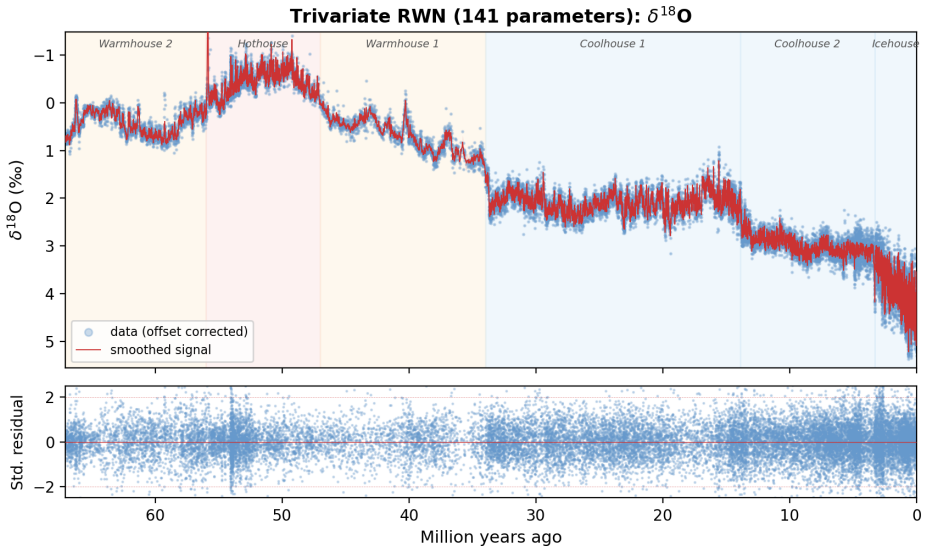
We develop a continuous-time state-space framework for the joint reconstruction of three Cenozoic climate proxies, benthic foraminiferal d18O and d13C and atmospheric CO2, from irregularly and unevenly sampled multi-site, multi-method data spanning the last 67 million years. The latent signals follow a trivariate random walk in continuous time; the measurement equation differentiates the error variance by drill site for the isotopes and by proxy group for CO2, with bias intercepts placing all sources on a common scale, and the transition equation lets the innovation covariance and a deterministic La2004 Milankovitch forcing depend on the prevailing climate state. All parameters are estimated by maximum likelihood through the Kalman filter with diffuse initialization. The estimated cross-proxy correlations reverse sign between the early Cenozoic greenhouse and the icehouse, the orbital sensitivity of the isotopes strengthens as continental ice sheets grow, and the reconstructed CO2 path, reported with calibrated confidence bands, places the atmospheric CO$_2$ thresholds of the major Cenozoic glaciations in relation to present-day concentrations.
Figures


Figures from the paper (7 more)





Reference graph
Works this paper leans on
-
[1]
Continuous-time state-space methods for ^
Bennedsen, Mikkel and Hillebrand, Eric and Koopman, Siem Jan and Larsen, Kathrine and Lupien, Rachel , journal=. Continuous-time state-space methods for ^. 2024 , doi=
2024
-
[2]
Science , volume=
Toward a. Science , volume=. 2023 , doi=
2023
-
[3]
Paleo-. 2026 , publisher=. doi:10.5281/zenodo.18236760 , note=
-
[4]
Data Product for ``. 2023 , publisher=. doi:10.5281/zenodo.10078932 , note=
-
[5]
and Pollard, David , title =
DeConto, Robert M. and Pollard, David , title =. Nature , year =
-
[6]
and Herold, N
Goldner, A. and Herold, N. and Huber, M. , title =. Nature , year =
-
[7]
and Zachos, James C
Hansen, James and Sato, Makiko and Kharecha, Pushker and Beerling, David and Berner, Robert and Masson-Delmotte, Valerie and Pagani, Mark and Raymo, Maureen and Royer, Dana L. and Zachos, James C. , journal=. Target atmospheric. 2008 , doi=
2008
-
[8]
Philosophical Transactions of the Royal Society A , volume=
Climate sensitivity, sea level and atmospheric carbon dioxide , author=. Philosophical Transactions of the Royal Society A , volume=. 2013 , doi=
2013
Show all 15 references
-
[9]
and Coxall, Helen K
Hutchinson, David K. and Coxall, Helen K. and O'Regan, Matt and Nilsson, Johan and Caballero, Rodrigo and de Boer, Agatha M. , title =. Nature Communications , year =
-
[10]
and Lowenstein, Tim K
Jagniecki, Elliot A. and Lowenstein, Tim K. and Jenkins, David M. and Demicco, Robert V. , title =. Geology , year =
-
[11]
Estimating breakpoints in the
Bennedsen, Mikkel and Hillebrand, Eric and Koopman, Siem Jan and Larsen, Kathrine and Lupien, Rachel , journal=. Estimating breakpoints in the. 2025 , doi=
2025
-
[12]
A long-term numerical solution for the insolation quantities of the
Laskar, Jacques and Robutel, Philippe and Joutel, Fr. A long-term numerical solution for the insolation quantities of the. Astronomy & Astrophysics , year =
-
[13]
and Nummelin, Aleksi and Gaina, Carmen and Nisancioglu, Kerim H
Straume, Eivind O. and Nummelin, Aleksi and Gaina, Carmen and Nisancioglu, Kerim H. , title =. Proceedings of the National Academy of Sciences , year =
-
[14]
Science , volume=
An astronomically dated record of Earth's climate and its predictability over the last 66 million years , author=. Science , volume=. doi:10.1126/science.aba6853 , year=
-
[15]
Science , volume=
Trends, rhythms, and aberrations in global climate 65 Ma to present , author=. Science , volume=. 2001 , doi=
2001
Reviewed June 25, 2026 · model on record in the stance chip above.
Discussion (0). Continue with ORCID to comment.