Offset-continuation-trajectory stacking based on common-reflection-point kinematics for five-dimensional prestack dataset regularization and enhancement
Pith reviewed 2026-06-25 21:27 UTC · model grok-4.3
The pith
The offset-continuation-trajectory operator reconstructs missing traces in five-dimensional prestack seismic data by stacking along physically consistent common-reflection-point traveltime surfaces.
A machine-rendered reading of the paper's core claim, the machinery that carries it, and where it could break.
Core claim
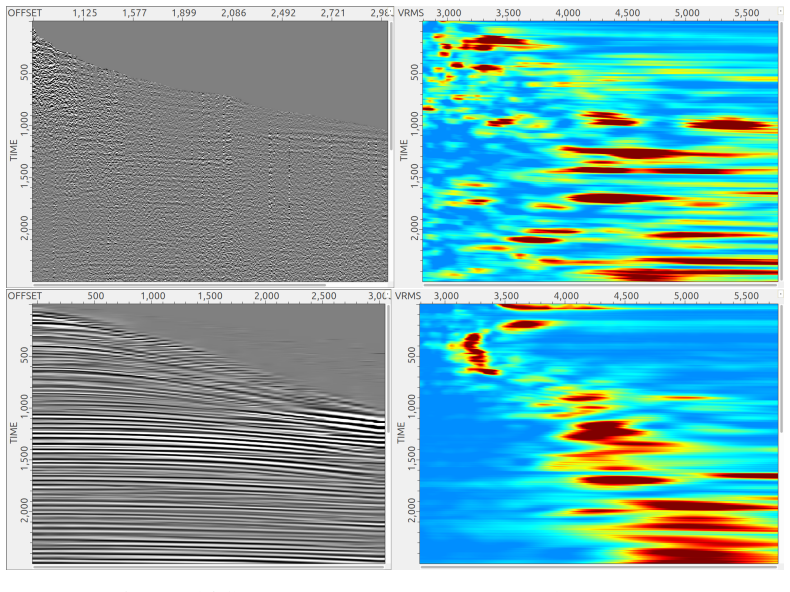
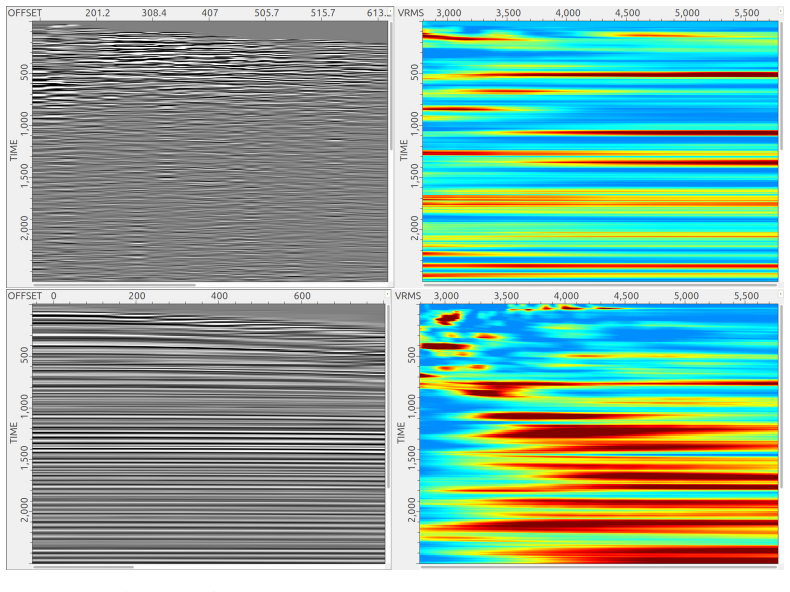
The central claim is that the offset-continuation-trajectory (OCT) operator, grounded in common-reflection-point (CRP) kinematics, reconstructs missing traces and enhances spatial continuity in 5D prestack datasets. It achieves this by stacking seismic events along traveltime surfaces derived from wavefront propagation, isochronous surface geometry, specular reflection, and diffraction kinematics, with all parameters estimated directly from the input data via global coevolutionary optimization. Applications demonstrate improved signal-to-noise ratio, enhanced structural continuity, and reliable recovery of unrecorded amplitudes while preserving both reflection and diffraction kinematics.
What carries the argument
The offset-continuation-trajectory (OCT) operator, a multi-parameter CRP traveltime stacking operator that derives coherent trajectories from wavefront propagation, isochronous surface geometry, specular reflection, and diffraction kinematics, with parameters estimated via global coevolutionary optimization.
If this is right
- Missing traces in 5D prestack datasets are reconstructed while preserving reflection and diffraction kinematics.
- Signal-to-noise ratio and structural continuity improve on both synthetic and field data without creation of artificial events.
- The method supplies a geologically consistent alternative to purely mathematical interpolation techniques.
- Data fidelity for subsequent imaging and quantitative interpretation steps increases.
Where Pith is reading between the lines
- The same kinematic stacking principle could be adapted to regularize other multidimensional geophysical datasets that obey similar wavefront and reflection rules.
- Errors in the recovered amplitudes might propagate into downstream velocity model building or amplitude-versus-offset analysis.
- The optimization step could be replaced by faster local search methods if the global coevolutionary approach proves computationally limiting on very large surveys.
Load-bearing premise
Kinematic parameters estimated directly from the input data via global coevolutionary optimization accurately capture the true subsurface wave propagation without overfitting noise or producing biased traveltime surfaces.
What would settle it
A synthetic test in which the reconstructed amplitudes or continuity visibly degrade relative to a known true model when the optimization step is replaced by random or noise-contaminated parameter values would falsify the claim that the estimated surfaces remain physically consistent.
Figures
read the original abstract
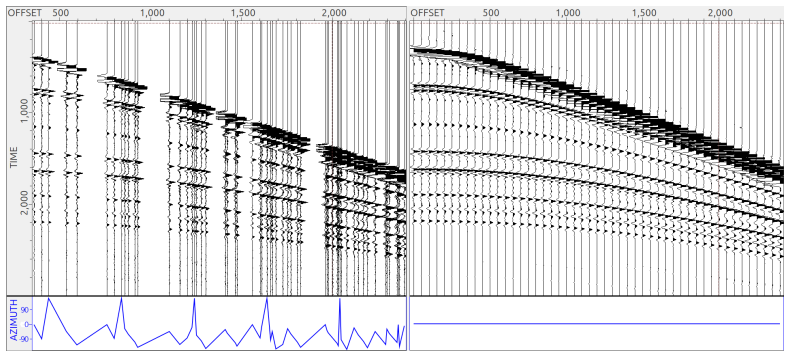
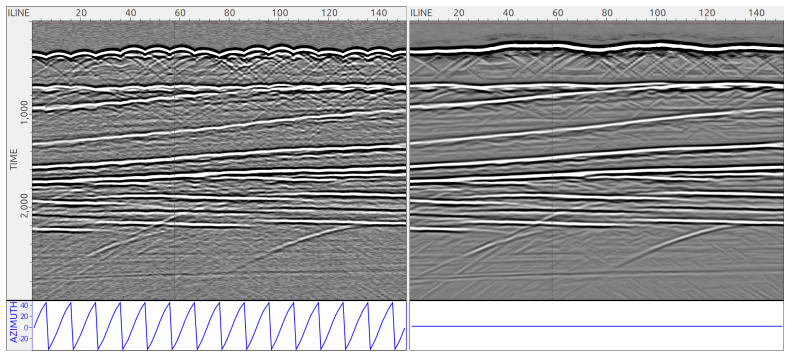
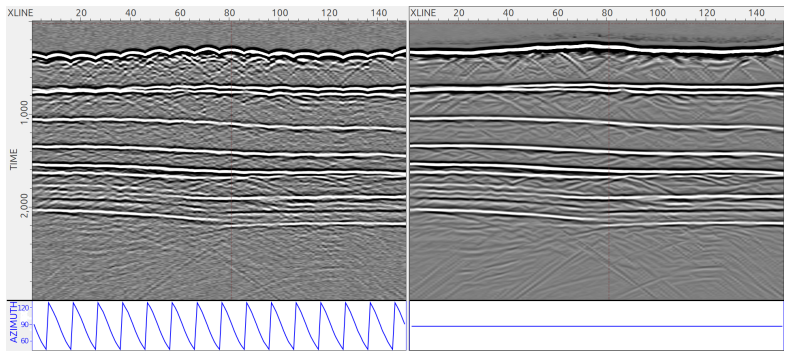
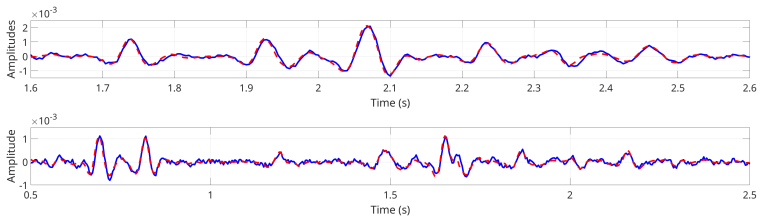
Prestack seismic data regularization and enhancement are critical steps for reliable imaging and inversion, particularly in five-dimensional (5D) dataset geometries affected by irregular sampling, noise contamination, and incomplete spatial coverage. These limitations often degrade event continuity and compromise the physical consistency of conventional interpolation methods. This study introduces a physics-informed framework for 5D prestack dataset reconstruction based on a multi-parameter common-reflection-point (CRP) traveltime stacking operator. The proposed offset-continuation-trajectory (OCT) operator derives coherent stacking trajectories from wavefront propagation, isochronous surface geometry, specular reflection, and diffraction kinematics. All kinematic parameters are estimated directly from the data through a global coevolutionary optimization strategy. The method reconstructs missing traces and enhances spatial continuity by stacking seismic events along physically consistent traveltime surfaces, preserving both reflection and diffraction kinematics. Applications to synthetic and field datasets demonstrate improved signal-to-noise ratio, enhanced structural continuity, and reliable recovery of unrecorded amplitudes without introducing artificial events. The results indicate that incorporating physically constrained traveltime models into the regularization process provides a robust, geologically consistent alternative to purely mathematical interpolation techniques, thereby improving data fidelity for subsequent imaging and quantitative interpretation.
Editorial analysis
A structured set of objections, weighed in public.
Referee Report
Summary. The manuscript introduces a physics-informed framework for 5D prestack seismic data regularization and enhancement using an offset-continuation-trajectory (OCT) operator derived from common-reflection-point (CRP) traveltime stacking. The OCT operator constructs coherent stacking trajectories from wavefront propagation, isochronous surface geometry, specular reflection, and diffraction kinematics, with all multi-parameter kinematic parameters estimated directly from the input data via global coevolutionary optimization. The method claims to reconstruct missing traces, enhance spatial continuity, improve SNR, and recover unrecorded amplitudes on synthetic and field datasets without introducing artificial events, providing a geologically consistent alternative to purely mathematical interpolation.
Significance. If the central claims hold under rigorous validation, the work could offer a meaningful advance in seismic processing by embedding physical wave-propagation constraints into data regularization, potentially yielding more reliable inputs for imaging and inversion. The explicit use of multiple kinematic principles (wavefront, isochronous, specular, diffraction) is a conceptual strength, though the data-driven parameter estimation requires careful scrutiny to confirm independence from the regularization target.
major comments (2)
- Abstract: the claims of improved SNR, enhanced structural continuity, and reliable amplitude recovery on synthetic and field datasets are asserted without any quantitative metrics, error bars, baseline comparisons (e.g., against existing 5D interpolation methods), or validation details, which is load-bearing for evaluating whether the OCT operator actually outperforms conventional approaches.
- Method description (kinematic estimation step): kinematic parameters are obtained via global coevolutionary optimization performed on the same input traces that are subsequently regularized; this introduces a circularity in which the traveltime surfaces used for stacking are shaped by a fit to the very data being enhanced, undermining the claim that the trajectories are independently 'physically consistent'.
minor comments (2)
- Notation for the multi-parameter kinematic vector and the explicit form of the OCT stacking operator should be defined with an equation early in the methods section to improve reproducibility.
- The manuscript should clarify whether the coevolutionary optimization includes any regularization term that prevents overfitting to noise, as this directly affects the physical-consistency argument.
Simulated Author's Rebuttal
We thank the referee for the constructive comments on our manuscript. We address each major point below and will revise the manuscript to improve clarity and strengthen the validation of our claims.
read point-by-point responses
-
Referee: Abstract: the claims of improved SNR, enhanced structural continuity, and reliable amplitude recovery on synthetic and field datasets are asserted without any quantitative metrics, error bars, baseline comparisons (e.g., against existing 5D interpolation methods), or validation details, which is load-bearing for evaluating whether the OCT operator actually outperforms conventional approaches.
Authors: We agree that the abstract would be strengthened by quantitative support. In the revised version, we will add specific metrics (e.g., SNR gains, RMS error reductions, structural similarity indices) with error bars from repeated trials, plus direct comparisons against established 5D methods such as minimum-weighted-norm interpolation and Fourier POCS. Validation details on the synthetic and field examples will be summarized concisely in the abstract while preserving its length. revision: yes
-
Referee: Method description (kinematic estimation step): kinematic parameters are obtained via global coevolutionary optimization performed on the same input traces that are subsequently regularized; this introduces a circularity in which the traveltime surfaces used for stacking are shaped by a fit to the very data being enhanced, undermining the claim that the trajectories are independently 'physically consistent'.
Authors: We acknowledge the concern about potential circularity. The coevolutionary optimization is performed exclusively on the recorded input traces to determine the multi-parameter kinematic model that best satisfies the physical constraints (wavefront propagation, isochronous surfaces, specular reflection, and diffraction). These parameters are then used to define stacking trajectories that enforce consistency across the entire 5D volume, including at unrecorded locations. In the revision we will expand the methods section with a flowchart and pseudocode clarifying this separation, and we will add a robustness test showing that parameter estimates remain stable under added noise before stacking is applied. revision: partial
Circularity Check
No significant circularity detected
full rationale
The paper's method estimates kinematic parameters from input data via optimization and applies them within an explicit physics-based model (wavefront propagation, isochronous surfaces, specular reflection, diffraction kinematics) to define stacking trajectories for regularization. This does not reduce the reconstructed output to the inputs by construction, nor does it present fitted values as independent predictions. No self-definitional equations, load-bearing self-citations, or ansatz smuggling appear in the abstract or described chain. The approach is a standard data-driven interpolation constrained by stated physical relations, making the derivation self-contained against external benchmarks.
Axiom & Free-Parameter Ledger
free parameters (1)
- multi-parameter kinematic parameters
axioms (1)
- domain assumption Wavefront propagation, isochronous surface geometry, specular reflection, and diffraction kinematics provide accurate descriptions of seismic event traveltimes.
invented entities (1)
-
Offset-continuation-trajectory (OCT) operator
no independent evidence
Reference graph
Works this paper leans on
-
[2]
R. H. Stolt, A. B. Weglein, Seismic Imaging and Inversion: Appli- cation of Linear Inverse Theory, Cambridge University Press, 2012. doi:https://doi.org/10.1017/CBO9781139056250
-
[3]
Ma, J.-P
C. Ma, J.-P. Huang, Z.-X. Qiao, S.-F. Li, W.-S. Duan, G.-L. Lei, Irreg- ularly seismic data interpolation based on deep learning with integrated channel-spatial attention mechanism, Petroleum Science
-
[4]
J. Park, S. Kim, S. J. Seol, J. Byun, Improving generalization perfor- mance of deep learning–based seismic data interpolation, Geophysical Prospecting 73 (5) (2025) 1534–1551. 30
2025
-
[5]
B. Liu, M. Sacchi, Minimum weighted norm interpolation of seismic records, Geophysics 69 (6) (2004) 1560–1568.doi:10.1190/1.1836829
-
[6]
H. Kaur, N. Pham, S. Fomel, Seismic data interpolation using cycle- gan, in: SEG technical program expanded abstracts 2019, Society of Exploration Geophysicists, 2019, pp. 2202–2206
2019
-
[7]
B. Wang, N. Zhang, W. Lu, J. Wang, Deep-learning-based seismic data interpolation: A preliminary result, Geophysics 84 (1) (2019) V11–V20
2019
-
[8]
Mikhailiuk, A
A. Mikhailiuk, A. Faul, Deep learning applied to seismic data inter- polation, in: 80th EAGE Conference and Exhibition 2018, Vol. 2018, European Association of Geoscientists & Engineers, 2018, pp. 1–5
2018
-
[9]
doi:https://doi.org/10.1190/1.9781560801580
Öz Yilmaz, Seismic Data Analysis: Processing, Inversion, and Inter- pretation of Seismic Data, Society of Exploration Geophysicists, 2001. doi:https://doi.org/10.1190/1.9781560801580
-
[10]
F. J. Herrmann, D. Wang, G. Hennenfent, P. P. Moghaddam, Curvelet- based seismic data processing: A multiscale and nonlinear approach, Geophysics 73 (1) (2008) A1–A5.doi:https://doi.org/10.1190/1. 2799517
work page doi:10.1190/1 2008
-
[11]
Trickett, F-xy Cadzow noise suppression, in: SEG Technical Program Expanded Abstracts, 2008, pp
S. Trickett, F-xy Cadzow noise suppression, in: SEG Technical Program Expanded Abstracts, 2008, pp. 2586–2590.doi:https://doi.org/10. 1190/1.3063880
2008
-
[12]
N. S. Neidell, M. T. Taner, Semblance and other coherency measures for multichannel data, Geophysics 36 (3) (1971) 482–497.doi:https: //doi.org/10.1190/1.1440186
-
[13]
D. Trad, Five-dimensional interpolation: Recovering from acquisition constraints, Geophysics (2009) 1ND–Z107doi:10.1190/1.3245216
-
[14]
S. Spitz, Seismic trace interpolation in the F-X domain, Geophysics 56 (6) (1991) 785–794.doi:10.1190/1.1443096
-
[15]
R. Abma, N. Kabir, 3D interpolation of irregular data with a POCS al- gorithm, Geophysics 71 (6) (2006) E91–E97.doi:10.1190/1.2369988. 31
-
[16]
T. A. Coimbra, J. Schleicher, A. Novais, Offset-continuation stacking: Theory and proof of concept, Geophysics 81 (5) (2016) V387–V401. doi:10.1190/geo2015-0473.1
-
[17]
F. J. Herrmann, G. Hennenfent, Non-parametric seismic data recovery with curvelet frames, Geophysical Journal International 173 (1) (2008) 233–248.doi:https://doi.org/10.1111/j.1365-246X.2007.03698. x
-
[18]
S. Xu, Y. Zhang, D. Pham, G. Lambaré, Antileakage fourier transform for seismic data regularization, Geophysics 70 (6) (2005) V87–V95.doi: https://doi.org/10.1190/1.1993713
-
[19]
Kreimer, M
N. Kreimer, M. D. Sacchi, A tensor higher-order singular value decom- position for prestack seismic data noise reduction and reconstruction, Geophysics 77 (3) (2012) V113–V122.doi:https://doi.org/10.1190/ geo2011-0399.1
2012
-
[20]
Fomel, Seismic data regularization with differential offset continu- ation, Geophysics 68 (2) (2003) 430–760.doi:https://doi.org/10
S. Fomel, Seismic data regularization with differential offset continu- ation, Geophysics 68 (2) (2003) 430–760.doi:https://doi.org/10. 1190/1.1567243
2003
-
[21]
B. Biondi, 3D Seismic Imaging, Society of Exploration Geophysicists, 2006.doi:https://doi.org/10.1190/1.9781560801689.fm
-
[22]
Metamorphictestingoflarge languagemodelsfornaturallanguageprocessing.doi:10.48550/arXiv
J. Ribeiro, N. Okita, T. A. Coimbra, J. H. Faccipieri, Ultra-fast travel- time parameters search by a coevolutionary optimization approach us- ing graphics processing units, arXiv 2304.11399.doi:10.48550/ARXIV. 2304.11399. URLhttps://arxiv.org/abs/2304.11399
work page internal anchor Pith review doi:10.48550/arxiv
-
[23]
Klem-Musatov, A
K. Klem-Musatov, A. M. Aizenberg, J. Pajchel, H. B. Helle, Edge and Tip Diffractions: Theory and Applications in Seismic Prospecting, So- ciety of Exploration Geophysicists, 2003.doi:https://doi.org/10. 1190/1.9781560801627.fm
2003
-
[24]
P. Hubral, Time migration—some ray theoretical aspects, Geophysical Prospecting 25 (4) (1977) 738–745.doi:10.1111/j.1365-2478.1977. tb01200.x. 32
-
[25]
T. A. Coimbra, J. H. Faccipieri, J. H. Speglich, L.-J. Gelius, M. Tygel, Enhancement of diffractions in prestack domain by means of a finite- offset double-square-root traveltime, Geophysics 84 (1) (2019) V81–V96. doi:10.1190/geo2018-0160.1
-
[26]
D. Hale, N. R. Hill, J. Stefani, Imaging salt with turning seismic waves, Geophysics 57 (11) (1992) 1453–1462.doi:10.1190/1.1443213
-
[27]
T. A. Coimbra, J. H. Faccipieri, D. S. Rueda, M. Tygel, Common- reflection-point time migration, Studia Geophysica et Geodaetica 60 (3) (2016) 500–530.doi:10.1007/s11200-015-0392-1. URLhttp://dx.doi.org/10.1007/s11200-015-0392-1
-
[28]
URLhttp://dx.doi.org/10.1190/1.1441702
D.Hale, Dip-moveoutbyfouriertransform, GEOPHYSICS49(6)(1984) 741–757.doi:10.1190/1.1441702. URLhttp://dx.doi.org/10.1190/1.1441702
-
[29]
Direct full waveform inversion of DAS fiber-optic data,
N. Okita, T. Coimbra, J. Faccipieri, Ultra-fast diffraction separation in the five-dimensional domain, in: 85th EAGE Annual Conference & Exhibition, European Association of Geoscientists & Engineers, 2024, p. 1–5.doi:10.3997/2214-4609.202410027. URLhttp://dx.doi.org/10.3997/2214-4609.202410027
-
[30]
J. Ribeiro, T. A. Coimbra, N. T. Okita, G. B. Ignácio, M. Tygel, Using adaptive differential evolution algorithm to improve parameter estima- tion in seismic processing: extended results, Brazilian Journal of Geo- physics 38 (3).doi:10.22564/rbgf.v38i3.2059. URLhttp://dx.doi.org/10.22564/rbgf.v38i3.2059
-
[31]
T. A. Coimbra, J. H. Faccipieri, L.-J. Gelius, M. Tygel, Enhancement of stacked sections using zo crs parameters, in: 14th International Congress of the Brazilian Geophysical Society & EXPOGEF, Rio de Janeiro, Brazil, 3-6 August 2015, Brazilian Geophysical Society, 2015, p. 1251–1255.doi:10.1190/sbgf2015-249. URLhttp://dx.doi.org/10.1190/sbgf2015-249
-
[32]
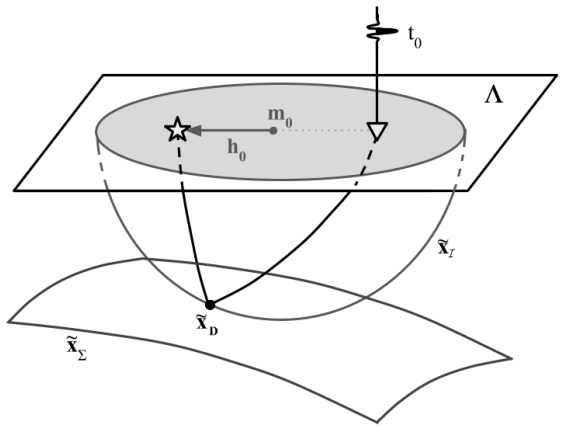
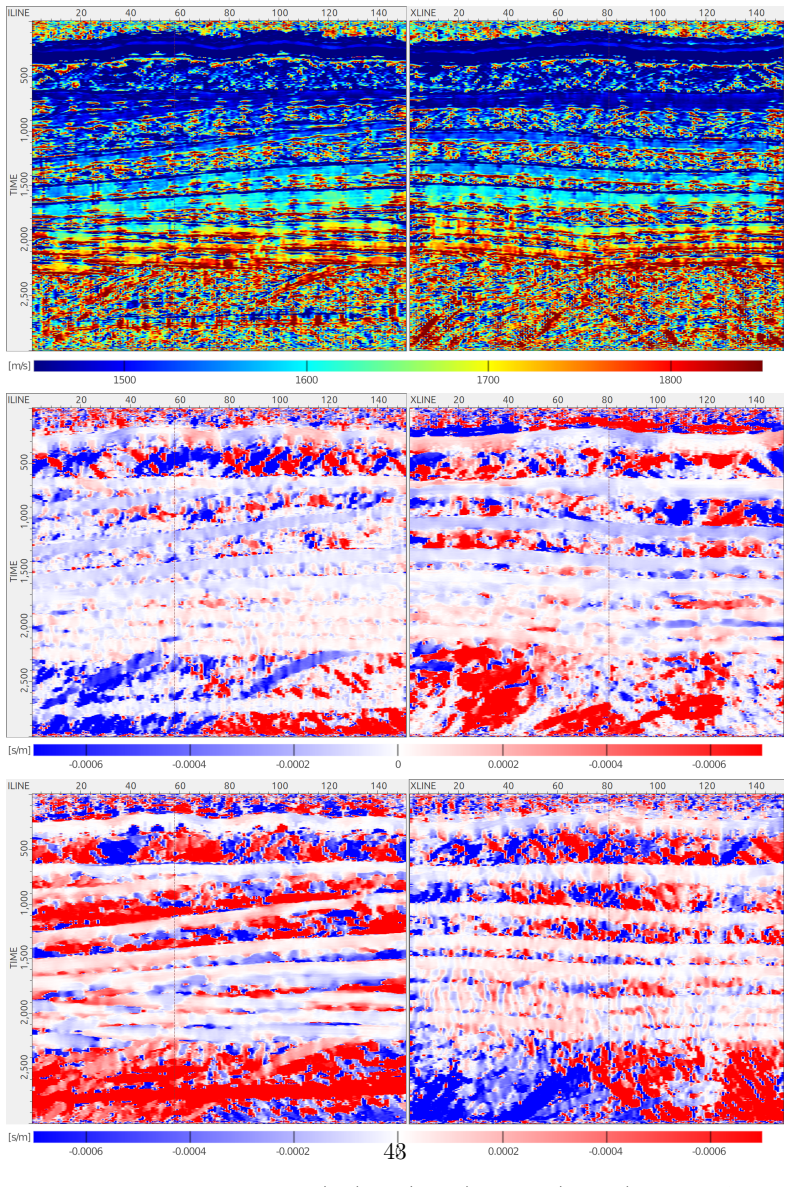
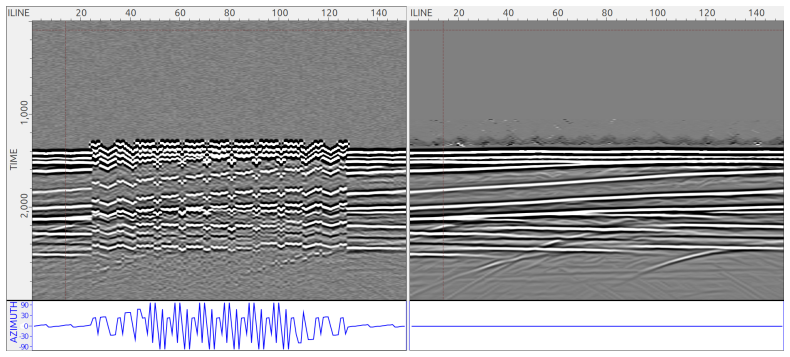
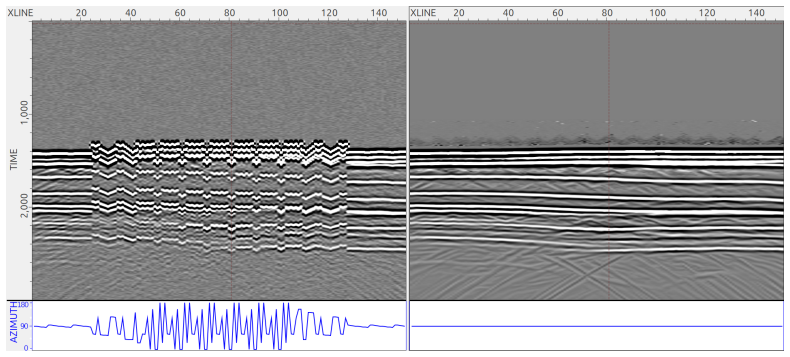
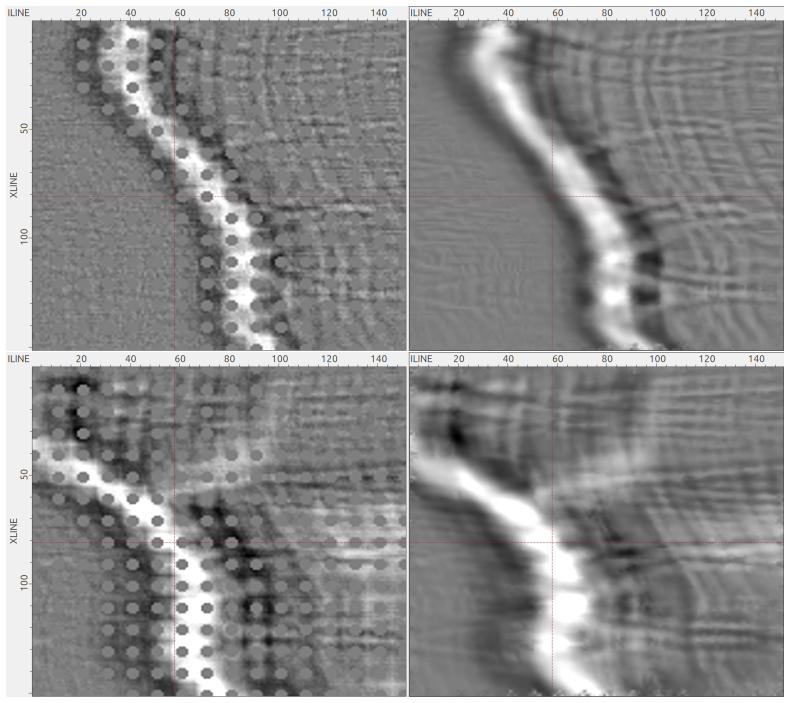
J. H. Faccipieri, T. A. Coimbra, L.-J. Gelius, M. Tygel, Stacking apertures and estimation strategies for reflection and diffraction en- hancement, Geophysics 81 (4) (2016) V271–V282.doi:10.1190/ 33 geo2015-0525.1. URLhttp://dx.doi.org/10.1190/geo2015-0525.1 34 Figure 1: Schematic representation of the acquisition geometry. The measurement plane is denote...
discussion (0)
Sign in with ORCID, Apple, or X to comment. Anyone can read and Pith papers without signing in.