REVIEW 1 major objections 1 minor 59 references
The Interplay of Thermal Melting and Pump Driven Melting of Charge Order: A Two-Temperature Study of the Holstein Model
T0 review · 1 major / 1 minor · reviewed 2026-06-25 · grok-4.3
Pith's one-line read Charge order in the Holstein model melts under independent control of electron temperature and bath temperature, yielding a two-dimensional phase diagram.
desk verdict The paper maps Holstein charge order in a T_el–T_bath plane via a two-temperature approximation, but the long-time states with T_el ≠ T_bath look hard to reach without continuous drive. read the letter →
The pith
A machine-rendered reading of the paper's core claim, the machinery that carries it, and where it could break.
The reading
What carries the argument
The two-temperature approximation, in which electronic excitations are represented by a quasi-equilibrium temperature T_el(t) while lattice phonons couple to an independent bath temperature T_bath, applied to the Holstein Hamiltonian to evolve the charge-order parameter.
What would settle it
Perform time-resolved measurements of the charge-order gap or Bragg peak intensity while independently varying pump fluence (which sets T_el) and sample base temperature (which sets T_bath), then check whether the observed melting boundary in the two-temperature plane matches the computed diagram.
Extended reading notes
Core claim
By assigning the pumped electrons a time-dependent temperature T_el(t) while the phonons remain coupled to a bath at T_bath, the Holstein model produces an order-parameter phase diagram in the T_el-T_bath plane. In the quasi-steady state reached at long times, the charge-order amplitude, its fluctuations, and the single-particle spectrum are determined by the pair of temperatures rather than by a single equilibrium temperature; order persists only below a boundary that depends on both values.
Load-bearing premise
The pump-induced electronic excitations can be captured by a slowly varying electron temperature that maintains a quasi-equilibrium electronic state.
Editorial extensions
If this is right
- The charge-order amplitude falls with rising T_el at fixed T_bath and with rising T_bath at fixed T_el, but the two paths produce different excitation spectra in the quasi-steady state.
- Long-time recovery of order after the pump pulse is controlled by the bath temperature once T_el has relaxed.
- A continuous boundary in the T_el-T_bath plane separates the charge-ordered phase from the melted phase.
- Static and dynamic properties measured in the quasi-steady state can be predicted from the pair of temperatures without solving the full time-dependent problem.
Reading between the lines
- The diagram offers a practical way to interpret pump-probe data on materials whose equilibrium charge order is known to be described by the Holstein model.
- If the quasi-equilibrium assumption breaks down at very short times, the phase boundaries would shift and additional transient states could appear.
- Spatial inhomogeneity or quantum phonon fluctuations omitted in the present treatment would likely round the sharp boundaries found here.
Editorial analysis
A structured set of objections, weighed in public.
Referee Report
Summary. The manuscript studies charge-order melting in the Holstein model under nonequilibrium conditions by coupling electrons to a time-dependent electron temperature T_el(t) that models the pump and phonons to a thermal bath at T_bath. It examines order-parameter dynamics, static properties, and excitations in the long-time quasi-steady state and constructs a phase diagram in the (T_el, T_bath) plane.
Significance. If the two-temperature states are dynamically accessible and the approximation holds, the phase diagram would clarify the interplay between thermal and photo-driven melting channels in open electron-phonon systems, offering a useful reference for interpreting pump-probe data on charge-ordered materials.
major comments (1)
- [Abstract and modeling description] Abstract and modeling description: the central claim that independent combinations of T_el and T_bath can be solved to produce a phase diagram in the long-time quasi-steady state rests on treating these temperatures as sustained control parameters. The Holstein interaction plus explicit phonon-bath coupling supplies an energy-relaxation channel that must drive the subsystems to a single common temperature once the external pump that sets T_el(t) is removed; without an additional continuous energy-injection term the reported states appear inaccessible within the stated dynamics.
minor comments (1)
- [Abstract] The abstract states the modeling choice and intent to produce a phase diagram but supplies no equations, numerical scheme, or validation data, making it impossible to assess the central claim from the provided text.
Simulated Author's Rebuttal
We thank the referee for their careful reading of the manuscript and for raising this important point about the dynamical accessibility of the two-temperature states. We address the comment below and will revise the manuscript to improve clarity on the modeling assumptions.
read point-by-point responses
-
Referee: the central claim that independent combinations of T_el and T_bath can be solved to produce a phase diagram in the long-time quasi-steady state rests on treating these temperatures as sustained control parameters. The Holstein interaction plus explicit phonon-bath coupling supplies an energy-relaxation channel that must drive the subsystems to a single common temperature once the external pump that sets T_el(t) is removed; without an additional continuous energy-injection term the reported states appear inaccessible within the stated dynamics.
Authors: We thank the referee for highlighting this crucial aspect of the model. In our two-temperature approach, T_el is introduced as a control parameter representing the effective electronic temperature maintained by the external pump, which continuously injects energy into the electronic subsystem. This is the standard setup in two-temperature models for pump-probe studies, where the pump is assumed to sustain the elevated T_el against relaxation via the Holstein coupling to the phonon bath at T_bath. We agree that, in the absence of ongoing energy injection from the pump, the system would relax to a common temperature. To address the concern, we will revise the abstract and modeling description to explicitly state that the phase diagram corresponds to quasi-steady states under sustained pumping, and we will add a brief discussion of the energy balance required to maintain T_el eq T_bath. This will clarify the conditions under which the reported states are accessible within the approximation. revision: yes
Circularity Check
No significant circularity; parameter scan is self-contained
full rationale
The paper introduces T_el(t) as an explicit modeling choice for the pump and then directly solves the Holstein model across independent combinations of T_el and T_bath to produce the phase diagram. This constitutes a straightforward parameter exploration within the stated approximation rather than any derivation that reduces outputs to inputs by construction. No equations equate a computed quantity to a fitted input, no self-citations bear the central claim, and no uniqueness theorems or ansatze are smuggled in. The reported results are therefore independent of the inputs beyond the explicit model definition.
Assumptions & free parameters
free parameters (2)
- T_el
- T_bath
assumptions (1)
- domain assumption Pump-induced electronic excitations can be represented by a slowly varying electron temperature T_el(t) that indicates quasi-equilibrium
Cite this review
Pith. "Pith review of The Interplay of Thermal Melting and Pump Driven Melting of Charge Order: A Two-Temperature Study of the Holstein Model." pith.science (2026). https://pith.science/paper/SLR2B7AE
@misc{pith2026260624800,
  author       = {Pith},
  title        = {Pith review of: The Interplay of Thermal Melting and Pump Driven Melting of Charge Order: A Two-Temperature Study of the Holstein Model},
  year         = {2026},
  howpublished = {\url{https://pith.science/paper/SLR2B7AE}},
  note         = {Machine review of arXiv:2606.24800}
}
abstract
Charge order driven by electron-phonon coupling is well understood at equilibrium but pump-probe experiments raise a new question: how does this order melt and recover after strong photoexcitation? A pump pulse promotes carriers across the charge-order gap and creates a nonequilibrium high-energy electronic population. In a closed system the subsequent dynamics is constrained by energy conservation. In an `open system' - where the system is coupled to a thermal bath at some temperature $T_{\rm bath}$ - there are new fluctuation and dissipation processes at play. One can attempt a computational scheme that incorporates coupling of electrons to a laser pump, the coupling of system phonons to a thermal bath, and the Holstein interaction that couples electrons and phonons. We attempt an approximation where the pump induced electronic excitations are modeled by a slowly time varying `electron temperature', $T_{\rm el}(t)$, indicative of a quasi-equilibrium electronic state. We solve the problem for different combinations of $T_{\rm el}$ and $T_{\rm bath}$, probing the order parameter dynamics, the static properties and excitations in the long time `quasi steady state', and establish a `phase diagram' in terms of bath temperature and electron temperature.
Figures


Figures from the paper (7 more)


Reference graph
Works this paper leans on
-
[1]
Inafullmicroscopictreatment, one would follow the pulse-driven electronic dynamics, energy redistribution within the electronic sector, and energy transfer to the lattice and bath
Electronic-temperature quench The pump primarily excites the electronic sector and creates a nonequilibrium population of high-energy electron-holeexcitations. Inafullmicroscopictreatment, one would follow the pulse-driven electronic dynamics, energy redistribution within the electronic sector, and energy transfer to the lattice and bath. Here we re- tain...
-
[2]
We use a short- range effective potential motivated by the two-site Hol- stein problem
Effective short-range phonon model The remaining task is to compute the force on the lat- tice distortions without diagonalizing the full electronic Hamiltonian at every Langevin step. We use a short- range effective potential motivated by the two-site Hol- stein problem. This approximation avoids theO(N 3) costofrepeateddiagonalization. Moreflexibleforce...
-
[3]
This is useful because the closed and open systems differ most directly in how the absorbed energy is redistributed and removed
Time dependence of the energy Before discussing the order-parameter recovery, we first examine the energy flow after the pump. This is useful because the closed and open systems differ most directly in how the absorbed energy is redistributed and removed. In the closed system, the pump injects energy into the electronic sector. After the pulse has passed,...
-
[4]
For T f el/thop = 0.3, the order parameter is suppressed af- ter the pump but remains finite
Order-parameter dynamics Fig.4 shows the time evolution of the charge-order structure factor for weak and strong pumps. For T f el/thop = 0.3, the order parameter is suppressed af- ter the pump but remains finite. The system retains memory of the original checkerboard pattern and recov- ers smoothly after noise averaging. ForT f el/thop = 0.7, the suppres...
-
[5]
For weak pumping, where the order parameter remains finite, we useS Q(t) = Ade−t/τdecay +S d +S r(1−e −t/τrec)
Recovery timescales We extract a characteristic recovery time by fitting the noise-averaged trajectories. For weak pumping, where the order parameter remains finite, we useS Q(t) = Ade−t/τdecay +S d +S r(1−e −t/τrec). HereS d is the dam- aged value of the order parameter,S r is the recovered component, andτ rec is the recovery time. For strong pumping, wh...
-
[6]
To visualize this pro- cess, we study an intermediate pump,T f el/thop = 0.5, atT bath/thop = 0.05
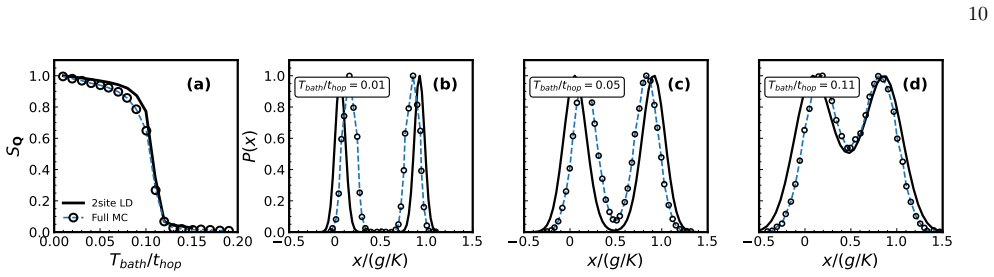
Real-space dynamics The recovery ofS Q involves both local amplitude restoration and domain growth. To visualize this pro- cess, we study an intermediate pump,T f el/thop = 0.5, atT bath/thop = 0.05. The checkerboard state has two symmetry-related configurations,CandC ′, differing by 7 0.01 0.04 0.08 0.12 Tbath/thop 0.0 0.2 0.4 0.6 0.8 1.0 1.2SQ( ) Equili...
-
[7]
7 shows the long-time value ofSQ as a function of Tbath for severalT f el
Steady-state statics Fig. 7 shows the long-time value ofSQ as a function of Tbath for severalT f el. The gray curve is the equilibrium result, with a thermal transition nearTbath/thop ≃0.12. For fixed nonzeroTf el, increasingTbath still destroys long- range order, but the transition shifts to lower bath tem- perature. Thus a hot electronic population redu...
-
[8]
8 summarizes the quasi-steady-state behavior
Phase diagram Fig. 8 summarizes the quasi-steady-state behavior. The low-temperature region is charge ordered. Increas- ingT bath at smallT f el destroys long-range order through thermal lattice fluctuations, but local distortions can re- main finite. We identify this disordered but locally dis- torted regime as a polaron liquid. IncreasingTf el at low Tb...
Show all 59 references
-
[9]
We computeS(q, ω)from the space-time Fourier transform ofx i(t)
Phonon spectrum The phonon dynamical structure factor gives a frequency-resolved view of the lattice fluctuations. We computeS(q, ω)from the space-time Fourier transform ofx i(t). Fig.9 shows the spectra for several two-temperature conditions. In equilibrium, the phonon mode n...
-
[10]
Electronic steady state We finally characterize the electronic properties of the quasi-steady state. Although the Langevin dynamics is generated using the effective short-range phonon model, the electronic density of states is computed from the full lattice electronic Hamilton...
-
[11]
Bloch, A
J. Bloch, A. Cavalleri, V. Galitski,et al., Strongly correlated electron–photon systems, Nature606, 41–48 (2022)
2022
-
[12]
Beaurepaire, J.-C
E. Beaurepaire, J.-C. Merle, A. Daunois, and J.-Y. Bigot, Ultrafast spin dynamics in ferromagnetic nickel, Phys. Rev. Lett.76, 4250 (1996)
1996
-
[13]
Carpene, E
E. Carpene, E. Mancini, C. Dallera, M. Brenna, E. Pup- pin, and S. De Silvestri, Dynamics of electron-magnon in- teractionandultrafastdemagnetizationinthinironfilms, Phys. Rev. B78, 174422 (2008)
2008
-
[14]
Beaud, S
P. Beaud, S. L. Johnson, E. Vorobeva, U. Staub, R. A. De Souza, C. J. Milne, Q. X. Jia, and G. Ingold, Ultrafast structural phase transition driven by photoinduced melt- ing of charge and orbital order, Phys. Rev. Lett.103, 155702 (2009)
2009
-
[15]
Fiebig, K
M. Fiebig, K. Miyano, Y. Tomioka,et al., Sub-picosecond photo-induced melting of a charge-ordered state in a per- ovskite manganite, Appl Phys B71, 211–215 (2000)
2000
-
[16]
Matsuzaki, H
H. Matsuzaki, H. Uemura, M. Matsubara, T. Kimura, Y. Tokura, and H. Okamoto, Detecting charge and lat- tice dynamics in photoinduced charge-order melting in perovskite-type manganites using a 30-femtosecond time resolution, Phys. Rev. B79, 235131 (2009)
2009
-
[17]
Chávez-Cervantes, G
M. Chávez-Cervantes, G. E. Topp, S. Aeschlimann, R. Krause, S. A. Sato, M. A. Sentef, and I. Gierz, Charge density wave melting in one-dimensional wires with fem- tosecondsubgapexcitation,Phys.Rev.Lett.123,036405 (2019)
2019
-
[18]
S. Iwai, M. Ono, A. Maeda, H. Matsuzaki, H. Kishida, H. Okamoto, and Y. Tokura, Ultrafast optical switching to a metallic state by photoinduced mott transition in a halogen-bridged nickel-chain compound, Phys. Rev. Lett. 91, 057401 (2003)
2003
-
[19]
Okamoto, H
H. Okamoto, H. Matsuzaki, T. Wakabayashi, Y. Taka- hashi, and T. Hasegawa, Photoinduced metallic state me- diated by spin-charge separation in a one-dimensional or- ganic mott insulator, Phys. Rev. Lett.98, 037401 (2007)
2007
-
[20]
D. Cho, S. Cheon, K. Kim, S. H. Lee, Y. H. Cho, S. W. Cheong, and H. W. Yeom, Nanoscale manipulation of the mott insulating state coupled to charge order in1T-TaS2, Nat. Comm7, 10453 (2015)
2015
-
[21]
Ichikawa, S
H. Ichikawa, S. Nozawa, T. Sato,et al., Transient pho- toinduced ‘hidden’ phase in a manganite, Nature Mater 10, 101–105 (2011)
2011
-
[22]
Q. M. Liu, D. Wu, Z. A. Li,et al., Photoinduced mul- tistage phase transitions in Ta2NiSe5, Nat Commun12, 2050 (2021)
-
[23]
Budden, T
M. Budden, T. Gebert, M. Buzzi,et al., Evidence for metastable photo-induced superconductivity in K3C60, Nat. Phys.17, 611–618 (2021)
2021
-
[24]
Fausti, R
D. Fausti, R. I. Tobey, N. Dean, S. Kaiser, A. Dienst, M. C. Hoffmann, S. Pyon, T. Takayama, H. Takagi, and A. Cavalleri, Light-induced superconductivity in a stripe- ordered cuprate, Science331, 189 (2011)
2011
-
[25]
Zhang, X
Y. Zhang, X. Shi, W. You, Z. Tao, Y. Zhong, F. Kabeer, P. Maldonado, P. Oppeneer, M. Bauer, K. Rossnagel, H. Kapteyn, and M. Murnane, Coherent modulation of the electron temperature and electron-phonon couplings in a 2d material, Proceedings Of The National Academy Of Sciences...
2020
-
[26]
Maklar, Y
J. Maklar, Y. W. Windsor, C. W. Nicholson,et al., Nonequilibrium charge-density-wave order beyond the thermal limit, Nat Commun12, 2499 (2021)
2021
-
[27]
Schmitt, P
F. Schmitt, P. Kirchmann, U. Bovensiepen, R. Moore, J. Chu, D. Lu, L. Rettig, M. Wolf, I. Fisher, and Z. Shen, Ultrafast electron dynamics in the charge density wave material TbTe3, New J. Phys13, 063022 (2011)
2011
-
[28]
L.Rettig, J.Chu, I.Fisher, U.Bovensiepen,andM.Wolf, Coherent dynamics of the charge density wave gap in tritellurides, Phys. Rev. Lett.114, 067402 (2014)
2014
-
[29]
T. Han, F. Zhou, C. Malliakas, P. Duxbury, S. Mahanti, M. Kanatzidis, and C.-Y. Ruan, Exploration of metasta- bility and hidden phases in correlated electron crystals visualized by femtosecond optical doping and electron crystallography, Science Advances1, e1400173 (2015)
2015
-
[30]
Hellmann, M
S. Hellmann, M. Beye, C. Sohrt, T. Rohwer, F. Sor- genfrei, H. Redlin, M. Kallane, M. Marczynski-Buhlow, F. Hennies, M. Bauer, A. Fohlisch, L. Kipp, W. Wurth, and K. Rossnagel, Ultrafast melting of a charge-density wave in the mott insulator1T-TaS 2, Phys. Rev. Lett. 105, 1874...
2010
-
[31]
Carpene, E
E. Carpene, E. Mancini, C. Dallera, G. Ghiringhelli, C. Manzoni, G. Cerullo, and S. D. Silvestri, A versatile apparatus for time-resolved photoemission spectroscopy via femtosecond pump-probe experiments, Rev. Sci. In- strum.80, 055101 (2009)
2009
-
[32]
Sobota, Y
J. Sobota, Y. He, and Z. Shen, Angle-resolved photoe- mission studies of quantum materials, Rev. Mod. Phys. 12 93, 025006 (2021)
2021
-
[33]
S. Eich, A. Stange, A. Carr, J. Urbancic, T. Pop- mintchev, M. Wiesenmayer, K. Jansen, A. Ruffing, S. Jakobs, T. Rohwer, S. Hellmann, C. Chen, P. Matyba, L. Kipp, K. Rossnagel, M. Bauer, M. Murnane, H. Kapteyn, S. Mathias, and M. Aeschlimann, Time- and angle-resolved photoemis...
2014
-
[34]
Gedik and I
N. Gedik and I. Vishik, Photoemission of quantum ma- terials, Nature Phys13, 1029–1033 (2017)
2017
-
[35]
C. Jia, K. Wohlfeld, Y. Wang, B. Moritz, and T. P. Dev- ereaux, Using rixs to uncover elementary charge and spin excitations, Phys. Rev. X6, 021020 (2016)
2016
-
[36]
Mitrano and Y
M. Mitrano and Y. Wang, Probing light-driven quantum materials with ultrafast resonant inelastic x-ray scatter- ing, Commun Phys3, 184 (2020)
2020
-
[37]
A. Zong, P. Dolgirev, A. Kogar, E. Ergeçen, M. Yilmaz, Y. Bie, T. Rohwer, I. Tung, J. Straquadine, X. Wang, S. Yang, X. Shen, L. Li, J. Yang, S. Park, L. Huber, J. Wen, J. Wang, P. Lee, E. Demler, and N. Gedik, Ev- idence for topological defects in a photoinduced phase transit...
2019
-
[38]
Frohlich, Electrons in lattice fields, Adv
H. Frohlich, Electrons in lattice fields, Adv. Phys.3, 325 (1954)
1954
-
[39]
E. K. H. Salje, A. S. Alexandrov, and W. Y. Liang, Po- larons and bipolarons in high temperature superconduc- tors and related materials, Cambridge University Press 10.1017/CBO9780511599811 (1995)
1995 doi
-
[40]
Franchini, M
C. Franchini, M. Reticcioli, M. Setvin, and et al., Po- larons in materials, Nat Rev Mater6, 560–586 (2021)
2021
-
[41]
C. P. Adams, J. W. Lynn, Y. M. Mukovskii, A. A. Ar- senov, and D. A. Shulyatev, Charge ordering and polaron formationinthemagnetoresistiveoxideLa 0.7Ca0.3MnO3, Phys. Rev. Lett.85, 3954 (2000)
2000
-
[42]
Bradley, G
O. Bradley, G. Batrouni, and R. Scalettar, Supercon- ductivity and charge density wave order in the two- dimensional holstein model, Phys. Rev. B103, 235104 (2021)
2021
-
[43]
C. W. Chen, J. Choe, and E. Morosan, Charge density waves in strongly correlated electron systems, Rep. Prog. Phys.79, 084505 (2016)
2016
-
[44]
S. S. Bakshi, D. Bose, A. Dutta, and P. Majumdar, Nonequilibrium dynamics of suppression, revival, and loss of charge order in a laser-pumped electron-phonon system, Physical Review B110, 075102 (2024)
2024
-
[45]
L. Yang, Y. Yang, and G.-W. Chern, Pattern formation in charge density wave states after a quantum quench, Physical Review B109, 195133 (2024)
2024
-
[46]
Yang and G.-W
L. Yang and G.-W. Chern, Photoinduced pattern forma- tion and melting of charge density wave order, Physical Review B111, 094208 (2025)
2025
-
[47]
L. Yang, H. Jang, S. S. Bakshi, Y. Yang, and G.- W. Chern, Pseudospin formulation of quench dynam- ics in the semiclassical holstein model, arXiv preprint arXiv:2601.01694 (2026), arXiv:2601.01694
2026
-
[48]
Jang and G.-W
H. Jang and G.-W. Chern, Suppressed coarsening af- ter an interaction quench in the holstein chain, arXiv preprint arXiv:2602.05815 10.48550/arXiv.2602.05815 (2026), arXiv:2602.05815 [cond-mat.str-el]
2026 doi
-
[49]
Cheng, S
C. Cheng, S. Zhang, and G.-W. Chern, Machine learn- ing for phase ordering dynamics of charge density waves, Physical Review B108, 014301 (2023), arXiv:2303.03493 [cond-mat.str-el]
2023
-
[50]
Y. Yang, C. Cheng, Y. Fan, and G.-W. Chern, Enhanced coarsening of charge density waves induced by electron correlation: Machine-learning enabled large-scale dy- namical simulations, arXiv preprint arXiv:2412.21072 10.48550/arXiv.2412.21072 (2024), arXiv:2412.21072 [cond-mat.str-el]
2024 doi
-
[51]
S. S. Bakshi, Y. Fan, and G.-W. Chern, Machine learning modeling of charge-density-wave recovery after laser melting, arXiv preprint arXiv:2602.03761 10.48550/arXiv.2602.03761 (2026), arXiv:2602.03761 [cond-mat.str-el]
2026 doi
-
[52]
Zwanzig,Nonequilibrium Statistical Mechanics(Ox- ford University Press, Oxford, 2001)
R. Zwanzig,Nonequilibrium Statistical Mechanics(Ox- ford University Press, Oxford, 2001)
2001
-
[53]
N. G. van Kampen,Stochastic Processes in Physics and Chemistry, 3rd ed. (North-Holland, Amsterdam, 2007)
2007
-
[54]
C. W. Gardiner,Stochastic Methods: A Handbook for the Natural and Social Sciences, 4th ed. (Springer, Berlin, 2009)
2009
-
[55]
Kubo, The fluctuation-dissipation theorem, Reports on Progress in Physics29, 255 (1966)
R. Kubo, The fluctuation-dissipation theorem, Reports on Progress in Physics29, 255 (1966)
1966
-
[56]
A. O. Caldeira and A. J. Leggett, Path integral approach toquantumbrownianmotion,PhysicaA121,587(1983)
1983
-
[57]
J. K. Bhattacharjee and D. Banerjee,Intermediate Sta- tistical Mechanics(World Scientific, Singapore, 2016)
2016
-
[58]
Bhattacharyya, S
S. Bhattacharyya, S. S. Bakshi, S. Kadge, and P. Majum- dar, Langevin approach to lattice dynamics in a charge- ordered polaronic system, Physical Review B99, 165150 (2019)
2019
-
[59]
Bhattacharyya, S
S. Bhattacharyya, S. S. Bakshi, S. Pradhan, and P. Ma- jumdar, Strongly anharmonic collective modes in a cou- pled electron-phonon-spin problem, Physical Review B 101, 125130 (2020)
2020
Reviewed June 25, 2026 · model on record in the stance chip above.
Discussion (0). Continue with ORCID to comment.