Structural Reductions for Monochromatic Matchings and Ramsey Tilings
Pith reviewed 2026-06-25 22:36 UTC · model grok-4.3
The pith
Every r-coloring of a sufficiently pseudo-random t-uniform hypergraph reduces with only o(n) loss in monochromatic matching size to a coloring of the complete hypergraph on a partitioned vertex set whose colors depend only on intersection p
A machine-rendered reading of the paper's core claim, the machinery that carries it, and where it could break.
Core claim
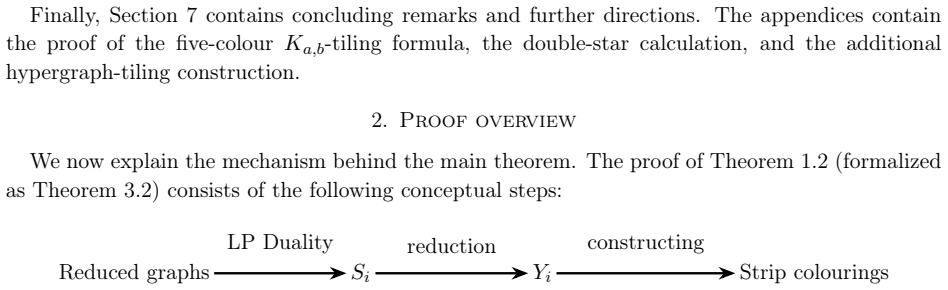
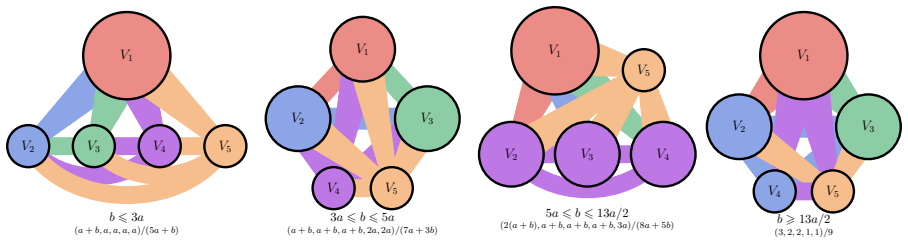
The central claim is that every r-edge-coloring of a sufficiently pseudo-random t-graph admits a reduction, losing only o(n) in the size of the largest monochromatic matching, to an r-edge-coloring of the complete t-uniform hypergraph whose vertex set is partitioned into at most r parts and whose edge colors depend only on intersection profiles with the parts. This reduction implies that the multicolour Ramsey tiling number Rt_r(H; K_n) equals (β_{r,H} + o(1))n, where β_{r,H} is the optimum of finitely many linear programs that depend only on the fixed graph H and the number of colors r.
What carries the argument
The structural reduction obtained by combining the hypergraph regularity lemma, LP duality, and convex-geometric compression, which converts an arbitrary pseudo-random coloring into an intersection-profile coloring on a bounded partition of the vertices.
If this is right
- The asymptotic form of the theorem on minimum monochromatic matching size in complete hypergraphs admits a proof that does not rely on topology.
- A transference principle holds that transfers the result from complete hypergraphs to sparse random hypergraphs.
- Near-exact bounds hold for certain linear-uniformity cases of stable Kneser-type problems.
- The multicolour Ramsey tiling problem on complete hosts has an effective asymptotic solution via linear programs.
- Explicit values of the asymptotic constant β are obtained for connected non-bipartite graphs, balanced Hall-type bipartite graphs, complete bipartite graphs with three to five colors, and some non-Hall bipartite graphs.
Where Pith is reading between the lines
- The reduction technique may extend to other multicolour problems involving matchings or tilings in hypergraphs where pseudo-randomness is present.
- The linear-program formulation opens the possibility of algorithmic computation of the tiling constants for concrete small values of r and H.
- The same compression approach could be tested on related problems in extremal set theory that currently rely on topological methods.
Load-bearing premise
The input hypergraph must be sufficiently pseudo-random for the regularity and compression steps to produce a reduction with only o(n) loss.
What would settle it
An r-edge-coloring of a pseudo-random t-uniform hypergraph in which every reduction to a partitioned profile coloring loses more than o(n) vertices from the largest monochromatic matching would disprove the main theorem.
Figures
read the original abstract
The Alon--Frankl--Lov\'asz theorem determines the chromatic number of Kneser hypergraphs; equivalently, it gives the sharp minimum size of a monochromatic matching in every \(r\)-edge-colouring of the complete \(t\)-uniform hypergraph. The known proofs of the exact theorem are topological. We develop a topology-free structural framework for its asymptotic form and for related sparse and tiling problems. Our main theorem shows that every \(r\)-colouring of a sufficiently pseudo-random \(t\)-graph can be reduced, with only \(o(n)\) loss in the largest monochromatic matching, to a colouring of \(K_n^{(t)}\) whose vertex set is partitioned into at most \(r\) parts and whose edge colours depend only on intersection profiles. The proof combines hypergraph regularity, LP duality, and convex-geometric compression. As consequences, we obtain a topology-free proof of the asymptotic AFL theorem, a sparse random transference theorem, and near-exact bounds in a linear-uniformity regime of Meunier's stable Kneser conjecture. For a graph \(H\), let \(Rt_r(H;K_n)\) be the minimum, over all \(r\)-edge-colourings of \(K_n\), of the largest monochromatic \(H\)-tiling. We prove \[ Rt_r(H;K_n)=(\beta_{r,H}+o(1))n, \] where \(\beta_{r,H}\) is effectively computable from finitely many linear programs depending only on \(H\) and \(r\). An additional multipartite Ramsey extraction is the key ingredient needed to reconstruct consistent graph templates. This gives an effective asymptotic solution to the complete-host multicolour Ramsey-tiling problem, extending the classical two-colour theorem of Burr, Erd\H{o}s and Spencer. We also determine explicit constants for several natural families, including connected non-bipartite graphs, balanced Hall-type bipartite graphs, complete bipartite graphs with three, four, and five colours, and a non-Hall bipartite example.
Editorial analysis
A structured set of objections, weighed in public.
Referee Report
Summary. The paper develops a topology-free structural framework for the asymptotic Alon–Frankl–Lovász theorem on monochromatic matchings in r-edge-colorings of complete t-uniform hypergraphs and for related sparse and tiling problems. The central result states that every r-coloring of a sufficiently pseudo-random t-graph reduces, with o(n) loss in the largest monochromatic matching, to an r-partite coloring of K_n^{(t)} whose colors depend only on intersection profiles; the proof uses hypergraph regularity, LP duality, and convex-geometric compression. Consequences include an asymptotic AFL theorem, a sparse random transference theorem, near-exact bounds for a linear-uniformity case of Meunier’s stable Kneser conjecture, and the asymptotic formula Rt_r(H;K_n)=(β_{r,H}+o(1))n where β_{r,H} is computable from finitely many linear programs depending only on H and r. Explicit constants are computed for several families of graphs H, extending the two-color Burr–Erdős–Spencer theorem via multipartite extraction.
Significance. If the central reduction holds, the work supplies a combinatorial alternative to topological proofs of the asymptotic AFL theorem and yields the first effective asymptotic solution to the multicolour Ramsey-tiling problem on complete hosts. The explicit computability of β_{r,H} from finitely many LPs (depending only on H and r) and the provision of concrete constants for natural families are notable strengths; the sparse transference and multipartite extraction steps also appear to be new.
minor comments (3)
- §1, paragraph after the statement of the main theorem: the precise quantitative notion of 'sufficiently pseudo-random' (e.g., the required uniformity or discrepancy parameters) is invoked but not restated; a one-sentence reminder would help readers who skip to the consequences.
- Definition of Rt_r(H;K_n) in the abstract and §1: the minimum is taken over colorings of K_n, yet the subsequent formula is stated for the complete host; a brief parenthetical clarifying that the host is complete would avoid momentary ambiguity.
- The linear programs defining β_{r,H} are described as 'finitely many' and depending only on H and r; an explicit bound on the number of programs or on the dimension of the LPs (in terms of |V(H)| and r) would strengthen the computability claim.
Simulated Author's Rebuttal
We thank the referee for the detailed summary, positive significance assessment, and recommendation of minor revision. No major comments were listed in the report, so we have no specific points to address point-by-point. We are pleased that the central reduction framework, topology-free asymptotic AFL theorem, and computable asymptotic densities for Ramsey tilings are viewed as strengths.
Circularity Check
No significant circularity identified
full rationale
The derivation proceeds from the hypergraph regularity lemma plus LP duality and convex compression to obtain an o(n)-loss reduction of any sufficiently pseudo-random t-graph colouring to an r-partite intersection-profile colouring of K_n^{(t)}; the quantity β_{r,H} is then defined directly as the optimum of finitely many linear programs on this structured class (depending only on H and r), and the asymptotic equality Rt_r(H;K_n)=(β_{r,H}+o(1))n follows by standard transference without any parameter fitting, self-definition, or load-bearing self-citation that collapses the claim to its inputs. The pseudo-randomness hypothesis is stated explicitly as a necessary precondition in the main theorem, rendering the argument self-contained.
Axiom & Free-Parameter Ledger
axioms (2)
- domain assumption Hypergraph regularity lemma applies to sufficiently pseudo-random t-graphs
- standard math LP duality and convex-geometric compression control the error term
Reference graph
Works this paper leans on
-
[1]
N. Alon, L. Drewnowski, and T. Łuczak. Stable Kneser hypergraphs and ideals inNwith the Nikodým property. Proceedings of the American Mathematical Society, 137(2):467–471, 2009
2009
-
[2]
N. Alon, P. Frankl, and L. Lovász. The chromatic number of kneser hypergraphs.Trans. Amer. Math. Soc., 298(1):359–370, 1986
1986
-
[3]
L. Aragão, X. Cheng, R. Filipe, R. Miyazaki, D. Peng, and Z. Yan. Ramsey properties for tilings in random graphs.arXiv:2605.21471, 2026
Pith/arXiv arXiv 2026
-
[4]
Balogh, A
J. Balogh, A. Freschi, and A. Treglown. Ramsey-type problems for tilings in dense graphs.Eur. J. Comb, 131:104228, 2026
2026
-
[5]
Balogh, R
J. Balogh, R. Morris, and W. Samotij. Independent sets in hypergraphs.J. Amer. Math. Soc., 28(3):669–709, 2015
2015
-
[6]
Bucić and B
M. Bucić and B. Sudakov. Tight Ramsey bounds for multiple copies of a graph.Adv. Comb., pages Paper No. 1, 22, 2023
2023
-
[7]
S. A. Burr. On the Ramsey numbersr(G, nH)andr(nG, nH)whennis large.Discrete Math., 65(3):215–229, 1987
1987
-
[8]
S. A. Burr, P. Erdős, and J. H. Spencer. Ramsey theorems for multiple copies of graphs.Trans. Amer. Math. Soc., 209:87–99, 1975
1975
-
[9]
P.-A. Chen. On the multichromatic number ofs-stable Kneser graphs.J. Graph Theory, 79(3):233–248, 2015
2015
-
[10]
Cockayne and P
E. Cockayne and P. Lorimer. The ramsey number for stripes.J. Aust. Math. Soc., 19:252–256, 1975
1975
-
[11]
Conlon and W
D. Conlon and W. T. Gowers. Combinatorial theorems in sparse random sets.Ann. of Math. (2), 184(2):367–454, 2016
2016
-
[12]
Conlon, W
D. Conlon, W. T. Gowers, W. Samotij, and M. Schacht. On the KLR conjecture in random graphs.Israel J. Math., 203(1):535–580, 2014
2014
-
[13]
H. Daneshpajouh. On the chromatic number of stable Kneser hypergraphs: Verifying the conjecture for new families.arXiv preprint arXiv:2509.22026, 2025
arXiv 2025
-
[14]
P. Erdös. Problems and results in combinatorial analysis and combinatorial number theory. InGraph theory, combinatorics, and applications, Vol. 1 (Kalamazoo, MI, 1988), Wiley-Intersci. Publ., pages 397–406. Wiley, New York, 1991
1988
-
[15]
A. Freschi, R. Martin, and A. Treglown. A random version of the burr-erdős-spencer theorem.arXiv:2605.22395, 2026
Pith/arXiv arXiv 2026
-
[16]
F. Frick. Chromatic numbers of stable Kneser hypergraphs via topological Tverberg-type theorems.Int. Math. Res. Not. IMRN, (13):4037–4061, 2020
2020
-
[17]
Gishboliner, S
L. Gishboliner, S. Glock, P. Michaeli, and A. Sgueglia. Defect and transference versions of the Alon-Frankl-Lovasz theorem.Combin. Probab. Comput., pages 1–12, 2026
2026
-
[18]
Gishboliner, M
L. Gishboliner, M. Krivelevich, and P. Michaeli. Color-biased hamilton cycles in random graphs.Random Struc- tures Algorithms, 60(3):289–307, 2022
2022
-
[19]
I. Haviv. The chromatic number of kneser hypergraphs via consensus division. InProceedings of the 15th Inno- vations in Theoretical Computer Science Conference (ITCS), LIPIcs, 2024
2024
-
[20]
A. Jafari. On the chromatic number of almost stable general Kneser hypergraphs.J. Comb., 13(3):437–444, 2022
2022
-
[21]
J. Jonsson. On the chromatic number of generalized stable Kneser graphs.Unpublished preprint, available at https://people.kth.se/ jakobj/research. html, 2012
2012
-
[22]
P. Keevash and P. Michaeli. A very robust Ramsey theorem for matchings.arXiv:2603.03139, 2026
arXiv 2026
-
[23]
M. Kneser. Aufgabe 360.Jahresbericht der Deutschen Mathematiker-Vereinigung, 58:27, 1955
1955
-
[24]
I. Kříž. Equivariant cohomology and lower bounds for chromatic numbers.Trans. Amer. Math. Soc., 333(2):567– 577, 1992. 35
1992
-
[25]
Loo.Multicolor Ramsey numbers for disjoint unions of graphs
S. Loo.Multicolor Ramsey numbers for disjoint unions of graphs. Ph.d. thesis, City University of New York, 1990
1990
-
[26]
L. Lovász. Kneser’s conjecture, chromatic number, and homotopy.J. Combin. Theory Ser. A, 25(3):319–324, 1978
1978
-
[27]
Matoušek
J. Matoušek. A combinatorial proof of Kneser’s conjecture.Combinatorica, 24(1):163–170, 2004
2004
-
[28]
F. Meunier. The chromatic number of almost stable Kneser hypergraphs.J. Combin. Theory Ser. A, 118(6):1820– 1828, 2011
2011
-
[29]
M. Niu and L. Wang. An exact robust Ramsey theorem for matchings.arXiv:2606.19851, 2026
Pith/arXiv arXiv 2026
-
[30]
Rödl and A
V. Rödl and A. Ruciński. Threshold functions for Ramsey properties.J. Amer. Math. Soc., 8(4):917–942, 1995
1995
-
[31]
Saxton and A
D. Saxton and A. Thomason. Hypergraph containers.Invent. Math., 201(3):925–992, 2015
2015
-
[32]
M. Schacht. Extremal results for random discrete structures.Ann. of Math. (2), 184(2):333–365, 2016
2016
-
[33]
Schrijver
A. Schrijver. Vertex-critical subgraphs of Kneser graphs.Nieuw Arch. Wisk. (3), 26(3):454–461, 1978
1978
-
[34]
G. M. Ziegler.Lectures on Polytopes. Springer, 1995
1995
-
[35]
G. M. Ziegler. Generalized Kneser coloring theorems with combinatorial proofs.Invent. Math., 147:671–691, 2002. AppendixA.Complete bipartite tilings in five colours We prove Theorem 6.12. We repeatedly use Lemma 6.7, as well as the fact that tilings supported on disjoint same-coloured pairs may be combined. A.1.Extremal templates.The four upper-bound temp...
2002
-
[36]
(0, 1 3 ,0),( 1 3 ,0, 1 3),( 1 7 , 1 7 , 1 7) R,B (0, 1 7 , 1 3),( 1 3 , 1 7 ,0),( 1 7 , 1 7 , 1
-
[37]
(0, 4 7 , 1 7),(0, 1 3 , 2 9),( 1 3 ,0, 1 2),( 1 7 , 1 7 , 1 7) B,R (0,0, 1 2),( 1 7 ,0, 1
-
[38]
(0, 1 2 ,0),( 1 7 , 1 7 , 1 7) B,B (0,0, 1 3),( 1 3 ,0,0),( 1 7 ,0, 1
-
[39]
Here the coordinates are ordered asA, U, W
(0, 4 7 , 1 7),(0, 1 2 , 1 6),( 1 7 , 1 7 , 1 7). Here the coordinates are ordered asA, U, W. Taking the scalar product with(x, u, v), and applying strong duality, gives the table.□ Lemma B.3.Every3-strip3-colouringψofK n satisfiesν D(ψ)⩾ 7 78 n−O(1). Proof.Putα:= 7 78 .Since the number of strip parts and copy types is fixed, it is enough to prove that th...
discussion (0)
Sign in with ORCID, Apple, or X to comment. Anyone can read and Pith papers without signing in.