Reading AI Model Compilation in MLIR Through the Lens of Formal Theories
Pith reviewed 2026-06-25 19:55 UTC · model grok-4.3
The pith
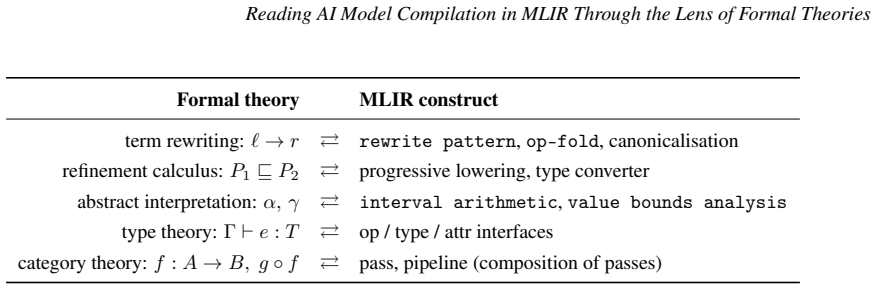
MLIR mechanisms such as match-and-rewrite correspond to formal theories including term-rewriting systems and refinement calculus.
A machine-rendered reading of the paper's core claim, the machinery that carries it, and where it could break.
Core claim
MLIR's match-and-rewrite engine corresponds to a term-rewriting-system, staged lowering has the structure of refinement calculus, and range analysis is grounded in abstract interpretation. Highlighting these correspondences supplies vocabulary precise enough to discuss structural questions about completeness and trade-offs in abstractions.
What carries the argument
The correspondences between MLIR's compiler mechanisms and formal theories such as term-rewriting systems, refinement calculus, and abstract interpretation.
Load-bearing premise
The stated correspondences between MLIR mechanisms and formal theories are deep and precise enough to clarify what completeness means for a given abstraction rather than remaining at the level of loose analogies.
What would settle it
A case where these formal mappings provide no clearer guidance on abstraction completeness or trade-offs than standard engineering practice would falsify the claimed utility.
Figures


read the original abstract
Compiler infrastructures such as MLIR rest on a set of design principles: IR abstractions, interfaces, match-and-rewrite, flow analysis, type conversion, staged lowering, and so on. These concepts have proven themselves in practice. Good designs typically arrive through engineering knowledge, intuition and experience. Many of them, however, have correspondences in formal theory. MLIR's match-and-rewrite engine has correspondence to a \emph{term-rewriting-system}~\cite{baadernipkow1998}; staged lowering has the structure of \emph{refinement calculus}~\cite{back1998}; and range analysis is grounded in \emph{abstract interpretation}~\cite{cousot1977,cousot1979}. Highlighting these correspondences is useful because each theory supplies vocabulary precise enough to discuss structural questions. Moreover, as coding agents lower the cost of implementation, good design and abstractions become the main concern~\cite{Lattner2026ClaudeCCompiler}. A coding agent can generate a pass, but it can only reason over the semantics the representation exposes. When essential structure is missing, the limitation is one of abstraction, not of implementation. The natural next question is how to design that substrate well. Well-chosen abstractions emerge from experience and intuition, but they often mirror concepts given a more precise treatment in formal theory. We argue that knowledge of these formal concepts clarifies what completeness means for a given abstraction, what the ideal design would be, and where practical trade-offs depart from it.
Editorial analysis
A structured set of objections, weighed in public.
Referee Report
Summary. The manuscript claims that core MLIR design mechanisms—match-and-rewrite, staged lowering, and range analysis—correspond to term-rewriting systems, refinement calculus, and abstract interpretation, respectively. Recognizing these links supplies precise formal vocabulary for structural questions in compiler design, clarifies what completeness means for a given abstraction, and identifies where practical trade-offs depart from the ideal, with particular relevance as coding agents reduce implementation effort.
Significance. If the correspondences can be shown to produce concrete design insights or clearer completeness criteria not already visible from engineering practice, the work would usefully connect extensible compiler infrastructures with formal methods, aiding principled abstraction choices in MLIR and similar systems.
major comments (1)
- [Abstract] Abstract: the load-bearing claim that the listed correspondences 'supply vocabulary precise enough to discuss structural questions' and 'clarify what completeness means for a given abstraction' is unsupported by any worked example; the text states the three mappings but applies none of the formal theories to derive a missing property, completeness criterion, or concrete departure from the ideal.
minor comments (1)
- [Abstract] The reference Lattner2026ClaudeCCompiler appears non-standard; clarify its publication status or replace with a peer-reviewed source if the citation is essential to the argument.
Simulated Author's Rebuttal
We thank the referee for the constructive feedback on the abstract. We address the major comment below.
read point-by-point responses
-
Referee: [Abstract] Abstract: the load-bearing claim that the listed correspondences 'supply vocabulary precise enough to discuss structural questions' and 'clarify what completeness means for a given abstraction' is unsupported by any worked example; the text states the three mappings but applies none of the formal theories to derive a missing property, completeness criterion, or concrete departure from the ideal.
Authors: We agree that the abstract's claim would be strengthened by a concrete worked example applying one of the formal theories. The manuscript's primary contribution is establishing the three mappings; the utility of the supplied vocabulary is illustrated by the existence of the correspondences themselves (e.g., term-rewriting systems provide established notions of completeness such as confluence). To directly address the concern, the revised manuscript will include a short worked example section, for instance using abstract interpretation to derive a completeness criterion for range analysis in MLIR or to identify a specific departure from the ideal in practice. revision: yes
Circularity Check
Conceptual mapping with no derivations or self-referential reductions
full rationale
The paper presents correspondences between MLIR mechanisms (match-and-rewrite, staged lowering, range analysis) and external formal theories (term-rewriting systems, refinement calculus, abstract interpretation) but contains no equations, derivations, predictions, or fitted quantities. All citations reference independent prior work by other authors. The central claim—that these mappings supply useful vocabulary for discussing structural questions and completeness—rests on conceptual assertion rather than any reduction to self-citation chains or definitional equivalence. No load-bearing step reduces to the paper's own inputs by construction.
Axiom & Free-Parameter Ledger
axioms (3)
- domain assumption MLIR's match-and-rewrite engine has correspondence to a term-rewriting-system
- domain assumption Staged lowering has the structure of refinement calculus
- domain assumption Range analysis is grounded in abstract interpretation
Reference graph
Works this paper leans on
-
[1]
Hexagon-mlir: An ai compilation stack for qual- comm’s neural processing units (npus)
Mohammed Javed Absar, Muthu Baskaran, Abhikrant Sharma, Abhilash Bhandari, Ankit Aggarwal, Arun Rangasamy, Dibyendu Das, Fateme Hosseini, Franck Slama, Iulian Brumar, Jyotsna Verma, Krishnaprasad Bindumadhavan, Mitesh Kothari, Mohit Gupta, Ravishankar Kolachana, Richard Lethin, Samarth Narang, San- jay Motilal Ladwa, Shalini Jain, Snigdha Suresh Dalvi, Ta...
-
[2]
Abellán, José Cano, and David Kaeli
Nicolas Bohm Agostini, Jude Haris, Perry Gibson, Malith Jayaweera, Norm Rubin, Antonino Tumeo, José L. Abellán, José Cano, and David Kaeli. Axi4mlir: User-driven automatic host code generation for custom axi- based accelerators. InProceedings of the IEEE/ACM International Symposium on Code Generation and Opti- mization (CGO), Piscataway, NJ, USA, 2024. IEEE
2024
-
[3]
Oxford University Press, Oxford, UK, 2nd edition, 2010
Steve Awodey.Category Theory. Oxford University Press, Oxford, UK, 2nd edition, 2010
2010
-
[4]
Cambridge University Press, Cambridge, UK, 1998
Franz Baader and Tobias Nipkow.Term Rewriting and All That. Cambridge University Press, Cambridge, UK, 1998
1998
-
[5]
Graduate Texts in Computer Science
Ralph-Johan Back and Joakim von Wright.Refinement Calculus: A Systematic Introduction. Graduate Texts in Computer Science. Springer, New York, NY , USA, 1998. 9 Reading AI Model Compilation in MLIR Through the Lens of Formal Theories
1998
-
[6]
Automated program refinement: Guide and verify code Large Language Model with refinement calculus.Proc
Yufan Cai, Zhe Hou, David Sanan, Xiaokun Luan, Yun Lin, and Jun Sun. Automated program refinement: Guide and verify code Large Language Model with refinement calculus.Proc. ACM Program. Lang., 9(POPL), January 2025
2025
-
[7]
TVM: An Automated End-to-End Optimizing Compiler for Deep Learning
Tianqi Chen, Thierry Moreau, Ziheng Jiang, et al. Tvm: An automated end-to-end optimizing compiler for deep learning. arXiv preprint arXiv:1802.04799, 2018
work page internal anchor Pith review Pith/arXiv arXiv 2018
-
[8]
Polyblocks: A compiler infrastructure for ai chips and programming frameworks
Yuran Chen et al. Polyblocks: A compiler infrastructure for ai chips and programming frameworks. arXiv preprint arXiv:2603.06731, 2026
-
[9]
A simple graph-based intermediate representation
Cliff Click and Michael Paleczny. A simple graph-based intermediate representation. InProceedings of the ACM SIGPLAN Workshop on Intermediate Representations, pages 35–49, New York, NY , USA, 1995. ACM
1995
-
[10]
Abstract interpretation: A unified lattice model for static analysis of pro- grams by construction or approximation of fixpoints
Patrick Cousot and Radhia Cousot. Abstract interpretation: A unified lattice model for static analysis of pro- grams by construction or approximation of fixpoints. InProceedings of the ACM Symposium on Principles of Programming Languages (POPL), pages 238–252, New York, NY , USA, 1977. ACM
1977
-
[11]
Systematic design of program analysis frameworks
Patrick Cousot and Radhia Cousot. Systematic design of program analysis frameworks. InProceedings of the ACM Symposium on Principles of Programming Languages (POPL), pages 269–282, New York, NY , USA, 1979. ACM
1979
-
[12]
First-class verification dialects for MLIR.Proc
Mathieu Fehr, Yuyou Fan, Hugo Pompougnac, John Regehr, and Tobias Grosser. First-class verification dialects for MLIR.Proc. ACM Program. Lang., 9(PLDI), June 2025
2025
-
[13]
The best of abstract interpretations.Proc
Roberto Giacobazzi and Francesco Ranzato. The best of abstract interpretations.Proc. ACM Program. Lang., 9(POPL), January 2025
2025
-
[14]
Towards a high-performance ai compiler with upstream mlir
Renato Golin, Lorenzo Chelini, Adam Siemieniuk, Kavitha Madhu, Niranjan Hasabnis, Hans Pabst, Evangelos Georganas, and Alexander Heinecke. Towards a high-performance ai compiler with upstream mlir. arXiv preprint arXiv:2404.15204, 2024
-
[15]
C. A. R. Hoare. An axiomatic basis for computer programming.Communications of the ACM, 12(10):576–580, 1969
1969
-
[16]
IREE: Retargetable MLIR-based machine learning compiler and runtime, 2024
IREE Open Source Contributors. IREE: Retargetable MLIR-based machine learning compiler and runtime, 2024
2024
-
[17]
Knuth and Peter B
Donald E. Knuth and Peter B. Bendix. Simple word problems in universal algebras. In John Leech, editor, Computational Problems in Abstract Algebra, pages 263–297. Pergamon Press, Oxford, UK, 1970
1970
-
[18]
The claude c compiler: What it reveals about the future of software, February 2026
Chris Lattner. The claude c compiler: What it reveals about the future of software, February 2026. Engineering blog post
2026
-
[19]
Mlir: Scaling compiler infrastructure for domain specific computation
Chris Lattner, Mehdi Amini, Uday Bondhugula, Albert Cohen, Andy Davis, Jacques Pienaar, River Riddle, Tatiana Shpeisman, Nicolas Vasilache, and Oleksandr Zinenko. Mlir: Scaling compiler infrastructure for domain specific computation. InProceedings of the IEEE/ACM International Symposium on Code Generation and Optimization (CGO), pages 2–14, Piscataway, NJ...
2021
-
[20]
SSA translation is an abstract interpretation.Proc
Matthieu Lemerre. SSA translation is an abstract interpretation.Proc. ACM Program. Lang., 7(POPL), January 2023
2023
-
[21]
Formal verification of a realistic compiler.Communications of the ACM, 52(7):107–115, 2009
Xavier Leroy. Formal verification of a realistic compiler.Communications of the ACM, 52(7):107–115, 2009
2009
-
[22]
Tinyiree: An ml execution environment for embedded systems from compilation to deployment
Hsin-I Cindy Liu, Marius Brehler, Mahesh Ravishankar, Nicolas Vasilache, Ben Vanik, and Stella Laurenzo. Tinyiree: An ml execution environment for embedded systems from compilation to deployment. arXiv preprint arXiv:2205.14479, 2022
-
[23]
Mlir lighthouse project.https://github.com/llvm/lighthouse, 2025
LLVM Project. Mlir lighthouse project.https://github.com/llvm/lighthouse, 2025
2025
-
[24]
Moses, Michel Steuwer, and Albert Cohen
Martin Paul Lücke, Oleksandr Zinenko, William S. Moses, Michel Steuwer, and Albert Cohen. The mlir trans- form dialect: Your compiler is more powerful than you think. arXiv preprint arXiv:2409.03864, 2024
-
[25]
Springer, New York, NY , USA, 1971
Saunders Mac Lane.Categories for the Working Mathematician, volume 5 ofGraduate Texts in Mathematics. Springer, New York, NY , USA, 1971
1971
-
[26]
Bibliopolis, Naples, Italy, 1984
Per Martin-Löf.Intuitionistic Type Theory. Bibliopolis, Naples, Italy, 1984. Notes by Giovanni Sambin of a series of lectures given in Padova, June 1980
1984
-
[27]
Ide-bench: Evaluating large language models as ide agents on real-world software engineering tasks
Spencer Mateega, Jeff Yang, Tiana Costello, Shaurya Jadhav, Nicole Tian, and Agustin Garcinuño. Ide-bench: Evaluating large language models as ide agents on real-world software engineering tasks. arXiv preprint arXiv:2601.20886, 2026
-
[28]
E-graphs as a persistent compiler abstraction
Jules Merckx, Alexandre Lopoukhine, Samuel Coward, Jianyi Cheng, Bjorn De Sutter, and Tobias Grosser. E-graphs as a persistent compiler abstraction. arXiv preprint arXiv:2602.16707, 2026. 10 Reading AI Model Compilation in MLIR Through the Lens of Formal Theories
-
[29]
Twenty years of rewriting logic.Journal of Logic and Algebraic Programming, 81(7-8):721–781, 2012
José Meseguer. Twenty years of rewriting logic.Journal of Logic and Algebraic Programming, 81(7-8):721–781, 2012
2012
-
[30]
Prentice Hall, Hemel Hempstead, UK, 1990
Carroll Morgan.Programming from Specifications. Prentice Hall, Hemel Hempstead, UK, 1990
1990
-
[31]
Maxwell H. A. Newman. On theories with a combinatorial definition of equivalence.Annals of Mathematics, 43(2):223–243, 1942
1942
-
[32]
Cuda tile: A tile-based programming model and mlir-based compiler infrastructure for nvidia gpus.https://github.com/NVIDIA/cuda-tile, 2024
NVIDIA Corporation. Cuda tile: A tile-based programming model and mlir-based compiler infrastructure for nvidia gpus.https://github.com/NVIDIA/cuda-tile, 2024. GitHub repository
2024
-
[33]
Pierce.Types and Programming Languages
Benjamin C. Pierce.Types and Programming Languages. MIT Press, Cambridge, MA, USA, 2002
2002
-
[34]
Gordon D. Plotkin. A structural approach to operational semantics. Technical Report DAIMI FN-19, Aarhus University, 1981. Reprinted in Journal of Logic and Algebraic Programming, 60-61:17–139, 2004
1981
-
[35]
Halide: A language and compiler for optimizing parallelism, locality, and recomputation
Jonathan Ragan-Kelley, Connelly Barnes, Andrew Adams, et al. Halide: A language and compiler for optimizing parallelism, locality, and recomputation. InProceedings of the ACM SIGPLAN Conference on Programming Language Design and Implementation (PLDI), pages 519–530, New York, NY , USA, 2013. ACM
2013
-
[36]
Decoding the Configuration of AI Coding Agents: Insights from Claude Code Projects
Helio Victor F. Santos, Vitor Costa, Joao Eduardo Montandon, and Marco Tulio Valente. Decoding the configu- ration of ai coding agents: Insights from claude code projects. arXiv preprint arXiv:2511.09268, 2025
work page internal anchor Pith review Pith/arXiv arXiv 2025
-
[37]
Dana S. Scott. Data types as lattices.SIAM Journal on Computing, 5(3):522–587, 1976
1976
-
[38]
Scott and Christopher Strachey
Dana S. Scott and Christopher Strachey. Toward a mathematical semantics for computer languages. Technical Report PRG-6, Oxford University Computing Laboratory, 1971
1971
-
[39]
Aster: Mlir c++ tool for programmable and highly-controllable assembly production on amd gpus.https://github.com/iree-org/aster/tree/main, 2026
The ASTER Authors. Aster: Mlir c++ tool for programmable and highly-controllable assembly production on amd gpus.https://github.com/iree-org/aster/tree/main, 2026. GitHub repository
2026
-
[40]
Nicolas Vasilache, Oleksandr Zinenko, Aart J. C. Bik, et al. Structured operations: Modular design of code generators for tensor compilers. InProceedings of the International Workshop on Languages and Compilers for Parallel Computing (LCPC), 2022. 11
2022
discussion (0)
Sign in with ORCID, Apple, or X to comment. Anyone can read and Pith papers without signing in.