Structuring International Governance through the Space of Concerns
Pith reviewed 2026-06-26 05:57 UTC · model grok-4.3
The pith
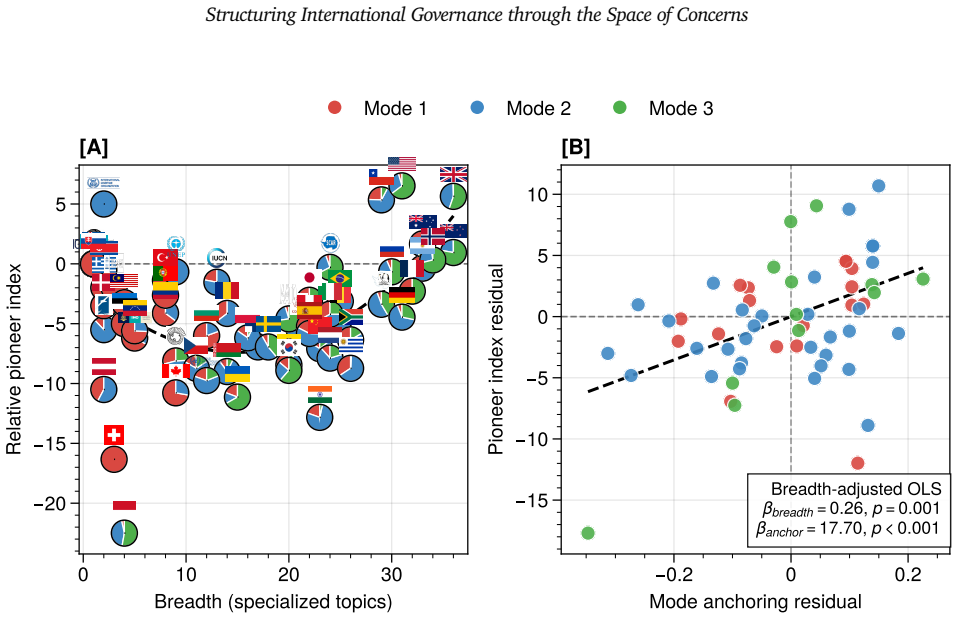
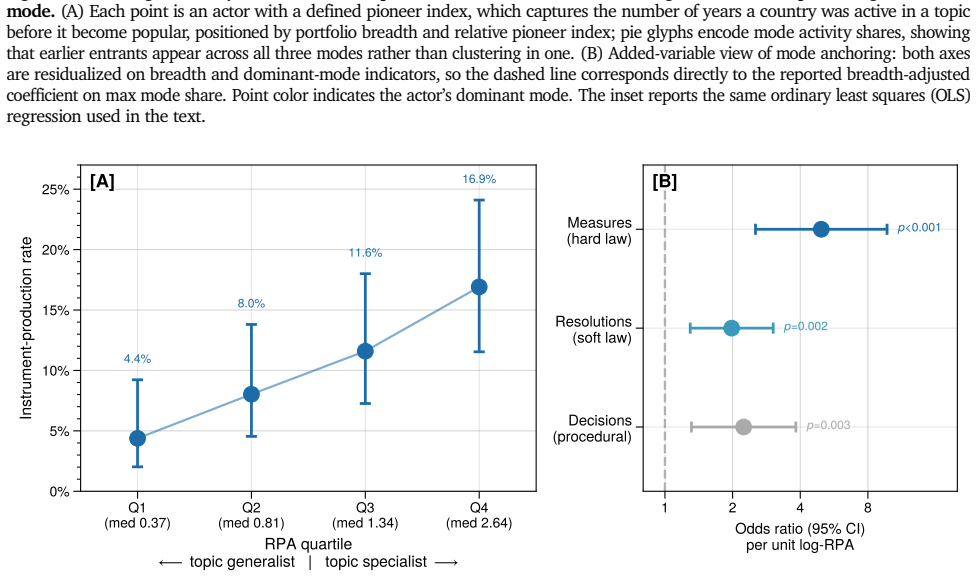
Specialized actors produce binding law at five times the baseline rate by shaping the space of concerns in consensus forums.
A machine-rendered reading of the paper's core claim, the machinery that carries it, and where it could break.
Core claim
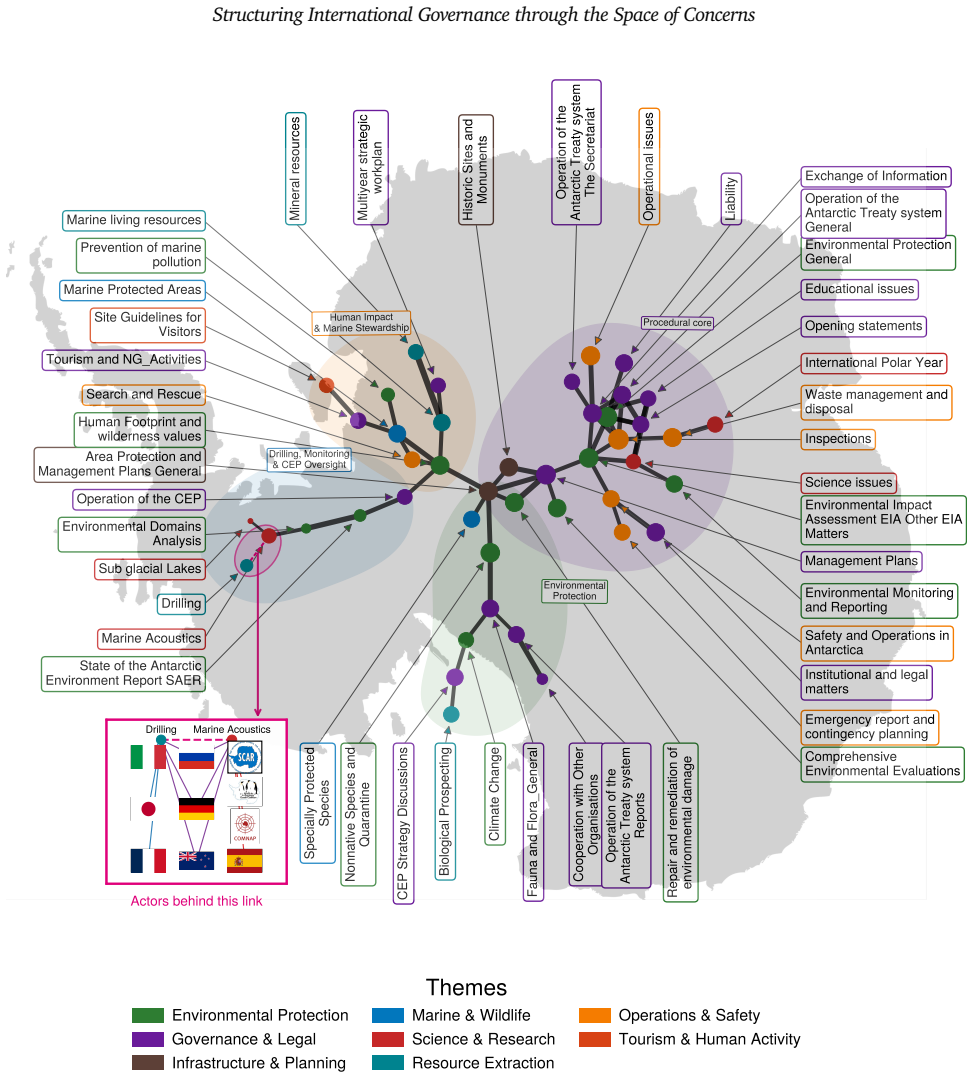
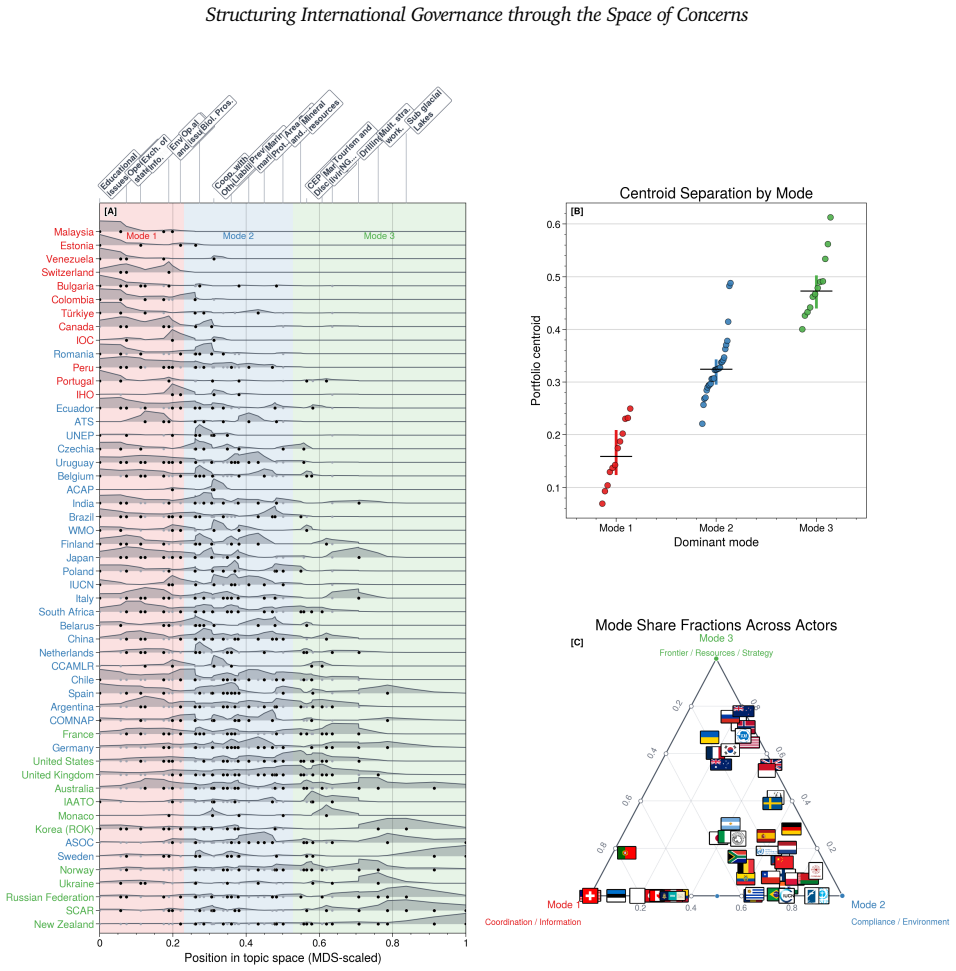
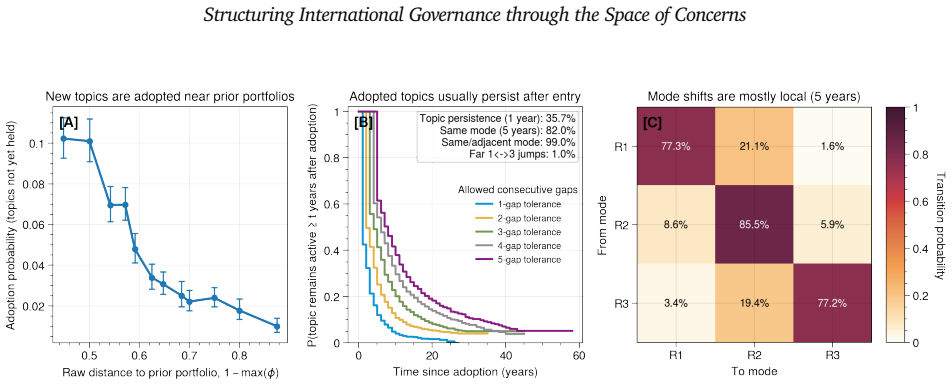
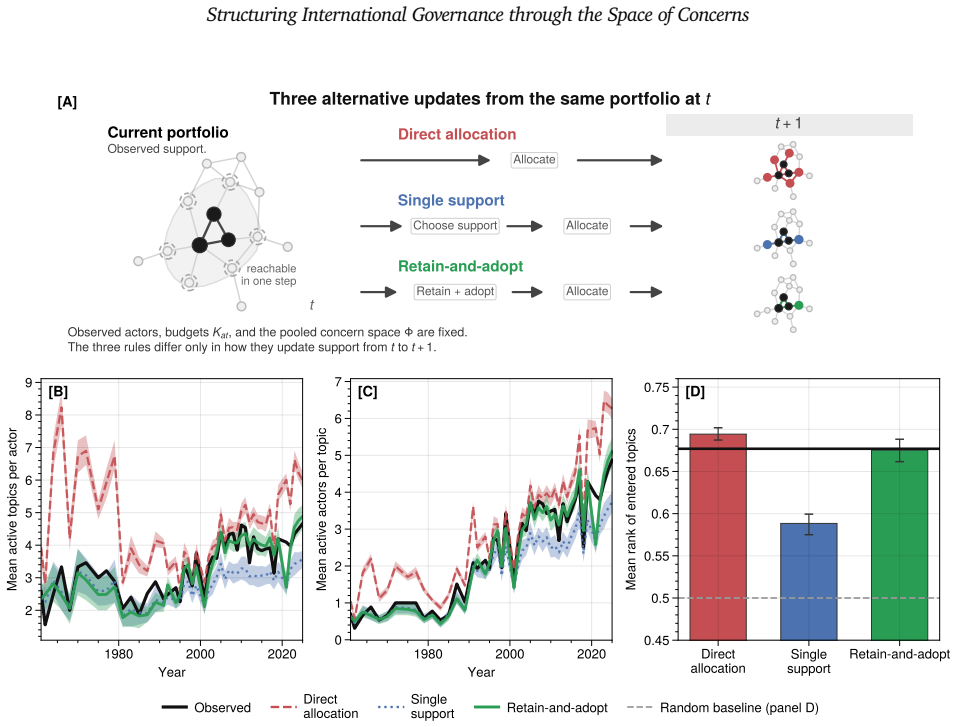
We introduce a space of concerns in which issues lie close when the same actors repeatedly specialize in both, turning a flat agenda into a measurable topology of attention. Across six decades of the Antarctic Treaty with 6,591 documents and 66 actors, engagement is structured, local, and persistent, and the most specialized actors produce binding law at roughly five times the baseline rate. The approach generalizes to any document-rich consensus forum and shows that unanimity does not erase political structure but relocates it upstream into the organization of attention.
What carries the argument
The space of concerns, a topology of attention constructed so that issues lie close when the same actors repeatedly specialize in both.
If this is right
- Engagement in the space of concerns is structured, local, and persistent rather than uniform or random.
- The most specialized actors produce binding law at roughly five times the baseline rate.
- Unanimity does not erase political structure; it relocates influence to the upstream organization of attention.
- The same mapping method applies to recover hidden structure in any other document-rich consensus forum.
Where Pith is reading between the lines
- The space of concerns could be applied to forums such as climate negotiations to identify which actors drive outcomes without relying on formal votes.
- Actors could increase their leverage by deliberately choosing specializations that place them near many other issues in the space.
- The fivefold multiplier may change with different consensus rules or issue types, offering a testable comparison across institutions.
- Varying how documents are tagged or actors are identified would test whether the observed structure is robust to processing choices.
Load-bearing premise
That proximity in the space of concerns, defined through shared actor specialization, captures real political structure rather than artifacts of document classification or actor labeling.
What would settle it
Recomputing the space of concerns after changing document or actor classification rules and finding that the fivefold rate difference in binding-law production disappears would falsify the central claim.
Figures
read the original abstract
When institutions decide by consensus, the official record shows agreement but hides who shaped what was decided. We introduce a way to recover that hidden structure from the one trace consensus cannot suppress: the documentary record of what actors choose to work on. Adapting tools from economic complexity, we map a ``space of concerns'' in which issues lie close when the same actors repeatedly specialize in both -- turning a flat agenda into a measurable topology of attention. Across six decades of the Antarctic Treaty (6,591 documents, 66 actors), engagement is structured, local, and persistent, and the most specialized actors produce binding law at roughly five times the baseline rate. The approach generalizes to any document-rich consensus forum, showing that unanimity does not erase political structure -- it relocates it upstream, into the organization of attention.
Editorial analysis
A structured set of objections, weighed in public.
Referee Report
Summary. The paper adapts methods from economic complexity to construct a 'space of concerns' from the documentary record of actor engagement in consensus institutions. Using 6,591 documents and 66 actors from the Antarctic Treaty over six decades, it maps issues by shared actor specialization, reports that engagement is structured, local, and persistent, and claims that the most specialized actors produce binding law at roughly five times the baseline rate. The approach is presented as generalizable to other document-rich consensus forums.
Significance. If the central empirical result is robust, the work provides a data-driven method to recover hidden structure in unanimous decision-making by relocating analysis to the organization of attention upstream of formal votes. The bipartite network construction and revealed-specialization scores offer a measurable topology that could be applied to other international regimes, with credit due for the large-scale documentary dataset and the attempt at a falsifiable quantitative claim.
major comments (2)
- [Methods (bipartite actor-issue matrix and specialization metric)] The headline claim that the most specialized actors produce binding law at roughly five times the baseline rate is load-bearing for the paper's contribution, yet the abstract and available description provide no indication whether binding instruments were excluded from the actor-issue matrix when computing specialization scores. If binding documents are retained in the corpus for the specialization step, actors who sponsor them receive elevated weights by construction on the corresponding concerns, which can mechanically generate the reported elevation without demonstrating independent causal structure. This endogeneity must be addressed with an explicit statement of the construction procedure and robustness checks that recompute specialization after removing binding documents.
- [Results (structure, locality, and persistence analysis)] The claim that engagement is 'structured, local, and persistent' requires specification of the quantitative criteria and controls used to establish these properties. Without reported modularity scores, distance thresholds in the concern space, null-model comparisons, or statistical tests against random actor-issue assignments, it is unclear whether the observed patterns exceed what would be expected from the dataset size and labeling choices alone.
minor comments (2)
- [Abstract] The abstract states a clear quantitative finding and dataset size but omits any mention of classification rules for documents or actors, the exact definition of the specialization threshold, or the baseline rate computation; these details should be added for reproducibility even if moved to the main text.
- [Methods] Notation for the 'space of concerns' and the revealed-specialization scores should be defined with explicit formulas or pseudocode in the methods section to allow readers to replicate the distance metric between issues.
Simulated Author's Rebuttal
We thank the referee for the constructive comments on our manuscript. We address each major comment point by point below, with plans to revise the paper accordingly where the concerns identify gaps in clarity or evidence.
read point-by-point responses
-
Referee: [Methods (bipartite actor-issue matrix and specialization metric)] The headline claim that the most specialized actors produce binding law at roughly five times the baseline rate is load-bearing for the paper's contribution, yet the abstract and available description provide no indication whether binding instruments were excluded from the actor-issue matrix when computing specialization scores. If binding documents are retained in the corpus for the specialization step, actors who sponsor them receive elevated weights by construction on the corresponding concerns, which can mechanically generate the reported elevation without demonstrating independent causal structure. This endogeneity must be addressed with an explicit statement of the construction procedure and robustness checks that recompute specialization after removing binding documents.
Authors: We agree this methodological detail is essential and currently underspecified in the manuscript. The text does not explicitly state whether binding instruments were retained in the actor-issue matrix during specialization score computation. In revision we will insert a precise description of the matrix construction procedure. We will also add robustness checks that recompute all specialization scores after excluding binding documents entirely from the corpus and report whether the reported elevation in binding-law production persists. revision: yes
-
Referee: [Results (structure, locality, and persistence analysis)] The claim that engagement is 'structured, local, and persistent' requires specification of the quantitative criteria and controls used to establish these properties. Without reported modularity scores, distance thresholds in the concern space, null-model comparisons, or statistical tests against random actor-issue assignments, it is unclear whether the observed patterns exceed what would be expected from the dataset size and labeling choices alone.
Authors: We accept that the claims of structured, local, and persistent engagement would be strengthened by explicit quantitative criteria. The current manuscript reports these properties descriptively but does not include modularity scores, distance thresholds, null-model benchmarks, or formal statistical tests against random assignments. In the revision we will add these elements, including modularity values for the concern space, explicit distance thresholds, comparisons to appropriate null models, and statistical tests to demonstrate that the observed patterns exceed those expected from dataset size and labeling alone. revision: yes
Circularity Check
No significant circularity; empirical mapping remains independent of outcome
full rationale
The paper adapts economic-complexity methods to construct a bipartite actor-issue matrix from the full documentary record and computes specialization scores as a revealed-preference measure of repeated engagement. The headline quantitative result (most specialized actors produce binding law at ~5× baseline rate) is presented as an observed correlation between these independently computed scores and a separate count of binding instruments. No equations, definitions, or self-citations are shown that would make the specialization metric depend on the binding-law count by construction, nor is the 5× ratio obtained by fitting a parameter to the same data it is then said to predict. The derivation therefore stays self-contained against external benchmarks and does not reduce to any of the enumerated circular patterns.
Axiom & Free-Parameter Ledger
free parameters (1)
- specialization threshold
axioms (1)
- domain assumption Issues lie close when the same actors repeatedly specialize in both
Reference graph
Works this paper leans on
-
[1]
Theorizing the Rise of Infor- mal International Governance
Kenneth W. Abbott et al. “Theorizing the Rise of Infor- mal International Governance”. In:International Orga- nization69.2 (2015), pp. 289–322.doi:10 . 1017 / S0020818314000451
2015
-
[2]
Signed in Madrid, 4 October 1991
Antarctic Treaty Consultative Parties.Protocol on Environ- mental Protection to the Antarctic Treaty. Signed in Madrid, 4 October 1991. Oct. 1991.url:https://www.ats.aq/ e/protocol.html(visited on 02/05/2026)
1991
-
[3]
https://www.ats.aq
Antarctic Treaty Secretariat.Antarctic Treaty Handbook. https://www.ats.aq. Online compilation of Antarctic Treaty System instruments and meeting documents. 2022
2022
-
[4]
BritishAntarcticSurvey.The Antarctic Treaty (1959).2018. url:https://www.bas.ac.uk/about/antarctica/ Page 10 of 29 Structuring International Governance through the Space of Concerns the - antarctic - treaty / the - antarctic - treaty - 1959/(visited on 01/29/2026)
1959
-
[5]
2018.url:https : / / www
British Antarctic Survey.The Antarctic Treaty Explained. 2018.url:https : / / www . bas . ac . uk / about / antarctica / the - antarctic - treaty / the - antarctic - treaty - explained/(visited on 01/29/2026)
2018
-
[6]
Emerging Threats to Antarctic Conservation
Zachary T. Carter et al. “Emerging Threats to Antarctic Conservation”. In:Nature Ecology & Evolution9.10 (Aug. 2025), pp. 1885–1896.doi:10 . 1038 / s41559 - 025 - 02814-4. (Visited on 04/23/2026)
2025
-
[7]
Antarctic Treaty System Past Not Pre- dictive
Steven L. Chown. “Antarctic Treaty System Past Not Pre- dictive”. In:Science339.6116 (Jan. 2013), pp. 141–141. doi:10.1126/science.339.6116.141-a
-
[8]
Background material on CCAMLR consensus practice
Commission for the Conservation of Antarctic Marine Living Resources (CCAMLR).Consensus Decision-Making in the Commission for the Conservation of Antarctic Marine Living Resources.https://www.ccamlr.org. Background material on CCAMLR consensus practice. 2022
2022
-
[9]
Governing Antarctica: Contemporary Chal- lenges and the Enduring Myth of Exceptionalism
Klaus Dodds. “Governing Antarctica: Contemporary Chal- lenges and the Enduring Myth of Exceptionalism”. In:The Polar Journal9.2 (2019), pp. 280–297.doi:10.1080/ 2154896X.2019.1641543
arXiv 2019
-
[10]
Accessed 2 January 2026
Klaus Dodds and Mathieu Boulegue.Ukraine: The Im- pact on Russia’s Posture and International Collabora- tion in the Antarctic.Council on Geostrategy Briefing Paper. Accessed 2 January 2026. 2023.url:https : / / www . geostrategy . org . uk / britains - world / ukraine - the - impact - on - russias - posture - and - international - collaboration - in - the...
2026
-
[11]
The hidden contesta- tion of norms: Decent work in the International Labour Organization and the United Nations
Johannes Drubel and Joe Hoover. “The hidden contesta- tion of norms: Decent work in the International Labour Organization and the United Nations”. In:Global Consti- tutionalism12.2 (2023), pp. 246–268.doi:10.1017/ S2045381722000259
2023
-
[12]
Becker.UltraPlot: A succinct wrapper for Matplotlib
Casper van Elteren and Matthew R. Becker.UltraPlot: A succinct wrapper for Matplotlib. Version 1.57.1. 2025.url: https://github.com/Ultraplot/UltraPlot
2025
-
[13]
Social change affects Antarctic priorities
Nick Gales, Phil Trathan, and Anthony Worby. “Social change affects Antarctic priorities”. In:Nature513 (2014), p. 487.doi:10.1038/513487a
-
[14]
MeasuringthePerformance of Antarctic Treaty Decision-Making
NatashaBlaizeGardineretal.“MeasuringthePerformance of Antarctic Treaty Decision-Making”. In:Conservation Biology39.1 (Feb. 2025), e14349.issn: 1523-1739.doi: 10.1111/cobi.14349. (Visited on 06/10/2025)
-
[15]
Antarctica—Continent of Inter- national Science
Laurence M. Gould. “Antarctica—Continent of Inter- national Science”. In:Science150.3705 (Dec. 1965), pp. 1775–1781.doi:10 . 1126 / science . 150 . 3705 . 1775
1965
-
[16]
Joerg Gross et al. “The evolution of universal cooperation”. In:Science Advances9 (2023).doi:10.1126/sciadv. add8289
-
[17]
What happens in Antarc- tica doesn’t stay in Antarctica
António Guterres.Secretary-General’s Video Message from Antarctica. United Nations. “What happens in Antarc- tica doesn’t stay in Antarctica.” Nov. 2023.url:https: / / www . un . org / sg / en / content / sg / statements / 2023-11-25/secretary-generals-video-message- antarctica(visited on 01/29/2026)
2023
-
[18]
Hannes Hansen-Magnusson, Timo Koivurova, et al. “Con- temporaryChallengestotheAntarcticTreatyandAntarctic Treaty System: Australian Interests, Interplay and the Evo- lution of a Regime Complex”. In:Politics and Governance 10.4 (2022). Cited in text as Aus2025, pp. 39–49.doi: 10.17645/pag.v10i4.5332
-
[19]
Antarctic TreatySystemReadyforaChallenge
Marcus Haward, Julia Jabour, and A. J. Press. “Antarctic TreatySystemReadyforaChallenge”.In:Science338.6107 (Nov. 2012), pp. 603–603.doi:10.1126/science.338. 6107.603. (Visited on 06/10/2025)
-
[22]
Theinternationalruleoflawandthedomestic analogy
IANHURD.“Theinternationalruleoflawandthedomestic analogy”. In:Global Constitutionalism4.3(2015), pp.365– 395.doi:10.1017/S2045381715000131
-
[23]
Columbia, SC: University of South Carolina Press, 1998
ChristopherC.Joyner.Governing the Frozen Commons: The Antarctic Regime and Environmental Protection. Columbia, SC: University of South Carolina Press, 1998
1998
-
[24]
Environmental Protection in the Arctic and Antarctic: Can the Polar Regimes Learn from Each Other?
Timo Koivurova. “Environmental Protection in the Arctic and Antarctic: Can the Polar Regimes Learn from Each Other?” In:International Journal of Legal Information33.2 (2005), pp. 204–234.issn: 0731-1265.doi:10.1017/ S0731126500000563.url:https://www.cambridge. org / core / journals / international - journal - of - legal - information / article / environme...
2005
-
[25]
RegulatetoprotectfragileAntarcticecosys- temsfromgrowingtourism
MingLuoetal.“RegulatetoprotectfragileAntarcticecosys- temsfromgrowingtourism”.In:Nature631(2024),p.275. doi:10.1038/d41586-024-02250-7
-
[26]
Antarctic marine life under pressure
Bettina Meyer et al. “Antarctic marine life under pressure”. In:Science378.6617 (Oct. 2022), pp. 230–230.doi:10. 1126/science.adf3606
2022
-
[27]
Nature. “Reform the Antarctic Treaty”. In:Nature(2018). doi:10.1038/d41586-018-05368-7
-
[28]
Diplomatic culture and institutional design: Analyzing sixty years of Antarctic Treaty gov- ernance
Daniela P. Sampaio. “Diplomatic culture and institutional design: Analyzing sixty years of Antarctic Treaty gov- ernance”. In:Anais da Academia Brasileira de Ciências 94 (suppl 1 2022), e20210539.issn: 1678-2690, 0001- 3765.doi:10 . 1590 / 0001 - 3765202220210539.url: http://www.scielo.br/scielo.php?script=sci_ arttext & pid = S0001 - 37652022000201803 & ...
2022
-
[29]
Emergence of healing in the Antarc- ticozonelayer
Susan Solomon et al. “Emergence of healing in the Antarc- ticozonelayer”.In:Science353.6296(July2016),pp.269– 274.doi:10.1126/science.aae0061
-
[30]
Informal Governance in International Organizations: Introduction to the Special Issue
Randall W. Stone. “Informal Governance in International Organizations: Introduction to the Special Issue”. In:The Review of International Organizations8.2 (June 2013), pp. 121–136.issn: 1559-744X.doi:10.1007/s11558- 013-9168-y. (Visited on 06/10/2025)
-
[31]
Antarctica and US policy: a strategic evolution amid global shifts
Agnieszka Szpak. “Antarctica and US policy: a strategic evolution amid global shifts”. In:Antarctic Science37.5 (2025). Published online 3 September 2025, pp. 501–510. doi:10.1017/S0954102025100278
-
[32]
From Louvain to Leiden: Guaranteeing Well-Connected Communities
V. A. Traag, L. Waltman, and N. J. van Eck. “From Louvain to Leiden: Guaranteeing Well-Connected Communities”. In:Scientific Reports9.1 (Mar. 2019), p. 5233.issn: 2045- 2322.doi: 10.1038/s41598-019-41695-z. (Visited on 06/17/2025)
-
[33]
Information, Measurement, and Quantum Mechanics
Vaughan Turekian and Peter Gluckman. “Rewiring science diplomacy”. In:Science(2025).doi:10.1126/science. aeb4815
-
[34]
An International Hierarchy of Science: Con- quest,Cooperation,andthe1959AntarcticTreatySystem
Joanne Yao. “An International Hierarchy of Science: Con- quest,Cooperation,andthe1959AntarcticTreatySystem”. In:European Journal of International Relations28.4(2022), pp. 939–963.doi:10.1177/13540661211033889
-
[35]
Parsa Yaryab.Parsayarya/Scraping-A TCM: A TCM WP and IP paper dataset. Version V1.0. Zenodo, Jan. 2024.doi: 10.5281/zenodo.10578846.url:https://doi.org/ 10.5281/zenodo.10578846. Page 11 of 29 Structuring International Governance through the Space of Concerns Author Contributions Casper van Elteren: first draft, analysis, interpretation, visualizations, co...
work page doi:10.5281/zenodo.10578846.url:https://doi.org/ 2024
discussion (0)
Sign in with ORCID, Apple, or X to comment. Anyone can read and Pith papers without signing in.