Active Learning for Optimal Experimental Design in Machine Learning-Based Building Energy System Identification
Pith reviewed 2026-06-25 20:37 UTC · model grok-4.3
The pith
Active learning for choosing training experiments outperforms random sampling when identifying building energy system dynamics with machine learning models.
A machine-rendered reading of the paper's core claim, the machinery that carries it, and where it could break.
Core claim
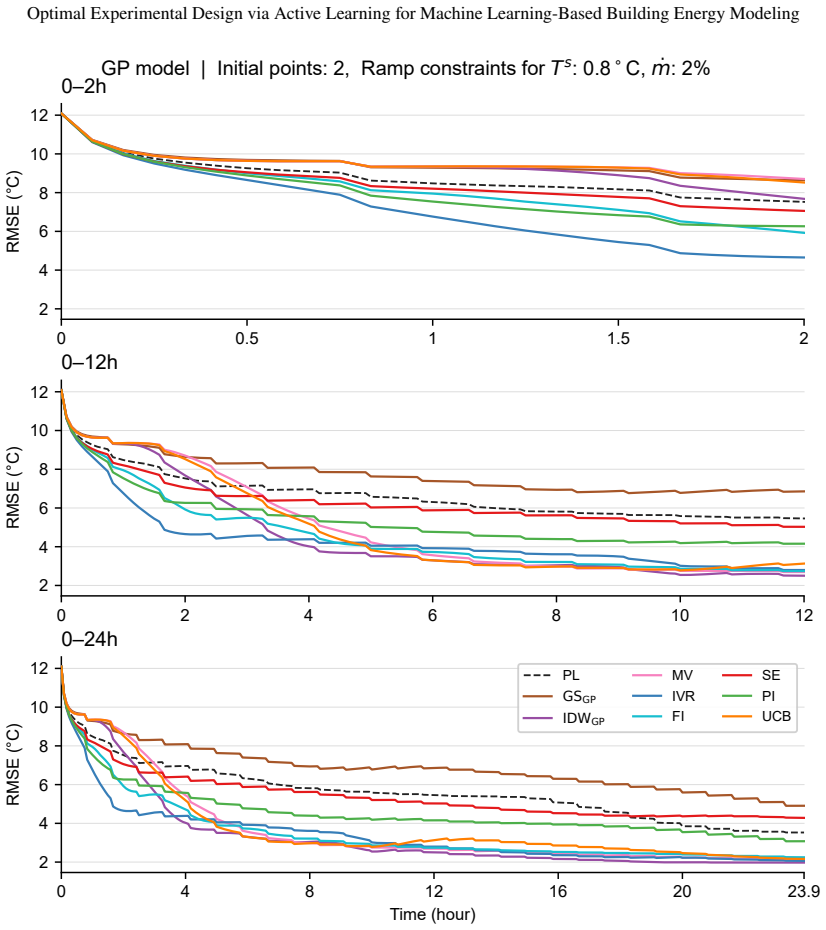
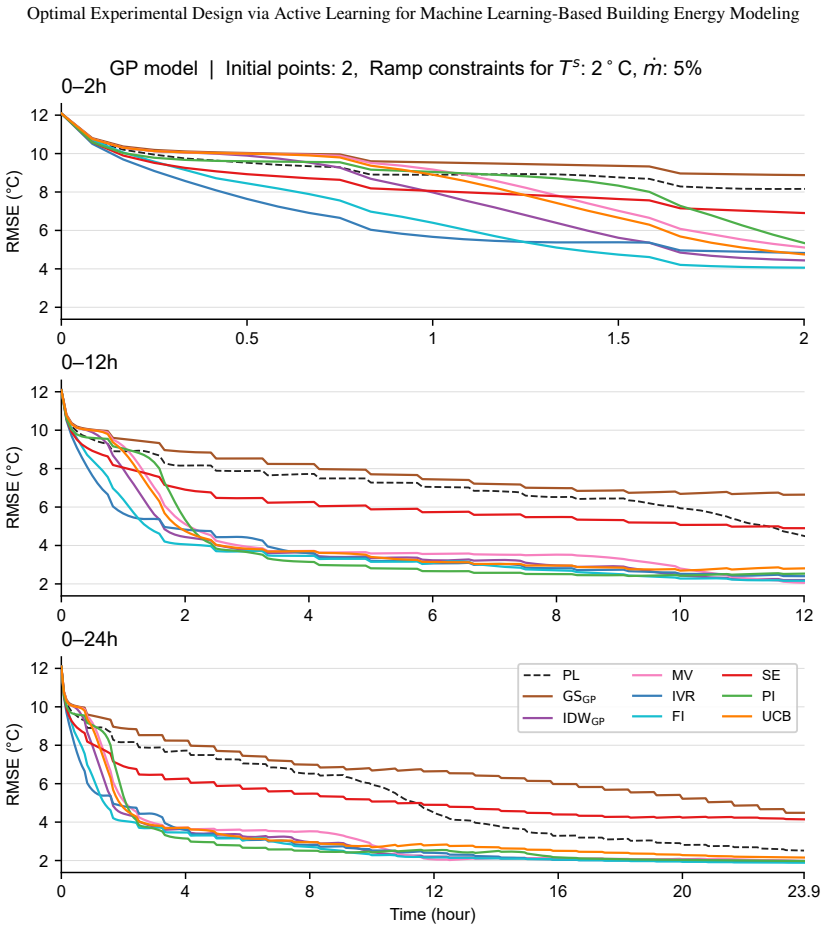
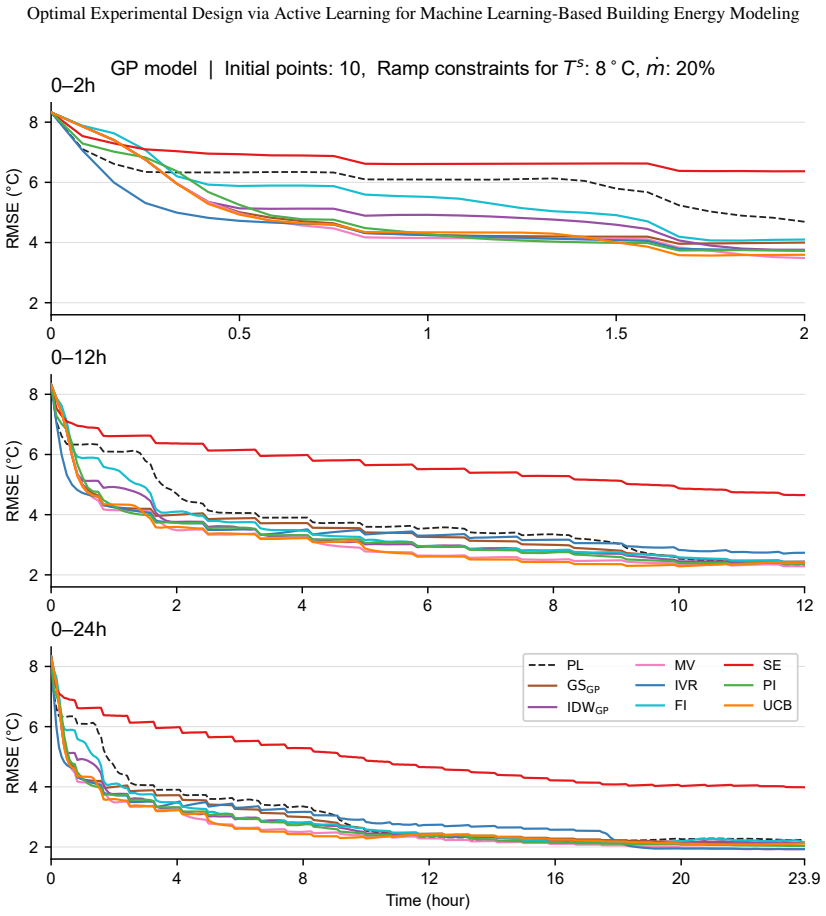
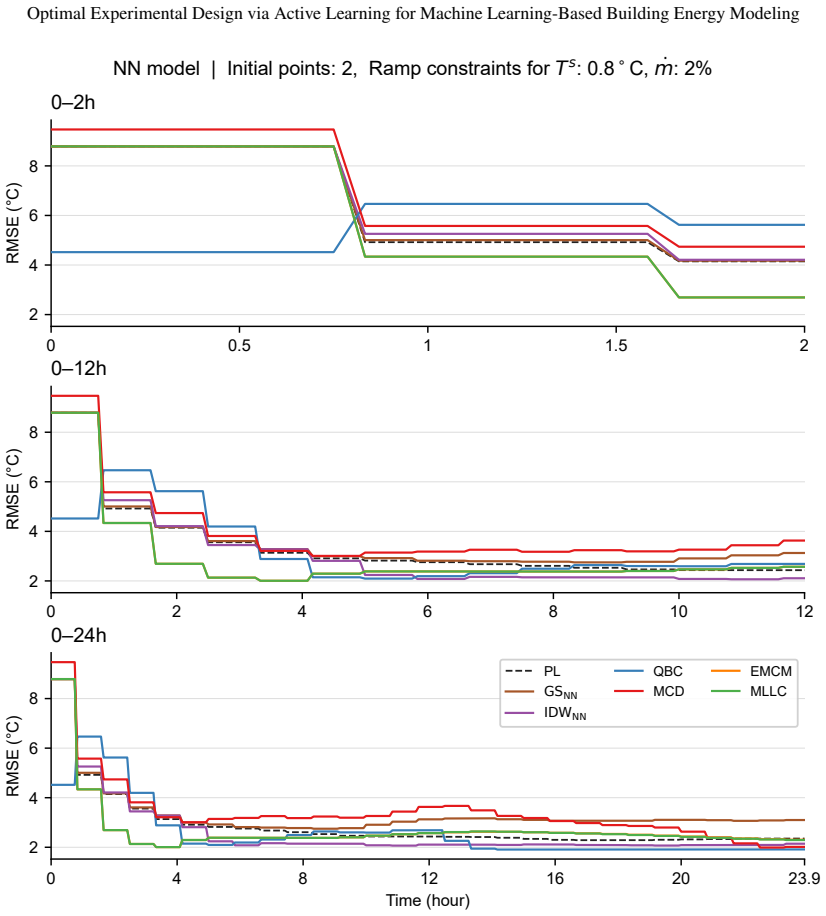
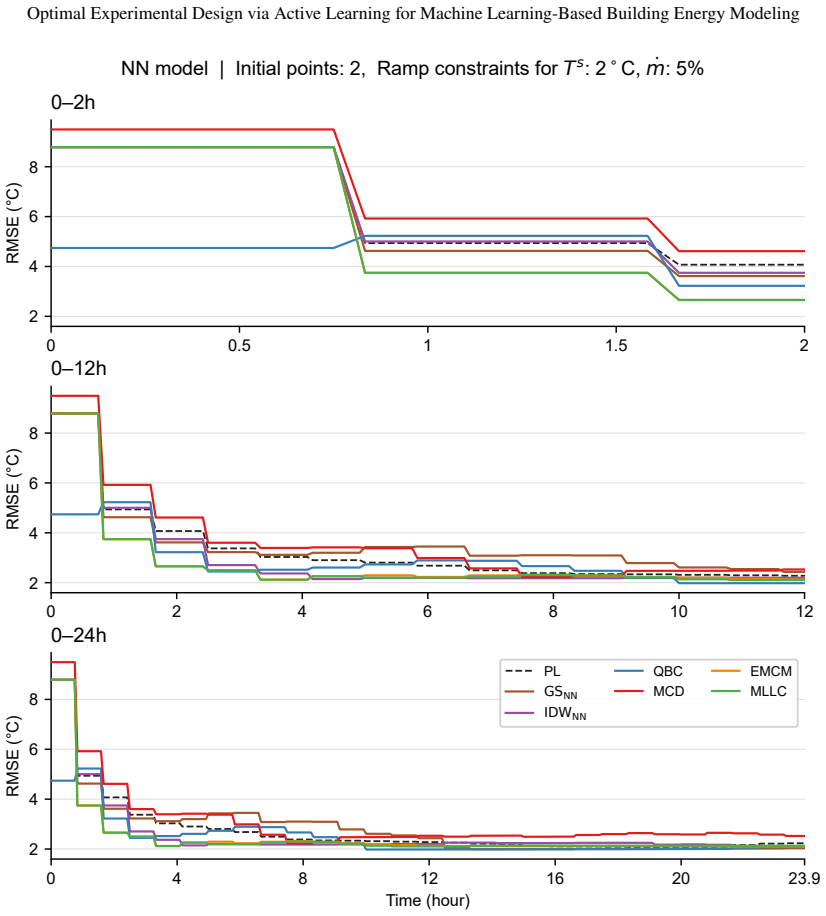
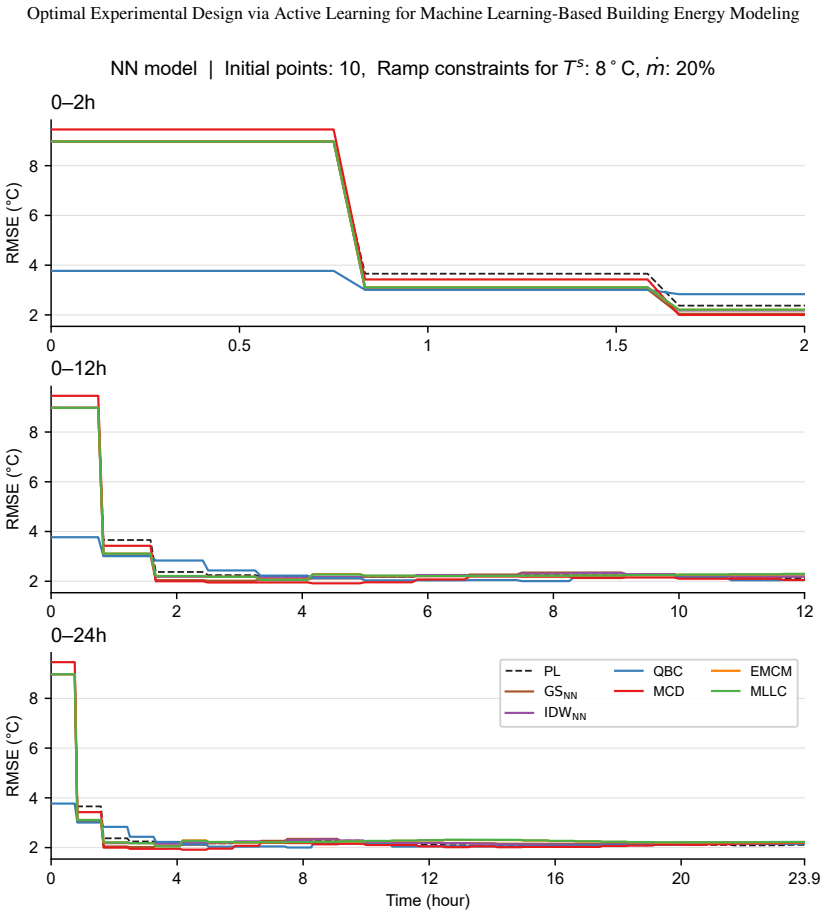
The central claim is that optimal experimental design realized through active learning yields machine learning models of building energy systems with lower root mean square error than models trained on passively collected uniformly random data, when both are evaluated across multiple test scenarios on the BOPTEST simulator. The improvement holds for both deterministic neural networks and stochastic Gaussian processes, with the magnitude varying by the specific acquisition function category and system operating regime.
What carries the argument
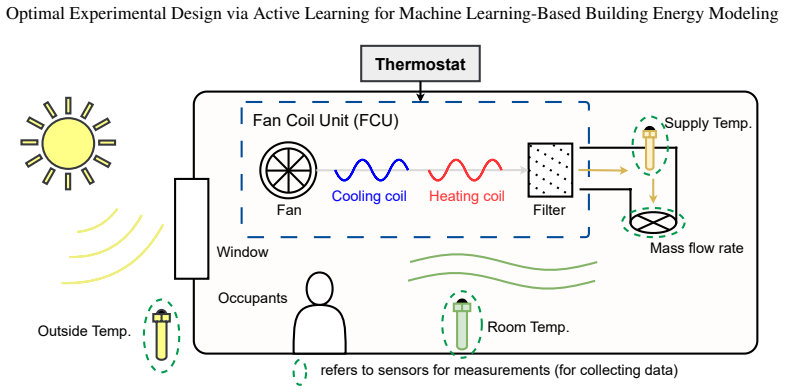
Four categories of active learning acquisition functions (data space, uncertainty, information gain, and model change) used to select control inputs for collecting training data on HVAC thermal dynamics.
Load-bearing premise
The BOPTEST high-fidelity simulator accurately captures the dynamics and conditions of real building energy systems.
What would settle it
Collecting data from a physical building HVAC system using the same active learning procedures and comparing the resulting model errors to those obtained in the BOPTEST simulations.
Figures
read the original abstract
Machine learning (ML) techniques have been commonly adopted to identify the dynamics of building energy systems (BESs), owing to their flexibility relative to first-principles, physics-based modeling approaches. Beyond the choice of ML architecture, the quality of the training data plays an essential role in the resulting model performance. Optimal experimental design (OED), realized in this work through active learning (AL), determines which experiments to conduct in order to collect informative data, rather than relying on standard approaches such as uniformly random sampling. This paper proposes a systematic comparison of OED via AL for building energy system identification, with a particular focus on HVAC thermal dynamics. We investigate fourteen AL techniques across two ML model classes, namely a deterministic feedforward neural network and a stochastic Gaussian process, and classify these techniques into four categories: data space, uncertainty, information gain, and model change. To examine the AL algorithms under realistic conditions, we implement and evaluate them on the high-fidelity building simulator BOPTEST. The results, reported as the root mean square error across multiple test scenarios with varying initial dataset sizes and control input constraints, show that AL-based models generally outperform models trained via passive learning (PL) with uniformly random control inputs, achieving error reductions of up to 54\%, although the magnitude and consistency of this improvement vary across acquisition functions and operating regimes.
Editorial analysis
A structured set of objections, weighed in public.
Referee Report
Summary. The paper claims that active learning (AL) techniques for optimal experimental design outperform passive learning (PL) with uniformly random control inputs in machine learning-based identification of building energy system (BES) dynamics. Using the BOPTEST high-fidelity simulator, fourteen AL techniques are evaluated across feedforward neural networks and Gaussian processes, categorized into data space, uncertainty, information gain, and model change. The results show error reductions of up to 54% in root mean square error, though the improvement varies across acquisition functions and operating regimes, with tests under varying initial dataset sizes and input constraints.
Significance. If the results hold with proper statistical support, this work would be significant for the field of building energy system identification by providing empirical evidence that AL can substantially improve model accuracy compared to standard random sampling approaches. The systematic comparison of multiple techniques on a realistic simulator could guide practitioners in selecting appropriate OED methods for HVAC dynamics modeling.
major comments (2)
- Results: The reported performance gains, including the 54% error reduction, are presented without details on statistical significance testing, the exact number of experimental runs, variance across trials, or sensitivity to initial dataset sizes, which are critical for establishing the robustness of the central claim.
- Methods: The manuscript does not provide sufficient details on the exact implementation of the fourteen AL techniques, data exclusion rules, or how the techniques are applied under different control input constraints, hindering reproducibility and verification of the findings.
minor comments (1)
- Abstract: The abstract mentions 'two ML model classes' but could benefit from briefly noting the specific architectures used for the neural network and Gaussian process.
Simulated Author's Rebuttal
We thank the referee for the constructive feedback. The comments correctly identify areas where additional rigor and transparency will strengthen the paper. We address both major comments below and will revise the manuscript to incorporate the requested details.
read point-by-point responses
-
Referee: The reported performance gains, including the 54% error reduction, are presented without details on statistical significance testing, the exact number of experimental runs, variance across trials, or sensitivity to initial dataset sizes, which are critical for establishing the robustness of the central claim.
Authors: We agree that explicit statistical support is necessary. The current manuscript reports results across multiple test scenarios with varying initial dataset sizes, but does not include the number of independent trials, variance measures, or formal significance tests. In the revision we will add these: we will state that each configuration was repeated over 10 independent trials, report mean RMSE with standard deviation, and include paired t-tests (or Wilcoxon tests where normality assumptions fail) comparing AL versus PL. We will also expand the sensitivity analysis to initial dataset sizes with additional tabulated results. revision: yes
-
Referee: The manuscript does not provide sufficient details on the exact implementation of the fourteen AL techniques, data exclusion rules, or how the techniques are applied under different control input constraints, hindering reproducibility and verification of the findings.
Authors: We accept that the current level of implementation detail is insufficient for full reproducibility. The revision will include a new subsection (or appendix) that specifies the exact acquisition-function formulations, any hyperparameters, data-exclusion criteria (e.g., rejection of duplicate or infeasible samples), and the precise mechanism used to enforce control-input constraints (projection onto feasible sets or rejection sampling). Pseudocode for the overall active-learning loop will also be added. revision: yes
Circularity Check
No circularity; empirical results from external simulator
full rationale
The paper performs a direct empirical comparison of active learning (AL) acquisition functions against passive learning (PL) with random inputs. Performance is measured by root-mean-square error on held-out test scenarios generated by the independent BOPTEST high-fidelity simulator. No equations, fitted parameters, or self-citations are used to derive the reported error reductions; the 54% figure is obtained by running the algorithms on the simulator and computing the metric. The central claim therefore rests on external simulation output rather than any reduction to its own inputs or prior self-referential results.
Axiom & Free-Parameter Ledger
Reference graph
Works this paper leans on
-
[1]
IEEE Transactions on Robotics 35, 1071–1083
Active learning of dynamics for data-driven control using koopman operators. IEEE Transactions on Robotics 35, 1071–1083. doi:10.1109/TRO.2019.2923880. American Society of Heating, Refrigerating and Air-Conditioning Engineers,
-
[2]
8927–8939
Gone fishing: Neural active learning with fisher embeddings, in: Advances in Neural Information Processing Systems 34 (NeurIPS 2021), pp. 8927–8939. Ash, J.T., Zhang, C., Krishnamurthy, A., Langford, J., Agarwal, A.,
2021
-
[3]
URL:https://arxiv.org/abs/1906.03671,arXiv:1906.03671
Deep batch active learning by diverse, uncertain gradient lower bounds. URL:https://arxiv.org/abs/1906.03671,arXiv:1906.03671. Atkinson, A., Donev, A., Tobias, R.,
arXiv 1906
-
[4]
International Journal of Control 97, 1512–1531
A learning- and scenario-based mpc design for nonlinear systems in lpv framework with safety and stability guarantees. International Journal of Control 97, 1512–1531. URL:https://doi.org/10.1080/00207179.2023.2212814, doi:10.1080/00207179.2023.2212814,arXiv:https://doi.org/10.1080/00207179.2023.2212814. Bemporad, A.,
-
[5]
Information Sciences 626, 275–292
Active learning for regression by inverse distance weighting. Information Sciences 626, 275–292. URL:https: //www.sciencedirect.com/science/article/pii/S0020025523000282, doi:https://doi.org/10.1016/j.ins.2023.01.028. Biemann, M., Gunkel, P.A., Scheller, F., Huang, L., Liu, X.,
-
[6]
IEEE Internet of Things Journal 10, 13876–13894
Data center hvac control harnessing flexibility potential via real-time pricing cost optimization using reinforcement learning. IEEE Internet of Things Journal 10, 13876–13894. doi:10.1109/JIOT.2023.3263261. Blum, D., Arroyo, J., Huang, S., Drgoňa, J., Jorissen, F., Walnum, H.T., Chen, Y., Benne, K., Vrabie, D., Wetter, M., Helsen, L.,
-
[7]
Journal of Building Performance Simulation 14, 586–610
Building optimization testing framework (boptest) for simulation-based benchmarking of control strategies in buildings. Journal of Building Performance Simulation 14, 586–610. URL:https://doi.org/10.1080/19401493.2021.1986574, doi:10.1080/19401493.2021. 1986574,arXiv:https://doi.org/10.1080/19401493.2021.1986574. Buisson-Fenet, M., Solowjow, F., Trimpe, S.,
-
[8]
Actively learning gaussian process dynamics, in: Bayen, A.M., Jadbabaie, A., Pappas, G., Parrilo,P.A.,Recht,B.,Tomlin,C.,Zeilinger,M.(Eds.),Proceedingsofthe2ndConferenceonLearningforDynamicsandControl,PMLR.pp. 5–15. URL:https://proceedings.mlr.press/v120/buisson-fenet20a.html. Burbidge,R.,Rowland,J.J.,King,R.D.,2007. Activelearningforregressionbasedonquer...
2007
-
[9]
Tissue antigens 62, 378–384
Sensitive quantitative predictions of peptide-mhc binding by a ‘query by committee’artificial neural network approach. Tissue antigens 62, 378–384. Cai,W.,Zhang,Y.,Zhou,J.,2013. Maximizingexpectedmodelchangeforactivelearninginregression,in:2013IEEE13thinternationalconference on data mining, IEEE. pp. 51–60. Carpentier, A., Lazaric, A., Ghavamzadeh, M., Mu...
2013
-
[10]
modAL: A modular active learning framework for Python
modal: A modular active learning framework for python. URL:https://arxiv.org/abs/1805.00979, arXiv:1805.00979. Drgoňa,J.,Arroyo,J.,CupeiroFigueroa,I.,Blum,D.,Arendt,K.,Kim,D.,Ollé,E.P.,Oravec,J.,Wetter,M.,Vrabie,D.L.,Helsen,L.,2020. Allyou need to know about model predictive control for buildings. Annual Reviews in Control 50, 190–232. URL:https://www.sci...
work page internal anchor Pith review Pith/arXiv arXiv doi:10.1016/j.arcontrol.2020.09.001 2020
-
[11]
Integrating active learning and semi-supervised learning for improved data-driven hvac fault diagnosis performance. Applied Energy 356, 122356. URL:https://www.sciencedirect.com/science/article/pii/S0306261923017208, doi:https://doi.org/10.1016/j.apenergy.2023.122356. Frazier, P.I.,
-
[12]
URL:https://arxiv.org/abs/1807.02811,arXiv:1807.02811
A tutorial on bayesian optimization. URL:https://arxiv.org/abs/1807.02811,arXiv:1807.02811. Freund, Y., Seung, H., Shamir, E., Tishby, N.,
-
[13]
Selective sampling using the query by committee algorithm. Machine Learning 28, 133–168. doi:10.1023/a:1007330508534. Gal,Y.,Ghahramani,Z.,2016.Dropoutasabayesianapproximation:Representingmodeluncertaintyindeeplearning,in:Balcan,M.F.,Weinberger, K.Q.(Eds.),ProceedingsofThe33rdInternationalConferenceonMachineLearning,PMLR,NewYork,NewYork,USA.pp.1050–1059. ...
-
[14]
URL:https: //arxiv.org/abs/1112.5745,arXiv:1112.5745
Bayesian active learning for classification and preference learning. URL:https: //arxiv.org/abs/1112.5745,arXiv:1112.5745. Jain, A., Nghiem, T., Morari, M., Mangharam, R.,
-
[15]
Learning and control using gaussian processes, in: 2018 ACM/IEEE 9th International Conference on Cyber-Physical Systems (ICCPS), pp. 140–149. doi:10.1109/ICCPS.2018.00022. Keesman, K.J.,
-
[16]
URL:https://arxiv.org/abs/1412.6980,arXiv:1412.6980
Adam: A method for stochastic optimization. URL:https://arxiv.org/abs/1412.6980,arXiv:1412.6980. Kontoudis, G.P., Otte, M.W.,
-
[17]
Advances in Applied Energy 16, 100189
Active learning concerning sampling cost for enhancing ai-enabled building energy system modeling. Advances in Applied Energy 16, 100189. URL:https://www.sciencedirect.com/science/article/pii/ S2666792424000271, doi:https://doi.org/10.1016/j.adapen.2024.100189. Ly,A.,Marsman,M.,Verhagen,J.,Grasman,R.P.,Wagenmakers,E.J.,2017. Atutorialonfisherinformation. ...
-
[18]
Active learning-based machine learning approach for enhancing environmental sustainability in green building energy consumption. Scientific Reports 14, 19894. Mania,H.,Jordan,M.I.,Recht,B.,2022. Activelearningfornonlinearsystemidentificationwithguarantees. JournalofMachineLearningResearch 23, 1–30. URL:http://jmlr.org/papers/v23/20-807.html. Mocanu,E.,Moc...
-
[19]
Physics-informed data-driven modeling of hvac systems: A systematic analysis. IEEE Access 14, 6481–6500. doi:10.1109/ACCESS.2026.3653004. Paszke, A., Gross, S., Massa, F., Lerer, A., Bradbury, J., Chanan, G., Killeen, T., Lin, Z., Gimelshein, N., Antiga, L., et al.,
-
[20]
A direct adaptive method for faster backpropagation learning: the rprop algorithm, in: IEEE International Conference on Neural Networks, pp. 586–591 vol.1. doi:10.1109/ICNN.1993.298623. Roinila, T., Abdollahi, H., Santi, E.,
-
[21]
IEEE Transactions on Power Electronics 36, 3744–3756
Frequency-domain identification based on pseudorandom sequences in analysis and control of dc power distribution systems: A review. IEEE Transactions on Power Electronics 36, 3744–3756. doi:10.1109/TPEL.2020.3024624. Settles, B.,
-
[22]
Journal of Physics: Conference Series 2600, 132004
Enhancing personalised thermal comfort models with active learning for improved hvac controls. Journal of Physics: Conference Series 2600, 132004. URL:https://doi.org/10.1088/1742-6596/2600/13/132004, doi:10.1088/ 1742-6596/2600/13/132004. Wang, X., Jin, Y., Schmitt, S., Olhofer, M.,
-
[23]
Journal of Building Performance Simu- lation 7, 253–270
Modelica buildings library. Journal of Building Performance Simu- lation 7, 253–270. URL:https://doi.org/10.1080/19401493.2013.765506, doi:10.1080/19401493.2013.765506, arXiv:https://doi.org/10.1080/19401493.2013.765506. Wu, D.,
-
[24]
Pool-based sequential active learning for regression. IEEE Transactions on Neural Networks and Learning Systems 30, 1348–1359. doi:10.1109/TNNLS.2018.2868649. Wu, D., Lin, C.T., Huang, J.,
-
[25]
Information Sciences 474, 90–105
Active learning for regression using greedy sampling. Information Sciences 474, 90–105. URL:https: //www.sciencedirect.com/science/article/pii/S0020025518307680, doi:https://doi.org/10.1016/j.ins.2018.09.060. Xie, K., Bemporad, A.,
-
[26]
Online design of experiments by active learning for system identification of autoregressive models, in: 2024 IEEE 63rd Conference on Decision and Control (CDC), pp. 7202–7207. doi:10.1109/CDC56724.2024.10886678. Yang, J., Xia, B.,
-
[27]
Active learning using uncertainty information, in: 2016 23rd International Conference on Pattern Recognition (ICPR), pp. 2646–2651. doi:10.1109/ICPR.2016.7900034. Yu, H., Kim, S.,
-
[28]
1151–1156
Passive sampling for regression, in: 2010 IEEE International Conference on Data Mining, pp. 1151–1156. doi:10.1109/ ICDM.2010.9. Zhang,L.,2021. Data-drivenbuildingenergymodelingwithfeatureselectionandactivelearningfordatapredictivecontrol. EnergyandBuildings 252, 111436. Zhang, L., Wen, J.,
2010
discussion (0)
Sign in with ORCID, Apple, or X to comment. Anyone can read and Pith papers without signing in.