Solar Radio Burst Fine Structures
Pith reviewed 2026-06-25 20:21 UTC · model grok-4.3
The pith
Recent sub-second imaging spectroscopy shows fine structures in solar radio bursts that existing models cannot explain.
A machine-rendered reading of the paper's core claim, the machinery that carries it, and where it could break.
Core claim
Sub-second imaging spectroscopy has revealed that many fine structures in solar radio bursts challenge existing theoretical models, pointing to the need for new frameworks and a reassessment of current interpretations of the emission processes.
What carries the argument
Fine frequency-time structures in solar radio bursts observed via high-resolution imaging spectroscopy, which encode details of small-scale physical conditions in the emitting plasma.
If this is right
- A clearer picture of how electrons are accelerated and transported in the solar atmosphere.
- Revised views on the role of magnetic reconnection in generating radio emission.
- Better characterization of turbulence in the solar corona.
- More reliable estimates of how solar energetic events affect space weather.
Where Pith is reading between the lines
- The same mismatch between observation and model may occur in radio emission from other astrophysical environments, implying a wider revision of plasma emission theory.
- Simultaneous multi-wavelength data could test whether the radio fine structures directly trace the sites of particle acceleration.
- Higher-resolution observations in additional frequency bands could isolate which emission mechanism is most deficient in current models.
Load-bearing premise
The fine frequency-time structures observed in recent sub-second imaging spectroscopy cannot be explained by existing theoretical models of solar radio emission processes.
What would settle it
A single theoretical model that reproduces the full set of observed fine structures while remaining within current frameworks for radio emission processes would falsify the need for new frameworks.
Figures
read the original abstract
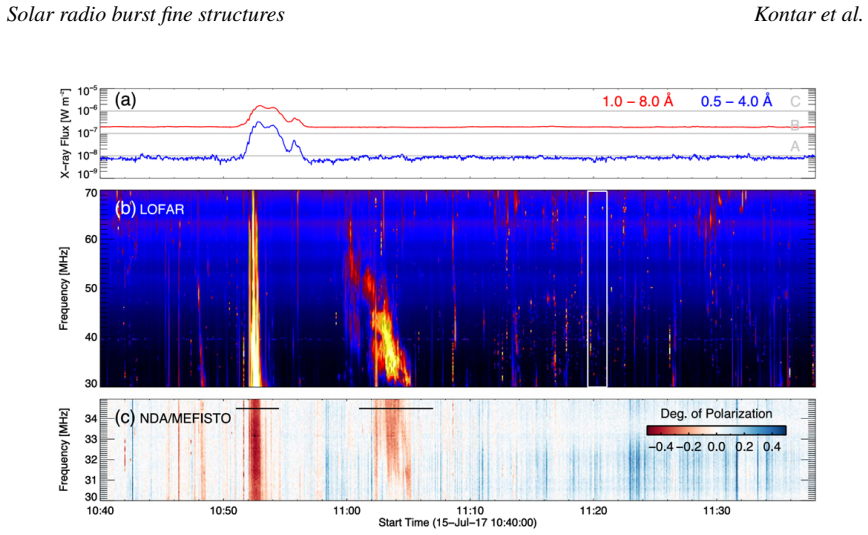
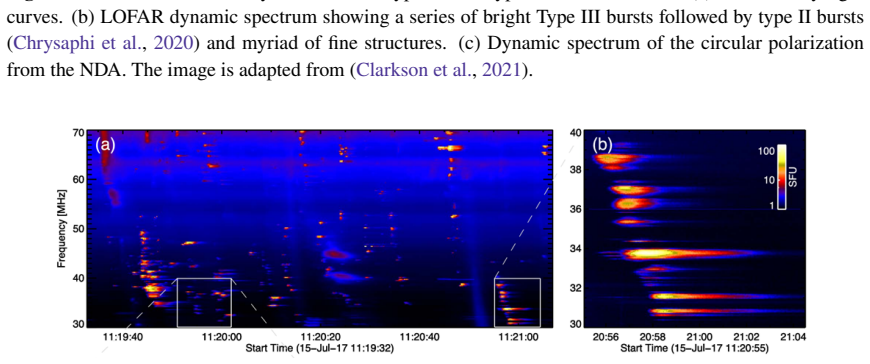
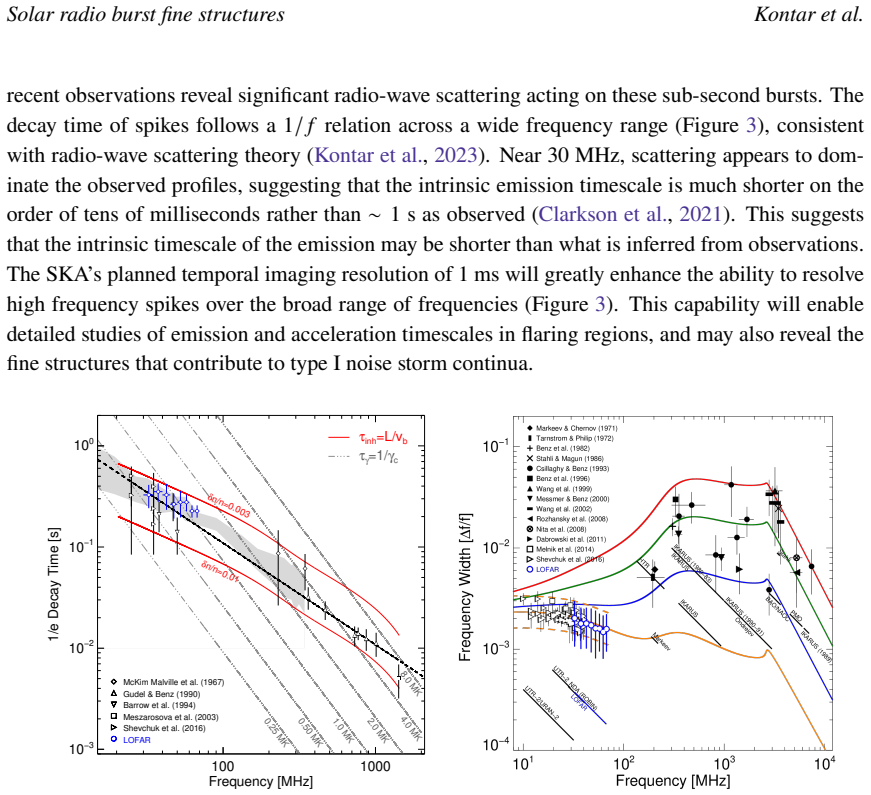
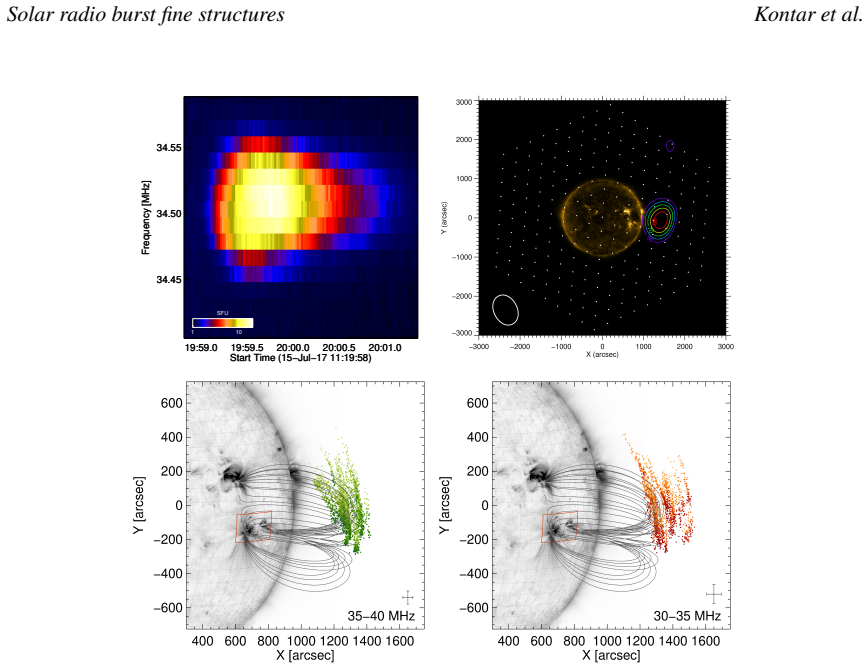
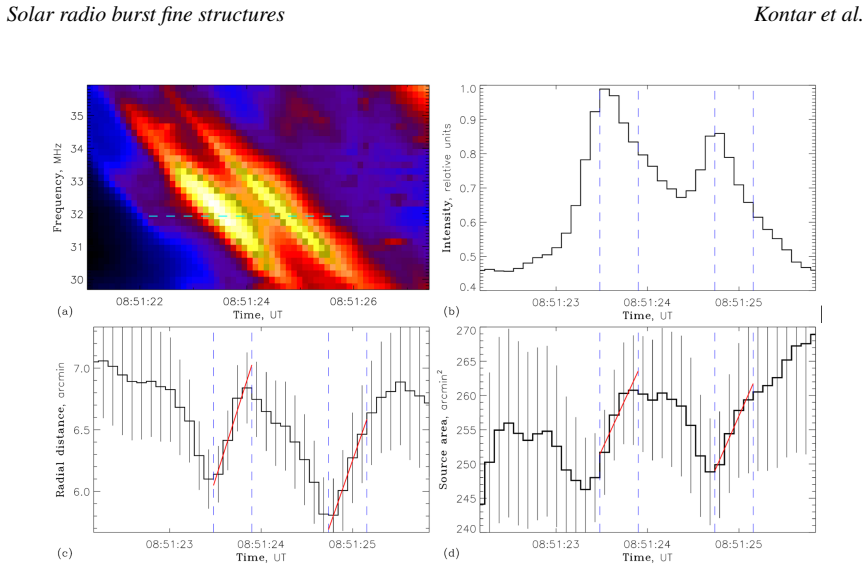
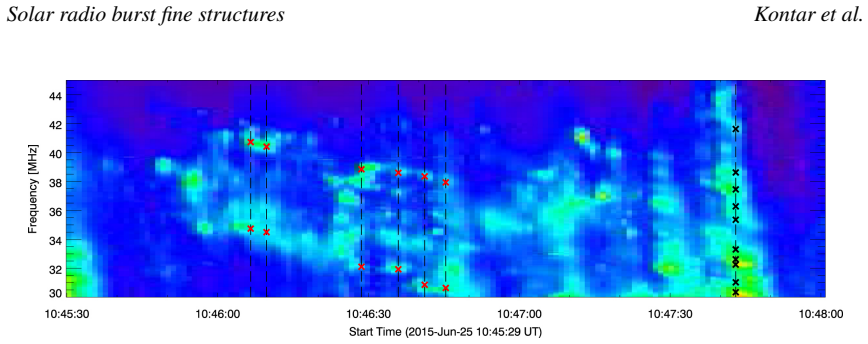
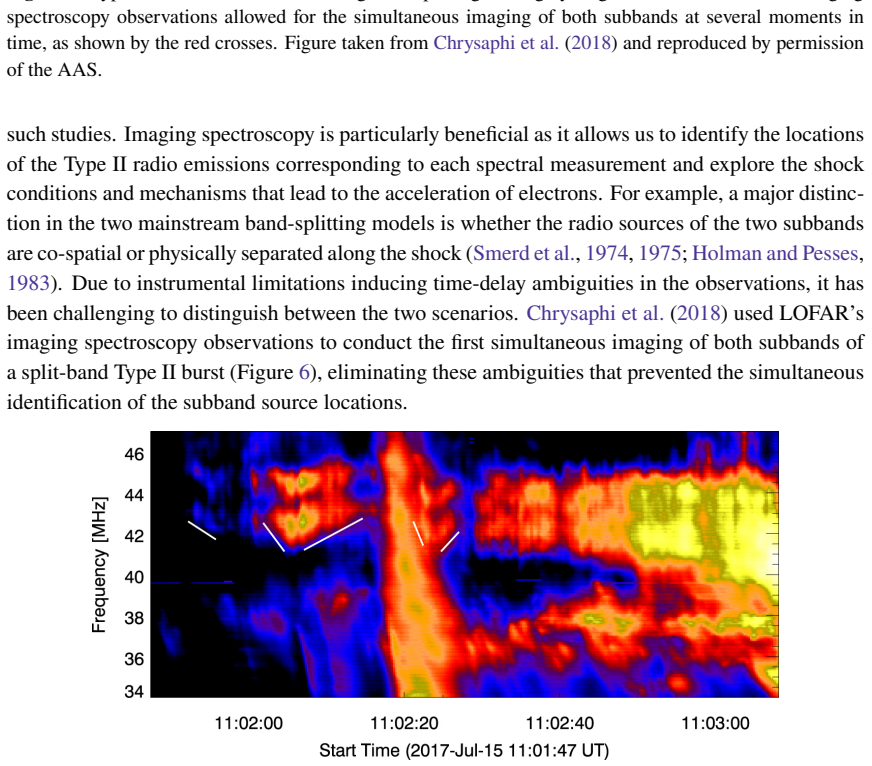
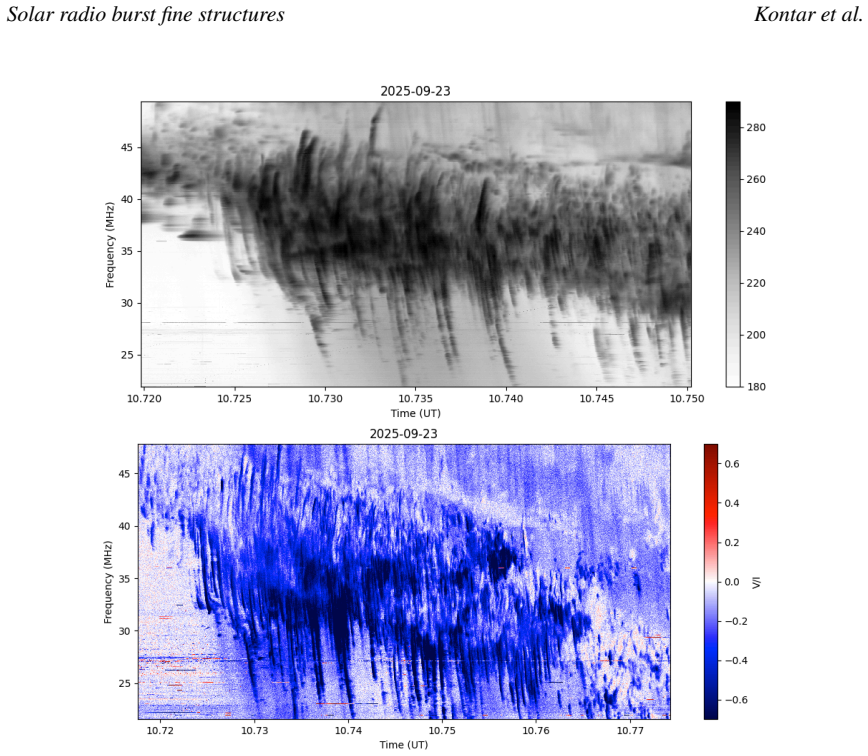
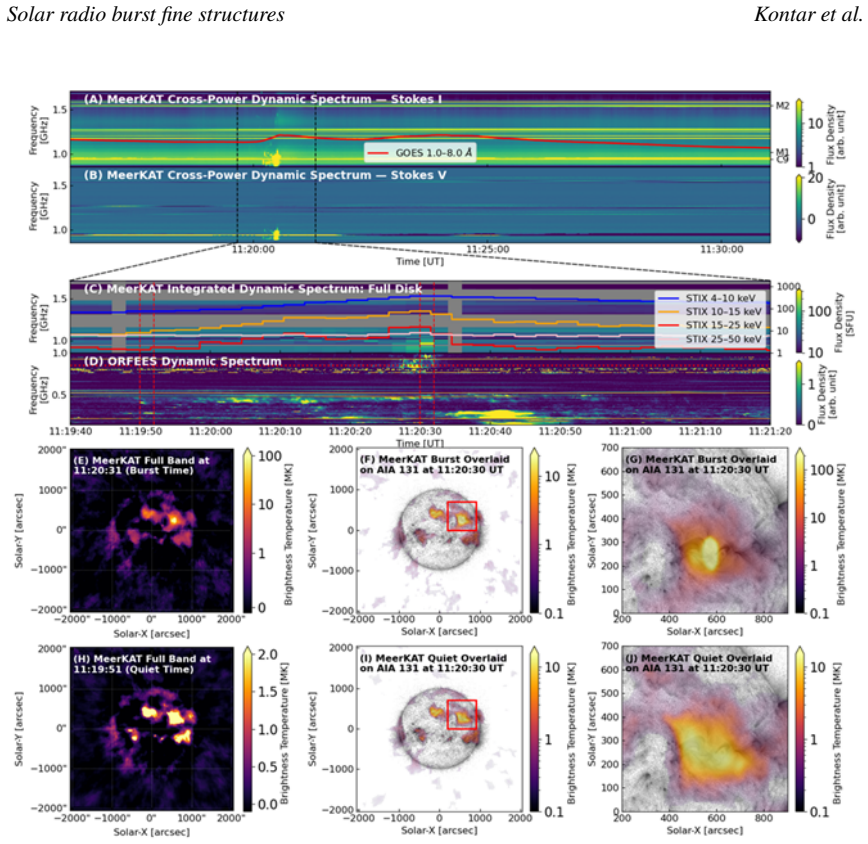
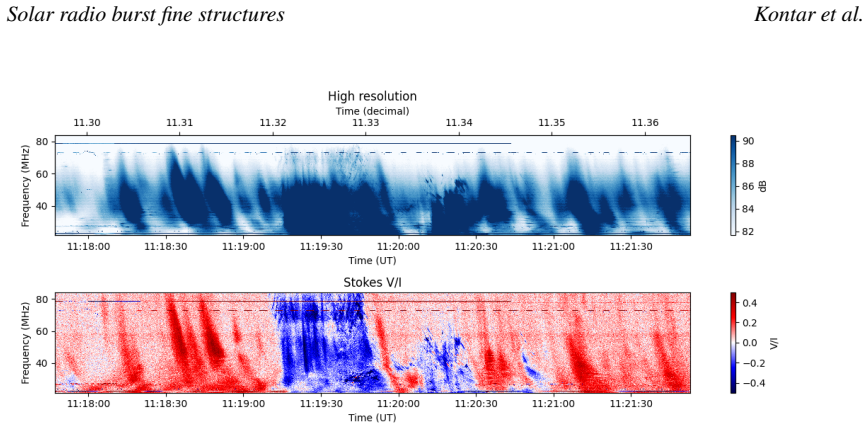
Solar radio bursts exhibit intricate variability in time, space, and frequency, often displaying a rich variety of fine frequency-time structures such as spikes, drift pairs, striae in Type III bursts, and herringbone patterns in Type II bursts, etc. Historically, limited spatial, spectral, and temporal resolution has hindered detailed investigation of these narrow-band, rapidly evolving features, restricting progress in identifying their physical origins and underlying processes at these scales. Advances in high-time-frequency-resolution solar imaging now offer transformative opportunities. Recent sub-second imaging spectroscopy has revealed that many fine structures challenge existing theoretical models, pointing to the need for new frameworks and a reassessment of current interpretations. The Square Kilometre Array (SKA), with its full-Stokes imaging spectroscopy at sub-second cadences, will provide unprecedented data essential for resolving these long-standing questions. These capabilities promise to significantly deepen our understanding of electron acceleration and transport, magnetic reconnection, and coronal plasma turbulence, thereby advancing our knowledge of solar energetic processes and improving assessments of their space-weather impacts.
Editorial analysis
A structured set of objections, weighed in public.
Referee Report
Summary. The manuscript is a review summarizing known fine frequency-time structures in solar radio bursts (spikes, drift pairs, striae in Type III bursts, herringbone patterns in Type II bursts). It notes that historical limits on spatial/spectral/temporal resolution have impeded progress, states that recent sub-second imaging spectroscopy has revealed many such structures to challenge existing theoretical models (necessitating new frameworks), and argues that the Square Kilometre Array (SKA) with full-Stokes sub-second imaging spectroscopy will supply the data needed to resolve open questions on electron acceleration, magnetic reconnection, coronal turbulence, and space-weather impacts.
Significance. If the assessment that recent observations cannot be accommodated by existing models is correct and properly documented, the review would usefully articulate the scientific motivation for SKA solar observations and could help prioritize observing strategies that advance understanding of solar energetic processes.
major comments (1)
- [Abstract] Abstract: The central claim that 'recent sub-second imaging spectroscopy has revealed that many fine structures challenge existing theoretical models' is presented without any citations, specific observational examples, error analysis, or identification of the models in question. This assertion is load-bearing for the paper's motivation yet is unsupported in the provided text.
minor comments (1)
- [Abstract] Abstract: The phrase 'etc.' at the end of the list of fine structures is informal; replace with a more complete enumeration or a pointer to a comprehensive review.
Simulated Author's Rebuttal
We thank the referee for their constructive comments, which help strengthen the manuscript's motivation and clarity. We address the single major comment below.
read point-by-point responses
-
Referee: [Abstract] Abstract: The central claim that 'recent sub-second imaging spectroscopy has revealed that many fine structures challenge existing theoretical models' is presented without any citations, specific observational examples, error analysis, or identification of the models in question. This assertion is load-bearing for the paper's motivation yet is unsupported in the provided text.
Authors: We agree the claim in the abstract requires explicit support. In the revised version we will (1) insert 2-3 key citations to recent sub-second imaging spectroscopy results (e.g., LOFAR and MWA studies of spikes and Type-III striae), (2) give one or two concrete observational examples that are difficult to reconcile with standard plasma-emission or beam-instability models, (3) briefly note the relevant observational uncertainties, and (4) identify the models being challenged. These additions will be placed in both the abstract and a short new paragraph in the introduction so the motivation for SKA observations rests on documented evidence rather than assertion. revision: yes
Circularity Check
No significant circularity; purely descriptive review
full rationale
This is a forward-looking review summarizing observed fine structures in solar radio bursts and advocating SKA capabilities. The central claim—that recent sub-second imaging spectroscopy reveals structures challenging existing models—is presented as established motivation from external observations rather than derived via equations, fits, or self-citation chains within the paper. No derivations, parameters, or load-bearing logical steps exist that could reduce to inputs by construction; the text contains no equations or quantitative predictions.
Axiom & Free-Parameter Ledger
Reference graph
Works this paper leans on
-
[1]
doi: 10.1007/BF00150141. H. Alvarez and F. T. Haddock. Sol. Phys., 29(1):197–209, Mar
-
[2]
doi: 10.1007/BF00153449. S. Armatas et al. A&A, 624:A76, Apr
-
[3]
doi: 10.1051/0004-6361/201834982. M. G. Aubier, Y . Leblanc, and B. Moller-Pedersen. A&A, 70:685, Nov
-
[4]
Planck Collaboration et al.Astron
doi: 10.1051/0004-6361/ 200912143. 16 Solar radio burst fine structures Kontar et al. A. O. Benz. Sol. Phys., 96(2):357–370, Apr
-
[5]
doi: 10.1007/BF00149690. A. O. Benz. Living Reviews in Solar Physics, 14(1):2, Dec
-
[6]
doi: 10.1007/s41116-016-0004-3. A. O. Benz, M. Jaeggi, and P . Zlobec. A&A, 109(2):305–313, May
-
[7]
doi: 10.1051/0004-6361/201527229. R. Braun et al. Anticipated performance of the square kilometre array – phase 1 (ska1),
-
[8]
URL https://arxiv.org/abs/1912.12699. A. I. Brazhenko et al. Kinematika i Fizika Nebesnykh Tel Supplement , 5:43–46, June
arXiv 1912
-
[9]
doi: 10.12942/ lrsp-2013-2. I. H. Cairns and R. D. Robinson. Sol. Phys., 111(2):365–383, Sept
2013
-
[10]
doi: 10.3847/1538-4357/ac1acd. A. P . Cerruti et al. Space Weather, 6(10):S10D07, Oct
-
[11]
doi: 10.1029/2007SW000375. B. Chen et al. Science, 350(6265):1238–1242, Dec
-
[12]
doi: 10.1126/science.aac8467. L. Chen et al. ApJ, 915(1):L22, July
-
[13]
doi: 10.3847/2041-8213/ac0b43. X. Chen et al. ApJ, 856(1):73, Mar
-
[14]
doi: 10.3847/1538-4357/aaa9bf. X. Chen et al. ApJ, 905(1):43, Dec
-
[15]
doi: 10.3847/1538-4357/abc24e. G. P . Chernov. Fine Structure of Solar Radio Bursts , volume
-
[16]
doi: 10.1007/978-3-642-20015-1. N. Chrysaphi, E. P . Kontar, G. D. Holman, and M. Temmer. ApJ, 868(2):79, Dec
-
[17]
doi: 10.3847/1538-4357/aae9e5. N. Chrysaphi, H. A. S. Reid, and E. P . Kontar. ApJ, 893(2):115, Apr
-
[18]
doi: 10.3847/1538-4357/ ab80c1. D. L. Clarkson and E. P . Kontar. ApJ, 978(1):73, Jan
-
[19]
doi: 10.3847/1538-4357/ad969c. D. L. Clarkson and E. P . Kontar. ApJ, 999(1):134, Mar. 2026a. doi: 10.3847/1538-4357/ae3dae. D. L. Clarkson and E. P . Kontar.arXiv e-prints, art. arXiv:2605.31450, May 2026b. doi: 10.48550/ arXiv.2605.31450. D. L. Clarkson et al. ApJ, 917(2):L32, Aug
work page internal anchor Pith review Pith/arXiv arXiv doi:10.3847/1538-4357/ad969c
-
[20]
doi: 10.3847/2041-8213/ac1a7d. D. L. Clarkson et al. ApJ, 946(1):33, Mar
-
[21]
doi: 10.3847/1538-4357/acbd3f. E. W. Cliver, D. F. Webb, and R. A. Howard. Sol. Phys., 187(1):89–114, June
-
[22]
doi: 10.1023/A: 1005115119661. E. W. Cliver, S. M. White, and K. S. Balasubramaniam. ApJ, 743(2):145, Dec
-
[23]
doi: 10.1007/s11214-011-9802-z. B. P . Dąbrowski, P . Rudawy, and M. Karlický. Sol. Phys., 273(2):377–392, Nov
-
[24]
1007/s11207-011-9756-z. V . V . Dorovskyy et al. Sol. Phys., 290(7):2031–2042, July
2031
-
[25]
doi: 10.1007/s11207-015-0725-9. M. Gordovskyy et al. ApJ, 925(2):140, Feb
-
[26]
doi: 10.3847/1538-4357/ac3bb7. M. Guedel and A. O. Benz. A&A, 231(1):202–212, May
-
[27]
doi: 10.1051/ swsc/2021039. G. A. Hampson et al. Journal of Astronomical Telescopes, Instruments, and Systems , 8:011018, Jan
-
[28]
doi: 10.1117/1.JATIS.8.1.011018. G. D. Holman and M. E. Pesses. ApJ, 267:837–843, Apr
-
[29]
doi: 10.1086/160918. G. D. Holman et al. Space Sci. Rev., 159(1-4):107–166, Sept
-
[30]
doi: 10.22323/1.277.0001. P . M. Kintner, B. O’Hanlon, D. E. Gary, and P . M. S. Kintner.Radio Science, 44(2):RS0A08, June
-
[31]
doi: 10.1029/2008RS004039. E. P . Kontar et al. Space Sci. Rev., 159(1-4):301–355, Sept
-
[32]
doi: 10.1038/s41467-017-01307-8. E. P . Kontar et al. ApJ, 884(2):122, Oct
-
[33]
doi: 10.3847/1538-4357/ab40bb. E. P . Kontar et al. ApJ, 956(2):112, Oct
-
[34]
doi: 10.3847/1538-4357/acf6c1. E. P . Kontar, A. G. Emslie, D. L. Clarkson, and A. Pitňa. ApJ, 991(2):L57, Oct
-
[35]
3847/2041-8213/ae09b0. A. Kontogeorgos et al. Experimental Astronomy , 21(1):41–55, Feb
2041
-
[36]
doi: 10.3847/1538-4357/acdbcc. S. Krucker and A. O. Benz. A&A, 285:1038–1046, May
-
[37]
doi: 10.3847/2041-8213/add688. A. A. Kuznetsov and E. P . Kontar. A&A, 631:L7, Nov
-
[38]
doi: 10.1051/0004-6361/201936447. A. A. Kuznetsov, N. Chrysaphi, E. P . Kontar, and G. Motorina. ApJ, 898(2):94, Aug
-
[39]
doi: 10.3847/1538-4357/aba04a. J. R. Lemen et al. Sol. Phys., 275(1-2):17–40, Jan
-
[40]
doi: 10.1007/s11207-011-9776-8. Y . Luo et al. ApJ, 911(1):4, Apr
-
[41]
doi: 10.3847/1538-4357/abe5a4. Y . Luo et al. ApJ, 998(2):L46, Feb
-
[42]
doi: 10.3847/2041-8213/ae42c1. S. Ma et al. Nature Communications, 17(1):5131, June
-
[43]
doi: 10.1038/s41467-026-74137-2. G. Mann and A. Klassen. A&A, 441(1):319–326, Oct
-
[44]
doi: 10.1051/0004-6361:20034396. G. Mann et al. A&A, 609:A41, Jan
-
[45]
doi: 10.1051/0004-6361/201730546. E. Marsch. Reviews in Modern Astronomy , 4:145–156, Jan
-
[46]
doi: 10.1023/B:SOLA.0000036854. 66380.a4. V . N. Melnik et al. In S. K. Chakrabarti, A. I. Zhuk, and G. S. Bisnovatyi-Kogan, editors, American Institute of Physics Conference Series, volume 1206 of American Institute of Physics Conference Series, pages 445–449. AIP, Jan
-
[47]
doi: 10.1063/1.3292552. V . N. Melnik et al. Sol. Phys., 289(5):1701–1714, May
-
[48]
doi: 10.1007/s11207-013-0434-1. V . N. Melnik et al. Sol. Phys., 293(2):26, Feb
-
[49]
doi: 10.1007/s11207-017-1234-9. D. B. Melrose and G. A. Dulk. ApJ, 259:844–858, Aug
-
[50]
18 Solar radio burst fine structures Kontar et al
doi: 10.1086/160219. 18 Solar radio burst fine structures Kontar et al. V . Mugundhan, K. Hariharan, and R. Ramesh. Sol. Phys., 292(11):155, Nov
-
[51]
doi: 10.33232/001c.120317. V . Nakariakov et al. In Advancing Astrophysics with the Square Kilometre Array (AASKA14), page 169, Apr
-
[52]
doi: 10.22323/1.215.0169. A. Nindos, E. P . Kontar, and D. Oberoi.Advances in Space Research, 63(4):1404–1424, Feb
-
[53]
doi: 10.1016/j.asr.2018.10.023. M. Pulupa et al. ApJS, 246(2):49, Feb
-
[54]
doi: 10.3847/1538-4365/ab5dc0. H. A. S. Reid and E. P . Kontar. Nature Astronomy , 5:796–804, May
-
[55]
doi: 10.1071/PH580215. J. A. Roberts. Australian Journal of Physics , 12:327, Dec
-
[56]
doi: 10.1071/PH590327. I. N. Sharykin, E. P . Kontar, and A. A. Kuznetsov. Sol. Phys., 293(8):115, Aug
-
[57]
doi: 10.1007/s11207-015-0799-4. S. F. Smerd, K. V . Sheridan, and R. T. Stewart. In G. A. Newkirk, editor, Coronal Disturbances, volume 57 of IAU Symposium, page 389,
-
[58]
doi: 10.1007/BF00159952. R. T. Stewart. Australian Journal of Physics , 19:209, Apr
-
[59]
doi: 10.1071/PH660209. S. Suzuki and D. E. Gary. PASA, 3(5-6):379–383, Jan
-
[60]
doi: 10.1017/S1323358000026151. T. Takakura and S. Y ousef. Sol. Phys., 40(2):421–438, Feb
-
[61]
doi: 10.1007/BF00162389. G. L. Tarnstrom and K. W. Philip. A&A, 16:21, Jan. 1972a. G. L. Tarnstrom and K. W. Philip. A&A, 17:267, Mar. 1972b. M. P . van Haarlem et al. A&A, 556:A2, Aug
-
[62]
doi: 10.1051/0004-6361/201220873. S. M. White et al. Space Sci. Rev., 159(1-4):225–261, Sept
-
[63]
doi: 10.1071/PH500399. P . Zhang et al. A&A, 639:A115, July
-
[64]
doi: 10.1051/0004-6361/202037733. 19
discussion (0)
Sign in with ORCID, Apple, or X to comment. Anyone can read and Pith papers without signing in.