MCRB and MSE Analysis for Parameter Estimation in AFDM-ISAC Systems
Pith reviewed 2026-06-25 20:33 UTC · model grok-4.3
The pith
AFDM-ISAC parameter estimation accuracy is better characterized by the MCRB and MSE lower bound than by the standard CRB when data symbols introduce model mismatch.
A machine-rendered reading of the paper's core claim, the machinery that carries it, and where it could break.
Core claim
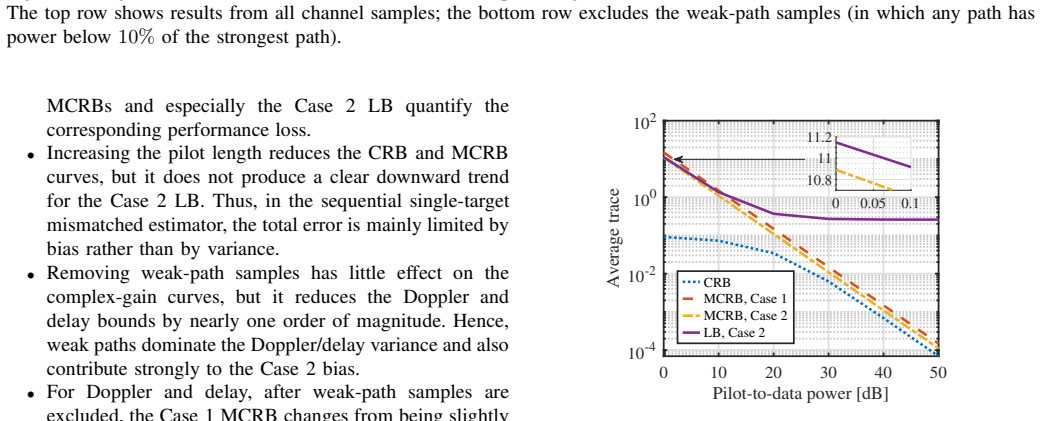
The paper extends the CRB to a general observation model that treats data symbols as unknown. It identifies covariance mismatch caused by insufficient pilot-data isolation and combined covariance-and-mean mismatch caused by sequential single-target estimation, derives the corresponding MCRB, characterizes the pseudotrue parameters under different prior knowledge levels, analyzes the resulting estimation bias, and establishes a lower bound on the MSE. Simulations validate the derived bounds and show that under model misspecification the CRB is overly optimistic while the MCRB and LB faithfully characterize the achievable accuracy, with the bounds varying according to pilot length and pilot po
What carries the argument
The misspecified Cramér-Rao bound (MCRB) applied to the covariance mismatch from pilot-data coupling and the combined mismatch from sequential estimation, which quantifies performance degradation when the estimator assumes a model different from the true signal.
If this is right
- The MCRB increases with insufficient pilot-data isolation, reflecting the covariance mismatch term.
- Sequential single-target estimation produces biased estimates whose mean-square error is bounded below by the derived LB.
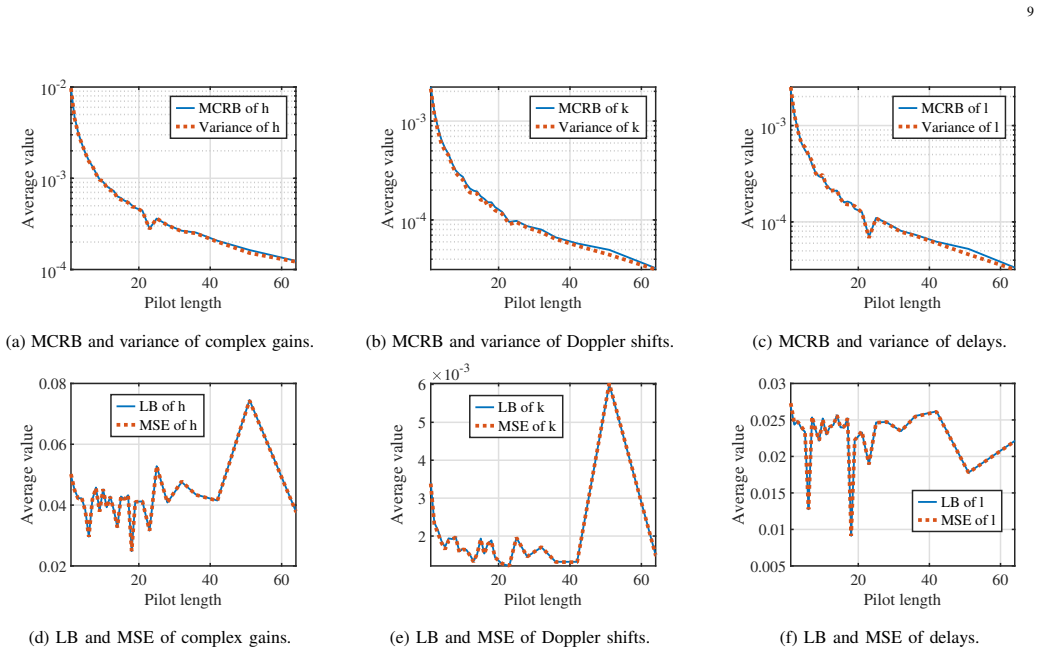
- The MCRB and LB vary with pilot length and power, supplying concrete guidance for pilot configuration.
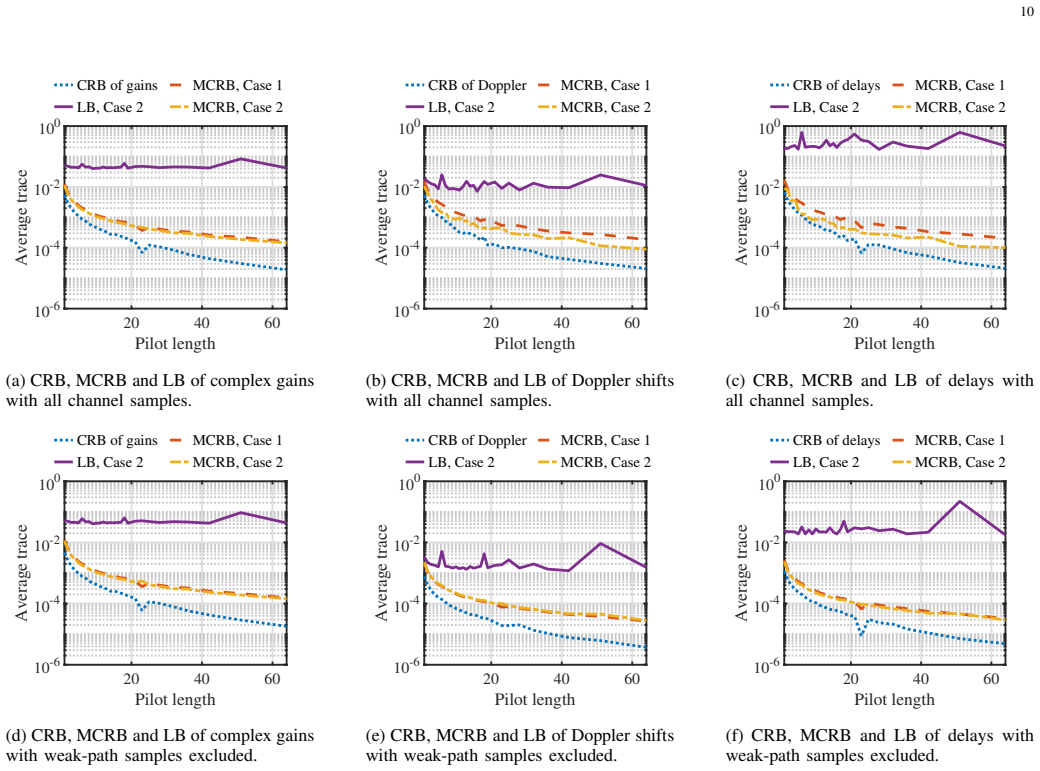
- Under the identified mismatches the standard CRB no longer upper-bounds the achievable accuracy while the MCRB and LB do.
Where Pith is reading between the lines
- The same mismatch framework could be applied to joint multi-target estimation to reduce the combined-mismatch term.
- Hardware measurements with varying data-to-pilot power ratios could test whether the predicted dependence of error on pilot settings holds in practice.
- The analysis supplies a quantitative tool for trading communication rate against sensing accuracy when full data isolation is unavailable.
- Similar covariance and mean mismatch effects are likely to appear in other multicarrier ISAC waveforms that embed pilots inside data symbols.
Load-bearing premise
The two identified sources of misspecification dominate over other possible deviations from the true signal model in practical AFDM-ISAC operation.
What would settle it
Measurements of actual mean-square error for parameter estimates in an AFDM-ISAC setup with controlled pilot-data interference and sequential single-target processing that align with the standard CRB instead of the derived MCRB would falsify the claim.
Figures
read the original abstract
Affine frequency division multiplexing (AFDM) is a promising waveform for integrated sensing and communication (ISAC). In AFDM systems, the complex gains, delays, and Doppler shifts are commonly estimated from the AFDM symbols carrying pilots and data simultaneously. In practice, however, the unknown data symbols and data-pilot coupling interference may render the estimator mismatched to the true signal model. In this paper, we systematically characterize the parameter-estimation performance of AFDM-ISAC systems under practical model misspecification. The main contributions are threefold. First, we extend the Cram\'er-Rao bound (CRB) for a general observation model that treats the data symbols as unknown, which generalizes existing AFDM CRB analyses and serves as the matched benchmark for the subsequent analysis. Second, we identify two practical sources of misspecification, namely a covariance mismatch caused by insufficient pilot-data isolation and a combined covariance-and-mean mismatch caused by sequential single-target estimation, and derive the corresponding misspecified CRB (MCRB). Third, we characterize the pseudotrue parameters under different levels of prior knowledge, analyze the resulting estimation bias, and establish a lower bound (LB) on the mean square error (MSE). Simulation results validate the derived bounds and show that, under model misspecification, the CRB is overly optimistic while the MCRB and LB faithfully characterize the achievable accuracy. The comparison further reveals how these bounds vary with the pilot length and pilot power, providing useful guidance for pilot configuration.
Editorial analysis
A structured set of objections, weighed in public.
Referee Report
Summary. The manuscript extends the Cramér-Rao bound (CRB) to a general observation model for AFDM-ISAC parameter estimation that treats data symbols as unknown. It identifies two practical misspecifications (covariance mismatch from insufficient pilot-data isolation and combined mean-covariance mismatch from sequential single-target estimation), derives the corresponding misspecified CRB (MCRB), analyzes pseudotrue parameters and resulting bias under varying prior knowledge, establishes a lower bound (LB) on MSE, and presents simulations showing that the CRB is overly optimistic under misspecification while the MCRB and LB track achievable accuracy, with further comparison of dependence on pilot length and power.
Significance. If the derivations and simulation validation hold, the work supplies practically relevant performance bounds for AFDM-ISAC systems that account for realistic model mismatches arising from unknown data symbols and sequential processing. This extends misspecified estimation theory to the AFDM waveform and yields concrete guidance on pilot configuration, strengthening the link between theoretical bounds and system design.
Simulated Author's Rebuttal
We thank the referee for the thorough and positive review of our manuscript, including the accurate summary of our contributions on extending the CRB to account for model misspecification in AFDM-ISAC systems, deriving the MCRB and MSE lower bound, and providing simulation validation. We are pleased that the referee recognizes the practical relevance for pilot configuration and system design, and we appreciate the recommendation to accept.
Circularity Check
No significant circularity; derivations are standard extensions of CRB/MCRB
full rationale
The paper applies the standard definitions of the Cramér-Rao bound and misspecified CRB to an AFDM observation model that treats data symbols as unknown, then identifies two specific mismatch sources (covariance mismatch and combined mean-covariance mismatch) and derives the corresponding bounds plus a lower bound on MSE. These steps follow directly from the statistical definitions without any reduction of a claimed prediction to a fitted parameter by construction, without load-bearing self-citations, and without smuggling an ansatz. Simulations are presented only as validation of the derived expressions against achievable accuracy, not as the source of the expressions themselves. The derivation chain is therefore self-contained against external statistical benchmarks.
Axiom & Free-Parameter Ledger
Reference graph
Works this paper leans on
-
[1]
Joint radar and communication design: Applications, state-of-t he-art, and the road ahead,
F. Liu, C. Masouros, A. P . Petropulu, H. Griffiths, and L. H anzo, “Joint radar and communication design: Applications, state-of-t he-art, and the road ahead,” IEEE Trans. Commun., vol. 68, no. 6, pp. 3834–3862, 2020
2020
-
[2]
Self-interference-resista nt IEEE 802.11ad- based joint communication and automotive radar design,
A. Tang, S. Li, and X. Wang, “Self-interference-resista nt IEEE 802.11ad- based joint communication and automotive radar design,” IEEE J. Sel. Topics Signal Process. , vol. 15, no. 6, pp. 1484–1499, 2021
2021
-
[3]
A survey on fundamental limits of integrated sensing and communicat ion,
A. Liu, Z. Huang, M. Li, Y . Wan, W. Li, T. X. Han, C. Liu, R. Du , D. K. P . Tan, J. Lu, Y . Shen, F. Colone, and K. Chetty, “A survey on fundamental limits of integrated sensing and communicat ion,” IEEE Commun. Surveys Tuts. , vol. 24, no. 2, pp. 994–1034, 2022
2022
-
[4]
Integrated sensing and communications: Toward dual-func tional wire- less networks for 6G and beyond,
F. Liu, Y . Cui, C. Masouros, J. Xu, T. X. Han, Y . C. Eldar, an d S. Buzzi, “Integrated sensing and communications: Toward dual-func tional wire- less networks for 6G and beyond,” IEEE J. Sel. Areas Commun. , vol. 40, no. 6, pp. 1728–1767, 2022
2022
-
[5]
Integrated sen sing and communications with affine frequency division multiplexin g,
A. Bemani, N. Ksairi, and M. Kountouris, “Integrated sen sing and communications with affine frequency division multiplexin g,” IEEE Wireless Commun. Lett. , vol. 13, no. 5, pp. 1255–1259, 2024
2024
-
[6]
Interfe rence can- cellation and iterative detection for orthogonal time freq uency space modulation,
P . Raviteja, K. T. Phan, Y . Hong, and E. Viterbo, “Interfe rence can- cellation and iterative detection for orthogonal time freq uency space modulation,” IEEE Trans. Wireless Commun., vol. 17, no. 10, pp. 6501– 6515, 2018
2018
-
[7]
Orthogonal chirp division multip lexing,
X. Ouyang and J. Zhao, “Orthogonal chirp division multip lexing,” IEEE Trans. Commun., vol. 64, no. 9, pp. 3946–3957, 2016
2016
-
[8]
Affine frequenc y division multiplexing for next generation wireless communications ,
A. Bemani, N. Ksairi, and M. Kountouris, “Affine frequenc y division multiplexing for next generation wireless communications ,” IEEE Trans. Wireless Commun., vol. 22, no. 11, pp. 8214–8229, Mar. 2023
2023
-
[9]
AFDM-SCMA: A promising waveform for massive connectivity over high mobility channels,
Q. Luo, P . Xiao, Z. Liu, Z. Wan, N. Thomos, Z. Gao, and Z. He, “AFDM-SCMA: A promising waveform for massive connectivity over high mobility channels,” IEEE Trans. Wireless Commun., vol. 23, no. 10, pp. 14 421–14 436, 2024
2024
-
[10]
Towards standardizing Affine Frequency Division Multiplexing (AFDM) for future wireless networks,
Q. Luo, L. Xiao, P . Xiao, Z. Liu, Y . Xu, Q. Peng, Z. Sui, H. W . Kim, and H. Arslan, “Towards standardizing Affine Frequency Division Multiplexing (AFDM) for future wireless networks,” 2026. [ Online]. Available: https://arxiv.org/abs/2606.13416
Pith/arXiv arXiv 2026
-
[11]
Q. Luo, Z. Sui, T. Ma, Q. Peng, Z. Liu, Y . Xu, P . Xiao, Y . L. Guan, H. Arslan, and G. K. Karagiannidis, “Chirp-based OCDM and AFDM waveforms for 6G and beyond: Principles, recent advances, and future opportunities,” 2026. [Online ]. Available: https://doi.org/10.22541/au.177145233.37871971/v1
-
[12]
Diagonally reconstructed channel estimation for MIMO-AFDM with inter-doppler interference in doubly selective channels,
H. Yin, X. Wei, Y . Tang, and K. Y ang, “Diagonally reconstructed channel estimation for MIMO-AFDM with inter-doppler interference in doubly selective channels,” IEEE Trans. Wireless Commun. , vol. 23, no. 10, pp. 14 066–14 079, Jun. 2024
2024
-
[13]
Channel es timation for AFDM with superimposed pilots,
K. Zheng, M. Wen, T. Mao, L. Xiao, and Z. Wang, “Channel es timation for AFDM with superimposed pilots,” IEEE Trans. V eh. Technol. , vol. 74, no. 2, pp. 3389–3394, 2025
2025
-
[14]
Iterative channel esti mation for AFDM with high spectral efficiency,
T. Ma, Y . Xu, D. He, and W. Zhang, “Iterative channel esti mation for AFDM with high spectral efficiency,” in Proc. 2025 IEEE/CIC Int. Conf. Commun. China (ICCC W orkshops) , 2025, pp. 1–6
2025
-
[15]
Mod els, methods, and waveforms for estimation and prediction of spa rse time- varying channels,
W. Benzine, A. Bemani, N. Ksairi, and D. T. M. Slock, “Mod els, methods, and waveforms for estimation and prediction of spa rse time- varying channels,” IEEE Trans. Wireless Commun. , vol. 25, pp. 9623– 9638, 2026
2026
-
[16]
An integrat ed sensing and communications system based on affine frequency division multiplexing,
Y . Ni, P . Y uan, Q. Huang, F. Liu, and Z. Wang, “An integrat ed sensing and communications system based on affine frequency division multiplexing,” IEEE Trans. Wireless Commun., vol. 24, no. 5, pp. 3763– 3779, 2025
2025
-
[17]
A novel angle- delay-doppler estimation scheme for AFDM-ISAC system in mi xed near-field and far-field scenarios,
Y . Luo, Y . L. Guan, Y . Ge, D. Gonz´ alez G, and C. Y uen, “A novel angle- delay-doppler estimation scheme for AFDM-ISAC system in mi xed near-field and far-field scenarios,” IEEE Internet Things J. , vol. 12, no. 13, pp. 22 669–22 682, 2025
2025
-
[18]
Performance tra de- off between communication and sensing based on AFDM paramet er adjustment,
H. Bao, H. Zhuang, Z. Wang, and G. Pang, “Performance tra de- off between communication and sensing based on AFDM paramet er adjustment,” in Proc. 2024 IEEE 35th Int. Symp. Pers., Indoor Mobile Radio Commun. (PIMRC) , 2024, pp. 1–6
2024
-
[19]
Agile affine frequency division mult iplexing,
Y . Cao and Y . Shao, “Agile affine frequency division mult iplexing,”
-
[20]
Available: https://arxiv.org/abs/2512
[Online]. Available: https://arxiv.org/abs/2512. 14424
-
[21]
Estimation of signal parameters in the pre sence of noise,
D. Slepian, “Estimation of signal parameters in the pre sence of noise,” Trans. IRE Prof. Group Inf. Theory , vol. 3, no. 3, pp. 68–89, 1954
1954
-
[22]
Array processing with generalized beam-f ormers,
W. J. Bangs, “Array processing with generalized beam-f ormers,” Ph.D. dissertation, Y ale University, New Haven, CT, USA, 1971
1971
-
[23]
Device-free localiza tion in ISAC networks: Performance limits and fisher information-based cooperative localization,
Z.-J. Wang, A. Tang, and X. Wang, “Device-free localiza tion in ISAC networks: Performance limits and fisher information-based cooperative localization,” IEEE J. Sel. Areas Commun. , vol. 44, pp. 626–641, 2026
2026
-
[24]
Optimized waveform design for OFDM-based ISAC systems und er limited resource occupancy,
S. Mura, D. Tagliaferri, M. Mizmizi, U. Spagnolini, and A. P . Petropulu, “Optimized waveform design for OFDM-based ISAC systems und er limited resource occupancy,” IEEE Trans. Wireless Commun. , vol. 24, no. 6, pp. 5241–5254, 2025
2025
-
[25]
Carrier aggregation enabled MIMO-OFDM integrated sensing and communication,
H. Liu, Z. Wei, J. Piao, H. Wu, X. Li, and Z. Feng, “Carrier aggregation enabled MIMO-OFDM integrated sensing and communication,” IEEE Trans. Wireless Commun. , vol. 24, no. 6, pp. 4532–4548, 2025
2025
-
[26]
Data-aided bistatic sensing and communication for mmWave MIMO-OFDM IS AC systems,
A. Gupta, P . Ganji, S. Srivastava, and A. K. Jagannatham , “Data-aided bistatic sensing and communication for mmWave MIMO-OFDM IS AC systems,” IEEE Trans. Commun. , vol. 73, no. 10, pp. 9720–9734, 2025
2025
-
[27]
AFDM-enabled integrated sensing and communication: Theoretical framework and pilot design ,
F. Zhang, Z. Wang, T. Mao, T. Jiao, Y . Zhuo, M. Wen, W. Xian g, S. Chen, and G. K. Karagiannidis, “AFDM-enabled integrated sensing and communication: Theoretical framework and pilot design ,” IEEE J. Sel. Areas Commun. , vol. 44, pp. 310–324, 2026
2026
-
[28]
AFDM for LEO inter-satellite links : Path-level CSI prediction and CRLB-guided pre-equalization,
H. Wang and O. Akan, “AFDM for LEO inter-satellite links : Path-level CSI prediction and CRLB-guided pre-equalization,” 2025. [ Online]. Available: https://arxiv.org/abs/2601.00819
arXiv 2025
-
[29]
Matched filtering-bas ed channel estimation for AFDM systems in doubly selective channels,
X. Li, Z. Liu, Z. Zhou, and P . Fan, “Matched filtering-bas ed channel estimation for AFDM systems in doubly selective channels,” 2026. [Online]. Available: https://arxiv.org/abs/2507.09268
arXiv 2026
-
[30]
Cram´ er-Rao bounds for misspecified model s,
Q. H. Vuong, “Cram´ er-Rao bounds for misspecified model s,” Oct
-
[31]
Available: https://doi.org/10.7907/7j7 ke-zja80
[Online]. Available: https://doi.org/10.7907/7j7 ke-zja80
-
[32]
Parameter bounds on e stimation accuracy under model misspecification,
C. D. Richmond and L. L. Horowitz, “Parameter bounds on e stimation accuracy under model misspecification,” IEEE Trans. Signal Process. , vol. 63, no. 9, pp. 2263–2278, 2015
2015
-
[33]
P erformance bounds for parameter estimation under misspecified models: Fundamen- tal findings and applications,
S. Fortunati, F. Gini, M. S. Greco, and C. D. Richmond, “P erformance bounds for parameter estimation under misspecified models: Fundamen- tal findings and applications,” IEEE Signal Process. Mag. , vol. 34, no. 6, pp. 142–157, 2017
2017
-
[34]
On OFDM ranging performance degradation in multipath scenarios: B ias and mis- specified Cram´ er-Rao bounds,
L. A. Navarro, C. C. J. M. Tiberius, and G. J. M. Janssen, “ On OFDM ranging performance degradation in multipath scenarios: B ias and mis- specified Cram´ er-Rao bounds,” IEEE Access, vol. 14, pp. 70 581–70 599, 2026
2026
-
[35]
Modelin g and analysis of OFDM-based 5G/6G localization under hardware i mpair- ments,
H. Chen, M. F. Keskin, S. R. Aghdam, H. Kim, S. Lindberg, A . Wolf- gang, T. E. Abrudan, T. Eriksson, and H. Wymeersch, “Modelin g and analysis of OFDM-based 5G/6G localization under hardware i mpair- ments,” IEEE Trans. Wireless Commun. , vol. 23, no. 7, pp. 7319–7333, 2024
2024
-
[36]
Near-field RIS-aided localiz ation under deliberate model misspecification: Bounds and algori thms,
B. Sun, M. F. Keskin, A. Pourafzal, H. Chen, M. Rahal, J. T alvitie, H. Wymeersch, and M. V alkama, “Near-field RIS-aided localiz ation under deliberate model misspecification: Bounds and algori thms,” IEEE Trans. Wireless Commun. , vol. 25, pp. 13 945–13 961, 2026
2026
-
[37]
MCRB on DOA estimation for automotive MIMO radar in the presence of multipath,
M. Levy-Israel, I. Bilik, and J. Tabrikian, “MCRB on DOA estimation for automotive MIMO radar in the presence of multipath,” IEEE Trans. Aerosp. Electron. Syst. , vol. 59, no. 5, pp. 4831–4843, 2023
2023
-
[38]
Misspecifi ed Cramer– Rao bounds for blind channel estimation under channel order misspec- ification,
L. T. Thanh, K. Abed-Meraim, and N. L. Trung, “Misspecifi ed Cramer– Rao bounds for blind channel estimation under channel order misspec- ification,” IEEE Trans. Signal Process. , vol. 69, pp. 5372–5385, 2021
2021
discussion (0)
Sign in with ORCID, Apple, or X to comment. Anyone can read and Pith papers without signing in.