Study for curvature radiation and magnetic pair creation process on polar-cap region of magnetic white dwarf
Pith reviewed 2026-06-25 20:19 UTC · model grok-4.3
The pith
Pair creation in magnetic white dwarfs occurs only for spin periods shorter than about 100 seconds when dipole fields are below 10^10 gauss.
A machine-rendered reading of the paper's core claim, the machinery that carries it, and where it could break.
Core claim
Within the space-charge-limited flow framework, pair creation via curvature photons occurs for spin periods P less than or equal to 100 seconds when the dipole field is less than or equal to 10^10 G. Adding a quadrupole component reduces the curvature radius and strengthens the accelerating electric field, making pair creation more efficient. This leads to a death line for white dwarf pulsars that is more restrictive than previous estimates.
What carries the argument
Space-charge-limited flow model applied to curvature radiation and magnetic pair creation processes, evaluated for both dipole and dipole-quadrupole field geometries.
Load-bearing premise
The space-charge-limited flow model, together with the adopted treatment of curvature radiation and magnetic pair creation, remains valid when extrapolated from neutron-star pulsars to white-dwarf parameters and geometries.
What would settle it
Detection of pair-creation signatures or radio pulses from a magnetic white dwarf with spin period longer than 100 seconds and dipole field strength around or above 10^10 G would challenge the result.
Figures
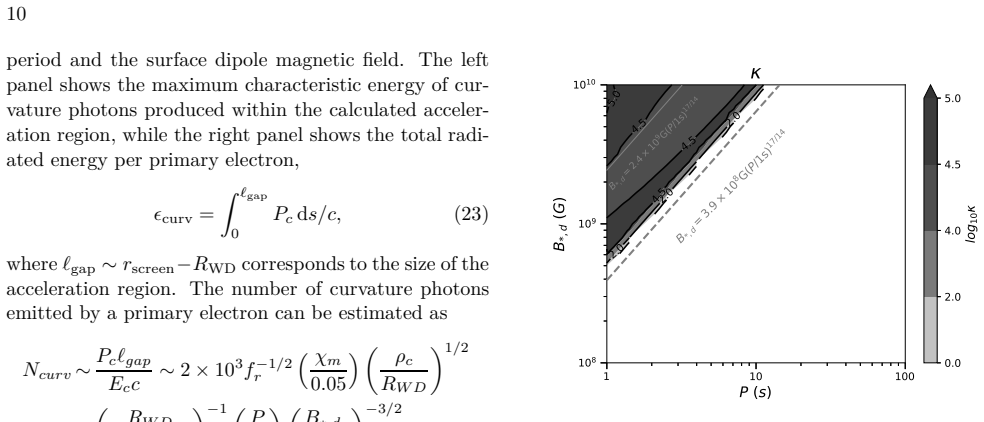
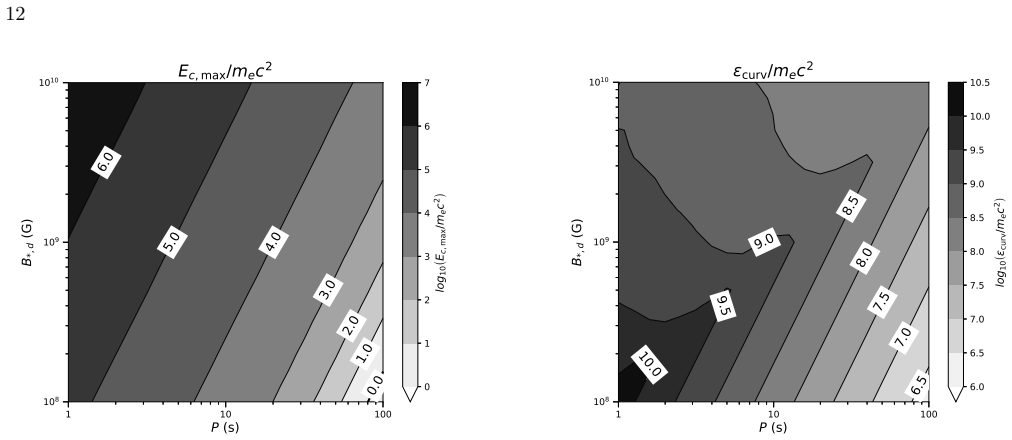
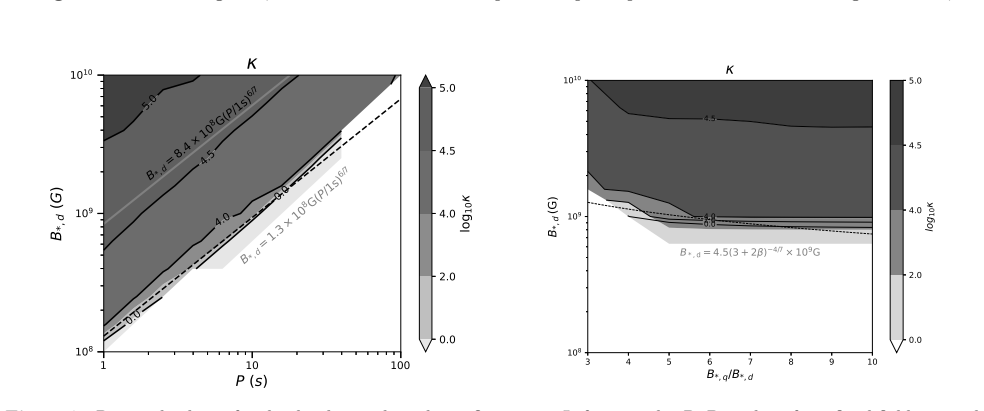
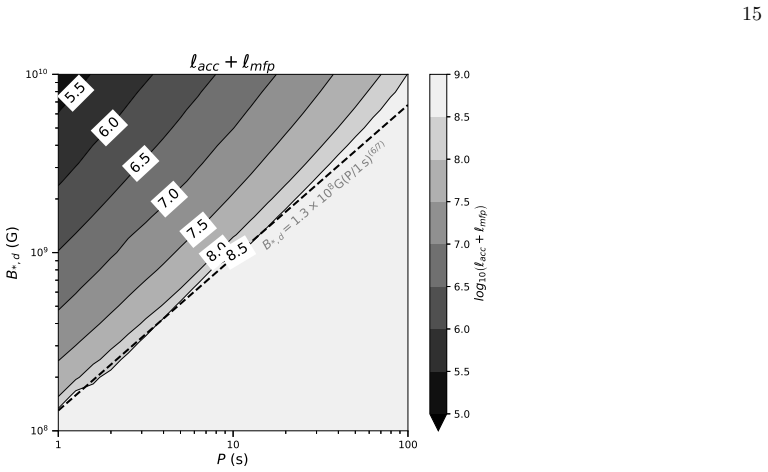
read the original abstract
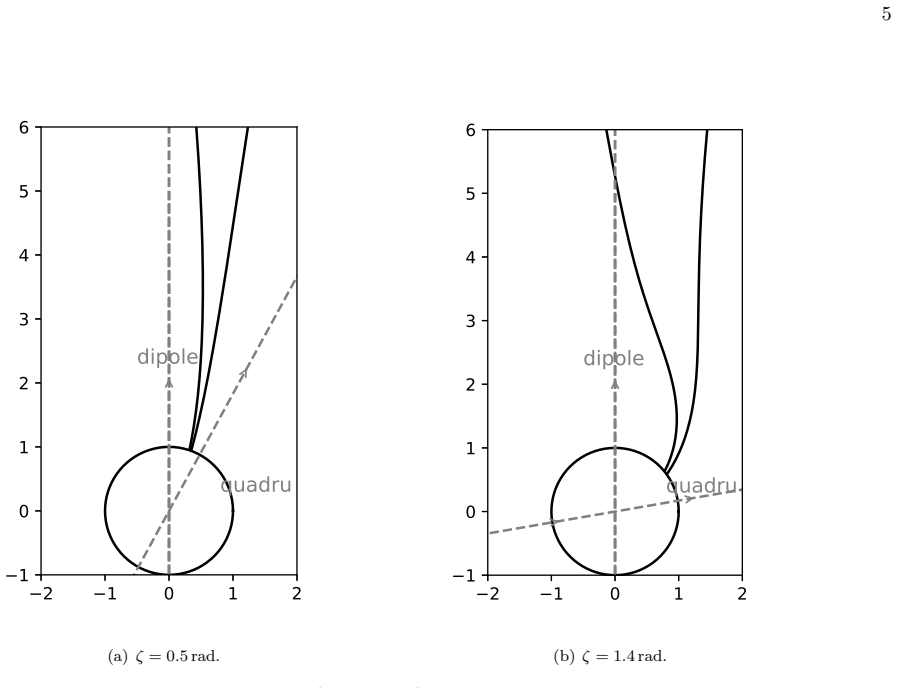
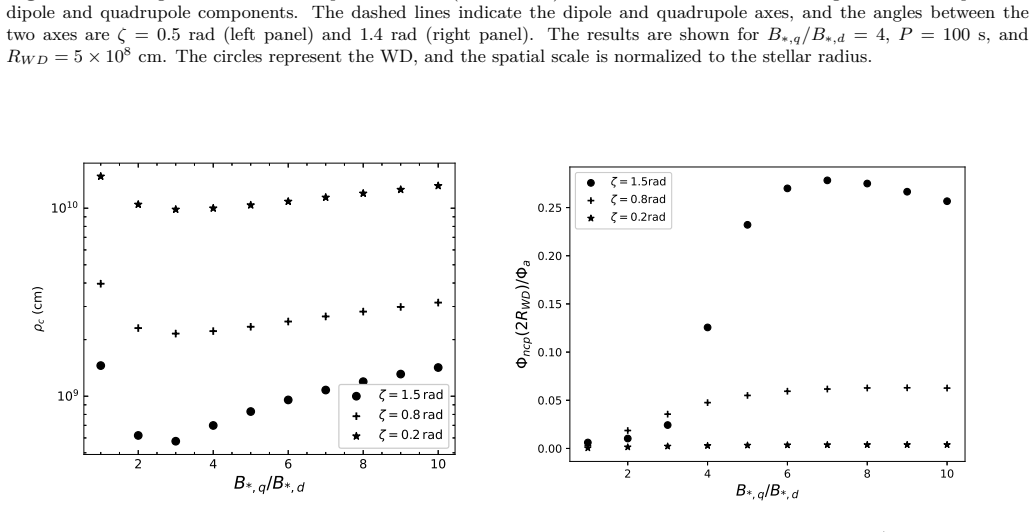
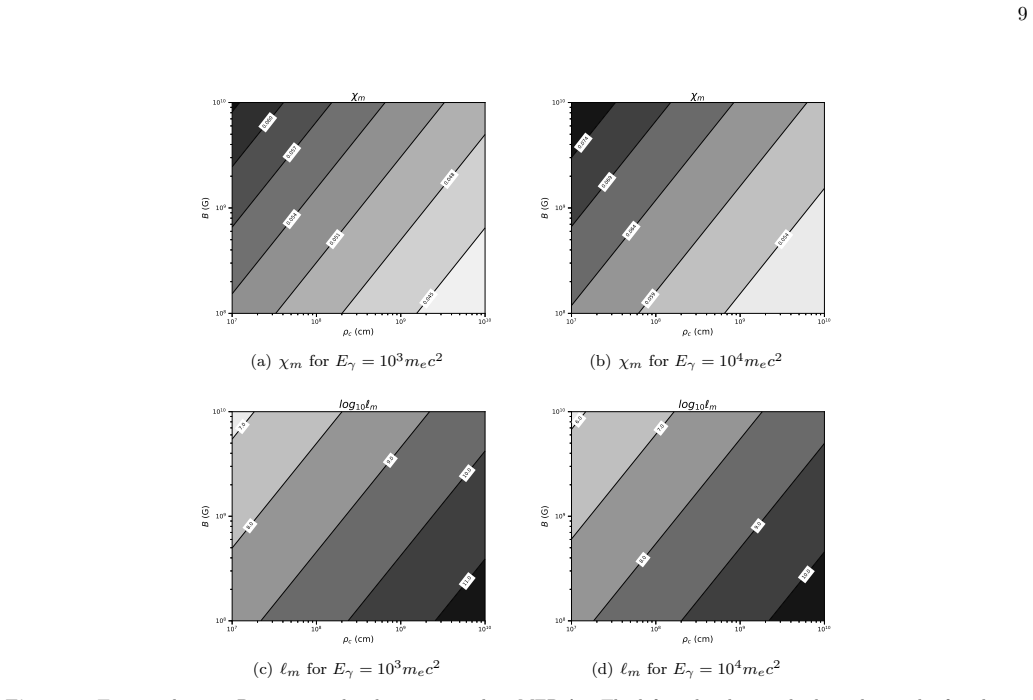
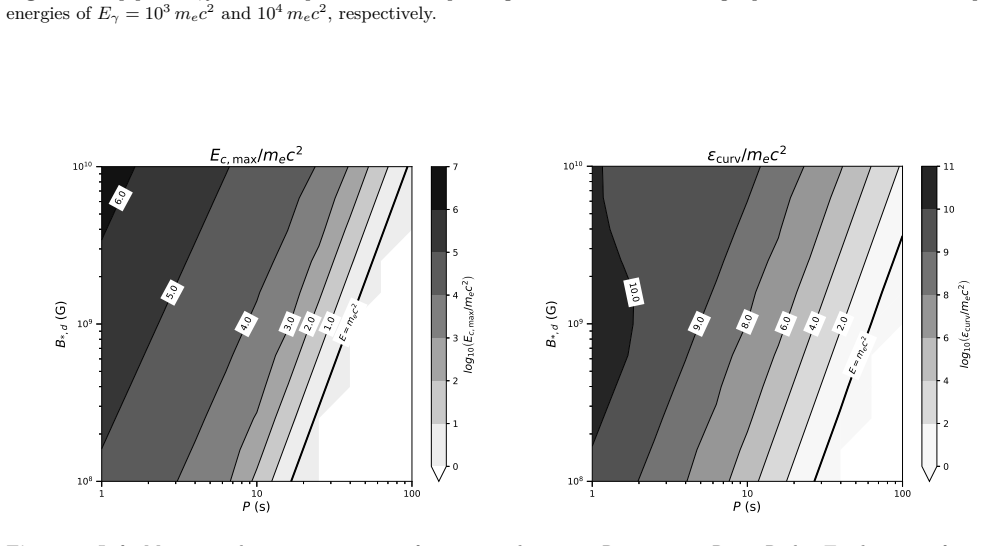
Rapidly rotating, strongly magnetized white dwarfs (WDs) have been proposed as potential sites of rotation-powered activity analogous to that of a neutron star pulsar. In this study, we investigate particle acceleration, radiation processes, pair creation and resulting synchrotron radiation in the polar cap acceleration region. Within the framework of the space-charge-limited flow model, we examine how these processes depend on the spin period and surface magnetic field using both one-dimensional numerical calculations and analytical estimates. To explore the impact of the magnetic field geometry on the accelerating process, we consider both a pure dipole field and a combination of dipole and quadrupole fields. The inclusion of a quadrupole component reduces the curvature radius of the magnetic field lines, and significantly enhances the accelerating field, leading to more efficient radiation and pair creation processes. Using this framework, we evaluate the WD death line with a more consistent treatment of the relevant physical processes than the previous studies. We find that the pair creation process can occur for spin periods $P\lesssim100$~s, when the dipole field strength $B_{*,d}\lesssim10^{10}$~G, indicating that pair creation is difficult to sustain in currently known magnetic WDs. We discuss the implications of our model for rotation-powered activity in rapidly spinning isolated magnetic WDs and for the possible WD interpretation of long-period radio transients.
Editorial analysis
A structured set of objections, weighed in public.
Referee Report
Summary. The manuscript investigates curvature radiation and magnetic pair creation in the polar-cap region of magnetic white dwarfs using the space-charge-limited flow (SCLF) model. It performs one-dimensional numerical calculations and analytical estimates for both pure dipole and dipole-plus-quadrupole field geometries, derives the conditions for efficient pair production, and locates a death line in the P–B plane, concluding that pair creation occurs only for P ≲ 100 s when B_{*,d} ≲ 10^{10} G.
Significance. If the SCLF framework and its numerical implementation remain valid when extrapolated from neutron-star to white-dwarf radii and field strengths, the work supplies a more self-consistent treatment of the death line than earlier studies and would imply that rotation-powered pair cascades are difficult to sustain in observed magnetic white dwarfs, with direct implications for the WD interpretation of long-period radio transients.
major comments (3)
- [Abstract] The central death-line result (abstract) is obtained from the same 1D SCLF numerical scheme whose free parameters (quadrupole amplitude, accelerating-field normalization) are adjusted to produce the reported P ≲ 100 s threshold; no independent external benchmark or observational constraint is supplied to break the circularity.
- [Abstract] No consistency check is reported in which the identical numerical scheme and analytic approximations for curvature radiation and magnetic pair production are applied to canonical neutron-star parameters (P ~ 1 s, B ~ 10^{12} G, R ~ 10^6 cm) to recover the known pulsar death line to within a factor of ~2; without this test the extrapolation to white-dwarf scales (R ~ 10^9 cm, B ~ 10^8–10^{10} G) carries an uncontrolled systematic uncertainty in the accelerating field, curvature radius, and pair-production optical depth.
- [Abstract] The abstract states that the calculations are one-dimensional and supplies no error bars, convergence tests with respect to grid resolution or integration tolerances, or explicit validation of the pair-creation threshold against known analytic limits.
minor comments (1)
- Notation for the quadrupole field component amplitude should be defined explicitly when first introduced rather than left implicit in the description of field geometry.
Simulated Author's Rebuttal
We thank the referee for the thorough review and valuable comments on our manuscript. We address each of the major comments point by point below, providing clarifications and indicating where revisions will be made to improve the presentation.
read point-by-point responses
-
Referee: [Abstract] The central death-line result (abstract) is obtained from the same 1D SCLF numerical scheme whose free parameters (quadrupole amplitude, accelerating-field normalization) are adjusted to produce the reported P ≲ 100 s threshold; no independent external benchmark or observational constraint is supplied to break the circularity.
Authors: The quadrupole component amplitude and the normalization of the accelerating field are indeed model parameters within the SCLF framework. These are selected based on physical motivations from neutron star studies and to investigate the effects of multipolar fields, rather than tuned specifically to achieve the P ≲ 100 s result. The death line emerges from the computed pair-creation threshold for those parameters. Nevertheless, we recognize the value of demonstrating robustness and will revise the manuscript to include a sensitivity analysis on these parameters and update the abstract to better describe the parameter selection process. revision: yes
-
Referee: [Abstract] No consistency check is reported in which the identical numerical scheme and analytic approximations for curvature radiation and magnetic pair production are applied to canonical neutron-star parameters (P ~ 1 s, B ~ 10^{12} G, R ~ 10^6 cm) to recover the known pulsar death line to within a factor of ~2; without this test the extrapolation to white-dwarf scales (R ~ 10^9 cm, B ~ 10^8–10^{10} G) carries an uncontrolled systematic uncertainty in the accelerating field, curvature radius, and pair-production optical depth.
Authors: We agree that performing a consistency check by applying the same numerical scheme to standard neutron star parameters would help validate the extrapolation and quantify systematic uncertainties. Although the underlying SCLF model and radiation processes are drawn from established pulsar literature, we did not include such a benchmark in the current work. We will incorporate this test in the revised version, applying the code to canonical pulsar values and comparing to the known death line. revision: yes
-
Referee: [Abstract] The abstract states that the calculations are one-dimensional and supplies no error bars, convergence tests with respect to grid resolution or integration tolerances, or explicit validation of the pair-creation threshold against known analytic limits.
Authors: The manuscript describes one-dimensional calculations, and the abstract reflects this. We acknowledge that explicit convergence tests, error bars, and direct comparisons to analytic pair-creation thresholds are not presented. We will revise the methods section and abstract to include a brief report on numerical convergence and validation against analytic limits where applicable. revision: yes
Circularity Check
No significant circularity; death line is direct numerical output of SCLF model applied to WD parameters
full rationale
The paper solves the space-charge-limited flow equations with curvature radiation and magnetic pair-production thresholds to locate the WD death line in the P–B plane. This is a forward computation from the adopted physical model and geometry (dipole or dipole+quadrupole), not a redefinition of inputs or a parameter fit whose output is then relabeled as a prediction. No load-bearing step reduces to a self-citation whose validity is assumed without external support, nor is any ansatz or uniqueness theorem imported from the authors' prior work. The result follows from integrating the model equations for the stated WD radii, periods and fields; any concern about extrapolation from NS parameters is a question of model applicability rather than circularity in the derivation itself.
Axiom & Free-Parameter Ledger
free parameters (1)
- quadrupole field component amplitude
axioms (1)
- domain assumption Space-charge-limited flow model governs particle acceleration in white-dwarf polar caps
Reference graph
Works this paper leans on
-
[1]
1983, ApJ, 266, 215, doi: 10.1086/160771
Arons, J. 1983, ApJ, 266, 215, doi: 10.1086/160771
-
[2]
2024, PASJ, 76, 702, doi: 10.1093/pasj/psae041
Bamba, A., Terada, Y., Kashiyama, K., et al. 2024, PASJ, 76, 702, doi: 10.1093/pasj/psae041
-
[3]
Barnard, J. J., & Arons, J. 1982, ApJ, 254, 713, doi: 10.1086/159784
-
[4]
2012, Journal of Physics G Nuclear Physics, 39, 065001, doi: 10.1088/0954-3899/39/6/065001
Bednarek, W. 2012, Journal of Physics G Nuclear Physics, 39, 065001, doi: 10.1088/0954-3899/39/6/065001
-
[5]
Beskin, V. S., & Istomin, A. Y. 2022, MNRAS, 516, 5084, doi: 10.1093/mnras/stac2423
-
[6]
Beskin, V. S., & Litvinov, P. E. 2022, MNRAS, 510, 2572, doi: 10.1093/mnras/stab3575
-
[7]
Borges, S. V., Rodrigues, C. V., Coelho, J. G., Malheiro, M., & Castro, M. 2020, The Astrophysical Journal, 895, 26, doi: 10.3847/1538-4357/ab8add
-
[8]
Caiazzo, I., Burdge, K. B., Fuller, J., et al. 2021, Nature, 595, 39, doi: 10.1038/s41586-021-03615-y
-
[9]
2022, Nature Astronomy, 6, 828, doi: 10.1038/s41550-022-01688-x 17
Caleb, M., Heywood, I., Rajwade, K., et al. 2022, Nature Astronomy, 6, 828, doi: 10.1038/s41550-022-01688-x 17
-
[10]
1993, ApJ, 402, 264, doi: 10.1086/172129
Chen, K., & Ruderman, M. 1993, ApJ, 402, 264, doi: 10.1086/172129
-
[11]
2025, MNRAS, 539, 3013, doi: 10.1093/mnras/staf580
Cheng, Y., & Takata, J. 2025, MNRAS, 539, 3013, doi: 10.1093/mnras/staf580
-
[12]
2024, ApJL, 974, L32, doi: 10.3847/2041-8213/ad7e24
Chernoglazov, A., Philippov, A., & Timokhin, A. 2024, ApJL, 974, L32, doi: 10.3847/2041-8213/ad7e24
-
[13]
A., Caiazzo, I., Cunningham, T., et al
Cristea, A. A., Caiazzo, I., Cunningham, T., et al. 2026, A&A, 706, A188, doi: 10.1051/0004-6361/202556432 de Ruiter, I., Rajwade, K. M., Bassa, C. G., et al. 2025, Nature Astronomy, 9, 672, doi: 10.1038/s41550-025-02491-0
-
[14]
2025, arXiv e-prin ts, arXiv:2509.03216, doi: 10.48550/arXiv.2509.03216
Desai, A., Caiazzo, I., Vennes, S., et al. 2025, arXiv e-prin ts, arXiv:2509.03216, doi: 10.48550/arXiv.2509.03216
-
[15]
Dong, F. A., Clarke, T., Curtin, A. P., et al. 2024, arXiv e-prints, arXiv:2407.07480, doi: 10.48550/arXiv.2407.07480
-
[16]
1966, Reviews of Modern Physics, 38, 626, doi: 10.1103/RevModPhys.38.626
Erber, T. 1966, Reviews of Modern Physics, 38, 626, doi: 10.1103/RevModPhys.38.626
-
[17]
Euchner, F., Reinsch, K., Jordan, S., Beuermann, K., & G¨ ansicke, B. T. 2005, A&A, 442, 651, doi: 10.1051/0004-6361:20053038 Garc ´ ıa-Berro, E., Lor´ en-Aguilar, P., Aznar-Sigu´ an, G., et al. 2012, The Astrophysical Journal, 749, 25, doi: 10.1088/0004-637X/749/1/25
-
[18]
Goldreich, P., & Julian, W. H. 1969, ApJ, 157, 869, doi: 10.1086/150119
-
[19]
Harding, A. K. 2002, ApJ, 565, 482, doi: 10.1086/324535
-
[20]
Harding, A. K., & Lai, D. 2006, Reports on Progress in Physics, 69, 2631, doi: 10.1088/0034-4885/69/9/R03
-
[21]
Harding, A. K., & Muslimov, A. G. 2002, ApJ, 568, 862, doi: 10.1086/338985
-
[22]
Hibschman, J. A., & Arons, J. 2001, ApJ, 560, 871, doi: 10.1086/323069
-
[23]
2022, Nature, 601, 526, doi: 10.1038/s41586-021-04272-x
Hurley-Walker, N., Zhang, X., Bahramian, A., et al. 2022, Nature, 601, 526, doi: 10.1038/s41586-021-04272-x
-
[24]
Hurley-Walker, N., Rea, N., McSweeney, S. J., et al. 2023, Nature, 619, 487, doi: 10.1038/s41586-023-06202-5
-
[25]
Ikhsanov, N. R. 1998, A&A, 338, 521
1998
-
[26]
T., Garc ´ ıa-Berro, E., et al
Ji, S., Fisher, R. T., Garc ´ ıa-Berro, E., et al. 2013, ApJ, 77 3, 136, doi: 10.1088/0004-637X/773/2/136
-
[27]
2011, PhRvD, 83, 023002, doi: 10.1103/PhysRevD.83.023002
Kashiyama, K., Ioka, K., & Kawanaka, N. 2011, PhRvD, 83, 023002, doi: 10.1103/PhysRevD.83.023002
-
[28]
Katz, J. I. 2022, Astrophysics and Space Science, 367, 108, doi: 10.1007/s10509-022-04174-2
-
[29]
Keane, E. F. 2018, Nature Astronomy, 2, 865, doi: 10.1038/s41550-018-0603-0
-
[30]
Lee, Y. W. J., Caleb, M., Murphy, T., et al. 2025, Nature Astronomy, 9, 393, doi: 10.1038/s41550-024-02452-z
-
[31]
Malheiro, M., Borges, S. V., Coelho, J. G., et al. 2026, Journal of High Energy Astrophysics, 53, 100593, doi: 10.1016/j.jheap.2026.100593
-
[32]
Marsh, T. R., G¨ ansicke, B. T., H¨ ummerich, S., et al. 2016, Nature, 537, 374, doi: 10.1038/nature18620
-
[33]
Martin, B., & Wickramasinghe, D. T. 1984, MNRAS, 206, 407, doi: 10.1093/mnras/206.2.407
-
[34]
Muslimov, A., & Harding, A. K. 1997, ApJ, 485, 735, doi: 10.1086/304457
-
[35]
2024, A&A, 691, A179, doi: 10.1051/0004-6361/202451352
Pakmor, R., Pelisoli, I., Justham, S., et al. 2024, A&A, 691, A179, doi: 10.1051/0004-6361/202451352
-
[36]
Pelisoli, I., Marsh, T. R., Buckley, D. A. H., et al. 2023, Nature Astronomy, 7, 931, doi: 10.1038/s41550-023-01995-x
-
[37]
2026, arXiv e-prints, arXiv:2601.10393, doi: 10.48550/arXiv.2601.10393
Rea, N., Hurley-Walker, N., & Caleb, M. 2026, arXiv e-prints, arXiv:2601.10393, doi: 10.48550/arXiv.2601.10393
-
[38]
2024, ApJ, 961, 214, doi: 10.3847/1538-4357/ad165d
Rea, N., Hurley-Walker, N., Pardo-Araujo, C., et al. 2024, ApJ, 961, 214, doi: 10.3847/1538-4357/ad165d
-
[39]
Rodriguez, A. C. 2025, A&A, 695, L8, doi: 10.1051/0004-6361/202553684
-
[40]
Periodic Radio and X-ray Emission from an Accreting White Dwarf Binary
Rose, K., Pritchard, J., Murphy, T., et al. 2026, arXiv e-prints, arXiv:2606.04232, doi: 10.48550/arXiv.2606.04232
work page internal anchor Pith review Pith/arXiv arXiv doi:10.48550/arxiv.2606.04232 2026
-
[41]
Ruderman, M. A., & Sutherland, P. G. 1975, ApJ, 196, 51, doi: 10.1086/153393
-
[42]
B., & Lightman, A
Rybicki, G. B., & Lightman, A. P. 1979, Radiative Processes in Astrophysics (New York: Wiley)
1979
-
[43]
Scharlemann, E. T., Arons, J., & Fawley, W. M. 1978, ApJ, 222, 297, doi: 10.1086/156144
-
[44]
Sousa, M. F., Coelho, J. G., de Araujo, J. C. N., Guidorzi, C., & Rueda, J. A. 2023, ApJ, 958, 134, doi: 10.3847/1538-4357/ad022f
-
[45]
Sturrock, P. A. 1971, ApJ, 164, 529, doi: 10.1086/150865
-
[46]
Takata, J., Hu, C. P., Lin, L. C. C., et al. 2018, ApJ, 853, 106, doi: 10.3847/1538-4357/aaa23d
-
[47]
Takata, J., Yang, H., & Cheng, K. S. 2017, ApJ, 851, 143, doi: 10.3847/1538-4357/aa9b33
-
[48]
Tan, C. M., Bassa, C. G., Cooper, S., et al. 2018, ApJ, 866, 54, doi: 10.3847/1538-4357/aade88
-
[49]
Timokhin, A. N., & Harding, A. K. 2015, ApJ, 810, 144, doi: 10.1088/0004-637X/810/2/144
-
[50]
Usov, V. V. 1988, Soviet Astronomy Letters, 14, 258
1988
-
[51]
Usov, V. V. 2002, in Neutron Stars, Pulsars, and Supernova Remnants, ed. W. Becker, H. Lesch, & J. Tr¨ umper, 240, doi: 10.48550/arXiv.astro-ph/0204402
work page internal anchor Pith review Pith/arXiv arXiv doi:10.48550/arxiv.astro-ph/0204402 2002
-
[52]
Valyavin, G., Wade, G. A., Bagnulo, S., et al. 2008, ApJ, 683, 466, doi: 10.1086/589234
-
[53]
Vennes, S., Schmidt, G. D., Ferrario, L., et al. 2003, ApJ, 593, 1040, doi: 10.1086/376728 18
-
[54]
Zhang, B., & Qiao, G. J. 1996, A&A, 310, 135
1996
-
[55]
Zhu, C., Pakmor, R., van Kerkwijk, M. H., & Chang, P. 2015, ApJL, 806, L1, doi: 10.1088/2041-8205/806/1/L1
discussion (0)
Sign in with ORCID, Apple, or X to comment. Anyone can read and Pith papers without signing in.