REVIEW 2 major objections 32 references
Multi-fidelity methods for kinetic models of epidemic dynamics with uncertain contact structure
T0 review · 2 major / 0 minor · reviewed 2026-06-25 · grok-4.3
Pith's one-line read A multi-fidelity framework pairs high-fidelity kinetic solvers with low-fidelity surrogates to enable efficient uncertainty quantification in epidemic models with uncertain contact structures.
desk verdict The paper sets up a multi-fidelity hierarchy with projection reconstruction for kinetic epidemic models under uncertain contacts, but the central claim rests on an untested assumption that the low-fidelity surrogates preserve enough structure for reliable sample selection. read the letter →
The pith
A machine-rendered reading of the paper's core claim, the machinery that carries it, and where it could break.
The reading
What carries the argument
The multi-fidelity hierarchy that uses low-fidelity surrogates to identify representative samples from high-dimensional uncertain parameter spaces and applies projection-based reconstruction to recover full kinetic solutions.
What would settle it
A controlled benchmark in which the multi-fidelity statistical estimates of epidemic observables differ substantially from those produced by exhaustive high-fidelity Monte Carlo sampling on the same high-dimensional uncertain contact model would refute the claimed accuracy.
Extended reading notes
Core claim
The central claim is that a hierarchical multi-fidelity framework, combining high-fidelity kinetic solvers with reduced macroscopic models and coarse kinetic descriptions, identifies representative parameter samples and reconstructs full high-fidelity solutions via projection-based techniques, thereby permitting accurate uncertainty propagation at reduced cost even in regimes where macroscopic closure is unavailable.
Load-bearing premise
The low-fidelity surrogates preserve enough of the high-fidelity dynamics to allow reliable identification of representative parameter samples and accurate projection-based reconstruction of full solutions.
Editorial extensions
If this is right
- Accurate statistical estimates of epidemic observables can be obtained in high-dimensional stochastic settings.
- Computational costs are significantly reduced compared to standard single-fidelity approaches.
- The method remains applicable in regimes where a macroscopic closure is unavailable.
- Low-fidelity surrogates suffice for both sample selection and solution reconstruction.
Reading between the lines
- The same sample-selection and projection structure could be applied to other kinetic models that carry high-dimensional parameter uncertainty.
- Adaptive choice of which surrogate level to use at each stage might further reduce cost without loss of accuracy.
- The method suggests a route to hybrid simulations that focus expensive kinetic runs only on the most influential regions of parameter space.
Editorial analysis
A structured set of objections, weighed in public.
Referee Report
Summary. The manuscript develops a multi-fidelity strategy for kinetic models of epidemic dynamics with uncertain contact structures. High-fidelity kinetic solvers are combined with a hierarchy of low-fidelity surrogates (reduced macroscopic models and coarse kinetic descriptions) that remain applicable even without macroscopic closure. The framework identifies representative parameter samples and reconstructs full solutions via projection-based techniques to enable efficient uncertainty propagation. Numerical experiments in high-dimensional stochastic settings are claimed to show that accurate statistical estimates of epidemic observables can be obtained at significantly reduced computational cost relative to standard approaches.
Significance. If the central claim holds, the work provides a practical route to uncertainty quantification for high-dimensional kinetic epidemic models where full high-fidelity sampling is prohibitive. The explicit handling of regimes without closure and the use of projection reconstruction distinguish it from standard multi-fidelity Monte Carlo or polynomial chaos methods. Successful validation would directly support more reliable assessment of heterogeneous contact effects in epidemiology.
major comments (2)
- [Abstract / Numerical experiments section] The abstract states that numerical experiments support the cost-reduction claim, but supplies no error metrics, baseline comparisons, or details on how surrogate accuracy was verified; this leaves the central claim only weakly supported from the available text.
- [Method description (hierarchy of surrogates)] The weakest assumption is that low-fidelity surrogates preserve enough of the high-fidelity dynamics for reliable sample selection and projection reconstruction. No analysis is provided on whether surrogate error correlates with the uncertain contact structure, which would bias identified samples and reconstructed statistics in high-dimensional stochastic regimes.
Simulated Author's Rebuttal
We thank the referee for the constructive feedback. We address the two major comments below and will revise the manuscript accordingly to strengthen the presentation of our results.
read point-by-point responses
-
Referee: [Abstract / Numerical experiments section] The abstract states that numerical experiments support the cost-reduction claim, but supplies no error metrics, baseline comparisons, or details on how surrogate accuracy was verified; this leaves the central claim only weakly supported from the available text.
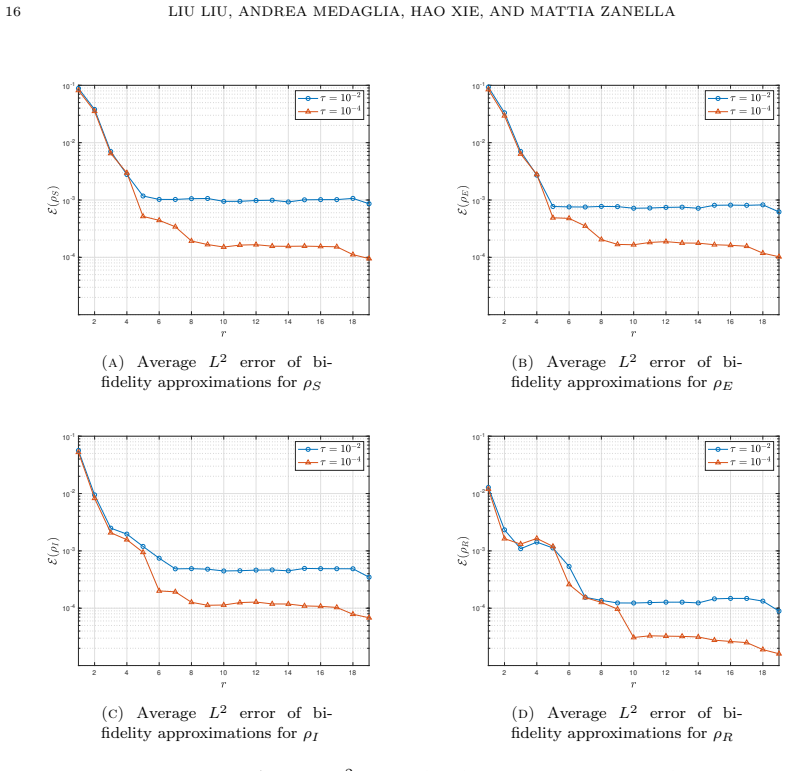
Authors: We agree that the abstract would benefit from explicit quantitative support. The full manuscript (Section 4) already contains error metrics (relative L2 errors on means and variances), direct comparisons against standard Monte Carlo and single-fidelity polynomial chaos baselines, and verification of surrogate accuracy via pointwise comparisons with high-fidelity kinetic solutions. To make this evidence immediately visible, we will revise the abstract to report the observed error levels (typically below 3%) and computational speed-ups (factors of 8–12) obtained in the high-dimensional test cases. revision: yes
-
Referee: [Method description (hierarchy of surrogates)] The weakest assumption is that low-fidelity surrogates preserve enough of the high-fidelity dynamics for reliable sample selection and projection reconstruction. No analysis is provided on whether surrogate error correlates with the uncertain contact structure, which would bias identified samples and reconstructed statistics in high-dimensional stochastic regimes.
Authors: This is a valid concern. While the numerical experiments demonstrate that the final reconstructed statistics remain accurate across the tested regimes, the manuscript does not contain an explicit study of how surrogate error varies with the uncertain contact parameters. We will add a new subsection (in the numerical experiments) that plots surrogate error against the contact-structure parameters, quantifies any correlation, and verifies that the selected representative samples remain representative even when such correlation exists. This analysis will be performed on the same high-dimensional test problems already reported. revision: yes
Circularity Check
No circularity: standard multi-fidelity hierarchy with projection reconstruction
full rationale
The derivation chain consists of a standard multi-fidelity hierarchy (high-fidelity kinetic solvers + reduced macroscopic and coarse kinetic surrogates) combined with established projection-based sample selection and reconstruction. No equation reduces to its own input by construction, no fitted parameter is relabeled as a prediction, and no load-bearing premise rests solely on self-citation. The numerical experiments are presented as empirical validation of cost reduction rather than tautological outputs. The framework is therefore self-contained against external benchmarks.
Assumptions & free parameters
assumptions (1)
- domain assumption Kinetic models of epidemic dynamics admit useful reduced macroscopic and coarse-grained descriptions that preserve essential statistical behavior for uncertainty propagation.
Cite this review
Pith. "Pith review of Multi-fidelity methods for kinetic models of epidemic dynamics with uncertain contact structure." pith.science (2026). https://pith.science/paper/XCE363AX
@misc{pith2026260625835,
  author       = {Pith},
  title        = {Pith review of: Multi-fidelity methods for kinetic models of epidemic dynamics with uncertain contact structure},
  year         = {2026},
  howpublished = {\url{https://pith.science/paper/XCE363AX}},
  note         = {Machine review of arXiv:2606.25835}
}
read the original abstract
In this work, we develop a multi-fidelity strategy for kinetic models in epidemiology with uncertain contact dynamics. Assessing and controlling the population-level effects of contact dynamics requires the development of models for understanding observable effects of heterogeneous contact structures, whose formation depends on complex social phenomena. These can be captured taking into account high-dimensional uncertain quantities. The proposed approach combines high-fidelity kinetic solvers with a hierarchy of low-fidelity surrogates, including reduced macroscopic models and coarse kinetic descriptions, remaining applicable even in regimes where a macroscopic closure is unavailable. This hierarchical framework identifies representative parameter samples and reconstructs full solutions via projection-based techniques, enabling efficient uncertainty propagation while drastically reducing computational cost. Numerical experiments in high-dimensional stochastic settings demonstrate that accurate statistical estimates of epidemic observables can be obtained with significantly reduced computational costs compared to standard approaches.
Figures


Figures from the paper (7 more)



Reference graph
Works this paper leans on
-
[1]
G. Albi, G. Bertaglia, W. Boscheri, G. Dimarco, L. Paresc hi, G. Toscani, and M. Zanella. Kinetic Modelling of Epidemic Dynamics: Social Contacts, Control with Uncert ain Data, and Multiscale Spatial Dynamics , pages 43–108. Springer International Publishing, Cham, 20 22
-
[2]
G. Albi, L. Pareschi, and M. Zanella. Control with uncert ain data of socially structured compartmental epidemic models. J. Math. Biol. , 82(63), 2021
2021
-
[3]
G. Albi, L. Pareschi, and M. Zanella. Modelling lockdown measures in epidemic outbreaks using selective socio-economic containment with uncertainty. Math. Biosci. Eng. , 18(6):7161–7190, 2021
2021
-
[4]
Barth´ elemy, A
M. Barth´ elemy, A. Barrat, R. Pastor-Satorras, and A. Ve spignani. Dynamical patterns of epidemic outbreaks in complex heterogeneous networks. J. Theoret. Biol. , 235(2):275–288, 2005
2005
-
[5]
Bertaglia, L
G. Bertaglia, L. Liu, L. Pareschi, and X. Zhu. Bi-fidelity stochastic collocation methods for epidemic transport models with uncertainties. Networks and Heterogeneous Media , 17(3):401–425, 2022
2022
-
[6]
Block, M
P. Block, M. Hoffman, I. J. Raabe, J. B. Dowd, C. Rahal, R. Ka shyap, and M. C. Mills. Social network- based distancing strategies to flatten the covid-19 curve in a post-lockdown world. Nature Human Behaviour , 4(6):588–596, 2020
2020
-
[7]
Britton, F
T. Britton, F. Ball, and P. Trapman. A mathematical model reveals the influence of population heterogeneity on herd immunity to sars-cov-2. Science, 369(6505):846–849, 2020
2020
-
[8]
B´ eraud, S
G. B´ eraud, S. Kazmercziak, P. Beutels, D. Levy-Bruhl, X . Lenne, N. Mielcarek, Y. Yazdanpanah, P.-Y. Bo¨ elle, N. Hens, and B. Dervaux. The french connection: The first large population-based contact survey in france relevant for the spread of infectious diseases. PLOS ONE , 10(7):1–22, 07 2015
2015
Show all 32 references
-
[9]
Colli, G
P. Colli, G. Marinoschi, E. Rocca, and A. Viguerie. Chemo taxis-inspired pde model for airborne infectious disease transmission: analysis and simulations. J. Nonlinear. Sci. , 35:28, 2025
2025
-
[10]
DeVore, G
R. DeVore, G. Petrova, and P. W ojtaszczyk. Greedy algor ithms for reduced bases in Banach spaces. Constr. Approx., 37(3):455–466, 2013
2013
-
[11]
Dimarco, L
G. Dimarco, L. Liu, L. Pareschi, and X. Zhu. Multi-fideli ty methods for uncertainty propagation in kinetic equations. Panoramas et Synth` eses , 2021
2021
-
[12]
Dimarco, L
G. Dimarco, L. Pareschi, G. Toscani, and M. Zanella. W ea tlh distribution under the spread of infectious diseases. Phys. Rev. E , 102(022303), 2020
2020
-
[13]
Dimarco, B
G. Dimarco, B. Perthame, G. Toscani, and M. Zanella. Kin etic models for epidemic dynamics with social heterogeneity. J. Math. Biol. , 83(1):Paper No. 4, 32, 2021
2021
-
[14]
Dimarco, G
G. Dimarco, G. Toscani, and M. Zanella. Optimal control of epidemic spreading in the presence of social heterogeneity. Philos. Trans. Roy. Soc. A , 380(2224):Paper No. 20210160, 16, 2022
2022
-
[15]
Franceschi, A
J. Franceschi, A. Medaglia, and M. Zanella. On the optim al control of kinetic epidemic models with uncertain social features. Optimal Control Appl. Methods , 45(2):494–522, 2024
2024
-
[16]
Fumanelli, M
L. Fumanelli, M. Ajelli, P. Manfredi, A. Vespignani, an d S. Merler. Inferring the structure of social contacts from demographic data in the analysis of infectious disease s spread. PLOS Computational Biology , 8(9):1–10, 09 2012. MULTI-FIDELITY FOR KINETIC MODELS WITH UNCERTA...
2012
-
[17]
Giambiagi-Ferrari, J.P
C. Giambiagi-Ferrari, J.P. Pinasco, and N. Saintier. C oupling epidemiological models with social dynamics. Bull. Math. Biol. , 83(74), 2021
2021
-
[18]
X. Jin, L. Liu, X. Zhong, and E. T. Chung. Efficient numeric al method for the Schr¨ odinger equation with high-contrast potentials. Multiscale Model. Simul. , 23(4):1581–1606, December 2026
2026
-
[19]
Lin and L
Y. Lin and L. Liu. On a class of multi-fidelity methods for the semiclassical Schr¨ odinger equation with uncertainties. SIAM J. Sci. Comput. , 47(5), 2025
2025
-
[20]
L. Liu, L. Pareschi, and X. Zhu. A bi-fidelity stochastic collocation method for transport equations with diffusive scaling and multi-dimensional random inputs. J. Comput. Phys. , 462:111252, 2022
2022
-
[21]
Liu and X
L. Liu and X. Zhu. A bi-fidelity method for the multiscale Boltzmann equation with random parameters. J. Comput. Phys. , 402:108914, 2020
2020
-
[22]
Martal` o, G
G. Martal` o, G. Toscani, and M. Zanella. Individual-ba sed foundation of sir-type epidemic models: mean-field limit and large-time behaviour. Proc. R. Soc. A , 482(2331):20250633, 02 2026
2026
-
[23]
Medaglia and M
A. Medaglia and M. Zanella. Kinetic and macroscopic epi demic models in presence of multiple heterogeneous populations. In Paolo Barbante, Francesco D. Belgiorno, Si lvia Lorenzani, and Lorenzo Valdettaro, editors, From Kinetic Theory to Turbulence Modeling , pages 191–201, Si...
2023
-
[24]
Mossong, N
J. Mossong, N. Hens, M. Jit, P. Beutels, K. Auranen, R. Mi kolajczyk, M. Massari, S. Salmaso, G. S. Tomba, J. W allinga, J. Heijne, M. Sadkowska-Todys, M. Rosinska, an d W. J. Edmunds. Social contacts and mixing patterns relevant to the spread of infectious diseases. PLOS Medi...
2008
-
[25]
K. Sun, W. W ang, L. Gao, Y. W ang, K. Luo, L. Ren, Z. Zhan, X. Chen, S. Zhao, Y. Huang, Q. Sun, Z. Liu, M. Litvinova, A. Vespignani, M. Ajelli, C. Viboud, and H. Yu. Transmission heterogeneities, kinetics, and controllability of SARS-CoV-2. Science, 371(6526):eabe2424, 2021
2021
-
[26]
Viguerie, G
A. Viguerie, G. F. Barros, M. Grave, A. Reali, and A.L.G. A. Coutinho. Coupled and uncoupled dynamic mode decomposition in multi-compartmental systems with ap plications to epidemiological and additive man- ufacturing problems. Comput. Methods Appl. Mech. Eng. , 391:114600, 2022
2022
-
[27]
Viguerie, A
A. Viguerie, A. Veneziani, G. Lorenzo, D. Baroli, N. Are tz-Nellesen, A. Patton, T. E. Yankeelov, A. Reali, T. J. R. Hughes, and F. Auricchio. Diffusion–reaction compar tmental models formulated in a continuum mechanics framework: application to COVID-19, mathematic al analysis...
2020
-
[28]
Z. Vizi, E. K. Korir, N. Bogya, C. Roszt´ oczy, Z. K¨ ok´ en y, G. Makay, and P. Boldog. Age group sensitivity analysis in age stratified epidemic models: Investigating t he impact of contact matrix structure. Epidemics, 55:100915, 2026
2026
-
[29]
M. Zanella. Derivation of macroscopic epidemic models from multi-agent systems. In Modeling, Analysis, and Control of Multi-Agent Systems Across Scales . EMS Series of Congress Reports, 2026
2026
-
[30]
Zanella and A
M. Zanella and A. Medaglia. Control of overpopulated ta ils in kinetic epidemic models. J. Hyperbolic Differ. Equ., 23(01):151–177, 2026
2026
-
[31]
X. Zhu, A. Narayan, and D. Xiu. Computational aspects of stochastic collocation with multifidelity models. SIAM/ASA J. Uncertain. Quantif. , 2(1):444–463, 2014
2014
-
[32]
Ziarelli, S
G. Ziarelli, S. Pagani, N. Parolini, F. Regazzoni, and M . Verani. A model learning framework for inferring the dynamics of transmission rate depending on exogenous va riables for epidemic forecasts. Comput. Meth. Appl. Mech. Eng. , 437:117796, 2025. The Chinese University of ...
2025
Reviewed June 25, 2026 · model on record in the stance chip above.
Discussion (0). Sign in to comment.