Pith. sign in

REVIEW 3 minor 4 cited by

The evolution of the galaxy gas-phase mass-metallicity relation from $z=15$ to $z=0$ in the COLIBRE cosmological simulations

T0 review · 0 major / 3 minor · reviewed 2026-06-25 · grok-4.3

Pith's one-line read The COLIBRE simulations show the galaxy mass-metallicity relation is already in place at redshift 10 and shows no evolution until redshift 5.

desk verdict COLIBRE's updated ISM and chemistry modules produce an MZR already in place at z~10 with little change to z~5, and the runs isolate AGN versus SN feedback roles with reported convergence. read the letter →

arxiv 2606.25995 v1 pith:6NKX7V7X submitted 2026-06-24 astro-ph.GA astro-ph.COastro-ph.SR

classification astro-ph.GAastro-ph.COastro-ph.SR
keywords mass-metallicityrelationgalaxyevolutioncosmologicalsimulationssupernovafeedbackAGNinterstellarmediummetalenrichmentredshift
verification ladder T0 review T1 audit T2 compute T3 formal

The pith

A machine-rendered reading of the paper's core claim, the machinery that carries it, and where it could break.

The reading

COLIBRE cosmological hydrodynamical simulations follow the gas-phase mass-metallicity relation of star-forming galaxies from redshift 15 to the present day. The runs incorporate a multiphase interstellar medium that cools to 10 K, non-equilibrium chemistry for hydrogen and helium, metal diffusion, and a live dust model. These features allow the simulations to match observed relations across all redshifts despite uncertainties in oxygen abundance measurements. The relation forms early at z approximately 10, stays flat until z approximately 5, then develops a shallower slope at lower redshifts.

What carries the argument

The mass-weighted gas-phase mass-metallicity relation for star-forming galaxies, which encodes the competition between metal production in stars and removal or dilution by feedback.

What would settle it

A measurement of strong evolution in the mass-metallicity relation between redshift 10 and redshift 5 at low stellar masses would contradict the reported lack of evolution.

Watch

Extended reading notes

Core claim

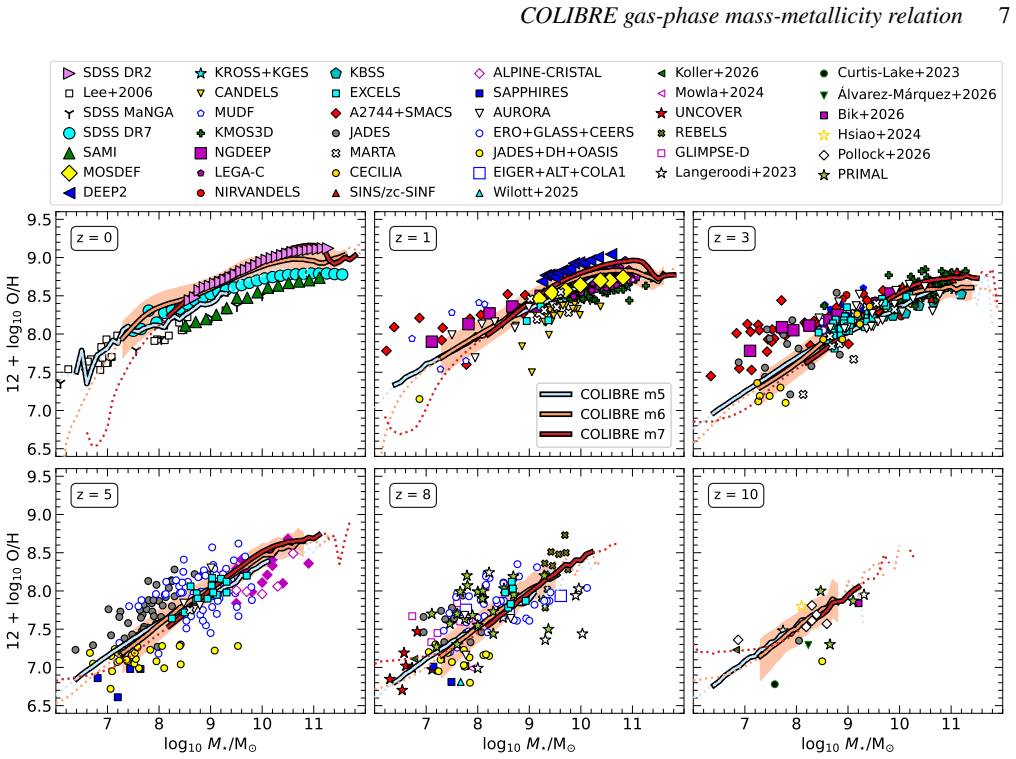
In the COLIBRE simulations the galaxy gas-phase mass-metallicity relation is already in place at cosmic dawn (z approximately 10) and exhibits no evolution until z approximately 5. The relation is reproduced across the full stellar mass range sampled by observations at all redshifts, with the slope becoming shallower at low redshifts. The high-mass end turnover is set primarily by AGN feedback, while the low-mass end depends on core-collapse supernova feedback. Variations in star formation efficiency or oxygen depletion on dust grains have smaller effects.

Load-bearing premise

The fiducial COLIBRE model of the multiphase interstellar medium, non-equilibrium chemistry, metal diffusion, and live dust accurately represents the physical processes that set gas-phase metallicities.

Editorial extensions

If this is right

  • The mass-metallicity relation exhibits no significant evolution between redshifts 10 and 5.
  • AGN feedback largely sets the turnover at the high-mass end of the relation.
  • Core-collapse supernova feedback controls the slope at the low-mass end.
  • The simulated relation shows numerical convergence across particle masses from 10^5 to 10^7 solar masses and box sizes from 25 to 400 comoving megaparsecs.

Reading between the lines

Editorial extensions of the paper, not claims the author makes directly.

  • Metal enrichment must proceed rapidly in the first galaxies to produce the observed relation by redshift 10.
  • Observations targeting low-mass galaxies at redshifts 5 to 10 could test the strength of supernova feedback assumed in the model.
  • The inclusion of live dust opens the possibility of predicting how dust depletion alters inferred metallicities in high-redshift observations.
Share X Bluesky LinkedIn Reddit HN

Signed reviews

No signed human review yet.

Editorial analysis

A structured set of objections, weighed in public.

Desk editor's note, referee report, simulated authors' rebuttal, and a circularity audit.

Referee Report

0 major / 3 minor

Summary. The paper presents the evolution of the galaxy gas-phase mass-metallicity relation (MZR) from z=15 to z=0 using the COLIBRE cosmological hydrodynamical simulations. These runs incorporate a multiphase ISM cooling to ~10 K, non-equilibrium H/He chemistry, metal diffusion, and a self-consistent live dust model. Across fiducial runs with particle masses 10^5-10^7 M⊙ and box sizes 25-400 cMpc, the median mass-weighted MZRs for star-forming galaxies are shown to reproduce observational compilations at all redshifts. The MZR is already established at z≈10 with no evolution to z≈5; the slope shallows at low z. High-mass turnover is attributed to AGN feedback and low-mass end to core-collapse SN feedback, with star-formation efficiency and dust depletion having minor effects. Numerical convergence is reported as excellent.

Significance. If the central results hold, the work provides a valuable, high-dynamic-range simulation benchmark for the MZR across cosmic time, enabled by the new ISM and chemistry modules. Explicit convergence across resolution and volume, plus targeted feedback variations, strengthen the attribution of MZR features to specific physical processes. This can inform both observational interpretations and future model development, particularly where the simulations uniquely cover the full observed stellar-mass range at high redshift.

minor comments (3)
  1. [Abstract, §3] Abstract and §3: the statement that the MZR 'shows no evolution until z≈5' would benefit from an explicit quantitative definition (e.g., change in normalization or slope below a stated threshold) and a figure showing the redshift-dependent parameters.
  2. [§4] The comparison to observations notes 'systematic uncertainties in observational measurements' but does not specify which abundance calibrations or diagnostics are adopted for the simulated oxygen abundances; a short table or paragraph reconciling the two would improve clarity.
  3. [Figures 2-5] Figure captions and text should explicitly state whether the plotted MZRs are mass-weighted or luminosity-weighted and how star-forming galaxies are selected (e.g., sSFR threshold).

Simulated Author's Rebuttal

0 responses · 0 unresolved

We thank the referee for their positive assessment of the manuscript, including the recognition that it provides a valuable high-dynamic-range benchmark for the MZR across cosmic time, enabled by the new ISM and chemistry modules, with explicit convergence tests and targeted feedback variations strengthening the physical attributions. The recommendation for minor revision is noted. No specific major comments were listed in the report for us to address point by point.

Circularity Check

0 steps flagged · score 0.0 of 10

No significant circularity; results are direct simulation outputs compared to external data

full rationale

The paper derives the MZR by running COLIBRE hydrodynamical simulations with explicit multiphase ISM, non-equilibrium chemistry, metal diffusion, and live dust physics, then measures median mass-weighted relations in star-forming galaxies across redshifts and compares them to independent observational compilations. No parameters are fitted to MZR data (variations in AGN/SN feedback, star-formation efficiency, and dust depletion are sensitivity tests, not fits), no self-citations justify core premises or uniqueness theorems, and no ansatzes or renamings reduce the reported evolution to inputs by construction. The claim that the MZR is in place at z≈10 with limited evolution to z≈5 is an emergent output, not a redefinition of the simulation setup. This is a standard, self-contained simulation-vs-observation comparison.

Assumptions & free parameters 0 free parameters · 0 assumptions · 0 invented entities

Abstract-only review supplies insufficient detail to enumerate free parameters, axioms, or invented entities; full text required for complete audit.

how reviews work

0 comments
Cite this review

Pith. "Pith review of The evolution of the galaxy gas-phase mass-metallicity relation from $z=15$ to $z=0$ in the COLIBRE cosmological simulations." pith.science (2026). https://pith.science/paper/6NKX7V7X

@misc{pith2026260625995,
  author       = {Pith},
  title        = {Pith review of: The evolution of the galaxy gas-phase mass-metallicity relation from $z=15$ to $z=0$ in the COLIBRE cosmological simulations},
  year         = {2026},
  howpublished = {\url{https://pith.science/paper/6NKX7V7X}},
  note         = {Machine review of arXiv:2606.25995}
}
abstract

We present the evolution of the galaxy gas-phase mass-metallicity relation (MZR) from $z=15$ to $z=0$ in the COLIBRE cosmological hydrodynamical simulations. Amongst other novel features, COLIBRE follows the multiphase interstellar medium with gas allowed to cool to $\sim 10\,\mathrm{K}$, and includes a new chemistry model in which hydrogen and helium are tracked in non-equilibrium, metals are allowed to mix and diffuse, and the chemical network is coupled to a self-consistent live dust model. Using fiducial COLIBRE runs spanning particle masses from $10^5\,\mathrm{M_{\odot}}$ to $10^7\,\mathrm{M_{\odot}}$ and box sizes $25 - 400\,\mathrm{cMpc}$, we derive the median, mass-weighted MZRs for star-forming galaxies and compare them with a comprehensive compilation of observational data and other simulations. COLIBRE reproduces the observed MZR across cosmic time, notwithstanding the systematic uncertainties in observational measurements of the gas-phase oxygen abundances. The simulations show excellent numerical convergence and uniquely probe the full stellar mass range sampled by current observations across all redshifts. We find that the MZR is already in place at cosmic dawn ($z \approx 10$), and shows no evolution until $z \approx 5$. The slope of the MZR becomes shallower at low redshifts. The turnover at the high-mass end is largely governed by feedback from active galactic nuclei (AGN), whereas the low-mass end of the MZR sensitively depends on the strength of feedback from core collapse supernovae. Variations in the star formation efficiency or depletion of oxygen on dust grains have a more minor impact on the MZR. We identify key physical processes that shape the MZR across cosmic time and highlight where future observations can further constrain galaxy formation models.

Figures

Figures reproduced from arXiv: 2606.25995 by the authors.

Figure 1
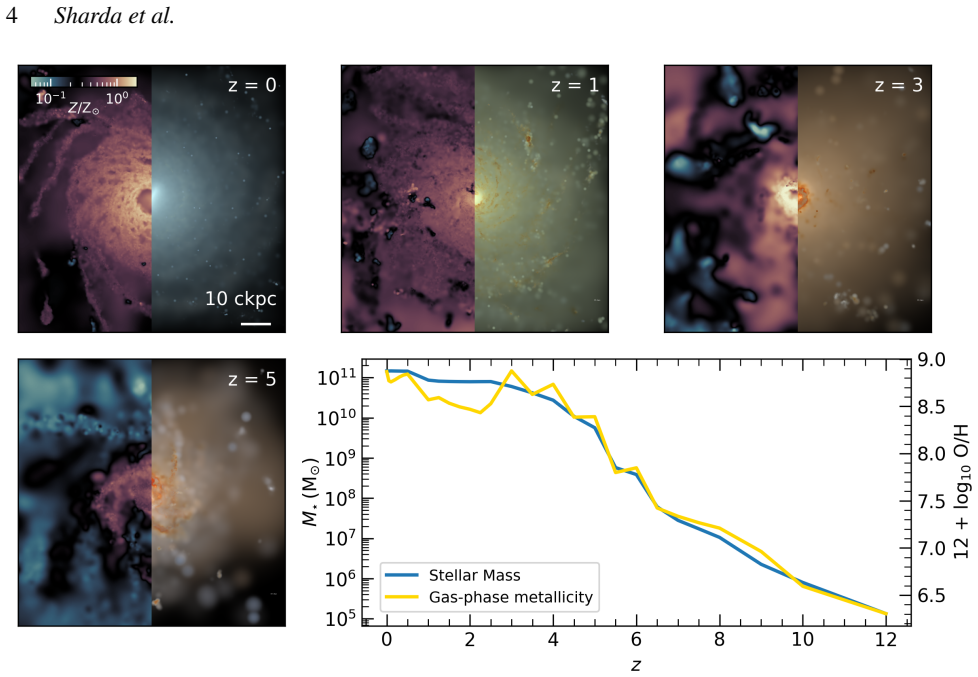
Figure 1. Face-on projections within a 50 comoving kpc volume of the gas-phase metallicity (left half of the image in each redshift panel) and integrated stellar light (right half of the image) as would be seen through near-IR JWST filters across cosmic time in a representative massive spiral galaxy from the COLIBRE L025m5 simulation. The metallicity scale is depicted in the top left panel, and stretches from 0.05 Z⊙ to 2 Z⊙.… view at source ↗
Figure 2
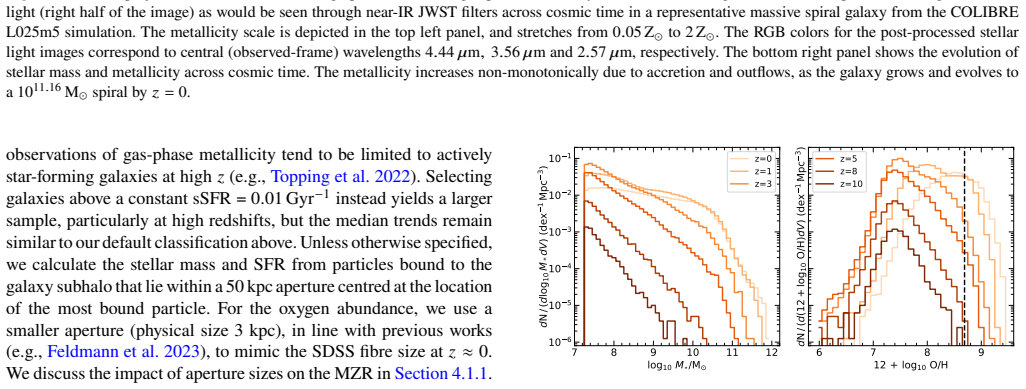
Figure 2. Left panel: Number density of star-forming COLIBRE galaxies as a function of stellar mass, measured in 0.1 dex mass bins and normalized by the simulation volume, at different redshifts in the L200m6 simulation. Increasingly darker shades of orange correspond to distributions at higher redshifts. The vertical hard cutoff at the low mass end in the distributions arises from only selecting galaxies with ≥ 10 star parti… view at source ↗
Figure 3
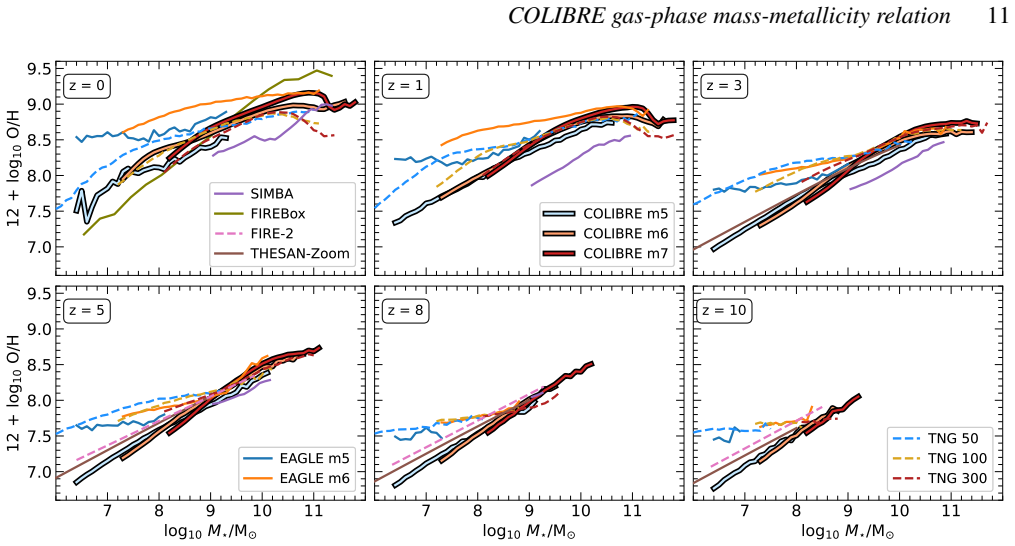
Figure 3. Evolution of the median gas-phase mass-metallicity relation (MZR) of star-forming galaxies across cosmic time in the COLIBRE simulations at three different mass resolutions: m5 (light blue), m6 (orange), m7 (red). COLIBRE curves transition from solid to dotted if the number of galaxies drops below 20 in a given stellar mass bin, or if the resolution limit is reached (< 10 star particles per galaxy). Shaded orange re… view at source ↗
Figures from the paper (13 more)
Figure 4
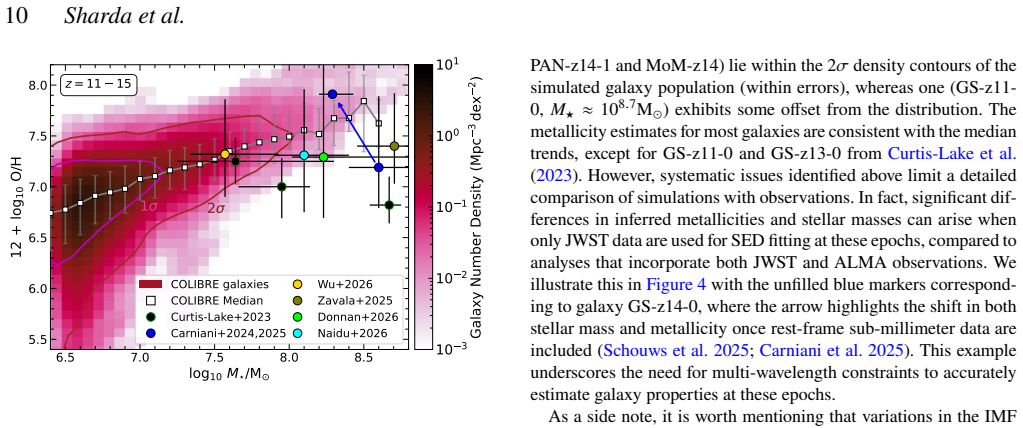
Figure 4. Figure 4: Gas-phase metallicity as a function of stellar mass for all re￾solved 𝑧 = 11 − 15 star-forming galaxies in the COLIBRE simulations. The smoothed, simulation volume-weighted 2D histogram includes star-forming galaxies at these redshifts at all three resolutions (m5, m6,…
Figure 5
Figure 5. Figure 5: Same as [PITH_FULL_IMAGE:figures/full_fig_p011_5.png]
Figure 6
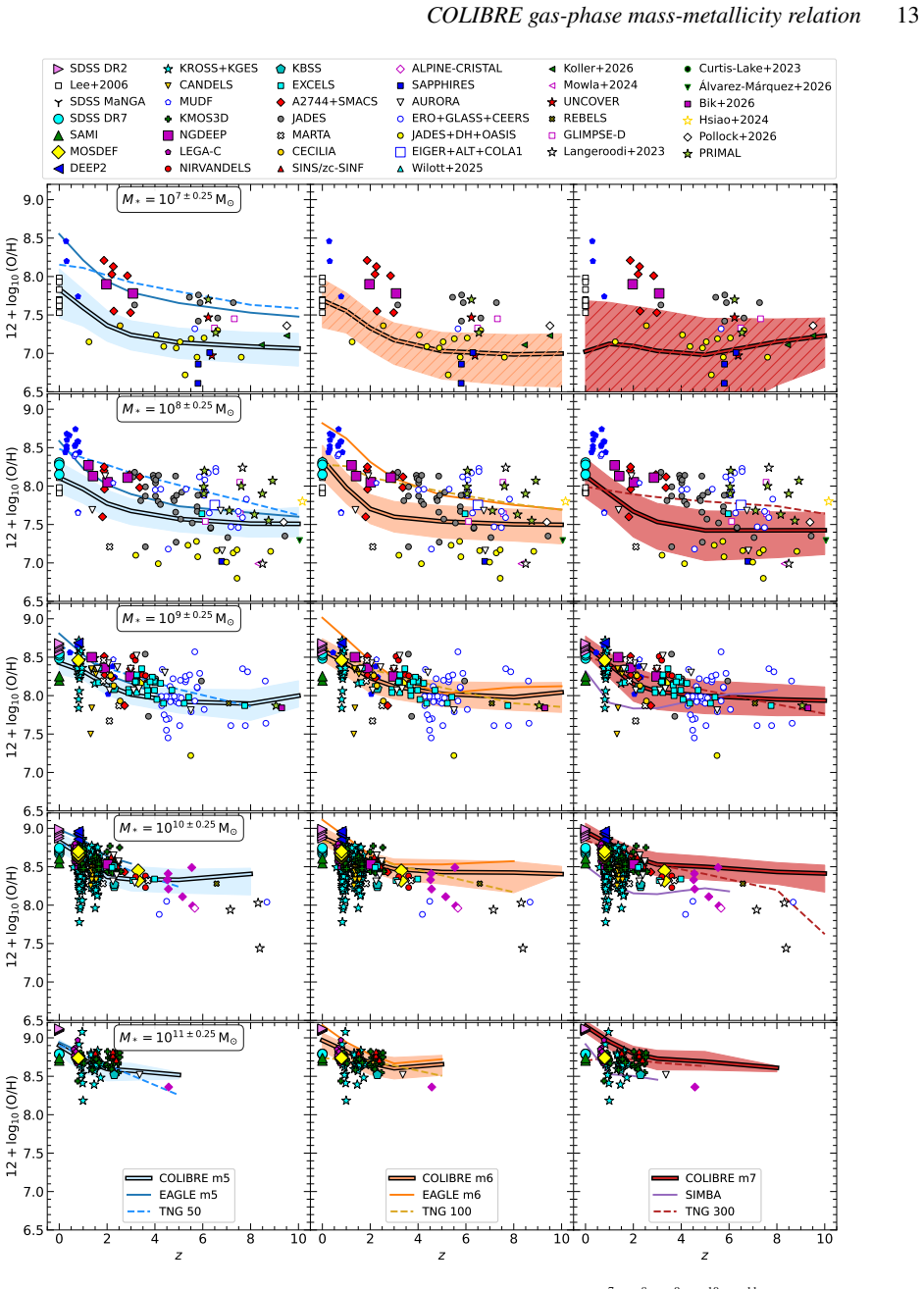
Figure 6. Figure 6: Evolution of the MZR with redshift in galaxies within different stellar mass bins per row (𝑀★ ≈ 107 , 108 , 109 , 1010 , 1011 M⊙), separated into three columns corresponding to different COLIBRE resolutions (m5, m6, m7). Shaded bands denote the 16th − 84th percentile r…
Figure 7
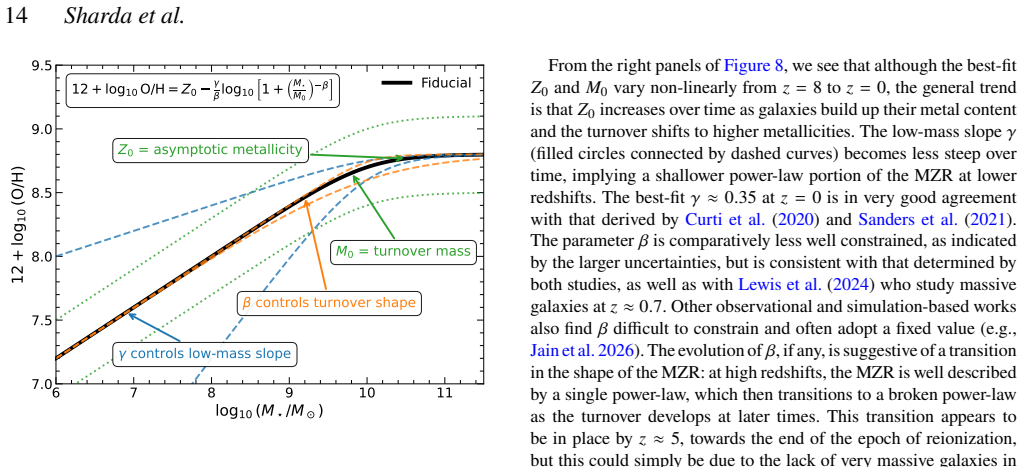
Figure 7. Figure 7: Schematic explaining how the free parameters in the broken power￾law model (equation 3) proposed by Curti et al. (2020) determine key aspects of the MZR. resolution, SIMBA predicts systematically lower metallicities than both COLIBRE and TNG 300. However, the simulatio…
Figure 8
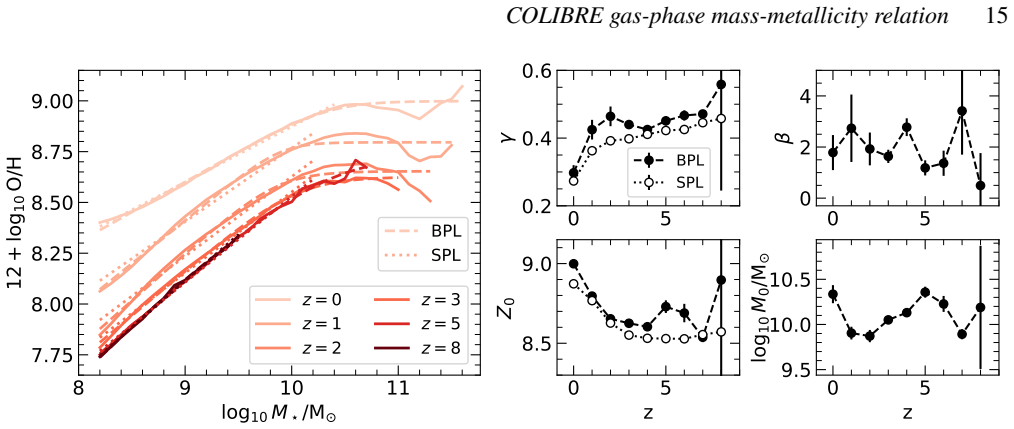
Figure 8. Figure 8: Left panel: Evolution of the median MZR in the COLIBRE L200m6 simulation at different redshifts (solid). Dashed and dotted lines represent broken power-law (BPL, equation 3) and single power-law (SPL, equation 4) fits to the MZRs, respectively. Right panels: Redshift e…
Figure 9
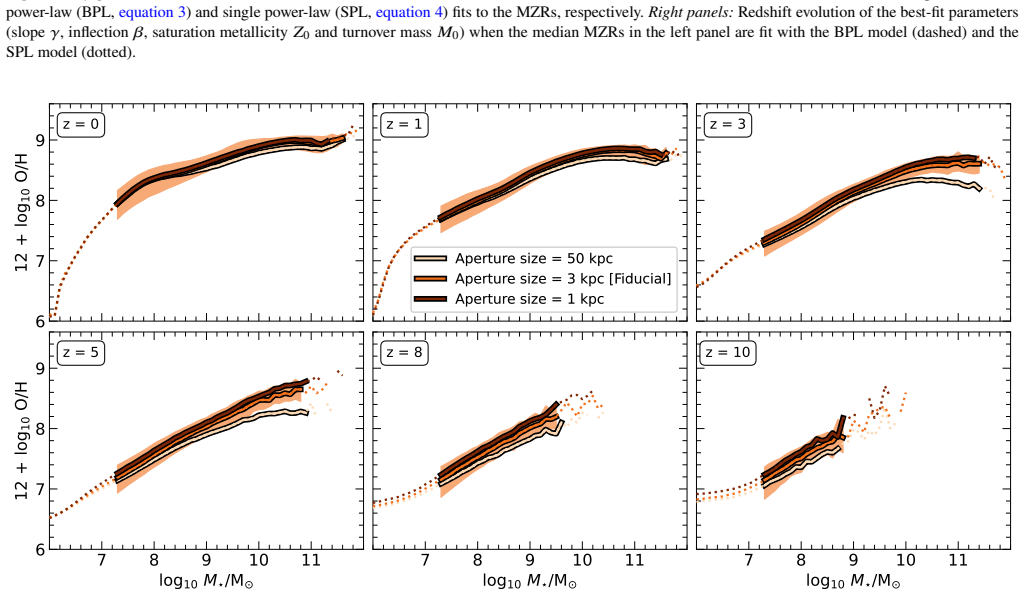
Figure 9. Figure 9: Effects of using different aperture sizes to measure the gas-phase metallicity on the MZR in the COLIBRE L200m6 simulation. Median MZRs from these COLIBRE simulations are shown for three aperture sizes (50 kpc, 3 kpc, and 1 kpc), indicated by progressively darker shade…
Figure 10
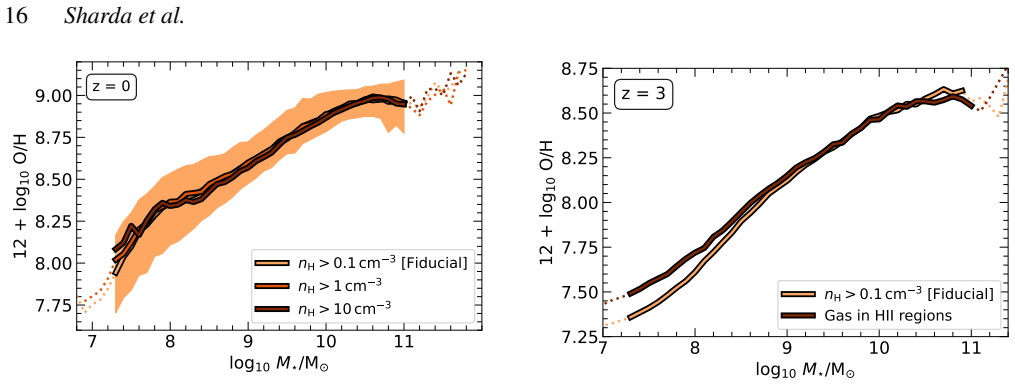
Figure 10. Figure 10: The effect of using a different density cut to select gas particles to obtain oxygen abundances. Median MZRs at 𝑧 = 0 from COLIBRE sim￾ulations at m6 resolution and box size 100 Mpc (L100m6) are shown for the different density cuts, indicated by progressively darker s…
Figure 12
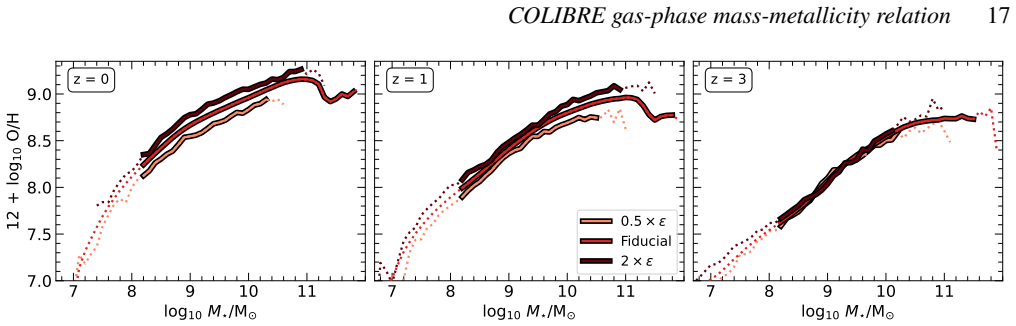
Figure 12. Figure 12: Impact of variations in the fiducial star formation model implemented in COLIBRE on the median MZR, for a smaller (50 Mpc) box at m7 resolution (L050m7). The fiducial model is from the L400m7 simulation. 𝜖 is the star formation efficiency per freefall time, set to 0.0…
Figure 13
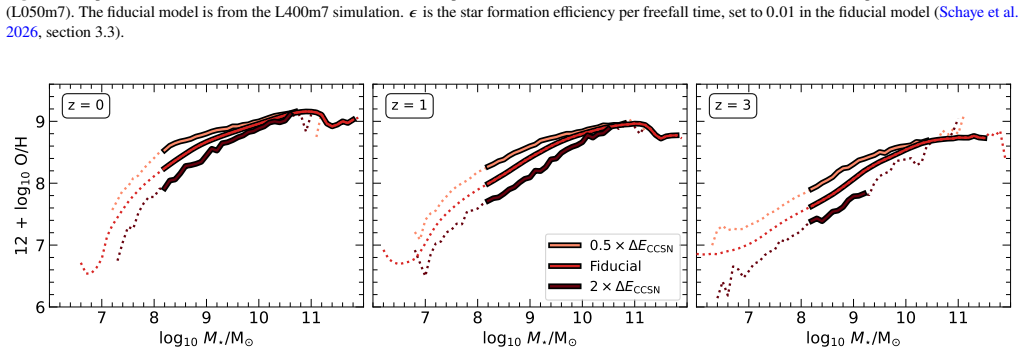
Figure 13. Figure 13: Impact of variations in the fiducial supernova feedback model implemented in COLIBRE on the median MZR, for a smaller (50 Mpc) box at m7 resolution (L050m7). The fiducial model is from the L400m7 simulation. Δ𝐸CCSN refers to the energy added to a star particle due to …
Figure 14
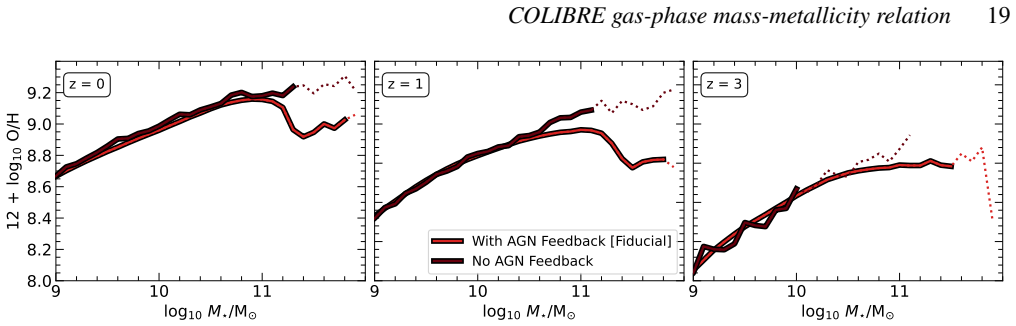
Figure 14. Figure 14: Impact of AGN feedback on the median MZR in the COLIBRE simulations at m7 resolution. The fiducial model is plotted for the L400m7 box whereas the model without AGN feedback is for the L050m7 box. Notice that axes limits differ from those in other plots. 9 10 11 log10…
Figure 15
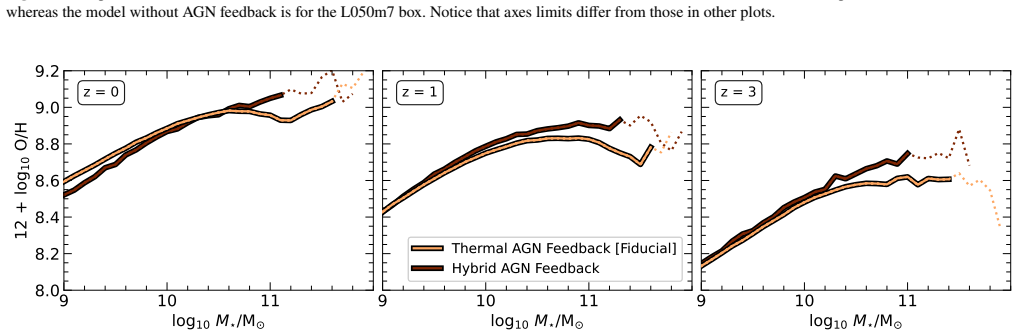
Figure 15. Figure 15: Impact of the mode of AGN feedback (thermal versus hybrid) on the median MZR in the COLIBRE simulations of box size 100 Mpc at m6 resolution (L100m6). The fiducial thermal feedback model only injects thermal energy from AGN into the surroundings, whereas the hybrid fe…
Figure 16
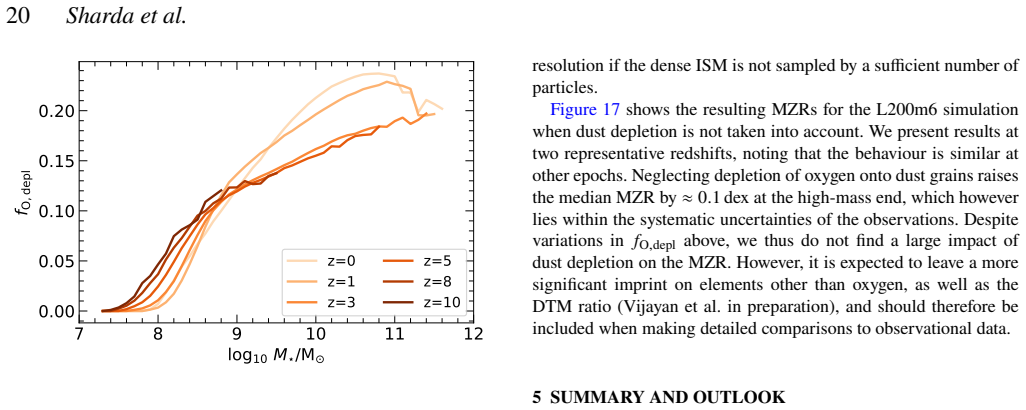
Figure 16. Figure 16: Median fraction of oxygen that is depleted onto dust grains, 𝑓O,depl, as a function of galaxy stellar mass, at different redshifts in the COLIBRE L200m6 simulation. 8 9 10 11 log10 M /M 7.75 8.00 8.25 8.50 8.75 9.00 1 2 + lo g10 O / H z = 0 z = 3 Diffuse Oxygen [Fiduc…
Figure 17
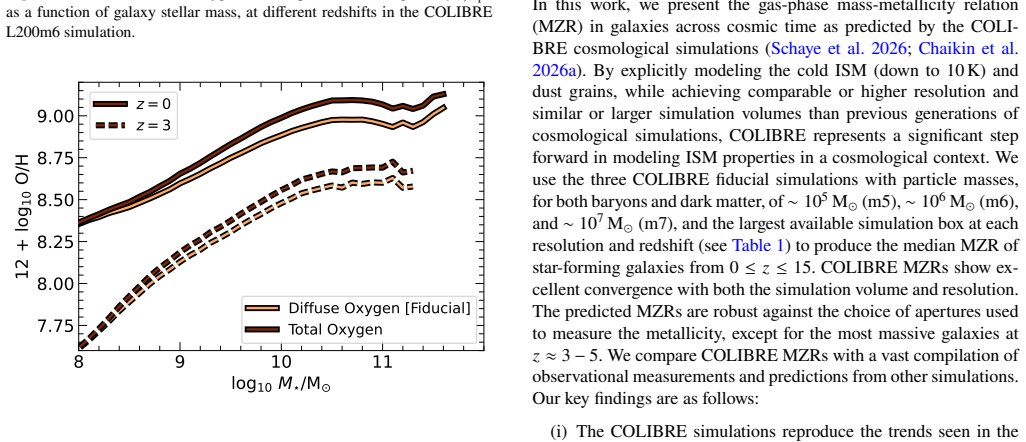
Figure 17. Figure 17: MZR for the L200m6 COLIBRE simulation at 𝑧 = 0 (solid) and 𝑧 = 3 (dashed), showing the impact of ignoring oxygen depletion onto dust grains. The darker shade of orange corresponds to the total oxygen abundance (gas+dust) whereas the lighter shade corresponds to the fi…

Discussion (0). Continue with ORCID to comment.

Forward citations

Cited by 4 Pith papers

Reviewed papers in the Pith corpus that reference this work. Sorted by Pith novelty score. Full citation record

  1. Smoothed particle magnetohydrodynamics for simulations of galaxy and cosmic structure formation

    astro-ph.GA 2026-08 conditional novelty 7.0 of 10

    A new conservative SPMHD scheme in SWIFT passes standard tests and achieves the first coupling of the EAGLE galaxy formation model to magnetohydrodynamics.

  2. The evolution of galaxy dust scaling relations in the COLIBRE simulations

    astro-ph.GA 2026-07 conditional novelty 7.0 of 10

    The COLIBRE simulations reproduce the broad evolution of galaxy dust scaling relations from z=15 to 0, but overproduce the z<1 cosmic dust mass density and miss the most extreme sub-millimeter galaxies.

  3. The effect of galaxy interactions on star formation rates in the COLIBRE simulations

    astro-ph.GA 2026-08 conditional novelty 6.0 of 10

    In the COLIBRE simulations, interacting galaxies show a specific star formation rate enhancement of up to about 1.7 at separations of 5-10 kpc, declining to unity by ~200 kpc, and underpredicting SDSS enhancements by ...

  4. The influence of feedback on the baryonic content of haloes in the COLIBRE simulations

    astro-ph.GA 2026-07 conditional novelty 6.0 of 10

    The halo gas fraction–halo mass relation in COLIBRE is non-monotonic and depends strongly on the subgrid AGN feedback model, with jet-hybrid feedback producing lower group gas fractions that better match eROSITA and k...

Reference graph

Works this paper leans on

298 extracted references · 287 canonical work pages · cited by 4 Pith papers

  1. [1]

    The Astropy Project: Building an inclusive, open-science project and status of the v2.0 core package

    The Astropy Project: Building an Open-science Project and Status of the v2.0 Core Package. , keywords =. doi:10.3847/1538-3881/aabc4f , archivePrefix =. 1801.02634 , primaryClass =

  2. [2]

    Astropy: A Community Python Package for Astronomy

    Astropy: A community Python package for astronomy. , keywords =. 2013. doi:10.1051/0004-6361/201322068 , archivePrefix =. 1307.6212 , primaryClass =

  3. [3]

    2006 , series =

    A guide to NumPy , author=. 2006 , series =

  4. [4]

    Array Programming with NumPy

    Array Programming with NumPy. , keywords =. doi:10.1038/s41586-020-2649-2 , archivePrefix =. 2006.10256 , primaryClass =

  5. [5]

    SciPy 1.0--Fundamental Algorithms for Scientific Computing in Python

    SciPy 1.0: fundamental algorithms for scientific computing in Python. Nature Methods , keywords =. doi:10.1038/s41592-019-0686-2 , archivePrefix =. 1907.10121 , primaryClass =

  6. [6]

    Hunter, J. D. , Title =. Computing in Science & Engineering , Volume =

  7. [7]

    The Journal of Open Source Software , keywords =

    CMasher: Scientific colormaps for making accessible, informative and 'cmashing' plots. The Journal of Open Source Software , keywords =. doi:10.21105/joss.02004 , archivePrefix =. 2003.01069 , primaryClass =

  8. [8]

    2022, ApJ, 933, 222, doi: 10.3847/1538-4357/ac6d56

    CLASSY III. The Properties of Starburst-driven Warm Ionized Outflows. , keywords =. doi:10.3847/1538-4357/ac6d56 , archivePrefix =. 2204.09181 , primaryClass =

Show all 298 references
  1. [9]

    , keywords =

    A unified model for galactic discs: star formation, turbulence driving, and mass transport. , keywords =. doi:10.1093/mnras/sty852 , archivePrefix =. 1706.00106 , primaryClass =

  2. [10]

    , keywords =

    The KMOS ^ 3D Survey: Design, First Results, and the Evolution of Galaxy Kinematics from 0.7 &lt;= z &lt;= 2.7. , keywords =. doi:10.1088/0004-637X/799/2/209 , archivePrefix =. 1409.6791 , primaryClass =

  3. [11]

    , keywords =

    The evolution of turbulent galactic discs: gravitational instability, feedback, and accretion. , keywords =. doi:10.1093/mnras/stac1324 , archivePrefix =. 2202.12331 , primaryClass =

  4. [12]

    , keywords =

    The metallicity's fundamental dependence on both local and global galactic quantities. , keywords =. doi:10.1093/mnras/stac3594 , archivePrefix =. 2210.03755 , primaryClass =

  5. [13]

    , keywords =

    Characterizing mass, momentum, energy, and metal outflow rates of multiphase galactic winds in the FIRE-2 cosmological simulations. , keywords =. doi:10.1093/mnras/stab2714 , archivePrefix =. 2103.06891 , primaryClass =

  6. [14]

    , keywords =

    The cosmic baryon cycle and galaxy mass assembly in the FIRE simulations. , keywords =. doi:10.1093/mnras/stx1517 , archivePrefix =. 1610.08523 , primaryClass =

  7. [15]

    , keywords =

    How supernovae launch galactic winds?. , keywords =. doi:10.1093/mnrasl/slx072 , archivePrefix =. 1704.01579 , primaryClass =

  8. [16]

    , keywords =

    First Results from SMAUG: Characterization of Multiphase Galactic Outflows from a Suite of Local Star-forming Galactic Disk Simulations. , keywords =. doi:10.3847/1538-4357/aba962 , archivePrefix =. 2006.16315 , primaryClass =

  9. [17]

    , keywords =

    Kinetic Energy Decay Rates of Supersonic and Super-Alfv \'e nic Turbulence in Star-Forming Clouds. , keywords =. doi:10.1103/PhysRevLett.80.2754 , archivePrefix =. astro-ph/9712013 , primaryClass =

  10. [18]

    Solenoidal versus compressive turbulence forcing

    Comparing the statistics of interstellar turbulence in simulations and observations. Solenoidal versus compressive turbulence forcing. , keywords =. doi:10.1051/0004-6361/200912437 , archivePrefix =. 0905.1060 , primaryClass =

  11. [19]

    Nature Astronomy , keywords =

    The sonic scale of interstellar turbulence. Nature Astronomy , keywords =. doi:10.1038/s41550-020-01282-z , archivePrefix =. 2011.06238 , primaryClass =

  12. [20]

    , keywords =

    The chemical make-up of the Sun: A 2020 vision. , keywords =. doi:10.1051/0004-6361/202140445 , archivePrefix =. 2105.01661 , primaryClass =

  13. [21]

    Planck 2018 results. VI. Cosmological parameters. arXiv e-prints , keywords =

  14. [22]

    , keywords =

    A Universal, Local Star Formation Law in Galactic Clouds, nearby Galaxies, High-redshift Disks, and Starbursts. , keywords =. doi:10.1088/0004-637X/745/1/69 , archivePrefix =. 1109.4150 , primaryClass =

  15. [23]

    , keywords =

    Cloud-scale Molecular Gas Properties in 15 Nearby Galaxies. , keywords =. doi:10.3847/1538-4357/aac326 , archivePrefix =. 1805.00937 , primaryClass =

  16. [24]

    , keywords =

    The Star Formation Efficiency in Nearby Galaxies: Measuring Where Gas Forms Stars Effectively. , keywords =. doi:10.1088/0004-6256/136/6/2782 , archivePrefix =. 0810.2556 , primaryClass =

  17. [25]

    , keywords =

    Galactic Stellar and Substellar Initial Mass Function. , keywords =. doi:10.1086/376392 , archivePrefix =. astro-ph/0304382 , primaryClass =

  18. [26]

    , keywords =

    A General Theory of Turbulence-regulated Star Formation, from Spirals to Ultraluminous Infrared Galaxies. , keywords =. doi:10.1086/431734 , archivePrefix =. astro-ph/0505177 , primaryClass =

  19. [27]

    arXiv e-prints , keywords =

    Delayed Massive-Star Mechanical Feedback at Low Metallicity. arXiv e-prints , keywords =

  20. [28]

    , keywords =

    Evidence for supernova feedback sustaining gas turbulence in nearby star-forming galaxies. , keywords =. doi:10.1051/0004-6361/202038223 , archivePrefix =. 2006.10764 , primaryClass =

  21. [29]

    , keywords =

    Density Studies of MHD Interstellar Turbulence: Statistical Moments, Correlations and Bispectrum. , keywords =. doi:10.1088/0004-637X/693/1/250 , archivePrefix =. 0811.0822 , primaryClass =

  22. [30]

    , keywords =

    Dissipation in Compressible Magnetohydrodynamic Turbulence. , keywords =. doi:10.1086/311718 , archivePrefix =. astro-ph/9809357 , primaryClass =

  23. [31]

    , keywords =

    A Constant Molecular Gas Depletion Time in Nearby Disk Galaxies. , keywords =. doi:10.1088/2041-8205/730/2/L13 , archivePrefix =. 1102.1720 , primaryClass =

  24. [32]

    , keywords =

    How stellar feedback simultaneously regulates star formation and drives outflows. , keywords =. doi:10.1093/mnras/stw2888 , archivePrefix =. 1510.05650 , primaryClass =

  25. [33]

    , keywords =

    Sub-Eddington star-forming regions are super-Eddington: momentum-driven outflows from supersonic turbulence. , keywords =. doi:10.1093/mnras/stv2331 , archivePrefix =. 1411.1769 , primaryClass =

  26. [34]

    , keywords =

    A Unified Model for the Coevolution of Galaxies and Their Circumgalactic Medium: The Relative Roles of Turbulence and Atomic Cooling Physics. , keywords =. doi:10.3847/1538-4357/acf3ea , archivePrefix =. 2211.09755 , primaryClass =

  27. [35]

    , keywords =

    The Star Formation Rate in the Gravoturbulent Interstellar Medium. , keywords =. doi:10.3847/1538-4357/aad002 , archivePrefix =. 1801.05428 , primaryClass =

  28. [36]

    , keywords =

    The Star Formation Rate of Turbulent Magnetized Clouds: Comparing Theory, Simulations, and Observations. , keywords =. doi:10.1088/0004-637X/761/2/156 , archivePrefix =. 1209.2856 , primaryClass =

  29. [37]

    , keywords =

    A multishock model for the density variance of anisotropic, highly magnetized, supersonic turbulence. , keywords =. doi:10.1093/mnras/stab1037 , archivePrefix =. 2102.00629 , primaryClass =

  30. [38]

    , keywords =

    The Link between Turbulence, Magnetic Fields, Filaments, and Star Formation in the Central Molecular Zone Cloud G0.253+0.016. , keywords =. doi:10.3847/0004-637X/832/2/143 , archivePrefix =. 1609.05911 , primaryClass =

  31. [39]

    , keywords =

    Testing star formation laws in a starburst galaxy at redshift 3 resolved with ALMA. , keywords =. doi:10.1093/mnras/sty886 , archivePrefix =. 1712.03661 , primaryClass =

  32. [40]

    , keywords =

    Testing star formation laws on spatially resolved regions in a z 4.3 starburst galaxy. , keywords =. doi:10.1093/mnras/stz1543 , archivePrefix =. 1906.01173 , primaryClass =

  33. [41]

    , keywords =

    The Global Schmidt Law in Star-forming Galaxies. , keywords =. doi:10.1086/305588 , archivePrefix =. astro-ph/9712213 , primaryClass =

  34. [42]

    , keywords =

    Feedback-regulated star formation in molecular clouds and galactic discs. , keywords =. doi:10.1093/mnras/stt866 , archivePrefix =. 1301.3905 , primaryClass =

  35. [43]

    , keywords =

    The SAMI galaxy survey: gas velocity dispersions in low-z star-forming galaxies and the drivers of turbulence. , keywords =. doi:10.1093/mnras/staa1272 , archivePrefix =. 2005.04874 , primaryClass =

  36. [44]

    , keywords =

    Galactic star formation and accretion histories from matching galaxies to dark matter haloes. , keywords =. doi:10.1093/mnras/sts261 , archivePrefix =. 1205.5807 , primaryClass =

  37. [45]

    , keywords =

    A new method for spatially resolving the turbulence-driving mixture in the ISM with application to the Small Magellanic Cloud. , keywords =. doi:10.1093/mnras/stad2718 , archivePrefix =. 2309.10755 , primaryClass =

  38. [46]

    , keywords =

    Photoelectric heating of interstellar gas. , keywords =. doi:10.1086/190513 , adsurl =

  39. [47]

    , keywords =

    Rosseland and Planck mean opacities for protoplanetary discs. , keywords =. doi:10.1051/0004-6361:20031279 , archivePrefix =. astro-ph/0308344 , primaryClass =

  40. [48]

    , keywords =

    Photodissociation of H _ 2 in protogalaxies: modelling self-shielding in three-dimensional simulations. , keywords =. doi:10.1111/j.1365-2966.2011.19538.x , archivePrefix =. 1106.3523 , primaryClass =

  41. [49]

    , keywords =

    The photodissociation and chemistry of CO isotopologues: applications to interstellar clouds and circumstellar disks. , keywords =. doi:10.1051/0004-6361/200912129 , archivePrefix =. 0906.3699 , primaryClass =

  42. [50]

    , keywords =

    Photochemistry and Heating/Cooling of the Multiphase Interstellar Medium with UV Radiative Transfer for Magnetohydrodynamic Simulations. , keywords =. doi:10.3847/1538-4365/ac9b1d , archivePrefix =. 2210.08024 , primaryClass =

  43. [51]

    Photodissociation regions. I. Basic model. , keywords =. doi:10.1086/163111 , adsurl =

  44. [52]

    , keywords =

    The UMIST Database for Astrochemistry 2022. , keywords =. doi:10.1051/0004-6361/202346908 , archivePrefix =. 2311.03936 , primaryClass =

  45. [53]

    , keywords =

    Cosmic-Ray--induced Photodissociation and Photoionization Rates of Interstellar Molecules. , keywords =. doi:10.1086/168117 , adsurl =

  46. [54]

    , keywords =

    H I-to-H _ 2 Transitions in Dust-free Interstellar Gas. , keywords =. doi:10.3847/1538-4357/ac167b , archivePrefix =. 2105.01681 , primaryClass =

  47. [55]

    , keywords =

    Production of atomic hydrogen by cosmic rays in dark clouds. , keywords =. doi:10.1051/0004-6361/201834008 , archivePrefix =. 1809.04168 , primaryClass =

  48. [56]

    The basic model, library of chemical reactions, and chemistry among C, N, and O compounds

    A model for gas phase chemistry in interstellar clouds: I. The basic model, library of chemical reactions, and chemistry among C, N, and O compounds. , keywords =. doi:10.1086/190665 , adsurl =

  49. [58]

    , keywords =

    The C/CO Ratio in Dense Interstellar Clouds. , keywords =. doi:10.1086/185073 , adsurl =

  50. [59]

    , keywords =

    Photodissociation and photoionisation of atoms and molecules of astrophysical interest. , keywords =. doi:10.1051/0004-6361/201628742 , archivePrefix =. 1701.04459 , primaryClass =

  51. [60]

    , keywords =

    Sensitivity analyses of dense cloud chemical models. , keywords =. doi:10.1051/0004-6361/200913856 , archivePrefix =. 1004.1902 , primaryClass =

  52. [61]

    , keywords =

    On the Effect of the Cosmic Microwave Background in High-redshift (Sub-)millimeter Observations. , keywords =. doi:10.1088/0004-637X/766/1/13 , archivePrefix =. 1302.0844 , primaryClass =

  53. [62]

    , keywords =

    CO lines in high redshift galaxies: perspective for future MM instruments. , keywords =. doi:10.48550/arXiv.astro-ph/9902286 , archivePrefix =. astro-ph/9902286 , primaryClass =

  54. [63]

    , keywords =

    A Heuristic Prediction of the Cosmic Evolution of the Co-luminosity Functions. , keywords =. doi:10.1088/0004-637X/702/2/1321 , archivePrefix =. 0907.3091 , primaryClass =

  55. [64]

    , keywords =

    UCLCHEM: A Gas-grain Chemical Code for Clouds, Cores, and C-Shocks. , keywords =. doi:10.3847/1538-3881/aa773f , archivePrefix =. 1705.10677 , primaryClass =

  56. [65]

    , keywords =

    Evaporation of ices near massive stars: models based on laboratory temperature programmed desorption data. , keywords =. doi:10.1111/j.1365-2966.2004.08273.x , archivePrefix =. astro-ph/0406054 , primaryClass =

  57. [66]

    Astrochem: Abundances of chemical species in the interstellar medium

  58. [68]

    , keywords =

    On the Stability and Evolution of Isolated BOK Globules. , keywords =. doi:10.1086/307823 , adsurl =

  59. [69]

    , keywords =

    Approximations for modelling CO chemistry in giant molecular clouds: a comparison of approaches. , keywords =. doi:10.1111/j.1365-2966.2011.20260.x , archivePrefix =. 1102.0670 , primaryClass =

  60. [70]

    , keywords =

    Modelling CO formation in the turbulent interstellar medium. , keywords =. doi:10.1111/j.1365-2966.2009.15718.x , archivePrefix =. 0907.4081 , primaryClass =

  61. [71]

    , keywords =

    Star formation in metal-poor gas clouds. , keywords =. doi:10.1111/j.1365-2966.2012.21737.x , archivePrefix =. 1203.4251 , primaryClass =

  62. [72]

    , keywords =

    Thermal and Fragmentation Properties of Star-forming Clouds in Low-Metallicity Environments. , keywords =. doi:10.1086/429955 , archivePrefix =. astro-ph/0503010 , primaryClass =

  63. [73]

    Shielded gas

    Non-equilibrium chemistry and cooling in the diffuse interstellar medium - II. Shielded gas. , keywords =. doi:10.1093/mnras/stu1046 , archivePrefix =. 1403.6155 , primaryClass =

  64. [74]

    , keywords =

    CN and HCN in Dense Interstellar Clouds. , keywords =. doi:10.1086/432864 , archivePrefix =. astro-ph/0506535 , primaryClass =

  65. [75]

    , keywords =

    The interstellar gas-phase chemistry of HCN and HNC. , keywords =. doi:10.1093/mnras/stu1089 , archivePrefix =. 1406.1696 , primaryClass =

  66. [76]

    , keywords =

    KROME - a package to embed chemistry in astrophysical simulations. , keywords =. doi:10.1093/mnras/stu114 , archivePrefix =. 1311.1070 , primaryClass =

  67. [77]

    , keywords =

    Ultraviolet H _ 2 luminescence in molecular clouds induced by cosmic rays. , keywords =. doi:10.1051/0004-6361/202348168 , archivePrefix =. 2312.02062 , primaryClass =

  68. [78]

    and Wolfire, Mark G

    Gong, Munan and Ostriker, Eve C. and Wolfire, Mark G. , number =. 2016 , journal =. doi:10.3847/1538-4357/aa7561 , arxivId =

  69. [79]

    , keywords =

    Modeling primordial gas in numerical cosmology. , keywords =. doi:10.1016/S1384-1076(97)00010-9 , archivePrefix =. astro-ph/9608040 , primaryClass =

  70. [80]

    doi:10.1086/171063 , adsurl =

    , keywords =. doi:10.1086/171063 , adsurl =

  71. [81]

    , keywords =

    A Hydrodynamic Approach to Cosmology: Methodology. , keywords =. doi:10.1086/191630 , adsurl =

  72. [82]

    , year = 1973, month = may, volume =

    Radiative and Dielectronic Recombination Coefficients for Complex Ions. , year = 1973, month = may, volume =

  73. [83]

    doi:10.1007/s11214-010-9712-5 , archiveprefix =

    , keywords =. doi:10.1007/s11214-010-9712-5 , archiveprefix =. 1011.1184 , primaryclass =

  74. [84]

    doi:10.1086/512238 , archiveprefix =

    , keywords =. doi:10.1086/512238 , archiveprefix =. astro-ph/0605120 , primaryclass =

  75. [85]

    , keywords =

    Towards the impact of GMC collisions on the star formation rate. , keywords =. doi:10.1093/mnras/stac3751 , archivePrefix =. 2109.06195 , primaryClass =

  76. [86]

    doi:10.1063/1.456748 , adsurl =

    , year = 1989, month = oct, volume =. doi:10.1063/1.456748 , adsurl =

  77. [87]

    doi:10.1051/0004-6361/201220465 , archiveprefix =

    , keywords =. doi:10.1051/0004-6361/201220465 , archiveprefix =. 1212.6362 , primaryclass =

  78. [88]

    Astrophysics of gaseous nebulae and active galactic nuclei

  79. [89]

    , keywords =

    The chemistry of the early Universe. , keywords =. doi:10.48550/arXiv.astro-ph/9803315 , archivePrefix =. astro-ph/9803315 , primaryClass =

  80. [90]

    , keywords =

    The cooling function of HD molecule revisited. , keywords =. doi:10.1111/j.1365-2966.2005.09226.x , archivePrefix =. astro-ph/0503682 , primaryClass =

  81. [91]

    , keywords =

    Uncertainties in H _ 2 and HD chemistry and cooling and their role in early structure formation. , keywords =. doi:10.1111/j.1365-2966.2008.13224.x , archivePrefix =. 0803.1768 , primaryClass =

  82. [92]

    An improved chemical model

    Simulating the formation of massive seed black holes in the early Universe - I. An improved chemical model. , keywords =. doi:10.1093/mnras/stv1059 , archivePrefix =. 1501.05960 , primaryClass =

  83. [93]

    Molecule formation and infrared emission in fast interstellar shocks. I. Physical processes. , keywords =. doi:10.1086/190631 , adsurl =

  84. [94]

    , keywords =

    Protostellar Collapse with Various Metallicities. , keywords =. doi:10.1086/308776 , archivePrefix =. astro-ph/0003212 , primaryClass =

  85. [95]

    , keywords =

    Metal and molecule cooling in simulations of structure formation. , keywords =. doi:10.1111/j.1365-2966.2007.12016.x , archivePrefix =. 0704.2182 , primaryClass =

  86. [96]

    Star Formation at Very Low Metallicity. I. Chemistry and Cooling at Low Densities. , keywords =. doi:10.1086/519445 , archivePrefix =. 0705.0182 , primaryClass =

  87. [97]

    , keywords =

    Radiative Cooling of Warm Molecular Gas. , keywords =. doi:10.1086/173388 , adsurl =

  88. [98]

    , keywords =

    Low-metallicity Star Formation: Prestellar Collapse and Protostellar Accretion in the Spherical Symmetry. , keywords =. doi:10.1088/0004-637X/722/2/1793 , archivePrefix =. 1008.4262 , primaryClass =

  89. [99]

    , keywords =

    CO/H _ 2 , C/CO, OH/CO, and OH/O _ 2 in dense interstellar gas: from high ionization to low metallicity. , keywords =. doi:10.1093/mnras/stv851 , archivePrefix =. 1409.6724 , primaryClass =

  90. [100]

    Saas-Fee Advanced Course , keywords =

    Physical Processes in the Interstellar Medium. Saas-Fee Advanced Course , keywords =. doi:10.1007/978-3-662-47890-5_2 , archivePrefix =. 1412.5182 , primaryClass =

  91. [101]

    , keywords =

    Thermal Balance in Dense Molecular Clouds: Radiative Cooling Rates and Emission-Line Luminosities. , keywords =. doi:10.1086/192211 , adsurl =

  92. [102]

    , keywords =

    Electron-Ion Recombination on Grains and Polycyclic Aromatic Hydrocarbons. , keywords =. doi:10.1086/324035 , archivePrefix =. astro-ph/0105237 , primaryClass =

  93. [103]

    , keywords =

    Photoelectric Emission from Interstellar Dust: Grain Charging and Gas Heating. , keywords =. doi:10.1086/320852 , archivePrefix =. astro-ph/9907251 , primaryClass =

  94. [104]

    , keywords =

    DESPOTIC - a new software library to Derive the Energetics and SPectra of Optically Thick Interstellar Clouds. , keywords =. doi:10.1093/mnras/stt2000 , archivePrefix =. 1304.2404 , primaryClass =

  95. [105]

    , keywords =

    A new ionization network and radiation transport module in PLUTO. , keywords =. doi:10.1093/mnras/stab578 , archivePrefix =. 2010.00457 , primaryClass =

  96. [106]

    , keywords =

    Ion-by-ion Cooling Efficiencies. , keywords =. doi:10.1088/0067-0049/199/1/20 , archivePrefix =. 1111.6980 , primaryClass =

  97. [107]

    Models of interstellar clouds. I. The Zeta Ophiuchi cloud. , keywords =. doi:10.1086/190455 , adsurl =

  98. [108]

    , keywords =

    Line Emission from Clumpy Photodissociation Regions. , keywords =. doi:10.1086/169516 , adsurl =

  99. [109]

    , keywords =

    H I-to-H _ 2 Transitions and H I Column Densities in Galaxy Star-forming Regions. , keywords =. doi:10.1088/0004-637X/790/1/10 , archivePrefix =. 1404.5042 , primaryClass =

  100. [110]

    , keywords =

    Cosmic-Ray and X-Ray Heating of Interstellar Clouds and Protoplanetary Disks. , keywords =. doi:10.1088/0004-637X/756/2/157 , archivePrefix =. 1208.0523 , primaryClass =

  101. [111]

    , keywords =

    Thermal Phases of the Neutral Atomic Interstellar Medium from Solar Metallicity to Primordial Gas. , keywords =. doi:10.3847/1538-4357/ab2fd1 , archivePrefix =. 1902.06764 , primaryClass =

  102. [112]

    , keywords =

    Infrared radiation feedback does not regulate star cluster formation. , keywords =. doi:10.1093/mnras/stac2702 , archivePrefix =. 2206.14190 , primaryClass =

  103. [113]

    , keywords =

    VETTAM: a scheme for radiation hydrodynamics with adaptive mesh refinement using the variable Eddington tensor method. , keywords =. doi:10.1093/mnras/stac485 , archivePrefix =. 2202.08778 , primaryClass =

  104. [114]

    , keywords =

    Neutral Atomic Phases of the Interstellar Medium in the Galaxy. , keywords =. doi:10.1086/368016 , archivePrefix =. astro-ph/0207098 , primaryClass =

  105. [115]

    , year = 1969, month = mar, volume =

    Cosmic-Ray Heating of the Interstellar Gas. , year = 1969, month = mar, volume =. doi:10.1086/180324 , adsurl =

  106. [116]

    , keywords =

    Analytic H I-to-H _ 2 Photodissociation Transition Profiles. , keywords =. doi:10.3847/0004-637X/822/2/83 , archivePrefix =. 1601.02608 , primaryClass =

  107. [117]

    , keywords =

    Structure of Stationary Photodissociation Fronts. , keywords =. doi:10.1086/177689 , archivePrefix =. astro-ph/9603032 , primaryClass =

  108. [118]

    , keywords =

    A photon dominated region code comparison study. , keywords =. doi:10.1051/0004-6361:20065918 , archivePrefix =. astro-ph/0702231 , primaryClass =

  109. [119]

    , year = 1998, month = jul, volume =

    CLOUDY 90: Numerical Simulation of Plasmas and Their Spectra. , year = 1998, month = jul, volume =. doi:10.1086/316190 , adsurl =

  110. [120]

    , keywords =

    CO in the circumstellar disks of Vega and beta Pictoris. , keywords =

  111. [121]

    , keywords =

    FUV irradiated molecular clumps: spherical geometry and density gradients. , keywords =

  112. [122]

    , keywords =

    [CII] 158 m emission and metallicity in photon dominated regions. , keywords =. doi:10.1051/0004-6361:20053845 , archivePrefix =. astro-ph/0601682 , primaryClass =

  113. [123]

    Diagnostics of irradiated gas in galaxy nuclei. I. A far-ultraviolet and X-ray dominated region code. , keywords =. doi:10.1051/0004-6361:20042398 , archivePrefix =. astro-ph/0502454 , primaryClass =

  114. [124]

    , keywords =

    Fluorescent Excitation of Interstellar H 2. , keywords =. doi:10.1086/165740 , adsurl =

  115. [125]

    , keywords =

    D/HD transition in Photon Dominated Regions (PDR). , keywords =. doi:10.1051/0004-6361:20020729 , adsurl =

  116. [126]

    , keywords =

    The Infrared Response of Molecular Hydrogen Gas to Ultraviolet Radiation: High-Density Regions. , keywords =. doi:10.1086/167193 , adsurl =

  117. [127]

    , keywords =

    Chemistry in Dense Photon-dominated Regions. , keywords =. doi:10.1086/192198 , adsurl =

  118. [128]

    , keywords =

    The chemistry of transient microstructure in the diffuse interstellar medium. , keywords =. doi:10.1111/j.1365-2966.2005.08693.x , archivePrefix =. astro-ph/0412291 , primaryClass =

  119. [129]

    The Journal of Open Source Software , keywords =

    swiftsimio: A Python library for reading SWIFT data. The Journal of Open Source Software , keywords =. doi:10.21105/joss.02430 , adsurl =

  120. [130]

    , keywords =

    The COLIBRE project: cosmological hydrodynamical simulations of galaxy formation and evolution. , keywords =. doi:10.1093/mnras/stag375 , archivePrefix =. 2508.21126 , primaryClass =

  121. [131]

    , keywords =

    SWIFT: A modern highly-parallel gravity and smoothed particle hydrodynamics solver for astrophysical and cosmological applications. , keywords =. doi:10.1093/mnras/stae922 , archivePrefix =. 2305.13380 , primaryClass =

  122. [132]

    The evolution in normalization of the mass-metallicity relation

    Does the fundamental metallicity relation evolve with redshift? - II. The evolution in normalization of the mass-metallicity relation. , keywords =. doi:10.1093/mnras/stae2587 , archivePrefix =. 2407.06254 , primaryClass =

  123. [133]

    , keywords =

    The Origin of the Mass-Metallicity Relation: Insights from 53,000 Star-forming Galaxies in the Sloan Digital Sky Survey. , keywords =. doi:10.1086/423264 , archivePrefix =. astro-ph/0405537 , primaryClass =

  124. [134]

    , keywords =

    The mass-metallicity and the fundamental metallicity relation revisited on a fully T _ e -based abundance scale for galaxies. , keywords =. doi:10.1093/mnras/stz2910 , archivePrefix =. 1910.00597 , primaryClass =

  125. [135]

    , keywords =

    The SAMI Galaxy Survey: the drivers of gas and stellar metallicity differences in galaxies. , keywords =. doi:10.1093/mnras/stab3430 , archivePrefix =. 2111.11627 , primaryClass =

  126. [136]

    , keywords =

    A Uniform Analysis of Gas-phase Metallicity Evolution with 1─3 Gyr Time Sampling over the Past 12 Gyr. , keywords =. doi:10.3847/1538-4357/ae4590 , archivePrefix =. 2508.18369 , primaryClass =

  127. [137]

    , keywords =

    The JWST EXCELS Survey: gas-phase metallicity evolution at 2 < z < 8. , keywords =. doi:10.1093/mnras/stag449 , archivePrefix =. 2511.00705 , primaryClass =

  128. [138]

    , keywords =

    REBELS-IFU: evidence for metal-rich massive galaxies at z 6 - 8. , keywords =. doi:10.1093/mnras/staf2023 , archivePrefix =. 2501.10559 , primaryClass =

  129. [139]

    , keywords =

    The ALPINE-CRISTAL-JWST Survey: JWST/IFU Optical Observations for 18 Main-sequence Galaxies at z = 4─6. , keywords =. doi:10.3847/1538-4365/ae0928 , archivePrefix =. 2510.16111 , primaryClass =

  130. [140]

    , keywords =

    JADES: Insights into the low-mass end of the mass-metallicity-SFR relation at 3 < z < 10 from deep JWST/NIRSpec spectroscopy. , keywords =. doi:10.1051/0004-6361/202346698 , archivePrefix =. 2304.08516 , primaryClass =

  131. [141]

    , keywords =

    JWST Census for the Mass-Metallicity Star Formation Relations at z = 4-10 with Self-consistent Flux Calibration and Proper Metallicity Calibrators. , keywords =. doi:10.3847/1538-4365/acd556 , archivePrefix =. 2301.12825 , primaryClass =

  132. [142]

    , keywords =

    The evolution of the galaxy stellar mass function and star formation rates in the COLIBRE simulations from redshift 17 to 0. , keywords =. doi:10.1093/mnras/stag740 , archivePrefix =. 2509.07960 , primaryClass =

  133. [143]

    , keywords =

    The bolometric quasar luminosity function at z = 0-7. , keywords =. doi:10.1093/mnras/staa1381 , archivePrefix =. 2001.02696 , primaryClass =

  134. [144]

    , keywords =

    COLIBRE: calibrating subgrid feedback in cosmological simulations that include a cold gas phase. , keywords =. doi:10.1093/mnras/stag300 , archivePrefix =. 2509.04067 , primaryClass =

  135. [145]

    , keywords =

    The origin and evolution of the galaxy mass-metallicity relation. , keywords =. doi:10.1093/mnras/stv2659 , archivePrefix =. 1504.02097 , primaryClass =

  136. [146]

    , keywords =

    Weak evolution of the mass-metallicity relation at cosmic dawn in the FirstLight simulations. , keywords =. doi:10.1093/mnras/staa880 , archivePrefix =. 1910.11729 , primaryClass =

  137. [147]

    , keywords =

    The Mass-Metallicity and Luminosity-Metallicity Relations from DEEP2 at z -0.5ex 0.8. , keywords =. doi:10.1088/0004-637X/730/2/137 , archivePrefix =. 1006.4877 , primaryClass =

  138. [148]

    , keywords =

    The Evolution of Metallicity and Metallicity Gradients from z = 2.7 to 0.6 with KMOS ^ 3D. , keywords =. doi:10.3847/0004-637X/827/1/74 , archivePrefix =. 1603.01139 , primaryClass =

  139. [149]

    , keywords =

    Unveiling the Cosmic Chemistry: Revisiting the Mass─Metallicity Relation with JWST/NIRSpec at 4 < z < 10. , keywords =. doi:10.3847/1538-4357/ad8f32 , archivePrefix =. 2408.07974 , primaryClass =

  140. [150]

    Nature Astronomy , keywords =

    Spectroscopic confirmation of four metal-poor galaxies at z = 10.3-13.2. Nature Astronomy , keywords =. doi:10.1038/s41550-023-01918-w , archivePrefix =. 2212.04568 , primaryClass =

  141. [151]

    UNCOVER-26185, a metal-poor SFG at z=10.05 with no evidence for a X-ray-luminous AGN

    PRISMS. UNCOVER-26185, a metal-poor SFG at z=10.05 with no evidence for a X-ray-luminous AGN. arXiv e-prints , keywords =. doi:10.48550/arXiv.2602.02323 , archivePrefix =. 2602.02323 , primaryClass =

  142. [152]

    Unveiling the Cosmic Chemistry. II. ``Direct'' T _ e -based Metallicity of Galaxies at 3 < z < 10 with JWST/NIRSpec. , keywords =. doi:10.3847/1538-4357/adc7b5 , archivePrefix =. 2412.15435 , primaryClass =

  143. [153]

    , keywords =

    The AURORA Survey: High-redshift Empirical Metallicity Calibrations from Electron Temperature Measurements at z = 2─10. , keywords =. doi:10.3847/1538-4357/ae66e2 , archivePrefix =. 2508.10099 , primaryClass =

  144. [154]

    , keywords =

    A subgrid model for chemical enrichment in cosmological simulations. , keywords =. doi:10.1093/mnras/stag645 , archivePrefix =. 2604.00980 , primaryClass =

  145. [155]

    , keywords =

    Exploring the Relationship between Stellar Mass, Metallicity, and Star Formation Rate at z 2.3 in KBSS-MOSFIRE. , keywords =. doi:10.3847/1538-4357/adc5f7 , archivePrefix =. 2503.10800 , primaryClass =

  146. [156]

    , keywords =

    Metallicity Calibrations and the Mass-Metallicity Relation for Star-forming Galaxies. , keywords =. doi:10.1086/587500 , archivePrefix =. 0801.1849 , primaryClass =

  147. [157]

    , keywords =

    Evolution of the Mass-Metallicity Relation from Redshift z 8 to the Local Universe. , keywords =. doi:10.3847/1538-4357/acdbc1 , archivePrefix =. 2212.02491 , primaryClass =

  148. [158]

    , keywords =

    The Mass-Metallicity Relation with the Direct Method on Stacked Spectra of SDSS Galaxies. , keywords =. doi:10.1088/0004-637X/765/2/140 , archivePrefix =. 1211.3418 , primaryClass =

  149. [159]

    , keywords =

    KURVS: chemical properties from multiple strong line calibrations for star-forming galaxies at z -0.5ex 1.5. , keywords =. doi:10.1093/mnras/staf1919 , archivePrefix =. 2512.09983 , primaryClass =

  150. [160]

    , keywords =

    The evolution of gas-phase metallicity and resolved abundances in star-forming galaxies at z ≍ 0.6-1.8. , keywords =. doi:10.1093/mnras/staa3400 , archivePrefix =. 2010.15847 , primaryClass =

  151. [161]

    , keywords =

    Rapid, out-of-equilibrium metal enrichment indicated by a flat mass-metallicity relation at z 6 from NIRCam grism spectroscopy. , keywords =. doi:10.1051/0004-6361/202556597 , archivePrefix =. 2510.19959 , primaryClass =

  152. [162]

    , keywords =

    Novel z 10 auroral line measurements extend the gradual offset of the fundamental metallicity relation deep into the first gigayear of cosmic time. , keywords =. doi:10.1051/0004-6361/202556032 , archivePrefix =. 2506.15779 , primaryClass =

  153. [163]

    , keywords =

    The Extreme Low-mass End of the Mass─Metallicity Relation at z 7. , keywords =. doi:10.3847/2041-8213/ad8dc9 , archivePrefix =. 2407.17110 , primaryClass =

  154. [164]

    , keywords =

    The Origin of Elements from Carbon to Uranium. , keywords =. doi:10.3847/1538-4357/abae65 , archivePrefix =. 2008.04660 , primaryClass =

  155. [165]

    , keywords =

    A fundamental relation between mass, star formation rate and metallicity in local and high-redshift galaxies. , keywords =. doi:10.1111/j.1365-2966.2010.17291.x , archivePrefix =. 1005.0006 , primaryClass =

  156. [166]

    , keywords =

    De re metallica: the cosmic chemical evolution of galaxies. , keywords =. doi:10.1007/s00159-018-0112-2 , archivePrefix =. 1811.09642 , primaryClass =

  157. [167]

    , keywords =

    Understanding Galaxy Evolution Through Emission Lines. , keywords =. doi:10.1146/annurev-astro-081817-051832 , archivePrefix =. 1910.09730 , primaryClass =

  158. [168]

    , keywords =

    Updated stellar yields from asymptotic giant branch models. , keywords =. doi:10.1111/j.1365-2966.2009.16198.x , archivePrefix =. 0912.2142 , primaryClass =

  159. [169]

    , keywords =

    Core-collapse Supernovae from 9 to 120 Solar Masses Based on Neutrino-powered Explosions. , keywords =. doi:10.3847/0004-637X/821/1/38 , archivePrefix =. 1510.04643 , primaryClass =

  160. [170]

    , keywords =

    The evolution of the mass-metallicity relation and its scatter in IllustrisTNG. , keywords =. doi:10.1093/mnras/stz243 , archivePrefix =. 1711.05261 , primaryClass =

  161. [171]

    , keywords =

    Galaxy metallicity scaling relations in the EAGLE simulations. , keywords =. doi:10.1093/mnras/stx2158 , archivePrefix =. 1704.00006 , primaryClass =

  162. [172]

    , keywords =

    The SAMI galaxy survey: exploring the gas-phase mass-metallicity relation. , keywords =. doi:10.1093/mnras/stz019 , archivePrefix =. 1812.11263 , primaryClass =

  163. [173]

    , keywords =

    The mass-metallicity relation revisited with CALIFA. , keywords =. doi:10.1093/mnras/stx808 , archivePrefix =. 1703.09769 , primaryClass =

  164. [174]

    , keywords =

    The physics of gas phase metallicity gradients in galaxies. , keywords =. doi:10.1093/mnras/stab252 , archivePrefix =. 2102.01234 , primaryClass =

  165. [175]

    , keywords =

    Gas Regulation of Galaxies: The Evolution of the Cosmic Specific Star Formation Rate, the Metallicity-Mass-Star-formation Rate Relation, and the Stellar Content of Halos. , keywords =. doi:10.1088/0004-637X/772/2/119 , archivePrefix =. 1303.5059 , primaryClass =

  166. [176]

    , keywords =

    The Metallicity of Galaxy Disks: Infall versus Outflow. , keywords =. doi:10.1086/508913 , archivePrefix =. astro-ph/0608590 , primaryClass =

  167. [177]

    , keywords =

    Constraints on star formation driven galaxy winds from the mass-metallicity relation at z= 0. , keywords =. doi:10.1111/j.1365-2966.2011.19456.x , archivePrefix =. 1007.3743 , primaryClass =

  168. [178]

    , keywords =

    An analytic model for the evolution of the stellar, gas and metal content of galaxies. , keywords =. doi:10.1111/j.1365-2966.2011.20148.x , archivePrefix =. 1108.0426 , primaryClass =

  169. [179]

    , keywords =

    The cosmic evolution of oxygen and nitrogen abundances in star-forming galaxies over the past 10 Gyr. , keywords =. doi:10.1051/0004-6361/201220070 , archivePrefix =. 1210.0334 , primaryClass =

  170. [180]

    , keywords =

    Mass, metal, and energy feedback in cosmological simulations. , keywords =. doi:10.1111/j.1365-2966.2008.13280.x , archivePrefix =. 0712.1827 , primaryClass =

  171. [181]

    , keywords =

    The equilibrium view on dust and metals in galaxies: Galactic outflows drive low dust-to-metal ratios in dwarf galaxies. , keywords =. doi:10.1093/mnras/stv552 , archivePrefix =. 1412.2755 , primaryClass =

  172. [182]

    , keywords =

    The mass-metallicity relation as a ruler for galaxy evolution: Insights from the James Webb Space Telescope. , keywords =. doi:10.1051/0004-6361/202451742 , archivePrefix =. 2408.00061 , primaryClass =

  173. [183]

    , keywords =

    The origin of the galaxy mass-metallicity relation and implications for galactic outflows. , keywords =. doi:10.1111/j.1365-2966.2008.12991.x , archivePrefix =. 0704.3100 , primaryClass =

  174. [184]

    , keywords =

    The interplay between feedback, accretion, transport, and winds in setting gas-phase metal distribution in galaxies. , keywords =. doi:10.1093/mnras/stae088 , archivePrefix =. 2303.15853 , primaryClass =

  175. [185]

    , keywords =

    Stellar mass, not dynamical mass nor gravitational potential, drives the mass-metallicity relationship. , keywords =. doi:10.1093/mnras/stad802 , archivePrefix =. 2303.08145 , primaryClass =

  176. [186]

    , keywords =

    Both stellar mass and gravitational potential shape the gas-phase metallicity. , keywords =. doi:10.1093/mnras/staf2011 , archivePrefix =. 2509.18961 , primaryClass =

  177. [187]

    The gravitational potential-metallicity relation ZR

    Stellar mass is not the best predictor of galaxy metallicity. The gravitational potential-metallicity relation ZR. , keywords =. doi:10.1051/0004-6361/202346708 , archivePrefix =. 2312.02046 , primaryClass =

  178. [188]

    The effect of the stellar metallicity on the gas-phase mass-metallicity and gravitational potential-metallicity relations

    More fundamental than the fundamental metallicity relation. The effect of the stellar metallicity on the gas-phase mass-metallicity and gravitational potential-metallicity relations. , keywords =. doi:10.1051/0004-6361/202348423 , archivePrefix =. 2402.01222 , primaryClass =

  179. [189]

    , keywords =

    On the origin of the mass-metallicity gradient relation in the local Universe. , keywords =. doi:10.1093/mnras/stab868 , archivePrefix =. 2102.09733 , primaryClass =

  180. [190]

    , keywords =

    The evolution of galaxy metallicity scaling relations in cosmological hydrodynamical simulations. , keywords =. doi:10.1093/mnras/stv1287 , archivePrefix =. 1506.02772 , primaryClass =

  181. [191]

    , keywords =

    Clues to the Origin of the Mass-Metallicity Relation: Dependence on Star Formation Rate and Galaxy Size. , keywords =. doi:10.1086/527296 , archivePrefix =. 0711.4833 , primaryClass =

  182. [192]

    , keywords =

    A fundamental plane for field star-forming galaxies. , keywords =. doi:10.1051/0004-6361/201014803 , archivePrefix =. 1005.0509 , primaryClass =

  183. [193]

    , keywords =

    Metallicity evolution, metallicity gradients, and gas fractions at z -0.5ex 3.4. , keywords =. doi:10.1051/0004-6361/201322099 , archivePrefix =. 1311.4576 , primaryClass =

  184. [194]

    , keywords =

    Galaxy and mass assembly (GAMA): the connection between metals, specific SFR and hi gas in galaxies: the Z-SSFR relation. , keywords =. doi:10.1093/mnrasl/slt054 , archivePrefix =. 1304.3889 , primaryClass =

  185. [195]

    Ultraviolet-line diagnostics of dominant ionizing sources

    Synthetic nebular emission from massive galaxies - II. Ultraviolet-line diagnostics of dominant ionizing sources. , keywords =. doi:10.1093/mnras/stz1256 , archivePrefix =. 1811.07909 , primaryClass =

  186. [196]

    , keywords =

    Theoretically Modeling Photoionized Regions with Fractal Geometry in Three Dimensions. , keywords =. doi:10.3847/2041-8213/ac80f3 , archivePrefix =. 2207.06672 , primaryClass =

  187. [197]

    , keywords =

    SDSS-IV MaNGA: the impact of diffuse ionized gas on emission-line ratios, interpretation of diagnostic diagrams and gas metallicity measurements. , keywords =. doi:10.1093/mnras/stw3308 , archivePrefix =. 1612.02000 , primaryClass =

  188. [198]

    , keywords =

    Biases in Metallicity Measurements from Global Galaxy Spectra: The Effects of Flux Weighting and Diffuse Ionized Gas Contamination. , keywords =. doi:10.3847/1538-4357/aa93e4 , archivePrefix =. 1708.04625 , primaryClass =

  189. [199]

    , keywords =

    Diffuse ionized gas in galaxies across the Hubble sequence at the CALIFA resolution. , keywords =. doi:10.1093/mnras/stx3022 , archivePrefix =. 1711.07844 , primaryClass =

  190. [200]

    , keywords =

    Metallicity calibrations for diffuse ionized gas and low-ionization emission regions. , keywords =. doi:10.1093/mnras/stz366 , archivePrefix =. 1902.01408 , primaryClass =

  191. [201]

    , keywords =

    A new diagnostic to separate line emission from star formation, shocks, and AGNs simultaneously in IFU data. , keywords =. doi:10.1093/mnrasl/slz028 , archivePrefix =. 1902.10295 , primaryClass =

  192. [202]

    , keywords =

    The MOSDEF Survey: Excitation Properties of z 2.3 Star-forming Galaxies. , keywords =. doi:10.1088/0004-637X/801/2/88 , archivePrefix =. 1409.7071 , primaryClass =

  193. [203]

    , keywords =

    The impact of the nitrogen-to-oxygen ratio on ionized nebula diagnostics based on [NII] emission lines. , keywords =. doi:10.1111/j.1365-2966.2009.15145.x , archivePrefix =. 0905.4621 , primaryClass =

  194. [204]

    , keywords =

    Theoretical Modeling of Starburst Galaxies. , keywords =. doi:10.1086/321545 , archivePrefix =. astro-ph/0106324 , primaryClass =

  195. [205]

    , keywords =

    The dependence of the mass-metallicity relation on large-scale environment. , keywords =. doi:10.1093/mnras/stx597 , archivePrefix =. 1702.03323 , primaryClass =

  196. [206]

    , keywords =

    New Improved Calibration Relations for the Determination of Electron Temperatures and Oxygen and Nitrogen Abundances in H II Regions. , keywords =. doi:10.1088/0004-637X/720/2/1738 , adsurl =

  197. [207]

    , keywords =

    On the electron temperatures in high-metallicity HII regions. , keywords =. doi:10.1111/j.1365-2966.2009.15182.x , archivePrefix =. 0907.0084 , primaryClass =

  198. [208]

    , keywords =

    Environmental Effects on the Metal Enrichment of Low-mass Galaxies in Nearby Clusters. , keywords =. doi:10.1088/0004-637X/749/2/133 , archivePrefix =. 1202.4164 , primaryClass =

  199. [209]

    , keywords =

    The High-Redshift Gas-Phase Mass─Metallicity Relation in FIRE-2. , keywords =. doi:10.3847/2041-8213/ad4cee , archivePrefix =. 2403.08853 , primaryClass =

  200. [210]

    , keywords =

    First light and reionization epoch simulations (FLARES) V: the redshift frontier. , keywords =. doi:10.1093/mnras/stac3280 , archivePrefix =. 2204.09431 , primaryClass =

  201. [211]

    , keywords =

    Astraeus V: the emergence and evolution of metallicity scaling relations during the epoch of reionization. , keywords =. doi:10.1093/mnras/stac2654 , archivePrefix =. 2112.02115 , primaryClass =

  202. [212]

    , keywords =

    Fundamental metallicity relation in CALIFA, SDSS-IV MaNGA, and high-z galaxies. , keywords =. doi:10.1051/0004-6361/201834637 , archivePrefix =. 1811.06015 , primaryClass =

  203. [213]

    The FMOS-COSMOS Survey of Star-forming Galaxies at z -0.5ex 1.6. II. The Mass-Metallicity Relation and the Dependence on Star Formation Rate and Dust Extinction. , keywords =. doi:10.1088/0004-637X/792/1/75 , archivePrefix =. 1310.4950 , primaryClass =

  204. [214]

    , keywords =

    The Mass-Metallicity and Fundamental Metallicity Relations at z > 2 Using Very Large Telescope and Subaru Near-infrared Spectroscopy of zCOSMOS Galaxies. , keywords =. doi:10.1088/0004-637X/792/1/3 , archivePrefix =. 1406.6069 , primaryClass =

  205. [215]

    A Critical Look at the Mass-Metallicity-Star Formation Rate Relation in the Local Universe. I. An Improved Analysis Framework and Confounding Systematics. , keywords =. doi:10.1088/0004-637X/797/2/126 , archivePrefix =. 1411.7391 , primaryClass =

  206. [216]

    , keywords =

    Introducing the NEWHORIZON simulation: Galaxy properties with resolved internal dynamics across cosmic time. , keywords =. doi:10.1051/0004-6361/202039429 , archivePrefix =. 2009.10578 , primaryClass =

  207. [217]

    , keywords =

    Dark Energy Survey Year 3 results: Cosmological constraints from galaxy clustering and weak lensing. , keywords =. doi:10.1103/PhysRevD.105.023520 , archivePrefix =. 2105.13549 , primaryClass =

  208. [218]

    , keywords =

    The Chemical Composition of the Sun. , keywords =. doi:10.1146/annurev.astro.46.060407.145222 , archivePrefix =. 0909.0948 , primaryClass =

  209. [219]

    , keywords =

    The effects of diffuse ionized gas and spatial resolution on metallicity gradients: TYPHOON two-dimensional spectrophotometry of M83. , keywords =. doi:10.1093/mnras/stz1241 , archivePrefix =. 1905.03251 , primaryClass =

  210. [220]

    , keywords =

    Modelling the evolution and influence of dust in cosmological simulations that include the cold phase of the interstellar medium. , keywords =. doi:10.1093/mnras/staf2040 , archivePrefix =. 2505.13056 , primaryClass =

  211. [221]

    , keywords =

    HYBRID-CHIMES: a model for radiative cooling and the abundances of ions and molecules in simulations of galaxy formation. , keywords =. doi:10.1093/mnras/staf1402 , archivePrefix =. 2506.15773 , primaryClass =

  212. [222]

    , keywords =

    Kennicutt─Schmidt relation of galaxies over 13 billion years in the COLIBRE hydrodynamical simulations. , keywords =. doi:10.1093/mnras/stag947 , archivePrefix =. 2512.11309 , primaryClass =

  213. [223]

    arXiv e-prints , keywords =

    The evolution of the sizes and angular momentum content of galaxies in the COLIBRE simulations. arXiv e-prints , keywords =. doi:10.48550/arXiv.2603.26200 , archivePrefix =. 2603.26200 , primaryClass =

  214. [224]

    , keywords =

    A thermal-kinetic subgrid model for supernova feedback in simulations of galaxy formation. , keywords =. doi:10.1093/mnras/stad1626 , archivePrefix =. 2211.04619 , primaryClass =

  215. [225]

    arXiv e-prints , keywords =

    The importance of super-Eddington black hole accretion for the emergence of massive quiescent galaxies at high redshift. arXiv e-prints , keywords =. doi:10.48550/arXiv.2601.15207 , archivePrefix =. 2601.15207 , primaryClass =

  216. [226]

    arXiv e-prints , keywords =

    Unveiling the properties and origin of massive quenched galaxies at z 2 in the COLIBRE hydrodynamical simulations. arXiv e-prints , keywords =. doi:10.48550/arXiv.2512.16208 , archivePrefix =. 2512.16208 , primaryClass =

  217. [227]

    , keywords =

    Non-explosive pre-supernova feedback in the COLIBRE model of galaxy formation. , keywords =. doi:10.1093/mnras/stag268 , archivePrefix =. 2509.25309 , primaryClass =

  218. [228]

    , keywords =

    Tests of subgrid models for star formation using simulations of isolated disc galaxies. , keywords =. doi:10.1093/mnras/stae1390 , archivePrefix =. 2309.13750 , primaryClass =

  219. [229]

    , keywords =

    A fundamental relation between the metallicity, gas content and stellar mass of local galaxies. , keywords =. doi:10.1093/mnras/stt817 , archivePrefix =. 1304.4940 , primaryClass =

  220. [230]

    arXiv e-prints , keywords =

    The tidal evolution of satellite galaxies in cosmological simulations: insights from COLIBRE. arXiv e-prints , keywords =

  221. [231]

    , keywords =

    Small-spatial-scale variations of nebular properties and the abundance discrepancy in three Galactic HII regions. , keywords =. doi:10.1111/j.1365-2966.2010.16664.x , archivePrefix =. 1003.2567 , primaryClass =

  222. [232]

    , keywords =

    On the O/H, Mg/H, Si/H, and Fe/H Gas and Dust Abundance Ratios in Galactic and Extragalactic H II Regions. , keywords =. doi:10.1088/0004-637X/724/1/791 , archivePrefix =. 1006.0692 , primaryClass =

  223. [233]

    , keywords =

    Cosmological simulations of the growth of supermassive black holes and feedback from active galactic nuclei: method and tests. , keywords =. doi:10.1111/j.1365-2966.2009.15043.x , archivePrefix =. 0904.2572 , primaryClass =

  224. [234]

    , keywords =

    A hybrid active galactic nucleus feedback model with spinning black holes, winds and jets. , keywords =. doi:10.1093/mnras/stag324 , archivePrefix =. 2509.05179 , primaryClass =

  225. [235]

    , keywords =

    UNIVERSEMACHINE: The correlation between galaxy growth and dark matter halo assembly from z = 0-10. , keywords =. doi:10.1093/mnras/stz1182 , archivePrefix =. 1806.07893 , primaryClass =

  226. [236]

    , keywords =

    A Characteristic Mass Scale in the Mass-Metallicity Relation of Galaxies. , keywords =. doi:10.3847/1538-4357/ab16ec , archivePrefix =. 1904.02721 , primaryClass =

  227. [237]

    , keywords =

    MUFASA: Galaxy star formation, gas, and metal properties across cosmic time. , keywords =. doi:10.1093/mnras/stx108 , archivePrefix =. 1610.01626 , primaryClass =

  228. [238]

    , keywords =

    The Gas Phase Mass Metallicity Relation for Dwarf Galaxies: Dependence on Star Formation Rate and H I Gas Mass. , keywords =. doi:10.1088/0004-637X/812/2/98 , archivePrefix =. 1509.05035 , primaryClass =

  229. [239]

    , keywords =

    Classification parameters for the emission-line spectra of extragalactic objects. , keywords =. doi:10.1086/130766 , adsurl =

  230. [240]

    arXiv e-prints , keywords =

    The morphologies of present-day galaxies in the COLIBRE simulations. arXiv e-prints , keywords =

  231. [241]

    , keywords =

    Cosmic Star-Formation History. , keywords =. doi:10.1146/annurev-astro-081811-125615 , archivePrefix =. 1403.0007 , primaryClass =

  232. [242]

    , keywords =

    An Ultradeep Multiband Very Large Array Survey of the Faint Radio Sky (COSMOS-XS): New Constraints on the Optically Dark Population. , keywords =. doi:10.3847/1538-4357/acd549 , adsurl =

  233. [243]

    , keywords =

    An ALMA survey of the SCUBA-2 CLS UDS field: physical properties of 707 sub-millimetre galaxies. , keywords =. doi:10.1093/mnras/staa769 , archivePrefix =. 1910.07524 , primaryClass =

  234. [244]

    , keywords =

    Characterising the contribution of dust-obscured star formation at z 5 using 18 serendipitously identified [C II] emitters. , keywords =. doi:10.1093/mnras/stae2171 , archivePrefix =. 2409.11463 , primaryClass =

  235. [245]

    The nature, luminosity function, and star formation history of dusty galaxies up to z ≃ 6

    The ALPINE-ALMA [CII] survey. The nature, luminosity function, and star formation history of dusty galaxies up to z ≃ 6. , keywords =. doi:10.1051/0004-6361/202038487 , archivePrefix =. 2006.04974 , primaryClass =

  236. [246]

    , keywords =

    The Brightest Galaxies in the Dark Ages: Galaxies Dust Continuum Emission during the Reionization Era. , keywords =. doi:10.3847/1538-4357/aac82d , archivePrefix =. 1805.10301 , primaryClass =

  237. [247]

    , keywords =

    The KMOS Redshift One Spectroscopic Survey (KROSS): dynamical properties, gas and dark matter fractions of typical z 1 star-forming galaxies. , keywords =. doi:10.1093/mnras/stw129 , archivePrefix =. 1601.03400 , primaryClass =

  238. [248]

    , keywords =

    From peculiar morphologies to Hubble-type spirals: the relation between galaxy dynamics and morphology in star-forming galaxies at z 1.5. , keywords =. doi:10.1093/mnras/stz3576 , archivePrefix =. 1911.12375 , primaryClass =

  239. [249]

    , keywords =

    JADES: Differing assembly histories of galaxies: Observational evidence for bursty star formation histories and (mini-)quenching in the first billion years of the Universe. , keywords =. doi:10.1051/0004-6361/202347102 , archivePrefix =. 2306.02470 , primaryClass =

  240. [250]

    , keywords =

    Seen and unseen: bursty star formation and its implications for observations of high-redshift galaxies with JWST. , keywords =. doi:10.1093/mnras/stad2902 , archivePrefix =. 2305.02713 , primaryClass =

  241. [251]

    , keywords =

    The JWST Early Release Observations. , keywords =. doi:10.3847/2041-8213/ac8a4e , archivePrefix =. 2207.13067 , primaryClass =

  242. [252]

    CEERS Key Paper. I. An Early Look into the First 500 Myr of Galaxy Formation with JWST. , keywords =. doi:10.3847/2041-8213/acade4 , archivePrefix =. 2211.05792 , primaryClass =

  243. [253]

    The GLASS-JWST Early Release Science Program. I. Survey Design and Release Plans. , keywords =. doi:10.3847/1538-4357/ac8158 , archivePrefix =. 2206.07978 , primaryClass =

  244. [254]

    , keywords =

    The ALMA REBELS Survey: specific star formation rates in the reionization era. , keywords =. doi:10.1093/mnras/stac2291 , archivePrefix =. 2203.07392 , primaryClass =

  245. [255]

    , keywords =

    Detection of [O III] _ 88 m in JADES-GS-z14-0 at z = 14.1793. , keywords =. doi:10.3847/1538-4357/adbf1b , archivePrefix =. 2409.20549 , primaryClass =

  246. [256]

    , keywords =

    Spectroscopic confirmation of two luminous galaxies at a redshift of 14. , keywords =. doi:10.1038/s41586-024-07860-9 , archivePrefix =. 2405.18485 , primaryClass =

  247. [257]

    , keywords =

    JADES NIRSpec Spectroscopy of GN-z11: Lyman- emission and possible enhanced nitrogen abundance in a z = 10.60 luminous galaxy. , keywords =. doi:10.1051/0004-6361/202346159 , archivePrefix =. 2302.07256 , primaryClass =

  248. [258]

    , keywords =

    Quantifying the effects of spatial resolution and noise on galaxy metallicity gradients. , keywords =. doi:10.1093/mnras/staa1100 , archivePrefix =. 2004.09482 , primaryClass =

  249. [259]

    , keywords =

    The Circumgalactic Medium. , keywords =. doi:10.1146/annurev-astro-091916-055240 , archivePrefix =. 1709.09180 , primaryClass =

  250. [260]

    , keywords =

    A unified accretion disc model for supermassive black holes in galaxy formation simulations: method and implementation. , keywords =. doi:10.1093/mnras/stae1422 , archivePrefix =. 2312.08428 , primaryClass =

  251. [261]

    , keywords =

    The evolution of SMBH spin and AGN luminosities for z < 6 within a semi-analytic model of galaxy formation. , keywords =. doi:10.1093/mnras/stz1216 , archivePrefix =. 1806.08370 , primaryClass =

  252. [262]

    The Open Journal of Astrophysics , keywords =

    MEGATRON: Disentangling Physical Processes and Observational Bias in the Multi-Phase ISM of High-Redshift Galaxies. The Open Journal of Astrophysics , keywords =. doi:10.33232/001c.158199 , archivePrefix =. 2510.06347 , primaryClass =

  253. [263]

    , keywords =

    The THESAN-ZOOM project: mystery N/O more ─ uncovering the origin of peculiar chemical abundances and a not-so-fundamental metallicity relation at 3 < z < 12. , keywords =. doi:10.1093/mnras/stag016 , archivePrefix =. 2507.08787 , primaryClass =

  254. [264]

    , keywords =

    Present-day mass-metallicity relation for galaxies using a new electron temperature method. , keywords =. doi:10.1051/0004-6361/201936506 , archivePrefix =. 1901.02890 , primaryClass =

  255. [265]

    The Open Journal of Astrophysics , keywords =

    Introducing the THESAN-ZOOM project: radiation-hydrodynamic simulations of high-redshift galaxies with a multi-phase interstellar medium. The Open Journal of Astrophysics , keywords =. doi:10.33232/001c.145804 , archivePrefix =. 2502.20437 , primaryClass =

  256. [266]

    The Journal of Open Source Software , keywords =

    SOAP: A Python Package for Calculating the Properties of Galaxies and Halos Formed in Cosmological Simulations. The Journal of Open Source Software , keywords =. doi:10.21105/joss.08252 , archivePrefix =. 2507.22669 , primaryClass =

  257. [267]

    , keywords =

    Higher order initial conditions for mixed baryon-CDM simulations. , keywords =. doi:10.1093/mnras/staa3773 , archivePrefix =. 2008.09124 , primaryClass =

  258. [268]

    , keywords =

    Accurate initial conditions for cosmological N-body simulations: minimizing truncation and discreteness errors. , keywords =. doi:10.1093/mnras/staa3149 , archivePrefix =. 2008.09588 , primaryClass =

  259. [269]

    , keywords =

    Spurious heating of stellar motions by dark matter particles in cosmological simulations of galaxy formation. , keywords =. doi:10.1093/mnras/stad2615 , archivePrefix =. 2306.05753 , primaryClass =

  260. [270]

    , keywords =

    Assessing subhalo finders in cosmological hydrodynamical simulations. , keywords =. doi:10.1093/mnras/staf1478 , archivePrefix =. 2502.06932 , primaryClass =

  261. [271]

    , keywords =

    SPHENIX: smoothed particle hydrodynamics for the next generation of galaxy formation simulations. , keywords =. doi:10.1093/mnras/stab3166 , archivePrefix =. 2012.03974 , primaryClass =

  262. [272]

    , keywords =

    The impact of stochastic modelling on the predictive power of galaxy formation simulations. , keywords =. doi:10.1093/mnras/stad2928 , archivePrefix =. 2211.08442 , primaryClass =

  263. [273]

    Computational Astrophysics and Cosmology , keywords =

    A fast multipole method for stellar dynamics. Computational Astrophysics and Cosmology , keywords =. doi:10.1186/s40668-014-0001-7 , archivePrefix =. 1405.2255 , primaryClass =

  264. [274]

    , year = 1959, month = mar, volume =

    The Rate of Star Formation. , year = 1959, month = mar, volume =. doi:10.1086/146614 , adsurl =

  265. [275]

    Thermal-instability-driven Turbulent Mixing in Galactic Disks. I. Effective Mixing of Metals. , keywords =. doi:10.1088/0004-637X/758/1/48 , archivePrefix =. 1208.4625 , primaryClass =

  266. [276]

    , keywords =

    Modelling chemical abundance distributions for dwarf galaxies in the Local Group: the impact of turbulent metal diffusion. , keywords =. doi:10.1093/mnras/stx2858 , archivePrefix =. 1710.06533 , primaryClass =

  267. [277]

    A new method for characterizing the cloud-scale physics of star formation and feedback across cosmic history

    An uncertainty principle for star formation - II. A new method for characterizing the cloud-scale physics of star formation and feedback across cosmic history. , keywords =. doi:10.1093/mnras/sty1128 , archivePrefix =. 1805.00012 , primaryClass =

  268. [278]

    , keywords =

    Pre-supernova feedback mechanisms drive the destruction of molecular clouds in nearby star-forming disc galaxies. , keywords =. doi:10.1093/mnras/stab2938 , archivePrefix =. 2010.13788 , primaryClass =

  269. [279]

    , keywords =

    Chemical enrichment in cosmological, smoothed particle hydrodynamics simulations. , keywords =. doi:10.1111/j.1365-2966.2009.15331.x , archivePrefix =. 0902.1535 , primaryClass =

  270. [280]

    , year = 2013, month = aug, volume =

    Nucleosynthesis in Stars and the Chemical Enrichment of Galaxies. , year = 2013, month = aug, volume =. doi:10.1146/annurev-astro-082812-140956 , adsurl =

  271. [281]

    , keywords =

    Galactic Chemical Evolution: Carbon through Zinc. , keywords =. doi:10.1086/508914 , archivePrefix =. astro-ph/0608688 , primaryClass =

  272. [282]

    , keywords =

    The most metal-rich stars in the universe: chemical contributions of low- and intermediate-mass asymptotic giant branch stars with metallicities within 0.04 Z 0.10. , keywords =. doi:10.1093/mnras/stab3379 , archivePrefix =. 2111.09527 , primaryClass =

  273. [283]

    , keywords =

    Evolution and Nucleosynthesis of Asymptotic Giant Branch Stellar Models of Low Metallicity. , keywords =. doi:10.1088/0004-637X/797/1/44 , archivePrefix =. 1410.7457 , primaryClass =

  274. [284]

    , keywords =

    Stellar Yields from Metal-rich Asymptotic Giant Branch Models. , keywords =. doi:10.3847/0004-637X/825/1/26 , archivePrefix =. 1604.02178 , primaryClass =

  275. [285]

    Nucleosynthesis and yields - Z = 0.02, 0.008 and 0.004

    Super and massive AGB stars - II. Nucleosynthesis and yields - Z = 0.02, 0.008 and 0.004. , keywords =. doi:10.1093/mnras/stt1877 , archivePrefix =. 1310.2614 , primaryClass =

  276. [286]

    , keywords =

    MARTA: Temperature-temperature relationships and strong-line metallicity calibrations from multiple auroral-line detections at cosmic noon. , keywords =. doi:10.1051/0004-6361/202554843 , archivePrefix =. 2504.03839 , primaryClass =

  277. [287]

    arXiv e-prints , keywords =

    CECILIA: The Mass-Metallicity Relation of Low-Mass Galaxies at Cosmic Noon. arXiv e-prints , keywords =. doi:10.48550/arXiv.2512.00162 , archivePrefix =. 2512.00162 , primaryClass =

  278. [288]

    , keywords =

    The Universal Relation of Galactic Chemical Evolution: The Origin of the Mass-Metallicity Relation. , keywords =. doi:10.1088/0004-637X/791/2/130 , archivePrefix =. 1404.7526 , primaryClass =

  279. [289]

    arXiv e-prints , keywords =

    Evolution of the Stellar Mass-Metallicity Relation Since z=0.75. arXiv e-prints , keywords =. doi:10.48550/arXiv.1112.3300 , archivePrefix =. 1112.3300 , primaryClass =

  280. [290]

    doi:10.5281/zenodo.11813 , version =

    LMFIT: Non-Linear Least-Square Minimization and Curve-Fitting for Python. doi:10.5281/zenodo.11813 , version =

  281. [291]

    , keywords =

    The MOSDEF Survey: The Evolution of the Mass-Metallicity Relation from z = 0 to z 3.3. , keywords =. doi:10.3847/1538-4357/abf4c1 , archivePrefix =. 2009.07292 , primaryClass =

  282. [292]

    , keywords =

    CO Emission, Molecular Gas, and Metallicity in Main-sequence Star-forming Galaxies at z 2.3. , keywords =. doi:10.3847/1538-4357/aca46f , archivePrefix =. 2204.06937 , primaryClass =

  283. [293]

    , keywords =

    Star Formation Regulation and Self-pollution by Stellar Wind Feedback. , keywords =. doi:10.3847/2041-8213/ac3333 , archivePrefix =. 2110.05508 , primaryClass =

  284. [294]

    , keywords =

    JADES-GS-z14-1: A Compact, Faint Galaxy at z 14 with Weak Metal Lines from Extremely Deep JWST MIRI, NIRCam, and NIRSpec Observations. , keywords =. doi:10.3847/1538-4357/ae01a1 , archivePrefix =. 2507.22858 , primaryClass =

  285. [295]

    , keywords =

    The eventful life of a luminous galaxy at z = 14: metal enrichment, feedback, and low gas fraction?. , keywords =. doi:10.1051/0004-6361/202452451 , archivePrefix =. 2409.20533 , primaryClass =

  286. [296]

    Astronomy and Computing , keywords =

    SKIRT: An advanced dust radiative transfer code with a user-friendly architecture. Astronomy and Computing , keywords =. doi:10.1016/j.ascom.2014.10.004 , archivePrefix =. 1410.1629 , primaryClass =

  287. [297]

    Astronomy and Computing , keywords =

    SKIRT: The design of a suite of input models for Monte Carlo radiative transfer simulations. Astronomy and Computing , keywords =. doi:10.1016/j.ascom.2015.05.006 , archivePrefix =. 1505.07708 , primaryClass =

  288. [298]

    The Journal of Open Source Software , keywords =

    SWIFTGalaxy: a Python package to work with particle groups from SWIFT simulations. The Journal of Open Source Software , keywords =. doi:10.21105/joss.09278 , archivePrefix =. 2510.22328 , primaryClass =

  289. [299]

    , keywords =

    Metal-enriched galactic outflows shape the mass-metallicity relationship. , keywords =. doi:10.1093/mnras/sty2380 , archivePrefix =. 1808.10453 , primaryClass =

  290. [300]

    , keywords =

    The mass-metallicity and fundamental metallicity relations in non-AGN and AGN-host galaxies. , keywords =. doi:10.1093/mnras/stae869 , archivePrefix =. 2403.16069 , primaryClass =

Pith tools

Reviewed June 25, 2026 · model on record in the stance chip above.