G-PINNs: Gaussian-based spatially weighted formulation for PINNs: 1D low-viscous Burgers
Pith reviewed 2026-06-25 19:34 UTC · model grok-4.3
The pith
Gaussian weighting in PINNs autonomously tracks shocks and halves the error in low-viscosity Burgers problems.
A machine-rendered reading of the paper's core claim, the machinery that carries it, and where it could break.
Core claim
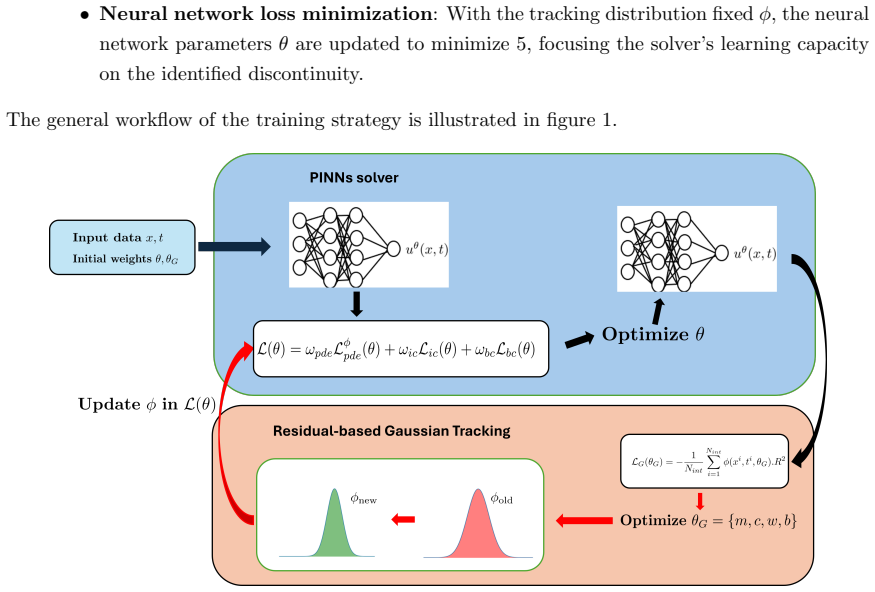
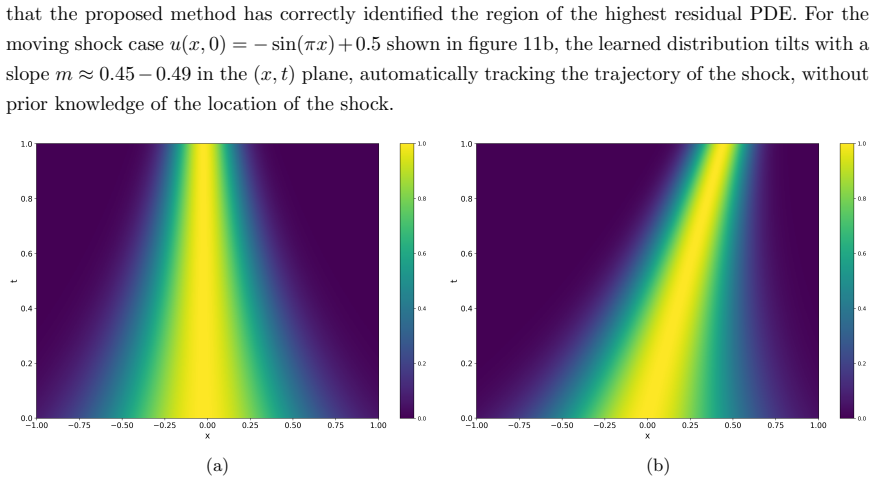
The authors establish that a spatially weighted loss based on Gaussian kernels, with parameters adapted from the residual field, enables PINNs to capture both stationary and propagating shocks in the quasi-inviscid Burgers equation. The weighting dynamically prioritizes collocation points near discontinuities detected solely from the PDE residual landscape, leading to the reported error reductions without requiring prior knowledge or manual intervention.
What carries the argument
The Gaussian-based spatially weighted loss framework, where Gaussian functions centered on high-residual areas multiply the residual terms in the training loss and their parameters are learned jointly with the neural network weights.
If this is right
- The approach removes the requirement for pre-known shock locations in PINN applications to hyperbolic conservation laws.
- It enables automatic handling of both fixed and time-dependent discontinuities in one-dimensional settings.
- The method demonstrates substantial accuracy gains specifically in the low-viscosity limit where standard PINNs struggle with sharp features.
- Autonomous adaptation from the residual makes the technique portable to other PDE problems with unknown discontinuity positions.
Where Pith is reading between the lines
- The same residual-driven Gaussian adaptation could be tested on two-dimensional or three-dimensional flow problems to check scalability.
- Integration with other PINN enhancements like adaptive point sampling might yield further improvements in shock resolution.
- This suggests residual landscapes contain enough information to locate features without explicit feature detection algorithms.
Load-bearing premise
The PDE residual landscape during optimization contains clear enough signals for the Gaussian parameters to converge on the true shock locations without additional guidance or tuning.
What would settle it
A test case where the residual has multiple local maxima or is corrupted by noise, and observation of whether the Gaussians still lock onto the physical shock and produce the claimed error levels.
Figures
read the original abstract
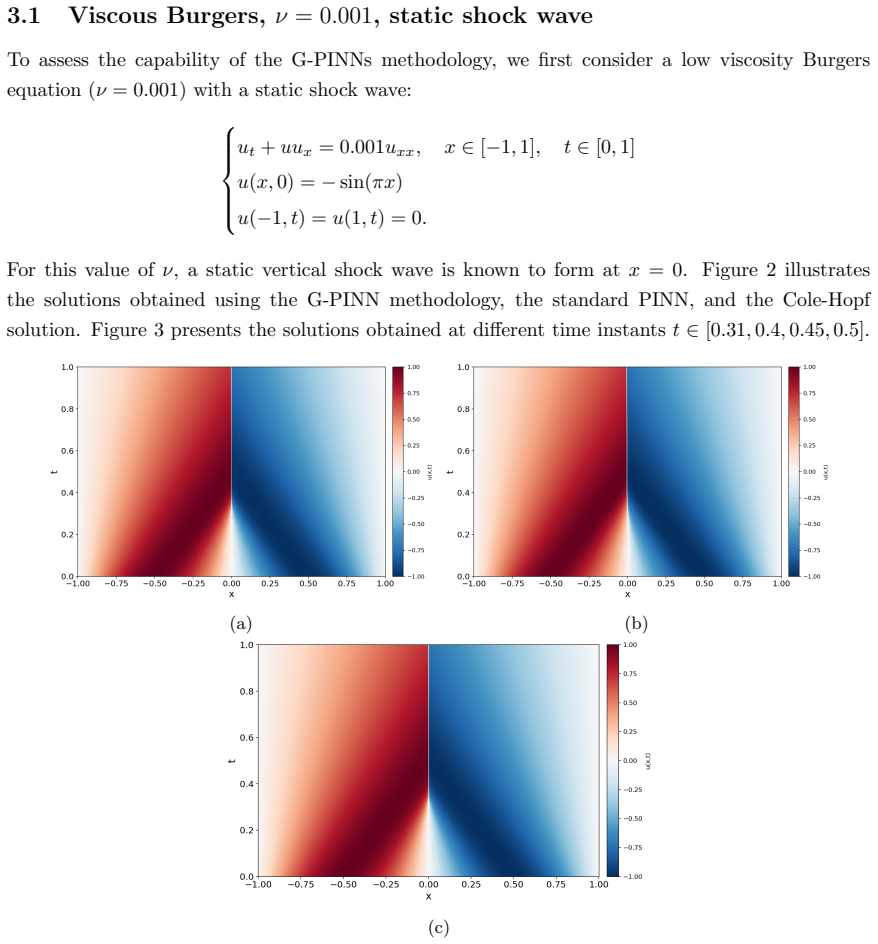
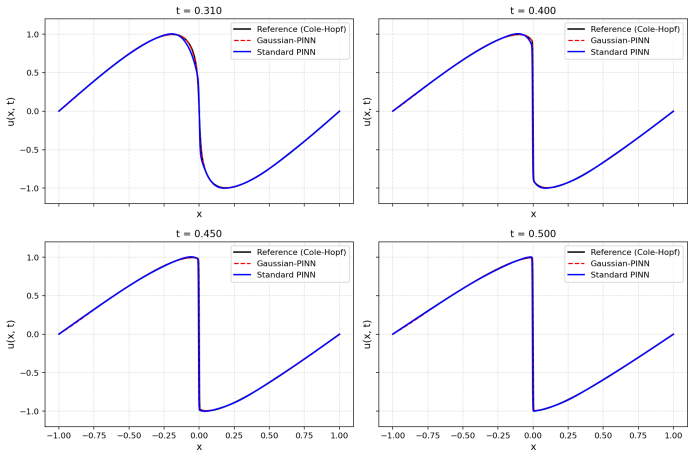
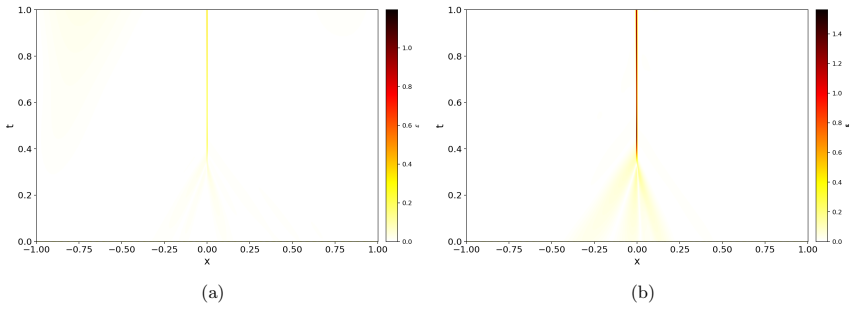
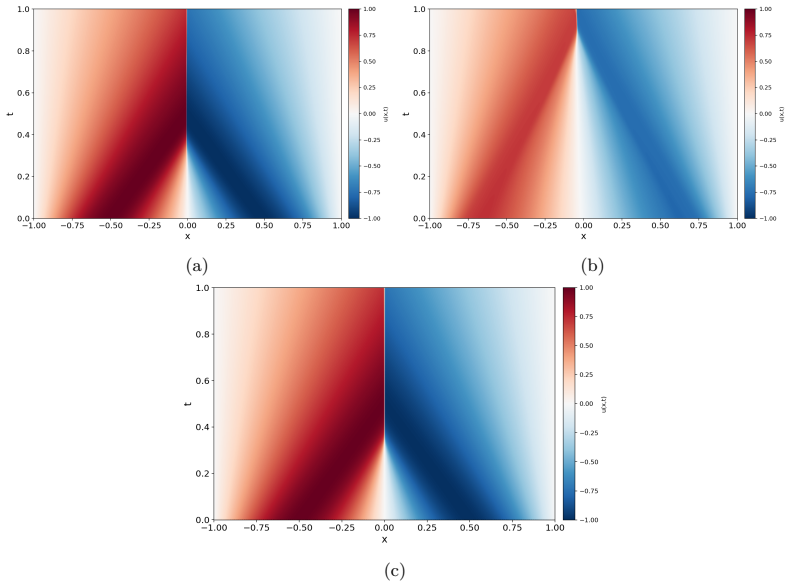
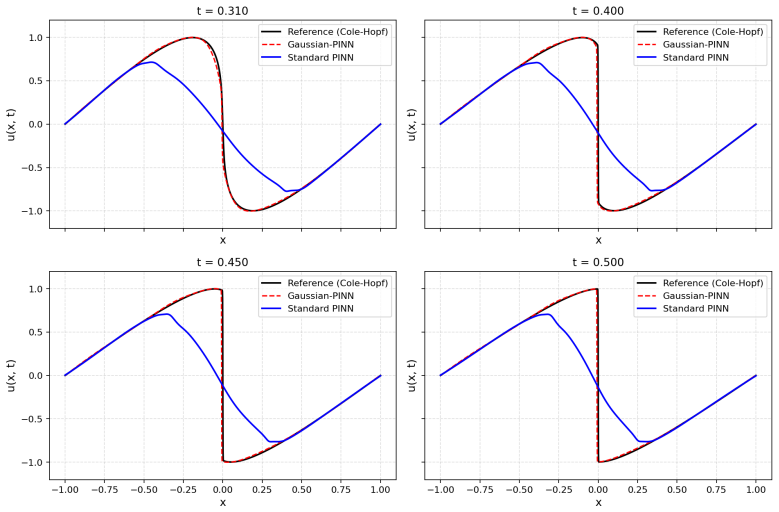
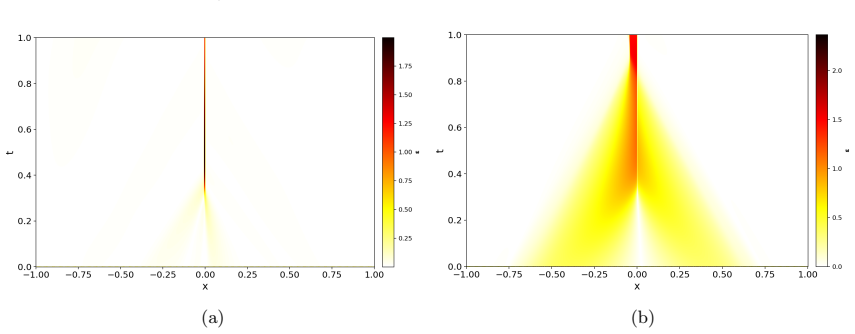
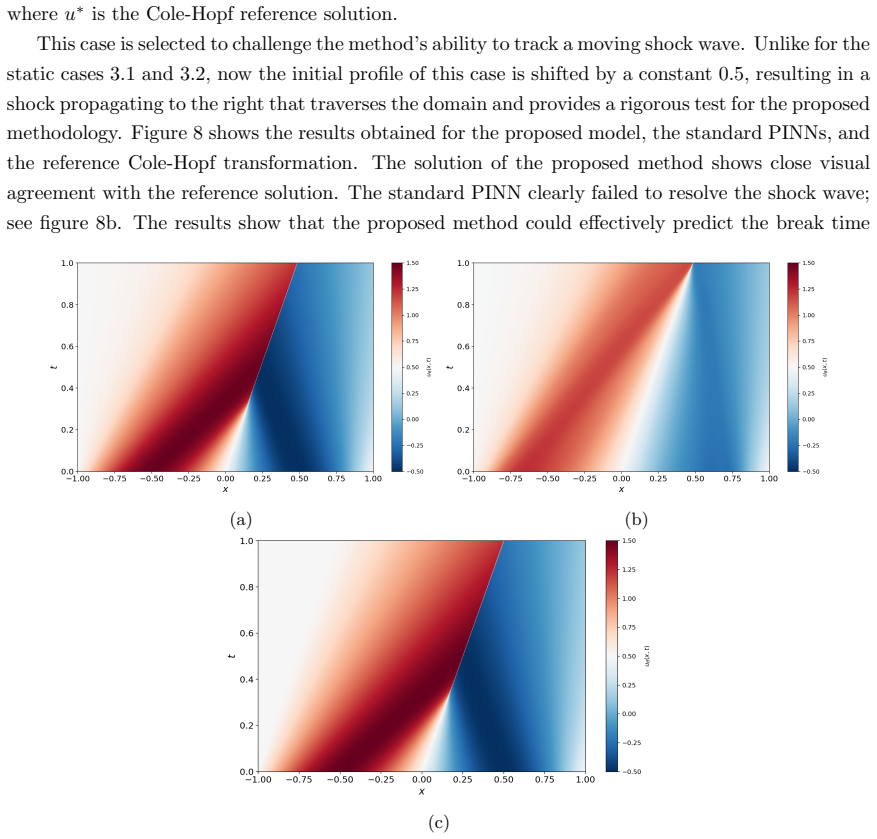
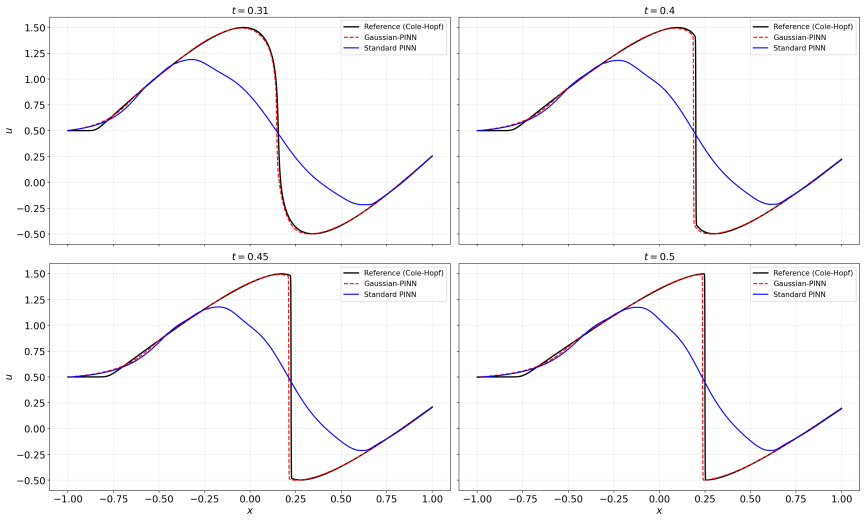
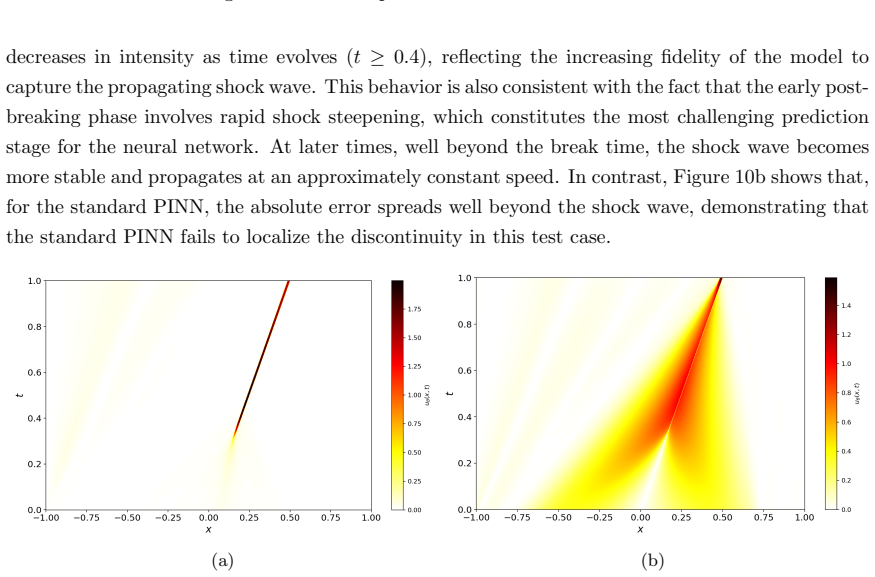
We introduce a Gaussian-based spatially weighted loss framework (G-PINNs) for physics-informed neural networks (PINNs) to improve the resolution of sharp discontinuities and shock waves. The proposed method dynamically prioritizes collocation points in high-gradient regions during optimization. Without requiring prior knowledge of the shock location or trajectory, the framework can autonomously detect and track moving discontinuities directly from the PDE residual landscape, making it broadly applicable to problems in which the position of shocks or discontinuities is unknown \textit{a priori}. The approach is validated using one-dimensional quasi-inviscid Burgers' problems exhibiting both stationary and moving shock waves. For the low-viscosity regime $(\nu = 0.0005)$, the proposed method achieves $L_2$ relative errors of approximately $13\%$ and $14\%$ for the stationary and moving shock cases, respectively, compared with $45\%$ and $33\%$ obtained when using standard PINNs.
Editorial analysis
A structured set of objections, weighed in public.
Referee Report
Summary. The manuscript introduces G-PINNs, a Gaussian-based spatially weighted loss for PINNs targeting 1D Burgers' equation at low viscosity. It claims the weighting dynamically prioritizes high-gradient collocation points, enables autonomous detection and tracking of stationary and moving shocks solely from the PDE residual landscape without prior knowledge or hand-tuned schedules, and yields L2 relative errors of approximately 13% (stationary) and 14% (moving) at ν=0.0005 versus 45% and 33% for standard PINNs.
Significance. If the autonomous adaptation mechanism proves robust, the approach could offer a practical route to improving PINN accuracy on hyperbolic problems with unknown discontinuities. The reported error reductions are large enough to be of practical interest in fluid-dynamics applications, and the absence of invented entities or free parameters in the abstract is a positive feature. However, the significance is currently constrained by the lack of any derivation, ablation studies, or robustness checks on the Gaussian-parameter update rule.
major comments (3)
- [Abstract] Abstract: the headline performance numbers (13–14% vs. 45–33% L2 error at ν=0.0005) are presented without any accompanying equations for the weighted loss, the explicit form of the Gaussian weighting function, or the update rule for the Gaussian means and variances; this leaves the central claim that the improvement arises from autonomous residual-driven adaptation unsupported by derivation.
- [Abstract] Abstract (paragraph on autonomous detection): the assertion that Gaussian parameters are optimized jointly with network weights using only the PDE residual, with no prior shock knowledge, is load-bearing for the novelty claim yet supplies neither the joint loss formulation nor any description of initialization, learning-rate schedule, or convergence criteria for the Gaussian parameters.
- [Abstract] Abstract: no ablation on Gaussian hyper-parameters (number of Gaussians, initial variance range, or adaptation frequency) or error bars from multiple random seeds is reported, so it is impossible to determine whether the observed error reduction is statistically reliable or sensitive to initialization of the Gaussian centers.
minor comments (1)
- [Abstract] The abstract uses “quasi-inviscid” without defining the precise viscosity range intended; a brief clarification would aid readers.
Simulated Author's Rebuttal
We thank the referee for the constructive feedback on our manuscript. The comments correctly identify that the abstract is concise and omits key technical details present in the main text. We address each point below and will revise the abstract to improve self-containment while preserving its brevity.
read point-by-point responses
-
Referee: [Abstract] Abstract: the headline performance numbers (13–14% vs. 45–33% L2 error at ν=0.0005) are presented without any accompanying equations for the weighted loss, the explicit form of the Gaussian weighting function, or the update rule for the Gaussian means and variances; this leaves the central claim that the improvement arises from autonomous residual-driven adaptation unsupported by derivation.
Authors: The abstract is written for brevity and focuses on results. The weighted loss, Gaussian form w(x) = ∑ exp(−(x−μ_i)²/(2σ_i²)), and residual-driven update rule for the parameters are fully derived and stated in Section 2. To better support the claims within the abstract itself, we will add one concise sentence describing the weighting function and its residual-based adaptation. revision: yes
-
Referee: [Abstract] Abstract (paragraph on autonomous detection): the assertion that Gaussian parameters are optimized jointly with network weights using only the PDE residual, with no prior shock knowledge, is load-bearing for the novelty claim yet supplies neither the joint loss formulation nor any description of initialization, learning-rate schedule, or convergence criteria for the Gaussian parameters.
Authors: The joint optimization (Gaussian parameters updated together with network weights via the PDE residual only), initialization procedure, and convergence criteria are detailed in Sections 2–3. We will insert a short clause in the abstract stating that the Gaussian parameters are optimized jointly from the residual landscape without prior shock location information. revision: yes
-
Referee: [Abstract] Abstract: no ablation on Gaussian hyper-parameters (number of Gaussians, initial variance range, or adaptation frequency) or error bars from multiple random seeds is reported, so it is impossible to determine whether the observed error reduction is statistically reliable or sensitive to initialization of the Gaussian centers.
Authors: The manuscript uses a fixed but effective hyper-parameter set identified through preliminary tuning; no systematic ablations or multi-seed statistics are currently reported. We agree this limits assessment of robustness. In revision we will add a brief sensitivity paragraph on the number of Gaussians and initial variance, together with error bars from a small number of additional seeds if space allows. revision: partial
Circularity Check
No circularity: new weighting framework validated empirically against external baseline
full rationale
The manuscript introduces G-PINNs as an algorithmic modification to the PINN loss (Gaussian spatial weighting whose parameters are optimized jointly with network weights from the PDE residual alone). Reported L2 errors (13-14% vs 45-33% at ν=0.0005) are direct numerical comparisons to unmodified PINNs on the same 1D Burgers problems; no equation, parameter fit, or uniqueness claim is shown to reduce by construction to its own inputs or to a self-citation. The derivation chain therefore remains self-contained against external benchmarks.
Axiom & Free-Parameter Ledger
Reference graph
Works this paper leans on
-
[1]
An adaptive sampling method based on expected im- provement function and residual gradient in PINNs
Liu Y, Chen L, Ding J, and Chen Y. An adaptive sampling method based on expected im- provement function and residual gradient in PINNs. IEEE Access 2024;12:92130–41
2024
-
[2]
A Residual-Based Adaptive Refinement Physics-Informed Neural Networks (RAR-PINNs) method for fifth-order KdV equation
Tian SF, Yu YX, and Li B. A Residual-Based Adaptive Refinement Physics-Informed Neural Networks (RAR-PINNs) method for fifth-order KdV equation. Chinese Physics B 2025
2025
-
[3]
Physics-informed neural networks with generalized residual- based adaptive sampling
Song X, Deng S, Fan J, and Sun Y. Physics-informed neural networks with generalized residual- based adaptive sampling. In:International Conference on Intelligent Computing. Springer. 2024:320–32
2024
-
[4]
Residual-based adap- tivity for two-phase flow simulation in porous media using physics-informed neural networks
Hanna JM, Aguado JV, Comas-Cardona S, Askri R, and Borzacchiello D. Residual-based adap- tivity for two-phase flow simulation in porous media using physics-informed neural networks. Computer Methods in Applied Mechanics and Engineering 2022;396:115100
2022
-
[5]
PACMANN: Point adaptive collocation method for ar- tificial neural networks
Visser C, Heinlein A, and Giovanardi B. PACMANN: Point adaptive collocation method for ar- tificial neural networks. Computer Methods in Applied Mechanics and Engineering 2026;452:118723
2026
-
[6]
An adaptive collocation point strategy for physics informed neural networks via the qr discrete empirical interpolation method
Celaya A, Fuentes D, and Riviere B. An adaptive collocation point strategy for physics informed neural networks via the qr discrete empirical interpolation method. arXiv e-prints 2025:arXiv– 2501
2025
-
[7]
AdaPW: An adaptive point-weighting method for training physics-informed neural networks
Li W, Wang H, Guan H, Zhou R, Zhang C, and Tao D. AdaPW: An adaptive point-weighting method for training physics-informed neural networks. Computers & Mathematics with Appli- cations 2025;198:255–73
2025
-
[8]
R-PINN: Recovery-type a-posteriori estimator enhanced adaptive PINN
Lu R, Jia J, Lee YJ, Lu Z, and Zhang CS. R-PINN: Recovery-type a-posteriori estimator enhanced adaptive PINN. Journal of Computational Physics 2026:114684
2026
-
[9]
Extended physics-informed neural networks (XPINNs): A generalized space-time domain decomposition based deep learning framework for nonlinear partial differential equations
Jagtap AD and Karniadakis GE. Extended physics-informed neural networks (XPINNs): A generalized space-time domain decomposition based deep learning framework for nonlinear partial differential equations. Communications in Computational Physics 2020;28
2020
-
[10]
hp-VPINNs: Variational physics-informed neural networks with domain decomposition
Kharazmi E, Zhang Z, and Karniadakis GE. hp-VPINNs: Variational physics-informed neural networks with domain decomposition. Computer Methods in Applied Mechanics and Engineer- ing 2021;374:113547
2021
-
[11]
Adaptive activation functions accelerate con- vergence in deep and physics-informed neural networks
Jagtap AD, Kawaguchi K, and Karniadakis GE. Adaptive activation functions accelerate con- vergence in deep and physics-informed neural networks. Journal of Computational Physics 2020;404:109136
2020
-
[12]
Simple yet effective adaptive activation functions for physics-informed neural networks
Zhang J and Ding C. Simple yet effective adaptive activation functions for physics-informed neural networks. Computer Physics Communications 2025;307:109428
2025
-
[13]
On the eigenvector bias of Fourier feature networks: From regression to solving multi-scale PDEs with physics-informed neural networks
Wang S, Wang H, and Perdikaris P. On the eigenvector bias of Fourier feature networks: From regression to solving multi-scale PDEs with physics-informed neural networks. Computer Methods in Applied Mechanics and Engineering 2021;384:113938
2021
-
[14]
Fourier feature-embedded physics-informed neural networks for geometrically nonlinear topology optimization
Jeong P, Challis V, and Gu Y. Fourier feature-embedded physics-informed neural networks for geometrically nonlinear topology optimization. In:World Congress on Structural and Multidis- ciplinary Optimization. 16th. 2025:374. 18
2025
-
[15]
Implicit neural representa- tions with periodic activation functions
Sitzmann V, Martel J, Bergman A, Lindell D, and Wetzstein G. Implicit neural representa- tions with periodic activation functions. Advances in neural information processing systems 2020;33:7462–73
2020
-
[16]
A study on shock capturing in the Burgers’ equation based on RH-piecewise PINNs
Han J, Chen J, Hu F, and Mei L. A study on shock capturing in the Burgers’ equation based on RH-piecewise PINNs. Computers & Mathematics with Applications 2025;199:309–24
2025
-
[17]
Self-adaptive physics-informed neural networks using a soft attention mecha- nism
Braga-Neto L. Self-adaptive physics-informed neural networks using a soft attention mecha- nism. 2021
2021
-
[18]
Heydari AA, Thompson CA, and Mehmood A. Softadapt: Techniques for adaptive loss weight- ing of neural networks with multi-part loss functions. arXiv preprint arXiv:1912.12355 2019
arXiv 1912
-
[19]
wbPINN: Weight balanced physics-informed neural networks for multi-objective learning
Cao F, Guo X, Dong X, and Yuan D. wbPINN: Weight balanced physics-informed neural networks for multi-objective learning. Applied Soft Computing 2025;170:112632
2025
-
[20]
Enhancement of physics-informed neural networks in appli- cations to fluid dynamics
Mochalin I, Wang J, Cai J, et al. Enhancement of physics-informed neural networks in appli- cations to fluid dynamics. Physics of Fluids 2025;37
2025
-
[21]
DDR-PINN: A Dynamic Domain–Gradient Reweighting Physics-Informed Neural Network
Lei S, Gulnar B, Yang C, Kunicina N, Grants R, and Grunde U. DDR-PINN: A Dynamic Domain–Gradient Reweighting Physics-Informed Neural Network. Applied Sciences 2026;16:2366
2026
-
[22]
Zhou H, Cao Y, and Zhao Y. Physics-guided curriculum learning for the identification of reaction-diffusion dynamics from partial observations. arXiv preprint arXiv:2601.17382 2026
Pith/arXiv arXiv 2026
-
[23]
Abbas N, Colao V, Macri D, and Spataro W. A Multi-Phase Dual-PINN Framework: Soft Boundary-Interior Specialization via Distance-Weighted Priors. arXiv preprint arXiv:2511.23409 2025
arXiv 2025
-
[24]
Enhanced physics-informed neural networks with augmented Lagrangian relaxation method (AL-PINNs)
Son H, Cho SW, and Hwang HJ. Enhanced physics-informed neural networks with augmented Lagrangian relaxation method (AL-PINNs). Neurocomputing 2023;548:126424
2023
-
[25]
Gaussian Causal Physics-Informed Neural Networks
Lian X and Chen L. Gaussian Causal Physics-Informed Neural Networks. In:Proceedings of the 2025 3rd International Conference on Mathematics and Machine Learning. ICMML ’25. Association for Computing Machinery, 2026:193–9.doi:10 . 1145 / 3783779 . 3783812.url: https://doi.org/10.1145/3783779.3783812
-
[26]
Physics-informed neural networks: A deep learning framework for solving forward and inverse problems involving nonlinear partial differential equations
Raissi M, Perdikaris P, and Karniadakis G. Physics-informed neural networks: A deep learning framework for solving forward and inverse problems involving nonlinear partial differential equations. Journal of Computational Physics 2019;378:686–707
2019
-
[27]
The partial differential equation ut + uux =µxx
Hopf E. The partial differential equation ut + uux =µxx. Communications on Pure and Applied Mathematics 1950;3:201–30. 19
1950
discussion (0)
Sign in with ORCID, Apple, or X to comment. Anyone can read and Pith papers without signing in.