Interfacial Spectral Memory as a State Variable for Finite-Depth Salt-Finger Exchange
Pith reviewed 2026-06-25 19:08 UTC · model grok-4.3
The pith
Simulations show the inherited roughness spectrum of a finite thermohaline interface alters salt-finger exchange rates and development pathways.
A machine-rendered reading of the paper's core claim, the machinery that carries it, and where it could break.
Core claim
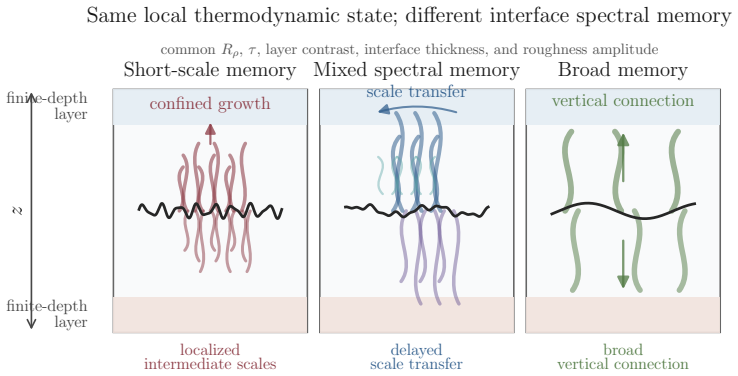
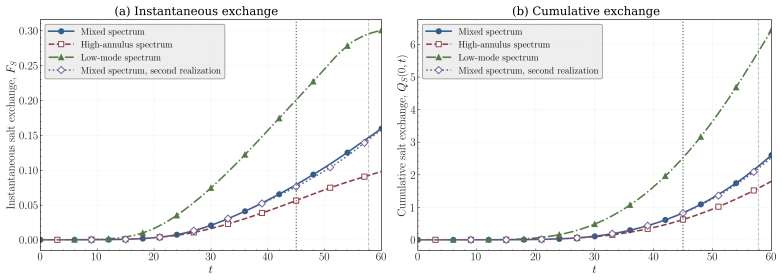
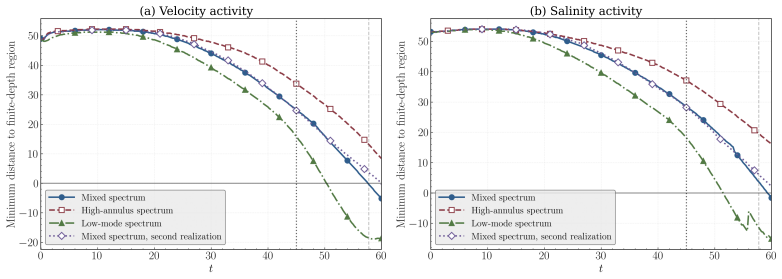
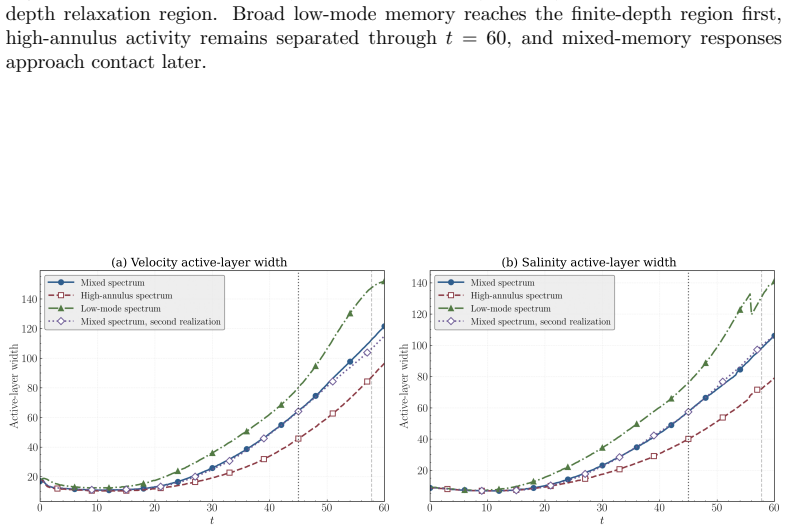
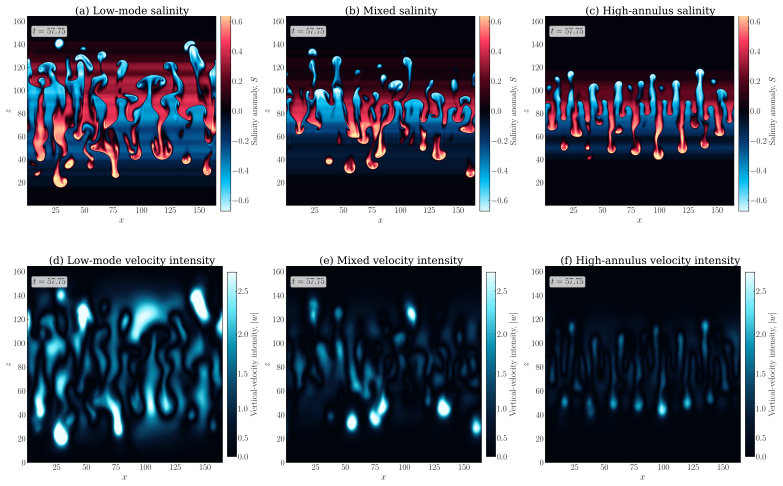
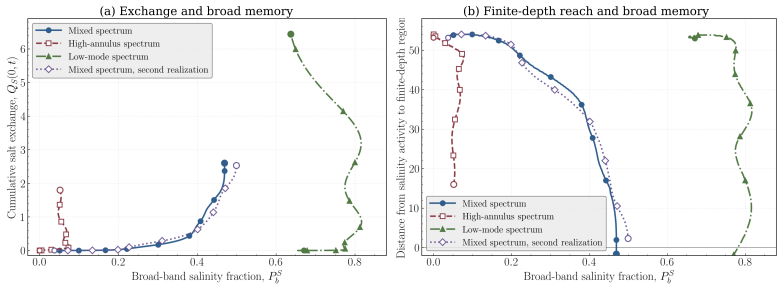
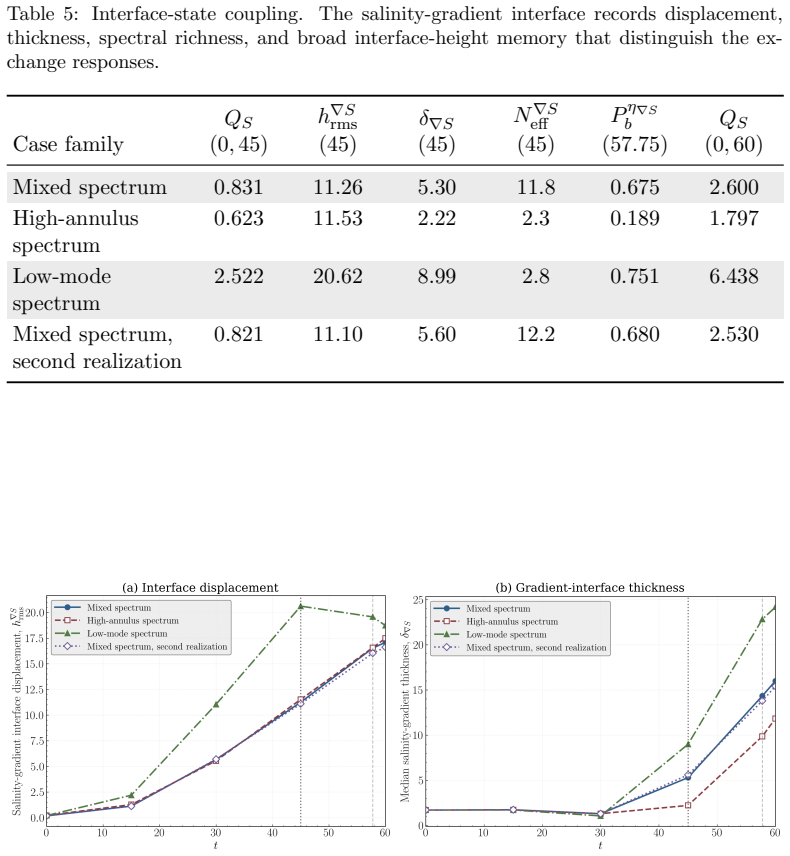
Controlled three-dimensional direct simulations demonstrate that varying only the imposed roughness spectrum of a finite interface, while keeping all other parameters fixed, produces distinct pathways of salt-finger activity: broad low-mode memory yields the largest cumulative salt exchange and earliest finite-depth contact, high-annulus memory remains localized and intermediate-scale dominated, and mixed memory produces delayed scale transfer with scalar-rich structures that prove robust in integrated exchange across a second realization. The simulations therefore support treating interfacial spectral memory as an additional state variable for finite-depth double-diffusive exchange, complem
What carries the argument
Interfacial spectral memory: the inherited roughness spectrum of a finite interface that sets the initial conditions for salt-finger instability development.
If this is right
- Broad low-mode spectral memory produces the largest cumulative salt exchange.
- High-annulus spectral memory keeps activity localized and intermediate-scale dominated.
- Mixed spectral memory delays scale transfer yet yields robust integrated exchange across realizations.
- Local plume timing and probe amplitudes remain sensitive to realization even when integrated measures do not.
- Spectral memory functions as a state variable complementary to local thermodynamic descriptors.
Where Pith is reading between the lines
- Ocean mixing parameterizations could track interface spectral history in addition to instantaneous density ratio to improve vertical transport estimates.
- The finding suggests that regions with intermittent prior stirring may sustain systematically different double-diffusive fluxes than smooth-interface assumptions predict.
- Testing whether spectral memory persists or decays under time-evolving interfaces would clarify how long the state variable remains relevant.
- Extending the same controlled-spectrum approach to diffusive-convection regimes could reveal whether the memory effect is specific to salt fingering or general to double diffusion.
Load-bearing premise
Varying only the imposed roughness spectrum while holding every other parameter fixed isolates the effect of spectral memory without confounding influences from the numerical setup or chosen spectra.
What would settle it
A set of simulations in which two interfaces with identical local thermodynamic properties and different roughness spectra exhibit identical salt-exchange rates and identical finger-development pathways would falsify the central claim.
Figures
read the original abstract
Thermohaline interfaces in the ocean are often treated through local double-diffusive favorability, yet finite interfaces can also inherit roughness from prior waves, stirring, intrusions, and earlier mixing events. Such inherited geometry can matter because salt fingering does not develop from a flat abstract surface in many geophysical settings. We use controlled three-dimensional direct simulations to test whether the spectral state of a finite rough interface changes the pathway by which salt-finger activity develops between adjacent layers. The density ratio, diffusivity ratio, Prandtl number, interface thickness, roughness amplitude, domain, resolution, and analysis window are held fixed; only the imposed roughness spectrum and, for one pair, the realization are changed. Broad low-mode memory produces the largest cumulative salt exchange and the earliest finite-depth contact. High-annulus memory remains localized and intermediate-scale dominated. Mixed memory produces delayed scale transfer and scalar-rich structure that is robust in integrated exchange and broad-memory measures across a second realization, while local plume timing and probe amplitudes remain realization-sensitive. The simulations therefore support treating interfacial spectral memory as an additional state variable for finite-depth double-diffusive exchange, complementary to local thermodynamic descriptors.
Editorial analysis
A structured set of objections, weighed in public.
Referee Report
Summary. The manuscript uses controlled three-dimensional direct numerical simulations of salt-fingering across finite thermohaline interfaces. With density ratio, diffusivity ratio, Prandtl number, interface thickness, roughness amplitude, domain, resolution, and analysis window held fixed, only the imposed roughness spectrum (and one realization pair) is varied. The results indicate that broad low-mode memory produces the largest cumulative salt exchange and earliest finite-depth contact, high-annulus memory remains localized and intermediate-scale dominated, and mixed memory yields delayed scale transfer with realization-sensitive local timing but robust integrated exchange. The authors conclude that interfacial spectral memory functions as an additional state variable complementary to local thermodynamic descriptors for finite-depth double-diffusive exchange.
Significance. If the differences are shown to be robust, the work identifies a potentially important role for inherited interface geometry spectra in controlling double-diffusive pathways, which could inform subgrid parameterizations in ocean models beyond purely local stability criteria. The simulation design that isolates spectral variation while fixing other scalars is a methodological strength.
major comments (2)
- [Abstract] Abstract and results description: the central claim that spectral memory alters exchange pathways rests entirely on qualitative descriptions of simulation outcomes. No quantitative metrics (e.g., integrated salt flux values, contact times with uncertainties), error analysis, or verification that differences exceed numerical artifacts or inter-realization variability are reported, leaving the load-bearing inference unsupported by the presented evidence.
- [Methods] Methods (implied by abstract): the concrete numerical procedure used to construct the initial interface matching each target roughness spectrum (Fourier amplitude/phase assignment, profile enforcement, or filtering steps) is not described. Systematic differences in these steps across spectra could introduce uncontrolled variations in local gradients or stability, confounding attribution of pathway changes solely to spectral memory as an independent state variable.
minor comments (1)
- [Abstract] The abstract refers to 'one pair' of realizations for mixed memory but does not specify the total number of simulations performed or the precise spectral definitions (e.g., wavenumber ranges for 'broad low-mode' versus 'high-annulus').
Simulated Author's Rebuttal
We thank the referee for the detailed review and for recognizing the methodological strength of isolating spectral variation. We address the two major comments below and will revise the manuscript accordingly to strengthen the evidence and clarity.
read point-by-point responses
-
Referee: [Abstract] Abstract and results description: the central claim that spectral memory alters exchange pathways rests entirely on qualitative descriptions of simulation outcomes. No quantitative metrics (e.g., integrated salt flux values, contact times with uncertainties), error analysis, or verification that differences exceed numerical artifacts or inter-realization variability are reported, leaving the load-bearing inference unsupported by the presented evidence.
Authors: We agree that the manuscript as submitted relies primarily on qualitative characterizations of the differing pathways (largest cumulative exchange and earliest contact for broad low-mode memory; localized intermediate-scale dominance for high-annulus memory; delayed transfer yet robust integrated exchange for mixed memory). While the simulation outcomes demonstrate clear distinctions under the controlled conditions, the absence of explicit quantitative metrics, uncertainties, and direct comparison to numerical or realization variability does leave the central inference less strongly supported than it could be. In the revised manuscript we will add quantitative values for integrated salt fluxes and contact times, include an assessment of inter-realization variability for the mixed case, and discuss consistency with respect to numerical artifacts. revision: yes
-
Referee: [Methods] Methods (implied by abstract): the concrete numerical procedure used to construct the initial interface matching each target roughness spectrum (Fourier amplitude/phase assignment, profile enforcement, or filtering steps) is not described. Systematic differences in these steps across spectra could introduce uncontrolled variations in local gradients or stability, confounding attribution of pathway changes solely to spectral memory as an independent state variable.
Authors: The referee is correct that the manuscript does not provide the explicit algorithmic steps used to generate each target roughness spectrum while preserving the fixed interface thickness and amplitude. This omission could reasonably raise concerns about unintended differences in local gradients. We will expand the methods section to document the precise Fourier amplitude and phase assignment procedure, any profile enforcement or filtering operations, and verification that the resulting initial fields satisfy the same mean thickness and roughness amplitude constraints across all cases. revision: yes
Circularity Check
No circularity; claim is direct inference from controlled simulations
full rationale
The paper reports outcomes from 3D direct numerical simulations in which density ratio, diffusivity ratio, Prandtl number, interface thickness, roughness amplitude, domain, resolution, and analysis window are held fixed while only the imposed roughness spectrum (and one realization) is varied. The central claim—that interfacial spectral memory acts as an additional state variable—is presented as an inference supported by the observed differences in salt exchange, contact timing, and structure. No equations, parameter-fitting procedures, self-citations, or ansatzes are described that would reduce any prediction to its inputs by construction. The derivation chain is therefore self-contained against external simulation benchmarks.
Axiom & Free-Parameter Ledger
axioms (1)
- domain assumption Salt fingering does not develop from a flat abstract surface in many geophysical settings
Reference graph
Works this paper leans on
-
[1]
, title =
Stern, Melvin E. , title =. Tellus , volume =. 1960 , doi =
1960
-
[2]
and Blanchard, Duncan , title =
Stommel, Henry and Arons, Arnold B. and Blanchard, Duncan , title =. Deep-Sea Research , volume =. 1956 , doi =
1956
-
[3]
Proceedings of the National Academy of Sciences of the United States of America , volume =
Turner, John Stewart and Stommel, Henry , title =. Proceedings of the National Academy of Sciences of the United States of America , volume =. 1964 , doi =
1964
-
[4]
, title =
Stern, Melvin E. , title =. Journal of Fluid Mechanics , volume =. 1969 , doi =
1969
-
[5]
and Turner, John Stewart , title =
Stern, Melvin E. and Turner, John Stewart , title =. Deep-Sea Research and Oceanographic Abstracts , volume =. 1969 , doi =
1969
-
[6]
Annual Review of Fluid Mechanics , volume =
Turner, John Stewart , title =. Annual Review of Fluid Mechanics , volume =. 1974 , doi =
1974
-
[7]
Turner, John Stewart , title =
-
[8]
and Turner, John Stewart , title =
Huppert, Herbert E. and Turner, John Stewart , title =. Journal of Fluid Mechanics , volume =. 1981 , doi =
1981
-
[9]
Annual Review of Fluid Mechanics , volume =
Turner, John Stewart , title =. Annual Review of Fluid Mechanics , volume =. 1985 , doi =
1985
-
[10]
Radko, Timour , title =
-
[11]
, title =
Schmitt, Raymond W. , title =. Deep-Sea Research Part A , volume =. 1979 , doi =
1979
-
[12]
, title =
Schmitt, Raymond W. , title =. Journal of Physical Oceanography , volume =. 1981 , doi =
1981
-
[13]
, title =
Ruddick, Barry R. , title =. Deep-Sea Research Part A , volume =. 1983 , doi =
1983
-
[14]
Holyer, J. Y. , title =. Journal of Fluid Mechanics , volume =. 1984 , doi =
1984
-
[15]
Journal of Marine Research , volume =
Kunze, Eric , title =. Journal of Marine Research , volume =. 1987 , doi =
1987
-
[16]
, title =
Gargett, Ann E. , title =. Progress in Oceanography , volume =. 2003 , doi =
2003
-
[17]
Deep-Sea Research Part I , volume =
You, Yuzhu , title =. Deep-Sea Research Part I , volume =. 2002 , doi =
2002
-
[18]
and Ledwell, James R
Schmitt, Raymond W. and Ledwell, James R. and Montgomery, Ellyn T. and Polzin, Kurt L. and Toole, John M. , title =. Science , volume =. 2005 , doi =
2005
-
[19]
, title =
Schmitt, Raymond W. , title =. Annual Review of Fluid Mechanics , volume =. 1994 , doi =
1994
-
[20]
Journal of Fluid Mechanics , volume =
Radko, Timour , title =. Journal of Fluid Mechanics , volume =. 2003 , doi =
2003
-
[21]
, title =
Merryfield, William J. , title =. Journal of Physical Oceanography , volume =. 2000 , doi =
2000
-
[22]
Kelley, D. E. and Fernando, H. J. S. and Gargett, A. E. and Tanny, J. and Ozsoy, E. , title =. Progress in Oceanography , volume =. 2003 , doi =
2003
-
[23]
and Flanagan, J
Radko, Timour and Bulters, A. and Flanagan, J. D. and Campin, Jean-Michel , title =. Journal of Physical Oceanography , volume =. 2014 , doi =
2014
-
[24]
Direct Numerical Simulation of 3D Salt Fingers: From Secondary Instability to Chaotic Convection
Simeonov, Julian A. and Stern, Melvin E. and Radko, Timour , title =. 2009 , eprint =. doi:10.48550/arXiv.0910.2434 , url =
work page internal anchor Pith review Pith/arXiv arXiv doi:10.48550/arxiv.0910.2434 2009
-
[25]
and Stellmach, Stephan and Garaud, Pascale and Radko, Timour and Brummell, Nicholas , title =
Traxler, Adrienne L. and Stellmach, Stephan and Garaud, Pascale and Radko, Timour and Brummell, Nicholas , title =. Journal of Fluid Mechanics , volume =. 2011 , doi =
2011
-
[26]
and Garaud, Pascale and Stellmach, Stephan , title =
Brown, Justin M. and Garaud, Pascale and Stellmach, Stephan , title =. The Astrophysical Journal , volume =. 2013 , doi =
2013
-
[27]
Annual Review of Fluid Mechanics , volume =
Garaud, Pascale , title =. Annual Review of Fluid Mechanics , volume =. 2018 , doi =
2018
-
[28]
and Krishfield, Richard and Winsor, Peter , title =
Timmermans, Mary-Louise and Toole, John M. and Krishfield, Richard and Winsor, Peter , title =. Journal of Geophysical Research: Oceans , volume =. 2008 , doi =
2008
-
[29]
and Timmermans, Mary-Louise and Carpenter, Jeffrey R
Shibley, Nicole C. and Timmermans, Mary-Louise and Carpenter, Jeffrey R. and Toole, John M. , title =. Journal of Geophysical Research: Oceans , volume =. 2017 , doi =
2017
-
[30]
Geophysical Research Letters , volume =
Durante, Salvatore and Schroeder, Katrin and Mazzei, Lorenzo and Pierini, Stefano and Borghini, Mireno , title =. Geophysical Research Letters , volume =. 2019 , doi =
2019
-
[31]
and Garaud, Pascale and Brummell, Nicholas and Radko, Timour , title =
Stellmach, Stephan and Traxler, Adrienne L. and Garaud, Pascale and Brummell, Nicholas and Radko, Timour , title =. Journal of Fluid Mechanics , volume =. 2011 , doi =
2011
-
[32]
Silvestri, Simone and Wagner, Gregory L. and Hill, Christopher and Raayai Ardakani, Matin and Blaschke, Johannes and Campin, Jean-Michel and Churavy, Valentin and Constantinou, Navid C. and Edelman, Alan and Marshall, John and Ramadhan, Ali and Souza, Andre and Ferrari, Raffaele , title =. 2023 , eprint =. doi:10.48550/arXiv.2309.06662 , url =
-
[33]
and Hill, Chris and Campin, Jean-Michel and Churavy, Valentin and Souza, Andre and Edelman, Alan and Ferrari, Raffaele and Marshall, John , title =
Ramadhan, Ali and Wagner, Gregory L. and Hill, Chris and Campin, Jean-Michel and Churavy, Valentin and Souza, Andre and Edelman, Alan and Ferrari, Raffaele and Marshall, John , title =. Journal of Open Source Software , volume =. 2020 , doi =
2020
-
[34]
L., Silvestri, S., Constantinou, N
Wagner, Gregory L. and Silvestri, Simone and Constantinou, Navid C. and Ramadhan, Ali and Campin, Jean-Michel and Hill, Chris and Chor, Tomas and Strong-Wright, Jago and Lee, Xin Kai and Poulin, Francis and Souza, Andre and Burns, Keaton J. and Bishnu, Siddhartha and Marshall, John and Ferrari, Raffaele , title =. 2025 , eprint =. doi:10.48550/arXiv.2502....
-
[35]
Kalathoor, Sriram P. , title =. 2026 , publisher =. doi:10.5281/zenodo.20756111 , url =
-
[36]
Kalathoor, Sriram P. , title =. 2026 , publisher =. doi:10.5281/zenodo.20806266 , url =
discussion (0)
Sign in with ORCID, Apple, or X to comment. Anyone can read and Pith papers without signing in.