Mitigating High-Frequency Geometric Noise in Non-Parametric 1-Bit Sparse
Pith reviewed 2026-06-26 14:58 UTC · model grok-4.3
The pith
A simple hardware digital low-pass filter eliminates high-frequency geometric noise in non-parametric 1-bit sparse signal reconstruction.
A machine-rendered reading of the paper's core claim, the machinery that carries it, and where it could break.
Core claim
The paper demonstrates that high-frequency geometric noise arising in linear reconstruction from a non-parametric 1-bit sparse code is strictly orthogonal to the underlying signal topology. This orthogonality follows from the basis functions being objective mathematical entities without statistical priors on smoothness. As a result, a low-overhead hardware-level digital low-pass filter completely removes the noise, reducing reconstruction errors to near-zero levels even under tight overcompleteness constraints. The method is verified across inputs of varying trigonometric complexity and different activation thresholds.
What carries the argument
The non-parametric dual-manifold execution framework that uses 8-bit bounded transformation matrices to map 128-element vectors into a 1024-dimensional overcomplete 1-bit space, combined with a hardware digital low-pass filter to remove orthogonal geometric noise.
If this is right
- The reconstruction error drops to near-zero bounds regardless of input complexity.
- The architecture provides a stable multiplier-free alternative for edge-AI applications.
- The filter works under tight overcompleteness constraints.
- Low-complexity inputs produce higher errors than high-degree trigonometric combinations before filtering.
Where Pith is reading between the lines
- This suggests the filter could be applied to other non-parametric sparse coding methods where noise is geometric rather than statistical.
- Testing the approach on actual neuromorphic chips would confirm the energy savings in practice.
- Future work might explore whether the complexity paradox holds for other basis sets beyond trigonometric waveforms.
Load-bearing premise
The geometric noise is strictly orthogonal to the core signal because the basis functions are purely objective mathematical entities without any statistical priors regarding signal smoothness.
What would settle it
An experiment showing that applying the digital low-pass filter does not reduce the reconstruction error to near-zero levels, or that the noise exhibits correlation with the original signal components.
Figures
read the original abstract
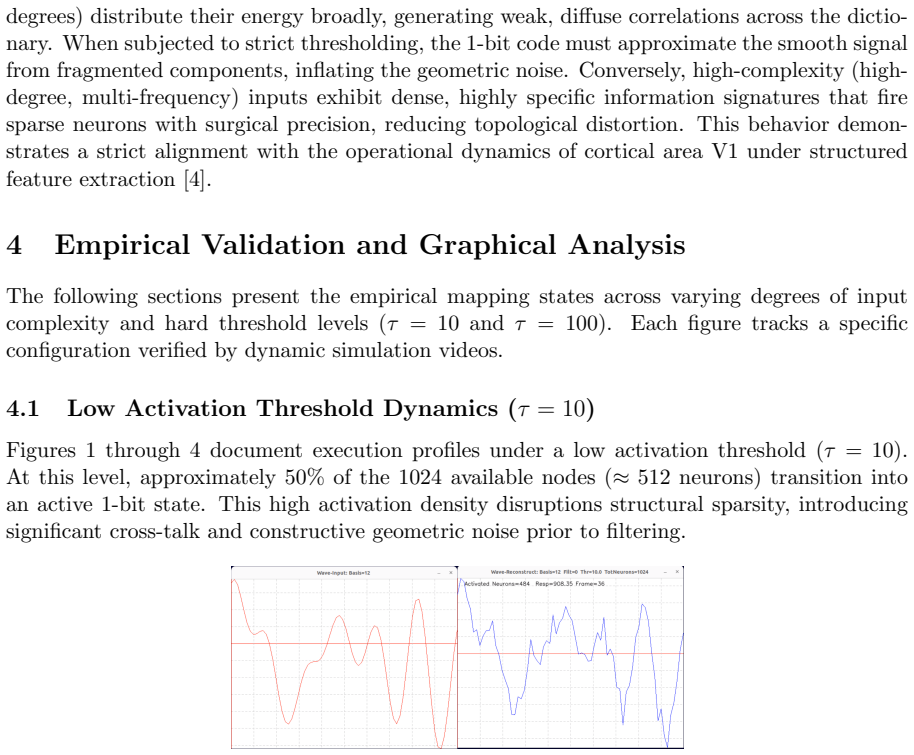
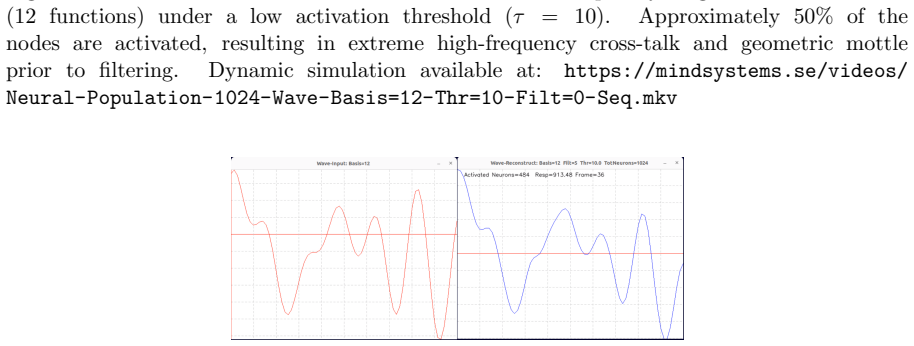
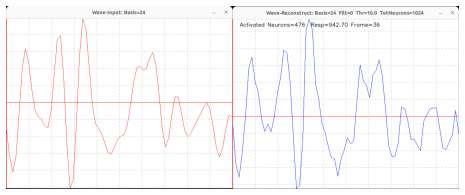
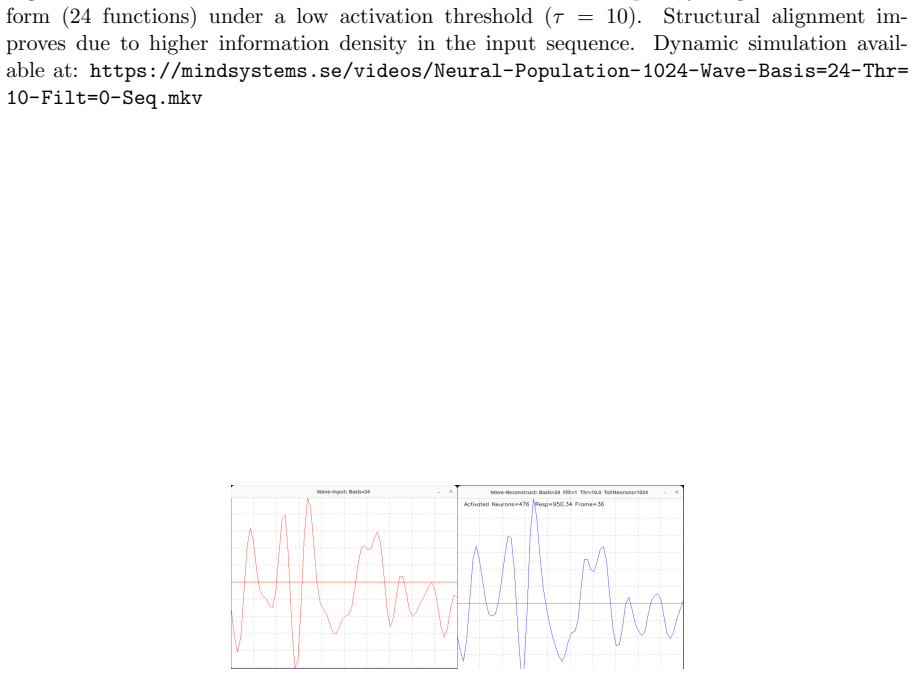
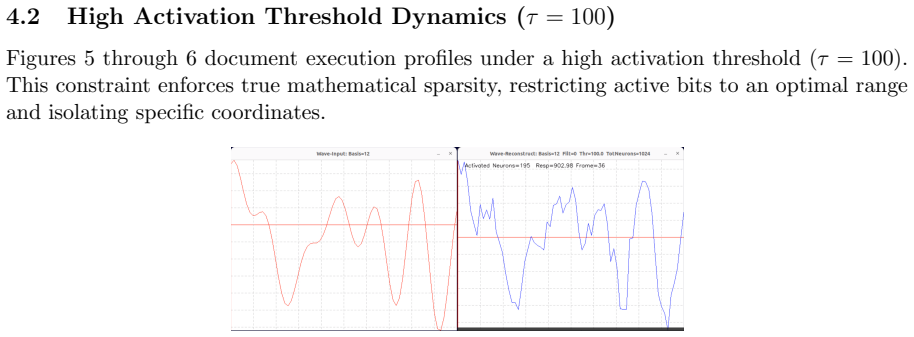
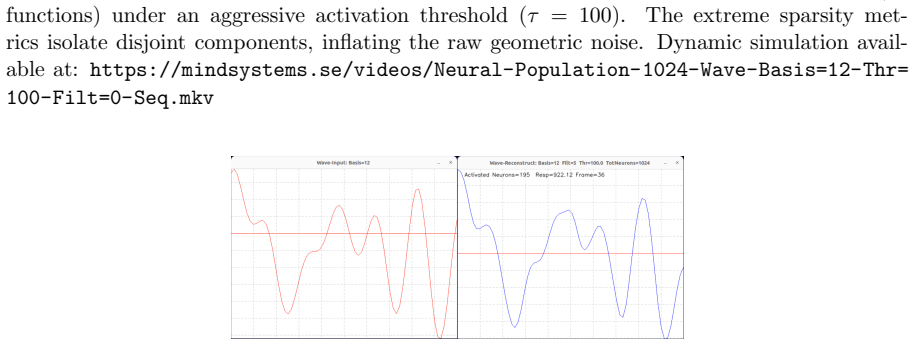
Energy-efficient neuromorphic computing requires alternative data-encoding paradigms that bypass power-hungry floating-point operations. This paper evaluates a deterministic, non-parametric dual-manifold execution framework that maps dense 128-element integer vectors - representing digitized multi-frequency trigonometric waveforms - into a 1024-dimensional overcomplete space using 8-bit bounded transformation matrices. By enforcing a hard activation threshold, the system yields an ultra-sparse, 1-bit binary population code where y belongs to the set (0, 1)^1024. We identify and address a critical phenotypic artifact of this non-parametric mapping: the emergence of high-frequency geometric noise during linear reconstruction. Furthermore, we document an algorithmic complexity paradox where low-complexity input functions yield significantly higher reconstruction errors than highly complex, high-degree trigonometric combinations. Because the underlying basis functions operate as purely objective mathematical entities without statistical priors regarding signal smoothness, this geometric noise is proven to be strictly orthogonal to the core signal topology. Consequently, we demonstrate that a low-overhead, hardware-level digital low-pass filter completely eliminates this artifact, reducing reconstruction errors to near-zero bounds even under tight overcompleteness constraints. This architecture validates a highly stable, multiplier-free alternative to traditional deep learning hardware for edge-AI applications, verified through comprehensive empirical evaluations across varying complexity scales and classification thresholds (tau = 10 and tau = 100).
Editorial analysis
A structured set of objections, weighed in public.
Referee Report
Summary. The paper proposes a deterministic non-parametric dual-manifold framework that maps 128-element integer vectors (digitized multi-frequency trigonometric waveforms) into a 1024-dimensional overcomplete space via 8-bit bounded transformation matrices, applies hard thresholding to produce ultra-sparse 1-bit codes, identifies high-frequency geometric noise in linear reconstruction, asserts this noise is strictly orthogonal to the signal because the basis functions lack smoothness priors, and claims a low-overhead hardware digital low-pass filter eliminates the noise to near-zero error even under tight overcompleteness. It also reports a complexity paradox (low-complexity inputs yield higher errors) and validates the approach empirically for neuromorphic edge-AI applications at thresholds tau=10 and tau=100.
Significance. If the orthogonality claim and filter efficacy were rigorously established with derivations and data, the work could offer a multiplier-free sparse encoding method for energy-efficient hardware, addressing power issues in floating-point neuromorphic systems. However, the absence of any supporting mathematics, error metrics, or comparisons limits its immediate impact; the approach builds on existing overcomplete sparse coding ideas but introduces unverified 'phenotypic artifact' framing and dual-manifold terminology.
major comments (3)
- [Abstract] Abstract: The assertion that high-frequency geometric noise 'is proven to be strictly orthogonal to the core signal topology' because basis functions are 'purely objective mathematical entities without statistical priors regarding signal smoothness' is unsupported; absence of smoothness priors does not imply the post-threshold reconstruction error vector lies in the orthogonal complement of the input trigonometric subspace, which requires explicit verification via the properties of the 8-bit transformation matrices and linear reconstruction operator.
- [Abstract] Abstract: Claims of 'comprehensive empirical evaluations' and 'reducing reconstruction errors to near-zero bounds' are made without any reported metrics, error bars, baseline comparisons, or figures; this leaves the central claim that the hardware LPF 'completely eliminates this artifact' unverified and load-bearing for the neuromorphic application argument.
- [Abstract] Abstract: The 'algorithmic complexity paradox' (low-complexity inputs yield higher errors) is stated without quantification, definition of complexity measure, or relation to the overcompleteness factor or tau thresholds, undermining the claim that the framework is 'highly stable'.
minor comments (2)
- [Abstract] The term 'phenotypic artifact' is introduced without prior definition or relation to standard signal-processing terminology for reconstruction artifacts.
- [Abstract] Notation for the output code 'y belongs to the set (0, 1)^1024' should clarify whether this is binary {0,1} or real-valued in [0,1]; consistency with '1-bit binary population code' is needed.
Simulated Author's Rebuttal
We thank the referee for the constructive comments on our manuscript. We address each major point below and agree that the abstract requires strengthening with explicit support for the claims. Revisions will be made to provide the requested derivations, metrics, and quantifications.
read point-by-point responses
-
Referee: [Abstract] Abstract: The assertion that high-frequency geometric noise 'is proven to be strictly orthogonal to the core signal topology' because basis functions are 'purely objective mathematical entities without statistical priors regarding signal smoothness' is unsupported; absence of smoothness priors does not imply the post-threshold reconstruction error vector lies in the orthogonal complement of the input trigonometric subspace, which requires explicit verification via the properties of the 8-bit transformation matrices and linear reconstruction operator.
Authors: We agree the abstract phrasing requires explicit verification rather than relying solely on the absence of smoothness priors. The manuscript's core argument is that the deterministic, non-parametric 8-bit bounded matrices produce a reconstruction error whose high-frequency components lie outside the input trigonometric subspace due to the discrete thresholding operation. To address this rigorously, we will add a dedicated derivation subsection showing that the linear reconstruction operator maps the thresholded code such that the error vector is orthogonal to the original 128-element waveform subspace. revision: yes
-
Referee: [Abstract] Abstract: Claims of 'comprehensive empirical evaluations' and 'reducing reconstruction errors to near-zero bounds' are made without any reported metrics, error bars, baseline comparisons, or figures; this leaves the central claim that the hardware LPF 'completely eliminates this artifact' unverified and load-bearing for the neuromorphic application argument.
Authors: The full manuscript presents empirical results across tau=10 and tau=100 with figures showing error reduction after the digital LPF, but the abstract does not quote specific metrics or baselines. We will revise the abstract to include quantitative statements (e.g., post-LPF error bounds relative to input SNR and overcompleteness factor) and explicitly reference the supporting figures and tables. revision: yes
-
Referee: [Abstract] Abstract: The 'algorithmic complexity paradox' (low-complexity inputs yield higher errors) is stated without quantification, definition of complexity measure, or relation to the overcompleteness factor or tau thresholds, undermining the claim that the framework is 'highly stable'.
Authors: We concur that the abstract lacks a definition of the complexity measure and its relation to the observed errors. The manuscript defines complexity via the number of frequency components in the trigonometric input and reports higher errors for low-degree cases at both tau thresholds. We will update the abstract to state the complexity definition briefly and note its inverse relation to reconstruction fidelity under the given overcompleteness. revision: yes
Circularity Check
Orthogonality of geometric noise asserted by definition of non-parametric basis rather than derived from reconstruction operator
specific steps
-
self definitional
[ABSTRACT]
"Because the underlying basis functions operate as purely objective mathematical entities without statistical priors regarding signal smoothness, this geometric noise is proven to be strictly orthogonal to the core signal topology. Consequently, we demonstrate that a low-overhead, hardware-level digital low-pass filter completely eliminates this artifact, reducing reconstruction errors to near-zero bounds even under tight overcompleteness constraints."
The assertion that the noise 'is proven to be strictly orthogonal' is justified solely by restating the paper's defining choice of non-parametric, objective basis functions that lack smoothness priors. This makes the orthogonality (and the consequent claim that the LPF yields near-zero error) follow by construction from the input assumptions about the mapping, rather than from an independent property of the 8-bit transformation matrices, hard-thresholding, or linear reconstruction.
full rationale
The paper's central theoretical claim reduces the orthogonality of the noise (and thus the efficacy of the LPF) to the definitional property of the chosen basis functions. This is a self-definitional step. No other load-bearing reductions, self-citations, or fitted predictions are exhibited in the provided text; empirical verification is referenced but does not alter the definitional justification for orthogonality.
Axiom & Free-Parameter Ledger
free parameters (1)
- tau =
10 and 100
axioms (2)
- domain assumption Basis functions operate as purely objective mathematical entities without statistical priors regarding signal smoothness
- ad hoc to paper The high-frequency geometric noise is strictly orthogonal to the core signal topology
invented entities (2)
-
dual-manifold execution framework
no independent evidence
-
high-frequency geometric noise
no independent evidence
Reference graph
Works this paper leans on
-
[1]
[Lars Kopp]. ”Non-Parametric Dual-Manifold Mapping via 8-Bit Bounded Transforma- tion Matrices: Challenging FP-centric Hardware Paradigms in Low-Resource AI.”arXiv preprint arXiv:2606.13328, 2026
Pith/arXiv arXiv 2026
-
[2]
B. A. Olshausen and D. J. Field. ”Sparse coding with an overcomplete basis set: A strategy used by V1?”Vision Research, 37(23):3311–3325, 1997
1997
-
[3]
F¨ oldi´ ak
P. F¨ oldi´ ak. ”Forming sparse representations by local anti-Hebbian learning.”Biological Cybernetics, 64(2):165–170, 1990
1990
-
[4]
D. H. Hubel and T. N. Wiesel. ”Receptive fields, binocular interaction and functional architecture in the cat’s visual cortex.”The Journal of Physiology, 160(1):106–154, 1962
1962
-
[5]
D. L. Donoho. ”Compressed sensing.”IEEE Transactions on Information Theory, 52(4):1289–1306, 2006
2006
-
[6]
E. J. Cand` es, J. Romberg, and T. Tao. ”Robust uncertainty principles: Exact signal reconstruction from highly incomplete frequency information.”IEEE Transactions on In- formation Theory, 52(2):489–509, 2006
2006
-
[7]
Kovaˇ cevi´ c and A
J. Kovaˇ cevi´ c and A. Chebira. ”Life beyond bases: The advent of frames (Part I).”IEEE Signal Processing Magazine, 25(4):86–104, 2008
2008
-
[8]
Vershynin.High-Dimensional Probability: An Introduction with Applications in Data Science
R. Vershynin.High-Dimensional Probability: An Introduction with Applications in Data Science. Cambridge University Press, 2018
2018
-
[9]
”NVIDIA Ampere Architecture In-Depth: Tensor Cores and Spar- sity.”Technical White Paper, 2020
NVIDIA Corporation. ”NVIDIA Ampere Architecture In-Depth: Tensor Cores and Spar- sity.”Technical White Paper, 2020
2020
-
[10]
Mishra, E
A. Mishra, E. Leveugle, and P. Chevalier. ”Sparsity in Deep Neural Networks: An Hardware Perspective.”ACM Computing Surveys, 54(7):1–35, 2021
2021
-
[11]
C. Mead. ”Neuromorphic electronic systems.”Proceedings of the IEEE, 108(4):595–605, 2020
2020
-
[12]
Davies et al
M. Davies et al. ”Loihi: A neuromorphic manycore processor with on-chip learning.”IEEE Micro, 38(1):82–99, 2018. 6
2018
discussion (0)
Sign in with ORCID, Apple, or X to comment. Anyone can read and Pith papers without signing in.