The fate of odd-parity magnetism in one dimension
Pith reviewed 2026-06-26 01:11 UTC · model grok-4.3
The pith
A one-dimensional p-wave magnet produces quasi-long-range order that gives electrons a p-wave spectral function at commensurate fillings.
A machine-rendered reading of the paper's core claim, the machinery that carries it, and where it could break.
Core claim
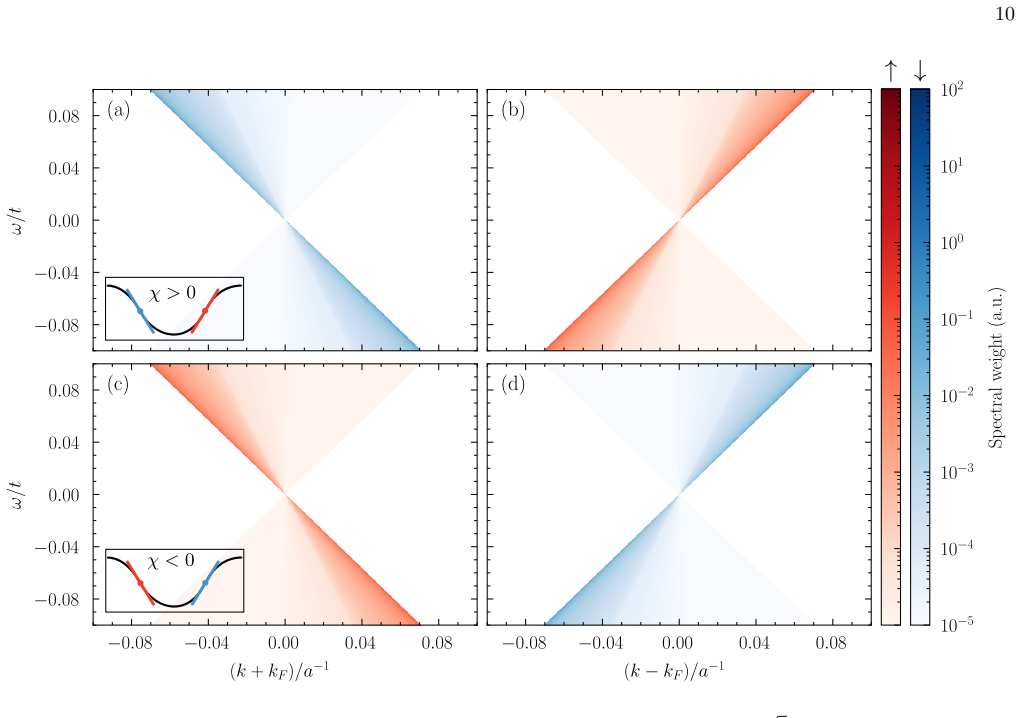
In the bosonized theory the spin chain acquires quasi long-range order consistent with the combined time-reversal and translation symmetry of the p-wave magnet. This order imposes a commensurability condition on the electronic filling under which additional interactions appear. These interactions give the electron spectral function a pronounced p-wave character. Away from commensurate filling the interactions are irrelevant and the p-wave character is lost.
What carries the argument
Coupled Luttinger liquids obtained by bosonizing the Kondo-coupled extended Hubbard model, with the magnetic order enforcing commensurability.
If this is right
- Quasi long-range order appears in the spin chain matching the p-wave magnet symmetry.
- Additional interactions arise in the bosonic field theory at commensurate electronic filling.
- The electron spectral function acquires p-wave character due to these interactions.
- The p-wave character disappears away from commensurate filling as the interactions become irrelevant.
Where Pith is reading between the lines
- Similar filling-dependent effects might occur in other one-dimensional magnetic systems where order sets commensurability.
- This suggests that signatures of odd-parity magnetism in spectra are density-selective in one dimension.
- The result could guide searches for p-wave magnets in engineered atomic chains or nanowires.
Load-bearing premise
The classical configuration of the local moments already contains the key features of an odd-parity magnet, and the bosonization approach works in the weak-coupling limit of the combined system.
What would settle it
If angle-resolved photoemission spectroscopy on a one-dimensional realization of this model at the commensurate filling shows no p-wave asymmetry in the spectral function, the predicted imprinting effect would be ruled out.
Figures
read the original abstract
We consider a one-dimensional model for a $p$-wave magnet within the bosonization framework. The model consists of itinerant electrons described by an extended Hubbard model coupled to a chain of localized moments through the Kondo exchange. The classical ground state of the local-moment system captures the salient features of an odd-parity magnet. By bosonizing the coupled system, a description in terms of coupled Luttinger liquids follows, giving rise to a rich weak-coupling phase diagram. It is shown that the spin chain develops quasi long-range order consistent with the combined time-reversal and translation symmetry defining the $p$-wave magnet. We highlight the peculiar role played by this order in establishing a commensurability condition on the electronic filling under which additional interactions appear in the bosonic field theory. It is demonstrated that these interactions endow the electron spectral function with a pronounced $p$-wave character. Away from commensurate filling, these interactions are rendered irrelevant and the ensuing $p$-wave character is lost.
Editorial analysis
A structured set of objections, weighed in public.
Referee Report
Summary. The manuscript analyzes a one-dimensional model of itinerant electrons (extended Hubbard) Kondo-coupled to localized moments. The local moments are placed in their classical ground state realizing odd-parity p-wave magnetism under combined time-reversal and translation. Bosonization yields coupled Luttinger liquids whose phase diagram exhibits quasi-long-range order in the spin sector consistent with the p-wave symmetry. At commensurate electron filling this order generates additional relevant interactions that impart p-wave character to the electron spectral function; the character is lost at incommensurate fillings.
Significance. If the central assumptions hold, the work supplies a controlled weak-coupling description of how odd-parity magnetic order can imprint on the single-particle spectrum of a 1D Kondo lattice. The explicit construction of the commensurability condition and the resulting operator content in the bosonic theory constitute a concrete, falsifiable prediction for spectral features.
major comments (2)
- [Model and bosonization setup] The analysis begins by fixing the local-moment chain to its classical ground state (abstract and model section). In one dimension this configuration is subject to strong quantum fluctuations that are not parametrically suppressed by the Kondo coupling or any implicit inter-moment exchange. No renormalization-group stability analysis or comparison with the quantum spin-chain spectrum is provided to show that the assumed p-wave order survives. Because the commensurability condition and the p-wave spectral features are derived directly from this background, the validity of the entire weak-coupling phase diagram rests on an unverified approximation.
- [Bosonization and phase diagram] The bosonization is performed around the classical local-moment configuration. It is not shown how the Kondo term is treated when the local moments are themselves dynamical quantum spins; in particular, whether the effective Luttinger-liquid parameters remain perturbative or acquire non-perturbative renormalizations from the spin sector is left unaddressed.
minor comments (1)
- [Abstract] The abstract states that the spin chain develops QLRO 'consistent with' the p-wave symmetry; the precise symmetry-allowed operators and their scaling dimensions should be listed explicitly in the bosonized Hamiltonian.
Simulated Author's Rebuttal
We thank the referee for the careful reading and constructive criticism. We address the two major comments below, indicating planned revisions where appropriate.
read point-by-point responses
-
Referee: [Model and bosonization setup] The analysis begins by fixing the local-moment chain to its classical ground state (abstract and model section). In one dimension this configuration is subject to strong quantum fluctuations that are not parametrically suppressed by the Kondo coupling or any implicit inter-moment exchange. No renormalization-group stability analysis or comparison with the quantum spin-chain spectrum is provided to show that the assumed p-wave order survives. Because the commensurability condition and the p-wave spectral features are derived directly from this background, the validity of the entire weak-coupling phase diagram rests on an unverified approximation.
Authors: We agree that the stability of the assumed p-wave order against quantum fluctuations of the local moments is not demonstrated in the manuscript. The classical configuration is adopted as an input to define the symmetry background for the subsequent bosonization analysis of the electron sector. In the revised manuscript we will add an explicit statement in the model section and introduction clarifying that all results are conditional on the persistence of this order, and that a full RG treatment of the coupled quantum spin-electron system lies outside the present scope. revision: yes
-
Referee: [Bosonization and phase diagram] The bosonization is performed around the classical local-moment configuration. It is not shown how the Kondo term is treated when the local moments are themselves dynamical quantum spins; in particular, whether the effective Luttinger-liquid parameters remain perturbative or acquire non-perturbative renormalizations from the spin sector is left unaddressed.
Authors: The bosonization is performed with the local moments fixed in the classical p-wave configuration, which sets the background for the Kondo coupling. When the moments are treated as fully dynamical quantum spins, additional non-perturbative effects on the Luttinger parameters could arise. We will revise the text to state this limitation explicitly and to emphasize that the reported phase diagram and spectral features are obtained within the classical-moment approximation. revision: yes
Circularity Check
No significant circularity; derivation applies standard bosonization to explicitly defined model
full rationale
The paper constructs an explicit Hamiltonian (extended Hubbard + Kondo coupling to local moments), adopts the classical ground state of the moment chain as an input assumption, and performs standard bosonization to obtain coupled Luttinger liquids. No quoted step equates a derived quantity to a fitted parameter or prior self-citation by construction; the commensurability condition and p-wave spectral features emerge from the resulting bosonic operators rather than being presupposed. The classical-ground-state assumption is an uncontrolled approximation whose validity is external to the derivation itself, not a circular reduction.
Axiom & Free-Parameter Ledger
axioms (2)
- domain assumption Bosonization framework applies to the coupled itinerant electrons and local moments in the weak-coupling limit
- domain assumption Classical ground state of the local-moment chain captures the salient features of an odd-parity magnet
Reference graph
Works this paper leans on
-
[1]
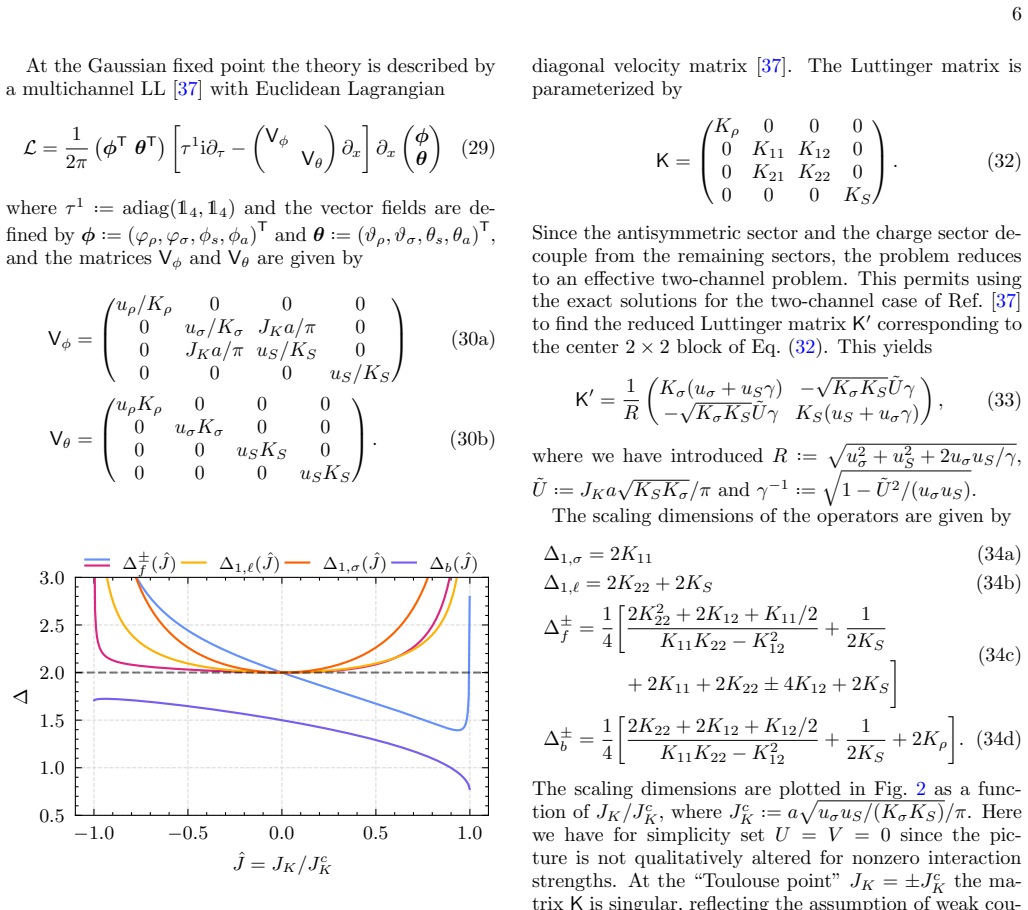
Toulouse point
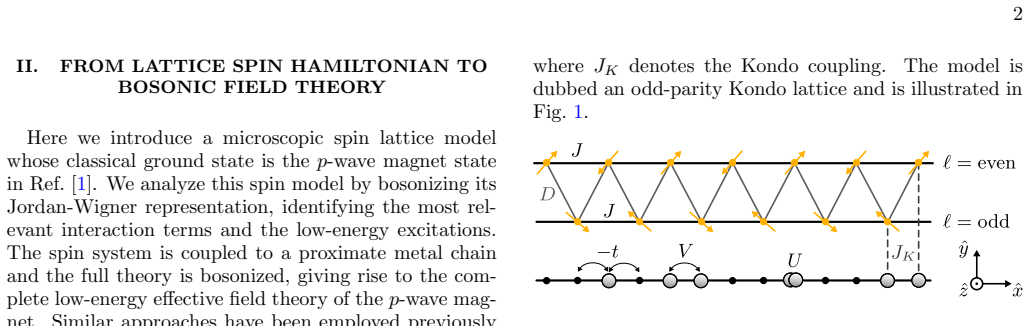
This coincides with the classical picture displayed in Fig. 1. We emphasize that this ordering is not at conflict with the Hohenberg-Mermin-Wagner theorem [17, 18]; the spin-rotation symmetry is explicitly broken by the presence of the DMI. To make this classical intuition more precise, we now demonstrate that the spin correlations capture the anti- ferro...
-
[2]
Brekke, P
B. Brekke, P. Sukhachov, H. G. Giil, A. Brataas, and J. Linder, Minimal models and transport properties of unconventionalp-wave magnets, Phys. Rev. Lett.133, 236703 (2024)
2024
-
[3]
A. B. Hellenes, T. Jungwirth, R. Jaeschke-Ubiergo, A. Chakraborty, J. Sinova, and L. ˇSmejkal, P-wave mag- nets (2024), arXiv:2309.01607 [cond-mat]
Pith/arXiv arXiv 2024
-
[4]
Q. Song, S. Stavri´ c, P. Barone, A. Droghetti, D. S. An- tonenko, J. W. F. Venderbos, C. A. Occhialini, B. Ilyas, E. Erge¸ cen, N. Gedik, S.-W. Cheong, R. M. Fernandes, S. Picozzi, and R. Comin, Electrical switching of a p-wave magnet, Nature642, 64 (2025)
2025
-
[5]
Yamada, M
R. Yamada, M. T. Birch, P. R. Baral, S. Okumura, R. Nakano, S. Gao, M. Ezawa, T. Nomoto, J. Masell, Y. Ishihara, K. K. Kolincio, I. Belopolski, H. Sagayama, H. Nakao, K. Ohishi, T. Ohhara, R. Kiyanagi, T. Naka- jima, Y. Tokura, T.-h. Arima, Y. Motome, M. M. Hirschmann, and M. Hirschberger, A metallic p-wave magnet with commensurate spin helix, Nature646, ...
2025
-
[6]
Dsouza, A
R. Dsouza, A. Kreisel, B. M. Andersen, D. F. Agter- berg, and M. H. Christensen, Odd-parity magnetism in Fe-based superconductors with coplanar magnetic order, Phys. Rev. B113, 144509 (2026)
2026
-
[7]
Sukhachov, H
P. Sukhachov, H. G. Giil, B. Brekke, and J. Linder, Co- existence ofp-wave magnetism and superconductivity, Phys. Rev. B111, L220403 (2025)
2025
-
[8]
E. W. Hodt, H. Bentmann, and J. Linder, Fate ofp-wave spin polarization in helimagnets with rashba spin-orbit coupling, Phys. Rev. B111, 205416 (2025)
2025
-
[9]
ˇSmejkal, R
L. ˇSmejkal, R. Gonz´ alez-Hern´ andez, T. Jungwirth, and J. Sinova, Crystal time-reversal symmetry breaking and spontaneous Hall effect in collinear antiferromagnets, Sci- ence Advances6, eaaz8809 (2020)
2020
-
[10]
ˇSmejkal, J
L. ˇSmejkal, J. Sinova, and T. Jungwirth, Emerging Re- search Landscape of Altermagnetism, Phys. Rev. X12, 040501 (2022)
2022
-
[11]
ˇSmejkal, J
L. ˇSmejkal, J. Sinova, and T. Jungwirth, Beyond Con- ventional Ferromagnetism and Antiferromagnetism: A Phase with Nonrelativistic Spin and Crystal Rotation Symmetry, Phys. Rev. X12, 031042 (2022)
2022
-
[12]
Krempask´ y, L
J. Krempask´ y, L. ˇSmejkal, S. W. D’Souza, M. Ha- jlaoui, G. Springholz, K. Uhl´ ırov´ a, F. Alarab, P. C. Constantinou, V. Strocov, D. Usanov, W. R. Pudelko, R. Gonz´ alez-Hern´ andez, A. Birk Hellenes, Z. Jansa, H. Reichlov´ a, Z. Sob´ an, R. D. Gonzalez Betancourt, P. Wadley, J. Sinova, D. Kriegner, J. Min´ ar, J. H. Dil, and T. Jungwirth, Altermagnet...
2024
-
[13]
Reimers, L
S. Reimers, L. Odenbreit, L. ˇSmejkal, V. N. Strocov, P. Constantinou, A. B. Hellenes, R. Jaeschke Ubiergo, W. H. Campos, V. K. Bharadwaj, A. Chakraborty, T. Denneulin, W. Shi, R. E. Dunin-Borkowski, S. Das, M. Kl¨ aui, J. Sinova, and M. Jourdan, Direct observation of altermagnetic band splitting in CrSb thin films, Nat Commun15, 2116 (2024)
2024
-
[14]
S. Lee, S. Lee, S. Jung, J. Jung, D. Kim, Y. Lee, B. Seok, J. Kim, B. G. Park, L. ˇSmejkal, C.-J. Kang, and C. Kim, Broken Kramers Degeneracy in Altermagnetic MnTe, Phys. Rev. Lett.132, 036702 (2024)
2024
-
[15]
Y. Yu, M. B. Lyngby, T. Shishidou, M. Roig, A. Kreisel, M. Weinert, B. M. Andersen, and D. F. Agterberg, Odd-Parity Magnetism Driven by Antiferromagnetic Ex- change, Phys. Rev. Lett.135, 046701 (2025)
2025
- [16]
-
[17]
Yu. B. Kudasov, Topological band structure due to mod- ified Kramers degeneracy for electrons in a helical mag- netic field, Phys. Rev. B109, L140402 (2024)
2024
-
[18]
P. C. Hohenberg, Existence of Long-Range Order in One and Two Dimensions, Phys. Rev.158, 383 (1967)
1967
-
[19]
N. D. Mermin and H. Wagner, Absence of Ferro- magnetism or Antiferromagnetism in One- or Two- Dimensional Isotropic Heisenberg Models, Phys. Rev. Lett.17, 1133 (1966)
1966
-
[20]
Doniach, The Kondo lattice and weak antiferromag- netism, Physica B+C91, 231 (1977)
S. Doniach, The Kondo lattice and weak antiferromag- netism, Physica B+C91, 231 (1977)
1977
-
[21]
Tsuchiizu and A
M. Tsuchiizu and A. Furusaki, Ground-state phase di- agram of the one-dimensional half-filled extended Hub- bard model, Phys. Rev. B69, 035103 (2004)
2004
-
[22]
Zachar, S
O. Zachar, S. A. Kivelson, and V. J. Emery, Exact Re- sults for a 1D Kondo Lattice from Bosonization, Phys. Rev. Lett.77, 1342 (1996)
1996
-
[23]
Zachar and A
O. Zachar and A. M. Tsvelik, One-dimensional electron gas interacting with a Heisenberg spin-1/2 chain, Phys. Rev. B64, 033103 (2001)
2001
-
[24]
Tomonaga, Remarks on Bloch’s Method of Sound Waves applied to Many-Fermion Problems, Prog Theor Phys5, 544 (1950)
S.-I. Tomonaga, Remarks on Bloch’s Method of Sound Waves applied to Many-Fermion Problems, Prog Theor Phys5, 544 (1950)
1950
-
[25]
J. M. Luttinger, An Exactly Soluble Model of a Many- Fermion System, J. Math. Phys.4, 1154 (1963)
1963
-
[26]
D. C. Mattis and E. H. Lieb, Exact Solution of a Many- Fermion System and Its Associated Boson Field, J. Math. Phys.6, 304 (1965)
1965
-
[27]
Coleman, Quantum sine-Gordon equation as the mas- sive Thirring model, Phys
S. Coleman, Quantum sine-Gordon equation as the mas- sive Thirring model, Phys. Rev. D11, 2088 (1975)
2088
-
[28]
Mandelstam, Soliton operators for the quantized sine- Gordon equation, Phys
S. Mandelstam, Soliton operators for the quantized sine- Gordon equation, Phys. Rev. D11, 3026 (1975)
1975
-
[29]
Luther and I
A. Luther and I. Peschel, Calculation of critical expo- nents in two dimensions from quantum field theory in one dimension, Phys. Rev. B12, 3908 (1975)
1975
-
[30]
S. R. White and I. Affleck, Dimerization and incommen- surate spiral spin correlations in the zigzag spin chain: Analogies to the Kondo lattice, Phys. Rev. B54, 9862 (1996)
1996
-
[31]
A. E. Sikkema, I. Affleck, and S. R. White, Spin Gap in a Doped Kondo Chain, Phys. Rev. Lett.79, 929 (1997)
1997
-
[32]
E. Berg, E. Fradkin, and S. A. Kivelson, Pair-Density- Wave Correlations in the Kondo-Heisenberg Model, Phys. Rev. Lett.105, 146403 (2010)
2010
-
[33]
Jordan and E
P. Jordan and E. Wigner, ¨Uber das Paulische ¨Aquivalenzverbot, Z. Physik47, 631 (1928)
1928
-
[34]
Giamarchi,Quantum Physics in One Dimension (Clarendon Press, 2004)
T. Giamarchi,Quantum Physics in One Dimension (Clarendon Press, 2004)
2004
-
[35]
D. C. Cabra and P. Pujol, Field-theoretical methods in quantum magnetism, inQuantum Magnetism, edited by U. Schollw¨ ock, J. Richter, D. J. J. Farnell, and R. F. Bishop (Springer, Berlin, Heidelberg, 2004) pp. 253–305
2004
-
[36]
S. D. Lundemo, F. S. Nogueira, and A. Sudbø, Quan- tum critical scaling of altermagnetism, Phys. Rev. B111, 214436 (2025)
2025
-
[37]
Brekke, A
B. Brekke, A. Brataas, and A. Sudbø, Two-dimensional altermagnets: Superconductivity in a minimal micro- scopic model, Phys. Rev. B108, 224421 (2023)
2023
-
[38]
Kagalovsky, I
V. Kagalovsky, I. V. Lerner, and I. V. Yurkevich, Local impurity in a multichannel Luttinger liquid, Phys. Rev. B95, 205122 (2017)
2017
-
[39]
Zhang and A
Y.-H. Zhang and A. Vishwanath, Pair-density-wave su- perconductor from doping Haldane chain and rung- singlet ladder, Phys. Rev. B106, 045103 (2022)
2022
-
[40]
Sengupta, A
P. Sengupta, A. W. Sandvik, and D. K. Campbell, Bond- order-wave phase and quantum phase transitions in the one-dimensional extended Hubbard model, Phys. Rev. B 65, 155113 (2002)
2002
-
[41]
Penc and F
K. Penc and F. Mila, Phase diagram of the one- dimensional extended Hubbard model with attractive and/or repulsive interactions at quarter filling, Phys. Rev. B49, 9670 (1994)
1994
-
[42]
Orignac, M
E. Orignac, M. Tsuchiizu, and Y. Suzumura, Spectral functions of two-band spinless fermion and single-band spin- 1 2 fermion models, Phys. Rev. B84, 165128 (2011)
2011
-
[43]
Meden and K
V. Meden and K. Sch¨ onhammer, Spectral functions for the Tomonaga-Luttinger model, Phys. Rev. B46, 15753 (1992)
1992
-
[44]
Voit, Charge-spin separation and the spectral proper- ties of Luttinger liquids, Phys
J. Voit, Charge-spin separation and the spectral proper- ties of Luttinger liquids, Phys. Rev. B47, 6740 (1993)
1993
-
[45]
A. M. Tsvelik, Fractionalized Fermi liquid in a Kondo- Heisenberg model, Phys. Rev. B94, 165114 (2016)
2016
-
[46]
Vojta, Orbital-Selective Mott Transitions: Heavy Fermions and Beyond, J Low Temp Phys161, 203 (2010)
M. Vojta, Orbital-Selective Mott Transitions: Heavy Fermions and Beyond, J Low Temp Phys161, 203 (2010)
2010
-
[47]
A. M. Tsvelik and O. M. Yevtushenko, Physics of ar- bitrarily doped Kondo lattices: From a commensurate insulator to a heavy Luttinger liquid and a protected he- lical metal, Phys. Rev. B100, 165110 (2019)
2019
-
[48]
Daghofer, K
M. Daghofer, K. Wohlfeld, and J. van den Brink, Al- termagnetic Polarons: The Fate of Altermagnetic Band Splittings at Strong Coupling, Phys. Rev. Lett.136, 146502 (2026)
2026
-
[49]
X. Zhang, Z. Jiang, S. Shen, J. Yuan, J. Yoo, X. Ma, M. Ye, J. Liu, Z. Liu, C. Kim, Y. Guo, Y. Wang, and D. Shen, Quenching of nonrelativisticp-wave spin splitting by reducedc-fcoupling in CeNiAsO (2026), arXiv:2606.02420 [cond-mat.str-el]
Pith/arXiv arXiv 2026
-
[50]
E. I. Kiselev, M. S. Scheurer, P. W¨ olfle, and J. Schmalian, Limits on dynamically generated spin-orbit coupling: Absence ofl= 1 pomeranchuk instabilities in metals, Phys. Rev. B95, 125122 (2017)
2017
-
[51]
Y.-M. Wu, A. Klein, and A. V. Chubukov, Conditions forl= 1 pomeranchuk instability in a fermi liquid, Phys. Rev. B97, 165101 (2018)
2018
-
[52]
I. S. Gradshteyn and I. M. Ryzhik,Table of Integrals, Series, and Products, 8th ed. (Academic Press, 2014)
2014
discussion (0)
Sign in with ORCID, Apple, or X to comment. Anyone can read and Pith papers without signing in.