Cutting with precision -- Leveraging Collapse Volumes to generate the next generation of zoom-in initial conditions
Pith reviewed 2026-06-26 01:42 UTC · model grok-4.3
The pith
A method that selects zoom-in regions from forward gravity-only runs produces boundaries stable against deformation and mixing, yielding uncontaminated volumes exceeding six virial radii.
A machine-rendered reading of the paper's core claim, the machinery that carries it, and where it could break.
Core claim
Selecting zoom-in regions via a forward run of a gravity-only version of the parent box produces initial conditions whose boundaries remain stable against deformation and mixing. The resulting high-resolution volumes stay free of high-mass particle contamination from outside the zoom region, reaching pristine extents larger than six virial radii around the target clusters.
What carries the argument
Collapse volumes identified by forward gravity-only evolution of the parent box; these volumes serve as the basis for placing stable, layered zoom-in boundaries that resist particle mixing.
If this is right
- The method supplies initial conditions for a set of directly comparable high-resolution local cluster simulations.
- Baryonic processes inside clusters and their immediate environments can be followed without contamination from external high-mass particles.
- The same construction can be applied to additional constrained local-universe volumes to enlarge the sample of pristine cluster analogues.
- Comparisons between simulated and observed cluster properties, intracluster medium physics, and galaxy evolution become feasible at higher fidelity.
Where Pith is reading between the lines
- The same forward-run selection step could be tested on non-cluster objects such as galaxy groups or field galaxies to check whether the stability benefit generalizes.
- If the pristine radius reliably exceeds six virial radii, the required buffer volume around each target can be reduced, lowering the particle count needed for a given science goal.
- The technique may allow tighter coupling between constrained large-scale initial conditions and zoom-in hydrodynamics without intermediate re-simulation steps.
Load-bearing premise
A forward gravity-only run of the parent box can reliably locate volumes that will remain free of high-mass particle contamination once the full hydrodynamical zoom-in simulation is performed.
What would settle it
A test simulation in which high-mass particles from outside the selected region cross the boundary and enter the high-resolution volume within a few virial radii would falsify the stability claim.
Figures
read the original abstract
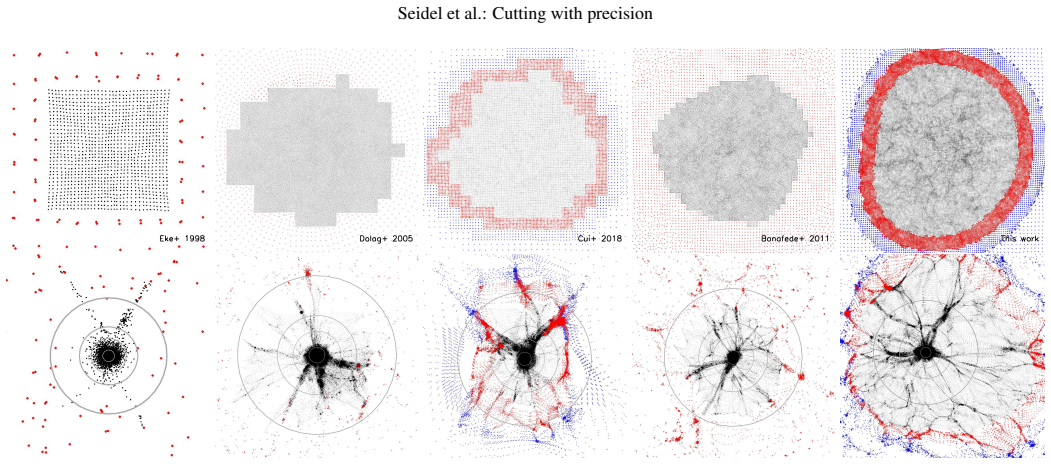
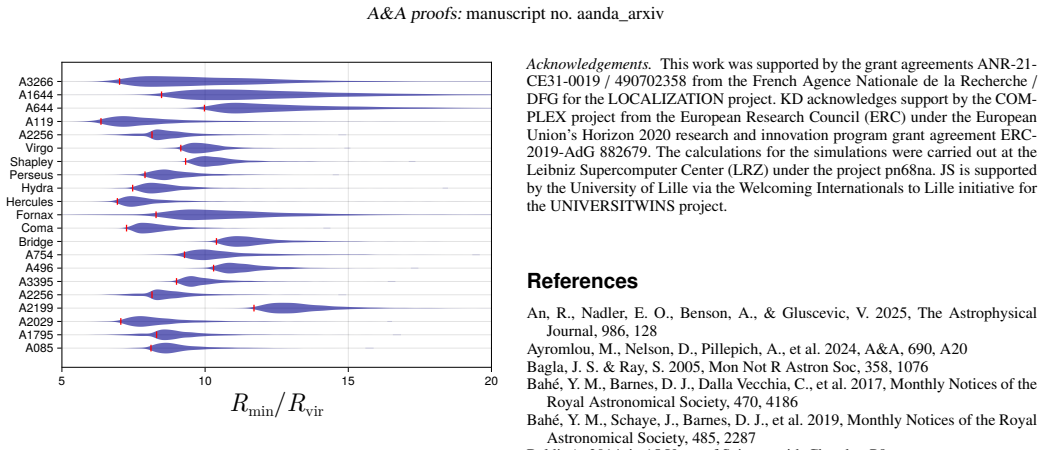
Astrophysical processes happen across a wide range of scales. This poses a significant challenge from the perspective of modeling these processes. Modern cosmological simulations attempt to maximize the simulation volume to capture the full range of the density power spectrum while simultaneously optimizing spatial resolution for improved modeling of dynamics at galactic scales. Performing zoom-in simulations of galaxy clusters is a way to reconcile computational cost, mass resolution, and large-scale realism in simulations. To study the baryonic evolution of structures it is critical to ensure that the volume of interest is uncontaminated by high-mass particles from outside the zoom-in region. We introduce a new method of constructing stable boundaries for layered zoom-in initial conditions. Applying this method to clusters from the SLOW constrained simulation, we introduce the SLOW cluster zoom-in initial conditions. We select regions using a forward run of a gravity-only version of the parent box. We performed test simulations for a set of 20 regions created from the SLOW constrained simulations containing 30 local clusters. The simulations demonstrate these initial conditions to be stable against deformation and mixing of the boundary region. Consequently, they are uncontaminated to an unprecedented degree, reaching pristine regions of sizes exceeding 6 virial radii. These simulations will provide the basis for the first high-resolution simulations of a large set of directly comparable local galaxy cluster analogues and their environment to date. Their high fidelity in terms of stability and resolution in combination with the accuracy of the underlying local Universe model makes these simulations the first of their kind. They will enable comparisons with state-of-the art observations targeting both cluster properties and ICM physics as well as galaxy evolution in the local Universe.
Editorial analysis
A structured set of objections, weighed in public.
Referee Report
Summary. The paper introduces a method for generating stable layered zoom-in initial conditions by identifying collapse volumes via forward gravity-only evolution of the parent box. This is applied to the SLOW constrained simulation to produce ICs for 30 local clusters. Test simulations on 20 regions are reported to confirm boundary stability against deformation and mixing, yielding uncontaminated pristine volumes exceeding 6 virial radii and enabling high-fidelity local Universe cluster simulations.
Significance. If the central claims hold with quantitative support, the work would advance zoom-in techniques by providing a reproducible way to achieve unusually clean boundaries, facilitating direct observational comparisons for local clusters and their environments. The use of constrained simulations and explicit testing of the selection assumption via forward runs is a methodological strength.
major comments (2)
- [Abstract] Abstract: the claims that the test simulations 'demonstrate these initial conditions to be stable against deformation and mixing' and produce 'uncontaminated' regions 'exceeding 6 virial radii' to an 'unprecedented degree' are presented without any quantitative metrics (e.g., contamination fractions, particle mixing statistics, boundary displacement measures, or comparison baselines). This directly undermines evaluation of the central claim.
- [Methods/Results] Methods/Results: the assumption that gravity-only forward runs accurately predict contamination-free volumes in the full (presumably hydro) zoom-in simulations is load-bearing, yet no details are given on how contamination was quantified in the 20 test runs, what resolution or physics were used, or any error analysis supporting the >6 r_vir claim.
minor comments (1)
- [Abstract] The abstract would be clearer with a short statement of the parent box properties and a reference to standard zoom-in contamination issues in the literature.
Simulated Author's Rebuttal
We thank the referee for their thorough review and constructive feedback. Below we address each major comment directly.
read point-by-point responses
-
Referee: [Abstract] Abstract: the claims that the test simulations 'demonstrate these initial conditions to be stable against deformation and mixing' and produce 'uncontaminated' regions 'exceeding 6 virial radii' to an 'unprecedented degree' are presented without any quantitative metrics (e.g., contamination fractions, particle mixing statistics, boundary displacement measures, or comparison baselines). This directly undermines evaluation of the central claim.
Authors: We agree that the abstract would benefit from quantitative support for these claims. The body of the manuscript presents results from the 20 test simulations, including measurements of pristine volumes. We will revise the abstract to include key quantitative metrics drawn from those results, such as the fraction of regions achieving pristine volumes beyond 6 r_vir and any reported boundary stability statistics. revision: yes
-
Referee: [Methods/Results] Methods/Results: the assumption that gravity-only forward runs accurately predict contamination-free volumes in the full (presumably hydro) zoom-in simulations is load-bearing, yet no details are given on how contamination was quantified in the 20 test runs, what resolution or physics were used, or any error analysis supporting the >6 r_vir claim.
Authors: The 20 test simulations are gravity-only runs performed at the resolution of the parent box, with contamination quantified by tracking high-mass particle IDs relative to the zoom-in boundaries. We will add a new subsection to the Methods detailing the exact quantification procedure, resolution, physics (gravity-only), and any error or robustness analysis supporting the >6 r_vir claim. We will also clarify that boundary stability is governed by gravitational dynamics, so the gravity-only forward runs provide a direct test of the selection method; full hydrodynamical effects on mixing will be addressed in future work once the ICs are used. revision: yes
Circularity Check
No significant circularity
full rationale
The paper introduces a practical method for generating zoom-in initial conditions by selecting regions via a gravity-only forward run of the parent simulation and then validates boundary stability through independent test simulations on 20 regions. No mathematical derivation chain exists that reduces a claimed result to its own inputs by construction. No self-citations are invoked as load-bearing uniqueness theorems, no parameters are fitted and then relabeled as predictions, and no ansatzes are smuggled via prior work. The central claim (uncontaminated volumes exceeding 6 r_vir) rests on direct numerical tests rather than definitional equivalence or self-referential justification.
Axiom & Free-Parameter Ledger
Reference graph
Works this paper leans on
-
[1]
O., Benson, A., & Gluscevic, V
An, R., Nadler, E. O., Benson, A., & Gluscevic, V . 2025, The Astrophysical Journal, 986, 128
2025
-
[2]
2024, A&A, 690, A20
Ayromlou, M., Nelson, D., Pillepich, A., et al. 2024, A&A, 690, A20
2024
-
[3]
Bagla, J. S. & Ray, S. 2005, Mon Not R Astron Soc, 358, 1076 Bahé, Y . M., Barnes, D. J., Dalla Vecchia, C., et al. 2017, Monthly Notices of the Royal Astronomical Society, 470, 4186 Bahé, Y . M., Schaye, J., Barnes, D. J., et al. 2019, Monthly Notices of the Royal Astronomical Society, 485, 2287
2005
-
[4]
2014, in 15 Years of Science with Chandra, P8
Baldi, A. 2014, in 15 Years of Science with Chandra, P8
2014
-
[5]
& Steinmetz, M
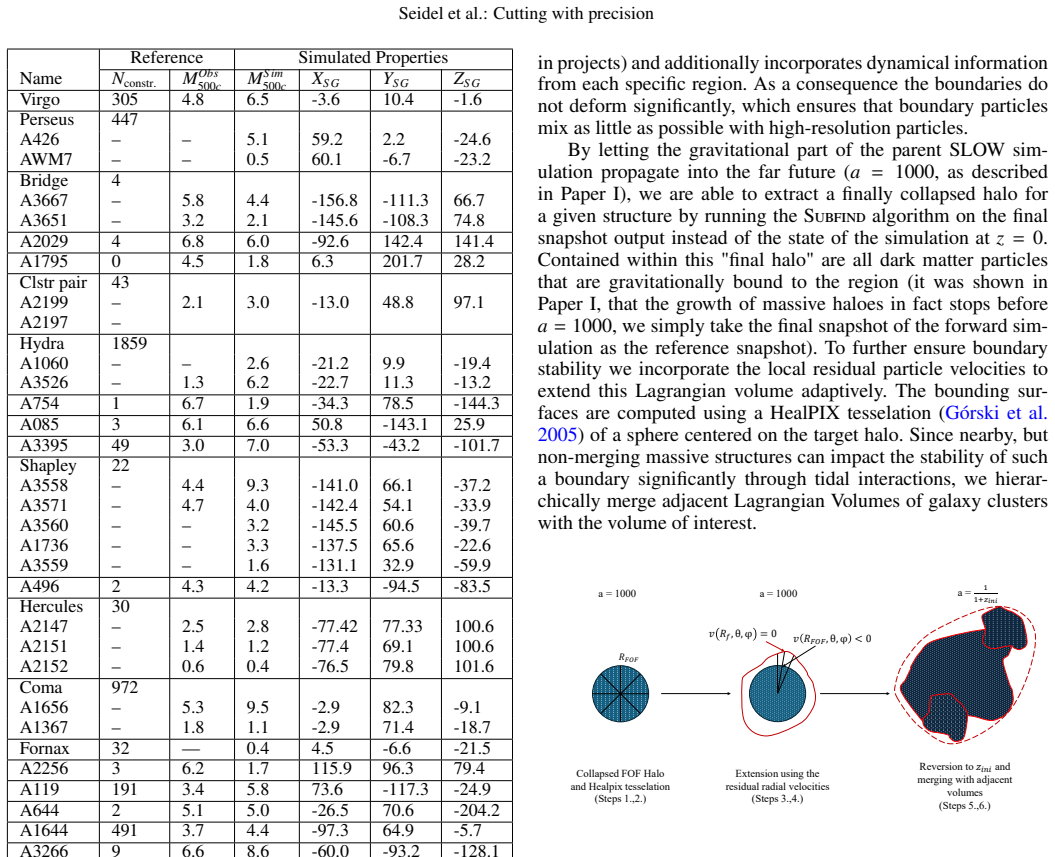
Bartelmann, M. & Steinmetz, M. 1996, MNRAS, 283, 431
1996
-
[6]
1995, A&A, 297, 1
Bartelmann, M., Steinmetz, M., & Weiss, A. 1995, A&A, 297, 1
1995
-
[7]
M., Murante, G., Arth, A., et al
Beck, A. M., Murante, G., Arth, A., et al. 2016, Monthly Notices of the Royal Astronomical Society, 455, 2110
2016
-
[8]
2017, MNRAS, 468, 531
Biffi, V ., Planelles, S., Borgani, S., et al. 2017, MNRAS, 468, 531
2017
-
[9]
2011, Monthly Notices of the Royal Astronomical Society, 418, 2234
Bonafede, A., Dolag, K., Stasyszyn, F., Murante, G., & Borgani, S. 2011, Monthly Notices of the Royal Astronomical Society, 418, 2234
2011
-
[10]
2006, MNRAS, 367, 1641
Borgani, S., Dolag, K., Murante, G., et al. 2006, MNRAS, 367, 1641
2006
-
[11]
2004, MNRAS, 348, 1078
Borgani, S., Murante, G., Springel, V ., et al. 2004, MNRAS, 348, 1078
2004
-
[12]
Brough, S., Collins, C., Demarco, R., et al. 2020 [arXiv:2001.11067]
arXiv 2020
-
[13]
J., Aragón-Salamanca, A., Kuchner, U., et al
Cornwell, D. J., Aragón-Salamanca, A., Kuchner, U., et al. 2023, Monthly No- tices of the Royal Astronomical Society, 524, 2148
2023
-
[14]
2022, MNRAS, 514, 977
Cui, W., Dave, R., Knebe, A., et al. 2022, MNRAS, 514, 977
2022
-
[15]
2018, Monthly Notices of the Royal Astro- nomical Society, 480, 2898 De Luca, F., De Petris, M., Yepes, G., et al
Cui, W., Knebe, A., Yepes, G., et al. 2018, Monthly Notices of the Royal Astro- nomical Society, 480, 2898 De Luca, F., De Petris, M., Yepes, G., et al. 2021, Monthly Notices of the Royal Astronomical Society, 504, 5383
2018
-
[16]
H., et al
Dietl, J., Pacaud, F., Reiprich, T. H., et al. 2024, A&A, 691, A286
2024
-
[17]
1999, A&A, 348, 351
Dolag, K., Bartelmann, M., & Lesch, H. 1999, A&A, 348, 351
1999
-
[18]
2004, A&A, 416, 853
Dolag, K., Bartelmann, M., Perrotta, F., et al. 2004, A&A, 416, 853
2004
-
[19]
2009, Monthly Notices of the Royal Astronomical Society, 399, 497
Dolag, K., Borgani, S., Murante, G., & Springel, V . 2009, Monthly Notices of the Royal Astronomical Society, 399, 497
2009
-
[20]
2010, Monthly Notices of the Royal As- tronomical Society, 405, 1544
Dolag, K., Murante, G., & Borgani, S. 2010, Monthly Notices of the Royal As- tronomical Society, 405, 1544
2010
-
[21]
& Schindler, S
Dolag, K. & Schindler, S. 2000, A&A, 364, 491
2000
-
[22]
G., Pilipenko, S., et al
Dolag, K., Sorce, J. G., Pilipenko, S., et al. 2023, Astronomy & Astrophysics, 677, A169
2023
-
[23]
R., Navarro, J
Eke, V . R., Navarro, J. F., & Frenk, C. S. 1998, ApJ, 503, 569 Euclid Collaboration, Zalesky, L., Weaver, J. R., et al. 2026, Astronomy & As- trophysics, 708, A104
1998
-
[24]
2011, MNRAS, 416, 801
Fabjan, D., Borgani, S., Rasia, E., et al. 2011, MNRAS, 416, 801
2011
-
[25]
S., Evrard, A
Frenk, C. S., Evrard, A. E., White, S. D. M., & Summers, F. J. 1996, ApJ, 472, 460
1996
-
[26]
Gallagher, C., Yasin, T., Stiskalek, R., Desmond, H., & Jarvis, M. J. 2026, Monthly Notices of the Royal Astronomical Society, 546, stag108 Górski, K. M., Hivon, E., Banday, A. J., et al. 2005, The Astrophysical Journal, 622, 759
2026
-
[27]
P., Valentini, M., & Dolag, K
Groth, F., Steinwandel, U. P., Valentini, M., & Dolag, K. 2023, Mon Not R As- tron Soc, 526, 616
2023
-
[28]
A., et al
Groth, F., Valentini, M., Seidel, B. A., et al. 2025, Turbulence in Simu- lated Local Cluster Analogs: One-to-One Comparisons between SLOW and XRISM/Hitomi
2025
-
[29]
2025, Astronomy & Astrophysics, 703, A112 Hernández-Martínez, E., Dolag, K., Seidel, B., et al
Harvey, D., Revaz, Y ., Schaller, M., et al. 2025, Astronomy & Astrophysics, 703, A112 Hernández-Martínez, E., Dolag, K., Seidel, B., et al. 2024, Simulating the LOcal Web (SLOW) – II: Properties of Local Galaxy Clusters
2025
-
[30]
& Ribak, E
Hoffman, Y . & Ribak, E. 1991, The Astrophysical Journal, 380, L5
1991
-
[31]
2010, Monthly Notices of the Royal Astronomical Society, 403, 1859 Article number, page 8 of 11 Seidel et al.: Cutting with precision
Jenkins, A. 2010, Monthly Notices of the Royal Astronomical Society, 403, 1859 Article number, page 8 of 11 Seidel et al.: Cutting with precision
2010
-
[32]
A., Montes, M., et al
Kluge, M., Hatch, N. A., Montes, M., et al. 2025, A&A, 697, A13
2025
-
[33]
2021, Monthly Notices of the Royal Astronomical Society, 503, 2065
Kuchner, U., Aragón-Salamanca, A., Rost, A., et al. 2021, Monthly Notices of the Royal Astronomical Society, 503, 2065
2021
-
[34]
G., & Aghanim, N
Lebeau, T., Sorce, J. G., & Aghanim, N. 2024, EPJ Web of Conferences, 293, 00028
2024
-
[35]
2024, A&A, 687, A129
Lehle, K., Nelson, D., Pillepich, A., Truong, N., & Rohr, E. 2024, A&A, 687, A129
2024
-
[36]
I., Carlesi, E., Grand, R
Libeskind, N. I., Carlesi, E., Grand, R. J. J., et al. 2020, Monthly Notices of the Royal Astronomical Society, 498, 2968
2020
-
[37]
G., Dolag, K., & Aghanim, N
Malavasi, N., Sorce, J. G., Dolag, K., & Aghanim, N. 2023, Astronomy & As- trophysics, 675, A76
2023
-
[38]
Negri, A., Dalla Vecchia, C., Aguerri, J. A. L., & Bahé, Y . 2022, Monthly Notices of the Royal Astronomical Society, 515, 2121
2022
-
[39]
2024, Introducing the TNG- Cluster Simulation: Overview and Physical Properties of the Gaseous Intr- acluster Medium Oñorbe, J., Garrison-Kimmel, S., Maller, A
Nelson, D., Pillepich, A., Ayromlou, M., et al. 2024, Introducing the TNG- Cluster Simulation: Overview and Physical Properties of the Gaseous Intr- acluster Medium Oñorbe, J., Garrison-Kimmel, S., Maller, A. H., et al. 2014, Monthly Notices of the Royal Astronomical Society, 437, 1894
2024
-
[40]
2025, arXiv e-prints, arXiv:2511.10353
Pilipenko, S., Yepes, G., Gottlöber, S., & Knollmann, S. 2025, arXiv e-prints, arXiv:2511.10353
arXiv 2025
-
[41]
2018, Monthly Notices of the Royal Astronomical Society, 473, 4077 Planck Collaboration, Ade, P
Pillepich, A., Springel, V ., Nelson, D., et al. 2018, Monthly Notices of the Royal Astronomical Society, 473, 4077 Planck Collaboration, Ade, P. a. R., Aghanim, N., et al. 2016, Astronomy & Astrophysics, 594, A13
2018
-
[42]
2014, MNRAS, 438, 195
Planelles, S., Borgani, S., Fabjan, D., et al. 2014, MNRAS, 438, 195
2014
-
[43]
2016, in Parallel Computing: On the Road to Exascale (IOS Press), 411–420
Ragagnin, A., Tchipev, N., Bader, M., Dolag, K., & Hammer, N. 2016, in Parallel Computing: On the Road to Exascale (IOS Press), 411–420
2016
-
[44]
J., et al
Rines, K., Mahdavi, A., Geller, M. J., et al. 2001, ApJ, 555, 558
2001
-
[45]
2024, A&A, 686, A86
Rohr, E., Pillepich, A., Nelson, D., Ayromlou, M., & Zinger, E. 2024, A&A, 686, A86
2024
-
[46]
A., Bower, R
Schaye, J., Crain, R. A., Bower, R. G., et al. 2015, Mon Not R Astron Soc, 446, 521
2015
-
[47]
A., Dolag, K., Remus, R.-S., et al
Seidel, B. A., Dolag, K., Remus, R.-S., et al. 2025, A&A, 702, A243
2025
-
[48]
2013, Mon Not R Astron Soc, 429, 323
Sembolini, F., Yepes, G., De Petris, M., et al. 2013, Mon Not R Astron Soc, 429, 323
2013
-
[49]
Sorce, J. G. 2015, Monthly Notices of the Royal Astronomical Society, 450, 2644
2015
-
[50]
Sorce, J. G. 2018, Monthly Notices of the Royal Astronomical Society, 478, 5199
2018
-
[51]
G., Dubois, Y ., Blaizot, J., et al
Sorce, J. G., Dubois, Y ., Blaizot, J., et al. 2021, Monthly Notices of the Royal Astronomical Society, 504, 2998
2021
-
[52]
G., Hoffman, Y ., & Gottlöber, S
Sorce, J. G., Hoffman, Y ., & Gottlöber, S. 2017, Monthly Notices of the Royal Astronomical Society, 468, 1812
2017
-
[53]
Sorce, J. G., McGee, S. L., Dubois, Y ., et al. 2026 [arXiv:2603.23606]
Pith/arXiv arXiv 2026
-
[54]
Sorce, J. G. & Tempel, E. 2018, Monthly Notices of the Royal Astronomical Society, 476, 4362
2018
-
[55]
2005, Mon Not R Astron Soc, 364, 1105
Springel, V . 2005, Mon Not R Astron Soc, 364, 1105
2005
-
[56]
2010, Monthly Notices of the Royal Astronomical Society, 401, 791
Springel, V . 2010, Monthly Notices of the Royal Astronomical Society, 401, 791
2010
-
[57]
Springel, V ., White, S. D. M., Tormen, G., & Kauffmann, G. 2001, Monthly Notices of the Royal Astronomical Society, 328, 726
2001
-
[58]
& White, S
Steinmetz, M. & White, S. D. M. 1997, MNRAS, 288, 545
1997
-
[59]
P., Dolag, K., Böss, L
Steinwandel, U. P., Dolag, K., Böss, L. M., & Marin-Gilabert, T. 2024, ApJ, 967, 125
2024
-
[60]
2025, A&A, 701, A114
Tevlin, L., Berlok, T., Pfrommer, C., et al. 2025, A&A, 701, A114
2025
-
[61]
R., & White, S
Tormen, G., Bouchet, F. R., & White, S. D. M. 1997, Monthly Notices of the Royal Astronomical Society, 286, 865
1997
-
[62]
2017, Monthly Notices of the Royal Astronomical Society, 470, 1121
Tremmel, M., Karcher, M., Governato, F., et al. 2017, Monthly Notices of the Royal Astronomical Society, 470, 1121
2017
-
[63]
R., Ricarte, A., et al
Tremmel, M., Quinn, T. R., Ricarte, A., et al. 2019, Mon Not R Astron Soc, 483, 3336
2019
-
[64]
C., Brooks, A
Tremmel, M., Wright, A. C., Brooks, A. M., et al. 2020, Monthly Notices of the Royal Astronomical Society, 497, 2786
2020
-
[65]
2024, A&A, 686, A200
Truong, N., Pillepich, A., Nelson, D., et al. 2024, A&A, 686, A200
2024
-
[66]
B., Courtois, H
Tully, R. B., Courtois, H. M., Dolphin, A. E., et al. 2013, The Astronomical Journal, 146, 86
2013
-
[67]
E., et al
Vurm, I., Nevalainen, J., Hong, S. E., et al. 2023, A&A, 673, A62
2023
-
[68]
2018, The Astrophysical Journal, 868, 130
Wang, Y ., Pearce, F., Knebe, A., et al. 2018, The Astrophysical Journal, 868, 130
2018
-
[69]
2017, Monthly Notices of the Royal Astronomical Society, 465, 3291
Weinberger, R., Springel, V ., Hernquist, L., et al. 2017, Monthly Notices of the Royal Astronomical Society, 465, 3291
2017
-
[70]
E., Hahn, O., et al
Wu, H.-Y ., Evrard, A. E., Hahn, O., et al. 2015, Monthly Notices of the Royal Astronomical Society, 452, 1982 XRISM Science Team. 2022, XRISM Quick Reference
2015
-
[71]
K., & Diaferio, A
Yoshida, N., Sheth, R. K., & Diaferio, A. 2001, MNRAS, 328, 669
2001
-
[72]
1999, The Astrophysical Journal, 520, 413
Zaroubi, S., Hoffman, Y ., & Dekel, A. 1999, The Astrophysical Journal, 520, 413
1999
-
[73]
Zaroubi, S., Hoffman, Y ., Fisher, K. B., & Lahav, O. 1995, The Astrophysical Journal, 449, 446 Zöller, R., Kluge, M., Bender, R., et al. 2025 [arXiv:2510.26889] Article number, page 9 of 11 A&A proofs:manuscript no. aanda_arxiv Appendix A: The SLOW cluster zoom-IC suite As mentioned in previous sections the full SLOW cluster set contains 30 local galaxy ...
arXiv 1995
discussion (0)
Sign in with ORCID, Apple, or X to comment. Anyone can read and Pith papers without signing in.