First full-shape joint analysis of the two- and three-point correlation functions on real data: ΛCDM cosmological constraints from BOSS DR12
Pith reviewed 2026-06-26 01:32 UTC · model grok-4.3
The pith
Joint analysis of two- and three-point correlation functions on BOSS DR12 data tightens cosmological constraints compared to the two-point function alone.
A machine-rendered reading of the paper's core claim, the machinery that carries it, and where it could break.
Core claim
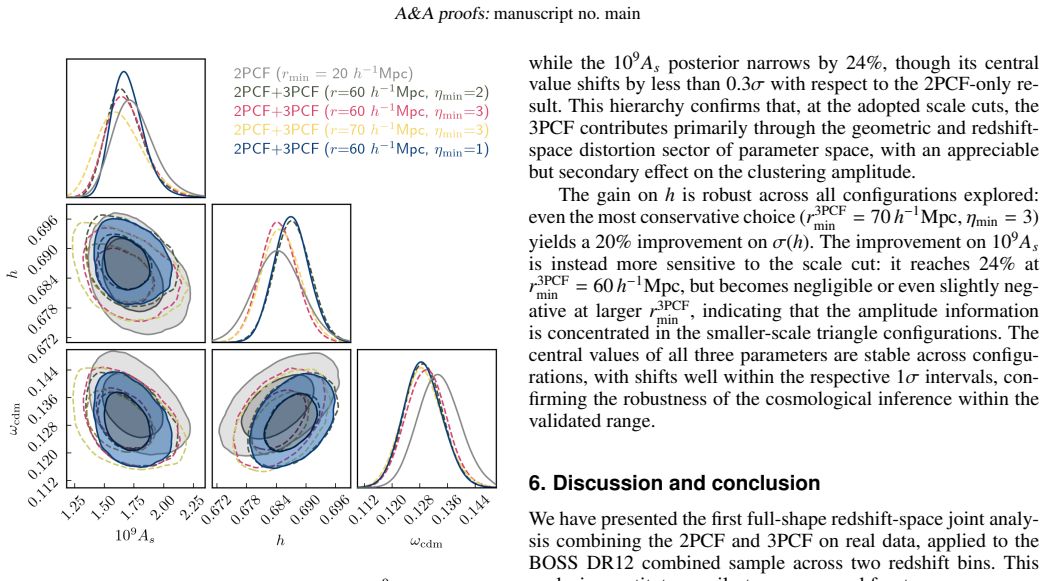
The joint 2PCF+3PCF analysis yields significant improvements over the 2PCF-only baseline, with gains of approximately 29%, 10%, and 24% on σ(h), σ(ω_cdm), and σ(A_s), respectively. The improvements mainly arise from the additional BAO cosmological information encoded in the 3PCF triangle configurations.
What carries the argument
The velocity difference generating function (VDG) framework, which supplies model predictions for both statistics including non-perturbative Fingers-of-God damping, complete Eulerian bias, and infrared resummation, with dedicated emulators enabling the likelihood analysis.
If this is right
- The three-point correlation function supplies additional baryon acoustic oscillation information that reduces the uncertainty on h by about 29 percent.
- The same joint analysis reduces the uncertainty on ω_cdm by 10 percent and on A_s by 24 percent relative to the two-point function alone.
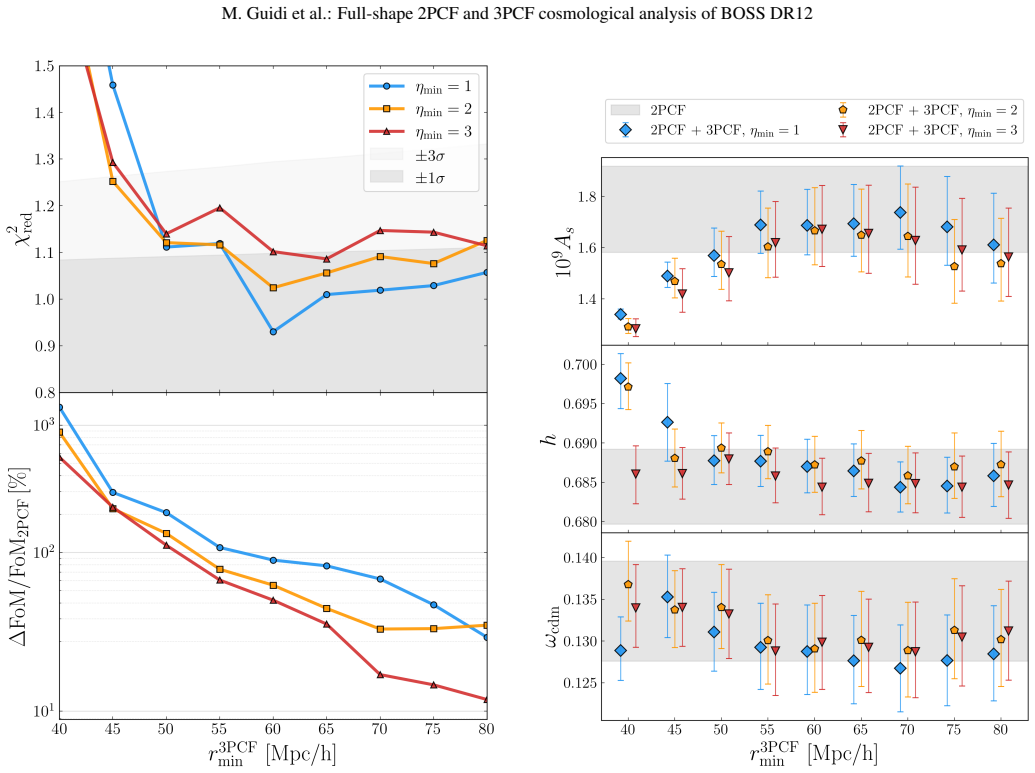
- The VDG model with emulators remains valid for the combined data vector down to r_min^{3PCF} ~ 60 h^{-1} Mpc according to the goodness-of-fit validation.
- An optimal compression of the data vector permits stable inversion of the covariance estimated from 2048 mocks.
Where Pith is reading between the lines
- The same joint-analysis pipeline could be applied to other existing or upcoming galaxy surveys to test whether comparable precision gains appear.
- The demonstrated improvement suggests that routine inclusion of three-point statistics in full-shape analyses could become standard for tightening parameter constraints.
- The real-data validation opens a route to combining this approach with other large-scale structure probes for cross-checks on the derived limits.
Load-bearing premise
The perturbative VDG model accurately describes the joint data vector down to scales of about 60 h^{-1} Mpc.
What would settle it
A failure of the goodness-of-fit tests or a clear mismatch between model and observed joint data vector near 60 h^{-1} Mpc would show that the reported constraint improvements do not hold.
Figures
read the original abstract
The three-point correlation function (3PCF) encodes cosmological information beyond the two-point correlation function (2PCF), yet a full-shape joint analysis in redshift space using real data has so far been lacking. We present the first full-shape cosmological constraints from a joint analysis of 2PCF and 3PCF in redshift space, using BOSS DR12 data, extending to real data, including Alcock--Paczy\'nski and redsfhit space distortions, the full-shape configuration-space framework validated in real space for the first time by Euclid Collaboration: Guidi et al (2026). We model both statistics adopting the velocity difference generating function (VDG) framework, incorporating non-perturbative Fingers-of-God damping, a complete Eulerian galaxy bias expansion, and infrared resummation. Fast and accurate theoretical predictions are obtained using dedicated emulators, which enable a full-shape likelihood analysis of the 3PCF and its combination with the 2PCF, varying the cosmological parameters $10^9 A_s, \omega_{\rm cdm}$ and $h$, while the baryon fraction density $\omega_{b}$ is fixed to its fiducial value. The covariance matrix is estimated from 2048 MultiDark-Patchy mocks, and an optimal data-vector compression ensures a stable covariance inversion. The perturbative model is validated against goodness-of-fit tests across different scales, and provides a good description of the joint data vector down to $r_{\rm min}^{\rm 3PCF} \sim 60\,h^{-1}{\rm Mpc}$. We find that the joint 2PCF+3PCF analysis yields significant improvements over the 2PCF-only baseline, with gains of approximately 29\%, 10\%, and 24\% on $\sigma(h)$, $\sigma(\omega_{\rm cdm})$, and $\sigma(A_s)$, respectively. The improvements mainly arise from the additional BAO cosmological information encoded in the 3PCF triangle configurations.
Editorial analysis
A structured set of objections, weighed in public.
Referee Report
Summary. The manuscript presents the first full-shape joint analysis of the 2PCF and 3PCF in redshift space on BOSS DR12 data. It models both statistics with the VDG framework (including FoG damping, complete Eulerian bias, and IR resummation), uses dedicated emulators for predictions, estimates covariance from 2048 MultiDark-Patchy mocks, applies optimal compression, and validates the model via goodness-of-fit tests down to r_min^{3PCF} ~60 h^{-1} Mpc. Varying 10^9 A_s, ω_cdm, and h (with ω_b fixed), it reports ~29%, 10%, and 24% improvements in σ(h), σ(ω_cdm), and σ(A_s) over the 2PCF-only baseline, attributing gains to additional BAO information in 3PCF triangles.
Significance. If the VDG model holds at the adopted scales, the work establishes the practical gain from joint 2PCF+3PCF full-shape analyses on real data, showing how 3PCF triangle configurations supply independent BAO information that tightens constraints on key parameters. The emulator-based approach and mock covariance support reproducibility and scalability to future surveys. The reported percentage improvements quantify the added value of higher-order statistics beyond standard 2PCF analyses.
major comments (2)
- [Abstract] Abstract: the assertion that the VDG model 'provides a good description of the joint data vector down to r_min^{3PCF} ~60 h^{-1} Mpc' is load-bearing for the claimed constraint gains, yet no χ²/dof values, per-bin residuals for the 3PCF triangles, or quantitative emulator error budgets at these scales are supplied. Without these, it is unclear whether unmodeled higher-order bias or FoG effects are absorbed into the reported tightening rather than producing genuine improvements.
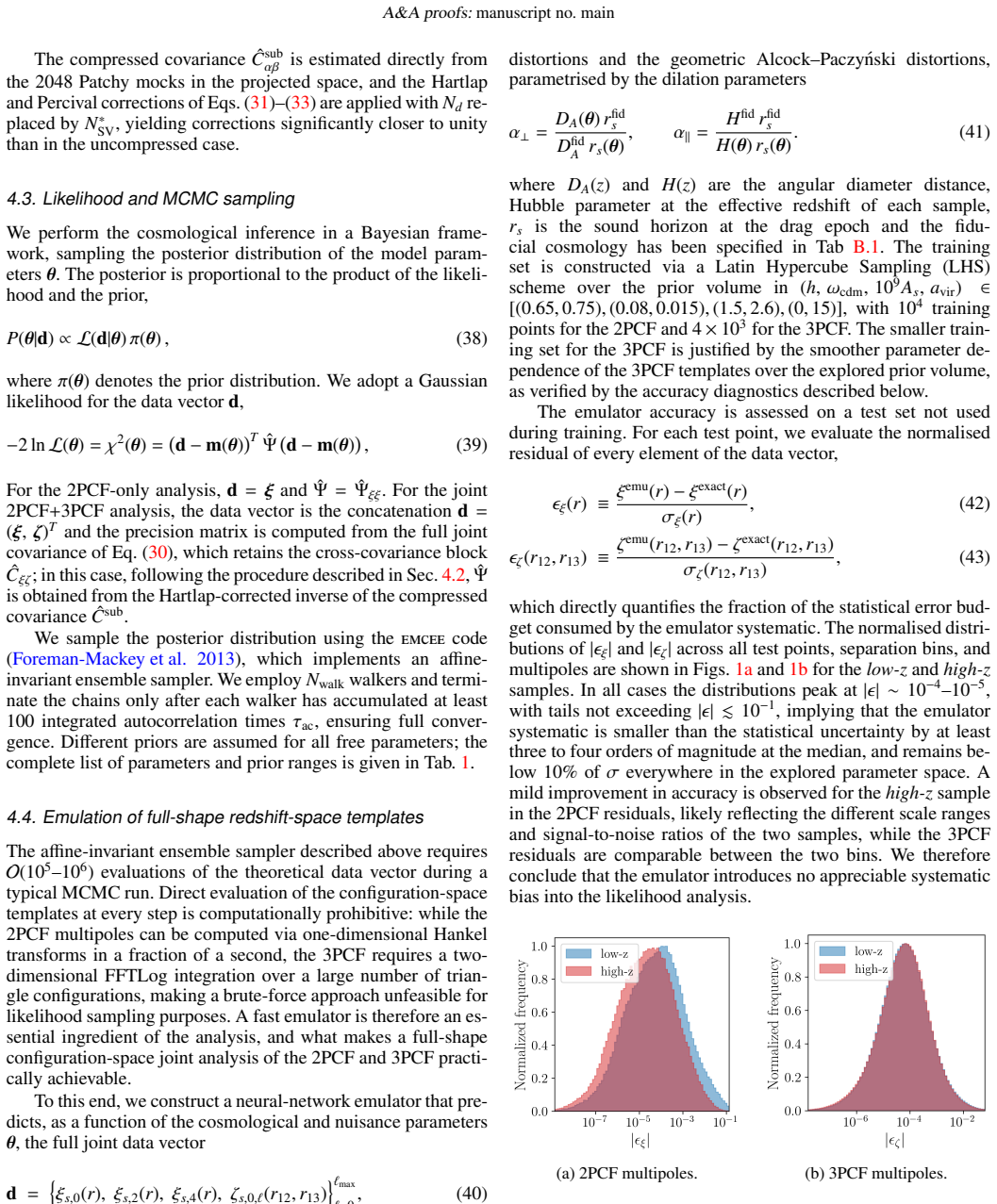
- [Emulator and compression section (likely §4–5)] The section describing emulator validation and data-vector compression: the abstract states that emulators enable the analysis and that optimal compression ensures stable inversion, but explicit accuracy metrics (e.g., fractional emulator error on the 3PCF monopole/quadrupole or triangle configurations) and the precise compression operator are not reported. These details are required to confirm that numerical systematics do not contribute to the 29/10/24% gains.
minor comments (1)
- [Abstract] Abstract: 'redsfhit space distortions' is a typographical error and should read 'redshift space distortions'.
Simulated Author's Rebuttal
We thank the referee for their careful reading and constructive comments, which help clarify the presentation of our results. We address each major comment below and will revise the manuscript accordingly to strengthen the validation sections.
read point-by-point responses
-
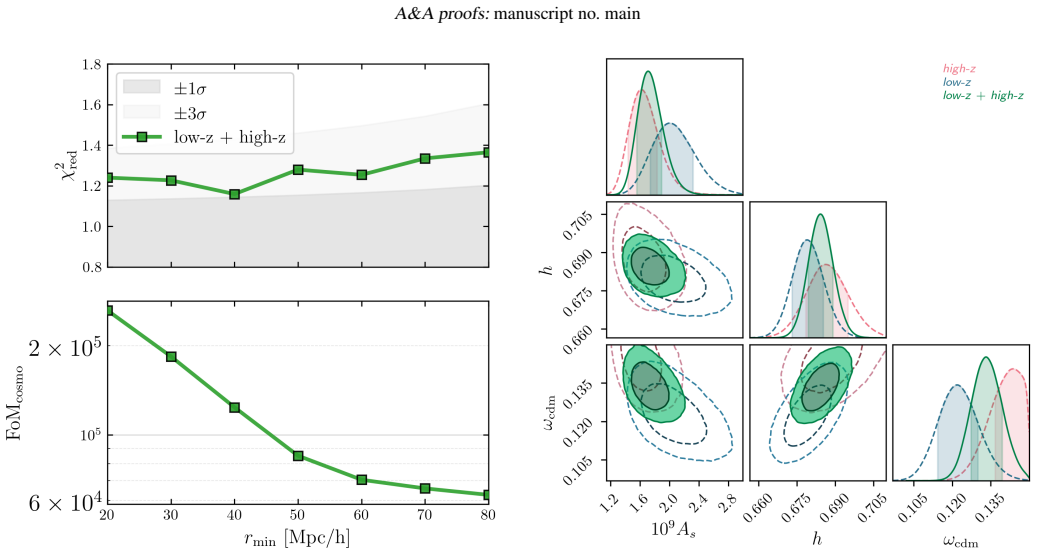
Referee: [Abstract] Abstract: the assertion that the VDG model 'provides a good description of the joint data vector down to r_min^{3PCF} ~60 h^{-1} Mpc' is load-bearing for the claimed constraint gains, yet no χ²/dof values, per-bin residuals for the 3PCF triangles, or quantitative emulator error budgets at these scales are supplied. Without these, it is unclear whether unmodeled higher-order bias or FoG effects are absorbed into the reported tightening rather than producing genuine improvements.
Authors: We agree that explicit quantitative validation is needed to substantiate the model description claim and rule out absorption of systematics. The manuscript reports goodness-of-fit tests in Section 6, but we will add in revision the specific χ²/dof values for the joint 2PCF+3PCF and 2PCF-only fits, representative per-bin residuals for the 3PCF triangles at r_min ~60 h^{-1} Mpc, and emulator error budgets at those scales. This will confirm the improvements arise from additional BAO information rather than unmodeled effects. revision: yes
-
Referee: [Emulator and compression section (likely §4–5)] The section describing emulator validation and data-vector compression: the abstract states that emulators enable the analysis and that optimal compression ensures stable inversion, but explicit accuracy metrics (e.g., fractional emulator error on the 3PCF monopole/quadrupole or triangle configurations) and the precise compression operator are not reported. These details are required to confirm that numerical systematics do not contribute to the 29/10/24% gains.
Authors: We acknowledge the need for more explicit metrics. While emulator validation appears in Sections 4–5, we will revise to report fractional emulator errors specifically on the 3PCF monopole/quadrupole for triangle configurations at the adopted scales, and we will state the precise form of the optimal compression operator (derived from the Fisher information matrix). These additions will demonstrate that numerical systematics are subdominant and do not drive the reported gains. revision: yes
Circularity Check
Minor self-citation to prior framework validation; central constraints are independent parameter fits to BOSS data with external covariance
full rationale
The paper's derivation consists of applying the VDG perturbative model (with FoG, bias expansion, IR resummation) via emulators to the joint 2PCF+3PCF data vector from BOSS DR12, estimating the covariance from 2048 external MultiDark-Patchy mocks, compressing the data vector, and running a full-shape likelihood analysis that varies 10^9 A_s, ω_cdm and h. The reported 29/10/24% gains are differences in posterior standard deviations between the joint and 2PCF-only runs. While the modeling framework is referenced to Euclid Collaboration: Guidi et al. (2026) (overlapping authors), the present work performs its own goodness-of-fit validation on the current dataset down to r_min^3PCF ~60 h^{-1} Mpc and does not reduce any reported improvement or constraint to a quantity defined by the fit itself. No self-definitional, fitted-input-renamed-as-prediction, or uniqueness-imported steps appear in the provided text.
Axiom & Free-Parameter Ledger
free parameters (3)
- 10^9 A_s
- ω_cdm
- h
axioms (3)
- domain assumption Velocity difference generating function (VDG) framework with non-perturbative FoG, complete Eulerian bias expansion, and IR resummation accurately models both 2PCF and 3PCF in redshift space.
- domain assumption Dedicated emulators deliver fast and accurate predictions sufficient for the full-shape likelihood analysis.
- domain assumption Covariance matrix estimated from 2048 MultiDark-Patchy mocks is accurate and invertible after optimal compression.
Reference graph
Works this paper leans on
-
[1]
WFIRST: The Essential Cosmology Space Observatory for the Coming Decade
WFIRST: The Essential Cosmology Space Observatory for the Coming Decade. , keywords =. doi:10.48550/arXiv.1904.01174 , archivePrefix =. 1904.01174 , primaryClass =
work page internal anchor Pith review Pith/arXiv arXiv doi:10.48550/arxiv.1904.01174 1904
-
[2]
Disentangling interacting dark energy cosmologies with the three-point correlation function
Disentangling interacting dark energy cosmologies with the three-point correlation function. , keywords =. doi:10.1093/mnras/stu1359 , archivePrefix =. 1312.4530 , primaryClass =
work page internal anchor Pith review Pith/arXiv arXiv doi:10.1093/mnras/stu1359
-
[3]
arXiv e-prints , keywords =
Cosmological constraints from the DESI DR1 Bispectrum Full-Shape and DR2 BAO. arXiv e-prints , keywords =
-
[4]
Cosmological constraints from the DESI DR1 joint power spectrum and bispectrum analysis. arXiv e-prints , keywords =. doi:10.48550/arXiv.2603.19356 , archivePrefix =. 2603.19356 , primaryClass =
-
[5]
Full-Shape analysis of the power spectrum and bispectrum of DESI DR1 LRG and QSO samples. , keywords =. doi:10.1088/1475-7516/2025/06/005 , archivePrefix =. 2503.09714 , primaryClass =
-
[6]
Euclid preparation. Three-dimensional galaxy clustering in configuration space: Three-point correlation function estimation. arXiv e-prints , keywords =. doi:10.48550/arXiv.2605.03012 , archivePrefix =. 2605.03012 , primaryClass =
work page internal anchor Pith review Pith/arXiv arXiv doi:10.48550/arxiv.2605.03012
-
[7]
Euclid preparation. Galaxy power spectrum and bispectrum modelling
Euclid preparation. Galaxy power spectrum and bispectrum modelling. arXiv e-prints , keywords =. doi:10.48550/arXiv.2603.27966 , archivePrefix =. 2603.27966 , primaryClass =
work page internal anchor Pith review Pith/arXiv arXiv doi:10.48550/arxiv.2603.27966
-
[8]
Galaxy power spectrum modelling in redshift space
Euclid preparation. Galaxy power spectrum modelling in redshift space. arXiv e-prints , keywords =. doi:10.48550/arXiv.2601.20826 , archivePrefix =. 2601.20826 , primaryClass =
-
[9]
Euclid preparation: Testing multi-field inflation with galaxy power spectrum and bispectrum
Euclid preparation: Testing multi-field inflation with galaxy power spectrum and bispectrum. arXiv e-prints , keywords =. doi:10.48550/arXiv.2605.21436 , archivePrefix =. 2605.21436 , primaryClass =
work page internal anchor Pith review Pith/arXiv arXiv doi:10.48550/arxiv.2605.21436
-
[10]
\ Euclid\ preparation. Baryon acoustic oscillations extraction techniques: comparison and optimisation. arXiv e-prints , keywords =. doi:10.48550/arXiv.2605.03446 , archivePrefix =. 2605.03446 , primaryClass =
work page internal anchor Pith review Pith/arXiv arXiv doi:10.48550/arxiv.2605.03446
-
[11]
Denoising clustering covariance matrices with Rotational Invariant Estimators
Denoising clustering covariance matrices with Rotational Invariant Estimators. arXiv e-prints , keywords =. doi:10.48550/arXiv.2604.13851 , archivePrefix =. 2604.13851 , primaryClass =
work page internal anchor Pith review Pith/arXiv arXiv doi:10.48550/arxiv.2604.13851
-
[12]
SDSS-III Baryon Oscillation Spectroscopic Survey Data Release 12: galaxy target selection and large-scale structure catalogues. , keywords =. doi:10.1093/mnras/stv2382 , archivePrefix =. 1509.06529 , primaryClass =
work page internal anchor Pith review Pith/arXiv arXiv doi:10.1093/mnras/stv2382
-
[13]
First Detection of the Baryon Acoustic Oscillation (BAO) Feature in the 3-Point Correlation Function of DESI DR1 Luminous Red Galaxies. arXiv e-prints , keywords =. doi:10.48550/arXiv.2602.16134 , archivePrefix =. 2602.16134 , primaryClass =
-
[14]
Preference for evolving dark energy in light of the galaxy bispectrum. arXiv e-prints , keywords =. doi:10.48550/arXiv.2503.04602 , archivePrefix =. 2503.04602 , primaryClass =
-
[15]
MultiDark simulations: the story of dark matter halo concentrations and density profiles
MultiDark simulations: the story of dark matter halo concentrations and density profiles. , keywords =. doi:10.1093/mnras/stw248 , archivePrefix =. 1411.4001 , primaryClass =
work page internal anchor Pith review Pith/arXiv arXiv doi:10.1093/mnras/stw248
-
[16]
The imprints of massive neutrinos on the three-point correlation function of large-scale structures
The imprints of massive neutrinos on the three-point correlation function of large-scale structures. , keywords =. doi:10.1051/0004-6361/202558719 , archivePrefix =. 2512.16992 , primaryClass =
work page internal anchor Pith review Pith/arXiv arXiv doi:10.1051/0004-6361/202558719
-
[17]
Boosting galaxy clustering analyses with nonperturbative modeling of redshift-space distortions. , keywords =. doi:10.1103/xjpb-tlrs , archivePrefix =. 2501.18597 , primaryClass =
-
[18]
Full-shape modelling of two-point and three-point correlation functions in real space
Euclid preparation: LXXVIII. Full-shape modelling of two-point and three-point correlation functions in real space. , keywords =. doi:10.1051/0004-6361/202556177 , archivePrefix =. 2506.22257 , primaryClass =
-
[19]
doi:10.1093/mnras/stx2723 , eprint =
, keywords =. doi:10.1093/mnras/stx2723 , eprint =
-
[20]
doi:10.1051/0004-6361/201628589 , eid =. arXiv , author =:1603.08924 , journal =
work page internal anchor Pith review Pith/arXiv arXiv doi:10.1051/0004-6361/201628589
-
[21]
doi:10.1038/35065528 , eprint =
, keywords =. doi:10.1038/35065528 , eprint =
-
[22]
, keywords =. doi:10.1086/383343 , eprint =
-
[23]
doi:10.1093/mnras/277.2.630 , eprint =
, keywords =. doi:10.1093/mnras/277.2.630 , eprint =
-
[24]
arXiv , author =:2412.06553 , journal =
doi:10.48550/arXiv.2412.06553 , eid =. arXiv , author =:2412.06553 , journal =
-
[25]
arXiv , author =:2412.05451 , journal =
doi:10.48550/arXiv.2412.05451 , eid =. arXiv , author =:2412.05451 , journal =
-
[26]
arXiv , author =:2412.05662 , journal =
doi:10.48550/arXiv.2412.05662 , eid =. arXiv , author =:2412.05662 , journal =
-
[27]
doi:10.1086/166721 , journal =
-
[28]
Figure of Merit for Dark Energy Constraints from Current Observational Data
doi:10.1103/PhysRevD.77.123525 , eid =. arXiv , author =:0803.4295 , journal =
work page internal anchor Pith review Pith/arXiv arXiv doi:10.1103/physrevd.77.123525
-
[29]
arXiv , author =:2412.00968 , journal =
doi:10.48550/arXiv.2412.00968 , eid =. arXiv , author =:2412.00968 , journal =
-
[30]
arXiv , author =:2412.03078 , journal =
doi:10.48550/arXiv.2412.03078 , eid =. arXiv , author =:2412.03078 , journal =
-
[31]
arXiv , author =:2412.03546 , journal =
doi:10.48550/arXiv.2412.03546 , eid =. arXiv , author =:2412.03546 , journal =
-
[32]
arXiv , author =:2412.03503 , journal =
doi:10.48550/arXiv.2412.03503 , eid =. arXiv , author =:2412.03503 , journal =
-
[33]
Szapudi, István and Szalay, Alexander S. , title =. 1998 , month =. doi:10.1086/311146 , url =
-
[34]
arXiv , author =:1910.09273 , journal =
doi:10.1051/0004-6361/202038071 , eid =. arXiv , author =:1910.09273 , journal =
-
[35]
arXiv , author =:2411.18722 , journal =
-
[36]
arXiv , author =:2411.19738 , journal =
-
[37]
arXiv , author =:2309.15814 , journal =
doi:10.1088/1475-7516/2024/08/036 , eid =. arXiv , author =:2309.15814 , journal =
-
[38]
arXiv , author =:2411.17623 , journal =
doi:10.48550/arXiv.2411.17623 , eid =. arXiv , author =:2411.17623 , journal =
-
[39]
arXiv , author =:2411.16500 , journal =
doi:10.48550/arXiv.2411.16500 , eid =. arXiv , author =:2411.16500 , journal =
-
[40]
arXiv , author =:2411.14947 , journal =
doi:10.48550/arXiv.2411.14947 , eid =. arXiv , author =:2411.14947 , journal =
-
[41]
doi:10.1093/mnras/stad432 , eprint =
, keywords =. doi:10.1093/mnras/stad432 , eprint =
-
[42]
, keywords =. doi:10.1093/mnras/stab3355 , eprint =
-
[43]
arXiv , author =:2411.12027 , journal =
-
[44]
arXiv , author =:2411.12026 , journal =
-
[45]
arXiv , author =:2411.12025 , journal =
-
[46]
arXiv , author =:2411.12024 , journal =
-
[47]
arXiv , author =:2411.12023 , journal =
-
[49]
arXiv , author =:2411.12021 , journal =
-
[50]
arXiv , author =:2411.12020 , journal =
-
[51]
arXiv , author =:2411.11974 , journal =
-
[52]
arXiv , author =:2011.05889 , journal =
doi:10.1088/1475-7516/2021/05/035 , eid =. arXiv , author =:2011.05889 , journal =
-
[53]
arXiv , author =:2212.07382 , journal =
doi:10.1088/1475-7516/2023/08/066 , eid =. arXiv , author =:2212.07382 , journal =
-
[54]
arXiv , author =:1810.11855 , journal =
doi:10.1088/1475-7516/2020/03/018 , eid =. arXiv , author =:1810.11855 , journal =
-
[55]
Non-linear Cosmological Perturbations for Coupled Dark Energy
doi:10.48550/arXiv.2411.06014 , eid =. arXiv , author =:2411.06014 , journal =
work page internal anchor Pith review Pith/arXiv arXiv doi:10.48550/arxiv.2411.06014
-
[56]
arXiv , author =:2411.07045 , journal =
doi:10.48550/arXiv.2411.07045 , eid =. arXiv , author =:2411.07045 , journal =
-
[57]
arXiv , author =:2309.11496 , journal =
doi:10.1103/PhysRevLett.132.201002 , eid =. arXiv , author =:2309.11496 , journal =
-
[58]
arXiv , author =:2411.08240 , journal =
-
[59]
doi:10.1093/mnras/stae2090 , eprint =
, keywords =. doi:10.1093/mnras/stae2090 , eprint =
-
[60]
arXiv , author =:2307.00049 , journal =
doi:10.1088/1475-7516/2023/11/036 , eid =. arXiv , author =:2307.00049 , journal =
-
[61]
arXiv , author =:2405.08413 , journal =
doi:10.1088/1475-7516/2024/10/051 , eid =. arXiv , author =:2405.08413 , journal =
-
[62]
arXiv , author =:2411.02261 , journal =
doi:10.48550/arXiv.2411.02261 , eid =. arXiv , author =:2411.02261 , journal =
-
[63]
arXiv , author =:2405.06047 , journal =
doi:10.48550/arXiv.2405.06047 , eid =. arXiv , author =:2405.06047 , journal =
-
[64]
arXiv , author =:2411.04513 , journal =
doi:10.48550/arXiv.2411.04513 , eid =. arXiv , author =:2411.04513 , journal =
-
[65]
arXiv , author =:2410.21374 , journal =
doi:10.48550/arXiv.2410.21374 , eid =. arXiv , author =:2410.21374 , journal =
-
[66]
arXiv , author =:2410.21457 , journal =
doi:10.48550/arXiv.2410.21457 , eid =. arXiv , author =:2410.21457 , journal =
-
[67]
arXiv , author =:2410.20501 , journal =
-
[68]
arXiv , author =:2410.18319 , journal =
doi:10.48550/arXiv.2410.18319 , eid =. arXiv , author =:2410.18319 , journal =
-
[69]
arXiv , author =:2410.18524 , journal =
doi:10.48550/arXiv.2410.18524 , eid =. arXiv , author =:2410.18524 , journal =
-
[70]
arXiv , author =:2206.08327 , journal =
doi:10.1088/1475-7516/2024/05/059 , eid =. arXiv , author =:2206.08327 , journal =
-
[71]
arXiv , author =:2410.18039 , journal =
-
[72]
arXiv , author =:2410.16358 , journal =
doi:10.48550/arXiv.2410.16358 , eid =. arXiv , author =:2410.16358 , journal =
-
[73]
arXiv , author =:2410.17109 , journal =
doi:10.48550/arXiv.2410.17109 , eid =. arXiv , author =:2410.17109 , journal =
-
[74]
arXiv , author =:2410.14623 , journal =
doi:10.48550/arXiv.2410.14623 , eid =. arXiv , author =:2410.14623 , journal =
-
[75]
arXiv , author =:2410.15295 , journal =
doi:10.48550/arXiv.2410.15295 , eid =. arXiv , author =:2410.15295 , journal =
-
[76]
arXiv , author =:2309.04468 , journal =
doi:10.1103/PhysRevD.108.123514 , eid =. arXiv , author =:2309.04468 , journal =
-
[77]
doi:10.1093/mnras/stac3667 , eprint =
, keywords =. doi:10.1093/mnras/stac3667 , eprint =
-
[78]
arXiv , author =:2410.07361 , journal =
-
[79]
arXiv , author =:2410.07548 , journal =
-
[80]
arXiv , author =:2410.08163 , journal =
-
[81]
arXiv , author =:2410.00090 , journal =
doi:10.48550/arXiv.2410.00090 , eid =. arXiv , author =:2410.00090 , journal =
discussion (0)
Sign in with ORCID, Apple, or X to comment. Anyone can read and Pith papers without signing in.