The 10-15 GHz radio continuum survey of the Galactic Plane with SKAO
Pith reviewed 2026-06-26 01:29 UTC · model grok-4.3
The pith
The SKA-Mid Galactic Plane survey at 10-15 GHz will deliver the first complete census of ionised gas and stellar feedback across the Milky Way.
A machine-rendered reading of the paper's core claim, the machinery that carries it, and where it could break.
Core claim
The SKA-Mid Galactic Plane survey at 10-15 GHz will provide the first panoptic view of ionised gas and stellar feedback across the Milky Way by resolving physical scales smaller than 0.05 pc at distances up to 20 kpc.
What carries the argument
The SKA-Mid Galactic Plane survey, a 10-15 GHz radio continuum survey that traces thermal radio jets, HII regions, supernova remnants, planetary nebulae, and evolved massive stars.
If this is right
- The survey will trace the earliest and latest phases of massive-star evolution through thermal radio jets, hypercompact and ultracompact HII regions, supernova remnants, planetary nebulae, and evolved massive stars.
- It will enable studies of stellar feedback processes across different Galactic environments at all relevant spatial scales.
- The resulting data will complement far-infrared, sub-millimetre, and molecular-line surveys to connect gas kinematics with ionised structures.
- A uniform Galaxy-wide census of ionised gas will become available for the first time.
Where Pith is reading between the lines
- The radio catalogue could be cross-matched with ALMA observations to link sub-parsec gas dynamics directly to larger-scale feedback.
- Statistical samples of feedback events from the survey would allow tests of how feedback efficiency changes with distance from the Galactic centre.
- New candidates for detailed multiwavelength follow-up would emerge from the complete census of compact ionised sources.
Load-bearing premise
The SKAO will deliver the sensitivity, angular resolution, and mapping speed needed to resolve the targeted physical scales across the full Galactic Plane.
What would settle it
SKA-Mid data that fail to detect or resolve ionised structures at scales below 0.05 pc over the full plane due to insufficient sensitivity or coverage would show the survey does not achieve its stated goals.
Figures
read the original abstract
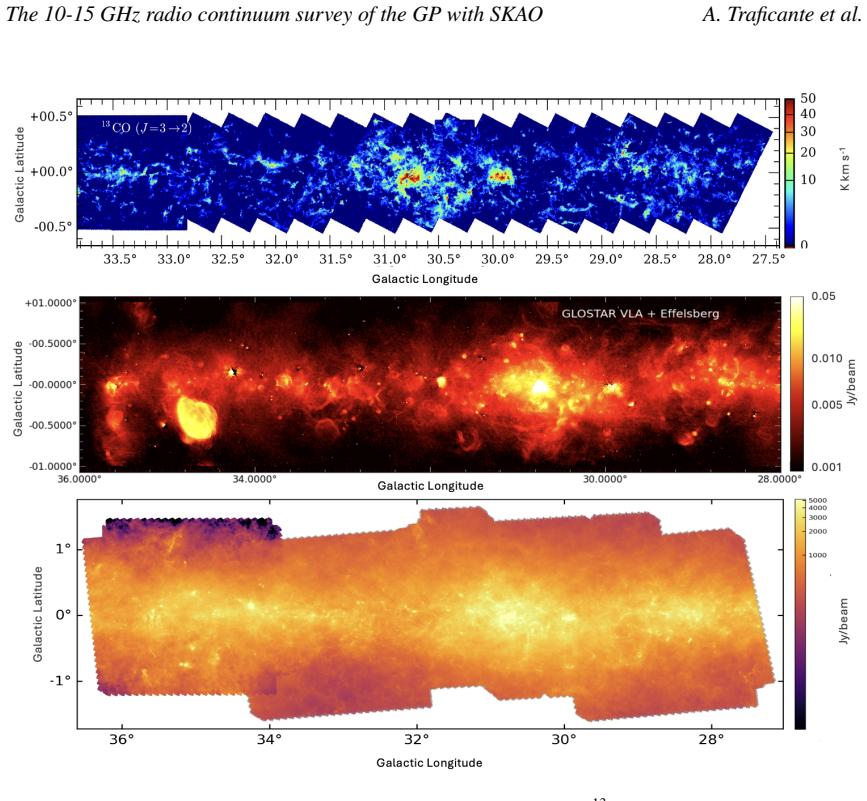
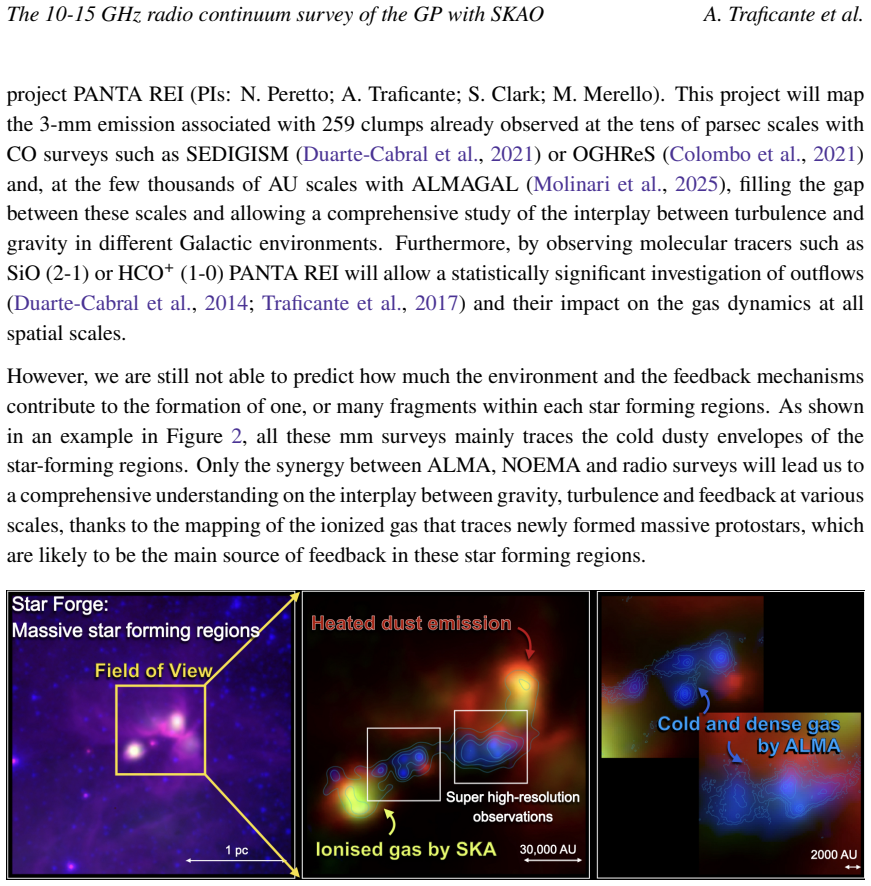
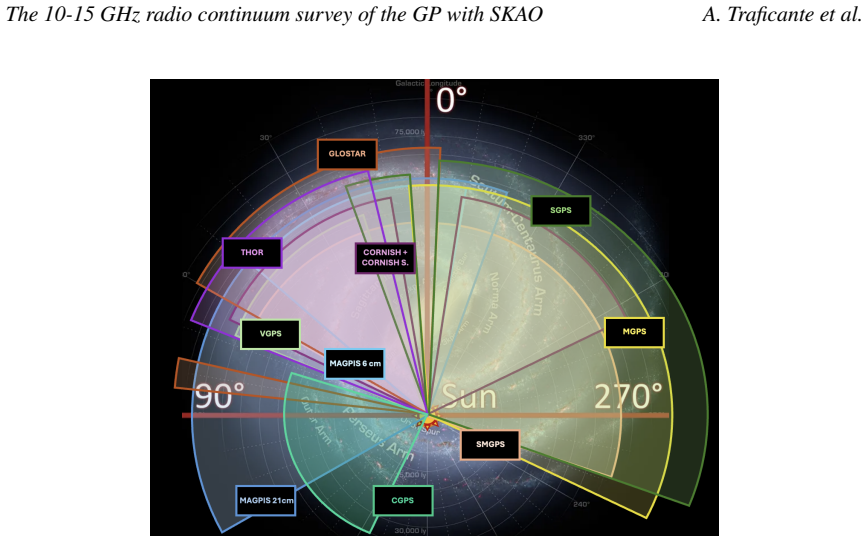
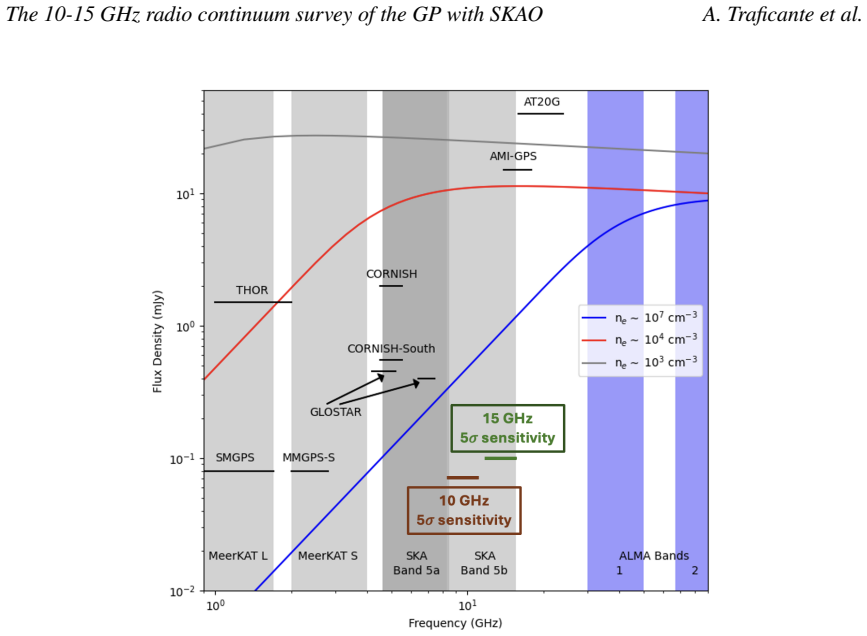
Star formation emerges from the complex interplay between gravity, turbulence, magnetic fields, and stellar feedback, all of which vary across spatial scales and Galactic environments. Over the past decades, extensive multiwavelength surveys of the Galactic Plane have progressively unveiled this complexity. Far-infrared and sub-millimetre surveys have identified and characterized tens of thousands of star-forming regions, revealing their mass, temperature, and evolutionary stage. Complementary molecular-line surveys, spanning several CO transitions and isotopologues, have mapped the gas kinematics from giant molecular clouds down to sub-parsec structures. The advent of interferometers such as ALMA has revolutionized this field, enabling systematic studies of gas dynamics, fragmentation, and collapse in dense clumps at scales of a few thousand astronomical units. At the same time, mid-infrared and radio surveys at frequencies 0.8 <= nu <= 5 GHz have traced ionised gas associated with the earliest and latest phases of massive-star evolution, including thermal radio jets, hypercompact and ultracompact HII regions, supernova remnants, planetary nebulae, and evolved massive stars. Yet, a uniform, Galaxy-wide census of ionised structures and feedback processes remains elusive. A transformational leap forward requires a sensitive, high-resolution radio survey of the Galactic Plane at 10-15 GHz, capable of resolving physical scales smaller than 0.05 pc at distances up to 20 kpc. This is precisely the goal of the SKA-Mid Galactic Plane survey, which will, with its unprecedented sensitivity, angular resolution, and mapping speed, provide the first panoptic view of ionised gas and stellar feedback across the Milky Way.
Editorial analysis
A structured set of objections, weighed in public.
Referee Report
Summary. The manuscript presents the scientific motivation for a 10-15 GHz radio continuum survey of the Galactic Plane with SKA-Mid. It reviews gaps in existing far-IR, sub-mm, molecular-line, and lower-frequency radio surveys, and claims that the proposed SKA-Mid survey will deliver the sensitivity, angular resolution, and mapping speed needed to resolve physical scales <0.05 pc at distances up to 20 kpc, thereby providing the first uniform, Galaxy-wide census of ionized gas and stellar feedback.
Significance. If the performance claims are realized, the survey would be significant for Galactic astronomy. It would enable the first panoptic, high-resolution view of ionized structures across the entire Plane, directly addressing the identified gap and allowing systematic studies of feedback processes on sub-parsec scales at large distances, in synergy with existing multi-wavelength datasets.
major comments (1)
- [Abstract] Abstract: The central claim that the SKA-Mid survey 'will, with its unprecedented sensitivity, angular resolution, and mapping speed, provide the first panoptic view of ionised gas and stellar feedback across the Milky Way' is load-bearing but unsupported. The text contains no sensitivity calculations, angular-resolution estimates, mapping-speed figures, baseline specifications, or citations to SKA technical documentation that would justify the <0.05 pc resolution at 20 kpc.
minor comments (1)
- [Abstract] The notation '0.8 <= nu <= 5 GHz' is functional but could be written as '0.8-5 GHz' for standard readability.
Simulated Author's Rebuttal
We thank the referee for their review and for highlighting the need to substantiate the performance claims. We address the single major comment below and will incorporate the requested supporting material in a revised manuscript.
read point-by-point responses
-
Referee: [Abstract] Abstract: The central claim that the SKA-Mid survey 'will, with its unprecedented sensitivity, angular resolution, and mapping speed, provide the first panoptic view of ionised gas and stellar feedback across the Milky Way' is load-bearing but unsupported. The text contains no sensitivity calculations, angular-resolution estimates, mapping-speed figures, baseline specifications, or citations to SKA technical documentation that would justify the <0.05 pc resolution at 20 kpc.
Authors: We agree that the abstract states the key performance claims without accompanying calculations or citations. While the full manuscript (Section 3, Survey Specifications) references the SKA-Mid array configuration and expected capabilities, these are not explicitly quantified or linked to the abstract. We will revise by adding a concise supporting statement (or footnote) that cites the SKA1-MID baseline design documents (Dewdney et al. 2016; SKA Memo series) and provides the relevant figures: ~0.5 arcsec resolution at 12 GHz (yielding <0.05 pc at 20 kpc), rms sensitivity of a few μJy beam⁻¹ in 1-hour integrations, and the mapping speed enabled by the 197-antenna core plus extended baselines. This directly justifies the resolution claim while preserving the motivational focus of the paper. revision: yes
Circularity Check
No circularity: purely descriptive survey proposal with no derivations
full rationale
The manuscript is a survey proposal paper whose central content is a forward-looking description of planned SKA-Mid observations at 10-15 GHz. It cites prior multi-wavelength surveys as motivation but contains no equations, fitted parameters, predictions, uniqueness theorems, or ansatzes. No load-bearing step reduces to a self-citation or input by construction. The text is self-contained as advocacy for new observations whose performance claims rest on external instrument specifications rather than internal derivation.
Axiom & Free-Parameter Ledger
Reference graph
Works this paper leans on
-
[1]
doi: 10.1088/0067-0049/192/1/4. L. Anderson et al. InAdvancing Astrophysics with the SKA – II (AASKAII)
-
[2]
doi: 10.1088/0004-637X/690/1/706. L. D. Anderson et al.A&A, 537:A1,
-
[3]
doi: 10.1051/0004-6361/201117640. L. D. Anderson et al.ApJSS, 212(1):1,
-
[4]
doi: 10.1088/0067-0049/212/1/1. L. D. Anderson et al.A&A, 605:A58,
-
[5]
doi: 10.1051/0004-6361/201731019. L. D. Anderson et al.A&A, 693:A247,
-
[6]
doi: 10.1051/0004-6361/202451038. M. Anderson et al.MNRAS, 508(2):2964–2978,
-
[7]
doi: 10.1093/mnras/stab2674. G. Anglada, L. F. Rodríguez, and C. Carrasco-González.A&ARv, 26(1):3,
-
[8]
doi: 10.1007/s00159-018-0107-z. M. Armante et al.A&A, 686:A122,
-
[9]
doi: 10.1051/0004-6361/202347595. A. Avison et al.MNRAS, 526(2):2278–2300,
-
[10]
doi: 10.1093/mnras/stad2824. P. J. Barnes et al.ApJSS, 196(1):12,
-
[11]
doi: 10.1088/0067-0049/196/1/12. P. J. Barnes et al.ApJ, 812(1):6,
-
[12]
W.Batrla,H.E.Matthews,K.M.Menten,andC.M.Walmsley.Nature,326(6108):49–51,1987
doi: 10.1088/0004-637X/812/1/6. W.Batrla,H.E.Matthews,K.M.Menten,andC.M.Walmsley.Nature,326(6108):49–51,1987. doi: 10.1038/326049a0. M. Benedettini et al.A&A, 633:A147,
-
[13]
31 The 10-15 GHz radio continuum survey of the GP with SKAO A
doi: 10.1051/0004-6361/201936096. 31 The 10-15 GHz radio continuum survey of the GP with SKAO A. Traficante et al. M. Benedettini et al.A&A, 654:A144,
-
[14]
doi: 10.1051/0004-6361/202141433. R. A. Benjamin et al.PASP, 115(810):953–964,
-
[15]
doi: 10.1086/376696. H. Beuther et al.A&A, 595:A32, 2016a. doi: 10.1051/0004-6361/201629143. H. Beuther et al.A&A, 595:A32, 2016b. doi: 10.1051/0004-6361/201629143. H. Beuther et al.A&A, 617:A100,
-
[16]
doi: 10.1051/0004-6361/201833021. H. Beuther, R. Kuiper, and M. Tafalla.ARA&A, 63(1):1–44,
-
[17]
doi: 10.1146/annurev-astro-013125-122023. M. Bonfand et al.A&A, 687:A163,
-
[18]
doi: 10.1051/0004-6361/202347856. C. Bordiu et al.MNRAS, 2025a. doi: 10.1093/mnras/staf1667. C. Bordiu et al.A&A, 695:A144, 2025b. doi: 10.1051/0004-6361/202450356. S.L.Breen,S.P.Ellingsen,J.L.Caswell,andB.E.Lewis.MNRAS,401(4):2219–2244,2010. doi: 10.1111/j.1365-2966. 2009.15831.x. S. L. Breen et al.MNRAS, 435(1):524–530,
-
[19]
doi: 10.1093/mnras/stt1315. S. L. Breen et al.MNRAS, 450(4):4109–4136,
-
[20]
doi: 10.1093/mnras/stv847. C. L. Brogan et al.ApJL, 639(1):L25–L29,
-
[21]
doi: 10.1086/501500. A. Brunthaler et al.A&A, 651:A85,
-
[22]
doi: 10.1051/0004-6361/202039856. C. S. Buemi et al.MNRAS, 465(4):4147–4158,
-
[23]
doi: 10.1093/mnras/stw3074. C. S. Buemi et al. InAdvancing Astrophysics with the SKA – II (AASKAII)
-
[24]
doi: 10.1017/pasa.2013.22. S. J. Carey et al.PASP, 121(875):76,
-
[25]
doi: 10.1086/596581. R. Cesaroni et al.A&A, 579:A71,
-
[26]
doi: 10.1051/0004-6361/201525953. X. Chen et al.MNRAS, 466(4):4364–4369,
-
[27]
doi: 10.1093/mnras/stx011. Y. Chen et al.A&A, 678:A137,
-
[28]
doi: 10.1051/0004-6361/202346491. E. Churchwell et al.ApJ, 649(2):759–778,
-
[29]
doi: 10.1086/507015. E. Churchwell et al.ApJ, 670(1):428–441,
-
[30]
doi: 10.1086/521646. E. Churchwell et al.PASP, 121(877):213,
-
[31]
doi: 10.1086/597811. A. Coletta et al.A&A, 696:A151,
-
[32]
doi: 10.1051/0004-6361/202452706. D. Colombo et al.A&A, 655:L2,
-
[33]
doi: 10.1051/0004-6361/202142182. Y. Contreras et al.A&A, 549:A45,
-
[34]
doi: 10.1051/0004-6361/201220155. T. Csengeri et al.A&A, 565:A75,
-
[35]
doi: 10.1051/0004-6361/201322434. C. J. Cyganowski et al.AJ, 136(6):2391–2412,
-
[36]
doi: 10.1088/0004-6256/136/6/2391. T. M. Dame, D. Hartmann, and P. Thaddeus.ApJ, 547(2):792,
-
[37]
doi: 10.1086/318388. C. G. De Pree et al.ApJL, 781(2):L36, 2014a. doi: 10.1088/2041-8205/781/2/L36. C. G. De Pree et al.ApJL, 781(2):L36, 2014b. doi: 10.1088/2041-8205/781/2/L36. L. Deharveng et al.A&A, 523:A6,
work page internal anchor Pith review doi:10.1086/318388 2041
-
[38]
doi: 10.1051/0004-6361/201014422. J. T. Dempsey, H. S. Thomas, and M. J. Currie.ApJSS, 209(1):8,
-
[39]
doi: 10.1088/0067-0049/209/1/8. J. Dey et al.A&A, 689:A254,
-
[40]
doi: 10.1051/0004-6361/202039873. R. Dokara et al.A&A, 671:A145,
-
[41]
doi: 10.1051/0004-6361/202245339. A. Duarte-Cabral et al.A&A, 558:A125,
-
[42]
doi: 10.1051/0004-6361/201321393. A. Duarte-Cabral et al.A&A, 570:A1,
-
[43]
doi: 10.1051/0004-6361/201423677. A. Duarte-Cabral et al.MNRAS, 500:3027–3049,
-
[44]
doi: 10.1093/mnras/staa2480. S. W. Duchesne et al.PASA, 40:e034,
-
[45]
doi: 10.1017/pasa.2023.31. S. A. Dzib et al.A&A, 670:A9,
-
[46]
doi: 10.1051/0004-6361/202143019. D. Elia et al.MNRAS, 504(2):2742–2766,
-
[47]
doi: 10.1093/mnras/stab1038. D. Elia et al.ApJ, 941(2):162,
-
[48]
doi: 10.3847/1538-4357/aca27d. I. N. Evans et al.ApJSS, 274(2):22,
-
[49]
doi: 10.3847/1538-4365/ad6319. L. Eyer et al.A&A, 674:A13,
-
[50]
doi: 10.1051/0004-6361/202244242. R. Franco-Hernández and L. F. Rodríguez.ApJL, 604(2):L105–L108,
-
[51]
doi: 10.1086/386282. A.Frank etal. InH.Beuther, R. S.Klessen, C.P. Dullemond, andT.Henning, editors,Protostars andPlanetsVI, pages 451–474,
-
[52]
doi: 10.2458/azu_uapress_9780816531240-ch020. S. Freund et al.A&A, 664:A105,
-
[53]
32 The 10-15 GHz radio continuum survey of the GP with SKAO A
doi: 10.1051/0004-6361/202142573. 32 The 10-15 GHz radio continuum survey of the GP with SKAO A. Traficante et al. Gaia Collaboration et al.A&A, 674:A41, 2023a. doi: 10.1051/0004-6361/202243232. Gaia Collaboration et al.A&A, 674:A1, 2023b. doi: 10.1051/0004-6361/202243940. R. Galván-Madrid, L. F. Rodríguez, P. T. P. Ho, and E. Keto.ApJL, 674(1):L33,
-
[54]
doi: 10.1086/528957. R. Galván-Madrid et al.ApJSS, 274(1):15,
-
[55]
doi: 10.3847/1538-4365/ad61e6. E. C. Gardiner et al.ApJ, 967(2):145,
-
[56]
doi: 10.3847/1538-4357/ad39e1. S. Geen, P. Hennebelle, P. Tremblin, and J. Rosdahl.MNRAS, 454(4):4484–4502, 2015a. doi: 10.1093/mnras/stv2272. S. Geen et al.MNRAS, 448(4):3248–3264, 2015b. doi: 1093/mnras/stv251. S. Goedhart et al.MNRAS, 531(1):649–681,
-
[57]
doi: 10.1093/mnras/stae1166. P. F. Goldsmith, U. A. Yıldız, W. D. Langer, and J. L. Pineda.ApJ, 814(2):133,
-
[58]
doi: 10.1086/590229. M. González-Avilés, S. Lizano, and A. C. Raga.ApJ, 621(1):359–371,
-
[59]
doi: 10.1086/427470. D. A. Green.Journal of Astrophysics and Astronomy, 46(1):14,
-
[60]
doi: 10.1007/s12036-024-10038-4. J. A. Green et al.MNRAS, 392(2):783–794,
-
[61]
doi: 10.1111/j.1365-2966.2008.14091.x. M. Y. Grudić et al.MNRAS, 512(1):216–232,
-
[62]
doi: 10.1093/mnras/stac526. A. Hacar et al. In S. Inutsuka et al., editors,Protostars and Planets VII, volume 534 ofAstronomical Society of the Pacific Conference Series, page 153,
-
[63]
doi: 10.48550/arXiv.2203.09562. D. J. Helfand et al.AJ, 131(5):2525–2537,
-
[64]
doi: 10.1086/503253. P. Hennebelle and M. Y. Grudić.ARA&A, 62(1):63–111,
-
[65]
doi: 10.1146/annurev-astro-052622-031748. M. G. Hoare et al. In B. Reipurth, D. Jewitt, and K. Keil, editors,Protostars and Planets V, page 181,
-
[66]
doi: 10.48550/arXiv.astro-ph/0603560. M. G. Hoare et al.PASP, 124(919):939,
work page internal anchor Pith review Pith/arXiv arXiv doi:10.48550/arxiv.astro-ph/0603560
-
[67]
doi: 10.1086/668058. P. F. Hopkins et al.MNRAS, 491(3):3702–3729,
-
[68]
doi: 10.1093/mnras/stz3129. A. Ingallinera et al. InAdvancing Astrophysics with the SKA – II (AASKAII)
-
[69]
doi: 10.1093/mnras/stad005. K. Ishihara et al.ApJ, 974(1):95,
-
[70]
doi: 10.3847/1538-4357/ad630f. N. Izumi et al.ApJ, 963(2):163,
-
[71]
doi: 10.3847/1538-4357/ad18c6. J. M. Jackson et al.ApJSS, 163(1):145,
-
[72]
doi: 10.1086/500091. J. M. Jackson et al.PASA, 30:e057,
-
[73]
doi: 10.1017/pasa.2013.37. D. T. Jaffe and J. Martín-Pintado.ApJ, 520(1):162–172,
-
[74]
doi: 10.1086/307440. A. Karska et al.A&A, 697:A186,
-
[75]
doi: 10.1051/0004-6361/202453109. A. Karska et al. InAdvancing Astrophysics with the SKA – II (AASKAII)
-
[76]
doi: 10.1086/379545. S. Khan et al.A&A, 689:A81,
-
[77]
doi: 10.1051/0004-6361/202449390. K.-T. Kim and B.-C. Koo.ApJ, 549(2):979–996,
-
[78]
M. Klassen, T. Peters, and R. E. Pudritz.ApJ, 758(2):137, 2012a. doi: 10.1088/0004-637X/758/2/137. M. Klassen, R. E. Pudritz, and T. Peters.MNRAS, 421(4):2861–2871, 2012b. doi: 10.1111/j.1365-2966.2012.20523.x. A. Koley et al.A&A, 702:A133,
-
[79]
doi: 10.1051/0004-6361/202553830. M. S. N. Kumar, P. Palmeirim, D. Arzoumanian, and S. I. Inutsuka.A&A, 642:A87,
-
[80]
doi: 10.1051/0004-6361/ 202038232. S. Kurtz. In R. Cesaroni, M. Felli, E. Churchwell, and M. Walmsley, editors,Massive Star Birth: A Crossroads of Astrophysics, volume 227 ofIAU Symposium, pages 111–119,
discussion (0)
Sign in with ORCID, Apple, or X to comment. Anyone can read and Pith papers without signing in.