Health feature extraction from battery energy storage system field fault data
Pith reviewed 2026-06-26 01:14 UTC · model grok-4.3
The pith
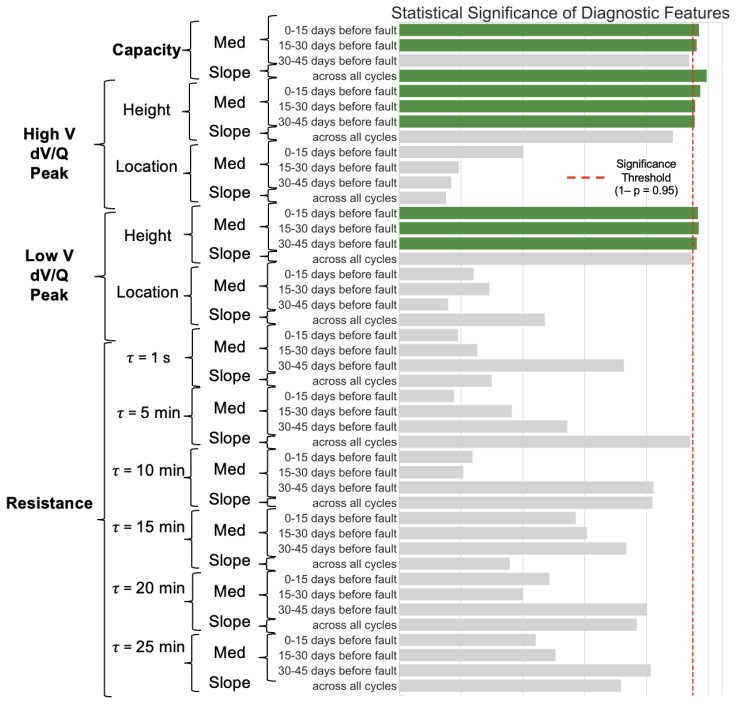
Capacity, degradation rate, and dV/dQ peaks separate faulty parallel cell groups in grid battery modules while resistance does not.
A machine-rendered reading of the paper's core claim, the machinery that carries it, and where it could break.
Core claim
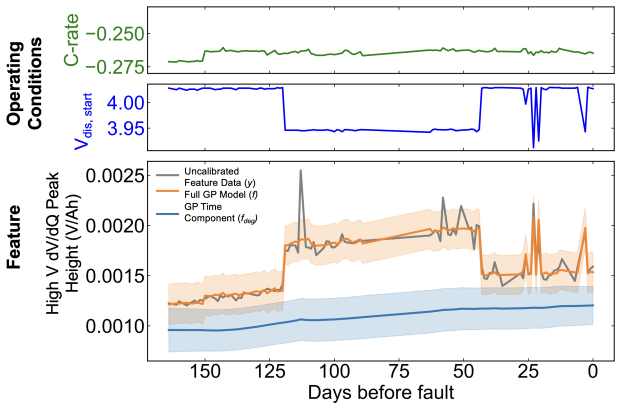
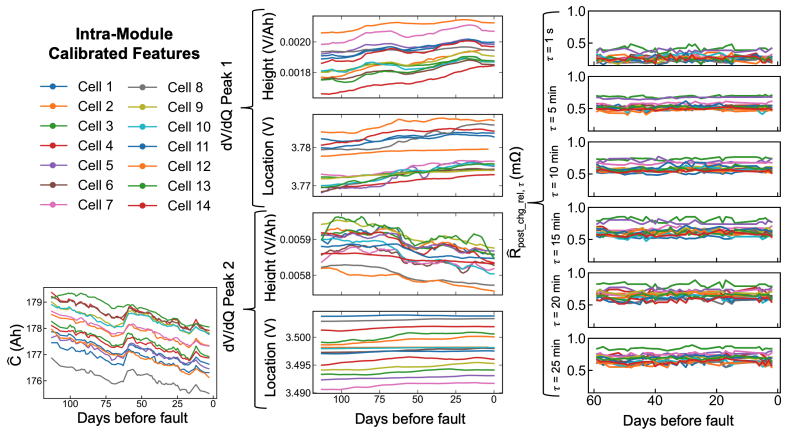
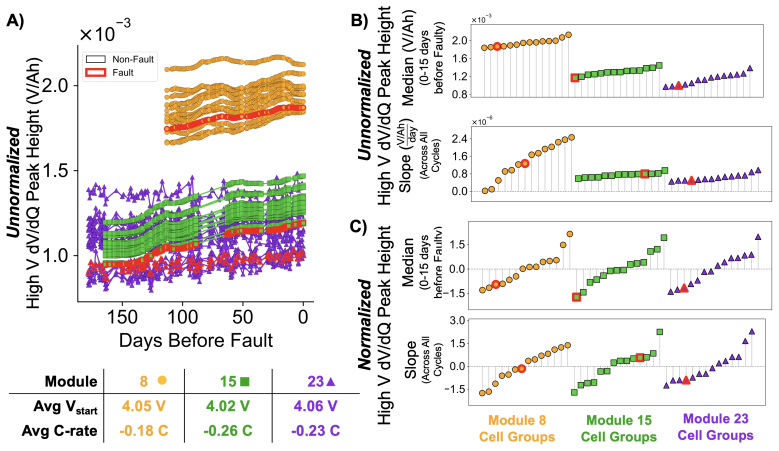
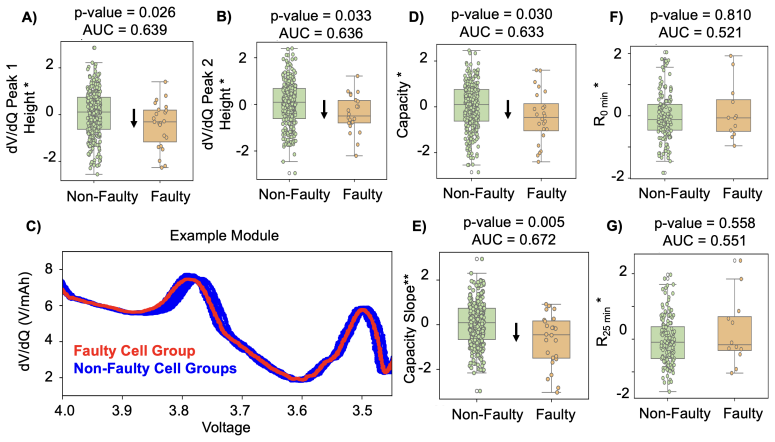
Using operational data from 25 grid-connected modules, calibrated group-level capacity, capacity degradation rate, and dV/dQ peak heights each separate the 25 faulty parallel cell groups from the 325 healthy ones at p<0.05, whereas group internal resistance does not, indicating that resistance increase was not the dominant fault signature in this dataset.
What carries the argument
Framework that extracts and calibrates health features (capacity, degradation rate, dV/dQ peaks, resistance) from sparse module-level voltage and current data to label faulty parallel groups.
If this is right
- Health monitoring of parallel groups inside modules becomes feasible from existing BMS data alone.
- Resistance-based alerts alone would miss the faults observed here.
- Feature signatures point to specific degradation mechanisms active under real grid cycling.
- The same calibration approach can be applied to other BESS fleets without hardware changes.
Where Pith is reading between the lines
- Operators could schedule targeted module replacements or balancing based on these three features rather than blanket resistance thresholds.
- Extending the calibration to modules with multiple simultaneous faults would test whether the signatures remain additive.
- The framework offers a route to label training data for machine-learning fault classifiers using only field logs and occasional post-mortems.
Load-bearing premise
Post-mortem examination supplies accurate labels for which parallel groups were faulty and the 25 modules supply enough variation to calibrate the features without lab controls or extra sensors.
What would settle it
Repeating the same statistical tests on a fresh collection of modules whose faulty groups are independently verified would fail to show p<0.05 separation for capacity or dV/dQ features.
Figures
read the original abstract
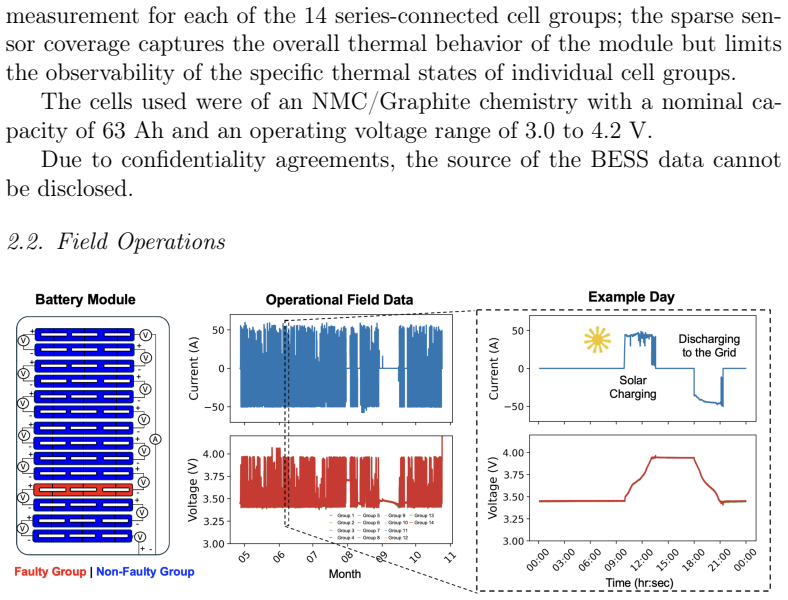
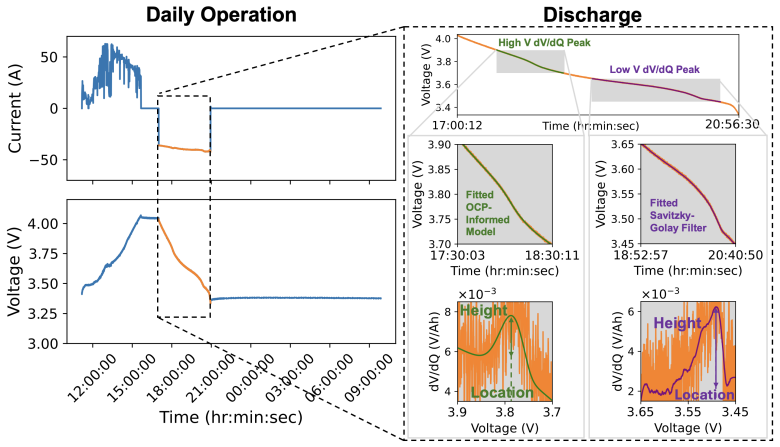
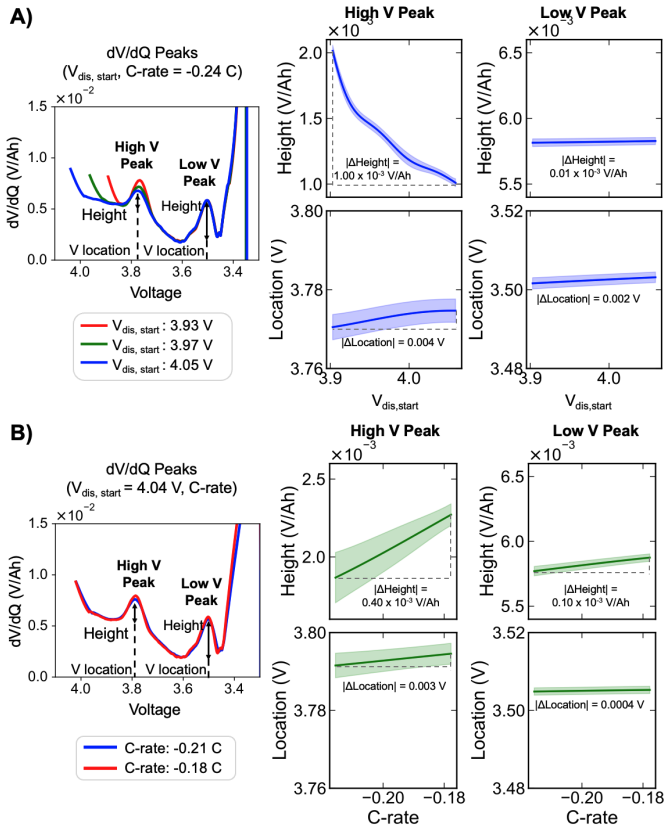
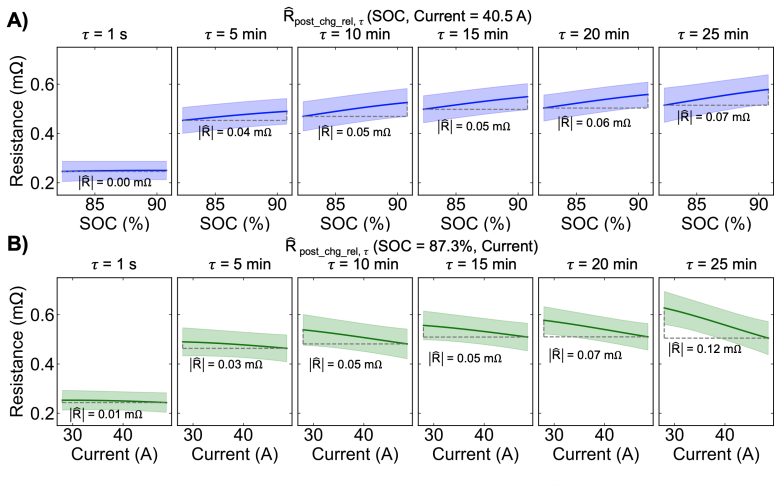
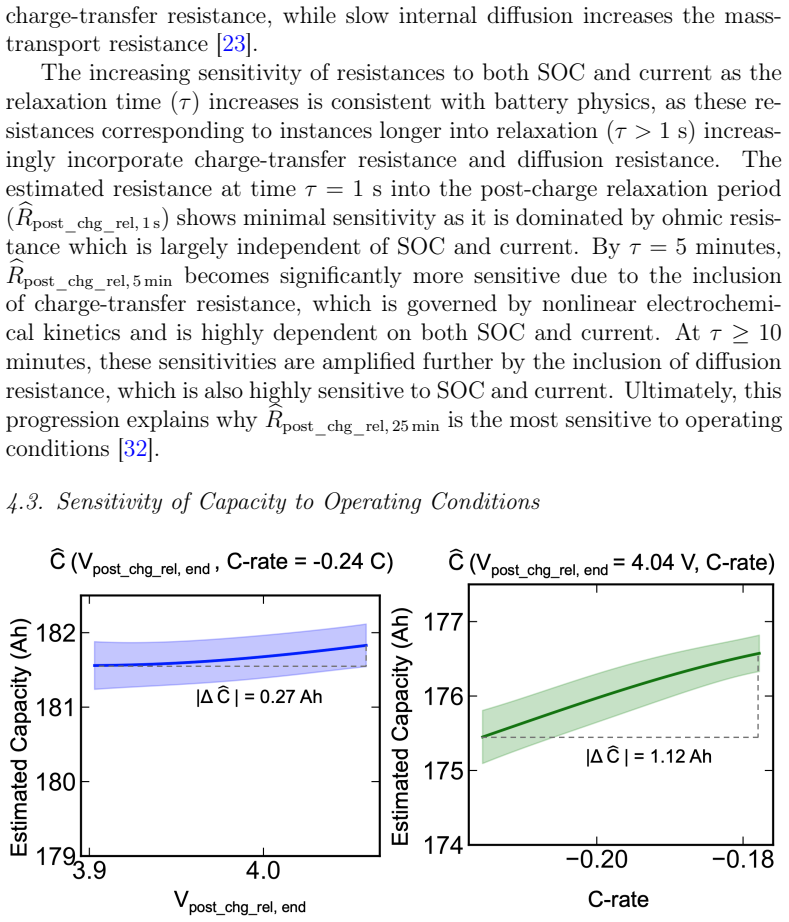
Health monitoring methods are critical for lithium-ion battery modules connected to the grid to prevent faults that can lead to catastrophic events. However, assessing the health of cells in modules from their operational data presents challenges including variable operating conditions, which directly confound health features, and sparse sensing in the modules, particularly within cells in parallel, which prevents observing critical states of individual cells. Here, we present a framework for extracting and calibrating health features for battery modules from their operational data to identify discriminative features for separating faulty parallel-connected cell groups within the modules. We applied this framework to operational data from 25 commercial grid-connected lithium-ion Battery Energy Storage System (BESS) modules. Each module consisted of 14 series-connected parallel groups, one of which was confirmed as faulty via post-mortem investigation; in total, the dataset included 25 faulty and 325 non-faulty cell groups. A statistical evaluation of these calibrated features demonstrated that group-level capacity, capacity degradation rate, and dV/dQ peak heights separate faulty parallel-connected cell groups within the modules with statistical significance (p<0.05). Conversely, group internal resistance did not (p>0.05), indicating that increased resistance was not a primary characteristic of the faults in this dataset. These findings challenge the exclusive reliance on resistance features for fault detection. The observed feature signatures suggest potential failure mechanisms, furthering the understanding of fault behavior in lithium-ion battery modules during field operation. More importantly, this work demonstrates a framework for robustly monitoring the health of cells in lithium-ion battery modules under real-world operations.
Editorial analysis
A structured set of objections, weighed in public.
Referee Report
Summary. The manuscript presents a framework for extracting and calibrating health features from operational data of grid-connected lithium-ion BESS modules to identify faulty parallel-connected cell groups. Applied to data from 25 commercial modules (each with 14 series-connected parallel groups, yielding 25 faulty groups confirmed by post-mortem and 325 non-faulty), statistical evaluation shows that calibrated group-level capacity, capacity degradation rate, and dV/dQ peak heights separate faulty from non-faulty groups at p<0.05, while group internal resistance does not (p>0.05). The work claims this challenges exclusive reliance on resistance features and suggests potential failure mechanisms under real-world variable conditions.
Significance. If the post-mortem labels are accurate and the calibration framework demonstrably handles variable operating conditions without additional sensors, the result would be significant as one of the few empirical analyses of field BESS fault data with ground-truth labels. The finding that resistance is not discriminative (while capacity and dV/dQ features are) could shift fault-detection approaches away from resistance-centric methods. The dataset size (350 groups) and real-world origin add value for practical health monitoring in grid storage systems.
major comments (2)
- [Abstract (post-mortem labels)] Abstract and post-mortem description: The central claim that capacity, degradation rate, and dV/dQ features separate faulty groups at p<0.05 rests on the 25 post-mortem labels being accurate ground truth. The manuscript states groups were 'confirmed as faulty via post-mortem investigation' but provides no details on the identification procedure, potential for misassignment from module-level data, quantitative validation of label accuracy, or inter-rater reliability. With only 25 positive cases, even modest label error would directly affect the reported significance.
- [Abstract (framework description)] Abstract (framework and methods): The abstract describes a 'framework for extracting and calibrating health features' to address variable operating conditions and sparse sensing, yet supplies no specifics on the calibration procedure, data exclusion criteria, or explicit handling of variable conditions. These omissions make it impossible to evaluate whether the p<0.05 separations are robust or confounded, which is load-bearing for the soundness of the statistical claims.
Simulated Author's Rebuttal
We thank the referee for their detailed review and constructive feedback. We address each major comment point-by-point below, with proposed revisions where the manuscript can be strengthened without misrepresenting the available data.
read point-by-point responses
-
Referee: [Abstract (post-mortem labels)] Abstract and post-mortem description: The central claim that capacity, degradation rate, and dV/dQ features separate faulty groups at p<0.05 rests on the 25 post-mortem labels being accurate ground truth. The manuscript states groups were 'confirmed as faulty via post-mortem investigation' but provides no details on the identification procedure, potential for misassignment from module-level data, quantitative validation of label accuracy, or inter-rater reliability. With only 25 positive cases, even modest label error would directly affect the reported significance.
Authors: We agree this is a substantive point. The manuscript relies on the 25 post-mortem confirmations as ground truth, and the full text describes the process as module disassembly followed by visual and capacity-based identification of damaged parallel groups. However, the current version does not include quantitative metrics on label accuracy or explicit discussion of misassignment risk from module-level data. We will revise the methods section to expand the post-mortem description with all available procedural details from the field investigation. We cannot provide inter-rater reliability statistics, as the confirmation was performed by a single technical team using objective physical evidence rather than subjective scoring. revision: partial
-
Referee: [Abstract (framework description)] Abstract (framework and methods): The abstract describes a 'framework for extracting and calibrating health features' to address variable operating conditions and sparse sensing, yet supplies no specifics on the calibration procedure, data exclusion criteria, or explicit handling of variable conditions. These omissions make it impossible to evaluate whether the p<0.05 separations are robust or confounded, which is load-bearing for the soundness of the statistical claims.
Authors: The abstract is written as a concise summary per journal conventions and therefore omits procedural specifics by design. The full manuscript details the calibration framework, including the normalization steps for variable operating conditions, data exclusion criteria based on SOC and temperature ranges, and the handling of sparse sensing through group-level aggregation, in Sections 3 and 4. The statistical results in Section 5 are derived from these calibrated features. We do not believe changes to the abstract are warranted, as expanding it would violate length constraints while duplicating material already present in the methods. revision: no
Circularity Check
No circularity: empirical statistical tests on post-mortem labels
full rationale
The paper applies a feature extraction and calibration framework to operational data from 25 BESS modules (25 faulty groups confirmed by post-mortem, 325 non-faulty) and reports statistical separation via p<0.05 tests on capacity, degradation rate, and dV/dQ peaks. No derivation chain, first-principles prediction, or fitted parameter is presented that reduces by construction to its own inputs; the results are direct empirical comparisons against external ground-truth labels. No self-citation load-bearing steps, uniqueness theorems, or ansatzes appear in the reported analysis. This is self-contained data-driven work with no reduction to fitted inputs or self-referential definitions.
Axiom & Free-Parameter Ledger
axioms (1)
- standard math Standard assumptions of statistical significance testing (e.g., appropriate distribution for p-value calculation) hold for the feature comparisons.
Reference graph
Works this paper leans on
-
[2]
Anseán, D., García, V., González, M., Viera, J., Blanco, C., Antuña, J.,
-
[3]
Dcinternalresistanceduringcharge: Analysisandstudyonlifepo4 batteries, in: 2013 World Electric Vehicle Symposium and Exhibition (EVS27), pp. 1–11. doi:10.1109/EVS.2013.6914746
-
[4]
Review—“Knees” in Lithium-Ion Battery Ag- ing Trajectories
Attia, P.M., Bills, A., Brosa Planella, F., Dechent, P., dos Reis, G., Dubarry, M., Gasper, P., Gilchrist, R., Greenbank, S., Howey, D., Liu, O., Khoo, E., Preger, Y., Soni, A., Sripad, S., Stefanopoulou, A.G., Sulzer, V., 2022. Review—“Knees” in Lithium-Ion Battery Ag- ing Trajectories. Journal of The Electrochemical Society 169, 060517. doi:10.1149/1945...
-
[5]
Charge transfer kinetics at the solid–solid interface in porous electrodes
Bai, P., Bazant, M.Z., 2014. Charge transfer kinetics at the solid–solid interface in porous electrodes. Nature Communications 5, 3585. URL: https://doi.org/10.1038/ncomms4585, doi:10.1038/ncomms4585
-
[6]
Criticalreviewofstateofhealthestimationmeth- ods of Li-ion batteries for real applications
Berecibar, M., Gandiaga, I., Villarreal, I., Omar, N., Van Mierlo, J., Van DenBossche, P., 2016. Criticalreviewofstateofhealthestimationmeth- ods of Li-ion batteries for real applications. Renewable and Sustainable Energy Reviews 56, 572–587. doi:10.1016/j.rser.2015.11.042
-
[7]
Detection of Li-ion battery failure and venting with Carbon Dioxide sensors
Cai, T., Valecha, P., Tran, V., Engle, B., Stefanopoulou, A., Siegel, J., 2021. Detection of Li-ion battery failure and venting with Carbon Dioxide sensors. eTransportation doi:10.1016/j.etran.2020.100100
-
[8]
Chen, M., Bai, F., Lin, S., Song, W., Li, Y., Feng, Z.,
-
[9]
Applied Thermal Engineering 146, 775–784
Performance and safety protection of internal short circuit in lithium-ion battery based on a multilayer electro-thermal cou- pling model. Applied Thermal Engineering 146, 775–784. URL: https://doi.org/10.1016/j.applthermaleng.2018.10.011, doi:10. 1016/j.applthermaleng.2018.10.011. 39
-
[12]
Wireless transmission of internal hazard signals in Li-ion batteries
Fan, J., Liu, C., Li, N., Yang, L., Yang, X.G., Dou, B., Hou, S., Feng, X., Jiang, H., Li, H., Song, W.L., Sun, L., Chen, H.S., Gao, H., Fang, D., 2025. Wireless transmission of internal hazard signals in Li-ion batteries. Nature 641, 639–645. URL:https://doi.org/10.1038/ s41586-025-08785-7, doi:10.1038/s41586-025-08785-7
-
[14]
Feng, X., Pan, Y., He, X., Wang, L., Ouyang, M., 2018. Detect- ing the internal short circuit in large-format lithium-ion battery us- ing model-based fault-diagnosis algorithm. Journal of Energy Stor- age 18, 26–39. URL:https://doi.org/10.1016/j.est.2018.04.020, doi:10.1016/j.est.2018.04.020
-
[15]
Multi-year field measurements of home storage systems and their use in capacity estimation
Figgener, J., van Ouwerkerk, J., Haberschusz, D., Bors, J., Wo- erner, P., Mennekes, M., Hildenbrand, F., Hecht, C., Kairies, K.P., Wessels, O., Sauer, D.U., 2024. Multi-year field measurements of home storage systems and their use in capacity estimation. Na- ture Energy 9, 1438–1447. URL:http://dx.doi.org/10.1038/ s41560-024-01620-9, doi:10.1038/s41560-0...
-
[17]
Gao, W., Zheng, Y., Ouyang, M., Li, J., Lai, X., Hu, X., 2019. Micro- short-circuit diagnosis for series-connected lithium-ion battery packs us- ing mean-difference model. IEEE Transactions on Industrial Electronics 66, 2132–2142. doi:10.1109/TIE.2018.2838109
-
[18]
Han, S., Choi, C., Kwon, S., Lee, S., Kim, J., 2020. Electrical analysis about internal short circuit using additional resistance in high energy lithium-ion battery. International Conference on Control, Automation and Systems 2020-Octob, 496–498. doi:10.23919/ICCAS50221.2020. 9268389
-
[19]
He, Z., Shen, X., Sun, Y., Zhao, S., Fan, B., Pan, C.,
-
[21]
Hu, X., Zhang, K., Liu, K., Lin, X., Dey, S., Onori, S., 2020. Advanced Fault Diagnosis for Lithium-Ion Battery Systems: A Review of Fault Mechanisms, Fault Features, and Diagnosis Procedures. IEEE Industrial Electronics Magazine 14, 65–91. doi:10.1109/MIE.2020.2964814
-
[22]
Social construction of fire accidents in battery energy storage systems in Korea
Im, D.H., Chung, J.B., 2023. Social construction of fire accidents in battery energy storage systems in Korea. Journal of Energy Storage 71, 108192. URL:https://doi.org/10.1016/j.est.2023.108192, doi:10.1016/j.est.2023.108192
-
[23]
Fast Thermal Runaway Detection for Lithium-Ion Cells in Large Scale Traction Batteries , 1–11doi:10
Koch, S., Birke, K.P., Kuhn, R., 2018. Fast Thermal Runaway Detection for Lithium-Ion Cells in Large Scale Traction Batteries , 1–11doi:10. 3390/batteries4020016. 41
2018
-
[24]
Lewerenz, M., Marongiu, A., Warnecke, A., Sauer, D.U., 2017. Differen- tial voltage analysis as a tool for analyzing inhomogeneous aging: A case study for LiFePO4|Graphite cylindrical cells. Journal of Power Sources 368, 57–67. URL:https://doi.org/10.1016/j.jpowsour.2017.09. 059, doi:10.1016/j.jpowsour.2017.09.059
-
[25]
Evaluation of cyclic aging tests of prismatic automotive LiNiMnCoO2-Graphite cells considering influence of homogeneity and anode overhang
Lewerenz, M., Sauer, D.U., 2018. Evaluation of cyclic aging tests of prismatic automotive LiNiMnCoO2-Graphite cells considering influence of homogeneity and anode overhang. Journal of Energy Storage 18, 421–
2018
-
[26]
URL:https://www.sciencedirect.com/science/article/pii/ S2352152X18301579, doi:https://doi.org/10.1016/j.est.2018.06. 003
-
[28]
Robust estimationofbatterysystemtemperaturedistributionundersparsesens- ing and uncertainty
Lin, X., Perez, H.E., Siegel, J.B., Stefanopoulou, A.G., 2020. Robust estimationofbatterysystemtemperaturedistributionundersparsesens- ing and uncertainty. IEEE Trans. Control Syst. Technol
2020
-
[29]
Big data generation platform for battery faults under real-world variances
Luder, D., John, P.T., Busch, P., Börner, M., Cao, W., Dechent, P., Barbers, E., Bihn, S., Liu, L., Feng, X., Sauer, D.U., Li, W., 2025. Big data generation platform for battery faults under real-world variances. Green Energy and Intelligent Transportation 4. doi:10.1016/j.geits. 2025.100282
-
[30]
Comparison of expansion and voltage differential indicators for battery capacity fade
Mohtat, P., Lee, S., Siegel, J.B., Stefanopoulou, A.G., 2022. Comparison of expansion and voltage differential indicators for battery capacity fade. Journal of Power Sources 518. doi:10.1016/j.jpowsour.2021.230714
-
[31]
Mohtat, P., Lee, S., Sulzer, V., Siegel, J.B., Stefanopoulou, A.G.,
-
[32]
Journal of The Electrochemical Society 167, 110561
Differential expansion and voltage model for li-ion batteries at practical charging rates. Journal of The Electrochemical Society 167, 110561. URL:https://dx.doi.org/10.1149/1945-7111/aba5d1, doi:10.1149/1945-7111/aba5d1. 42
-
[33]
Mohtat, P., Nezampasandarbabi, F., Mohan, S., Siegel, J.B., Ste- fanopoulou, A.G., 2017. On identifying the aging mechanisms in li-ion batteries using two points measurements, in: 2017 American Control Conference (ACC), pp. 98–103. doi:10.23919/ACC.2017.7962937
-
[34]
ACriti- cal Look at Coulomb Counting Approach for State of Charge Estimation in Batteries
Movassagh, K., Raihan, A., Balasingam, B., Pattipati, K., 2021. ACriti- cal Look at Coulomb Counting Approach for State of Charge Estimation in Batteries. Energies 14. URL:https://www.mdpi.com/1996-1073/ 14/14/4074, doi:10.3390/en14144074
-
[35]
Degradation in parallel- connected lithium-ion battery packs under thermal gradients
Naylor Marlow, M., Chen, J., Wu, B., 2024. Degradation in parallel- connected lithium-ion battery packs under thermal gradients. Com- munications Engineering 3, 2. URL:https://doi.org/10.1038/ s44172-023-00153-5, doi:10.1038/s44172-023-00153-5
-
[37]
Battery Management Systems, Volume II: Equivalent- Circuit Methods
Plett, G., 2015. Battery Management Systems, Volume II: Equivalent- Circuit Methods. Artech. chapter 3
2015
-
[39]
Battery pack capacity estimation for electric vehicles based on enhanced ma- chine learning and field data
Qi, Q., Liu, W., Deng, Z., Li, J., Song, Z., Hu, X., 2024. Battery pack capacity estimation for electric vehicles based on enhanced ma- chine learning and field data. Journal of Energy Chemistry 92, 605–
2024
-
[40]
URL:https://www.sciencedirect.com/science/article/pii/ S2095495624000858, doi:https://doi.org/10.1016/j.jechem.2024. 01.047
-
[41]
Rasmussen, C.E., Williams, C.K.I., 2005. Gaussian Processes for Ma- chine Learning. The MIT Press. URL:https://doi.org/10.7551/ mitpress/3206.001.0001, doi:10.7551/mitpress/3206.001.0001
-
[42]
Schaeffer, J., Lenz, E., Gulla, D., Bazant, M.Z., Braatz, R.D., Findeisen, R., 2024. Gaussian-process-based online health monitoring and fault 43 analysis of lithium-ion battery systems from field data. Cell Reports Physical Science 5, 102258. URL:https://doi.org/10.1016/j.xcrp. 2024.102258, doi:10.1016/j.xcrp.2024.102258,arXiv:2406.19015
-
[43]
Local degradation and differential voltage analysis of aged lithium-ion pouch cells
Sieg, J., Storch, M., Fath, J., Nuhic, A., Bandlow, J., Spier, B., Sauer, D.U., 2020. Local degradation and differential voltage analysis of aged lithium-ion pouch cells. Journal of Energy Storage 30, 101582. URL: https://doi.org/10.1016/j.est.2020.101582, doi:10.1016/j.est. 2020.101582
-
[44]
Nonlinear Covariance Control via Differential Dynamic Programming,
Song, Z., Delgado, F.P., Hou, J., Hofmann, H., Sun, J., 2020. Individ- ual Cell Fault Detection for Parallel-Connected Battery Cells Based on the Statistical Model and Analysis. Proceedings of the American Con- trol Conference 2020-July, 1155–1160. doi:10.23919/ACC45564.2020. 9147423
-
[45]
The challenge and opportunity of battery lifetime pre- diction from field data
Sulzer, V., Mohtat, P., Aitio, A., Lee, S., Yeh, Y.T., Steinbacher, F., Khan, M.U., Lee, J.W., Siegel, J.B., Stefanopoulou, A.G., Howey, D.A., 2021. The challenge and opportunity of battery lifetime pre- diction from field data. Joule 5, 1934–1955. URL:https://www. sciencedirect.com/science/article/pii/S2542435121002932, doi:https://doi.org/10.1016/j.joul...
-
[46]
Tian, Y., Lin, C., Chen, X., Yu, X., Xiong, R., Zhang, Q., 2023. Re- versible lithium plating on working anodes enhances fast charging capa- bility in low-temperature lithium-ion batteries. Energy Storage Mate- rials 56, 412–423. URL:https://doi.org/10.1016/j.ensm.2023.01. 035, doi:10.1016/j.ensm.2023.01.035
-
[47]
Principles of the Battery Data Genome
Ward, L., Babinec, S., Dufek, E.J., Howey, D.A., Viswanathan, V., Aykol, M., Beck, D.A., Blaiszik, B., Chen, B.R., Crabtree, G., Clark, S., De Angelis, V., Dechent, P., Dubarry, M., Eggleton, E.E., Finegan, D.P., Foster, I., Gopal, C.B., Herring, P.K., Hu, V.W., Paulson, N.H., Preger, Y., Uwe-Sauer, D., Smith, K., Snyder, S.W., Sripad, S., Tanim, T.R., Te...
-
[49]
Differential voltage analysis for battery manufacturing process control
Weng, A., Siegel, J.B., Stefanopoulou, A., 2023. Differential voltage analysis for battery manufacturing process control. Frontiers in Energy Research 11
2023
-
[51]
Quantifying imbalances in parallel-connected cell groups using group voltage and current
Wong, C., Weng, A., Movahedi, H., Choi, J., Yang, S.Y., Jin, H., Siegel, J., Stefanopoulou, A., 2026. Quantifying imbalances in parallel-connected cell groups using group voltage and current. Journal of Energy Storage 150, 120507. URL:https://www. sciencedirect.com/science/article/pii/S2352152X26001714, doi:https://doi.org/10.1016/j.est.2026.120507
-
[52]
Xiong, R., Li, L., Tian, J., 2018. Towardsasmarterbatterymanagement system: A critical review on battery state of health monitoring meth- ods. Journal of Power Sources 405, 18–29. URL:https://doi.org/ 10.1016/j.jpowsour.2018.10.019, doi:10.1016/j.jpowsour.2018. 10.019
-
[53]
Xu, J., Ma, J., Zhang, K., Li, J., Zhao, X., He, Z., Wu, X.,
-
[55]
Yi, J., Kim, U.S., Shin, C.B., Han, T., Park, S., 2013. Three- Dimensional Thermal Modeling of a Lithium-Ion Battery Considering the Combined Effects of the Electrical and Thermal Contact Resistances 45 between Current Collecting Tab and Lead Wire. Journal of The Elec- trochemical Society 160, A437–A443. doi:10.1149/2.039303jes
-
[56]
Information Fusion90, 241–252 (2023), ISSN 1566-2535,https://doi.org/https://doi.org/10.1016/j
Yuan, Y., Wang, H., Sun, Y., Han, X., Zhu, C., Ouyang, M., 2025. The influence of local lithium plating on battery safety and a novel detection method. Energy 321, 135529. URL:https://doi.org/10.1016/j. energy.2025.135529, doi:10.1016/j.energy.2025.135529
work page doi:10.1016/j 2025
-
[57]
Zhao, J., Feng, X., Tran, M.K., Fowler, M., Ouyang, M., Burke, A.F.,
-
[58]
Battery safety: Fault diagnosis from laboratory to real world. Journal of Power Sources 598. doi:10.1016/j.jpowsour.2024.234111
-
[59]
and Duck, P.Stochastic wind speed modelling for estimation of expected wind power output
Zhou, Z., Aitio, A., Howey, D., 2025. Learning Li-ion battery health and degradation modes from data with aging-aware circuit models. Applied Energy 397, 126375. URL:https://doi.org/10.1016/j.apenergy. 2025.126375, doi:10.1016/j.apenergy.2025.126375. 46
discussion (0)
Sign in with ORCID, Apple, or X to comment. Anyone can read and Pith papers without signing in.