SKA VLBI survey of the Southern sky for astrometry, geodesy, and astrophysics
Pith reviewed 2026-06-26 04:22 UTC · model grok-4.3
The pith
SKA will enable dedicated VLBI surveys of the Southern sky for geodesy and reference frames.
A machine-rendered reading of the paper's core claim, the machinery that carries it, and where it could break.
Core claim
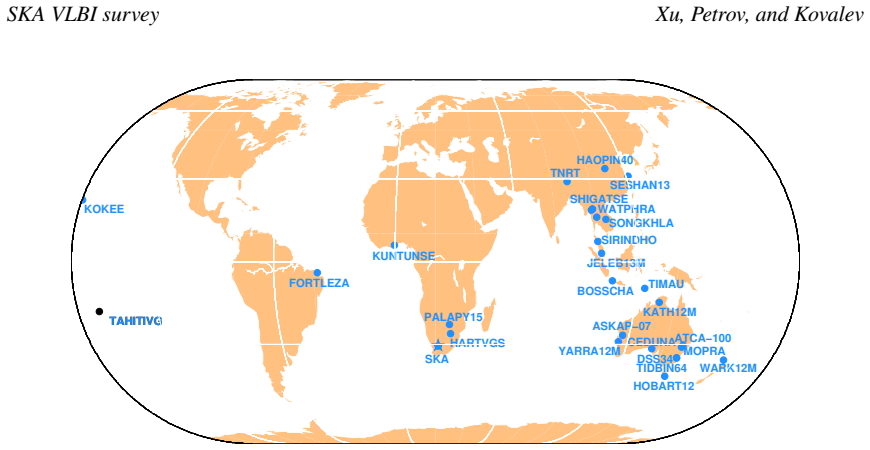
The development of SKA will open the opportunity to run dedicated VLBI surveys of the Southern sky and observe sources not visible at radio telescopes located in the Northern hemisphere. These surveys will allow for doing geodesy with a Southern hemisphere-centered network, increase the density of compact radio sources that can be used as calibrators, further extend the celestial reference frame to deep south, and facilitate high-precision differential astrometry for a wide range of applications including supporting Cherenkov and neutrino telescope science cases as well as joint VLBI-Gaia studies of active galaxies.
What carries the argument
Dedicated southern VLBI surveys with the SKA that achieve deep completeness and measure parsec-scale properties of extragalactic radio sources.
Load-bearing premise
The SKA will be built and operated with the sensitivity, resolution, and scheduling flexibility required to reach deep completeness and parsec-scale measurements.
What would settle it
After SKA operations begin, southern VLBI source counts and completeness levels remain comparable to those already achievable with existing northern networks.
Figures
read the original abstract
The development of SKA will open the opportunity to run dedicated VLBI surveys of the Southern sky and observe sources not visible at radio telescopes located in the Northern hemisphere. These surveys will allow for doing geodesy with a Southern hemisphere-centered network, increase the density of compact radio sources that can be used as calibrators, further extend the celestial reference frame to deep south, and facilitate high-precision differential astrometry for a wide range of applications. Achieving a deep completeness level and determining the parsec-scale properties of extragalactic radio sources is crucial for multi-wavelength and multi-messenger astrophysics. This includes supporting Cherenkov and neutrino telescope science cases, as well as joint VLBI-Gaia studies of active galaxies.
Editorial analysis
A structured set of objections, weighed in public.
Referee Report
Summary. The manuscript proposes that the development of the SKA will enable dedicated VLBI surveys of the Southern sky to support geodesy with a Southern hemisphere-centered network, increase the density of compact radio calibrators, extend the celestial reference frame to the deep south, and facilitate high-precision differential astrometry for multi-wavelength and multi-messenger astrophysics applications including Cherenkov/neutrino science and joint VLBI-Gaia studies of active galaxies.
Significance. If the SKA delivers the necessary VLBI sensitivity, resolution, and scheduling flexibility, the proposed surveys would address a clear gap in Southern hemisphere coverage and provide tangible benefits for reference-frame maintenance and multi-messenger follow-up. The motivations align with established needs in radio astrometry and geodesy.
major comments (2)
- Abstract: the stated goals of achieving deep completeness and determining parsec-scale properties are presented without any sensitivity calculations, baseline requirements, or survey completeness estimates, which are load-bearing for assessing whether the listed applications can be realized.
- Abstract: the central premise is conditional on future SKA VLBI performance, yet no quantitative assessment of the required parameters (e.g., thermal noise, uv-coverage for parsec-scale imaging, or scheduling constraints) is supplied to support the feasibility of the geodesy and reference-frame claims.
Simulated Author's Rebuttal
We thank the referee for their comments. We address the major points below and agree that revisions to the abstract are warranted to better reflect the scope and conditional nature of the proposal.
read point-by-point responses
-
Referee: Abstract: the stated goals of achieving deep completeness and determining parsec-scale properties are presented without any sensitivity calculations, baseline requirements, or survey completeness estimates, which are load-bearing for assessing whether the listed applications can be realized.
Authors: We agree that the abstract would be strengthened by acknowledging the absence of quantitative survey design elements. The manuscript is a high-level scientific motivation paper rather than a technical feasibility study; detailed sensitivity calculations and completeness estimates depend on finalized SKA VLBI configurations and are intended for subsequent dedicated papers. We will revise the abstract to clarify that the stated goals are contingent on achieving the required performance and to avoid implying that completeness estimates are already available. revision: yes
-
Referee: Abstract: the central premise is conditional on future SKA VLBI performance, yet no quantitative assessment of the required parameters (e.g., thermal noise, uv-coverage for parsec-scale imaging, or scheduling constraints) is supplied to support the feasibility of the geodesy and reference-frame claims.
Authors: We accept this criticism. The abstract does not provide the requested quantitative parameters because the paper focuses on scientific drivers rather than engineering specifications. We will revise the abstract to explicitly state that the proposed applications assume the SKA meets its target VLBI sensitivity, resolution, and operational flexibility, and we will add a short forward reference in the introduction to ongoing technical studies on these parameters. revision: yes
Circularity Check
No significant circularity
full rationale
The manuscript is a forward-looking survey proposal with no equations, derivations, fitted parameters, or load-bearing predictions. Its central claims are conditional on the external premise of SKA construction and performance; no internal chain reduces to self-definition, self-citation, or renaming of inputs. This is the most common honest finding for descriptive proposals.
Axiom & Free-Parameter Ledger
Reference graph
Works this paper leans on
-
[1]
doi: 10.1007/s00190-023-01738-w. J. M. Anderson and M. H. Xu.JGR-SE, 123(11):10,162–10,190,
-
[2]
doi: 10.3847/1538-4357/ab11c7. S. Duchesne et al.PASA, 42:38, Jan
-
[3]
doi: 10.1017/pasa.2025.2. A. L. Fey et al.AJ, 127(3):1791–1795, Mar
-
[4]
G.FichetdeClairfontaine,M.Perucho,J.M.Martí,andY.Y.Kovalev.A&A,693:A270,Jan.2025
doi: 10.1086/381957. G.FichetdeClairfontaine,M.Perucho,J.M.Martí,andY.Y.Kovalev.A&A,693:A270,Jan.2025. doi: 10.1051/0004-6361/202451914. X. He et al.ASR, 76(10):5872–5889, Nov
-
[5]
doi: 10.1016/j.asr.2025.08.036. L. Kern, H. Krásná, A. Nothnagel, and J. Böhm.Earth, Planets and Space, 77(1):40, Mar
-
[6]
doi: 10.1186/s40623-025-02159-z. S. Kiehlmann et al.ApJ, 961(2):240, Feb
-
[7]
doi: 10.3847/1538-4357/ad0c56. T. A. Koryukova, A. B. Pushkarev, A. V. Plavin, and Y. Y. Kovalev.MNRAS, 515(2):1736–1750, Sept
-
[8]
doi: 10.1093/mnras/stac1898. Y. Y. Kovalev.ApJL, 707(1):L56–L59, Dec
-
[9]
doi: 10.1088/0004-637X/707/1/L56. Y. Y. Kovalev, L. Petrov, and A. V. Plavin.A&A, 598:L1,
-
[10]
doi: 10.1051/0004-6361/ 201630031. Y. Y. Kovalev et al.A&A, 700:L12, Aug
-
[11]
doi: 10.1051/0004-6361/202555400. B. Marcote et al.Nature, 577(7789):190–194, Jan
-
[12]
doi: 10.1038/s41586-019-1866-z. J.McKeanetal. InAdvancing Astrophysics with the Square Kilometre Array (AASKA14),page84, Apr
-
[13]
doi: 10.22323/1.215.0084. A. Niell et al.Radio Science, 53(10):1269–1291,
-
[14]
doi: 10.1029/2018RS006617. R. P. Norris et al.PASA, 28(3):215–248, Aug
-
[15]
doi: 10.1071/AS11021. L. Petrov.AJ, 165(4):183, Apr
-
[16]
doi: 10.3847/1538-3881/acc174. L. Petrov et al.MNRAS, 414:2528–2539, July
-
[17]
doi: 10.1111/j.1365-2966.2011.18570.x. L. Petrov et al.MNRAS, 485(1):88–101, May
-
[18]
doi: 10.1093/mnras/stz242. L. Petrov, C. Ploetz, and M. Schartner.arXiv e-prints, art. arXiv:2506.15859, June
-
[19]
doi: 10.48550/arXiv.2506.15859. L. Y. Petrov and Y. Y. Kovalev.ApJSS, 276(2):38, Feb
-
[20]
doi: 10.3847/1538-4365/ad8c36. B. G. Piner and P. G. Edwards.ApJ, 853(1):68, Jan
-
[21]
doi: 10.3847/1538-4357/aaa425. A. V. Plavin, Y. Y. Kovalev, and L. Y. Petrov.ApJ,
-
[22]
doi: 10.3847/1538-4357/aaf650. A. V. Plavin, Y. Y. Kovalev, Y. A. Kovalev, and S. V. Troitsky.MNRAS, 523(2):1799–1808, Aug
-
[23]
doi: 10.1093/mnras/stad1467. M. J. Reid and M. Honma.ARA&A, 52:339–372,
-
[24]
doi: 10.1029/2023RS007734. T. Treu.ARA&A, 48:87–125, Sept
-
[25]
doi: 10.1146/annurev-astro-081309-130924. S. Weston et al.PASA, 40:e041, Sept
-
[26]
doi: 10.1017/pasa.2023.33. M. H. Xu and P. Charlot.AJ, 169(3):173, feb
-
[27]
doi: 10.3847/1538-3881/adb133. M. H. Xu et al.Journal of Geodesy, 95(5):51, May
-
[28]
doi: 10.1007/s00190-021-01496-7. M. H. Xu et al.JGR-SE, 128(3),
-
[29]
doi: 10.1029/2022JB02519810.1002/essoar.10512041.1. 7
discussion (0)
Sign in with ORCID, Apple, or X to comment. Anyone can read and Pith papers without signing in.