Semi-empirical Predictions for Ultra-deep Radio Counts of Star-forming Galaxies with the SKAO
Pith reviewed 2026-06-26 04:13 UTC · model grok-4.3
The pith
SKA-Mid observations recover at least 20 percent of the predicted star formation rate density in under 20 hours
A machine-rendered reading of the paper's core claim, the machinery that carries it, and where it could break.
Core claim
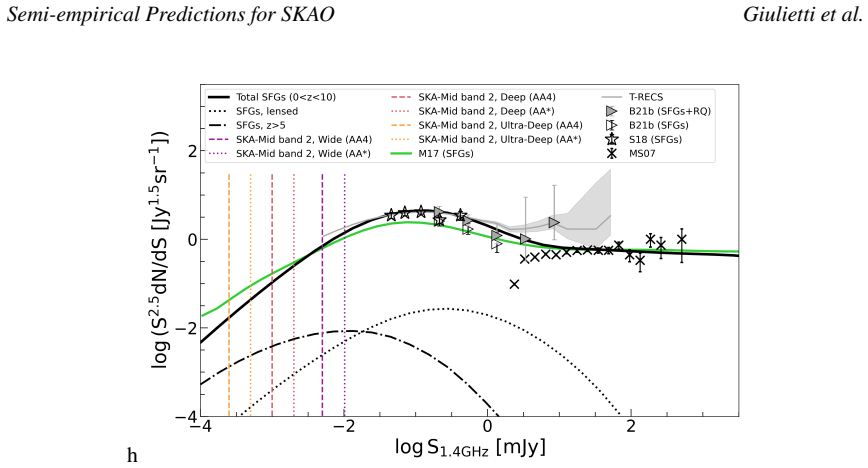
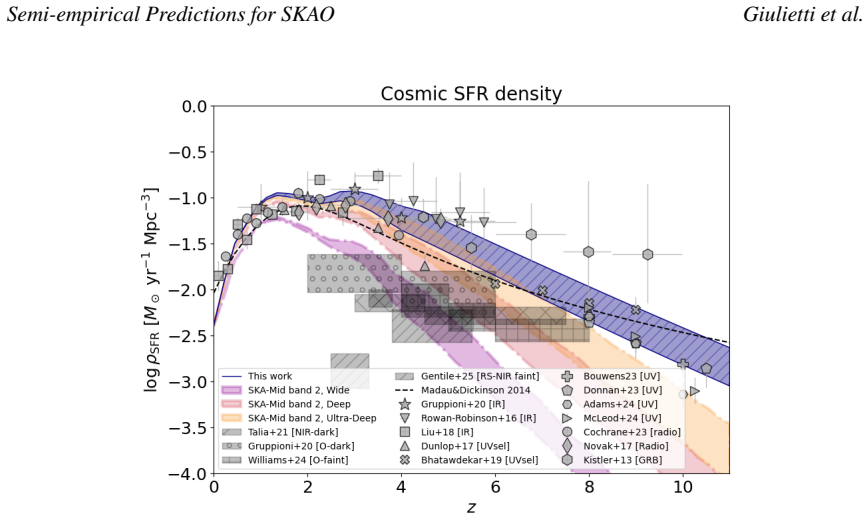
SEMPER predicts the radio luminosity functions and number counts of star-forming galaxies by integrating redshift-dependent stellar mass functions with the galaxy main sequence and the IR/radio correlation, including an evolving starburst fraction. Extended to SKA-Mid Band 2, the model shows that surveys in the faintest flux-density regimes are dominated by star-formation-powered galaxies, and that less than 20 hours of observations recover at least approximately 20 percent of the total SFRD predicted by SEMPER, including contributions from optically and NIR-dark systems up to redshift approximately 6.
What carries the argument
SEMPER semi-empirical model, which combines observed stellar mass functions with the galaxy main sequence and IR/radio correlation to generate radio luminosity functions and differential number counts at 1.4 GHz
If this is right
- SKA surveys will probe flux densities below 0.1 mJy where star-forming galaxies dominate the radio sky.
- The model naturally includes a substantial population of massive dust-obscured galaxies already in place at early epochs.
- Radio observations can trace the cosmic star formation rate density up to redshift approximately 10.
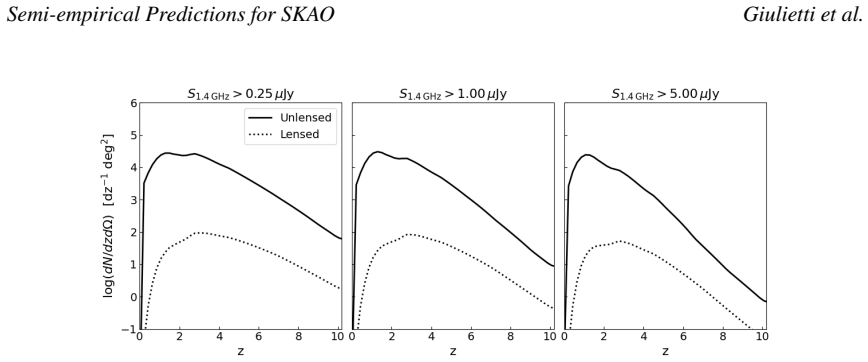
- Both lensed and unlensed star-forming galaxy counts at 1.4 GHz are predicted for SKA configurations.
Where Pith is reading between the lines
- If the predictions hold, radio surveys could deliver a more complete accounting of star formation at high redshift than optical or near-infrared surveys alone.
- Direct comparison of SKA number counts to these forecasts would test whether the underlying empirical relations require adjustment at the faintest levels.
- The same modeling approach could be extended to predict counts at other SKA frequency bands or for future radio facilities.
Load-bearing premise
The galaxy main sequence, the infrared-radio correlation, and the evolving starburst fraction continue to apply to massive high-redshift galaxies in the ultra-faint radio flux regimes that SKA will reach.
What would settle it
Deep SKA observations that recover a recovered SFRD fraction from radio sources up to z approximately 6 that is substantially different from 20 percent, or that fail to show star-forming galaxies dominating below 0.1 mJy, would falsify the model's predictions.
Figures
read the original abstract
Star-forming galaxies (SFGs) dominate the faint radio sky at flux densities below 0.1 mJy. Identifying these systems through a multiwavelength approach is essential to tracing the cosmic history of star formation. Upcoming surveys with the Square Kilometre Array Observatory (SKAO) in its AA4 configuration for the Mid array will probe these faint populations, offering unprecedented insights into the star formation activity of galaxies across cosmic time. Semi-empirical models, built on minimal assumptions and empirical galaxy relations, provide an efficient framework to study galaxy evolution using recent radio and optical/near-infrared (NIR) data. We developed SEMPER (Semi-EMPirical model for Extragalactic Radio emission) to predict the radio luminosity functions and number counts of SFGs. SEMPER combines redshift-dependent stellar mass functions from deep NIR surveys with empirical relations such as the galaxy main sequence and the IR/radio correlation, to characterise the radio properties of massive, high-redshift galaxies. The model shows excellent agreement with recent deep radio observations and naturally predicts a substantial population of massive, dust-obscured galaxies already in place at early epochs. In this chapter, we extend the SEMPER framework to SKA surveys by including an evolving starburst fraction and computing differential number counts at 1.4 GHz for both lensed and unlensed SFGs. Furthermore, we predict the cosmic star formation rate density (SFRD) traced by radio-emitting galaxies up to $z\approx10$. Our results show that SKA surveys will probe the faintest flux-density regimes, dominated by galaxies powered by star formation, and that <20 hours of SKA-Mid Band 2 observations will recover at least $\approx$20% of the total SFRD predicted by SEMPER, including contributions from optically/NIR-dark systems up to $z\approx 6$.
Editorial analysis
A structured set of objections, weighed in public.
Referee Report
Summary. The manuscript presents the SEMPER semi-empirical model combining redshift-dependent stellar mass functions from deep NIR surveys with the galaxy main sequence and IR/radio correlation to predict radio luminosity functions and number counts of star-forming galaxies. It extends the framework by including an evolving starburst fraction, computes 1.4 GHz differential number counts for lensed and unlensed SFGs, and forecasts that <20 hours of SKA-Mid Band 2 observations recover at least ≈20% of the total SFRD (including optically/NIR-dark systems) up to z≈6. The model is stated to show excellent agreement with recent deep radio observations.
Significance. If the empirical relations hold under extrapolation, the work supplies concrete forecasts for the fraction of cosmic star formation rate density accessible to SKA surveys in the star-formation-dominated regime below 0.1 mJy, with explicit inclusion of dust-obscured populations. The semi-empirical construction allows efficient use of existing NIR and radio data to generate falsifiable number-count predictions.
major comments (3)
- [Abstract] Abstract: the central claim that <20 h of SKA-Mid Band 2 recovers ≥20% of the SEMPER SFRD (including NIR-dark galaxies to z≈6) is load-bearing and depends entirely on the validity of the main sequence, IR/radio correlation, and evolving starburst fraction when extrapolated to z≈6 and S<0.1 μJy; no independent high-z radio stacking or lensing anchor is cited that could falsify the extrapolation inside the claimed parameter space.
- [Model extension] Model extension (evolving starburst fraction): the starburst fraction is treated as a free parameter whose functional form and calibration range are not shown to be constrained by data independent of the relations used to generate the SFRD integral; without a sensitivity analysis or posterior predictive check, it is unclear whether the 20% recovery figure is robust or an artifact of the chosen parameterization.
- [Comparison to observations] Comparison to observations: the statement of 'excellent agreement with recent deep radio observations' is used to support model reliability, yet the text provides no explicit list of datasets, exclusion rules, fitting procedure, or error propagation, preventing assessment of whether the agreement is independent of the extrapolation assumptions that underpin the SKA prediction.
minor comments (2)
- [Abstract] Abstract: the sentence beginning 'In this chapter, we extend...' is phrased as if excerpted from a thesis; reword for a standalone journal article.
- [Throughout] Notation: ensure consistent definition of SEMPER, SKAO, and SFRD on first use and avoid undefined acronyms in figure captions or equations.
Simulated Author's Rebuttal
We thank the referee for their constructive and detailed comments, which highlight important aspects of model validation and transparency. We address each major comment point by point below, indicating where revisions will be made to strengthen the manuscript.
read point-by-point responses
-
Referee: [Abstract] Abstract: the central claim that <20 h of SKA-Mid Band 2 recovers ≥20% of the SEMPER SFRD (including NIR-dark galaxies to z≈6) is load-bearing and depends entirely on the validity of the main sequence, IR/radio correlation, and evolving starburst fraction when extrapolated to z≈6 and S<0.1 μJy; no independent high-z radio stacking or lensing anchor is cited that could falsify the extrapolation inside the claimed parameter space.
Authors: We agree that the central prediction relies on extrapolation of the adopted empirical relations beyond the primary calibration range (typically z ≲ 4 for the main sequence and IR/radio correlation). The SEMPER framework is anchored in redshift-dependent stellar mass functions from deep NIR surveys and in the observed agreement with faint radio number counts from existing deep fields; these counts probe the star-formation-dominated regime at flux densities comparable to the SKA forecasts. We do not cite independent high-z radio stacking or strong-lensing anchors because such datasets remain sparse at the relevant redshifts and depths. In the revised manuscript we will add an explicit limitations subsection that qualifies the extrapolation, discusses the range of validity, and outlines how future SKA data themselves can falsify the model. revision: partial
-
Referee: [Model extension] Model extension (evolving starburst fraction): the starburst fraction is treated as a free parameter whose functional form and calibration range are not shown to be constrained by data independent of the relations used to generate the SFRD integral; without a sensitivity analysis or posterior predictive check, it is unclear whether the 20% recovery figure is robust or an artifact of the chosen parameterization.
Authors: The evolving starburst fraction is parameterized from literature compilations of the starburst contribution to the cosmic SFRD at different epochs. We acknowledge that the current text does not present a dedicated sensitivity analysis. In the revised version we will include a new figure and accompanying text showing the effect on the recovered SFRD fraction when the starburst fraction is varied within the observational uncertainties reported in the literature; this will demonstrate the robustness of the ≈20 % figure. revision: yes
-
Referee: [Comparison to observations] Comparison to observations: the statement of 'excellent agreement with recent deep radio observations' is used to support model reliability, yet the text provides no explicit list of datasets, exclusion rules, fitting procedure, or error propagation, preventing assessment of whether the agreement is independent of the extrapolation assumptions that underpin the SKA prediction.
Authors: We regret the omission of these details. The revised manuscript will contain a dedicated subsection that (i) lists the specific deep radio surveys and flux-density ranges used for comparison, (ii) describes the criteria applied to separate star-forming from AGN-dominated sources, (iii) outlines the χ² fitting procedure and the treatment of upper limits, and (iv) reports how uncertainties in the luminosity-function parameters are propagated into the number-count predictions. This will allow readers to evaluate the independence of the validation from the high-z extrapolation assumptions. revision: yes
Circularity Check
No significant circularity; semi-empirical extrapolation is forward prediction, not reduction to inputs
full rationale
The SEMPER model is constructed by combining published stellar mass functions with established empirical relations (main sequence, IR/radio correlation) that were calibrated on independent datasets; the SKA number-count and SFRD predictions are explicit extrapolations beyond the calibration regime. The abstract reports agreement with existing deep radio observations as a consistency check rather than a tautology, and no equations or self-citations are shown that would make the 20 % recovery figure equivalent to the fitted inputs by construction. This is a standard semi-empirical forward model whose central claim remains falsifiable by future SKA data.
Axiom & Free-Parameter Ledger
free parameters (1)
- evolving starburst fraction
axioms (2)
- domain assumption Redshift-dependent stellar mass functions from deep NIR surveys accurately describe the parent population of radio-emitting SFGs
- domain assumption The galaxy main sequence and IR/radio correlation remain valid at z>3 for massive galaxies
Reference graph
Works this paper leans on
-
[1]
doi: 10.3847/1538-4357/ad2a7b. H. S. B. Algera et al.ApJ, 903(2):139, Nov
-
[2]
doi: 10.3847/1538-4357/abb77a. M. Behiri et al.ApJ, 957(2):63, Nov
-
[3]
P.Behroozi,R.H.Wechsler,A.P.Hearin,andC.Conroy.MNRAS,488(3):3143–3194,Sept.2019
doi: 10.3847/1538-4357/acf616. P.Behroozi,R.H.Wechsler,A.P.Hearin,andC.Conroy.MNRAS,488(3):3143–3194,Sept.2019. doi: 10.1093/mnras/stz1182. P. N. Best et al.MNRAS, 523(2):1729–1755, Aug
-
[4]
doi: 10.1093/mnras/stad1308. M. Béthermin et al.ApJL, 757(2):L23, Oct
-
[5]
doi: 10.1088/2041-8205/757/2/L23. R. Bhatawdekar, C. J. Conselice, B. Margalef-Bentabol, and K. Duncan.MNRAS, 486(3):3805– 3830, July
-
[6]
L.Bisigello, K.I.Caputi, N.Grogin, andA.Koekemoer.A&A,609:A82, Jan.2018
doi: 10.1093/mnras/stz866. L.Bisigello, K.I.Caputi, N.Grogin, andA.Koekemoer.A&A,609:A82, Jan.2018. doi: 10.1051/ 0004-6361/201731399. A. Bonaldi et al.MNRAS, 482(1):2–19, Jan
-
[7]
doi: 10.1093/mnras/sty2603. A. Bonaldi et al.MNRAS, 524(1):993–1007, Sept
-
[8]
doi: 10.1093/mnras/stad1913. M. Bonato et al.MNRAS, 500(1):22–33, Jan
-
[9]
doi: 10.1093/mnras/staa3218. R. J. Bouwens et al.MNRAS, 523(1):1036–1055, July
-
[10]
doi: 10.1093/mnras/stad1145. J. Brinchmann et al.MNRAS, 351(4):1151–1179, July
-
[11]
doi: 10.1111/j.1365-2966.2004. 07881.x. K. I. Caputi et al.ApJ, 849(1):45, Nov
-
[12]
doi: 10.3847/1538-4357/aa901e. G. Chabrier.PASP, 115(809):763–795, July
-
[13]
doi: 10.1086/376392. M. Chruślińska, G. Nelemans, L. Boco, and A. Lapi.MNRAS, 508(4):4994–5027, Dec
work page internal anchor Pith review doi:10.1086/376392
-
[14]
doi: 10.1093/mnras/stab2690. R. K. Cochrane et al.MNRAS, 523(4):6082–6102, Aug
-
[15]
doi: 10.1093/mnras/stad1602. J. J. Condon.ARA&A, 30:575–611, Jan
-
[16]
doi: 10.1146/annurev.aa.30.090192.003043. J. J. Condon, W. D. Cotton, and J. J. Broderick.AJ, 124(2):675–689, Aug
-
[17]
doi: 10.1051/0004-6361/202039647. C. T. Donnan et al.MNRAS, 518(4):6011–6040, Feb
-
[18]
doi: 10.1093/mnras/stac3472. S. P. Driver et al.MNRAS, 513(1):439–467, June
-
[19]
doi: 10.1093/mnras/stac472. J. S. Dunlop et al.MNRAS, 466(1):861–883, Apr
-
[20]
doi: 10.1093/mnras/stw3088. A. Enia et al.ApJ, 927(2):204, Mar
-
[21]
doi: 10.3847/1538-4357/ac51ca. F. Gentile et al.ApJ, 962(1):26, Feb
-
[22]
doi: 10.3847/1538-4357/ad1519. F. Gentile et al.A&A, 697:A46, May
-
[23]
doi: 10.1051/0004-6361/202452461. M. Giulietti et al. A&A, 697:A81, May
-
[24]
doi: 10.1051/0004-6361/202453331. C. Gruppioni et al.A&A, 643:A8, Nov
-
[25]
D.J.Helfand,R.L.White,andR.H.Becker.ApJ,801(1):26,Mar.2015
doi: 10.1051/0004-6361/202038487. D.J.Helfand,R.L.White,andR.H.Becker.ApJ,801(1):26,Mar.2015. doi: 10.1088/0004-637X/ 801/1/26. G. Helou, B. T. Soifer, and M. Rowan-Robinson.ApJL, 298:L7–L11, Nov
-
[26]
doi: 10.1093/mnras/stab3021. O. Ilbert et al.A&A, 579:A2, July
-
[27]
doi: 10.1051/0004-6361/201425176. R. C. Kennicutt and N. J. Evans.ARA&A, 50:531–608, Sept
-
[28]
The Cosmic Star Formation Rate from the Faintest Galaxies in the Unobservable Universe
doi: 10.1146/ 10 Semi-empirical Predictions for SKAO Giulietti et al. annurev-astro-081811-125610. M.D.Kistler,H.Yuksel,andA.M.Hopkins.arXive-prints,art.arXiv:1305.1630,May2013. doi: 10.48550/arXiv.1305.1630. M. Lacy et al.PASP, 132(1009):035001, Mar
work page internal anchor Pith review Pith/arXiv arXiv doi:10.48550/arxiv.1305.1630
-
[29]
doi: 10.1088/1538-3873/ab63eb. A. Lapi et al.ApJ, 755(1):46, Aug
-
[30]
doi: 10.1088/0004-637X/755/1/46. A. Lapi, L. Boco, and F. Shankar.Encyclopedia of Astrophysics, Elsevier, in press, art. arXiv:2502.12764, Feb
-
[31]
doi: 10.48550/arXiv.2502.12764. D. Liu et al.ApJ, 853(2):172, Feb
-
[32]
doi: 10.3847/1538-4357/aaa600. P. Madau and M. Dickinson.ARA&A, 52:415–486, Aug
-
[33]
T.MauchandE.M.Sadler.MNRAS,375(3):931–950,Mar.2007
doi: 10.3847/1538-4357/aa745d. T.MauchandE.M.Sadler.MNRAS,375(3):931–950,Mar.2007. doi: 10.1111/j.1365-2966.2006. 11353.x. I. McCheyne et al.A&A, 662:A100, June
-
[34]
doi: 10.1051/0004-6361/202141307. D. J. McLeod et al.MNRAS, 527(3):5004–5022, Jan
-
[35]
doi: 10.1093/mnras/stad3471. B. P. Moster, T. Naab, and S. D. M. White.MNRAS, 477(2):1822–1852, June
-
[36]
doi: 10.1088/0004-637X/737/2/67. K. G. Noeske et al.ApJL, 660(1):L43–L46, May
-
[37]
doi: 10.1086/517926. R. P. Norris et al.PASA, 38:e046, Sept
work page internal anchor Pith review doi:10.1086/517926
-
[38]
doi: 10.1017/pasa.2021.42. M. Novak et al.A&A, 602:A5, June
-
[39]
doi: 10.1051/0004-6361/201629436. P. Padovani.A&ARv, 24(1):13, Sept
-
[40]
doi: 10.1007/s00159-016-0098-6. P. Padovani et al.MNRAS, 452(2):1263–1279, Sept
-
[41]
doi: 10.1093/mnras/stv1375. P. Popesso et al.MNRAS, 519(1):1526–1544, Feb
-
[42]
doi: 10.1093/mnras/stac3214. I. Prandoni and N. Seymour. InAdvancing Astrophysics with the Square Kilometre Array (AASKA14), page 67, Apr
-
[43]
doi: 10.22323/1.215.0067. I. Prandoni et al.MNRAS, 481(4):4548–4565, Dec
-
[44]
doi: 10.1093/mnras/sty2521. I. Prandoni et al. InAdvancing Astrophysics with the SKA – II (AASKAII)
-
[45]
doi: 10.3847/1538-4357/adb309. M. Rowan-Robinson et al.MNRAS, 461(1):1100–1111, Sept
-
[46]
doi: 10.1093/mnras/stw1169. M. T. Sargent, M. Béthermin, E. Daddi, and D. Elbaz.ApJL, 747(2):L31, Mar
-
[47]
doi: 10.1088/2041-8205/747/2/L31. C. Schreiber et al.A&A, 575:A74, Mar
-
[48]
N.Seymouretal.MNRAS,386(3):1695–1708,May2008.doi: 10.1111/j.1365-2966.2008.13166.x
doi: 10.1051/0004-6361/201425017. N.Seymouretal.MNRAS,386(3):1695–1708,May2008.doi: 10.1111/j.1365-2966.2008.13166.x. T. W. Shimwell et al.A&A, 659:A1, Mar
-
[49]
doi: 10.1051/0004-6361/202142484. M. Shuntov et al.A&A, 695:A20, Mar
-
[50]
doi: 10.1051/0004-6361/202452570. V. Smolčić et al.A&A, 602:A1, June
-
[51]
doi: 10.1051/0004-6361/201628704. V. Smolčić et al.The Astrophysical Journal Supplement Series, 177(1):14, jul
-
[52]
doi: 10.3847/1538-4357/abd6e3. D. van der Vlugt et al.ApJ, 907(1):5, Jan
-
[53]
doi: 10.3847/1538-4357/abcaa3. D. van der Vlugt et al.ApJ, 951(2):131, July
-
[54]
11 Semi-empirical Predictions for SKAO Giulietti et al
doi: 10.3847/1538-4357/acd549. 11 Semi-empirical Predictions for SKAO Giulietti et al. van Haarlem, M. P. et al.A&A, 556:A2,
-
[55]
doi: 10.1051/0004-6361/201220873. L. Wang et al.A&A, 631:A109, Nov
-
[56]
doi: 10.1051/0004-6361/201935913. J. R. Weaver et al.A&A, 677:A184, Sept
-
[57]
doi: 10.1051/0004-6361/202245581. C. C. Williams et al.ApJ, 968(1):34, June
-
[58]
doi: 10.3847/1538-4357/ad3f17. 12
discussion (0)
Sign in with ORCID, Apple, or X to comment. Anyone can read and Pith papers without signing in.