End-to-end probabilistic hierarchical forecasting of large hierarchies via probabilistic top-down
Reviewed by Pith2026-06-26 03:20 UTCgrok-4.3pith:ZQ5B5N7Wopen to challenge →
The pith
e2eTD produces coherent probabilistic forecasts for hierarchies of thousands of time series by directly predicting only the top aggregates and sampling lower levels from historical proportion distributions.
A machine-rendered reading of the paper's core claim, the machinery that carries it, and where it could break.
Core claim
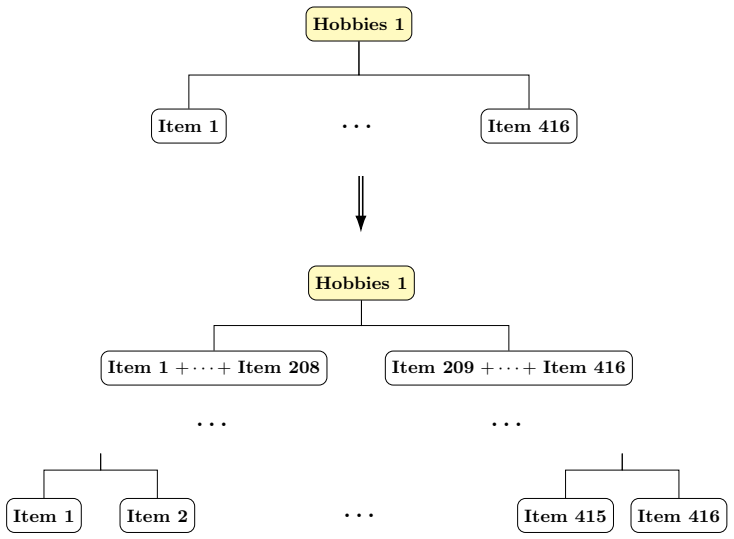
e2eTD directly forecasts only a small subset of aggregate series (about 0.3 percent of the hierarchy), which are smoother and thus more predictable than the intermittent bottom series. The resulting forecast samples are propagated to the bottom level through a probabilistic top-down sampling algorithm in which the historical disaggregation proportions are modeled as joint distributions estimated in-sample. Coherent forecasts for all aggregation levels are then obtained by summing the joint bottom-level samples.
What carries the argument
The probabilistic top-down sampling algorithm that models historical disaggregation proportions as joint distributions estimated in-sample, allowing samples at the bottom level to be drawn conditionally on top-level forecasts.
If this is right
- Coherent probabilistic forecasts become available at every aggregation level without post-hoc reconciliation.
- Computational cost stays low enough for daily use on hierarchies with 300,000 series using only a standard laptop.
- Risk-aware decisions at product, store, and regional levels can draw from the same underlying sample set.
- Accuracy improves over two-step forecast-then-reconcile pipelines on large retail benchmarks.
Where Pith is reading between the lines
- The joint-distribution approach may capture cross-product dependencies in proportions that independent sampling would miss.
- Periodic re-estimation of the proportion distributions could be required if market conditions alter typical disaggregation patterns.
- The same sampling structure might transfer to non-retail hierarchies such as regional energy loads or website traffic categories where coherence across scales is required.
Load-bearing premise
The joint distributions of historical disaggregation proportions estimated from past data remain representative enough to produce accurate bottom-level samples when applied to new aggregate forecasts.
What would settle it
On a held-out retail hierarchy, the bottom-level samples generated by the proportion distributions fail to sum exactly to the input aggregate forecasts or produce higher weighted scaled pinball loss than a standard bottom-up or reconciliation baseline.
Figures




read the original abstract
Retail and supply chain operations rely on demand forecasts to drive decisions, from replenishment at the product level to capacity planning at the store level. These forecasts should be probabilistic, to allow risk-aware decisions, and coherent across the aggregation hierarchy, so that decisions taken at different levels are not based on conflicting demand forecasts. However, producing coherent probabilistic forecasts is computationally demanding; at retail scale, with hierarchies of thousands of time series, this cost becomes a first-order operational concern. Existing two-step forecast-then-reconcile procedures and end-to-end neural models scale poorly, rely on restrictive assumptions, or require specialized hardware and engineering effort. We propose e2eTD, a fast and scalable method for probabilistic coherent forecasting of large hierarchical and grouped time series. e2eTD directly forecasts only a small subset of aggregate series (about 0.3\% of the hierarchy in our experiments), which are smoother and thus more predictable than the intermittent bottom series. The resulting forecast samples are propagated to the bottom level through a novel probabilistic top-down sampling algorithm, in which the historical disaggregation proportions are modeled as joint distributions, estimated in-sample. Coherent forecasts for all aggregation levels are then obtained by summing the joint bottom-level samples. On the two largest publicly available retail datasets, M5 and Favorita, e2eTD achieves the lowest weighted scaled pinball loss (the M5 competition's probabilistic score) across aggregation levels among all competing methods; it would have ranked 11th of 892 teams in the M5 Uncertainty competition. On a standard laptop, e2eTD runs in about five minutes on M5 ($\sim$40K series) and twenty minutes on Favorita ($\sim$300K series).
Editorial analysis
A structured set of objections, weighed in public.
Referee Report
Summary. The paper proposes e2eTD, a scalable method for probabilistic coherent forecasting of large hierarchical time series. It forecasts only a small subset (~0.3%) of smoother aggregate series and propagates samples to the bottom level via a probabilistic top-down algorithm that models historical disaggregation proportions as in-sample joint distributions; coherent forecasts at all levels are obtained by summation. On the M5 and Favorita retail datasets, e2eTD reports the lowest weighted scaled pinball loss across aggregation levels among compared methods and would have placed 11th of 892 teams in the M5 Uncertainty competition, with runtimes of ~5 min (M5, ~40K series) and ~20 min (Favorita, ~300K series) on a laptop.
Significance. If the empirical claims hold after addressing the representativeness assumption, the work would be significant for operational retail forecasting by offering a computationally lightweight alternative to reconciliation or end-to-end neural methods on hierarchies of hundreds of thousands of series. Explicit strengths include the emphasis on forecasting aggregates rather than intermittent bottom series and the reported wall-clock performance on two of the largest public retail benchmarks.
major comments (2)
- [Abstract] Abstract: the headline performance claim (lowest weighted scaled pinball loss on M5/Favorita) rests on the unverified assumption that in-sample joint distributions of historical disaggregation proportions remain representative when applied to new aggregate forecasts. Retail hierarchies are subject to assortment changes and promotions that can alter disaggregation structure, yet the abstract supplies no stationarity tests, online updating mechanism, or out-of-sample validation of this joint-distribution step.
- [Abstract] Abstract: no error bars, standard deviations across runs, or ablation results are reported for the weighted scaled pinball loss comparisons, and the joint-distribution modeling step receives no separate validation. These omissions make it impossible to assess whether the reported superiority is robust or driven by the specific in-sample proportion estimation.
minor comments (1)
- [Abstract] The description of how the joint distributions are estimated and sampled would benefit from explicit pseudocode or a small illustrative diagram to clarify the probabilistic top-down procedure.
Simulated Author's Rebuttal
We thank the referee for the constructive comments regarding the abstract and the core assumptions of e2eTD. We address each major comment point by point below and will revise the manuscript accordingly to improve transparency.
read point-by-point responses
-
Referee: [Abstract] Abstract: the headline performance claim (lowest weighted scaled pinball loss on M5/Favorita) rests on the unverified assumption that in-sample joint distributions of historical disaggregation proportions remain representative when applied to new aggregate forecasts. Retail hierarchies are subject to assortment changes and promotions that can alter disaggregation structure, yet the abstract supplies no stationarity tests, online updating mechanism, or out-of-sample validation of this joint-distribution step.
Authors: We agree that the representativeness of historical disaggregation proportions is a foundational assumption and that the abstract would benefit from explicit acknowledgment. The full manuscript discusses this modeling choice in Section 3, where the joint distributions are estimated from in-sample data and applied to new aggregate forecasts; strong empirical results on M5 and Favorita (which contain promotions and assortment changes) provide indirect support for practical applicability under typical retail conditions. We will revise the abstract to state the assumption clearly and note its empirical validation on the benchmark datasets. Formal stationarity tests and an online updating mechanism are not part of the current method, which prioritizes computational scalability via static in-sample estimation; we can expand the discussion section to address potential limitations in highly non-stationary settings. revision: yes
-
Referee: [Abstract] Abstract: no error bars, standard deviations across runs, or ablation results are reported for the weighted scaled pinball loss comparisons, and the joint-distribution modeling step receives no separate validation. These omissions make it impossible to assess whether the reported superiority is robust or driven by the specific in-sample proportion estimation.
Authors: The reported results reflect single executions with fixed seeds for reproducibility on large-scale data. We acknowledge that variability measures and targeted ablations would strengthen the claims. In the revised manuscript we will report standard deviations from multiple independent runs (where feasible given dataset size) for the weighted scaled pinball loss and add an ablation isolating the joint-distribution component. This will allow clearer assessment of robustness. revision: yes
Circularity Check
No significant circularity; empirical method with external validation
full rationale
The paper proposes an algorithmic procedure (forecast small aggregates then sample bottoms via in-sample joint disaggregation proportions) whose headline claims consist of measured weighted scaled pinball loss on the external M5 and Favorita datasets. No derivation chain, equation, or self-citation is shown that reduces any reported performance figure to a fitted parameter or prior result by construction. The in-sample proportion estimation is an explicit modeling choice whose out-of-sample validity is tested by the reported benchmarks rather than assumed tautologically. The work is therefore self-contained against external data.
Axiom & Free-Parameter Ledger
Reference graph
Works this paper leans on
-
[1]
International Statistical Review , author=
Rethinking the Effective Sample Size , year=. International Statistical Review , author=
-
[2]
Journal of Empirical Finance , volume=
Modeling corporate defaults: Poisson autoregressions with exogenous covariates (PARX) , author=. Journal of Empirical Finance , volume=. 2016 , publisher=
2016
-
[3]
Journal of Applied Econometrics , Year =
Generalized Autoregressive Score Models With Applications , Author =. Journal of Applied Econometrics , Year =
-
[4]
Dynamic Models for Volatility and Heavy Tails: With Applications to Financial and Economic Time Series , Author =
-
[5]
Do we want coherent hierarchical forecasts, or minimal MAPEs or MAEs? (We won’t get both!) , journal =. 2022 , issn =. doi:https://doi.org/10.1016/j.ijforecast.2022.11.006 , author =
-
[6]
International Journal of Forecasting , volume=
Why the “best” point forecast depends on the error or accuracy measure , author=. International Journal of Forecasting , volume=. 2020 , publisher=
2020
-
[7]
Economic Modelling , volume=
Tree networks to assess financial contagion , author=. Economic Modelling , volume=. 2020 , publisher=
2020
-
[8]
The Journal of Risk , volume=
A value-at-risk analysis of credit default swaps , author=. The Journal of Risk , volume=
-
[9]
European Journal of Operational Research , volume=
Temporal hierarchies with autocorrelation for load forecasting , author=. European Journal of Operational Research , volume=. 2020 , publisher=
2020
-
[10]
2003 , publisher=
Statistical models , author=. 2003 , publisher=
2003
-
[11]
2018 , note =
ZIM: Zero-Inflated Models (ZIM) for Count Time Series with Excess Zeros , author =. 2018 , note =
2018
-
[12]
Monash Time Series Forecasting Archive
Monash time series forecasting archive , author=. arXiv:2105.06643 , year=
-
[13]
Statistics and Computing , volume=
Efficient probabilistic reconciliation of forecasts for real-valued and count time series , author=. Statistics and Computing , volume=. 2024 , publisher=
2024
-
[14]
International Journal of Forecasting , volume =
Properties of the reconciled distributions for. International Journal of Forecasting , volume =. 2024 , author =
2024
-
[15]
Foresight: The International Journal of Applied Forecasting , volume=
Another look at forecast-accuracy metrics for intermittent demand , author=. Foresight: The International Journal of Applied Forecasting , volume=. 2006 , publisher=
2006
-
[16]
Journal of the American Statistical Association , pages=
Count time series: A methodological review , author=. Journal of the American Statistical Association , pages=. 2021 , publisher=
2021
- [17]
-
[18]
Communications in Statistics-Simulation and Computation , volume=
Criteria for evaluating approximations of count distributions , author=. Communications in Statistics-Simulation and Computation , volume=. 2020 , publisher=
2020
-
[19]
International Journal of forecasting , volume=
Quantiles as optimal point forecasts , author=. International Journal of forecasting , volume=. 2011 , publisher=
2011
-
[20]
2017 , volume =
Tobias Liboschik and Konstantinos Fokianos and Roland Fried , journal =. 2017 , volume =
2017
-
[21]
Probabilistic programming in Python using
Salvatier, John and Wiecki, Thomas V and Fonnesbeck, Christopher , journal=. Probabilistic programming in Python using. 2016 , publisher=
2016
-
[22]
Simulation of correlated
Barbiero, Alessandro and Ferrari, Pier Alda , journal=. Simulation of correlated. 2015 , publisher=
2015
-
[23]
2021 , issn =
Kaggle forecasting competitions: An overlooked learning opportunity , journal =. 2021 , issn =
2021
-
[24]
International Journal of Forecasting , volume=
Evaluating predictive count data distributions in retail sales forecasting , author=. International Journal of Forecasting , volume=. 2016 , publisher=
2016
-
[25]
Botev, Z I , journal =
-
[26]
Cao, Jian and Genton, Marc G. and Keyes, David E. and Turkiyyah, George M. , title=. Statistics and Computing , year=. doi:10.1007/s11222-020-09978-y , url=
-
[27]
Lecture Notes in Computer Science (including subseries Lecture Notes in Artificial Intelligence and Lecture Notes in Bioinformatics) , pages =
Akbudak, Kadir and Ltaief, Hatem and Mikhalev, Aleksandr and David, Keyes , doi =. Lecture Notes in Computer Science (including subseries Lecture Notes in Artificial Intelligence and Lecture Notes in Bioinformatics) , pages =
-
[28]
Hackbusch, Wolfgang , doi =
-
[29]
Journal of Computational and Graphical Statistics , author =
Dario Azzimonti and David Ginsbourger , title =. Journal of Computational and Graphical Statistics , volume =. 2018 , publisher =. doi:10.1080/10618600.2017.1360781 , URL =
-
[30]
, eprint =
Murray, Iain and Adams, Ryan Prescott and MacKay, David J.C. , eprint =. Journal of Machine Learning Research , number =
-
[31]
and Keyes, David E
Cao, Jian and Genton, Marc G. and Keyes, David E. and Turkiyyah, George M. , doi =. Statistics and Computing , keywords =
-
[32]
2020 , editor =
Gessner, Alexandra and Kanjilal, Oindrila and Hennig, Philipp , booktitle =. 2020 , editor =
2020
-
[33]
Dario Azzimonti and Manuel Schürch and Alessio Benavoli and Marco Zaffalon , year=. 2007.06363 , archivePrefix=
-
[34]
Recursive estimation for sparse
Manuel Schürch and Dario Azzimonti and Alessio Benavoli and Marco Zaffalon , keywords =. Recursive estimation for sparse. Automatica , volume =. 2020 , issn =. doi:https://doi.org/10.1016/j.automatica.2020.109127 , url =
-
[35]
When Gaussian Process Meets Big Data: A Review of Scalable GPs
Liu, Haitao and Ong, Yew-Soon and Shen, Xiaobo and Cai, Jianfei , DOI =. 2020 , Journal =. 1807.01065 , archivePrefix=
work page internal anchor Pith review Pith/arXiv arXiv 2020
-
[36]
, booktitle =
Titsias, Michalis K. , booktitle =
-
[37]
Journal of Machine Learning Research , keywords =
Qui. Journal of Machine Learning Research , keywords =
-
[38]
End-to-End Learning of Coherent Probabilistic Forecasts for Hierarchical Time Series , author=. Proc. 38th Int. Conference on Machine Learning (ICML) , pages=
-
[39]
2021 , author =
Elucidate structure in intermittent demand series , journal =. 2021 , author =
2021
-
[40]
Alessio Benavoli and Dario Azzimonti and Dario Piga , year=. 2012.06846 , archivePrefix=
-
[41]
, eprint =
Gonzalez, Javier and Dai, Zhenwen and Damianou, Andreas and Lawrence, Neil D. , eprint =. 34th International Conference on Machine Learning, ICML 2017 , pages =
2017
-
[42]
ICML 2005 - Proceedings of the 22nd International Conference on Machine Learning , keywords =
Chu, Wei and Ghahramani, Zoubin , doi =. ICML 2005 - Proceedings of the 22nd International Conference on Machine Learning , keywords =
2005
-
[43]
Alessio Benavoli and Dario Azzimonti and Dario Piga , year=. 2008.06677 , archivePrefix=
-
[44]
Journal of Machine Learning Research , keywords =
Nickisch, Hannes and Rasmussen, Carl Edward , issn =. Journal of Machine Learning Research , keywords =
-
[45]
and Shen, Xilin , doi =
Naveau, Philippe and Genton, Marc G. and Shen, Xilin , doi =. Journal of Multivariate Analysis , keywords =
-
[46]
Probabilistic Reconciliation of Hierarchical Forecast via
Corani, Giorgio and Azzimonti, Dario and Augusto, Joao PSC and Zaffalon, Marco , booktitle=. Probabilistic Reconciliation of Hierarchical Forecast via
-
[47]
Hoffman and Daniel Lee and Ben Goodrich and Michael Betancourt and Marcus Brubaker and Jiqiang Guo and Peter Li and Allen Riddell , title =
Bob Carpenter and Andrew Gelman and Matthew D. Hoffman and Daniel Lee and Ben Goodrich and Michael Betancourt and Marcus Brubaker and Jiqiang Guo and Peter Li and Allen Riddell , title =. Journal of Statistical Software, Articles , volume =. 2017 , issn =
2017
-
[48]
Durante, Daniele , doi =. Biometrika , keywords =. arXiv , arxivId =:1802.09565 , issn =
-
[49]
and Genton, Marc G
Arellano-Valle, Reinaldo B. and Genton, Marc G. , doi =. Journal of Multivariate Analysis , keywords =
-
[50]
Biometrika , number =
Azzalini, Adelchi and. Biometrika , number =
-
[51]
Arellano-Valle, Reinaldo B. B. and Azzalini, Adelchi , doi =. Scandinavian Journal of Statistics , keywords =
-
[52]
Azzalini, Adelchi and Capitanio, Antonella , doi =
-
[53]
Azzalini, Adelchi , journal =
-
[54]
and Leonard, Tom , doi =
O'Hagan, A. and Leonard, Tom , doi =. Biometrika , month =
-
[55]
Opper, Manfred and Archambeau, C. Neural Computation , month =. doi:10.1162/neco.2008.08-07-592 , issn =
-
[56]
and Gibbs, M.N
Mackay, D.J.C. and Gibbs, M.N. , doi =. IEEE Transactions on Neural Networks , number =
-
[57]
Modeling and stochastic learning for forecasting in high dimensions , pages=
Game-theoretically optimal reconciliation of contemporaneous hierarchical time series forecasts , author=. Modeling and stochastic learning for forecasting in high dimensions , pages=. 2015 , publisher=
2015
-
[58]
, school =
Minka, Thomas P. , school =
-
[59]
and Barber, David , doi =
Williams, Christopher K.I. and Barber, David , doi =. IEEE Transactions on Pattern Analysis and Machine Intelligence , keywords =
-
[60]
Neal, Radford M , journal =
-
[61]
Zhang, Yu and Yeung, Dit Yan , booktitle =
-
[62]
Student-t Processes as Alternatives to Gaussian Processes
Shah, Amar and Wilson, Andrew Gordon and Ghahramani, Zoubin , booktitle =. arXiv , arxivId =:1402.4306 , issn =
work page internal anchor Pith review Pith/arXiv arXiv
-
[63]
Santner, Thomas J and Williams, Brian J and Notz, William I , doi =
-
[64]
and de Freitas, Nando , doi =
Shahriari, Bobak and Swersky, Kevin and Wang, Ziyu and Adams, Ryan P. and de Freitas, Nando , doi =. Proceedings of the IEEE , month =
-
[65]
Murphy , title =
Kevin P. Murphy , title =. 2021 , url =
2021
-
[66]
and Casella, George , doi =
Robert, Christian P. and Casella, George , doi =
-
[67]
Philosophical Transactions of the Royal Society A: Mathematical, Physical and Engineering Sciences , publisher =
Gaussian processes for time-series modelling , author =. Philosophical Transactions of the Royal Society A: Mathematical, Physical and Engineering Sciences , publisher =
-
[68]
International Journal of Forecasting , year=
M5 competition uncertainty: Overdispersion, distributional forecasting, GAMLSS, and beyond , author=. International Journal of Forecasting , year=
-
[69]
2022 , publisher=
Makridakis, Spyros and Spiliotis, Evangelos and Assimakopoulos, Vassilios and Chen, Zhi and Gaba, Anil and Tsetlin, Ilia and Winkler, Robert L , journal=. 2022 , publisher=
2022
-
[70]
Proceedings of the Workshop on Automatic Machine Learning , volume = 64, pages =
Bayesian optimization for automated model selection , author =. Proceedings of the Workshop on Automatic Machine Learning , volume = 64, pages =
-
[71]
Machine learning: a probabilistic perspective , author =
-
[72]
Kim, Hyunjik and Teh, Yee Whye , year = 2018, booktitle =
2018
-
[73]
Journal of Statistical Computation and Simulation , volume=
B. Journal of Statistical Computation and Simulation , volume=. 2020 , publisher=
2020
-
[74]
Bayesian Data Analysis (3rd ed.) , author =
-
[75]
Proceedings of the AAAI Conference on Artificial Intelligence , volume = 34, pages =
Scalable variational Bayesian kernel selection for sparse Gaussian process regression , author =. Proceedings of the AAAI Conference on Artificial Intelligence , volume = 34, pages =
-
[76]
2021 , journal =
Forecast reconciliation: A geometric view with new insights on bias correction , author =. 2021 , journal =
2021
-
[77]
Advances in neural information processing systems , pages =
Learning Gaussian process kernels via hierarchical Bayes , author =. Advances in neural information processing systems , pages =
-
[78]
Mcomp: Data from the M-Competitions , author =
-
[79]
Salinas, David and Flunkert, Valentin and Gasthaus, Jan and Januschowski, Tim , year = 2020, journal =
2020
-
[80]
M4comp2018: Data from the M4-Competition , author =
discussion (0)
Sign in with ORCID, Apple, or X to comment. Anyone can read and Pith papers without signing in.