Spectral condensation in a finite nonequilibrium atmospheric transition
Pith reviewed 2026-06-26 02:19 UTC · model grok-4.3
The pith
Sudden stratospheric warmings show spectral condensation then decondensation and recondensation in their eigen-microstate occupations.
A machine-rendered reading of the paper's core claim, the machinery that carries it, and where it could break.
Core claim
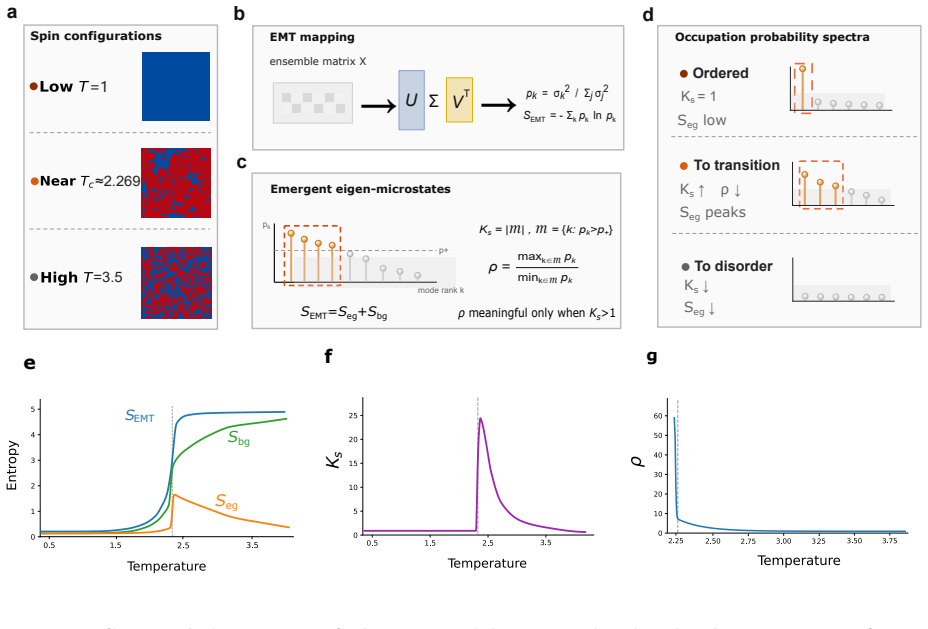
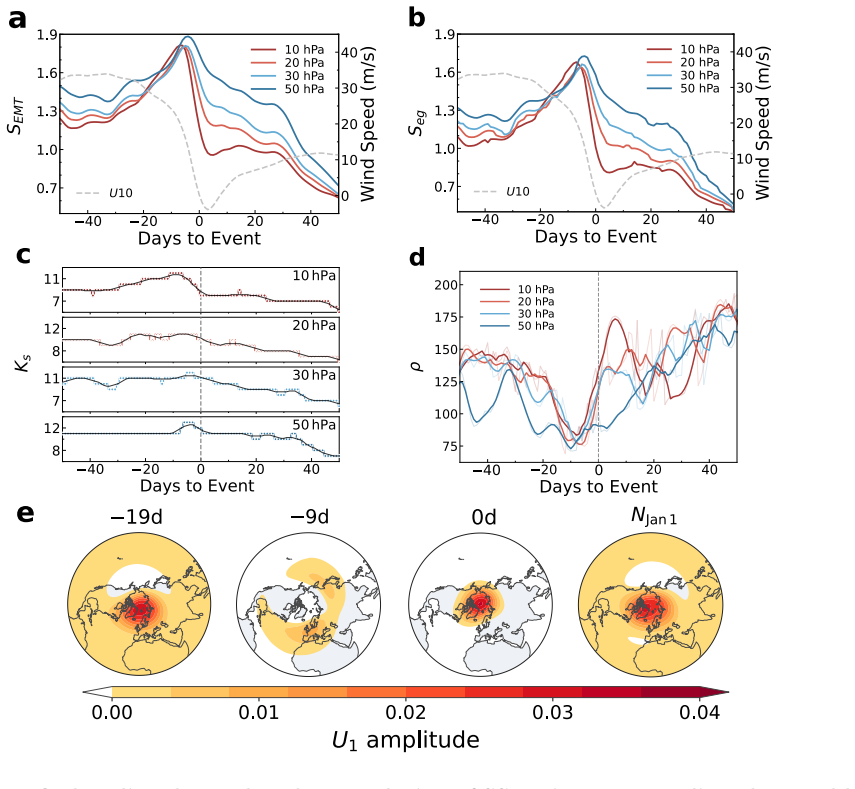
The event-aligned ensemble undergoes spectral condensation, decondensation and recondensation: a polar-vortex state dominated by a few eigen-microstates gives way to a high-entropy regime of competing emergent states before selecting a reorganized weak-vortex state. Eigen Microstate Theory combined with a Marchenko-Pastur baseline isolates the emergent sector whose entropy quantifies the competition and serves as the diagnostic.
What carries the argument
Entropy of the emergent sector isolated by the Marchenko-Pastur random-matrix baseline from the eigen-microstate occupation spectrum.
If this is right
- The entropy maximum marks the point of greatest competition among collective states during polar-vortex breakdown.
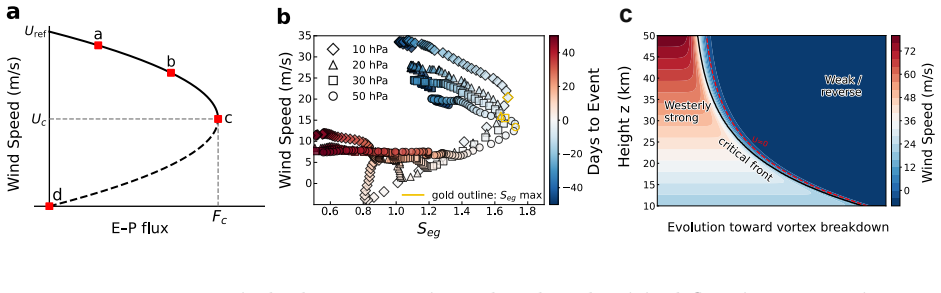
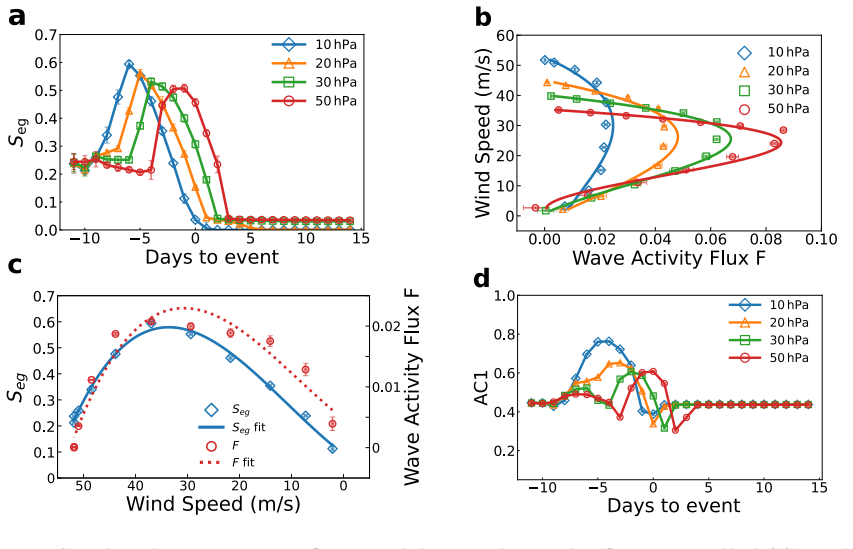
- The stochastic wave-mean-flow model reproduces the entropy peak, collapse and top-down timing when upward wave-activity flux is supplied as the control coordinate.
- Polar-vortex breakdown belongs to a broader class of finite nonequilibrium phase reorganizations diagnosable by the same spectral method.
- Emergent-sector entropy supplies a state-based spectral diagnostic for transitions in non-Hamiltonian systems.
Where Pith is reading between the lines
- The same entropy diagnostic could be tested on other high-dimensional nonequilibrium records such as ocean or climate tipping events to check whether condensation-decondensation patterns appear generically.
- If the Marchenko-Pastur separation remains stable across datasets, the approach offers a route to order parameters extracted directly from observations rather than from assumed governing equations.
- Varying the number of retained eigen-microstates or the random-matrix threshold in controlled simulations would show how sensitive the entropy peak is to the isolation step.
Load-bearing premise
The Marchenko-Pastur random-matrix baseline correctly isolates an emergent sector whose entropy functions as an order-parameter-like diagnostic without post-hoc tuning to the specific atmospheric events.
What would settle it
If the emergent-sector entropy fails to reach a clear maximum at the transition time in the 51 ERA5 events or in the stochastic model when wave-activity flux is varied, the claim that entropy tracks the reorganization would not hold.
Figures
read the original abstract
Order parameters are difficult to define in high-dimensional nonequilibrium systems that lack a Hamiltonian, a thermodynamic limit or an observed control coordinate. Here we show that such transitions can be diagnosed from the spectrum of occupations over data-derived eigen-microstates. We combine Eigen Microstate Theory with a Marchenko--Pastur random-matrix baseline to isolate an emergent sector, whose entropy quantifies competition among statistically significant collective states. As a finite atmospheric realization, we analyse 51 sudden stratospheric warmings in ERA5. The event-aligned ensemble undergoes spectral condensation, decondensation and recondensation: a polar-vortex state dominated by a few eigen-microstates gives way to a high-entropy regime of competing emergent states before selecting a reorganized weak-vortex state. A stochastic wave--mean-flow model, in which upward wave-activity flux provides a reduced control coordinate, reproduces the same entropy maximum, collapse and top-down timing. These results identify emergent-sector entropy as an order-parameter-like, state-based spectral diagnostic for non-Hamiltonian transitions and place polar-vortex breakdown within a broader class of finite nonequilibrium phase reorganizations.
Editorial analysis
A structured set of objections, weighed in public.
Referee Report
Summary. The paper claims that transitions in high-dimensional nonequilibrium systems without Hamiltonians or thermodynamic limits can be diagnosed via the Shannon entropy of an emergent sector isolated from the occupation spectrum of data-derived eigen-microstates. Eigen Microstate Theory is combined with a Marchenko-Pastur random-matrix baseline to separate signal from noise; the resulting entropy is presented as an order-parameter-like diagnostic of competition among collective states. Analysis of 51 sudden stratospheric warming events in ERA5 shows a condensation–decondensation–recondensation sequence in the event-aligned ensemble, with a polar-vortex state giving way to a high-entropy regime before reorganizing into a weak-vortex state. A stochastic wave–mean-flow model with upward wave-activity flux as control coordinate reproduces the entropy maximum, collapse, and top-down timing.
Significance. If the central claim is substantiated, the work supplies a concrete spectral diagnostic for finite nonequilibrium reorganizations that lack conventional order parameters. The demonstration on ERA5 reanalysis data for a well-studied atmospheric phenomenon, together with reproduction in a reduced stochastic model, provides an empirical anchor. The approach could generalize to other high-dimensional systems where collective states compete without an obvious control parameter.
major comments (2)
- [Section on eigen-microstate analysis and Marchenko-Pastur baseline] The Marchenko-Pastur baseline is central to isolating the emergent sector whose entropy serves as the diagnostic (abstract and the section on eigen-microstate analysis). The law assumes i.i.d. entries in the underlying matrix, yet ERA5 fields are spatially and temporally correlated and the event-alignment procedure imposes additional structure. No surrogate-data test or robustness check against correlation-preserving null models is described, leaving open the possibility that the reported condensation sequence partly reflects residual correlations rather than genuine emergent-sector competition.
- [Section on entropy as diagnostic] The claim that emergent-sector entropy functions as an order-parameter-like quantity rests on the entropy maximum coinciding with the transition (abstract). Without an explicit comparison to alternative baselines (e.g., eigenvalue thresholding or shuffled ensembles) or a demonstration that the entropy peak is insensitive to the precise Marchenko-Pastur edge location, it remains unclear whether the diagnostic is robust or partly shaped by the baseline choice.
minor comments (2)
- The first use of 'SSW' should be spelled out; subsequent abbreviations are then clear.
- Figure captions should explicitly state the number of events (51) and the alignment procedure so that readers can assess the ensemble size without returning to the text.
Simulated Author's Rebuttal
We thank the referee for the constructive comments on the robustness of the Marchenko-Pastur baseline and the entropy diagnostic. We address each point below and will revise the manuscript accordingly.
read point-by-point responses
-
Referee: The Marchenko-Pastur baseline is central to isolating the emergent sector whose entropy serves as the diagnostic (abstract and the section on eigen-microstate analysis). The law assumes i.i.d. entries in the underlying matrix, yet ERA5 fields are spatially and temporally correlated and the event-alignment procedure imposes additional structure. No surrogate-data test or robustness check against correlation-preserving null models is described, leaving open the possibility that the reported condensation sequence partly reflects residual correlations rather than genuine emergent-sector competition.
Authors: We acknowledge that ERA5 reanalysis fields contain spatial and temporal correlations and that event alignment adds structure, so the strict i.i.d. assumption of the Marchenko-Pastur law is an approximation. The baseline is employed as a conservative noise threshold rather than an exact null model. In the revised manuscript we will add surrogate tests that preserve spatial and temporal correlations (phase-randomized Fourier surrogates and block-bootstrap resampling of the event-aligned ensemble) to confirm that the emergent-sector isolation and the condensation-decondensation-recondensation sequence remain statistically significant beyond these correlations. revision: yes
-
Referee: The claim that emergent-sector entropy functions as an order-parameter-like quantity rests on the entropy maximum coinciding with the transition (abstract). Without an explicit comparison to alternative baselines (e.g., eigenvalue thresholding or shuffled ensembles) or a demonstration that the entropy peak is insensitive to the precise Marchenko-Pastur edge location, it remains unclear whether the diagnostic is robust or partly shaped by the baseline choice.
Authors: The entropy maximum is observed to align with the known dynamical transition in both the ERA5 ensemble and the stochastic wave-mean-flow model. To demonstrate robustness, the revised manuscript will include (i) direct comparisons of the entropy diagnostic against simple eigenvalue-thresholding and fully shuffled ensembles and (ii) a sensitivity analysis showing that the location and height of the entropy peak remain stable under small shifts of the Marchenko-Pastur edge (within the range of finite-sample corrections). These additions will clarify that the reported behavior is not an artifact of the precise baseline choice. revision: yes
Circularity Check
No circularity: derivation uses external baselines and independent model reproduction
full rationale
The provided abstract and context describe combining Eigen Microstate Theory with the standard Marchenko-Pastur law (an external random-matrix result) to isolate an emergent sector from ERA5 data, then computing its Shannon entropy as a diagnostic. A separate stochastic wave-mean-flow model is shown to reproduce the entropy sequence. No quoted equations or steps reduce by construction to the inputs (no self-definitional loops, no fitted parameters renamed as predictions, no load-bearing self-citations, and no ansatz smuggled via prior work). The central claim rests on data analysis plus an independent reduced model, remaining self-contained against external benchmarks.
Axiom & Free-Parameter Ledger
axioms (2)
- domain assumption Eigen Microstate Theory yields statistically meaningful eigen-microstates from the atmospheric data
- domain assumption Marchenko-Pastur distribution correctly separates noise from emergent collective states in this finite ensemble
Reference graph
Works this paper leans on
-
[1]
Lev D. Landau. On the theory of phase transitions.Phys. Z. Sowjetunion, 11:26–35, 1937
1937
-
[2]
Eugene Stanley.Introduction to Phase Transitions and Critical Phenomena
H. Eugene Stanley.Introduction to Phase Transitions and Critical Phenomena. Oxford Uni- versity Press, Oxford, 1971
1971
-
[3]
Westview Press, Boulder, CO, 1992
Nigel Goldenfeld.Lectures on Phase Transitions and the Renormalization Group, volume 85 ofFrontiers in Physics. Westview Press, Boulder, CO, 1992. doi: 10.1201/9780429493492
-
[4]
Pierre C. Hohenberg and Bertrand I. Halperin. Theory of dynamic critical phenomena.Rev. Mod. Phys., 49:435–479, 1977. doi: 10.1103/RevModPhys.49.435. 13
-
[5]
Mark C. Cross and Pierre C. Hohenberg. Pattern formation outside of equilibrium.Rev. Mod. Phys., 65:851–1112, 1993. doi: 10.1103/RevModPhys.65.851
-
[6]
Non-equilibrium critical phenomena and phase transitions into absorbing states.Adv
Haye Hinrichsen. Non-equilibrium critical phenomena and phase transitions into absorbing states.Adv. Phys., 49:815–958, 2000. doi: 10.1080/00018730050198152
-
[7]
Brock, Victor Brovkin, Stephen R
Marten Scheffer, Jordi Bascompte, William A. Brock, Victor Brovkin, Stephen R. Carpenter, Vasilis Dakos, Hermann Held, Egbert H. van Nes, Max Rietkerk, and George Sugihara. Early- warning signals for critical transitions.Nature, 461:53–59, 2009. doi: 10.1038/nature08227
-
[8]
van Nes, Victor Brovkin, Vladimir Petoukhov, and Hermann Held
Vasilis Dakos, Marten Scheffer, Egbert H. van Nes, Victor Brovkin, Vladimir Petoukhov, and Hermann Held. Slowing down as an early warning signal for abrupt climate change.Proc. Natl Acad. Sci. USA, 105:14308–14312, 2008. doi: 10.1073/pnas.0802430105
-
[9]
Timothy M. Lenton, Valerie N. Livina, Vasilis Dakos, Egbert H. van Nes, and Marten Scheffer. Early warning of climate tipping points from critical slowing down: comparing methods to improve robustness.Phil. Trans. R. Soc. A, 370:1185–1204, 2012. doi: 10.1098/rsta.2011.0304
-
[10]
Vasilis Dakos, Stephen R. Carpenter, William A. Brock, Aaron M. Ellison, Vishwesha Guttal, Anthony R. Ives, Sonia K’efi, Valerie Livina, David A. Seekell, Egbert H. van Nes, and Marten Scheffer. Methods for detecting early warnings of critical transitions in time series illustrated using simulated ecological data.PLoS ONE, 7:e41010, 2012. doi: 10.1371/jou...
-
[11]
Ambiguity of early warning signals for climate tipping points.Nat
Max Rietkerk, Vanessa Skiba, Els Weinans, Rapha¨ el H´ ebert, and Thomas Laepple. Ambiguity of early warning signals for climate tipping points.Nat. Clim. Chang., 15:479–488, 2025. doi: 10.1038/s41558-025-02328-8
-
[12]
Blaschke, Nils Bochow, Chris A
Niklas Boers, Teng Liu, Sebastian Bathiany, Maya Ben-Yami, Lana L. Blaschke, Nils Bochow, Chris A. Boulton, Timothy M. Lenton, Andreas Morr, Da Nian, Martin Rypdal, and Taylor Smith. Destabilization of earth system tipping elements.Nat. Geosci., 18:949–960, 2025. doi: 10.1038/s41561-025-01787-0
-
[13]
Die explosionsartigen stratosph¨ arenerw¨ armungen des sp”atwinters 1951/52
Richard Scherhag. Die explosionsartigen stratosph¨ arenerw¨ armungen des sp”atwinters 1951/52. Ber. Dtsch. Wetterdienstes US-Zone, 6(38):51–63, 1952
1951
-
[14]
Amy H. Butler, Dian J. Seidel, Steven C. Hardiman, Neal Butchart, Thomas Birner, and Aaron Match. Defining sudden stratospheric warmings.Bull. Am. Meteorol. Soc., 96:1913– 1928, 2015. doi: 10.1175/BAMS-D-13-00173.1
-
[15]
Baldwin, Blanca Ayarzag¨ uena, Thomas Birner, Neal Butchart, Amy H
Mark P. Baldwin, Blanca Ayarzag¨ uena, Thomas Birner, Neal Butchart, Amy H. Butler, An- drew J. Charlton-Perez, Daniela I. V. Domeisen, Chaim I. Garfinkel, Hella Garny, Edwin P. Gerber, et al. Sudden stratospheric warmings.Rev. Geophys., 59:e2020RG000708, 2021. doi: 10.1029/2020RG000708
-
[16]
A dynamical model of the stratospheric sudden warming.J
Taroh Matsuno. A dynamical model of the stratospheric sudden warming.J. Atmos. Sci., 28: 1479–1494, 1971. doi: 10.1175/1520-0469(1971)028⟨1479:ADMOTS⟩2.0.CO;2
-
[17]
Andrews, James R
David G. Andrews, James R. Holton, and Conway B. Leovy.Middle Atmosphere Dynam- ics, volume 40 ofInternational Geophysics Series. Academic Press, San Diego, 1987. ISBN 9780120585762. 14
1987
-
[18]
Lorenzo M. Polvani and Darryn W. Waugh. Upward wave activity flux as a precursor to extreme stratospheric events and subsequent anomalous surface weather regimes.J. Clim., 17: 3548–3554, 2004. doi: 10.1175/1520-0442(2004)017⟨3548:UWAFAA⟩2.0.CO;2
-
[19]
Thomas Birner and John R. Albers. Sudden stratospheric warmings and anomalous upward wave activity flux.SOLA, 13A:8–12, 2017. doi: 10.2151/sola.13A-002
-
[20]
James R. Holton and Clifford Mass. Stratospheric vacillation cycles.J. Atmos. Sci., 33: 2218–2225, 1976. doi: 10.1175/1520-0469(1976)033⟨2218:SVC⟩2.0.CO;2
-
[21]
R. Alan Plumb. Instability of the distorted polar night vortex: a theory of stratospheric warmings.J. Atmos. Sci., 38:2514–2531, 1981. doi: 10.1175/1520-0469(1981)038⟨2514: IOTDPN⟩2.0.CO;2
-
[22]
Richard K. Scott and Lorenzo M. Polvani. Internal variability of the winter stratosphere. Part I: time-independent forcing.J. Atmos. Sci., 63:2758–2776, 2006. doi: 10.1175/JAS3797.1
-
[23]
Albers, Thomas Birner, Rolando R
’Alvaro de la C´ amara, John R. Albers, Thomas Birner, Rolando R. Garcia, Peter Hitch- cock, Douglas E. Kinnison, and Anne K. Smith. Sensitivity of sudden stratospheric warm- ings to previous stratospheric conditions.J. Atmos. Sci., 74:2857–2877, 2017. doi: 10.1175/ JAS-D-17-0136.1
2017
-
[24]
’Alvaro de la C´ amara, Thomas Birner, and John R. Albers. Are sudden stratospheric warmings preceded by anomalous tropospheric wave activity?J. Clim., 32:7173–7189, 2019. doi: 10. 1175/JCLI-D-19-0269.1
2019
-
[25]
Charlton and Lorenzo M
Andrew J. Charlton and Lorenzo M. Polvani. A new look at stratospheric sudden warmings. Part I: climatology and modeling benchmarks.J. Clim., 20:449–469, 2007. doi: 10.1175/ JCLI3996.1
2007
-
[26]
Nicholas J. Matthewman, James G. Esler, Andrew J. Charlton-Perez, and Lorenzo M. Polvani. A new look at stratospheric sudden warmings. Part III: polar vortex evolution and vertical structure.J. Clim., 22:1566–1585, 2009. doi: 10.1175/2008JCLI2365.1
-
[27]
Yuki Yasuda, Freddy Bouchet, and Antoine Venaille. A new interpretation of vortex-split sudden stratospheric warmings in terms of equilibrium statistical mechanics.J. Atmos. Sci., 74:3915–3936, 2017. doi: 10.1175/JAS-D-17-0045.1
-
[28]
Noboru Nakamura, Jonathan Falk, and Sandro W. Lubis. Why are stratospheric sudden warmings sudden (and intermittent)?J. Atmos. Sci., 77:943–964, 2020. doi: 10.1175/ JAS-D-19-0249.1
2020
-
[29]
Condensation of eigen microstate in statistical ensemble and phase transition.Sci
Gaoke Hu, Teng Liu, Maoxin Liu, Wei Chen, and Xiaosong Chen. Condensation of eigen microstate in statistical ensemble and phase transition.Sci. China Phys. Mech. Astron., 62: 990511, 2019. doi: 10.1007/s11433-018-9353-x
-
[30]
Eigen microstates and their evolutions in complex systems.Com- mun
Yu Sun, Gaoke Hu, Yongwen Zhang, Bo Lu, Zhenghui Lu, Jingfang Fan, Xiaoteng Li, Qimin Deng, and Xiaosong Chen. Eigen microstates and their evolutions in complex systems.Com- mun. Theor. Phys., 73:065603, 2021. doi: 10.1088/1572-9494/abf127
-
[31]
Eigen microstates in self-organized criticality.Phys
Yongwen Zhang, Maoxin Liu, Gaoke Hu, Teng Liu, and Xiaosong Chen. Eigen microstates in self-organized criticality.Phys. Rev. E, 109:044130, 2024. doi: 10.1103/PhysRevE.109.044130. 15
-
[32]
Vladimir A. Marchenko and Leonid A. Pastur. Distribution of eigenvalues for some sets of ran- dom matrices.Math. USSR-Sb., 1:457–483, 1967. doi: 10.1070/SM1967v001n04ABEH001994
-
[33]
Else- vier/Academic Press, Amsterdam, 3 edition, 2004
Madan Lal Mehta.Random Matrices, volume 142 ofPure and Applied Mathematics. Else- vier/Academic Press, Amsterdam, 3 edition, 2004. ISBN 9780120884094
2004
-
[34]
Kunihiko Kodera, Hitoshi Mukougawa, Pascal Maury, Hiroaki Ueda, and Chantal Claud. Ab- sorbing and reflecting sudden stratospheric warming events and their relationship with tropo- spheric circulation.J. Geophys. Res. Atmos., 121:80–94, 2016. doi: 10.1002/2015JD023359
-
[35]
Ian P. White, Chaim I. Garfinkel, Judah Cohen, Martin Jucker, and Jian Rao. The impact of split and displacement sudden stratospheric warmings on the troposphere.J. Geophys. Res. Atmos., 126:e2020JD033989, 2021. doi: 10.1029/2020JD033989
-
[36]
Stratospheric polar vortex, wave absorption/reflection and effect on surface climate.Clim
Abdel Hannachi, Maximilian Lechner, Katharina Finke, and Dmitry Mukhin. Stratospheric polar vortex, wave absorption/reflection and effect on surface climate.Clim. Dyn., 63:126,
-
[37]
doi: 10.1007/s00382-025-07610-1
-
[38]
Sorting sudden stratospheric warmings with the downward tro- pospheric influence using ERA5 and CESM2-WACCM.Atmos
Rongzhao Lu and Jian Rao. Sorting sudden stratospheric warmings with the downward tro- pospheric influence using ERA5 and CESM2-WACCM.Atmos. Chem. Phys., 26:3723–3742,
-
[39]
doi: 10.5194/acp-26-3723-2026
-
[40]
Peter Hitchcock and Peter H. Haynes. Stratospheric control of planetary waves.Geophys. Res. Lett., 43:11884–11892, 2016. doi: 10.1002/2016GL071372
-
[41]
Phase transition revealed by eigen microstate entropy, 2025
Teng Liu, Xuezhi Niu, Mingli Zhang, Gaoke Hu, Yuhan Chen, Yongwen Zhang, Rui Shi, Jingyuan Li, Peng Tan, Maoxin Liu, Hui Li, and Xiaosong Chen. Phase transition revealed by eigen microstate entropy, 2025. URLhttps://arxiv.org/abs/2512.23086. 16 f K s g a Spin configurations =1 ≈2.269 =3.5 b ensemble matrix X U Σ V T pk =σ k2 /Σ j σj2 SEMT = - Σk pk lnp k ...
arXiv 2025
discussion (0)
Sign in with ORCID, Apple, or X to comment. Anyone can read and Pith papers without signing in.