When the Timetable Breaks: Physics-Anchored Scientific Machine Learning for Cold-Wave-Robust Battery-Electric Bus Operations
Pith reviewed 2026-06-26 02:57 UTC · model grok-4.3
The pith
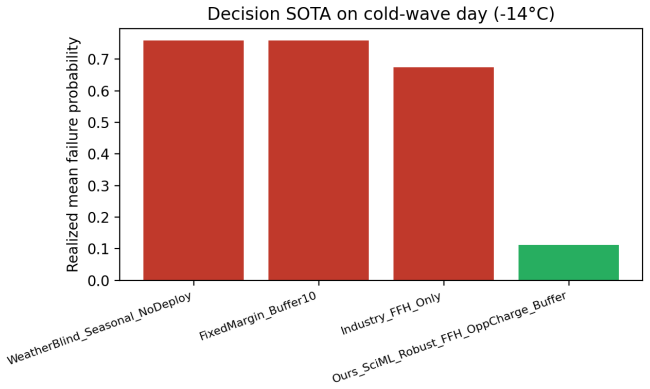
A weather-injected energy model combined with forecast-triggered charging reduces electric-bus cold-wave timetable failure probability from 0.759 to 0.112.
A machine-rendered reading of the paper's core claim, the machinery that carries it, and where it could break.
Core claim
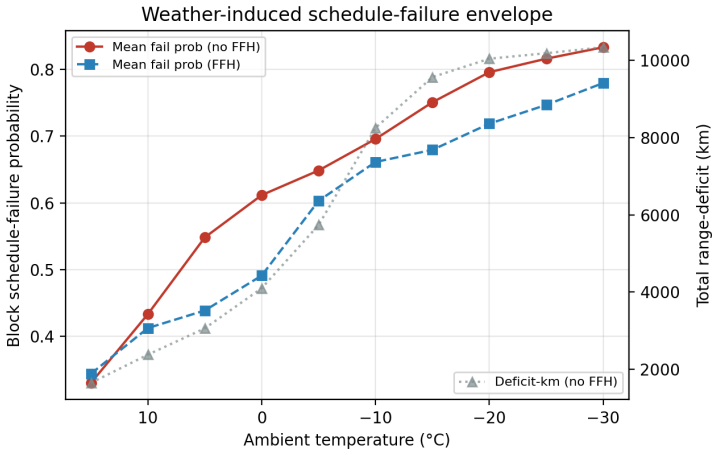
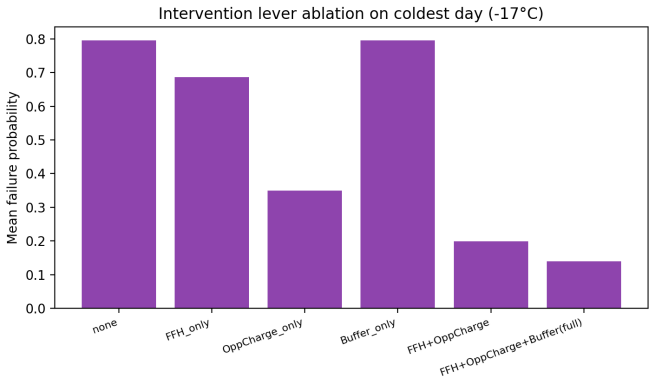
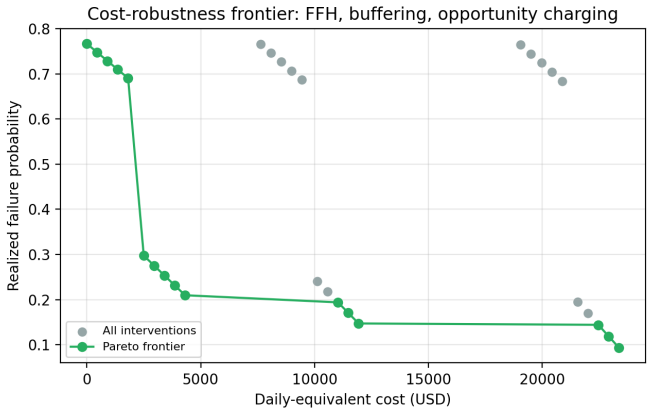
The WeatherRobustBus framework couples a transparent traction and cabin-thermal backbone with a bounded monotone residual ensemble to predict energy use from weather, achieving 0.213 kWh RMSE over 8760 hours and remaining reliable for temperatures at or below -12°C. When the predictions are embedded in a Monte Carlo block-feasibility simulator over 60 real Toronto TTC vehicle blocks, they expose a sharp weather-induced failure envelope; a forecast-triggered robust policy that combines opportunity charging, a fuel-fired cabin-heating bridge, and modest buffering then reduces mean cold-wave failure probability from 0.759 to 0.112 across eight cold-wave days.
What carries the argument
The WeatherRobustBus framework that injects hourly weather into real vehicle blocks, couples a physics thermal model with a residual ensemble for energy prediction, and runs Monte Carlo simulation to obtain block-level failure probabilities.
If this is right
- Opportunity charging is the dominant lever while the fuel heater acts as a low-cost complement.
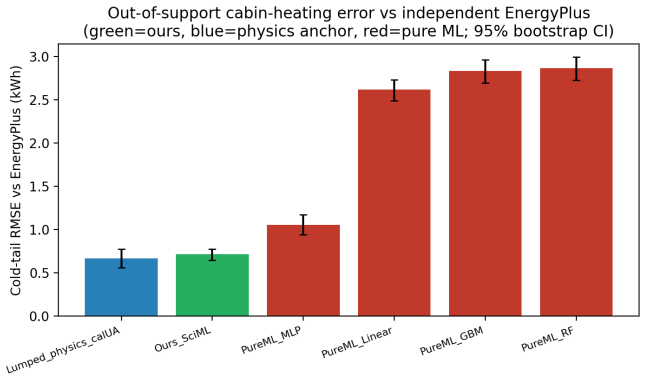
- The physics-anchored model maintains accuracy in the cold tail where pure machine-learning baselines degrade by factors of 1.5 to 4.
- One cold day without intervention can cascade into full timetable infeasibility for entire vehicle blocks.
- Validation against an independent EnergyPlus cabin simulation confirms the thermal backbone across the full temperature range.
Where Pith is reading between the lines
- Daily dispatch software could ingest the block-level failure probabilities to adjust schedules in real time.
- The same weather-injection plus Monte Carlo approach could be tested on other cold-sensitive electric fleets such as delivery vehicles.
- Live operational trials would reveal whether simulator assumptions about charging availability and driver behavior hold.
- Agencies in early electrification phases could retain limited fuel heaters as a transitional risk-reduction tool.
Load-bearing premise
The Monte Carlo block-feasibility simulator over 60 real Toronto TTC vehicle blocks accurately captures real-world timetable infeasibility once energy uncertainty is propagated from the weather-injected model.
What would settle it
Apply the forecast-triggered policy to actual Toronto electric-bus operations during a documented cold wave and compare observed timetable completion rates against the simulated 0.112 mean failure probability.
Figures
read the original abstract
Cold-climate transit agencies are electrifying fixed-timetable fleets, but winter exposes a block-level failure mode hidden by seasonal energy margins: cabin heating can deplete batteries faster than layovers recharge them, causing later trips to start undercharged and making one cold day cascade into timetable infeasibility. We present WeatherRobustBus, an open-data framework that converts this risk into block-level failure probability by injecting real hourly weather into real transit duties and propagating cold-weather energy uncertainty. The framework couples a transparent traction and cabin-thermal backbone with a bounded monotone residual ensemble, and validates cabin heating against an independent EnergyPlus bus-cabin simulation driven by the same Toronto weather record. Against this first-principles reference, it achieves the lowest all-year error (0.213 kWh RMSE over 8760 hours) and remains reliable in the out-of-support cold tail ($T \le -12^\circ$C), where pure machine-learning baselines degrade by 1.5--4x and the best competitor reaches only 1.055 kWh. Embedded in a Monte Carlo block-feasibility simulator over 60 real Toronto TTC vehicle blocks, the model reveals a sharp weather-induced failure envelope. A forecast-triggered robust policy combining opportunity charging, a fuel-fired cabin-heating bridge, and modest buffering reduces mean cold-wave failure probability from 0.759 to 0.112 across eight cold-wave days; a deconfounded ablation shows opportunity charging is the dominant lever and the heater is a low-cost complement. WeatherRobustBus provides a reproducible pathway from weather data to winter-resilience decisions for electric-bus fleets.
Editorial analysis
A structured set of objections, weighed in public.
Referee Report
Summary. The manuscript introduces WeatherRobustBus, a framework coupling first-principles traction and cabin-thermal models with a bounded monotone residual ensemble to predict battery-electric bus energy consumption under cold weather. It validates the cabin-heating component against an independent EnergyPlus simulation (0.213 kWh RMSE, reliable for T ≤ -12°C), embeds the model in a Monte Carlo block-feasibility simulator over 60 real Toronto TTC vehicle blocks, and reports that a forecast-triggered policy (opportunity charging + fuel-fired heater bridge + modest buffering) reduces mean cold-wave failure probability from 0.759 to 0.112 across eight cold-wave days, with an ablation attributing dominance to opportunity charging.
Significance. If the simulator's infeasibility logic is externally supported, the work supplies a reproducible, open-data pathway from weather records to winter-resilience decisions for electrified transit fleets. Strengths include the physics-anchored residual ensemble, explicit out-of-support cold-tail validation, and deconfounded policy ablation; these elements distinguish the contribution from purely data-driven baselines.
major comments (1)
- [Monte Carlo block-feasibility simulator] Monte Carlo block-feasibility simulator (section following the energy model and validation): The central claim that the robust policy reduces failure probability from 0.759 to 0.112 rests on the simulator correctly mapping weather-injected SOC shortfalls at layovers into missed later trips and timetable cascades. No comparison to actual TTC operational logs, delay records, or observed cold-wave failures is provided, so the quantitative risk reduction may be an artifact of the chosen infeasibility threshold and buffering rules rather than a transferable result.
minor comments (1)
- [Abstract] The abstract states the cabin-heating RMSE as 0.213 kWh but does not specify the exact number of hours or the precise cold-tail subset used for the out-of-support comparison; adding these counts would improve reproducibility.
Simulated Author's Rebuttal
We thank the referee for the constructive comment on the Monte Carlo simulator and for recognizing the framework's other strengths. We respond point-by-point below.
read point-by-point responses
-
Referee: [Monte Carlo block-feasibility simulator] Monte Carlo block-feasibility simulator (section following the energy model and validation): The central claim that the robust policy reduces failure probability from 0.759 to 0.112 rests on the simulator correctly mapping weather-injected SOC shortfalls at layovers into missed later trips and timetable cascades. No comparison to actual TTC operational logs, delay records, or observed cold-wave failures is provided, so the quantitative risk reduction may be an artifact of the chosen infeasibility threshold and buffering rules rather than a transferable result.
Authors: We agree that the absence of direct comparison to TTC operational logs or observed cold-wave failures is a genuine limitation of the current validation. Such granular, proprietary delay and failure records are not publicly available, so we cannot perform that comparison. The simulator applies the validated energy model to 60 real TTC blocks and defines infeasibility via explicit SOC thresholds at layovers; the reported probabilities are therefore model-based estimates under those rules. In revision we will (i) expand the methods section with a precise statement of the infeasibility logic and buffering rules, and (ii) add a sensitivity study varying the SOC threshold and buffer sizes to show that the reduction from 0.759 to 0.112 remains qualitatively stable. We will also qualify the abstract and results to present the numbers as simulated risk reductions rather than empirically observed rates. revision: partial
- Direct empirical validation against TTC operational logs or observed cold-wave failures, because such data are not publicly available.
Circularity Check
No circularity detected; derivation remains self-contained
full rationale
The abstract and description present a first-principles traction/thermal backbone validated externally against EnergyPlus (0.213 kWh RMSE), with the residual ensemble and Monte Carlo block-feasibility simulator applied to real TTC blocks to evaluate policy effects on failure probability. No quoted equations or steps reduce a claimed prediction to a fitted input by construction, invoke self-citation as load-bearing uniqueness, or rename known results. The reported probability drop is an output of the simulator under stated assumptions rather than an input-equivalent tautology, satisfying the requirement for independent content.
Axiom & Free-Parameter Ledger
Reference graph
Works this paper leans on
-
[1]
Transportation Research Part C: Emerging Technologies 156, 104357
Electric bus fleet scheduling under travel time and energy consumption uncertainty. Transportation Research Part C: Emerging Technologies 156, 104357. doi:10.1016/j.tr c.2023.104357. Ben-Tal, A., El Ghaoui, L., Nemirovski, A.,
-
[2]
Technical Report
Fuel-Fired Heater White Paper. Technical Report. CAL- START. URL: https://calstart.org/wp-content/uploads/2022/01/FFH -White-Paper_Final.pdf. City of Toronto,
2022
-
[3]
Energy and Buildings 33, 319–331
Energyplus: creating a new-generation building energy simulation program. Energy and Buildings 33, 319–331. doi:10.1016/S0 378-7788(00)00114-6. EnergyPlus Development Team,
-
[4]
The Annals of Statistics 29, 1189–1232
Greedy function approximation: A gradient boosting machine. The Annals of Statistics 29, 1189–1232. doi:10.1214/aos/1013 203451. Gao, Z., Lin, Z., LaClair, T.J., Liu, C., Li, J.M., Birky, A.K., Ward, J.,
-
[5]
Battery capacity and recharging needs for electric buses in city transit service. Energy 122, 588–600. doi:10.1016/j.energy.2017.01.101. Gu, J., Liao, Q., Zhang, K.M.,
-
[6]
Transportation Research Part D: Transport and Environment doi:10.1016/j.trd.2025.104809
Assessing the cold-weather impact on battery-electric transit buses. Transportation Research Part D: Transport and Environment doi:10.1016/j.trd.2025.104809. article 104809. Hendriks, J.N., Sturmberg, B.C.P.,
-
[7]
International Council on Clean Transportation,
doi:10.1038/s44333-024-00008-2. International Council on Clean Transportation,
-
[8]
Physics-informed machine learning. Nature Reviews Physics 3, 422–440. doi:10.1038/s42254-021-00314-5. Lakshminarayanan, B., Pritzel, A., Blundell, C.,
-
[9]
Transportation Research Record 2672, 96–107
Planningoffast-chargingstationsforabattery electric bus system under energy consumption uncertainty. Transportation Research Record 2672, 96–107. doi:10.1177/0361198118772953. Ma, X., Miao, R., Wu, X., Liu, X.,
-
[10]
Examining influential factors on the energy consumption of electric and diesel buses: A data-driven analysis of large-scale automatic vehicle location data. Energy 216, 119196. doi:10.1016/j.energy.2020.119196. MobilityData,
-
[11]
European Journal of Operational Research 301, 395–413
Electric bus planning and scheduling: A review of related problems and methodologies. European Journal of Operational Research 301, 395–413. doi:10.1016/j.ejor.202 1.10.058. Qian, X., Wang, X., Wu, Y., Zhang, J., Li, Z., Guo, Q., Zhang, H., Sun, H.,
-
[12]
V2Sim: An Open-Source Microscopic V2G Simulation Platform in Urban Power and Transportation Network
V2sim: An open-source microscopic v2g simulation platform in urbanpowerandtransportationnetwork. arXivpreprintarXiv:2412.09808. doi:10.48550/arXiv.2412.09808. Raissi, M., Perdikaris, P., Karniadakis, G.E.,
work page internal anchor Pith review Pith/arXiv arXiv doi:10.48550/arxiv.2412.09808
-
[13]
Physics-informed neural networks: A deep learning framework for solving forward and inverse prob- lems involving nonlinear partial differential equations. Journal of Compu- tational Physics 378, 686–707. doi:10.1016/j.jcp.2018.10.045. Willard, J., Jia, X., Xu, S., Steinbach, M., Kumar, V.,
-
[14]
Integrating sci- entific knowledge with machine learning for engineering and environmental systems. ACM Computing Surveys 55, 1–37. doi:10.1145/3514228. 20
discussion (0)
Sign in with ORCID, Apple, or X to comment. Anyone can read and Pith papers without signing in.