Battery thermal-safety reserve erosion by mandatory cabin ventilation in shared-cooling electric vehicles
Pith reviewed 2026-06-26 03:21 UTC · model grok-4.3
The pith
Raising fresh-air ventilation to improve cabin air quality reduces cooling capacity available to the battery in shared EV climate systems.
A machine-rendered reading of the paper's core claim, the machinery that carries it, and where it could break.
Core claim
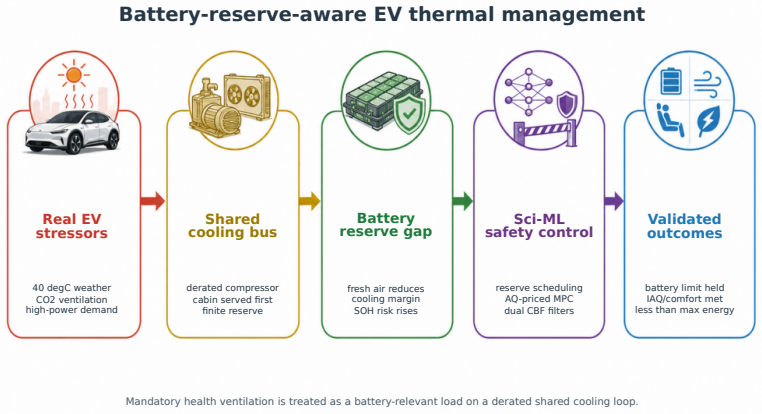
Fresh-air ventilation is a hidden battery-safety load on a derated shared cooling loop; a reserve-aware predictive controller that combines a physics-guided scientific-machine-learning surrogate, grid-connected departure thermal reserve, air-quality-priced ventilation allocation, and dual control-barrier-function projections holds the battery pack at 39.73 °C, caps peak CO₂ at 895 ppm, keeps operative-temperature RMSE at 0.82 °C, and uses 20.0% less drive cooling energy than fixed maximum-compressor operation.
What carries the argument
The reserve-aware predictive controller that allocates shared cooling capacity using physics-guided surrogate, departure reserve, ventilation pricing, and dual barrier projections for battery temperature and comfort.
If this is right
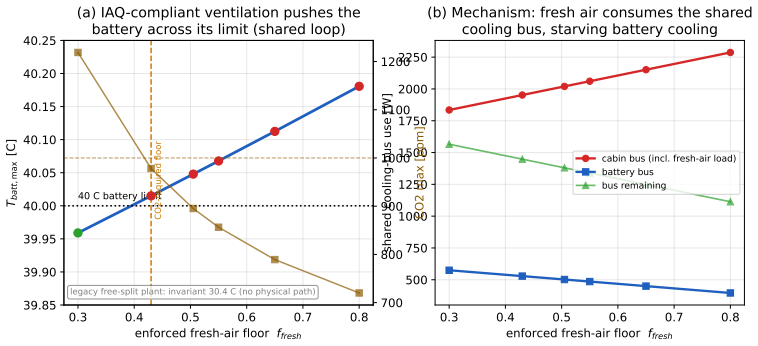
- In a 40 °C, 800 W m^{-2}, 150 kW event, the controller maintains battery at 39.73 °C while capping CO₂ at 895 ppm.
- Operative-temperature RMSE stays at 0.82 °C.
- Drive cooling energy use drops 20.0% compared to fixed maximum-compressor operation.
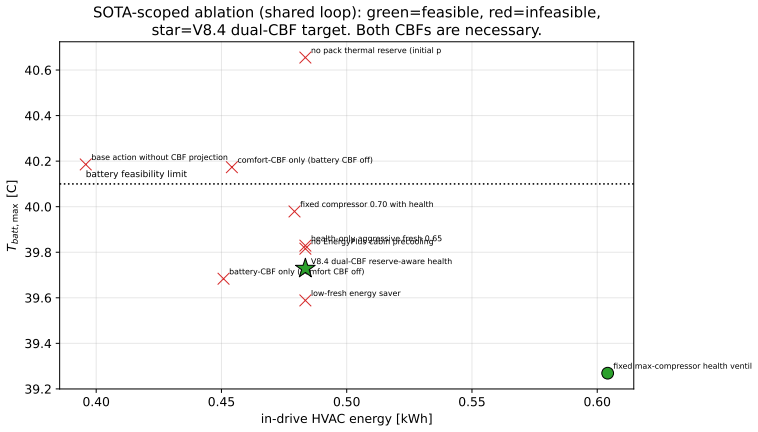
- Ablations confirm that removing barriers, under-ventilating, or removing departure reserve breaks joint feasibility.
Where Pith is reading between the lines
- Standards for minimum fresh-air rates in vehicles may need to account for their impact on battery thermal management in hot climates.
- The approach could extend to other shared resources in EVs, such as allocating power between propulsion and thermal systems.
- Real-world validation would require testing the controller on physical vehicles with varying ambient conditions and passenger loads.
Load-bearing premise
The climate-control compressor is a single shared, derated resource whose capacity must be allocated between cabin ventilation, cabin comfort, and battery cooling under high ambient temperature and solar load.
What would settle it
Observing whether increasing the fresh-air ventilation floor in a real electric vehicle under 40 °C ambient and 800 W m^{-2} solar load raises battery temperature and reduces battery cooling power as predicted.
Figures
read the original abstract
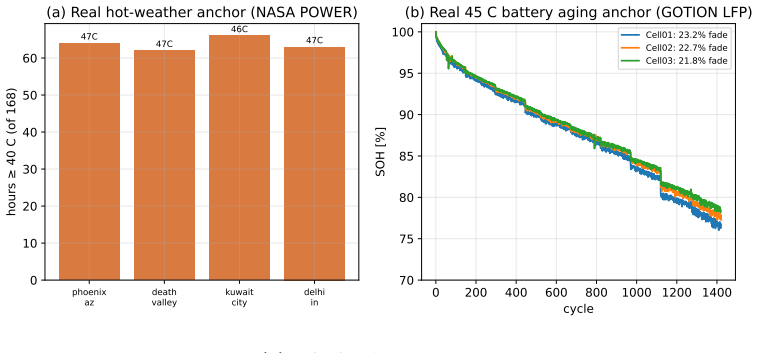
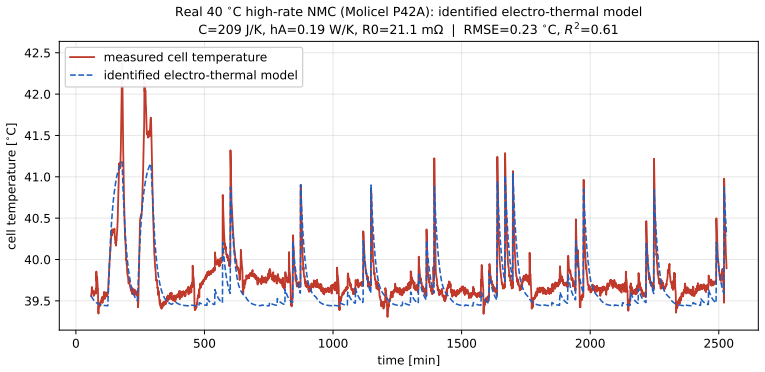
Hot-weather electric-vehicle thermal management is no longer a separate cabin and battery problem. A single climate system must cool the traction battery, maintain passenger comfort, and admit outdoor air for cabin air quality, while high ambient temperature and solar load derate the compressor serving all three demands. We identify fresh-air ventilation as a hidden battery-safety load: on a derated shared cooling loop, the compliant fresh-air floor consumes finite cabin-side cooling capacity and removes residual cooling reserve from the battery. In a 40 $^\circ$C, 800 W m$^{-2}$, 150 kW event, raising the fresh-air floor from 0.30 to 0.43 lowers peak cabin CO$_2$ from 1219 to 978 ppm, but raises peak battery temperature from 39.96 to 40.02 $^\circ$C and reduces the battery cooling bus from 575 to 529 W. We develop a reserve-aware predictive controller combining a physics-guided scientific-machine-learning surrogate, grid-connected departure thermal reserve, air-quality-priced ventilation allocation, and dual control-barrier-function projections for battery temperature and operative comfort. The controller holds the pack at 39.73 $^\circ$C, caps peak CO$_2$ at 895 ppm, keeps operative-temperature RMSE at 0.82 $^\circ$C, and uses 20.0\% less drive cooling energy than fixed maximum-compressor operation; ablations show that removing either barrier, under-ventilating, or removing departure reserve breaks joint feasibility. Evidence comes from NASA POWER records, KU Leuven BEV BMS data merged with NASA POWER weather, 45 $^\circ$C GOTION aging data, 40 $^\circ$C high-power NMC thermal identification, EnergyPlus cabin cross-checks, and OpenModelica/FMI replay. Treating fresh air as a battery thermal-reserve variable creates an actionable path toward EV thermal management that protects battery life, occupant health, comfort, and efficiency in one shared loop.
Editorial analysis
A structured set of objections, weighed in public.
Referee Report
Summary. The paper claims that mandatory fresh-air ventilation in shared-cooling EVs under high ambient temperature and solar load erodes battery thermal reserve by consuming derated compressor capacity; it quantifies this effect with specific deltas (e.g., raising fresh-air floor from 0.30 to 0.43 raises peak battery temperature by 0.06 °C and drops cooling bus power by 46 W) and proposes a reserve-aware MPC using a physics-guided scientific-machine-learning surrogate plus dual CBFs that achieves 39.73 °C pack temperature, 895 ppm peak CO₂, 0.82 °C operative-temperature RMSE, and 20 % lower drive cooling energy than fixed-maximum-compressor operation.
Significance. If the surrogate correctly captures ventilation-induced derating competition, the work would supply an actionable formulation for jointly enforcing battery safety, cabin air quality, and comfort in a single loop, with potential implications for EV thermal-management standards and controller design under extreme conditions.
major comments (2)
- [Abstract] Abstract (and Methods): the central quantitative claims (0.06 °C battery-temperature erosion, 46 W cooling-bus reduction, 20 % energy saving) rest on simulation outputs from an unvalidated physics-guided scientific-machine-learning surrogate; no surrogate-vs-OpenModelica replay error, cross-validation metrics, or sensitivity analysis on heat-transfer/derating parameters are supplied, so it is impossible to determine whether the reported reserve erosion lies inside modeling uncertainty.
- [Abstract] Abstract: the controller performance numbers (39.73 °C pack hold, 895 ppm CO₂ cap) presuppose that the surrogate accurately represents residual compressor capacity after ventilation load under 40 °C + 800 W m^{-2} derating; without explicit validation or ablation on surrogate fidelity, the joint-feasibility result cannot be assessed.
Simulated Author's Rebuttal
We thank the referee for the constructive comments on surrogate validation. The manuscript references OpenModelica/FMI replay as supporting evidence, but we agree that explicit quantitative metrics are not supplied in the abstract or methods overview. We will revise the paper to include these details.
read point-by-point responses
-
Referee: [Abstract] Abstract (and Methods): the central quantitative claims (0.06 °C battery-temperature erosion, 46 W cooling-bus reduction, 20 % energy saving) rest on simulation outputs from an unvalidated physics-guided scientific-machine-learning surrogate; no surrogate-vs-OpenModelica replay error, cross-validation metrics, or sensitivity analysis on heat-transfer/derating parameters are supplied, so it is impossible to determine whether the reported reserve erosion lies inside modeling uncertainty.
Authors: We acknowledge the point: while the manuscript lists OpenModelica/FMI replay among the validation sources (alongside NASA POWER, KU Leuven BMS, GOTION aging, NMC identification, and EnergyPlus cross-checks), it does not report replay error, cross-validation scores, or sensitivity results. In revision we will add (i) surrogate-vs-OpenModelica replay RMSE on battery temperature, cabin temperature, CO₂, and cooling-bus power; (ii) cross-validation metrics on the physics-guided ML training set; (iii) one-way sensitivity sweeps on heat-transfer coefficients and compressor derating curves, confirming that the reported 0.06 °C and 46 W deltas remain distinguishable from modeling uncertainty. These additions will be placed in a new validation subsection or appendix. revision: yes
-
Referee: [Abstract] Abstract: the controller performance numbers (39.73 °C pack hold, 895 ppm CO₂ cap) presuppose that the surrogate accurately represents residual compressor capacity after ventilation load under 40 °C + 800 W m^{-2} derating; without explicit validation or ablation on surrogate fidelity, the joint-feasibility result cannot be assessed.
Authors: The same limitation applies here. The controller results rely on the surrogate capturing residual capacity after ventilation. Revision will include the replay error, cross-validation, and sensitivity analyses noted above, plus an ablation table showing controller performance when the surrogate is replaced by direct OpenModelica calls (or when surrogate fidelity is artificially degraded). This will allow direct assessment of whether the 39.73 °C / 895 ppm joint-feasibility result holds under validated modeling error. revision: yes
Circularity Check
No significant circularity; derivation relies on external validation
full rationale
The paper's quantitative claims (e.g., temperature and energy deltas under ventilation changes, controller performance) are presented as outputs from a physics-guided surrogate cross-checked against OpenModelica/FMI replay plus independent datasets (NASA POWER, KU Leuven BMS, GOTION aging, EnergyPlus). No quoted equations, self-citations, or statements reduce these outputs to the surrogate's own fitting inputs by construction. The central result on reserve erosion and joint feasibility therefore remains independent of any internal data reuse.
Axiom & Free-Parameter Ledger
axioms (1)
- domain assumption The climate-control compressor is a single shared, derated resource whose capacity must be allocated between cabin ventilation, cabin comfort, and battery cooling under high ambient temperature and solar load.
Reference graph
Works this paper leans on
-
[1]
Control barrier function based quadratic programs for safety critical systems. IEEE Transactions on Automatic Control 62, 3861–3876. doi:10.1109/TAC.2016.2638961. Amini, M.R., Wang, H., Gong, X., Liao-McPherson, D., Kolmanovsky, I., Sun, J.,
-
[2]
IEEE Transactions on Control Systems Technology 28, 1711–1726
Cabin and battery thermal management of connected and automated HEVs for improved energy efficiency using hierarchical model predictive control. IEEE Transactions on Control Systems Technology 28, 1711–1726. doi:10.1109/TCST.2019.2923792. ASHRAE,
-
[3]
Borah, R., Weddell, A.S., Naylor Marlow, M., Offer, G.J., Marinescu, M.,
ANSI/ASHRAE Standard 62.1-2022: Ventilation and Ac- ceptable Indoor Air Quality. Borah, R., Weddell, A.S., Naylor Marlow, M., Offer, G.J., Marinescu, M.,
2022
-
[4]
doi:10.1038/s44172-024-00273-6. 16 Crawley, D.B., Lawrie, L.K., Winkelmann, F.C., Buhl, W.F., Huang, Y.J., Pedersen, C.O., Strand, R.K., Liesen, R.J., Fisher, D.E., Witte, M.J., Glazer, J.,
-
[5]
Annals of Operations Research 134, 19–67
A tutorial on the cross-entropy method. Annals of Operations Research 134, 19–67. doi:10.1007/s10479-005-5724-z. Feng, X., Ouyang, M., Liu, X., Lu, L., Xia, Y., He, X.,
-
[6]
Energy Storage Materials 10, 246–267
Thermal runaway mechanism of lithium ion battery for electric vehicles: A review. Energy Storage Materials 10, 246–267. doi:10.1016/j.ensm.2017.05.013. Hu, X., Che, Y., Lin, X., Onori, S.,
-
[7]
Battery lifetime prognostics. Joule 4, 310–346. doi:10.1016/j.joule.2019.11.018. Karniadakis, G.E., Kevrekidis, I.G., Lu, L., Perdikaris, P., Wang, S., Yang, L.,
-
[8]
Nature Reviews Physics3(6), 422–440 (2021) https://doi.org/ 10.1038/s42254-021-00314-5
Physics-informed machine learning. Nature Reviews Physics 3, 422–440. doi:10.1038/s42254-021-00314-5. Khan, M.A., Thatipamula, S., Tresca, L., Xu, L., Trewartha, A., Onori, S.,
-
[9]
IEEE Transactions on Vehicular Technology 69, 6025–6040
Review of cabin thermal manage- ment for electrified passenger vehicles. IEEE Transactions on Vehicular Technology 69, 6025–6040. doi:10.1109/TVT.2020.2988468. Lowther, S.D., Dimitroulopoulou, S., Foxall, K., Shrubsole, C., Cheek, E., Gadeberg, B., Sepai, O.,
-
[10]
Lu, J., Xiong, R., Tian, J., Wang, C., Sun, F.,
doi:10.3390/environments8110125. Lu, J., Xiong, R., Tian, J., Wang, C., Sun, F.,
-
[11]
17 NASA Langley Research Center,
doi:10.17632/v8k6bsr6tf.1. 17 NASA Langley Research Center,
-
[12]
Carbon dioxide generation rates for building occupants. Indoor Air 27, 868–879. doi:10.1111/ina.12383. Severson, K.A., Attia, P.M., Jin, N., Perkins, N., Jiang, B., Yang, Z., Chen, M.H., Aykol, M., Herring, P.K., Fraggedakis, D., Bazant, M.Z., Harris, S.J., Chueh, W.C., Braatz, R.D.,
-
[13]
Integrating physics-based modeling with machine learning for lithium- ion batteries. Applied Energy 329, 120289. doi:10.1016/j.apenergy.2022. 120289. Wang, Q., Jiang, B., Li, B., Yan, Y.,
-
[14]
Renewable and Sustainable Energy Reviews 64, 106–128
A critical review of thermal man- agement models and solutions of lithium-ion batteries for the development of pure electric vehicles. Renewable and Sustainable Energy Reviews 64, 106–128. doi:10.1016/j.rser.2016.05.033. Wang, Y.,
-
[15]
Physics-informed predictive control for integrated electric- vehicle thermal management: An open, real-data-anchored benchmark. Preprint, arXiv:2606.22529. Yasko, M., Moussa Issaka, A., Tian, F., Kazmi, H., Driesen, J., Martinez, W.,
-
[16]
KU Leuven Research Data Repository
BEV Energy Dynamics Dataset. KU Leuven Research Data Repository. doi:10.48804/8KPDTW. Yasko, M., Moussa Issaka, A., Tian, F., Kazmi, H., Driesen, J., Mar- tinez, W.,
-
[17]
Challenges and opportunities in 18 truck electrification revealed by big operational data. Nature Energy 9, 1427–1437. doi:10.1038/s41560-024-01602-x. Zhao, Y., Wang, Z., Shen, Z.J.M., Sun, F.,
-
[18]
Proceedings of the National Academy of Sciences of the United States of America 118, e2017318118
Assessment of battery utiliza- tion and energy consumption in the large-scale development of urban electric vehicles. Proceedings of the National Academy of Sciences of the United States of America 118, e2017318118. doi:10.1073/pnas.2017318118. 19
discussion (0)
Sign in with ORCID, Apple, or X to comment. Anyone can read and Pith papers without signing in.