Quantum statistics on atom-ion Feshbach resonances
Pith reviewed 2026-06-26 02:14 UTC · model grok-4.3
The pith
Tuning spin polarization in a Li Fermi gas reveals nonlinear ion loss rates near a Ba+ Feshbach resonance due to quantum statistics.
A machine-rendered reading of the paper's core claim, the machinery that carries it, and where it could break.
Core claim
By tuning the spin composition of a Li Fermi gas at constant density and temperature, the measured Ba+ ion loss rate near an atom-ion Feshbach resonance exhibits a pronounced nonlinear dependence on spin polarization. This reveals a reduced contribution from recombination pathways involving identical fermions, consistent with antisymmetrization restricting entrance channels and causing interference in a two-step recombination picture using adiabatic hyperspherical methods.
What carries the argument
Antisymmetrization of identical fermions within an adiabatic hyperspherical treatment of a two-step recombination process, which restricts available entrance channels and generates interference between indistinguishable pathways.
If this is right
- Atom-ion hybrid systems can be used to control three-body collision rates through quantum statistics.
- Exchange-symmetry effects remain visible in observables even when thermal averaging obscures underlying threshold laws.
- The two-step recombination picture with channel restriction explains the observed nonlinearity without requiring full quantum threshold behavior.
Where Pith is reading between the lines
- Similar spin-tuning experiments could test whether the same suppression appears in other atom-ion or atom-molecule mixtures at different temperatures.
- If the interference mechanism holds, varying the magnetic field detuning from resonance should modulate the nonlinearity in a predictable way.
- The robustness under thermal conditions suggests the effect may survive in larger, more complex many-body settings where identical-particle statistics matter.
Load-bearing premise
Tuning spin composition at constant density and temperature fully isolates quantum-statistics effects without introducing uncontrolled changes in the collision environment or Feshbach resonance properties.
What would settle it
A strictly linear dependence of the ion loss rate on spin polarization across the full range of polarizations would contradict the claimed reduction in identical-fermion recombination pathways.
Figures
read the original abstract
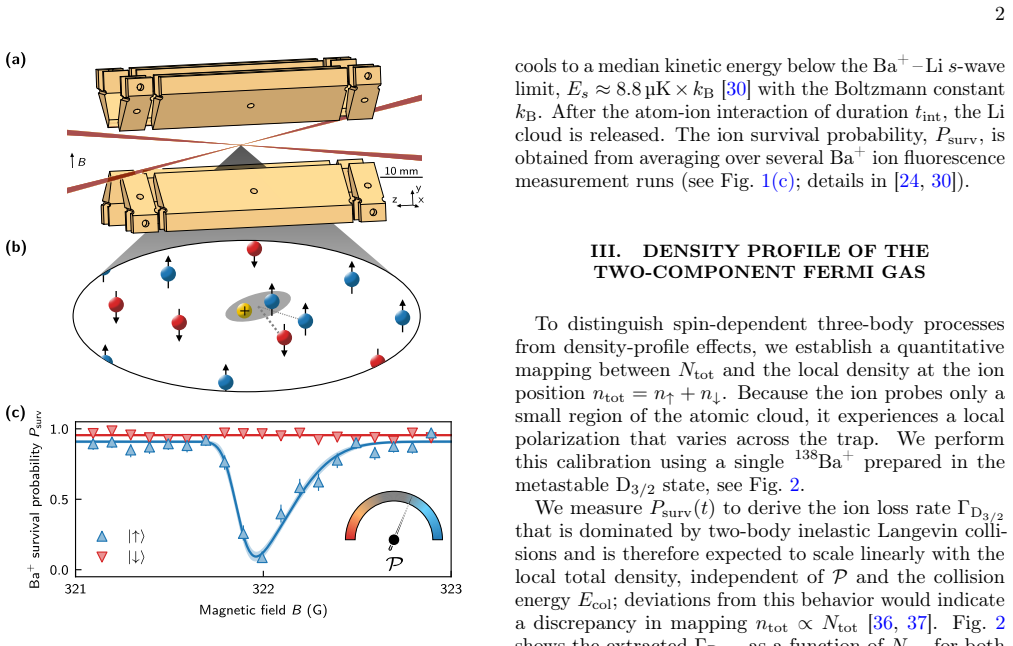
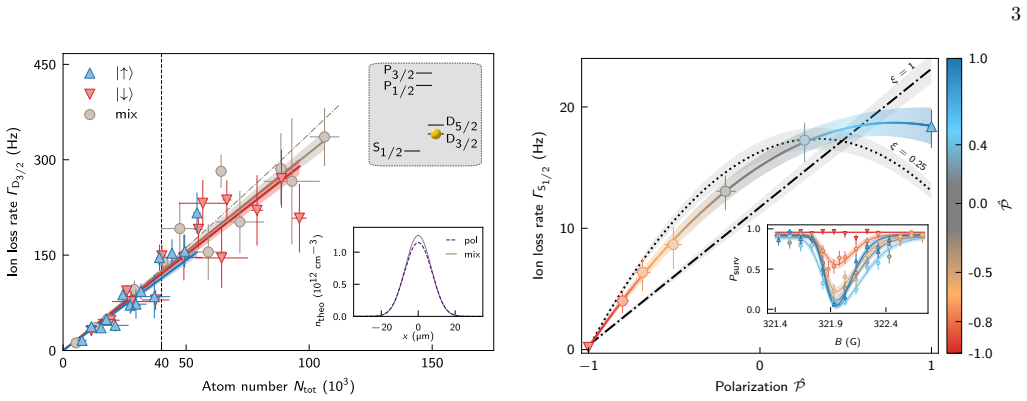
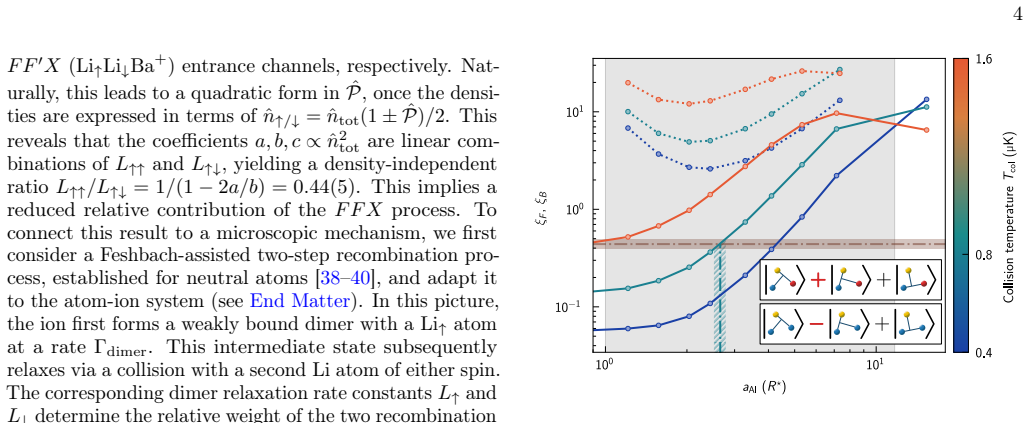
We investigate three-body recombination in a hybrid atom-ion system consisting of a single trapped Ba$^+$ ion immersed in a two-component Fermi gas of Li atoms near an atom-ion Feshbach resonance. By tuning the spin composition at constant density and temperature, we isolate the role of quantum statistics in atom-atom-ion collisions. The measured ion loss rate exhibits a pronounced nonlinear dependence on spin polarization, revealing a reduced contribution of recombination pathways involving identical fermions already at the level of experimental observables. The observations are consistent with a two-step recombination picture and an adiabatic hyperspherical approach, where antisymmetrization restricts the available entrance channels and gives rise to interference between indistinguishable recombination pathways. Our work establishes atom-ion systems as a platform for controlling three-body collisions via quantum statistics and demonstrates that exchange-symmetry effects remain robust even under thermal averaging that obscures the underlying threshold-law behavior.
Editorial analysis
A structured set of objections, weighed in public.
Referee Report
Summary. The manuscript investigates three-body recombination of a single trapped Ba+ ion immersed in a two-component Fermi gas of Li atoms near an atom-ion Feshbach resonance. By varying the spin polarization of the Li gas while asserting constant density and temperature, the authors report a nonlinear dependence of the ion loss rate on polarization. They interpret this as evidence that antisymmetrization restricts recombination pathways involving identical fermions, consistent with a two-step recombination model and adiabatic hyperspherical calculations. The work claims to establish atom-ion systems as a platform for quantum-statistics control of collisions, with exchange effects robust under thermal averaging.
Significance. If the experimental isolation of quantum-statistics effects is robust, the result would demonstrate direct control of three-body loss via spin composition in hybrid atom-ion systems and show that antisymmetrization signatures survive thermal averaging. This could open avenues for studying exchange symmetry in ultracold ion-atom chemistry without requiring ultralow temperatures where threshold laws dominate.
major comments (2)
- [Abstract and experimental methods] Abstract and experimental methods: the central claim that the observed nonlinearity arises purely from quantum statistics requires density and temperature to remain invariant under spin-composition changes. The manuscript asserts constancy but provides no quantitative bounds, in-situ density profiles, independent temperature diagnostics, or checks for differential mean-field shifts or trap-frequency changes that could produce an apparent nonlinearity unrelated to antisymmetrization.
- [Results and discussion] Results and discussion: the stated consistency with the two-step recombination model and hyperspherical approach is presented without error bars on the loss-rate data, without raw datasets, and without quantitative fit metrics (e.g., reduced chi-squared or residual analysis). This makes it impossible to evaluate whether the model reproduces the measured nonlinearity at a statistically meaningful level or whether the agreement is merely qualitative.
minor comments (2)
- [Introduction] Notation for the two-component Fermi gas (e.g., spin labels or polarization definition) should be defined explicitly in the first section where it appears to avoid ambiguity for readers unfamiliar with the specific Li-Ba+ system.
- [Figures] Figure captions should include the number of experimental realizations or averaging details for the loss-rate curves to allow assessment of statistical reliability.
Simulated Author's Rebuttal
We thank the referee for the careful reading and constructive comments on our manuscript. We address the two major comments point by point below, indicating the revisions we will implement.
read point-by-point responses
-
Referee: [Abstract and experimental methods] Abstract and experimental methods: the central claim that the observed nonlinearity arises purely from quantum statistics requires density and temperature to remain invariant under spin-composition changes. The manuscript asserts constancy but provides no quantitative bounds, in-situ density profiles, independent temperature diagnostics, or checks for differential mean-field shifts or trap-frequency changes that could produce an apparent nonlinearity unrelated to antisymmetrization.
Authors: We agree that explicit quantitative evidence for the invariance of density and temperature under changes in spin composition is necessary to substantiate the central claim. While the experiment maintained these quantities constant through trap-parameter adjustments and post-sequence time-of-flight diagnostics, the manuscript does not report the associated bounds or additional checks. We will revise the experimental methods section to include quantitative bounds (density variation <5%, temperature variation <10%), representative in-situ density profiles, and analysis ruling out differential mean-field or trap-frequency shifts. These additions will appear in the main text and as supplementary material. revision: yes
-
Referee: [Results and discussion] Results and discussion: the stated consistency with the two-step recombination model and hyperspherical approach is presented without error bars on the loss-rate data, without raw datasets, and without quantitative fit metrics (e.g., reduced chi-squared or residual analysis). This makes it impossible to evaluate whether the model reproduces the measured nonlinearity at a statistically meaningful level or whether the agreement is merely qualitative.
Authors: The loss-rate measurements were repeated across multiple runs, yielding standard-deviation error bars in the underlying data. We acknowledge that these were not displayed in the figures and that no quantitative fit metrics were provided. In the revised manuscript we will add error bars to all data points in the relevant figures, include a quantitative comparison to the two-step model and hyperspherical calculations (with reduced chi-squared and residual analysis), and make the raw datasets available as supplementary material or upon request. This will permit a statistically rigorous evaluation of the agreement. revision: yes
Circularity Check
No significant circularity: central claim is direct experimental observable
full rationale
The paper's strongest claim is the measured nonlinear dependence of ion loss rate on spin polarization, presented as a direct experimental observable obtained by tuning spin composition at constant density and temperature. No load-bearing step reduces a prediction or uniqueness result to a fitted parameter or self-citation by the paper's own equations. The consistency with a two-step recombination picture is interpretive and secondary; the reported nonlinearity does not rely on any ansatz or renaming that collapses to the input data. This is a standard experimental result with independent content.
Axiom & Free-Parameter Ledger
axioms (1)
- domain assumption The observed ion loss is dominated by three-body recombination whose rate depends on entrance-channel symmetry after antisymmetrization.
Reference graph
Works this paper leans on
-
[1]
Giorgini, L
S. Giorgini, L. P. Pitaevskii, and S. Stringari, Theory of ultracold atomic fermi gases, Rev. Mod. Phys.80, 1215 (2008)
2008
-
[2]
C. H. Greene, P. Giannakeas, and J. Pérez-Ríos, Universal few-body physics and cluster formation, Rev. Mod. Phys. 89, 035006 (2017)
2017
-
[3]
Kraemer, M
T. Kraemer, M. Mark, P. Waldburger, J. G. Danzl, C. Chin, B. Engeser, A. D. Lange, K. Pilch, A. Jaakkola, H.-C. Nägerl, and R. Grimm, Evidence for Efimov quan- tum states in an ultracold gas of caesium atoms, Nature 440, 315 (2006)
2006
-
[4]
Sanner, E
C. Sanner, E. J. Su, A. Keshet, R. Gommers, Y.-i. Shin, W. Huang, and W. Ketterle, Suppression of density fluc- tuations in a quantum degenerate fermi gas, Phys. Rev. Lett.105, 040402 (2010)
2010
-
[5]
Naidon and S
P. Naidon and S. Endo, Efimov physics: A review, Reports on Progress in Physics80, 056001 (2017)
2017
-
[6]
J. P. D’Incao, Few-body physics in resonantly interacting ultracold quantum gases, Journal of Physics B: Atomic, Molecular and Optical Physics51, 043001 (2018)
2018
-
[7]
J. H. Huckans, J. R. Williams, E. L. Hazlett, R. W. Stites, and K. M. O’Hara, Three-body recombination in a three- state fermi gas with widely tunable interactions, Phys. Rev. Lett.102, 165302 (2009)
2009
-
[8]
T. B. Ottenstein, T. Lompe, M. Kohnen, A. N. Wenz, and S. Jochim, Collisional stability of a three-component degenerate fermi gas, Phys. Rev. Lett.101, 203202 (2008)
2008
-
[9]
A. N. Wenz, T. Lompe, T. B. Ottenstein, F. Serwane, G. Zürn, and S. Jochim, Universal trimer in a three- component fermi gas, Phys. Rev. A80, 040702(R) (2009)
2009
-
[10]
Niemann and H.-W
P. Niemann and H.-W. Hammer, Pauli-blocking effects and cooper triples in three-component fermi gases, Phys. Rev. A86, 013628 (2012)
2012
-
[11]
G. L. Schumacher, J. T. Mäkinen, Y. Ji, G. G. T. As- sumpção, J. Chen, S. Huang, F. J. Vivanco, and N. Navon, Observation of anomalous decay of a polarized three- component fermi gas, Nature Communications17, 174 (2026)
2026
-
[12]
Camargo, R
F. Camargo, R. Schmidt, J. D. Whalen, R. Ding, G. Woehl, S. Yoshida, J. Burgdörfer, F. B. Dunning, H. R. Sadeghpour, E. Demler, and T. C. Killian, Creation of rydberg polarons in a bose gas, Phys. Rev. Lett.120, 083401 (2018)
2018
-
[13]
S. K. Kanungo, Y. Lu, F. B. Dunning, S. Yoshida, J. Burgdörfer, and T. C. Killian, Measuring nonlocal three-body spatial correlations with rydberg trimers in ul- tracold quantum gases, Phys. Rev. A107, 033322 (2023)
2023
-
[14]
M. Deiß, S. Willitsch, and J. Hecker Denschlag, Cold trapped molecular ions and hybrid platforms for ions and neutral particles, Nature Physics20, 713 (2024)
2024
-
[15]
Z. Meir, T. Sikorsky, R. Ben-shlomi, N. Akerman, Y. Dal- lal, and R. Ozeri, Dynamics of a Ground-State Cooled Ion Colliding with Ultracold Atoms, Physical Review Letters 117, 243401 (2016)
2016
-
[16]
A. T. Grier, M. Cetina, F. Oručević, and V. Vuletić, Observation of Cold Collisions between Trapped Ions and Trapped Atoms, Physical Review Letters102, 223201 (2009)
2009
-
[17]
Zipkes, S
C. Zipkes, S. Palzer, C. Sias, and M. Köhl, A trapped single ion inside a Bose–Einstein condensate, Nature464, 388 (2010)
2010
-
[18]
Ratschbacher, C
L. Ratschbacher, C. Zipkes, C. Sias, and M. Köhl, Con- trolling chemical reactions of a single particle, Nature Physics8, 649 (2012)
2012
-
[19]
Dieterle, M
T. Dieterle, M. Berngruber, C. Hölzl, R. Löw, K. Jachym- ski, T. Pfau, and F. Meinert, Transport of a Single Cold Ion Immersed in a Bose-Einstein Condensate, Physical Review Letters126, 033401 (2021)
2021
-
[20]
Härter, A
A. Härter, A. Krükow, A. Brunner, W. Schnitzler, S. Schmid, and J. H. Denschlag, Single Ion as a Three- Body Reaction Center in an Ultracold Atomic Gas, Phys- ical Review Letters109, 123201 (2012)
2012
-
[21]
M. Tomza, K. Jachymski, R. Gerritsma, A. Negretti, T. Calarco, Z. Idziaszek, and P. S. Julienne, Cold hy- brid ion-atom systems, Reviews of Modern Physics91, 10.1103/revmodphys.91.035001 (2019)
-
[22]
J. G¸ ebala, M. Tomza, and J. P. D’Incao, Universality in Ionic Three-body Systems Near an Ion-atom Feshbach Resonance (2025), 2511.00325 [physics.atom-ph]
Pith/arXiv arXiv 2025
-
[23]
Feldker, H
T. Feldker, H. Fürst, H. Hirzler, N. V. Ewald, M. Maz- zanti, D. Wiater, M. Tomza, and R. Gerritsma, Buffer gas cooling of a trapped ion to the quantum regime, Nature Physics16, 413 (2020)
2020
-
[24]
Weckesser, F
P. Weckesser, F. Thielemann, D. Wiater, A. Wo- jciechowska, L. Karpa, K. Jachymski, M. Tomza, T. Walker, and T. Schaetz, Observation of Feshbach reso- nances between a single ion and ultracold atoms, Nature 600, 429 (2021)
2021
-
[25]
J. Schmidt, D. Hönig, P. Weckesser, F. Thielemann, T. Schaetz, and L. Karpa, Mass-selective removal of ions from Paul traps using parametric excitation, Applied Physics B126, 10.1007/s00340-020-07491-8 (2020)
-
[27]
Leibfried, R
D. Leibfried, R. Blatt, C. Monroe, and D. Wineland, Quantum dynamics of single trapped ions, Reviews of Modern Physics75, 281 (2003)
2003
-
[28]
J.-S. Chen, E. Nielsen, M. Ebert, V. Inlek, K. Wright, V. Chaplin, A. Maksymov, E. Páez, A. Poudel, P. Maunz, and J. Gamble, Benchmarking a trapped-ion quantum computer with 30 qubits, Quantum8, 1516 (2024)
2024
-
[29]
Bermudez, X
A. Bermudez, X. Xu, R. Nigmatullin, J. O’Gorman, V. Negnevitsky, P. Schindler, T. Monz, U. G. Poschinger, C. Hempel, J. Home, F. Schmidt-Kaler, M. Bier- cuk, R. Blatt, S. Benjamin, and M. Müller, Assessing 7 the Progress of Trapped-Ion Processors Towards Fault- Tolerant Quantum Computation, Physical Review X7, 041061 (2017)
2017
-
[30]
Thielemann, J
F. Thielemann, J. Siemund, D. von Schoenfeld, W. Wu, P. Weckesser, K. Jachymski, T. Walker, and T. Schaetz, Exploring Atom-Ion Feshbach Resonances below thes- Wave Limit, Physical Review X15, 011051 (2025)
2025
-
[31]
Bloch, J
I. Bloch, J. Dalibard, and S. Nascimbène, Quantum sim- ulations with ultracold quantum gases, Nature Physics8, 267 (2012)
2012
-
[32]
Sobirey, N
L. Sobirey, N. Luick, M. Bohlen, H. Biss, H. Moritz, and T. Lompe, Observation of superfluidity in a strongly correlated two-dimensional Fermi gas, Science372, 844 (2021)
2021
-
[33]
Trotzky, P
S. Trotzky, P. Cheinet, S. Fölling, M. Feld, U. Schnor- rberger, A. M. Rey, A. Polkovnikov, E. A. Demler, M. D. Lukin, and I. Bloch, Time-Resolved Observation and Con- trol of Superexchange Interactions with Ultracold Atoms in Optical Lattices, Science319, 295 (2008)
2008
-
[34]
M. H. Anderson, J. R. Ensher, M. R. Matthews, C. E. Wieman, and E. A. Cornell, Observation of Bose-Einstein Condensation in a Dilute Atomic Vapor, Science269, 198 (1995)
1995
-
[35]
DeMarco and D
B. DeMarco and D. S. Jin, Onset of Fermi Degeneracy in a Trapped Atomic Gas, Science285, 1703 (1999)
1999
-
[36]
X. Xing, P. Weckesser, F. Thielemann, T. Jónás, R. Vex- iau, N. Bouloufa-Maafa, E. Luc-Koenig, K. W. Madison, A. Orbán, T. Xie, T. Schaetz, and O. Dulieu, Competing excitation quenching and charge exchange in ultracold Li−Ba + collisions, Journal of Physics B: Atomic, Molec- ular and Optical Physics57, 245201 (2024)
2024
-
[37]
Surpassing the en- ergy resolution limit with ferromagnetic torque sensors,
J. Joger, H. Fürst, N. Ewald, T. Feldker, M. Tomza, and R. Gerritsma, Observation of collisions between cold Li atomsandYb+ions,PhysicalReviewA96,10.1103/phys- reva.96.030703 (2017)
-
[38]
Hirzler, E
H. Hirzler, E. Trimby, R. Gerritsma, A. Safavi-Naini, and J. Pérez-Ríos, Trap-Assisted Complexes in Cold Atom-Ion Collisions, Physical Review Letters130, 143003 (2023)
2023
-
[39]
R. E. Roberts, R. B. Bernstein, and C. F. Curtiss, Reso- nance Theory of Termolecular Recombination Kinetics: H+H+M→H2M, The Journal of Chemical Physics50, 5163 (1969)
1969
-
[40]
A. E. Orel, Nascent vibrational/rotational distribution produced by hydrogen atom recombination, The Journal of Chemical Physics87, 314 (1987)
1987
-
[41]
J. Schmidt, P. Weckesser, F. Thielemann, T. Schaetz, and L. Karpa, Optical Traps for Sympathetic Cooling of Ions with Ultracold Neutral Atoms, Physical Review Letters 124, 10.1103/physrevlett.124.053402 (2020)
-
[42]
Schaetz, Trapping ions and atoms optically, Journal of Physics B: Atomic, Molecular and Optical Physics50, 102001 (2017)
T. Schaetz, Trapping ions and atoms optically, Journal of Physics B: Atomic, Molecular and Optical Physics50, 102001 (2017)
2017
-
[43]
Giannakeas and J
P. Giannakeas and J. Pérez-Ríos, (2026), in preparation
2026
-
[44]
Avery,Hyperspherical Harmonics: Applications in Quantum Theory(Kluwer Academic Publishers, Norwell, MA, 1989)
J. Avery,Hyperspherical Harmonics: Applications in Quantum Theory(Kluwer Academic Publishers, Norwell, MA, 1989)
1989
-
[45]
Y. F. Smirnov and K. V. Shitikova, Method of K har- monics and the shell model, Sov. J. Part. Nucl.8, 44 (1977)
1977
-
[46]
Pöschl and E
G. Pöschl and E. Teller, Bemerkungen zur Quanten- mechanik des anharmonischen Oszillators, Zeitschrift für Physik83, 143 (1933)
1933
-
[47]
M. D. Higgins and C. H. Greene, Three and four identical fermions near the unitary limit, Phys. Rev. A106, 023304 (2022)
2022
-
[48]
C. Chin, R. Grimm, P. Julienne, and E. Tiesinga, Fesh- bach resonances in ultracold gases, Reviews of Modern Physics82, 1225 (2010)
2010
-
[49]
M. Puchalski, D. Kędziera, and K. Pachucki, Lithium electric dipole polarizability, Physical Review A84, 10.1103/PhysRevA.84.052518 (2011)
-
[50]
J. P. D’Incao and B. D. Esry, Scattering Length Scal- ing Laws for Ultracold Three-Body Collisions, Physical Review Letters94, 213201 (2005). 8 Appendix A: Adiabatic hyperspherical potentials The relative degrees of freedom of an arbitrary three- body system can be conveniently described utilizing the hyperspherical coordinates (for details see [2]), yiel...
2005
discussion (0)
Sign in with ORCID, Apple, or X to comment. Anyone can read and Pith papers without signing in.