Estimation of High Dimensional Bounded Discrete Graphical Models via Regularized Generalized Score Matching
Pith reviewed 2026-06-26 02:33 UTC · model grok-4.3
The pith
Bounded discrete graphical models for finite-support responses remove interaction constraints by construction and support a normalization-free regularized score matching estimator with high-dimensional recovery guarantees.
A machine-rendered reading of the paper's core claim, the machinery that carries it, and where it could break.
Core claim
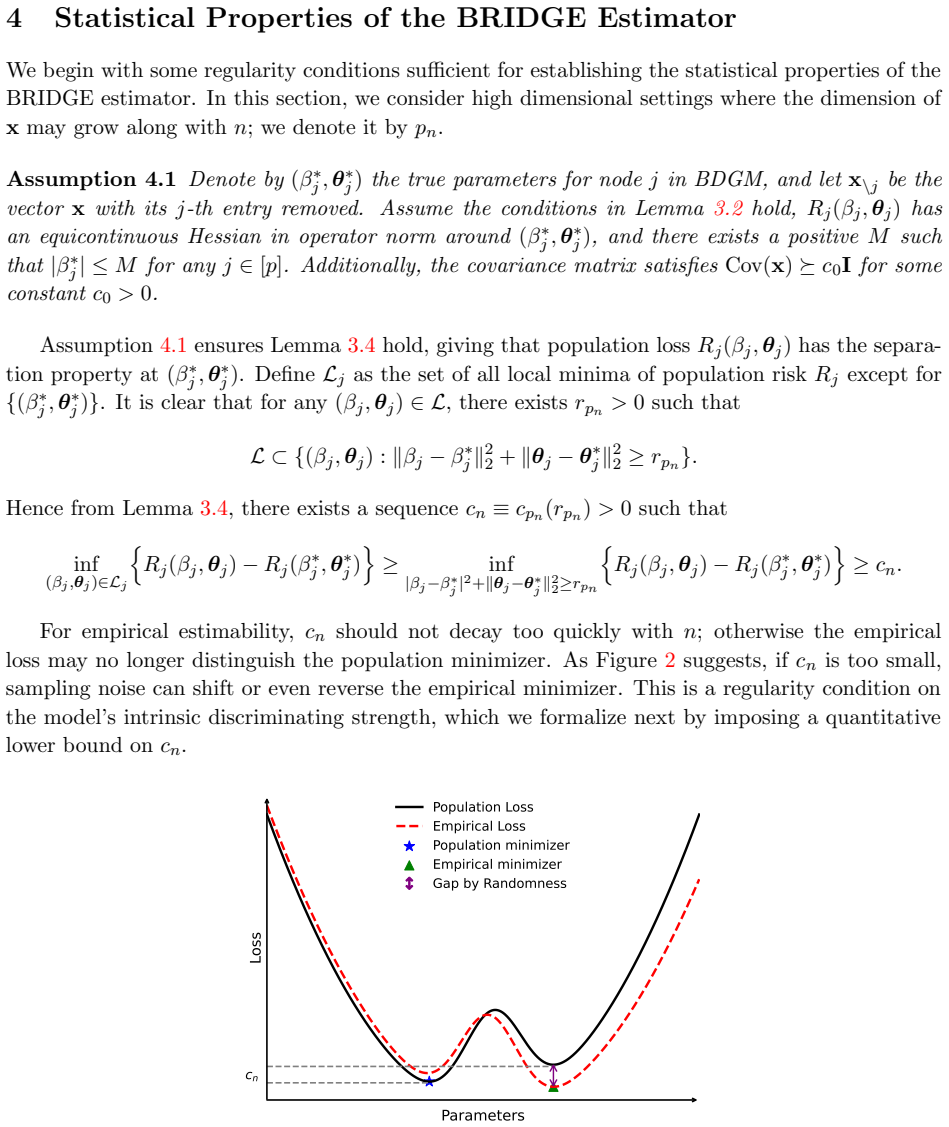
Bounded discrete graphical models for responses with finite support remove constraints on interaction parameters while preserving interpretable dependence; the BRIDGE regularized generalized score matching estimator provides a normalization-free surrogate that yields a unified system of estimating equations, and analysis of its nonconvex objective via a population separation property produces nonasymptotic estimation error bounds together with exact support recovery in high-dimensional regimes.
What carries the argument
The BRIDGE regularized generalized score matching estimator, reparameterized to restore curvature along the intercept, whose analysis rests on a population separation property that substitutes for global convexity.
If this is right
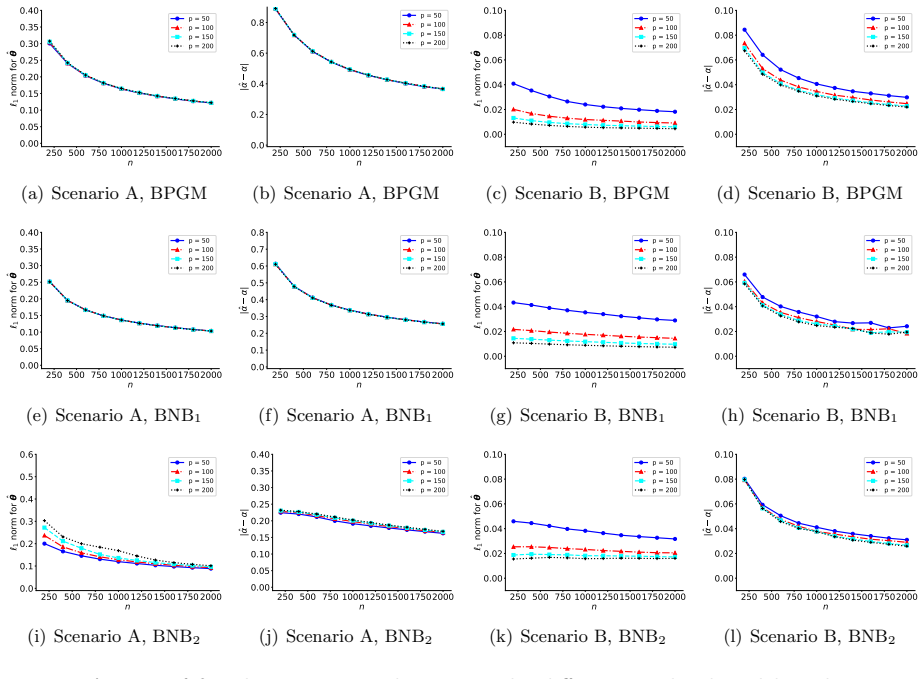
- The estimator achieves nonasymptotic estimation error bounds for all parameters in high-dimensional settings.
- Exact support recovery of the underlying graph holds with high probability under the population separation property.
- The approach supplies a unified estimating equation system that accommodates joint l1 regularization across all parameters.
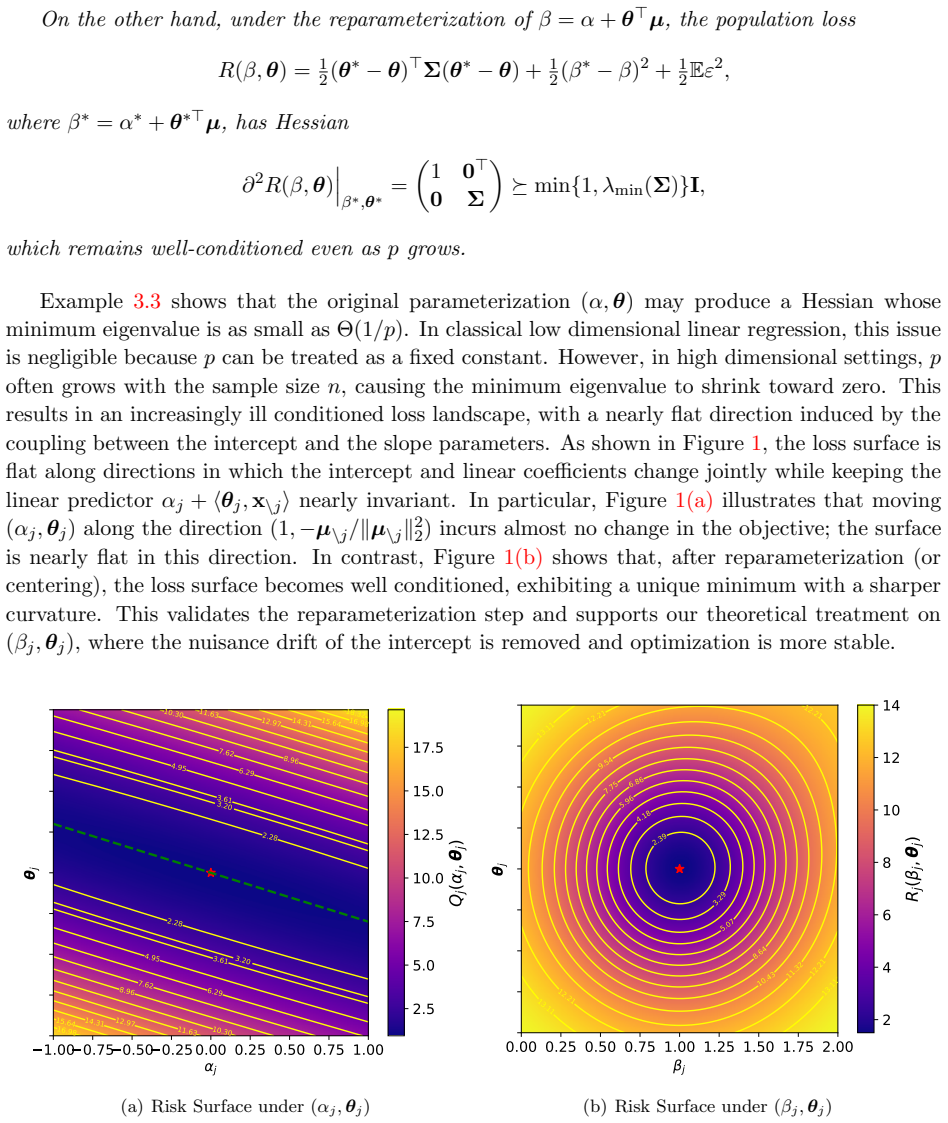
- Reparameterization restores sufficient curvature for stable numerical computation of the nonconvex objective.
Where Pith is reading between the lines
- The finite-support modeling choice could extend to other discrete graphical model settings where normalization constraints currently limit parameter ranges.
- The population separation property might be adaptable to other nonconvex score-matching or pseudo-likelihood objectives in high-dimensional statistics.
- Real-data applications suggest the method could handle mixed bounded discrete and continuous responses if the separation property generalizes.
Load-bearing premise
The discrete responses have finite support.
What would settle it
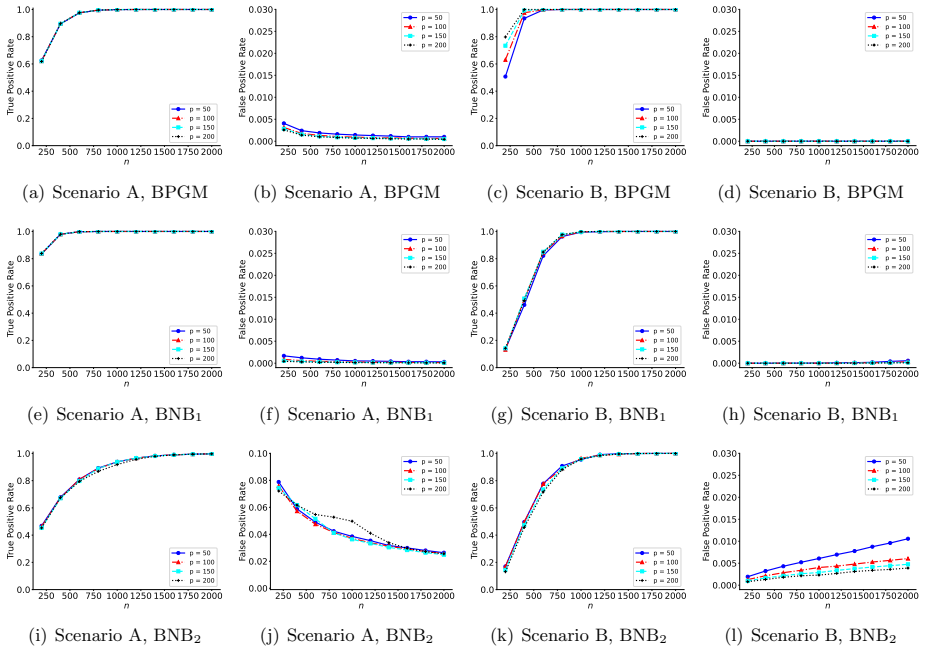
A simulation or dataset in which the BRIDGE estimator fails to achieve exact support recovery under the stated high-dimensional regime with bounded discrete variables would falsify the recovery claim.
Figures
read the original abstract
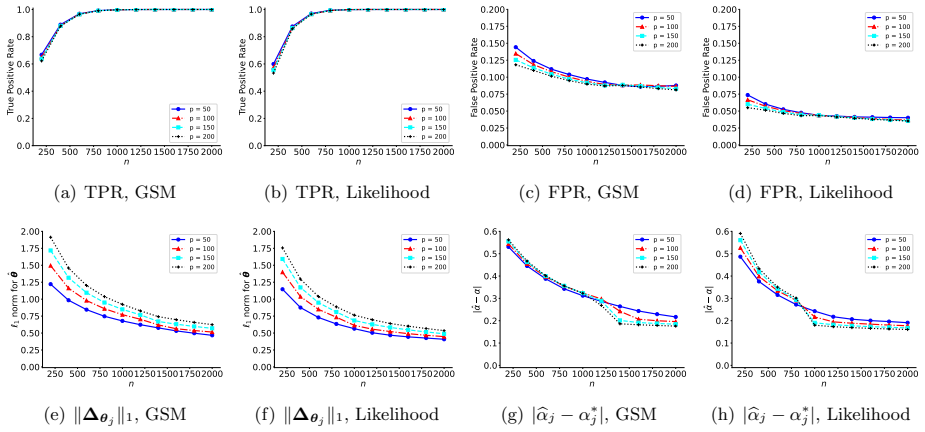
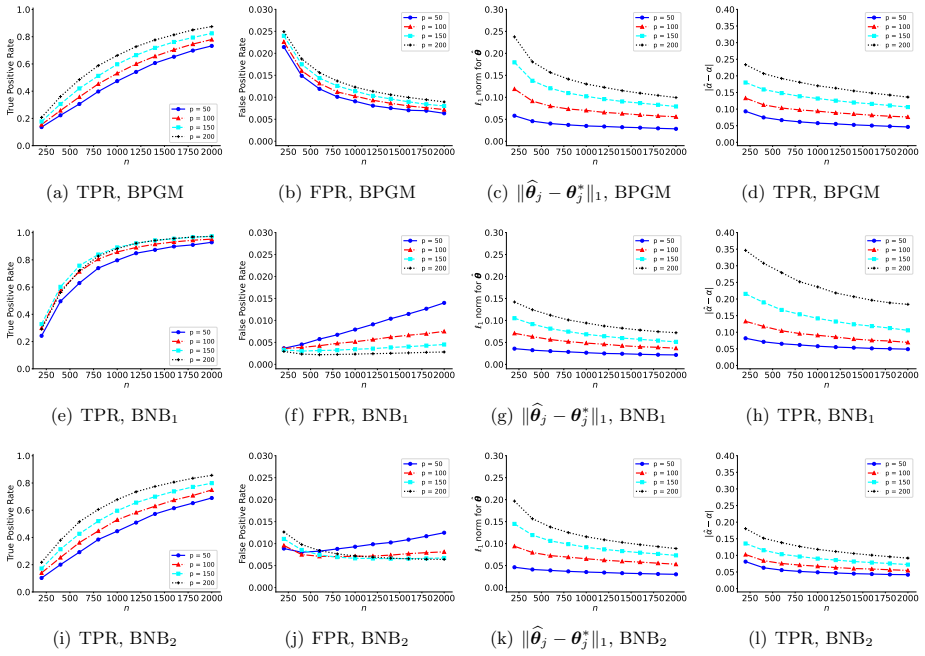
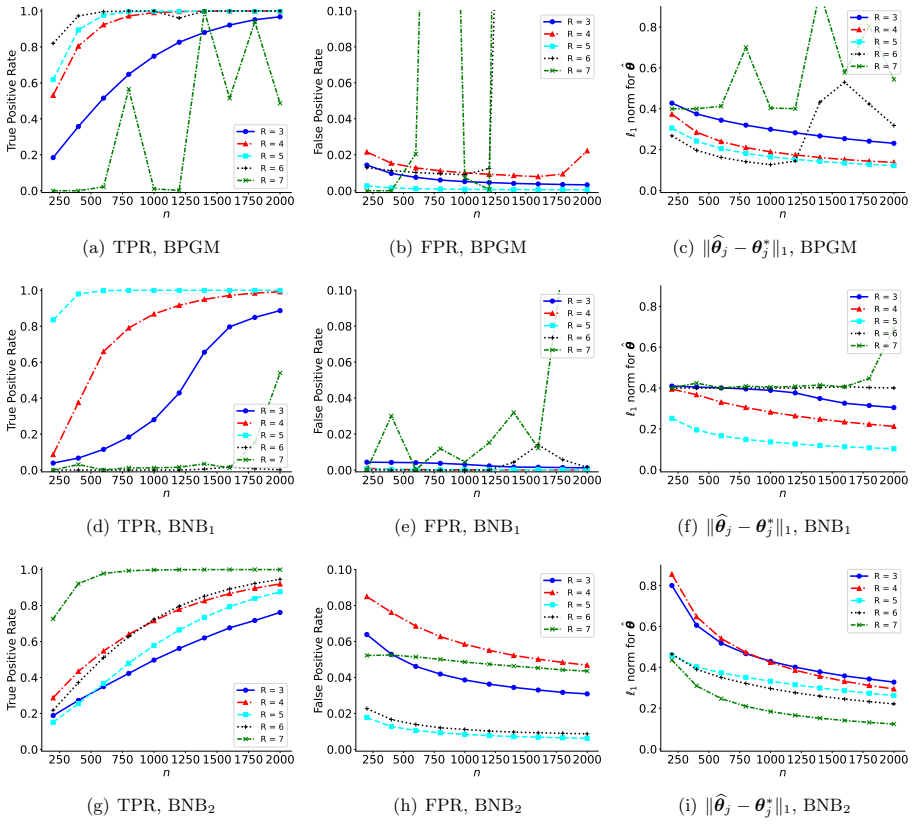
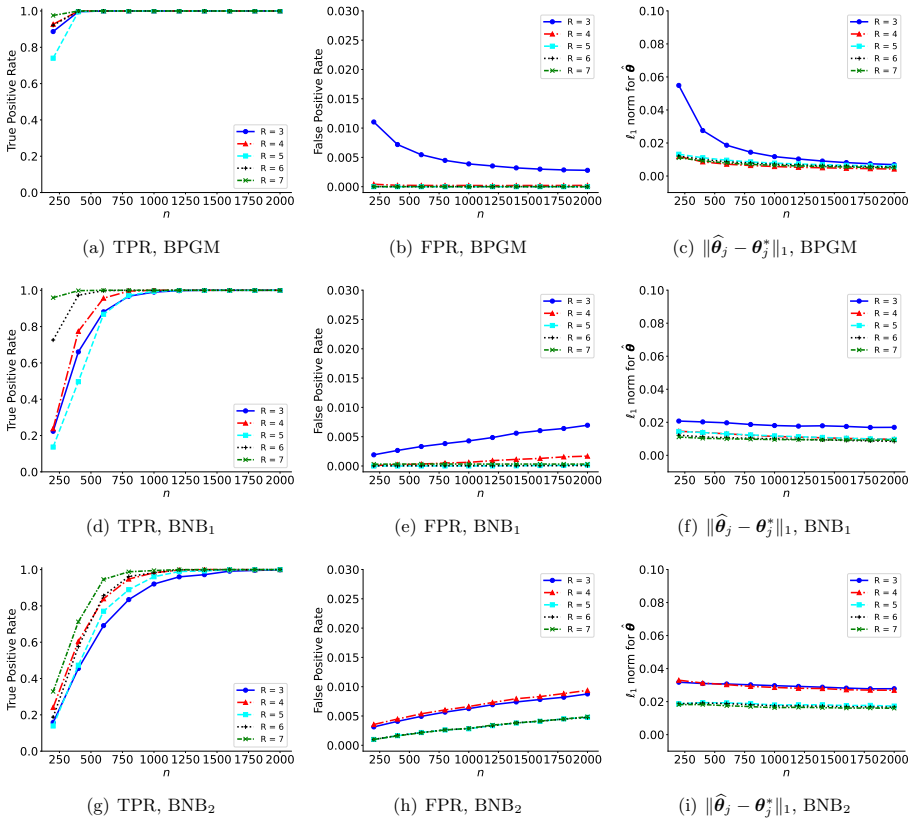
Graphical models for multivariate count data are widely used to characterize conditional dependence structures. For count variables with unbounded support, however, ensuring a finite normalizing constant typically imposes restrictive constraints on interaction parameters. We propose bounded discrete graphical models for multivariate discrete responses with finite support, which remove such constraints by construction while retaining interpretable dependence on the observed scale. We develop a regularized generalized score matching estimator (BRIDGE), which provides a normalization-free surrogate for likelihood-based estimation. The approach yields a unified system of estimating equations for all parameters and enables joint regularization through an $\ell_1$ penalty. To address degeneracy in the loss geometry, we introduce a reparameterization that restores curvature along the intercept direction and facilitates stable computation. On the theoretical side, we analyze a nonconvex objective and establish a population separation property that replaces global convexity. This yields nonasymptotic estimation error bounds and exact support recovery in high-dimensional regimes. Simulation studies and real data analyses demonstrate that BRIDGE accurately recovers graph structure and provides a stable and interpretable framework for high-dimensional discrete graphical modeling.
Editorial analysis
A structured set of objections, weighed in public.
Referee Report
Summary. The paper proposes bounded discrete graphical models for multivariate discrete responses with finite support, removing constraints on interaction parameters that arise in unbounded count models. It develops the BRIDGE estimator, a regularized generalized score-matching procedure that is normalization-free, yields a unified system of estimating equations, and incorporates joint ℓ1 regularization. A reparameterization is introduced to restore curvature along the intercept direction. Theoretically, the nonconvex population loss is shown to satisfy a separation property that substitutes for global convexity, delivering nonasymptotic estimation error bounds and exact support recovery under high-dimensional regimes. Simulation studies and real-data examples illustrate graph recovery and interpretability.
Significance. If the separation property and ensuing bounds hold, the work supplies a coherent, constraint-free framework for high-dimensional discrete graphical modeling that directly targets the observed scale. The normalization-free score-matching route and the explicit handling of nonconvexity via population separation are technically distinctive and could extend to other bounded or truncated discrete models. The combination of theoretical nonasymptotic guarantees with joint regularization addresses a practical gap in existing count-graphical-model literature.
major comments (2)
- [§3.3] §3.3 (population separation property): The separation inequality is stated to hold uniformly over the parameter space after reparameterization, yet the proof sketch does not explicitly verify that the separation constant remains bounded away from zero when the minimum edge strength scales as o(1/√n); this scaling is load-bearing for the exact support-recovery claim in Theorem 4.1.
- [Table 2] Table 2 (simulation design): The reported support-recovery rates for BRIDGE are compared only against the unconstrained Poisson graphical model; an additional baseline that enforces the same bounded-support truncation would isolate whether the performance gain stems from the model class or from the estimator.
minor comments (2)
- [§2.1] §2.1: The definition of the bounded discrete graphical model uses the same symbol for the interaction matrix before and after reparameterization; introducing distinct notation would prevent confusion when the estimating equations are written.
- [Figure 3] Figure 3 caption: The legend lists “BRIDGE (λ=0.1)” but the plotted curves correspond to the cross-validated λ; the caption should be updated for accuracy.
Simulated Author's Rebuttal
We thank the referee for the positive evaluation and the detailed comments. We address the two major comments point by point below.
read point-by-point responses
-
Referee: [§3.3] §3.3 (population separation property): The separation inequality is stated to hold uniformly over the parameter space after reparameterization, yet the proof sketch does not explicitly verify that the separation constant remains bounded away from zero when the minimum edge strength scales as o(1/√n); this scaling is load-bearing for the exact support-recovery claim in Theorem 4.1.
Authors: We appreciate the referee highlighting this detail. The separation constant in the population loss after reparameterization is controlled by the minimum nonzero edge strength β_min. Under the conditions of Theorem 4.1, which require β_min to be at least on the order of √((log p)/n) (standard for exact support recovery), the constant remains bounded away from zero uniformly. We acknowledge that the current proof sketch does not spell out this dependence explicitly for the o(1/√n) regime. We will revise §3.3 (and the appendix proof) to include an explicit lower bound on the separation constant in terms of β_min, confirming it stays positive under the theorem assumptions. revision: yes
-
Referee: [Table 2] Table 2 (simulation design): The reported support-recovery rates for BRIDGE are compared only against the unconstrained Poisson graphical model; an additional baseline that enforces the same bounded-support truncation would isolate whether the performance gain stems from the model class or from the estimator.
Authors: We agree this comparison would strengthen the simulation section. We will add a new baseline consisting of a regularized score-matching estimator applied to a truncated (bounded-support) Poisson model in the revised Table 2 and accompanying text, allowing readers to separate the contribution of the bounded discrete model class from that of the BRIDGE estimator itself. revision: yes
Circularity Check
No significant circularity identified
full rationale
The paper introduces bounded discrete graphical models as a modeling choice that removes parameter constraints by finite support, develops the BRIDGE estimator as a normalization-free surrogate, and separately analyzes the nonconvex objective to establish a population separation property yielding nonasymptotic bounds and support recovery. None of these steps reduce by the paper's own equations or self-citation to fitted inputs or prior results by the same authors; the separation property is presented as an independent analytic step replacing global convexity. The derivation chain is self-contained.
Axiom & Free-Parameter Ledger
Reference graph
Works this paper leans on
-
[1]
Journal of Machine Learning Research , volume=
The nonparanormal: Semiparametric estimation of high dimensional undirected graphs , author=. Journal of Machine Learning Research , volume=
-
[2]
Nucleic Acids Research , volume=
KEGG: integrating viruses and cellular organisms , author=. Nucleic Acids Research , volume=. 2021 , doi=
2021
-
[3]
Leukemia , volume=
The RAS pathway in leukemia , author=. Leukemia , volume=. 2012 , doi=
2012
-
[4]
Leukemia , volume=
PI3K/AKT/mTOR signaling in acute myeloid leukemia , author=. Leukemia , volume=. 2011 , doi=
2011
-
[5]
Cell , volume=
Hematopoiesis: an evolving paradigm for stem cell biology , author=. Cell , volume=. 2008 , doi=
2008
-
[6]
Journal of Machine Learning Research , volume=
Generalized score matching for non-negative data , author=. Journal of Machine Learning Research , volume=
-
[7]
Advances in Neural Information Processing Systems , volume=
High-dimensional graphical model selection: tractable graph families and necessary conditions , author=. Advances in Neural Information Processing Systems , volume=
-
[8]
1996 , publisher=
Graphical Models , author=. 1996 , publisher=
1996
-
[9]
The Annals of Statistics , volume=
High-dimensional Ising model selection using _1 -regularized logistic regression , author=. The Annals of Statistics , volume=
-
[10]
Journal of Machine Learning Research , volume=
The huge package for high-dimensional undirected graph estimation in R , author=. Journal of Machine Learning Research , volume=. 2012 , publisher=
2012
-
[11]
Yang, Eunho and Ravikumar, Pradeep and Allen, Genevera and Liu, Zhandong , journal=. On
-
[12]
Journal of Machine Learning Research , volume=
Graphical models via univariate exponential family distributions , author=. Journal of Machine Learning Research , volume=
-
[13]
Journal of the Royal Statistical Society: Series B (Methodological) , volume=
Spatial interaction and the statistical analysis of lattice systems , author=. Journal of the Royal Statistical Society: Series B (Methodological) , volume=
-
[14]
Journal of the Royal Statistical Society: Series B (Statistical Methodology) , volume=
High dimensional semiparametric latent graphical model for mixed data , author=. Journal of the Royal Statistical Society: Series B (Statistical Methodology) , volume=
-
[15]
Journal of Machine Learning Research , volume=
Estimation of non-normalized statistical models by score matching , author=. Journal of Machine Learning Research , volume=
-
[16]
International Conference on Artificial Intelligence and Statistics , pages=
On model selection consistency of lasso for high-dimensional ising models , author=. International Conference on Artificial Intelligence and Statistics , pages=. 2023 , organization=
2023
-
[17]
Asymptotic properties of
Wang, Jane-Ling , journal=. Asymptotic properties of. 1999 , publisher=
1999
-
[18]
Electronic Journal of Statistics , volume=
Estimation of high-dimensional graphical models using regularized score matching , author=. Electronic Journal of Statistics , volume=
-
[19]
2014 , howpublished =
Gerd Kortemeyer , title =. 2014 , howpublished =
2014
-
[20]
Archives of Psychology , volume =
Rensis Likert , title =. Archives of Psychology , volume =. 1932 , publisher =
1932
-
[21]
2017 , url =
Common Terminology Criteria for Adverse Events (CTCAE) Version 5.0 , institution =. 2017 , url =
2017
-
[22]
Common Terminology Criteria for Adverse Events (CTCAE) -- updates and resources , year =
-
[23]
Journal of Machine Learning Research , volume=
Learning non-Gaussian graphical models via Hessian scores and triangular transport , author=. Journal of Machine Learning Research , volume=
-
[24]
Journal of the Royal Statistical Society: Series B (Methodological) , volume=
Regression models for ordinal data , author=. Journal of the Royal Statistical Society: Series B (Methodological) , volume=
-
[25]
Proceedings of the Twenty-Seventh Conference on Uncertainty in Artificial Intelligence , pages=
Bregman divergence as general framework to estimate unnormalized statistical models , author=. Proceedings of the Twenty-Seventh Conference on Uncertainty in Artificial Intelligence , pages=
-
[26]
Disorder in physical systems: A volume in honour of John M
Markov random fields in statistics , author=. Disorder in physical systems: A volume in honour of John M. Hammersley , pages=
-
[27]
Journal of Multivariate Analysis , volume=
High-dimensional nonconvex LASSO-type M-estimators , author=. Journal of Multivariate Analysis , volume=. 2024 , publisher=
2024
-
[28]
IEEE transactions on information theory , volume=
Sharp Thresholds for High-Dimensional and Noisy Sparsity Recovery Using L1 Constrained Quadratic Programming Lasso , author=. IEEE transactions on information theory , volume=
-
[29]
Advances in neural information processing systems , volume=
Graphical models via generalized linear models , author=. Advances in neural information processing systems , volume=
-
[30]
Advances in Neural Information Processing Systems , volume=
Learning exponential families from truncated samples , author=. Advances in Neural Information Processing Systems , volume=
-
[31]
Journal of Machine Learning Research , volume=
Estimating density models with truncation boundaries using score matching , author=. Journal of Machine Learning Research , volume=
-
[32]
2025 , author =
Generalized score matching , journal =. 2025 , author =
2025
-
[33]
Computational statistics & data analysis , volume=
Some extensions of score matching , author=. Computational statistics & data analysis , volume=. 2007 , publisher=
2007
-
[34]
Journal of Machine Learning Research , volume=
Simultaneous inference for pairwise graphical models with generalized score matching , author=. Journal of Machine Learning Research , volume=
-
[35]
Journal of Machine Learning Research , volume=
Nonparametric graphical model for counts , author=. Journal of Machine Learning Research , volume=
-
[36]
Jingfei Zhang and Yi Li , title =. Journal of Computational and Graphical Statistics , volume =. 2024 , publisher =. doi:10.1080/10618600.2024.2421246 , URL =
-
[37]
and Wang, Z
Samuels, Y. and Wang, Z. and Bardelli, A. and et al. , journal=. Oncogenic mutations of. 2004 , publisher=
2004
-
[38]
Nature , volume=
Comprehensive genomic characterization defines human glioblastoma genes and core pathways , author=. Nature , volume=. 2008 , publisher=
2008
-
[39]
Cancer Research , volume=
Genes for epidermal growth factor receptor, transforming growth factor alpha, and epidermal growth factor and their expression in human gliomas in vivo , author=. Cancer Research , volume=. 1991 , publisher=
1991
-
[40]
Genome Biology , volume=
Identification of genetic variants that impact gene co-expression relationships using large-scale single-cell data , author=. Genome Biology , volume=. 2023 , publisher=
2023
-
[41]
Handbook for Automatic Computation: Volume II: Linear Algebra , pages=
Singular value decomposition and least squares solutions , author=. Handbook for Automatic Computation: Volume II: Linear Algebra , pages=. 1971 , publisher=
1971
-
[42]
Statistica Sinica , volume=
Prior knowledge guided ultra-high dimensional variable screening with application to neuroimaging data , author=. Statistica Sinica , volume=. 2022 , publisher=
2022
-
[43]
Markowitz , author=
Harry M. Markowitz , author=. Portfolio selection, Journal of Finance , volume=
-
[44]
Methods of Information in Medicine , volume=
Generalized estimating equations , author=. Methods of Information in Medicine , volume=. 2010 , publisher=
2010
-
[45]
2000 , publisher=
Kanehisa, Minoru and Goto, Susumu , journal=. 2000 , publisher=
2000
-
[46]
Gusev, Yuriy and Bhuvaneshwar, Krithika and Song, Lei and Zenklusen, Jean-Claude and Fine, Howard and Madhavan, Subha , journal=. The. 2018 , publisher=
2018
-
[47]
Annals of Statistics , volume=
High-dimensional graphs and variable selection with the lasso , author=. Annals of Statistics , volume=
-
[48]
A sparse conditional
Yin, Jianxin and Li, Hongzhe , journal=. A sparse conditional. 2011 , publisher=
2011
-
[49]
Journal of the American Statistical Association , volume=
Sparse estimation of conditional graphical models with application to gene networks , author=. Journal of the American Statistical Association , volume=. 2012 , publisher=
2012
-
[50]
Journal of Computational and Graphical Statistics , volume=
Sparse multivariate regression with covariance estimation , author=. Journal of Computational and Graphical Statistics , volume=. 2010 , publisher=
2010
-
[51]
The Annals of Statistics , volume=
On Asymptotically Optimal Confidence Regions And Tests For High-Dimensional Models , author=. The Annals of Statistics , volume=. 2014 , publisher=
2014
-
[52]
Journal of the Iranian Statistical Society , volume=
An overview of the new feature selection methods in finite mixture of regression models , author=. Journal of the Iranian Statistical Society , volume=. 2022 , publisher=
2022
-
[53]
PLoS Genet , volume=
Statistical analysis reveals co-expression patterns of many pairs of genes in yeast are jointly regulated by interacting loci , author=. PLoS Genet , volume=. 2013 , publisher=
2013
-
[54]
Genome Medicine , volume=
An integrative approach for building personalized gene regulatory networks for precision medicine , author=. Genome Medicine , volume=. 2018 , publisher=
2018
-
[55]
Cancers , volume=
Strategies in gene therapy for glioblastoma , author=. Cancers , volume=. 2013 , publisher=
2013
-
[56]
Journal of Neuro-oncology , volume=
Recent advances in the molecular understanding of glioblastoma , author=. Journal of Neuro-oncology , volume=. 2012 , publisher=
2012
-
[57]
Nature Genetics , volume=
Single-cell RNA sequencing identifies celltype-specific cis-eQTLs and co-expression QTLs , author=. Nature Genetics , volume=. 2018 , publisher=
2018
-
[58]
2012 , publisher=
Wang, Yupeng and Joseph, Sandeep J and Liu, Xinyu and Kelley, Michael and Rekaya, Romdhane , journal=. 2012 , publisher=
2012
-
[59]
Journal of Computational and Graphical Statistics , volume=
Generalized connectivity matrix response regression with applications in brain connectivity studies , author=. Journal of Computational and Graphical Statistics , volume=. 2023 , publisher=
2023
-
[60]
Macroeconomic Forecasting in the Era of Big Data: Theory and Practice , pages=
Variable selection and feature screening , author=. Macroeconomic Forecasting in the Era of Big Data: Theory and Practice , pages=. 2020 , publisher=
2020
-
[61]
Journal of the American Statistical Association , volume=
Covariate information number for feature screening in ultrahigh-dimensional supervised problems , author=. Journal of the American Statistical Association , volume=. 2022 , publisher=
2022
-
[62]
Journal of the American Statistical Association , volume=
Conditional sure independence screening , author=. Journal of the American Statistical Association , volume=. 2016 , publisher=
2016
-
[63]
Journal of the American Statistical Association , volume=
Forward regression for ultra-high dimensional variable screening , author=. Journal of the American Statistical Association , volume=. 2009 , publisher=
2009
-
[64]
Advances in Neural Information Processing Systems , volume=
High-dimensional regression with noisy and missing data: Provable guarantees with non-convexity , author=. Advances in Neural Information Processing Systems , volume=
-
[65]
Journal of the Royal Statistical Society Series B: Statistical Methodology , volume=
Regularization and variable selection via the elastic net , author=. Journal of the Royal Statistical Society Series B: Statistical Methodology , volume=. 2005 , publisher=
2005
-
[66]
Journal of the American statistical Association , volume=
Variable selection via nonconcave penalized likelihood and its oracle properties , author=. Journal of the American statistical Association , volume=. 2001 , publisher=
2001
-
[67]
Journal of the Royal Statistical Society Series B: Statistical Methodology , volume=
Regression shrinkage and selection via the lasso , author=. Journal of the Royal Statistical Society Series B: Statistical Methodology , volume=. 1996 , publisher=
1996
-
[68]
Journal of the Royal Statistical Society Series B: Statistical Methodology , volume=
Sure independence screening for ultrahigh dimensional feature space , author=. Journal of the Royal Statistical Society Series B: Statistical Methodology , volume=. 2008 , publisher=
2008
-
[69]
Annals of Statistics , volume=
Variable selection in semiparametric regression modeling , author=. Annals of Statistics , volume=. 2008 , publisher=
2008
-
[70]
Journal of the American Statistical Association , volume=
Linear hypothesis testing in dense high-dimensional linear models , author=. Journal of the American Statistical Association , volume=. 2018 , publisher=
2018
-
[71]
Biometrics , volume=
Drawing inferences for high-dimensional linear models: A selection-assisted partial regression and smoothing approach , author=. Biometrics , volume=. 2019 , publisher=
2019
-
[72]
Journal of Machine Learning Research , volume=
Estimation and inference for high dimensional generalized linear models: A splitting and smoothing approach , author=. Journal of Machine Learning Research , volume=
-
[73]
The Econometrics Journal , volume=
Double/debiased machine learning for treatment and structural parameters , author=. The Econometrics Journal , volume=. 2018 , publisher=
2018
-
[74]
Journal of Machine Learning Research , year =
Jiahe Lin and Sumanta Basu and Moulinath Banerjee and George Michailidis , title =. Journal of Machine Learning Research , year =
-
[75]
Journal of the Royal Statistical Society: Series B (Statistical Methodology) , volume=
The joint graphical lasso for inverse covariance estimation across multiple classes , author=. Journal of the Royal Statistical Society: Series B (Statistical Methodology) , volume=. 2014 , publisher=
2014
-
[76]
Biometrika , volume=
Joint estimation of multiple graphical models , author=. Biometrika , volume=. 2011 , publisher=
2011
-
[77]
Moving beyond sub-
Kuchibhotla, Arun Kumar and Chakrabortty, Abhishek , journal=. Moving beyond sub-. 2022 , publisher=
2022
-
[78]
IEEE Transactions on Information Theory , volume=
Sparse group lasso: Optimal sample complexity, convergence rate, and statistical inference , author=. IEEE Transactions on Information Theory , volume=. 2022 , publisher=
2022
-
[79]
Journal of Computational and Graphical Statistics , volume=
A sparse-group lasso , author=. Journal of Computational and Graphical Statistics , volume=. 2013 , publisher=
2013
-
[80]
Multi-task Learning for
Zhang, Jingfei and Li, Yi , journal=. Multi-task Learning for
discussion (0)
Sign in with ORCID, Apple, or X to comment. Anyone can read and Pith papers without signing in.