On the Effects of Decentralized Moderation on Network Robustness and Information Diffusion in Mastodon
Pith reviewed 2026-06-26 02:18 UTC · model grok-4.3
The pith
Decentralized moderation on Mastodon produces a stable signed network that isolates norm-violating instances and directs information flow asymmetrically.
A machine-rendered reading of the paper's core claim, the machinery that carries it, and where it could break.
Core claim
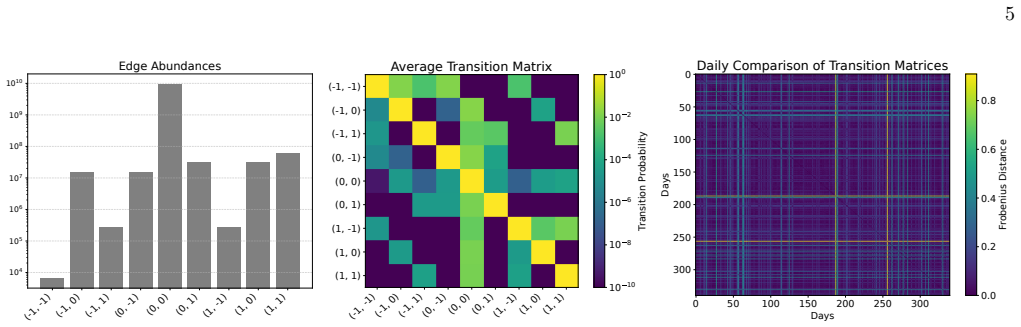
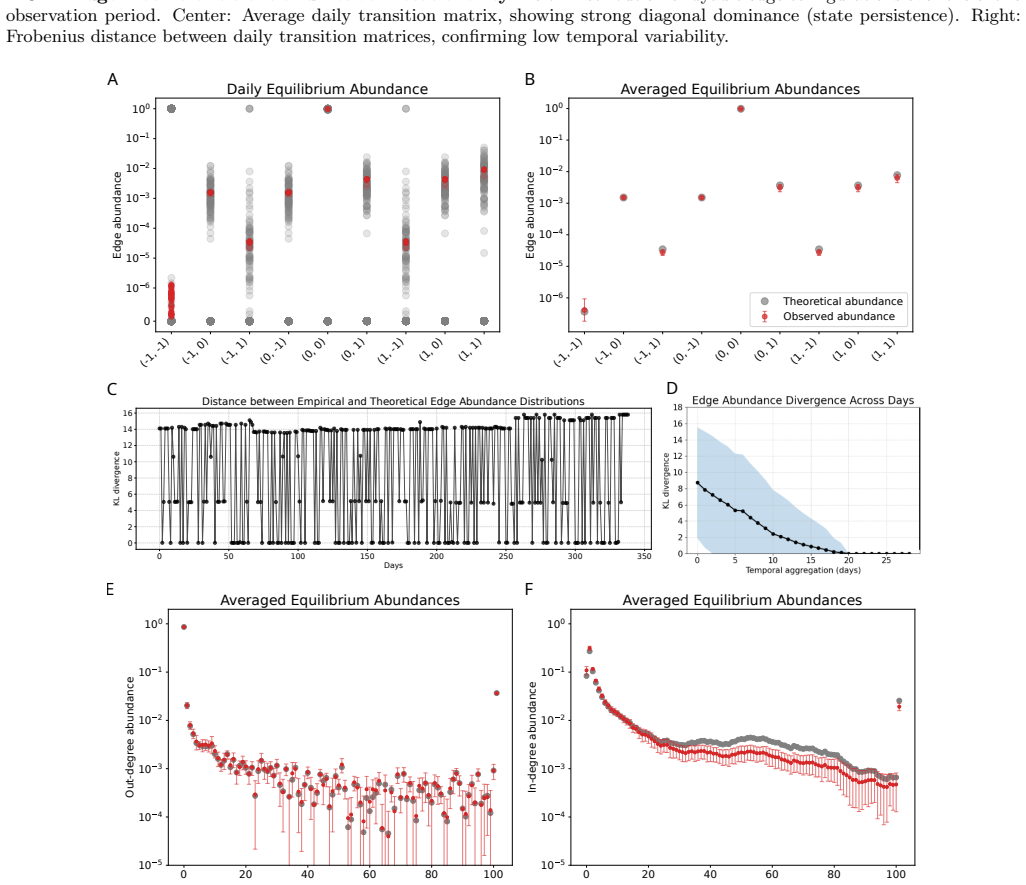
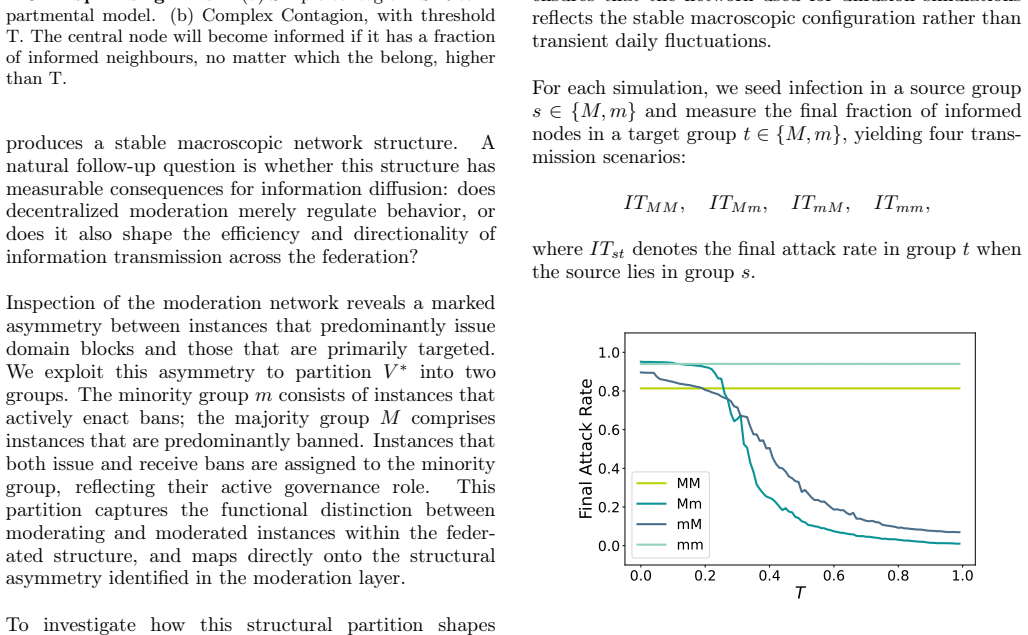
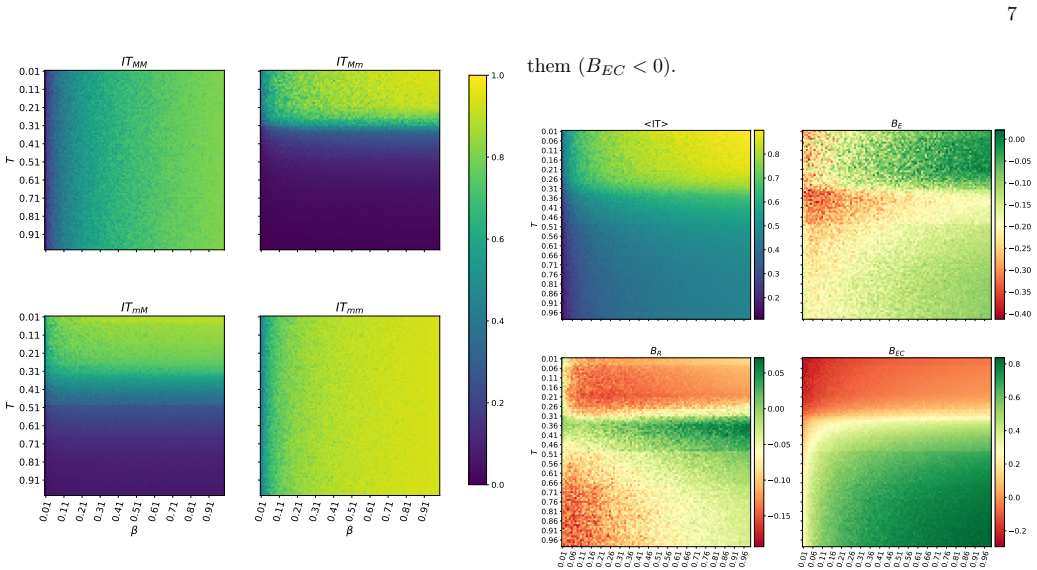
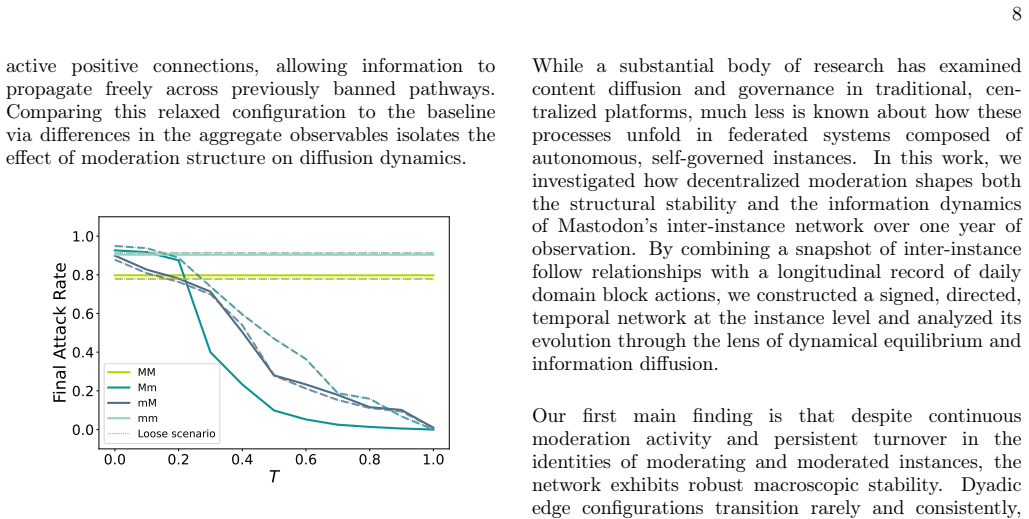
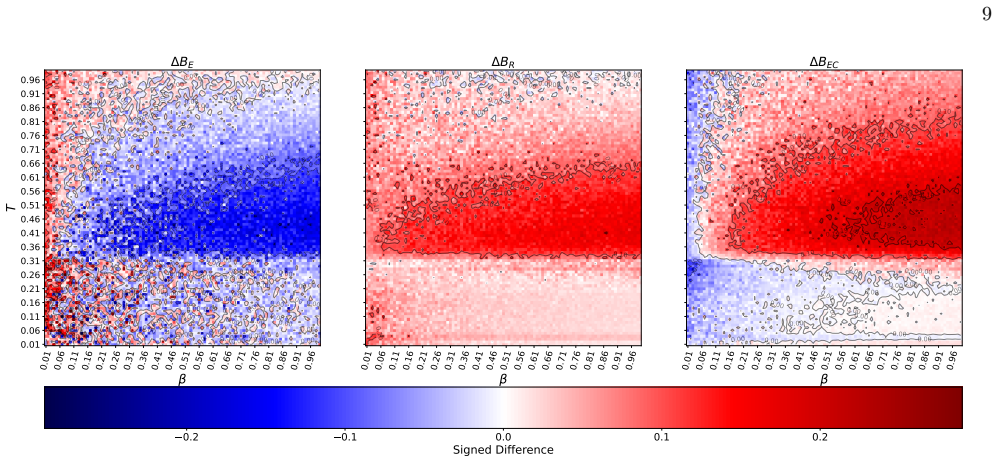
Despite continuous moderation activity and changing roles among instances, the Mastodon network exhibits strong structural stability: signed dyadic motifs and degree distributions display highly persistent dynamics, and aggregated transition matrices satisfy Markovian equilibrium conditions over intermediate time scales. Information originating in the minority of moderating instances spreads more efficiently, both internally and toward the majority, while the opposite direction is fragile and sensitive to contagion parameters. Echo-chamber effects emerge even in a globally balanced signed network and become stronger under stricter contagion conditions.
What carries the argument
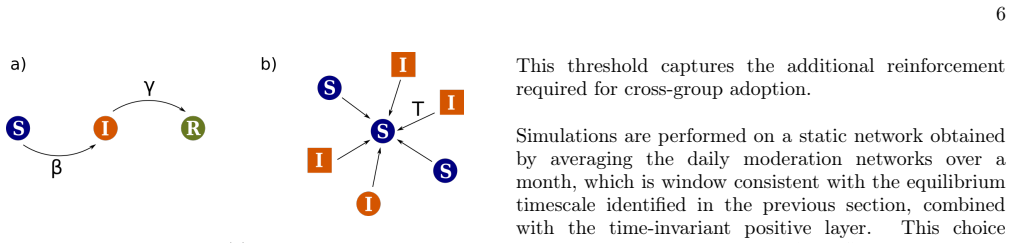
Signed directed temporal network (positive follow edges, negative block edges) analyzed with a hybrid contagion model that combines simple contagion within groups and complex contagion across groups.
If this is right
- The network maintains persistent signed motifs and degree distributions that satisfy Markovian equilibrium despite continuous blocks.
- Information from moderating instances reaches the majority more reliably than information traveling in the opposite direction.
- Echo-chamber effects form naturally from the signed structure and intensify when contagion rules become stricter.
- Local moderation decisions alone suffice to isolate norm-violating domains at the macroscopic scale.
Where Pith is reading between the lines
- The same stability mechanism could appear in other federated platforms that rely on independent server-level moderation.
- Direct measurement of actual information cascades on Mastodon would provide a concrete test of the hybrid contagion predictions.
- Further concentration of moderation power among a small set of instances might amplify the observed information asymmetry over time.
Load-bearing premise
The hybrid contagion model parameters and the mapping of blocks to negative edges accurately reflect real information diffusion and moderation effects on the platform.
What would settle it
Observing that information originating in predominantly banned instances spreads as efficiently or more efficiently than information from moderating instances, under the same hybrid contagion parameters, would falsify the reported asymmetry.
Figures
read the original abstract
Decentralized online social networks such as Mastodon distribute moderation power across thousands of independently governed servers, raising fundamental questions about how local block decisions shape global structure and information flow. In this paper, we analyze Mastodon at the instance level by constructing a signed, directed, temporal network in which positive edges aggregate inter-instance follow relationships and negative edges encode daily block actions. Using one year of data, we show that despite continuous moderation activity and changing roles among instances, the network exhibits strong structural stability: signed dyadic motifs and degree distributions display highly persistent dynamics, and aggregated transition matrices satisfy Markovian equilibrium conditions over intermediate time scales. Building on the marked asymmetry between instances that predominantly issue bans and those that are mostly banned, we then study information diffusion on the positive network via a hybrid contagion model that combines simple contagion within groups and complex contagion across groups. We find that information originating in the minority of moderating instances spreads more efficiently, both internally and toward the majority, while the opposite direction is fragile and sensitive to contagion parameters. Echo-chamber effects emerge even in a globally balanced signed network and become stronger under stricter contagion conditions. Together, these results show that decentralized moderation in Mastodon generates a stable macroscopic configuration that both structures and constrains information exchange, effectively isolating norm-violating domains without centralized control.
Editorial analysis
A structured set of objections, weighed in public.
Referee Report
Summary. The paper constructs a signed directed temporal network from one year of Mastodon instance-level data, with positive edges for follows and negative edges for daily blocks. It reports that signed dyadic motifs and degree distributions remain persistent despite ongoing moderation, that aggregated transition matrices satisfy Markov equilibrium over intermediate timescales, and that a hybrid contagion model (simple within groups, complex across) shows asymmetric diffusion efficiency favoring spread from the minority of moderating instances, producing echo-chamber effects that isolate norm-violating domains without centralized control.
Significance. If the modeling steps are validated, the work supplies concrete evidence that decentralized, instance-level moderation can induce stable macroscopic structure and directional constraints on information flow in a federated network, with direct relevance to robustness and governance questions in online social systems.
major comments (3)
- [Abstract / Methods] Abstract and Methods: the hybrid contagion model (simple within groups, complex across) is introduced without any reported calibration of its transmission probabilities or functional form against observed Mastodon diffusion traces such as boosts, mentions, or retweet cascades; the reported asymmetry in spread efficiency and the echo-chamber conclusion therefore rest on unvalidated parameter choices rather than on the observed network structure alone.
- [Abstract] Abstract: the claims of 'highly persistent dynamics' for signed motifs and degree distributions and that 'aggregated transition matrices satisfy Markovian equilibrium conditions' are stated without quantitative validation, error bars, or parameter-sensitivity results, leaving open whether these properties are robust or artifacts of the chosen aggregation windows.
- [Abstract] Abstract: the mapping of daily block actions to static negative edges is presented without discussion of temporal decay, threshold effects, or alternative encodings; if this mapping mis-specifies the functional impact of moderation on information flow, the central claim that decentralized blocks 'effectively isolate norm-violating domains' does not follow from the data.
Simulated Author's Rebuttal
We thank the referee for their constructive comments. We address each major point below and have revised the manuscript to strengthen validation, add quantitative support, and clarify modeling choices.
read point-by-point responses
-
Referee: [Abstract / Methods] Abstract and Methods: the hybrid contagion model (simple within groups, complex across) is introduced without any reported calibration of its transmission probabilities or functional form against observed Mastodon diffusion traces such as boosts, mentions, or retweet cascades; the reported asymmetry in spread efficiency and the echo-chamber conclusion therefore rest on unvalidated parameter choices rather than on the observed network structure alone.
Authors: The hybrid model is used to examine how the empirically measured network asymmetry (minority of moderating instances vs. majority) shapes diffusion under standard simple/complex contagion rules drawn from the literature. Instance-level data precludes direct calibration to individual cascades. In revision we add a full parameter-sensitivity section showing that the directional efficiency advantage for moderating instances and the echo-chamber pattern are robust across wide ranges of transmission probabilities and thresholds, indicating the result is driven by topology rather than specific parameter values. revision: yes
-
Referee: [Abstract] Abstract: the claims of 'highly persistent dynamics' for signed motifs and degree distributions and that 'aggregated transition matrices satisfy Markovian equilibrium conditions' are stated without quantitative validation, error bars, or parameter-sensitivity results, leaving open whether these properties are robust or artifacts of the chosen aggregation windows.
Authors: The results section already contains time-series statistics, autocorrelation measures, and stationarity tests supporting persistence and Markov equilibrium. We have revised the abstract to include concise quantitative indicators and added error bars plus aggregation-window sensitivity checks to the relevant figures and text. revision: yes
-
Referee: [Abstract] Abstract: the mapping of daily block actions to static negative edges is presented without discussion of temporal decay, threshold effects, or alternative encodings; if this mapping mis-specifies the functional impact of moderation on information flow, the central claim that decentralized blocks 'effectively isolate norm-violating domains' does not follow from the data.
Authors: We agree the encoding choice requires explicit justification. The revised Methods section now includes a dedicated subsection on negative-edge construction that discusses persistence (blocks remain active until lifted), tests exponential-decay and threshold alternatives, and reports that core structural and diffusion conclusions are insensitive to these variants. revision: yes
Circularity Check
No significant circularity detected
full rationale
The derivation proceeds by constructing an empirical signed network directly from observed follow and block data, computing structural statistics (motifs, degrees, transition matrices) on that network, and then running a hybrid contagion simulation whose outputs are model-dependent quantities on the fixed input graph. No equation or result is shown to equal its own input by construction, no parameter is fitted to a diffusion outcome and then relabeled as a prediction, and no load-bearing premise reduces to a self-citation. The reported asymmetries and echo-chamber effects are therefore simulation results rather than tautologies. This is the normal case of an empirical network study whose modeling assumptions can be critiqued on external grounds but do not collapse the claimed chain internally.
Axiom & Free-Parameter Ledger
Reference graph
Works this paper leans on
-
[1]
that can pose significant risks to public health or electoral integrity [6–8]. A wide range of harmful con- tent, including misinformation, harassment, hate speech, and coordinated manipulation, can spread rapidly across densely connected systems, often outpacing mechanisms designed to detect or counteract it [9–11]. Studies across multiple platforms have...
Pith/arXiv arXiv 2026
-
[2]
Three-body models have been frequently used (see e.g
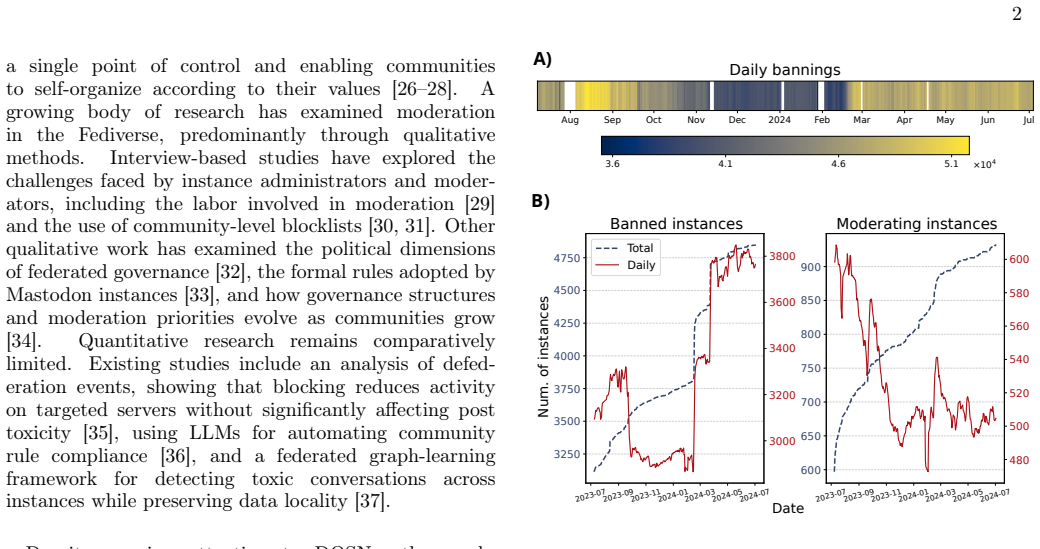
We record an average of approximately4.5×104 block actions per day, peaking at around5.2×10 4 in August 2023, dropping to a minimum of approximately3.6×104 during winter 2023–2024, and stabilizing near4.7×104 for the remainder of the period. A marked asymmetry characterizes the actors involved: on any given day, the number of distinct instances being targ...
-
[3]
D. Lazer, A. Pentland, L. Adamic, S. Aral, A.-L. Barabási, D. Brewer, N. Christakis, N. Contrac- tor, J. Fowler, M. Gutmann, T. Jebara, G. King, M. Macy, D. Roy, and M. V. Alstyne, Compu- tational social science, Science323, 721 (2009), https://www.science.org/doi/pdf/10.1126/science.1167742
-
[4]
Bakshy, I
E. Bakshy, I. Rosenn, C. Marlow, and L. Adamic, The role of social networks in information diffusion, inPro- ceedings of the 21st International Conference on World Wide Web, WWW ’12 (Association for Computing Ma- chinery, New York, NY, USA, 2012) p. 519–528
2012
-
[5]
F. Meng, J. Xie, J. Sun, C. Xu, Y. Zeng, X. Wang, T. Jia, S. Huang, Y. Deng, and Y. Hu, Spreading dynamics of information on online social networks, Proceedings of the National Academy of Sciences122, e2410227122 (2025), https://www.pnas.org/doi/pdf/10.1073/pnas.2410227122
-
[6]
Lorenz-Spreen, B
P. Lorenz-Spreen, B. M. Mønsted, P. Hövel, and S. Lehmann, Accelerating dynamics of collective atten- tion, Nature Communications10, 1759 (2019)
2019
-
[7]
Desiderio, L
A. Desiderio, L. M. Aiello, G. Cimini, and L. Alessan- dretti, The dynamics of the reddit collective action lead- ing to the gamestop short squeeze, npj Complexity2, 5 (2025)
2025
-
[8]
Gallotti, F
R. Gallotti, F. Valle, N. Castaldo, P. Sacco, and M. De Domenico, Assessing the risks of ‘infodemics’ in re- sponse to covid-19 epidemics, Nature Human Behaviour 4, 1285 (2020)
2020
-
[9]
Bovet and H
A. Bovet and H. A. Makse, Influence of fake news in twitter during the 2016 us presidential election, Nature Communications10, 7 (2019)
2016
-
[10]
N. Grinberg, K. Joseph, L. Friedland, B. Swire-Thompson, and D. Lazer, Fake news on twitter during the 2016 u.s. pres- idential election, Science363, 374 (2019), https://www.science.org/doi/pdf/10.1126/science.aau2706
-
[11]
D. M. J. Lazer, M. A. Baum, Y. Benkler, A. J. Berinsky, K. M. Greenhill, F. Menczer, M. J. Met- zger, B. Nyhan, G. Pennycook, D. Rothschild, M. Schudson, S. A. Sloman, C. R. Sunstein, E. A. Thorson, D. J. Watts, and J. L. Zittrain, The science of fake news, Science359, 1094 (2018), https://www.science.org/doi/pdf/10.1126/science.aao2998
-
[12]
Vosoughi, D
S. Vosoughi, D. Roy, and S. Aral, The spread of true and false news online, Science359, 1146 (2018)
2018
-
[13]
J. L. Juul and J. Ugander, Comparing in- formation diffusion mechanisms by matching on cascade size, Proceedings of the National Academy of Sciences118, e2100786118 (2021), https://www.pnas.org/doi/pdf/10.1073/pnas.2100786118
-
[14]
Del Vicario, G
M. Del Vicario, G. Vivaldo, A. Bessi, F. Zollo, A. Scala, and G. Caldarelli, Echo chambers: Emotional contagion and group polarization on facebook, Scientific Reports6, 37825 (2016)
2016
-
[15]
M. Cinelli, G. D. F. Morales, A. Galeazzi, W. Quat- trociocchi, and M. Starnini, The echo chamber ef- fect on social media, Proceedings of the National Academy of Sciences118, e2023301118 (2021), https://www.pnas.org/doi/pdf/10.1073/pnas.2023301118
-
[16]
Conover, J
M. Conover, J. Ratkiewicz, M. Francisco, B. Goncalves, F. Menczer, and A. Flammini, Political polarization on twitter, Proceedings of the International AAAI Confer- ence on Web and Social Media5, 89 (2021)
2021
-
[17]
S. Jhaver, C. Boylston, D. Yang, and A. Bruckman, Eval- uating the effectiveness of deplatforming as a moderation strategy on twitter, Proc. ACM Hum.-Comput. Interact. 5, 10.1145/3479525 (2021)
-
[18]
H. Innes and M. Innes, De-platforming disinforma- tion: conspiracy theories and their control, Infor- mation, Communication & Society26, 1262 (2023), https://doi.org/10.1080/1369118X.2021.1994631
-
[19]
R. Rogers, Deplatforming: Following extreme internet celebrities to telegram and alternative social media, European Journal of Communication35, 213 (2020), https://doi.org/10.1177/0267323120922066
-
[20]
D. R. Thomas and L. A. Wahedi, Disrupting hate: The effect of deplatforming hate organizations on their online audience, Proceedings of the National Academy of Sciences120, e2214080120 (2023), https://www.pnas.org/doi/pdf/10.1073/pnas.2214080120
-
[21]
S. Ali, M. H. Saeed, E. Aldreabi, J. Blackburn, E.DeCristofaro, S.Zannettou,andG.Stringhini,Under- standing the effect of deplatforming on social networks, inProceedings of the 13th ACM Web Science Conference 2021,WebSci’21(AssociationforComputingMachinery, New York, NY, USA, 2021) p. 187–195
2021
-
[22]
Horta Ribeiro, H
M. Horta Ribeiro, H. Hosseinmardi, R. West, and D. J. Watts, Deplatforming did not decrease parler users’ ac- tivity on fringe social media, PNAS Nexus2, pgad035 (2023)
2023
-
[23]
A. Mekacher, M. Falkenberg, and A. Baronchelli, The systemic impact of deplatforming on social media, PNAS Nexus2, 10.1093/pnasnexus/pgad346 (2023)
-
[24]
La Cava, S
L. La Cava, S. Greco, and A. Tagarelli, Understanding the growth of the fediverse through the lens of mastodon, Applied Network Science6, 64 (2021)
2021
-
[25]
Brauweiler, M
M. Brauweiler, M. C. Pindiprolu, J. Pfeffer, and U. Bran- des, Decentralized discourse: Interaction dynamics on mastodon, inProceedings of the 17th ACM Web Science Conference 2025, Websci ’25 (Association for Computing Machinery, New York, NY, USA, 2025) p. 358–368
2025
-
[26]
E. Sabo, T. Gesthuizen, K. J. A. Bouma, D. Karastoy- anova, and M. Riveni, An analysis of mastodon adoption dynamics based on instance types, Social Network Anal- ysis and Mining14, 184 (2024)
2024
-
[27]
A. Z. Rozenshtein, Moderating the fediverse: Content moderation on distributed social media, Journal of Free Speech Law3, 217 (2023)
2023
-
[28]
I. H. Anaobi, A. Raman, I. Castro, H. B. Zia, D. Ibosiola, and G. Tyson, Will admins cope? decentralized moder- ation in the fediverse, inProceedings of the ACM Web Conference 2023, WWW ’23 (Association for Comput- ing Machinery, New York, NY, USA, 2023) p. 3109–3120
2023
-
[29]
Surve, A
A. Surve, A. Shamraj, and S. Mehta,How Decentraliza- tion Affects User Agency on Social Platforms(ICWSM, 2024)
2024
-
[30]
C. A. Bono, L. La Cava, L. Luceri, and F. Pierri, An exploration of decentralized moderation on mastodon, inProceedings of the 16th ACM Web Science Confer- ence, WEBSCI ’24 (Association for Computing Machin- ery, New York, NY, USA, 2024) p. 53–58
2024
-
[31]
C. Spencer-Smith and T. Tomaz, Labour pains: Content moderation challenges in mastodon growth, Internet Pol- 11 icy Review14, 10.14763/2025.1.1831 (2025)
-
[32]
E. Melder, A. Lerner, and M. A. DeVito, "a blocklist is a boundary": Tensions between community protection and mutual aid on federated social networks, Proc. ACM um.-Comput. Interact.9, 10.1145/3710919 (2025)
-
[33]
O. X. Zhang, S. Hwang, Y. Liu, M. Horta Ribeiro, and A. Monroy-Hernández, Understanding community-level blocklists in decentralized social media, arXiv preprint arXiv:2506.05522 (2025), arXiv:2506.05522 [cs.SI]
arXiv 2025
-
[34]
R. W. Gehl and D. Zulli, The digital covenant: non-centralized platform governance on the mastodon social network, Information, Com- munication & Society26, 3275 (2023), https://doi.org/10.1080/1369118X.2022.2147400
-
[35]
M. N. Nicholson, B. C. Keegan, and C. Fiesler, Mastodon rules: Characterizing formal rules on popular mastodon instances, inCompanion Publication of the 2023 Confer- ence on Computer Supported Cooperative Work and So- cial Computing (CSCW ’23 Companion)(Association for Computing Machinery, New York, NY, USA, 2023) pp. 86–90
2023
-
[36]
Federating Governance: How Community Rules Scale with Mastodon Instances
R. Muralidharan, Y.-Y. Ahn, and B. T. Truong, Fed- erating governance: How community rules scale with mastodon instances, arXiv preprint arXiv:2606.05069 10.48550/arXiv.2606.05069 (2026), accepted to CSCW 2026, Salt Lake City, Utah, USA, arXiv:2606.05069 [cs.SI]
work page internal anchor Pith review Pith/arXiv arXiv doi:10.48550/arxiv.2606.05069 2026
-
[37]
C. Colglazier, N. TeBlunthuis, and A. Shaw, The effects of group sanctions on participation and toxicity: Quasi- experimental evidence from the fediverse, arXiv preprint arXiv:2404.02109 (2024), arXiv:2404.02109 [cs.SI]
arXiv 2024
-
[38]
La Cava and A
L. La Cava and A. Tagarelli, Safeguarding decentralized social media: LLM agents for automating community rule compliance, Online Soc. Networks Media48, 100319 (2025)
2025
-
[39]
DeTox-Fed: Detecting Toxic Conversations in the Fediverse with Federated Graph Neural Networks
P. Leonidou, N. Salamanos, S. Gypsiotis, and M. Siri- vianos, Detox-fed: Detecting toxic conversations in the fediverse with federated graph neural networks, arXiv preprint arXiv:2605.21054 10.48550/arXiv.2605.21054 (2026), arXiv:2605.21054 [cs.SI]
work page internal anchor Pith review Pith/arXiv arXiv doi:10.48550/arxiv.2605.21054 2026
-
[40]
M. A. González-Casado, A. S. Teixeira, and A. Sánchez, Evidence of equilibrium dynamics in human social net- works evolving in time, Communications Physics8, 227 (2025)
2025
-
[41]
Leskovec, L
J. Leskovec, L. Backstrom, R. Kumar, and A. Tomkins, Microscopic evolution of social networks, inProceedings of the 14th ACM SIGKDD International Conference on Knowledge Discovery and Data Mining, KDD ’08 (Asso- ciation for Computing Machinery, New York, NY, USA,
-
[42]
Gaito, M
S. Gaito, M. Zignani, G. P. Rossi, A. Sala, X. Zhao, H. Zheng, and B. Y. Zhao, On the bursty evolution of on- line social networks, inProceedings of the First ACM In- ternational Workshop on Hot Topics on Interdisciplinary Social Networks Research, HotSocial ’12 (Association for Computing Machinery, New York, NY, USA, 2012) p. 1–8
2012
-
[43]
Vendeville and F
A. Vendeville and F. Diaz-Diaz, Modeling echo cham- ber effects in signed networks, Phys. Rev. E111, 024302 (2025)
2025
-
[44]
D. Centola, The spread of behavior in an online social network experiment, Science329, 1194 (2010), https://www.science.org/doi/pdf/10.1126/science.1185231
-
[45]
Diaz-Diaz, M
F. Diaz-Diaz, M. San Miguel, and S. Meloni, Echo cham- bers and information transmission biases in homophilic and heterophilic networks, Scientific Reports12, 9350 (2022)
2022
discussion (0)
Sign in with ORCID, Apple, or X to comment. Anyone can read and Pith papers without signing in.