Riemannian Penrose Inequality for Manifolds with Corners via Non-Linear Potential Theory
Pith reviewed 2026-06-26 02:33 UTC · model grok-4.3
The pith
A direct proof establishes both the positive mass theorem and Riemannian Penrose inequality for three-dimensional asymptotically flat manifolds whose metrics fail to be C1 across a hypersurface.
A machine-rendered reading of the paper's core claim, the machinery that carries it, and where it could break.
Core claim
By establishing an approximate monotonicity for the quantity introduced by Agostiniani-Mantegazza-Mazzieri-Oronzio and applying Miao's approximation scheme to metrics of class C^{2,α} up to the hypersurface Σ, both the positive mass theorem and the Riemannian Penrose inequality are recovered directly for three-dimensional asymptotically flat manifolds with corners.
What carries the argument
Approximate monotonicity of the AMMO quantity under Miao's approximation scheme applied to C^{2,α} metrics up to the corner hypersurface.
If this is right
- The positive mass theorem holds for asymptotically flat 3-manifolds whose metric is C^{2,α} up to a corner hypersurface.
- The Riemannian Penrose inequality holds for the same class of manifolds.
- Both results follow from a single monotonicity argument rather than separate reductions to the smooth case.
- The method applies whenever the metric satisfies the stated regularity up to Σ.
Where Pith is reading between the lines
- The same approximation technique could be tested on other monotonicity quantities that appear in general-relativity inequalities with low regularity.
- Numerical codes that evolve initial data containing corners could monitor the approximate monotonicity as a diagnostic for code accuracy.
- If the monotonicity survives further weakening of regularity, the results might extend to metrics that are only Lipschitz across Σ.
Load-bearing premise
The approximate monotonicity of the chosen quantity must continue to hold when the metric is merely C^{2,α} across the hypersurface rather than smoother.
What would settle it
Construct or numerically approximate a three-dimensional asymptotically flat manifold with a C^{2,α} corner hypersurface whose total mass is negative or whose horizon area violates the Penrose bound while satisfying the dominant energy condition away from the corner.
Figures
read the original abstract
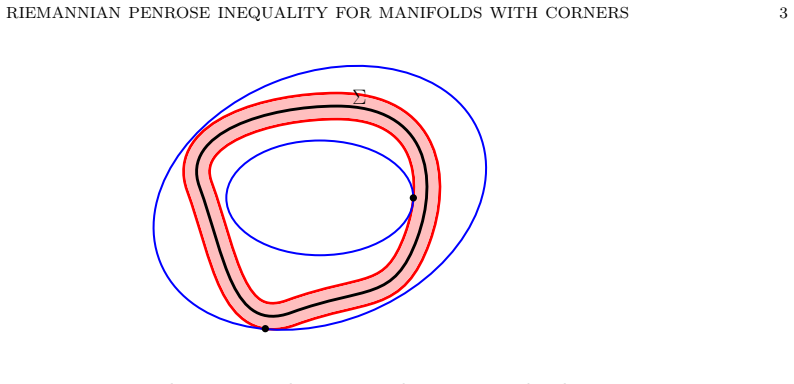
We present a new proof of the Positive Mass Theorem and the Riemannian Penrose Inequality for three-dimensional asymptotically flat Riemannian manifolds whose metrics fail to be $C^1$ across a hypersurface $\Sigma$, first proven by Miao and McCormick-Miao, respectively. Unlike these approaches, ours recovers these results directly, without relying on their original formulations for smooth metrics. The proofs are based on a unified argument which applies to both theorems. We achieve this by establishing an approximate monotonicity for the quantity introduced by Agostiniani-Mantegazza-Mazzieri-Oronzio, employing the approximation scheme of Miao, for metrics with $C^{2,\alpha}$ regularity up to $\Sigma$.
Editorial analysis
A structured set of objections, weighed in public.
Referee Report
Summary. The paper claims a new direct proof of the Positive Mass Theorem and the Riemannian Penrose Inequality for 3-dimensional asymptotically flat Riemannian manifolds whose metrics are not C¹ across a hypersurface Σ (first proven by Miao and McCormick-Miao). The unified argument establishes approximate monotonicity of the AMMO quantity (Agostiniani-Mantegazza-Mazzieri-Oronzio) via Miao's approximation scheme, for metrics with C^{2,α} regularity up to Σ, without reducing to the smooth-metric case.
Significance. If the error control in the approximate monotonicity is rigorous, the result offers a unified treatment of both theorems for manifolds with corners using non-linear potential theory; this is a methodological strength relative to prior reductions to smooth metrics. The approach is internally consistent with standard approximation techniques in geometric inequalities.
minor comments (2)
- The introduction could include a brief comparison table or paragraph contrasting the new direct argument with the original Miao/McCormick-Miao reductions, to clarify the novelty for readers.
- Notation for the approximation parameter (e.g., ε) and the precise statement of the C^{2,α} regularity up to Σ should be fixed consistently between the abstract and §2.
Simulated Author's Rebuttal
We thank the referee for their positive summary, significance assessment, and recommendation of minor revision. No specific major comments were raised in the report.
Circularity Check
No significant circularity; derivation relies on external approximation and prior independent quantity
full rationale
The paper's central argument establishes approximate monotonicity of the AMMO quantity (introduced in prior work by overlapping authors) via Miao's external approximation scheme for C^{2,α} metrics. No equations or steps in the provided abstract or description reduce the target theorems to a self-definition, fitted input renamed as prediction, or load-bearing self-citation chain. The cited quantity and scheme are treated as independent inputs, with the new contribution being their application to the corner case without relying on smooth-metric formulations. This is self-contained against external benchmarks and does not exhibit any of the enumerated circularity patterns.
Axiom & Free-Parameter Ledger
Reference graph
Works this paper leans on
-
[1]
A new proof of the Riemannian Penrose inequality
V. Agostiniani, C. Mantegazza, L. Mazzieri, and F. Oronzio. “A new proof of the Riemannian Penrose inequality”. In:Atti Accad. Naz. Lincei Rend. Lincei Mat. Appl.34.3 (2023), pp. 715– 726.issn: 1120-6330,1720-0768.doi:10.4171/rlm/1024.url:https://doi.org/10.4171/ rlm/1024
work page doi:10.4171/rlm/1024.url:https://doi.org/10.4171/ 2023
-
[2]
V. Agostiniani, L. Mazzieri, and F. Oronzio.A Green’s Function Proof of the Positive Mass Theorem. 2024.doi:10.48550/arXiv.2108.08402. arXiv:2108.08402
-
[3]
Nonlinear isocapacitary concepts of mass in 3- manifolds with nonnegative scalar curvature
L. Benatti, M. Fogagnolo, and L. Mazzieri. “Nonlinear isocapacitary concepts of mass in 3- manifolds with nonnegative scalar curvature”. In:SIGMA Symmetry Integrability Geom. Meth- ods Appl.19 (2023), Paper No. 091, 29.issn: 1815-0659.doi:10.3842/SIGMA.2023.091.url: https://doi.org/10.3842/SIGMA.2023.091
-
[4]
Minkowski inequality on complete Riemannian manifolds with nonnegative Ricci curvature
L. Benatti, M. Fogagnolo, and L. Mazzieri. “Minkowski inequality on complete Riemannian manifolds with nonnegative Ricci curvature”. In:Anal. PDE17.9 (2024), pp. 3039–3077.issn: 2157-5045,1948-206X.doi:10.2140/apde.2024.17.3039.url:https://doi.org/10.2140/ apde.2024.17.3039
work page doi:10.2140/apde.2024.17.3039.url:https://doi.org/10.2140/ 2024
-
[5]
On the isoperimetric Riemannian Penrose inequal- ity
L. Benatti, M. Fogagnolo, and L. Mazzieri. “On the isoperimetric Riemannian Penrose inequal- ity”. In:Comm. Pure Appl. Math.78.5 (2025), pp. 1042–1085.issn: 0010-3640,1097-0312.doi: 10.1002/cpa.22239.url:https://doi.org/10.1002/cpa.22239
work page doi:10.1002/cpa.22239.url:https://doi.org/10.1002/cpa.22239 2025
-
[6]
Stability of a shell around a black hole
P. R. Brady, J. Louko, and E. Poisson. “Stability of a shell around a black hole”. In:Phys. Rev. D (3)44.6 (1991), pp. 1891–1894.issn: 0556-2821.doi:10.1103/PhysRevD.44.1891. url:https://doi.org/10.1103/PhysRevD.44.1891
-
[7]
Harmonic functions and the mass of 3-dimensional asymptotically flat Riemannian manifolds
H. L. Bray, D. P. Kazaras, M. A. Khuri, and D. L. Stern. “Harmonic functions and the mass of 3-dimensional asymptotically flat Riemannian manifolds”. In:J. Geom. Anal.32.6 (2022), Paper No. 184, 29.issn: 1050-6926,1559-002X.doi:10.1007/s12220- 022- 00924- 0.url: https://doi.org/10.1007/s12220-022-00924-0
-
[8]
C1+α local regularity of weak solutions of degenerate elliptic equations
E. DiBenedetto. “C1+α local regularity of weak solutions of degenerate elliptic equations”. In: Nonlinear Anal.7.8 (1983), pp. 827–850.issn: 0362-546X,1873-5215.doi:10 . 1016 / 0362 - 546X(83)90061-5.url:https://doi.org/10.1016/0362-546X(83)90061-5
-
[9]
Strings and other distributional sources in general relativity
R. Geroch and J. Traschen. “Strings and other distributional sources in general relativity”. In: Phys. Rev. D (3)36.4 (1987), pp. 1017–1031.issn: 0556-2821.doi:10.1103/PhysRevD.36. 1017.url:https://doi.org/10.1103/PhysRevD.36.1017
-
[10]
D. Gilbarg and N. S. Trudinger.Elliptic partial differential equations of second order. Sec- ond. Vol. 224. Grundlehren der mathematischen Wissenschaften [Fundamental Principles of Mathematical Sciences]. Springer-Verlag, Berlin, 1983, pp. xiii+513.isbn: 3-540-13025-X.doi: 10.1007/978-3-642-61798-0.url:https://doi.org/10.1007/978-3-642-61798-0
work page doi:10.1007/978-3-642-61798-0.url:https://doi.org/10.1007/978-3-642-61798-0 1983
-
[11]
Heinonen, T
J. Heinonen, T. Kilpeläinen, and O. Martio.Nonlinear potential theory of degenerate elliptic equations. Oxford Mathematical Monographs. Oxford Science Publications. The Clarendon Press, Oxford University Press, New York, 1993, pp. vi+363.isbn: 0-19-853669-0
1993
-
[12]
The inverse mean curvature flow and the Riemannian Penrose inequality
G. Huisken and T. Ilmanen. “The inverse mean curvature flow and the Riemannian Penrose inequality”. In:J. Differential Geom.59.3 (2001), pp. 353–437.issn: 0022-040X,1945-743X. url:http://projecteuclid.org/euclid.jdg/1090349447
arXiv 2001
-
[13]
Singular hypersurfaces and thin shells in general relativity
W. Israel. “Singular hypersurfaces and thin shells in general relativity”. In:Il Nuovo Cimento B (1965-1970)44.1 (1966), pp. 1–14
1965
-
[14]
The positive mass theorem for manifolds with distributional curvature
D. A. Lee and P. G. LeFloch. “The positive mass theorem for manifolds with distributional curvature”. In:Comm. Math. Phys.339.1 (2015), pp. 99–120.issn: 0010-3616,1432-0916.doi: 10.1007/s00220-015-2414-9.url:https://doi.org/10.1007/s00220-015-2414-9. 22 REFERENCES
work page doi:10.1007/s00220-015-2414-9.url:https://doi.org/10.1007/s00220-015-2414-9 2015
-
[15]
Symmetric Green’s functions on complete manifolds
P. Li and L.-F. Tam. “Symmetric Green’s functions on complete manifolds”. In:Amer. J. Math.109.6 (1987), pp. 1129–1154.issn: 0002-9327,1080-6377.doi:10.2307/2374588.url: https://doi.org/10.2307/2374588
-
[16]
The positive mass theorem for non-spin manifolds with distributional curvature
Y. Li. “The positive mass theorem for non-spin manifolds with distributional curvature”. In: Ann. Henri Poincaré21.6 (2020), pp. 2093–2114.issn: 1424-0637,1424-0661.doi:10.1007/ s00023-020-00915-3.url:https://doi.org/10.1007/s00023-020-00915-3
-
[17]
Lindqvist.Notes on thep-Laplace Equation
P. Lindqvist.Notes on thep-Laplace Equation. 161. University of Jyväskylä, 2017
2017
-
[18]
Rigidity of Riemannian Penrose inequality with corners and its impli- cations
S. Lu and P. Miao. “Rigidity of Riemannian Penrose inequality with corners and its impli- cations”. In:J. Funct. Anal.281.10 (2021), Paper No. 109231, 11.issn: 0022-1236,1096-0783. doi:10.1016/j.jfa.2021.109231.url:https://doi.org/10.1016/j.jfa.2021.109231
work page doi:10.1016/j.jfa.2021.109231.url:https://doi.org/10.1016/j.jfa.2021.109231 2021
-
[19]
L. Mazurowski and X. Yao.A Positive Mass Theorem for Continuous Metrics. 2026. arXiv: 2606.19123 [math.DG].url:https://arxiv.org/abs/2606.19123
Pith/arXiv arXiv 2026
-
[20]
On a Penrose-like inequality in dimensions less than eight
S. McCormick and P. Miao. “On a Penrose-like inequality in dimensions less than eight”. In:Int. Math. Res. Not. IMRN7 (2019), pp. 2069–2084.issn: 1073-7928,1687-0247.doi: 10.1093/imrn/rnx181.url:https://doi.org/10.1093/imrn/rnx181
work page doi:10.1093/imrn/rnx181.url:https://doi.org/10.1093/imrn/rnx181 2019
-
[21]
On the positive mass theorem for manifolds with corners
D. McFeron and G. Székelyhidi. “On the positive mass theorem for manifolds with corners”. In:Comm. Math. Phys.313.2 (2012), pp. 425–443.issn: 0010-3616,1432-0916.doi:10.1007/ s00220-012-1498-8.url:https://doi.org/10.1007/s00220-012-1498-8
-
[22]
Positive mass theorem on manifolds admitting corners along a hypersurface
P. Miao. “Positive mass theorem on manifolds admitting corners along a hypersurface”. In: Adv. Theor. Math. Phys.6.6 (2002), 1163–1182 (2003).issn: 1095-0761,1095-0753.doi:10. 4310/ATMP.2002.v6.n6.a4.url:https://doi.org/10.4310/ATMP.2002.v6.n6.a4
-
[23]
P. Miao. “On a localized Riemannian Penrose inequality”. In:Comm. Math. Phys.292.1 (2009), pp. 271–284.issn: 0010-3616,1432-0916.doi:10.1007/s00220- 009- 0834- 0.url:https: //doi.org/10.1007/s00220-009-0834-0
-
[24]
On the proof of the positive mass conjecture in general relativity
R. Schoen and S. T. Yau. “On the proof of the positive mass conjecture in general relativity”. In:Comm. Math. Phys.65.1 (1979), pp. 45–76.issn: 0010-3616,1432-0916.url:http : / / projecteuclid.org/euclid.cmp/1103904790
arXiv 1979
-
[25]
On the rigidity of Riemannian-Penrose inequality for asymp- totically flat 3-manifolds with corners
Y. Shi, W. Wang, and H. Yu. “On the rigidity of Riemannian-Penrose inequality for asymp- totically flat 3-manifolds with corners”. In:Math. Z.291.1-2 (2019), pp. 569–589.issn: 0025- 5874,1432-1823.doi:10 . 1007 / s00209 - 018 - 2095 - 0.url:https : / / doi . org / 10 . 1007 / s00209-018-2095-0
2019
-
[26]
Space-times with distribution-valued curvature tensors
A. H. Taub. “Space-times with distribution-valued curvature tensors”. In:J. Math. Phys.21.6 (1980), pp. 1423–1431.issn: 0022-2488,1089-7658.doi:10 . 1063 / 1 . 524568.url:https : //doi.org/10.1063/1.524568
-
[27]
A new proof of the positive energy theorem
E. Witten. “A new proof of the positive energy theorem”. In:Comm. Math. Phys.80.3 (1981), pp. 381–402.issn: 0010-3616,1432-0916.url:http : / / projecteuclid . org / euclid . cmp / 1103919981. Università degli Studi di Trento Email address:virginia.agostiniani@unitn.it Università degli Studi di Trento Email address:christina.karapiperi@unitn.it Università ...
1981
discussion (0)
Sign in with ORCID, Apple, or X to comment. Anyone can read and Pith papers without signing in.