Quasi-Feynman formulas that provide fast converging Chernoff approximations to solution of parabolic differential equation on the real line
Reviewed by Pith T0 review T1 audit T2 compute T3 formal T4 kernel 2026-06-26 03:25 UTCgrok-4.3pith:RM42FTQ3record.jsonopen to challenge →
The pith
Chernoff approximations using quasi-Feynman formulas converge uniformly at quadratic rate for parabolic PDEs on the real line.
A machine-rendered reading of the paper's core claim, the machinery that carries it, and where it could break.
Core claim
The central claim is that a new operator-valued function defined by proper Riemann integrals over a bounded interval, when inserted into Chernoff's product formula, generates quasi-Feynman formulas whose iterates converge uniformly to the PDE solution at quadratic order in the time step whenever the data and coefficients are sufficiently smooth.
What carries the argument
A new operator-valued function defined through proper Riemann integrals over a bounded interval, inserted into Chernoff's product formula to generate the sequence of approximations.
If this is right
- The approximations can be evaluated by repeated application of bounded integrals without spatial discretization.
- The error bound improves from order one to order two in the time step under the stated smoothness conditions.
- The same construction supplies an explicit analytic representation that is neither grid-based nor projection-based.
- The method extends the range of Chernoff formulas that remain practical for variable-coefficient parabolic problems on unbounded domains.
Where Pith is reading between the lines
- The integral construction might be adapted to higher-dimensional domains by replacing the one-dimensional Riemann integral with a suitable multi-dimensional analogue.
- Quadratic convergence would reduce the number of product-formula steps needed to reach a target accuracy compared with standard first-order Chernoff schemes.
- The approach could be tested on related evolution equations whose generators admit similar bounded-integral representations.
Load-bearing premise
The initial data and coefficients are sufficiently smooth.
What would settle it
A concrete counter-example or numerical run in which the observed uniform error for a smooth initial datum and coefficient decays only linearly with the time step would falsify the quadratic-rate claim.
Figures


read the original abstract
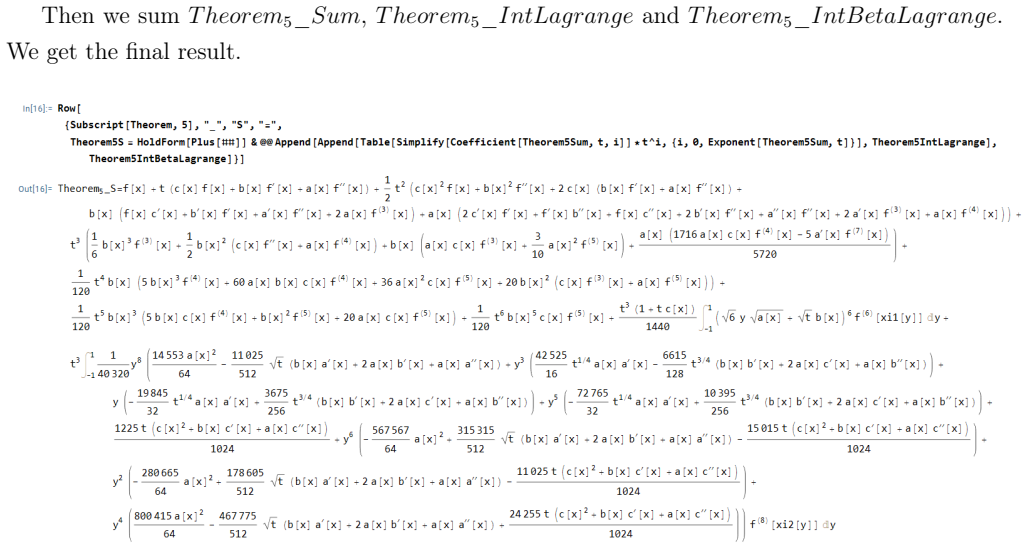
We construct explicit approximations to the solution of a second-order parabolic partial differential equation on the real line with variable coefficients. The method is based on Chernoff's product formula and uses a new operator-valued function defined through proper Riemann integrals over a bounded interval, which makes the approach readily usable in numerical practice. For sufficiently smooth initial data and coefficients, we prove that the resulting Chernoff approximations converge uniformly in space and time with a quadratic rate, improving the standard first-order estimate. The construction yields a new class of quasi-Feynman formulas that are neither grid-based nor Galerkin-type, but instead rely on semigroup theory and multiple bounded integrals. The theoretical findings are validated by symbolic computation, and the paper contributes both refined error bounds and a practical analytical tool for parabolic problems.
Editorial analysis
A structured set of objections, weighed in public.
Referee Report
Summary. The manuscript constructs explicit approximations to solutions of second-order parabolic PDEs on the real line with variable coefficients via Chernoff's product formula. It introduces a new operator-valued function defined through proper Riemann integrals over a bounded interval and proves that, for sufficiently smooth initial data and coefficients, the resulting approximations converge uniformly in space and time at a quadratic rate (improving the standard first-order Chernoff estimate). The construction yields a class of quasi-Feynman formulas relying on semigroup theory and multiple bounded integrals; results are validated by symbolic computation.
Significance. If the quadratic convergence holds, the work supplies refined error bounds and a practical, non-grid, non-Galerkin analytical tool for parabolic problems. The explicit use of bounded Riemann integrals and the validation by symbolic computation are concrete strengths that enhance usability and verifiability.
minor comments (2)
- [Abstract] The abstract states that the approximations 'converge uniformly in space and time with a quadratic rate' but does not indicate the precise function spaces or the dependence of the constant on the smoothness parameters; a brief clarification in the introduction or §2 would help readers locate the exact statement of the main theorem.
- [§3] The description of the new operator-valued function via 'proper Riemann integrals over a bounded interval' is central to the construction; ensure that the definition (likely in §3) explicitly states the integrability conditions on the coefficients so that the operator is well-defined for the claimed class of variable-coefficient problems.
Simulated Author's Rebuttal
We thank the referee for the positive summary, significance assessment, and recommendation of minor revision. No major comments were listed in the report.
Circularity Check
No significant circularity
full rationale
The derivation rests on Chernoff's product formula (standard semigroup theory) to construct explicit operator approximations via Riemann integrals, then proves uniform quadratic convergence under an explicit smoothness hypothesis on initial data and coefficients. No equation reduces to its own input by definition, no parameter is fitted then relabeled as a prediction, and no load-bearing step depends on a self-citation chain. The result is a standard error analysis that remains independent of the target claim.
Axiom & Free-Parameter Ledger
axioms (1)
- domain assumption Chernoff's product formula applies to the semigroup generated by the second-order differential operator with variable coefficients
invented entities (1)
-
new operator-valued function defined through proper Riemann integrals over a bounded interval
no independent evidence
Reference graph
Works this paper leans on
-
[1]
C. Batty, A. Gomilko, Yu. Tomilov. A Besov algebra calculus for generators of operator semigroups and related norm-estimates. // Mathematische Annalen (2019) online open access paper https://doi.org/10.1007/s00208-019-01924-2
-
[2]
Bogachev, O.G
V.I. Bogachev, O.G. Smolyanov O.G. Real and Functional Analysis. — Springer. 2020. 586 p
2020
-
[3]
Ya.A. Butko. The Method of Chernoff Approximation. // In: Banasiak J., Bobrowski A., Lachowicz M., Tomilov Y. (eds) Semigroups of Operators — Theory and Applications. SOTA
-
[4]
Springer Proceedings in Mathematics and Statistics. 2020. V. 325. P. 19-46
2020
-
[5]
Butko, M
Ya.A. Butko, M. Grothaus, O.G. Smolyanov. Lagrangian Feynman formulas for second-order parabolic equations in bounded and unbounded domains. // Infinite Dimensional Analyasis, Quantum Probability and Related Topics, vol. 13, No. 3 (2010), 377-392
2010
-
[6]
Chernoff
Paul R. Chernoff. Note on product formulas for operator semigroups. // J. Functional Analysis 2:2 (1968), 238-242
1968
-
[7]
K. A. Dragunova, N. Nikbakht, I. D. Remizov. Numerical Study of the Rate of Convergence of Chernoff Approximations to Solutions of the Heat Equation.// Zhurnal Srednevolzhskogo matematicheskogo obshchestva. 25:4(2023), 255-272
2023
-
[8]
K. A. Katalova (Dragunova), N. Nikbakht, and I. D. Remizov. Concrete examples of the rate of convergence of Chernoff approximations: numerical results for the heat semigroup and open questions on them with full list of illustrations and Python source code.arXiv:2301.05284 [math.NA, math.FA], 2023. 28
-
[9]
One-Parameter Semigroups for Linear Evolution Equations
Engel K.-J., Nagel R. One-Parameter Semigroups for Linear Evolution Equations. — Springer- Verlag. New York. 2000. 609 p
2000
-
[10]
Evans, J
G. Evans, J. Blackledge, P. Yardley. Numerical Methods for Partial Differential Equations. — Springer, 2000
2000
-
[11]
O.E. Galkin, I.D. Remizov. Upper and lower estimates for rate of convergence in the Chernoff product formula for semigroups of operators. // arXiv:2104.01249v2 (2021)
-
[12]
Galkin, I.D
O.E. Galkin, I.D. Remizov. Upper and lower estimates for rate of convergence in the Chernoff product formula for semigroups of operators. // Isr. J. Math. 265, 929-943 (2025)
2025
-
[13]
O.E.Galkin, I.D.Remizov.SpeedofconvergenceofChernoffapproximationstoC 0-semigroups of operators.// Mathematical Notes, Vol. 111, No. 2, pp. 137-139 (2022)
2022
-
[14]
A general approach to approximation theory of operator semigroups// Journal de Math´ ematiques Pures et Appliqu´ ees 127 (2019) 216-267
A.Gomilko, S.Kosowicz, Yu.Tomilov. A general approach to approximation theory of operator semigroups// Journal de Math´ ematiques Pures et Appliqu´ ees 127 (2019) 216-267
2019
-
[15]
Gomilko, Yu
A. Gomilko, Yu. Tomilov. On convergence rates in approximation theory for operator semi- groups. //Journal of Functional Analysis 266:5 (2014), 3040-3082
2014
-
[16]
Hille, R.S
E. Hille, R.S. Phillips. Functional Analysis and Semi-groups. — American Mathematical So- ciety. 1996. 819 p
1996
-
[17]
Mazumder
S. Mazumder. Numerical Methods for Partial Differential Equations. Finite Difference and Finite Volume Methods. // Academic Press, 2016
2016
-
[18]
Zagrebnov
Hagen Neidhardt, Artur Stephan and Valentin A. Zagrebnov. Remarks on the operator-norm convergence of the Trotter product formula. // Integral Equations and Operator Theory, 90:15 (2018)
2018
-
[19]
Zagrebnov
Hagen Neidhardt, Artur Stephan, Valentin A. Zagrebnov. Operator-Norm Convergence of the Trotter Product Formula on Hilbert and Banach Spaces: A Short Survey. // Current Research in Nonlinear Analysis, pp 229-247 (2018)
2018
-
[20]
Orlov, V.Zh
Yu.N. Orlov, V.Zh. Sakbaev, O.G. Smolyanov. Rate of convergence of Feynman approxima- tions of semigroups generated by the oscillator Hamiltonian.// Theoretical and Mathematical Physics 172, 987–1000 (2012)
2012
-
[21]
Numerical Methods for PDEs
Daniele Antonio Di Pietro, Alexandre Ern, Luca Formaggia (Eds.). Numerical Methods for PDEs. State of the Art Techniques. — Springer 2018
2018
-
[22]
Prudnikov
P.S. Prudnikov. Speed of convergence of Chernoff approximations for two model examples: heat equation and transport equation// arXiv 2020 29
2020
-
[23]
I.D. Remizov. Approximations to the solution of Cauchy problem for a linear evolution equa- tion via the space shift operator (second-order equation example). // Applied Mathematics and Computaton 328 (2018), 243-246
2018
-
[24]
I. D. Remizov. On estimation of error in approximations provided by chernoff’s product for- mula.// International Conference ’ShilnikovWorkshop-2018’ dedicated to the memory of out- standing Russian mathematician Leonid Pavlovich Shilnikov (1934-2011), book of abstracts, 38-41, 2018
2018
-
[25]
I.D. Remizov. Quasi-Feynman formulas – a method of obtaining the evolution operator for the Schr¨ odinger equation. // Journal of Functional Analysis 270:12 (2016), 4540-4557
2016
-
[26]
I.D. Remizov. Solution-giving formula to Cauchy problem for multidimensional parabolic equation with variable coefficients.// Journal of Mathematical Physics, 60:7 (2019), 071505
2019
-
[27]
V. Ruas. Numerical Methods for Partial Differential Equations: An Introduction. — Wiley,
-
[28]
Smolyanov
O.G. Smolyanov. Feynman formulae for evolutionary equations. // Trends in Stochastic Anal- ysis, London Mathematical Society Lecture Notes Series 353, 2009
2009
-
[29]
Smolyanov, A.G
O.G. Smolyanov, A.G. Tokarev, A. Truman. Hamiltonian Feynman path integrals via the Chernoff formula. // J. Math. Phys. 43, 10 (2002) 5161-5171
2002
-
[30]
O. G. Smolyanov, A. Truman. Feynman Formulas for Solutions of the Schr¨ odinger Equation on Compact Riemannian Manifolds. // Math. Notes, 68:5 (2000), 668-671
2000
-
[31]
Smolyanov, H.v
O.G. Smolyanov, H.v. Weizs¨ acker, and O. Wittich. Brownian motion on a manifold as limit of stepwise conditioned standard Brownian motions. // Stochastic processes, Physics and Geometry: New Interplays. II: A Volume in Honour of S. Albeverio, volume 29 of Can. Math. Soc. Conf. Proc., pages 589–602. Am. Math. Soc., 2000
2000
-
[32]
Smolyanov, H.v
O.G. Smolyanov, H.v. Weiz¨ sacker, O. Wittich. Diffusion on compact Riemannian manifolds, and surface measures. // Doklady Math. 2000. V. 61. P. 230-234
2000
-
[33]
Vedenin, V.S
A.V. Vedenin, V.S. Voevodkin, V.D. Galkin, E.Yu. Karatetskaya, I.D. Remizov. Speed of Convergence of Chernoff Approximations to Solutions of Evolution Equations// Mathematical Notes 108(3) 451-456 (2020)
2020
-
[34]
Comments on the Chernoff√n-lemma
V.A.Zagrebnov. Comments on the Chernoff√n-lemma. // In book [Series of Congress Re- ports: Functional Analysis and Operator Theory for Quantum Physics, The Pavel Exner Anniversary Volume. Jaroslav Dittrich, Hynek Kovaˇ r´ik, Ari Laptev (eds). European Mathe- matical Society, 2017] pp. 564-573, 2017. 30
2017
-
[35]
Zagrebnov
V.A. Zagrebnov. Notes on the Chernoff product formula.// Journal of Functional Analysis 279:7 (2020) 108696 31 4 Appendix: symbolic computation verification of the for- mula forS(t) As can be seen in the text above, many concrete number coefficients were obtained via rather lengthy calculations, which potentially leaves space for a mistake to occur. In or...
2020
discussion (0)
Sign in with ORCID, Apple, or X to comment. Anyone can read and Pith papers without signing in.