Collective modes and screening in an electric-magnetic dual plasma
Pith reviewed 2026-06-29 01:30 UTC · model grok-4.3
The pith
In an electric-magnetic dual plasma the transverse modes form two stable branches cut off at the electric and magnetic plasma frequencies exchanged by duality while longitudinal modes are stabilized by entrainment for κ² less than 1.
A machine-rendered reading of the paper's core claim, the machinery that carries it, and where it could break.
Core claim
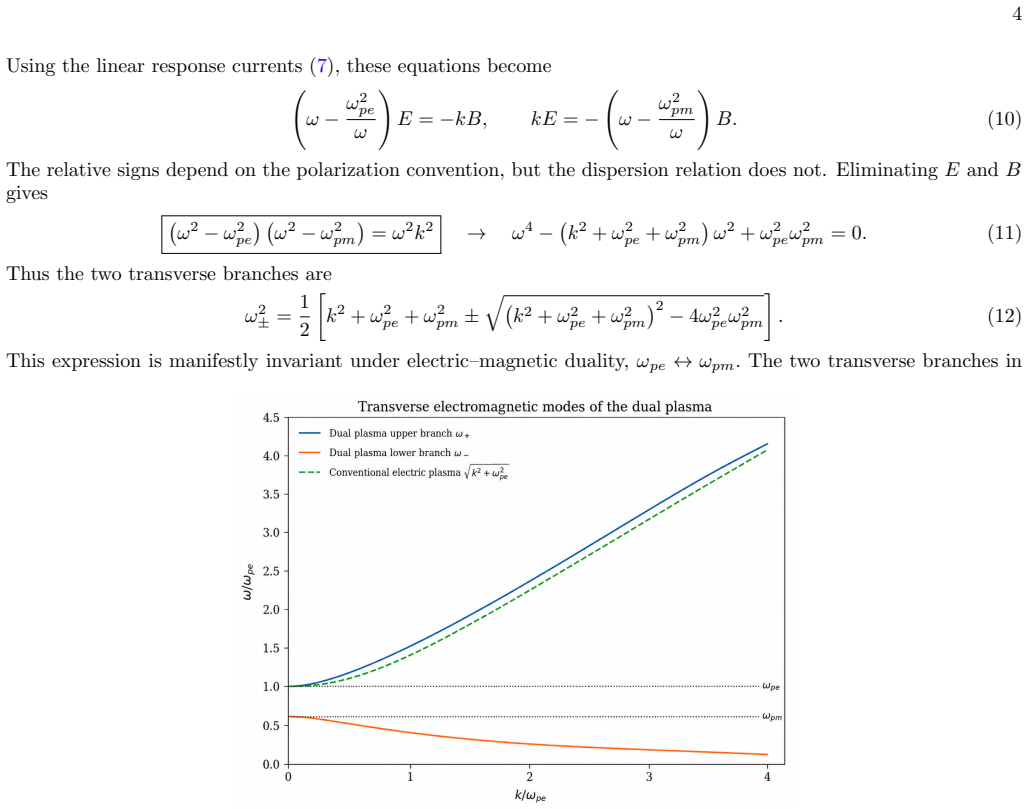
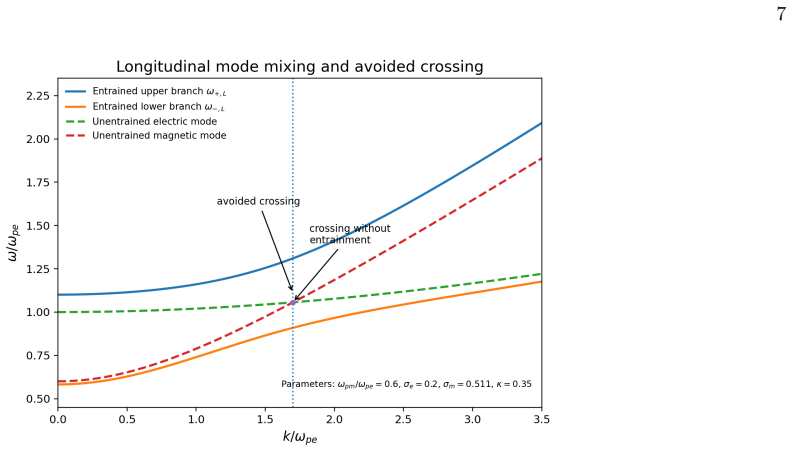
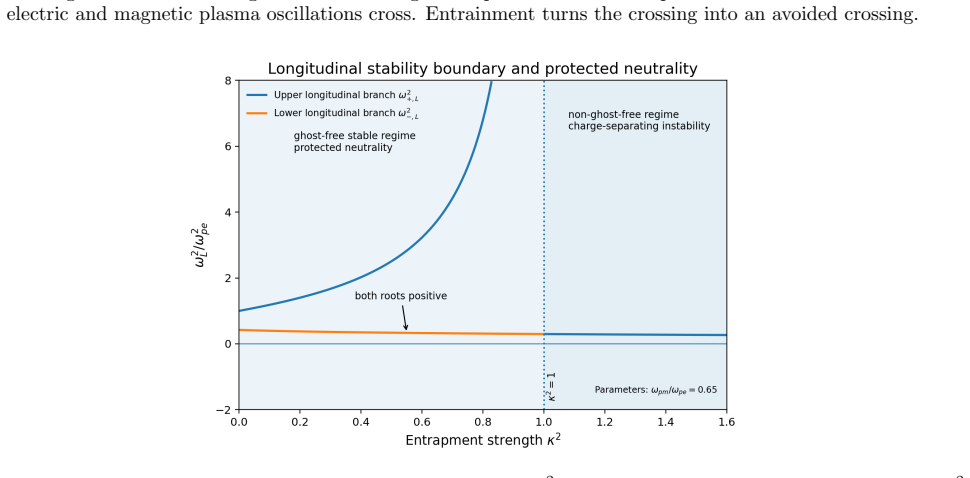
Around a homogeneous, neutral, and unmagnetized background, the transverse electromagnetic response contains two stable branches whose cutoffs are set by the electric and magnetic plasma frequencies and are exchanged by electric-magnetic duality. In the longitudinal sector, entrainment mixes the electric and magnetic density oscillations, turns their crossing into an avoided crossing, and gives the stability condition κ²<1, equivalent to positive definiteness of the two-fluid momentum matrix. Resolving the magnetic component into monopole and antimonopole species gives a neutral branch selected by magnetic charge conjugation C_m in which the net magnetic current vanishes so the long-range mo
What carries the argument
The Carter-type entrainment in the two-fluid momentum matrix that mixes electric and magnetic density oscillations and enforces the longitudinal stability condition κ²<1.
Load-bearing premise
The magnetic component can be treated as an effective charge-carrying fluid so that the dynamics close within the two-fluid equations without needing explicit monopole field equations.
What would settle it
A dispersion relation measurement showing that the transverse electromagnetic wave cutoffs are not exchanged when electric and magnetic plasma frequencies are swapped, or the appearance of instability in longitudinal modes for entrainment parameters satisfying κ² greater than 1.
Figures
read the original abstract
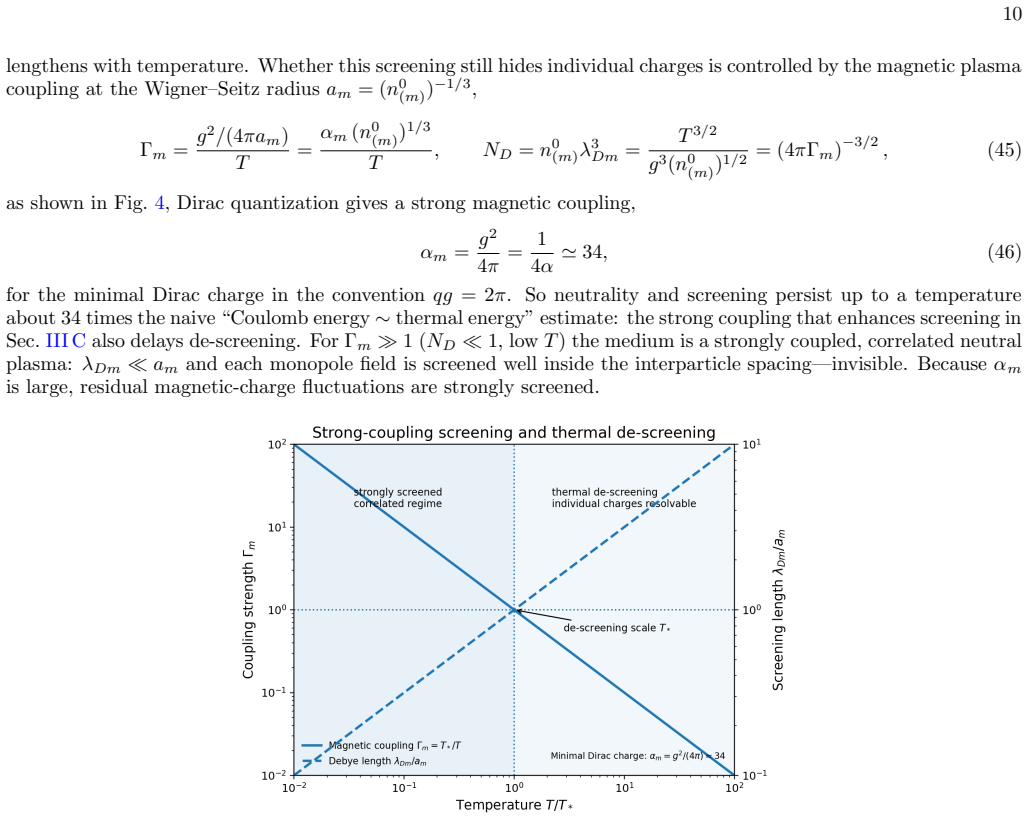
We study the linear response of an effective relativistic two-fluid medium carrying separately conserved electric and magnetic charge currents. The model is defined by the duality-symmetric Maxwell equations with electric and magnetic sources, together with Lorentz-force dynamics for two fluids with independent inertia and possible Carter-type entrainment. The magnetic component is treated as an effective charge-carrying constituent, so the analysis uses only the closed two-fluid equations. Around a homogeneous, neutral, and unmagnetized background, the transverse electromagnetic response contains two stable branches whose cutoffs are set by the electric and magnetic plasma frequencies and are exchanged by electric--magnetic duality. In the longitudinal sector, entrainment mixes the electric and magnetic density oscillations, turns their crossing into an avoided crossing, and gives the stability condition $ \kappa^2<1 ,$ equivalent to positive definiteness of the two-fluid momentum matrix. Resolving the magnetic component into monopole and antimonopole species gives a neutral branch selected by magnetic charge conjugation \(C_m\). In this branch the net magnetic current vanishes, so the long-range monopole field is absent, while the total magnetic density can still produce screened collective response. The resulting picture is that magnetic charge can be statically hidden but dynamically visible. A robust observable signature is the density scaling $\omega_{\rm coll}^2\sim\omega_{pm}^2\propto n^0_{(m)},$ which may survive dissipative broadening even when sharp ideal-plasma poles are not resolved. We briefly comment on possible dyonic interpretations of magnetically neutral composites, but the linear-response results do not rely on that interpretation.
Editorial analysis
A structured set of objections, weighed in public.
Referee Report
Summary. The manuscript develops a linear-response analysis for an effective relativistic two-fluid plasma carrying separately conserved electric and magnetic charge currents. The model employs duality-symmetric Maxwell equations together with Lorentz-force dynamics for two fluids that may exhibit Carter-type entrainment. Around a homogeneous, neutral, unmagnetized background the transverse sector yields two stable electromagnetic branches whose cutoffs are the electric and magnetic plasma frequencies and are interchanged by duality. In the longitudinal sector entrainment mixes the density oscillations, converts a crossing into an avoided crossing, and produces the stability criterion κ² < 1, which is stated to be equivalent to positive definiteness of the two-fluid momentum matrix. Resolving the magnetic fluid into monopole/antimonopole species isolates a magnetically neutral branch selected by charge conjugation C_m in which net magnetic current vanishes while total magnetic density remains dynamically active. A robust prediction is the density scaling ω_coll² ∼ ω_pm² ∝ n_{(m)}^0.
Significance. If the effective two-fluid closure is valid, the work supplies a concrete realization of duality-symmetric collective modes and a stability criterion that could constrain the parameter space of dual plasmas. The explicit mapping of transverse cutoffs under duality and the identification of a magnetically neutral yet dynamically responsive branch are distinctive features. The claimed density-independent scaling of the collective frequency constitutes a falsifiable prediction that could survive moderate dissipation. These elements would be of interest to plasma theorists exploring extensions beyond standard MHD or to condensed-matter analogs of magnetic charge.
major comments (3)
- [Abstract and §2 (model equations)] Abstract (paragraph 2) and model definition: the stability condition κ² < 1 is presented as equivalent to positive definiteness of the two-fluid momentum matrix. The manuscript must exhibit the explicit form of that matrix (including the entrainment parameter κ) and demonstrate that its eigenvalues or determinant yield precisely this inequality; otherwise the condition risks being an input assumption rather than a derived output.
- [Longitudinal sector analysis] Longitudinal dispersion relation (presumably §4): the avoided crossing and the resulting stability boundary are obtained after imposing the closed two-fluid equations with Carter entrainment. The derivation should be checked to confirm that the mixing term arises solely from the off-diagonal entrainment entries and does not presuppose the positive-definiteness result already used to restrict κ.
- [Model setup and discussion of magnetic resolution] Effective magnetic fluid closure (abstract, paragraph 2): all reported branches and the density scaling rest on treating the magnetic current as an effective charge-carrying constituent within the two-fluid framework. The manuscript should delineate the regime in which this closure remains consistent with underlying monopole dynamics, or state explicitly that the linear-response results are independent of that consistency.
minor comments (2)
- [Abstract] The symbol κ for the entrainment parameter is introduced without an explicit definition or range of allowed values in the abstract; a short parenthetical definition or reference to its appearance in the momentum matrix would improve readability.
- [Discussion of observable signatures] The claim that the density scaling “may survive dissipative broadening” is stated qualitatively. A brief estimate of the damping rate relative to the real frequency, even if order-of-magnitude, would strengthen the observational relevance.
Simulated Author's Rebuttal
We thank the referee for the careful reading and constructive suggestions. We address each major comment below and will revise the manuscript accordingly to strengthen the presentation.
read point-by-point responses
-
Referee: [Abstract and §2 (model equations)] Abstract (paragraph 2) and model definition: the stability condition κ² < 1 is presented as equivalent to positive definiteness of the two-fluid momentum matrix. The manuscript must exhibit the explicit form of that matrix (including the entrainment parameter κ) and demonstrate that its eigenvalues or determinant yield precisely this inequality; otherwise the condition risks being an input assumption rather than a derived output.
Authors: We agree that the explicit matrix form and the derivation of the inequality should be shown for clarity. In the revised manuscript we will insert the two-fluid momentum matrix (with off-diagonal entrainment entries proportional to κ) in §2 and demonstrate that its positive-definiteness conditions (positive trace and positive determinant) reduce exactly to κ² < 1. revision: yes
-
Referee: [Longitudinal sector analysis] Longitudinal dispersion relation (presumably §4): the avoided crossing and the resulting stability boundary are obtained after imposing the closed two-fluid equations with Carter entrainment. The derivation should be checked to confirm that the mixing term arises solely from the off-diagonal entrainment entries and does not presuppose the positive-definiteness result already used to restrict κ.
Authors: The mixing term in the longitudinal dispersion relation originates directly from the off-diagonal κ entries in the momentum matrix before any stability restriction is imposed. We will reorder the presentation in §4 to first write the full dispersion relation with the entrainment mixing, then impose the positive-definiteness condition to obtain the stability boundary, thereby making the logical sequence explicit. revision: yes
-
Referee: [Model setup and discussion of magnetic resolution] Effective magnetic fluid closure (abstract, paragraph 2): all reported branches and the density scaling rest on treating the magnetic current as an effective charge-carrying constituent within the two-fluid framework. The manuscript should delineate the regime in which this closure remains consistent with underlying monopole dynamics, or state explicitly that the linear-response results are independent of that consistency.
Authors: The linear-response analysis is performed entirely within the effective two-fluid closure; the reported branches and scaling are therefore independent of the detailed consistency between the effective magnetic fluid and underlying monopole dynamics. We will add an explicit statement to this effect in the discussion section. revision: yes
Circularity Check
Stability condition presented as derived result but equivalent to input positive-definiteness assumption
specific steps
-
self definitional
[Abstract]
"In the longitudinal sector, entrainment mixes the electric and magnetic density oscillations, turns their crossing into an avoided crossing, and gives the stability condition κ²<1 , equivalent to positive definiteness of the two-fluid momentum matrix."
The reported stability condition is defined to be equivalent to positive definiteness of the momentum matrix. Positive definiteness is an input assumption required for the two-fluid model with Carter-type entrainment to be physically acceptable; therefore the 'derived' bound κ²<1 is a tautological renaming of that assumption rather than a nontrivial prediction.
full rationale
The paper's central longitudinal result states that entrainment produces an avoided crossing whose stability bound is κ²<1 and is equivalent to positive definiteness of the two-fluid momentum matrix. This equivalence indicates the bound is a direct restatement of a model assumption rather than an independent output of the linear-response calculation. No other steps reduce predictions to fitted parameters or self-citations; the transverse duality-exchanged branches follow from the explicitly duality-symmetric Maxwell equations and are not circular. The overall derivation remains mostly self-contained once the two-fluid closure and entrainment matrix are granted as inputs.
Axiom & Free-Parameter Ledger
free parameters (1)
- κ (entrainment parameter)
axioms (2)
- domain assumption Duality-symmetric Maxwell equations with electric and magnetic sources
- domain assumption Lorentz-force dynamics for two fluids with independent inertia and possible Carter-type entrainment
invented entities (1)
-
Effective magnetic charge-carrying fluid constituent
no independent evidence
Reference graph
Works this paper leans on
-
[1]
Quantised singularities in the electromagnetic field,
P. A. M. Dirac, “Quantised singularities in the electromagnetic field,”Proc. R. Soc. Lond. A133, 60–72 (1931)
1931
-
[2]
The theory of magnetic poles,
P. A. M. Dirac, “The theory of magnetic poles,”Phys. Rev.74, 817–830 (1948)
1948
-
[3]
Magnetic charge and quantum field theory,
J. Schwinger, “Magnetic charge and quantum field theory,”Phys. Rev.144, 1087–1093 (1966)
1966
-
[4]
Concept of nonintegrable phase factors and global formulation of gauge fields,
T. T. Wu and C. N. Yang, “Concept of nonintegrable phase factors and global formulation of gauge fields,”Phys. Rev. D 12, 3845–3857 (1975)
1975
-
[5]
Quantum electrodynamics with Dirac monopoles,
N. Cabibbo and E. Ferrari, “Quantum electrodynamics with Dirac monopoles,”Nuovo Cimento23, 1147–1154 (1962)
1962
-
[6]
Local Lagrangian quantum field theory of electric and magnetic charges,
D. Zwanziger, “Local Lagrangian quantum field theory of electric and magnetic charges,”Phys. Rev. D3, 880–891 (1971)
1971
-
[7]
Duality symmetric actions with manifest space-time symmetries,
P. Pasti, D. Sorokin and M. Tonin, “Duality symmetric actions with manifest space-time symmetries,”Phys. Rev. D52, R4277–R4281 (1995)
1995
-
[8]
Covariant theory of conductivity in ideal fluid or solid media,
B. Carter, “Covariant theory of conductivity in ideal fluid or solid media,” inRelativistic Fluid Dynamics, edited by A. Anile and Y. Choquet-Bruhat, Lecture Notes in Mathematics1385, 1–64 (Springer, Berlin, 1989)
1989
-
[9]
Convective variational approach to relativistic thermodynamics of dissipative fluids,
B. Carter, “Convective variational approach to relativistic thermodynamics of dissipative fluids,”Proc. R. Soc. Lond. A 433, 45–62 (1991)
1991
-
[10]
Relativistic models for superconducting-superfluid mixtures,
B. Carter and D. Langlois, “Relativistic models for superconducting-superfluid mixtures,”Nucl. Phys. B531, 478–504 (1998)
1998
-
[11]
Relativistic fluid dynamics: physics for many different scales,
N. Andersson and G. L. Comer, “Relativistic fluid dynamics: physics for many different scales,”Living Rev. Relativity24, 3 (2021)
2021
-
[12]
H. C. Kim and Y. Lee, Class. Quant. Grav.39, no.24, 245011 (2022) doi:10.1088/1361-6382/aca1a1 [arXiv:2206.09555 [gr-qc]]
-
[13]
C., Lee, J., & Yun, Y
Ho, J., Kim, H. C., Lee, J., & Yun, Y. (2026). Electromagnetism from relativistic fluid dynamics. Classical and Quantum Gravity, 43(9), 095016
2026
-
[14]
Electromagnetism from two matter spaces: mutual helicity and the nondegenerate completion
H. C. Kim, “Electromagnetism from two matter spaces: mutual helicity and the nondegenerate completion,” [arXiv:2606.08917 [gr-qc]]
work page internal anchor Pith review Pith/arXiv arXiv
-
[15]
Magnetic monopoles in spin ice,
C. Castelnovo, R. Moessner and S. L. Sondhi, “Magnetic monopoles in spin ice,”Nature451, 42–45 (2008)
2008
-
[16]
Magnetic monopoles,
J. Preskill, “Magnetic monopoles,”Annu. Rev. Nucl. Part. Sci.34, 461–530 (1984)
1984
-
[17]
On the concentration of relic magnetic monopoles in the universe,
Ya. B. Zeldovich and M. Yu. Khlopov, “On the concentration of relic magnetic monopoles in the universe,”Phys. Lett. B 79, 239–241 (1978)
1978
-
[18]
Quantum field theory of particles with both electric and magnetic charges,
D. Zwanziger, “Quantum field theory of particles with both electric and magnetic charges,” Phys. Rev.176, 1489–1495 (1968). doi:10.1103/PhysRev.176.1489
-
[19]
E. Witten, “Dyons of Chargeeθ/2π,” Phys. Lett. B86, 283–287 (1979). doi:10.1016/0370-2693(79)90838-4
discussion (0)
Sign in with ORCID, Apple, or X to comment. Anyone can read and Pith papers without signing in.