Simulation-Based Inference for Cluster Cosmology with Set-Based Neural Network Architectures
Pith reviewed 2026-06-29 01:23 UTC · model grok-4.3
The pith
A set-based neural network with simulation-based inference recovers input cosmologies from realistic galaxy cluster mocks at 11.5 percent precision on matter density.
A machine-rendered reading of the paper's core claim, the machinery that carries it, and where it could break.
Core claim
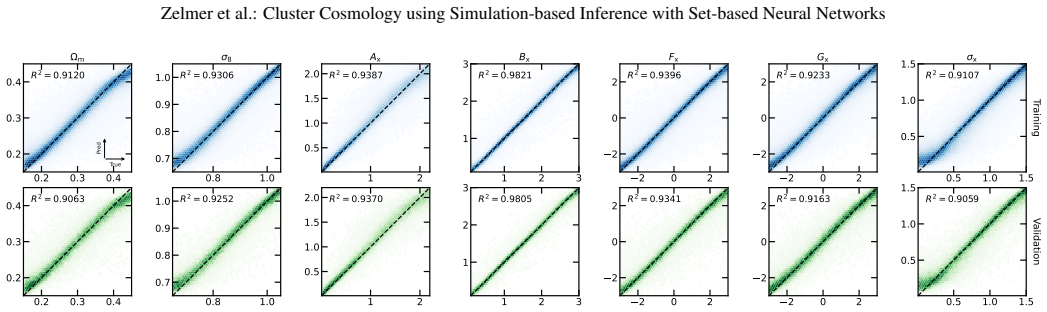
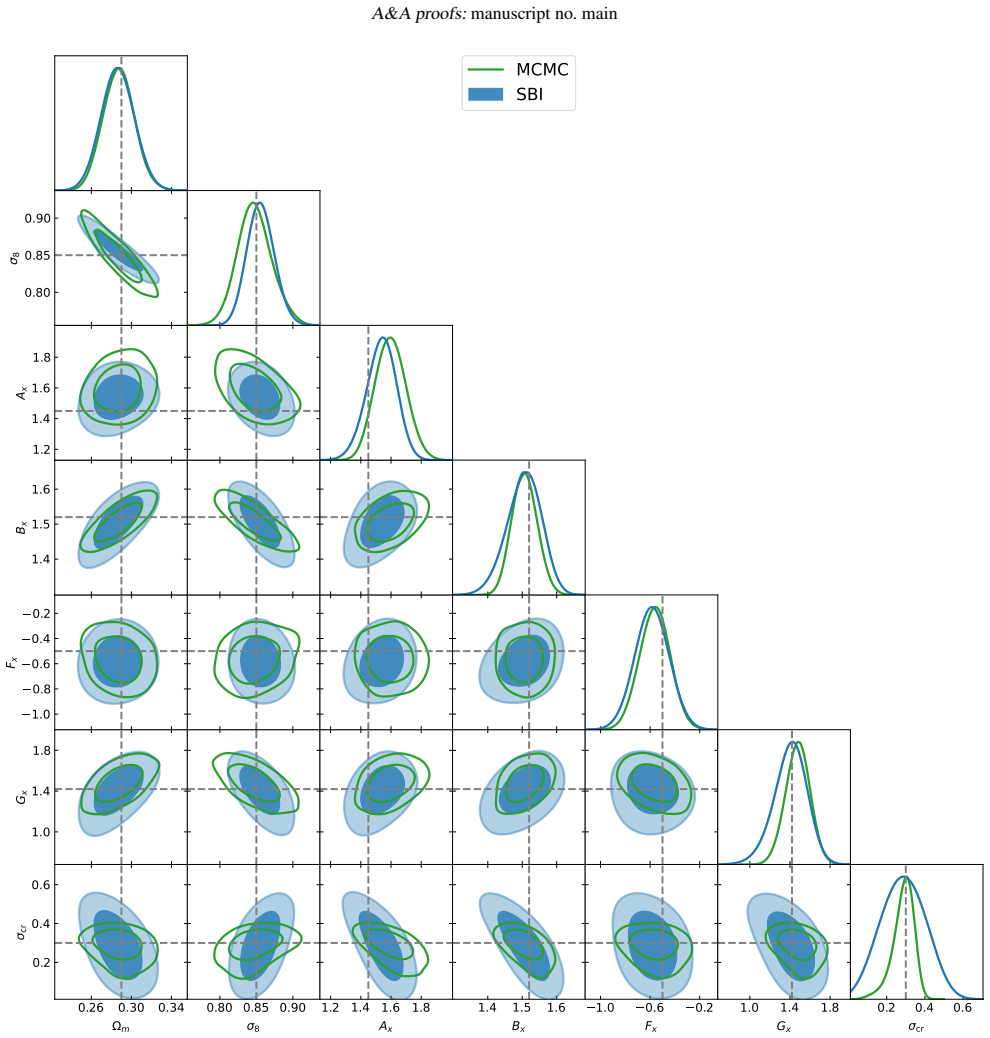
The central claim is that coupling a set-based neural network to a masked autoregressive flow, trained via simulation-based inference on catalogs propagated through the eRASS1 selection function, produces accurate posterior estimates for cosmological parameters, recovering the input cosmologies within uncertainties for mock samples of 3259 clusters and delivering average precisions of 11.5 percent on Omega_m and 4.4 percent on sigma_8.
What carries the argument
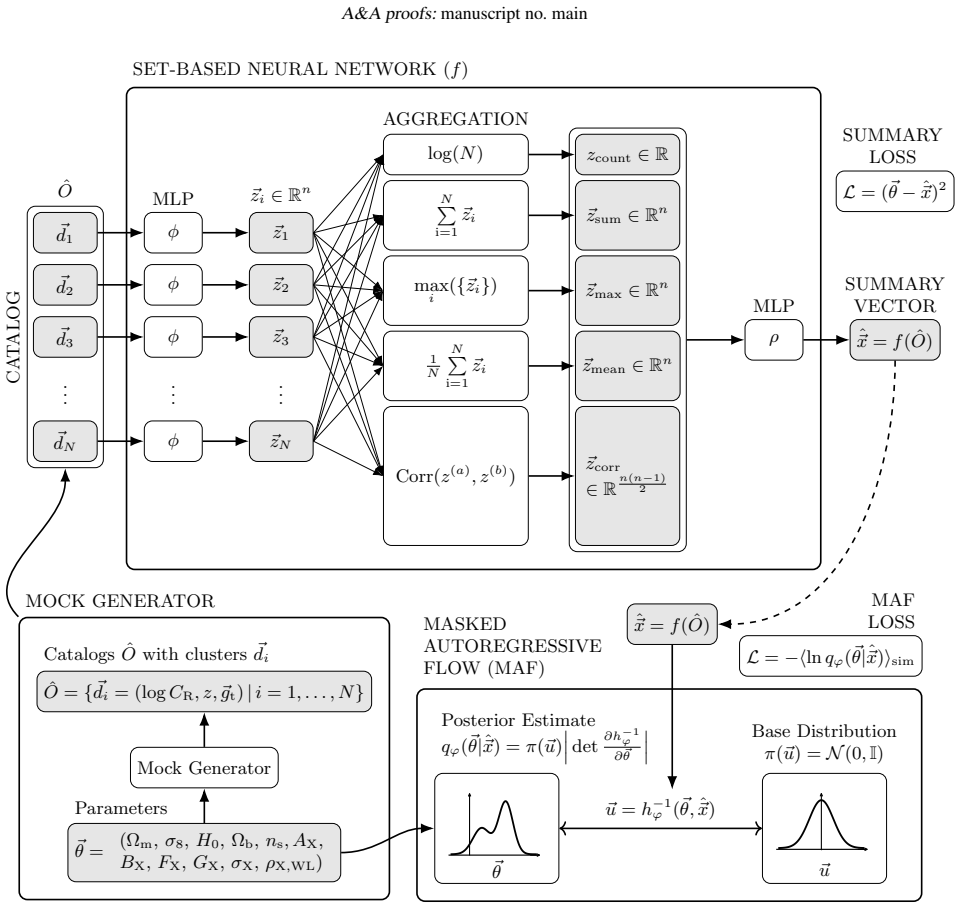
set-based neural network (GNN on sets) that encodes cluster-level information, coupled to a masked autoregressive flow for posterior density estimation
If this is right
- The framework recovers the input cosmologies within the inferred uncertainties for the tested mock catalogs.
- Calibration tests are passed, showing robustness to realistic survey effects.
- Mock constraints reach 11.5 percent on Omega_m and 4.4 percent on sigma_8 for samples matching the effective size of 3259 clusters.
- Precision is comparable to traditional MCMC analyses that require substantially larger cluster samples.
- The method is readily extensible to more complex forward models and additional observables.
Where Pith is reading between the lines
- The same architecture could be retrained on mocks from other X-ray or SZ surveys to test transferability across selection functions.
- Including additional per-cluster observables such as weak-lensing mass estimates might further tighten the reported parameter precisions.
- Direct application to observed eRASS1 data would provide a test of whether the mock-calibrated posteriors remain well-calibrated on real measurements.
Load-bearing premise
The realistic mock-generation pipeline calibrated on eRASS1 simulations accurately reproduces the statistical properties of the actual survey data after propagation through the selection function.
What would settle it
Applying the trained model to the real eRASS1 cluster catalog of 3259 objects and checking whether the inferred Omega_m and sigma_8 values are consistent with independent cosmological constraints from other probes such as the cosmic microwave background.
Figures
read the original abstract
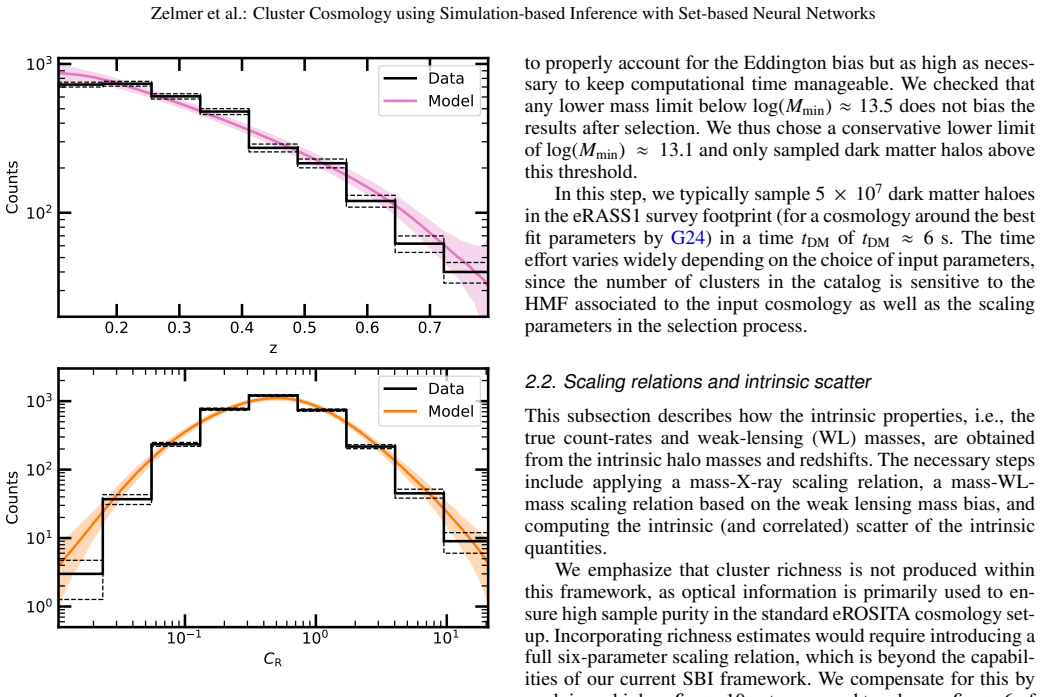
The unprecedented statistical power of galaxy cluster catalogs from the SRG (Spectrum Roentgen Gamma)/eROSITA All-Sky Survey provides a unique opportunity to place stringent constraints on cosmological models through measurements of structure growth. Fully exploiting the potential of these large X-ray-selected cluster samples, however, requires robust statistical frameworks that accurately connect observable quantities to the underlying cosmological parameters. We develop and implement a simulation-based inference (SBI) framework for cosmological parameter estimation using a realistic mock-generation pipeline calibrated on eRASS1 simulations. Synthetic galaxy cluster catalogs are propagated through the survey selection function to produce mock eRASS1 observations that reproduce the data's statistical properties. At the core of the method lies a set-based neural network (GNN on sets) that encodes information from individual clusters and is coupled to a masked autoregressive flow for flexible posterior density estimation. This approach enables the use of the full cluster-level information content without compressing the observables into binned summary statistics. Our framework recovers the input cosmologies within the inferred uncertainties, and passes calibration tests, demonstrating robustness in the presence of realistic survey effects. We obtain mock constraints of 11.5% on $\Omega_m$ and 4.4% on $\sigma_8$ averaged over a suite of simulated cluster catalogs matching the effective sample size of the data set (3,259 clusters). We achieve a precision comparable to that obtained with traditional MCMC analyses based on substantially larger cluster samples. The framework is readily extensible to more complex forward models and additional observables. This work highlights the potential of SBI methods for next-generation large-scale structure analyses with forthcoming X-ray cluster surveys.
Editorial analysis
A structured set of objections, weighed in public.
Referee Report
Summary. The manuscript develops a simulation-based inference (SBI) framework for cosmological parameter estimation from X-ray-selected galaxy cluster catalogs. It employs a graph neural network (GNN) operating directly on sets of clusters to encode individual observables, coupled to a masked autoregressive flow (MAF) for posterior density estimation. Synthetic catalogs are generated via a mock pipeline calibrated on eRASS1 simulations and propagated through the survey selection function. The framework is tested on mocks matching the effective sample size of 3,259 clusters, recovering input cosmologies within uncertainties, passing calibration tests, and yielding average constraints of 11.5% on Ω_m and 4.4% on σ_8, stated to be competitive with traditional MCMC analyses on larger samples.
Significance. If the central claims hold, the work demonstrates that set-based neural architectures can extract cosmological information from the full cluster-level data without summary-statistic compression, while incorporating realistic survey effects. This is a potentially useful methodological advance for next-generation X-ray cluster surveys, where sample sizes will be large and forward modeling complex. The explicit use of SBI with GNN+MAF avoids some limitations of binned analyses and is noted as extensible.
major comments (2)
- [Mock-generation pipeline (Section 3)] Mock-generation pipeline description: the assertion that the synthetic catalogs 'reproduce the data's statistical properties' after selection is load-bearing for the robustness and recovery claims, yet no quantitative validation metrics (e.g., binned number counts, mass or redshift distribution comparisons, or two-point statistics) between the propagated mocks and the actual 3,259-cluster eRASS1 sample are reported. Any unaccounted mismatch would directly affect the GNN+MAF posteriors and the quoted 11.5%/4.4% precisions.
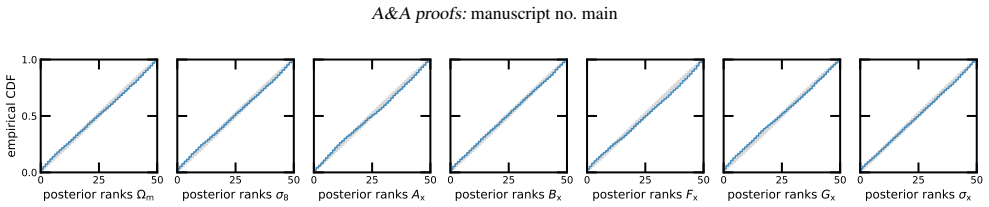
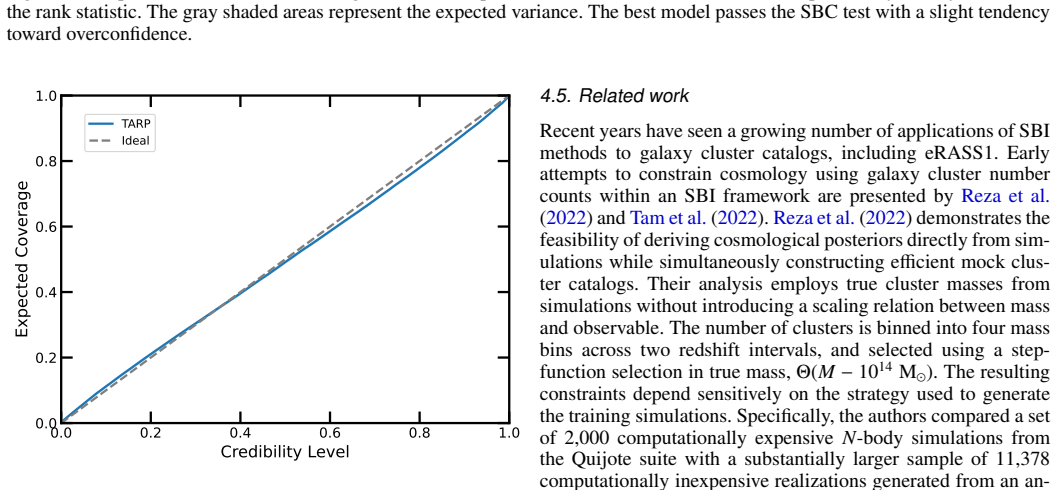
- [Results and calibration tests (Section 4)] Calibration and recovery tests (results section): while the abstract states that input cosmologies are recovered within uncertainties and calibration tests are passed, the manuscript provides no explicit details on the test implementation (e.g., probability integral transform histograms, coverage probabilities, or the number of test realizations), making it impossible to evaluate whether the tests are sufficiently stringent to support the robustness conclusion.
minor comments (2)
- [Methods] The abstract and methods would benefit from a brief statement of the GNN message-passing update rule or the MAF architecture hyperparameters to allow readers to assess the network capacity.
- [Figures] Figure captions for the posterior contours or calibration plots should explicitly state the number of mock realizations used and any averaging procedure applied to the reported precisions.
Simulated Author's Rebuttal
We thank the referee for their careful reading and constructive comments, which help improve the clarity and robustness of the manuscript. We address each major comment below and will revise the manuscript to incorporate the requested details and validations.
read point-by-point responses
-
Referee: [Mock-generation pipeline (Section 3)] Mock-generation pipeline description: the assertion that the synthetic catalogs 'reproduce the data's statistical properties' after selection is load-bearing for the robustness and recovery claims, yet no quantitative validation metrics (e.g., binned number counts, mass or redshift distribution comparisons, or two-point statistics) between the propagated mocks and the actual 3,259-cluster eRASS1 sample are reported. Any unaccounted mismatch would directly affect the GNN+MAF posteriors and the quoted 11.5%/4.4% precisions.
Authors: We agree that quantitative validation metrics are essential to substantiate the claim that the mocks reproduce the data's statistical properties. The current manuscript relies on the statement without providing explicit comparisons. In the revised version, we will add a dedicated subsection (or appendix) in Section 3 with quantitative metrics, including binned number count comparisons, mass and redshift distribution histograms, and relevant two-point statistics between the propagated mocks and the eRASS1 sample. This will directly address the concern and strengthen the foundation for the subsequent inference results. revision: yes
-
Referee: [Results and calibration tests (Section 4)] Calibration and recovery tests (results section): while the abstract states that input cosmologies are recovered within uncertainties and calibration tests are passed, the manuscript provides no explicit details on the test implementation (e.g., probability integral transform histograms, coverage probabilities, or the number of test realizations), making it impossible to evaluate whether the tests are sufficiently stringent to support the robustness conclusion.
Authors: We concur that additional details on the calibration and recovery tests are necessary for readers to assess their stringency. The manuscript currently states that the tests are passed without describing the implementation. In the revised manuscript, we will expand Section 4 (and the associated figures) to explicitly detail the test procedures, including the number of test realizations, the construction of probability integral transform (PIT) histograms, coverage probability calculations, and any other relevant diagnostics. We will also include the corresponding plots or summary statistics to allow full evaluation of the results. revision: yes
Circularity Check
No circularity: SBI validation recovers known inputs from external mocks
full rationale
The paper's central claims rest on training and testing a GNN+MAF architecture on synthetic cluster catalogs generated from known input cosmologies via an externally calibrated mock pipeline. Recovery of those inputs within uncertainties and passage of calibration tests constitute a standard external benchmark test rather than any reduction of the reported mock constraints (11.5% on Ω_m, 4.4% on σ_8) to quantities fitted inside the inference step itself. No self-definitional equations, fitted-input predictions, or load-bearing self-citations appear in the provided text; the framework is self-contained against the simulation benchmarks.
Axiom & Free-Parameter Ledger
axioms (1)
- domain assumption The mock-generation pipeline calibrated on eRASS1 simulations accurately reproduces the statistical properties of real observations after selection function propagation.
Reference graph
Works this paper leans on
-
[1]
Abbott, T. M. C., Aguena, M., Alarcon, A., et al. 2022, Phys. Rev. D, 105, 023520
2022
-
[2]
Abbott, T. M. C., Aguena, M., Alarcon, A., et al. 2025, Phys. Rev. D, 112, 083535
2025
-
[3]
Akeret, J., Refregier, A., Amara, A., Seehars, S., & Hasner, C. 2015, J. Cosmol- ogy Astropart. Phys., 2015, 043
2015
-
[4]
2019, MNRAS, 488, 4440
Alsing, J., Charnock, T., Feeney, S., & Wandelt, B. 2019, MNRAS, 488, 4440
2019
-
[5]
2022, arXiv e-prints, arXiv:2211.12346
Anagnostidis, S., Thomsen, A., Kacprzak, T., et al. 2022, arXiv e-prints, arXiv:2211.12346
-
[6]
2025, The Open Journal of Astro- physics, 8, 46158
Anbajagane, D., Zhang, Z., Chang, C., et al. 2025, The Open Journal of Astro- physics, 8, 46158
2025
-
[7]
2025, A&A, 696, A5
Artis, E., Bulbul, E., Grandis, S., et al. 2025, A&A, 696, A5
2025
-
[8]
2024, A&A, 691, A301
Artis, E., Ghirardini, V ., Bulbul, E., et al. 2024, A&A, 691, A301
2024
-
[9]
2025, arXiv e-prints, arXiv:2509.02068
Aymerich, G., Grandis, S., Douspis, M., et al. 2025, arXiv e-prints, arXiv:2509.02068
-
[10]
E., Bulbul, E., Clerc, N., et al
Bahar, Y . E., Bulbul, E., Clerc, N., et al. 2022, A&A, 661, A7 Bahé, Y . M., McCarthy, I. G., & King, L. J. 2012, MNRAS, 421, 1073
2022
-
[11]
2025, A&A, 701, A283
Balzer, F., Bulbul, E., Kluge, M., et al. 2025, A&A, 701, A283
2025
-
[12]
A., Zhang, W., & Balding, D
Beaumont, M. A., Zhang, W., & Balding, D. J. 2002, Genetics, 162, 2025
2002
-
[13]
Becker, M. R. & Kravtsov, A. V . 2011, ApJ, 740, 25
2011
-
[14]
Blum, M. G. B., Nunes, M. A., Prangle, D., & Sisson, S. A. 2012, arXiv e-prints, arXiv:1202.3819
work page internal anchor Pith review Pith/arXiv arXiv 2012
-
[15]
P., Schrabback, T., et al
Bocquet, S., Dietrich, J. P., Schrabback, T., et al. 2019, ApJ, 878, 55
2019
-
[16]
E., et al
Bocquet, S., Grandis, S., Bleem, L. E., et al. 2024, Phys. Rev. D, 110, 083510 Böhringer, H., Chon, G., & Collins, C. A. 2014, Astronomy & Astrophysics, 570, A31
2024
-
[17]
2018, in Society of Photo-Optical In- strumentation Engineers (SPIE) Conference Series, V ol
Brunner, H., Boller, T., Coutinho, D., et al. 2018, in Society of Photo-Optical In- strumentation Engineers (SPIE) Conference Series, V ol. 10699, Space Tele- scopes and Instrumentation 2018: Ultraviolet to Gamma Ray, ed. J.-W. A. den
2018
-
[18]
2022, A&A, 661, A1
Brunner, H., Liu, T., Lamer, G., et al. 2022, A&A, 661, A1
2022
-
[19]
J., et al
Bulbul, E., Chiu, I.-N., Mohr, J. J., et al. 2019, ApJ, 871, 50
2019
-
[20]
2024, A&A, 685, A106
Bulbul, E., Liu, A., Kluge, M., et al. 2024, A&A, 685, A106
2024
-
[21]
Charnock, T., Lavaux, G., & Wandelt, B. D. 2018, Phys. Rev. D, 97, 083004
2018
-
[22]
F., Dasoulas, G., & Vazirgiannis, M
Chatzianastasis, M., Lutzeyer, J. F., Dasoulas, G., & Vazirgiannis, M. 2022, arXiv e-prints, arXiv:2204.05351
-
[23]
2025, A&A, 704, A110
Chiu, I.-N., Ghirardini, V ., Grandis, S., et al. 2025, A&A, 704, A110
2025
-
[24]
2022, A&A, 661, A11
Chiu, I.-N., Ghirardini, V ., Liu, A., et al. 2022, A&A, 661, A11
2022
-
[25]
2024, A&A, 687, A238
Clerc, N., Comparat, J., Seppi, R., et al. 2024, A&A, 687, A238
2024
-
[26]
2020, The Open Journal of As- trophysics, 3, 13
Comparat, J., Eckert, D., Finoguenov, A., et al. 2020, The Open Journal of As- trophysics, 3, 13
2020
-
[27]
2019, Monthly Notices of the Royal Astronomical Society, 488, 4779
Costanzi, M., Rozo, E., Simet, M., et al. 2019, Monthly Notices of the Royal Astronomical Society, 488, 4779
2019
-
[28]
2021, Phys
Costanzi, M., Saro, A., Bocquet, S., et al. 2021, Phys. Rev. D, 103, 043522
2021
-
[29]
2020, Proceedings of the National Academy of Sciences, 117, 30055
Cranmer, K., Brehmer, J., & Louppe, G. 2020, Proceedings of the National Academy of Sciences, 117, 30055
2020
-
[30]
2020, Proceedings of the National Academy of Science, 117, 30055 de Santi, N
Cranmer, K., Brehmer, J., & Louppe, G. 2020, Proceedings of the National Academy of Science, 117, 30055 de Santi, N. S. M., Shao, H., Villaescusa-Navarro, F., et al. 2023, ApJ, 952, 69 de Santi, N. S. M., Villaescusa-Navarro, F., Raul Abramo, L., et al. 2025, J. Cosmology Astropart. Phys., 2025, 082 Euclid Collaboration, Giocoli, C., Meneghetti, M., et al...
2020
-
[31]
Constructing Summary Statistics for Approximate Bayesian Computation: Semi-automatic ABC
Fearnhead, P. & Prangle, D. 2010, arXiv e-prints, arXiv:1004.1112
work page internal anchor Pith review Pith/arXiv arXiv 2010
-
[32]
2022, A&A, 663, A3
Garrel, C., Pierre, M., Valageas, P., et al. 2022, A&A, 663, A3
2022
-
[33]
2021, MNRAS, 504, 4312
Gatti, M., Sheldon, E., Amon, A., et al. 2021, MNRAS, 504, 4312
2021
-
[34]
2024, A&A, 689, A298
Ghirardini, V ., Bulbul, E., Artis, E., et al. 2024, A&A, 689, A298
2024
-
[35]
J., Klein, M., & Dolag, K
Grandis, S., Bocquet, S., Mohr, J. J., Klein, M., & Dolag, K. 2021, MNRAS, 507, 5671
2021
-
[36]
2024, A&A, 687, A178
Grandis, S., Ghirardini, V ., Bocquet, S., et al. 2024, A&A, 687, A178
2024
-
[37]
Han, J. J., Dey, A., Price-Whelan, A. M., et al. 2023, arXiv e-prints, arXiv:2306.11784
-
[38]
2022, arXiv e-prints, arXiv:2205.14368
Huang, Z., Wang, Y ., Li, C., & He, H. 2022, arXiv e-prints, arXiv:2205.14368
-
[39]
2021, MNRAS, 501, 954
Jeffrey, N., Alsing, J., & Lanusse, F. 2021, MNRAS, 501, 954
2021
-
[40]
Jiang, B., Wu, T.-y., Zheng, C., & Wong, W. H. 2015, arXiv e-prints, arXiv:1510.02175 Jimenez Rezende, D. & Mohamed, S. 2015, arXiv e-prints, arXiv:1505.05770
work page internal anchor Pith review Pith/arXiv arXiv 2015
-
[41]
I., Ghahramani, Z., Jaakkola, T
Jordan, M. I., Ghahramani, Z., Jaakkola, T. S., & Saul, L. K. 1999, Machine Learning, 37, 183
1999
-
[42]
1986, MNRAS, 222, 323
Kaiser, N. 1986, MNRAS, 222, 323
1986
-
[43]
2024, arXiv e- prints, arXiv:2403.17410
Kimura, M., Shimizu, R., Hirakawa, Y ., Goto, R., & Saito, Y . 2024, arXiv e- prints, arXiv:2403.17410
-
[44]
2025, A&A, 695, A216
Kleinebreil, F., Grandis, S., Schrabback, T., et al. 2025, A&A, 695, A216
2025
-
[45]
2024, A&A, 688, A210
Kluge, M., Comparat, J., Liu, A., et al. 2024, A&A, 688, A210
2024
-
[46]
2025, A&A, 693, A46
Kosiba, M., Cerardi, N., Pierre, M., et al. 2025, A&A, 693, A46
2025
-
[47]
2024, A&A, 682, A132
Krippendorf, S., Baron Perez, N., Bulbul, E., et al. 2024, A&A, 682, A132
2024
-
[48]
& Leibler, R
Kullback, S. & Leibler, R. A. 1951, The Annals of Mathematical Statistics, 22, 79
1951
-
[49]
Lehman, K., Krippendorf, S., Weller, J., & Dolag, K. 2025, J. Cosmology As- tropart. Phys., 2025, 032
2025
-
[50]
2023, 40th Inter- national Conference on Machine Learning, 202, 19256 Article number, page 15 of 18 A&A proofs:manuscript no
Lemos, P., Coogan, A., Hezaveh, Y ., & Perreault-Levasseur, L. 2023, 40th Inter- national Conference on Machine Learning, 202, 19256 Article number, page 15 of 18 A&A proofs:manuscript no. main
2023
-
[51]
F., Marulli, F., Moscardini, L., et al
Lesci, G. F., Marulli, F., Moscardini, L., et al. 2025, A&A, 703, A25
2025
-
[52]
Flexible statistical inference for mechanistic models of neural dynamics
Lueckmann, J.-M., Goncalves, P. J., Bassetto, G., et al. 2017, arXiv e-prints, arXiv:1711.01861
work page internal anchor Pith review Pith/arXiv arXiv 2017
-
[53]
L., Charnock, T., Lemos, P., et al
Makinen, T. L., Charnock, T., Lemos, P., et al. 2022, The Open Journal of Astro- physics, 5, 18
2022
-
[54]
Massara, E., Villaescusa-Navarro, F., & Percival, W. J. 2023, J. Cosmology As- tropart. Phys., 2023, 012
2023
-
[55]
2024, A&A, 682, A34
Merloni, A., Lamer, G., Liu, T., et al. 2024, A&A, 682, A34
2024
-
[56]
& Durakovic, A
Mistele, T. & Durakovic, A. 2024, The Open Journal of Astrophysics, 7, 120
2024
-
[57]
2025, The Open Journal of Astrophysics, 8, 132
Mistele, T., Lelli, F., McGaugh, S., Schombert, J., & Famaey, B. 2025, The Open Journal of Astrophysics, 8, 132
2025
-
[58]
2023, Phys
Miyatake, H., Sugiyama, S., Takada, M., et al. 2023, Phys. Rev. D, 108, 123517
2023
-
[59]
H., Grandis, S., et al
Okabe, N., Reiprich, T. H., Grandis, S., et al. 2025, A&A, 700, A46
2025
-
[60]
Ong, E. & Veliˇckovi´c, P. 2022, arXiv e-prints, arXiv:2212.08541
-
[61]
Fast $\epsilon$-free Inference of Simulation Models with Bayesian Conditional Density Estimation
Papamakarios, G. & Murray, I. 2016, arXiv e-prints, arXiv:1605.06376
work page internal anchor Pith review Pith/arXiv arXiv 2016
-
[62]
Papamakarios, G., Nalisnick, E., Jimenez Rezende, D., Mohamed, S., & Laksh- minarayanan, B. 2019, arXiv e-prints, arXiv:1912.02762
-
[63]
2017, in Advances in Neural In- formation Processing Systems 30, ed
Papamakarios, G., Pavlakou, T., & Murray, I. 2017, in Advances in Neural In- formation Processing Systems 30, ed. I. Guyon, U. V . Luxburg, S. Bengio, H. Wallach, R. Fergus, S. Vishwanathan, & R. Garnett (Curran Associates Inc.), 2335–2344
2017
-
[64]
Masked Autoregressive Flow for Density Estimation
Papamakarios, G., Pavlakou, T., & Murray, I. 2017, arXiv e-prints, arXiv:1705.07057
work page internal anchor Pith review Pith/arXiv arXiv 2017
-
[65]
PyTorch: An Imperative Style, High-Performance Deep Learning Library
Paszke, A., Gross, S., Massa, F., et al. 2019, arXiv e-prints, arXiv:1912.01703 Planck Collaboration, Aghanim, N., Akrami, Y ., et al. 2020, A&A, 641, A6
work page internal anchor Pith review Pith/arXiv arXiv 2019
-
[66]
W., Arnaud, M., Biviano, A., et al
Pratt, G. W., Arnaud, M., Biviano, A., et al. 2019, Space Sci. Rev., 215, 25
2019
-
[67]
Predehl, P., Andritschke, R., Arefiev, V ., &et al.2021, Astronomy & Astro- physics, 647, A1
2021
-
[68]
PointNet: Deep Learning on Point Sets for 3D Classification and Segmentation
Qi, C. R., Su, H., Mo, K., & Guibas, L. J. 2016, arXiv e-prints, arXiv:1612.00593
work page internal anchor Pith review Pith/arXiv arXiv 2016
-
[69]
E., Fiorino, L., Bulbul, E., et al
Ramos-Ceja, M. E., Fiorino, L., Bulbul, E., et al. 2025, arXiv e-prints, arXiv:2511.14356
-
[70]
2012, New Journal of Physics, 14, 055018
Rasia, E., Meneghetti, M., Martino, R., et al. 2012, New Journal of Physics, 14, 055018
2012
-
[71]
2026, A&A, 708, A260
Regamey, M., Eckert, D., Seppi, R., et al. 2026, A&A, 708, A260
2026
-
[72]
2022, in Machine Learning for Astrophysics, 20
Reza, M., Zhang, Y ., Nord, B., et al. 2022, in Machine Learning for Astrophysics, 20
2022
-
[73]
C., Sifón, C., Asgari, M., et al
Robertson, N. C., Sifón, C., Asgari, M., et al. 2024, A&A, 681, A87
2024
-
[74]
2023, arXiv e-prints, arXiv:2311.01588
Roncoli, A., ´Ciprijanovi´c, A., V oetberg, M., Villaescusa-Navarro, F., & Nord, B. 2023, arXiv e-prints, arXiv:2311.01588
-
[75]
Rubin, D. B. 1984, The Annals of Statistics, 12, 1151
1984
-
[76]
2022, A&A, 665, A78
Seppi, R., Comparat, J., Bulbul, E., et al. 2022, A&A, 665, A78
2022
-
[77]
2024, A&A, 686, A196
Seppi, R., Comparat, J., Ghirardini, V ., et al. 2024, A&A, 686, A196
2024
-
[78]
2023, ApJ, 944, 27
Shao, H., Villaescusa-Navarro, F., Villanueva-Domingo, P., et al. 2023, ApJ, 944, 27
2023
-
[79]
W., Schrabback, T., & Grandis, S
Sommer, M. W., Schrabback, T., & Grandis, S. 2025, MNRAS, 538, L50
2025
-
[80]
2021, A&A, 656, A132
Sunyaev, R., Arefiev, V ., Babyshkin, V ., et al. 2021, A&A, 656, A132
2021
discussion (0)
Sign in with ORCID, Apple, or X to comment. Anyone can read and Pith papers without signing in.