SU(4) Heisenberg model on the hyperhoneycomb lattice
Pith reviewed 2026-06-29 01:00 UTC · model grok-4.3
The pith
The SU(4) Heisenberg model on the hyperhoneycomb lattice has a gapless spin-liquid ground state.
A machine-rendered reading of the paper's core claim, the machinery that carries it, and where it could break.
Core claim
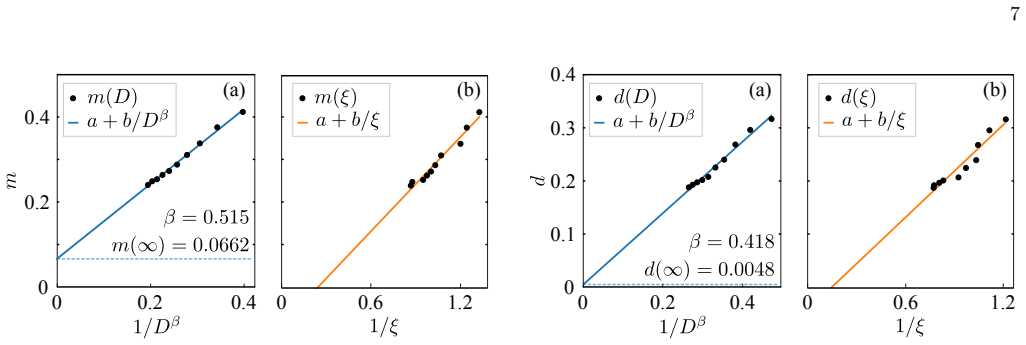
Using three-dimensional projected entangled pair states, the ground state of the SU(4) Heisenberg model on the hyperhoneycomb lattice is studied. Loop expansions allow computation of observables and converge quickly on this lattice. Extrapolations to infinite bond dimensions point toward a gapless spin-liquid ground state.
What carries the argument
Three-dimensional projected entangled pair states combined with loop expansions for observables on the hyperhoneycomb lattice
If this is right
- The ground state remains gapless in the infinite-bond-dimension limit.
- Loop expansions provide a practical route to ground-state observables on this lattice.
- The hyperhoneycomb geometry with SU(4) symmetry supports a quantum spin liquid without magnetic order.
Where Pith is reading between the lines
- The same numerical approach could be tested on other three-dimensional frustrated lattices with higher symmetry.
- Candidate materials with effective SU(4) interactions might be examined for gapless excitations.
- Alternative tensor-network ansatze or larger-scale simulations could provide independent checks on the gap.
Load-bearing premise
The loop expansions converge quickly enough and the finite-bond-dimension data can be reliably extrapolated to infinite bond dimension to determine the presence or absence of a gap.
What would settle it
A calculation at significantly larger bond dimensions that extrapolates to a finite nonzero gap would contradict the gapless conclusion.
Figures
read the original abstract
We study the ground state of the SU(4) Heisenberg model on the hyperhoneycomb lattice using three-dimensional projected entangled pair states. We show that it is possible to compute physical observables for the ground states using loop expansions, which converge quickly on tree-like lattices. Our extrapolations to the limit of infinite bond dimensions point toward gapless spin-liquid ground state.
Editorial analysis
A structured set of objections, weighed in public.
Referee Report
Summary. The manuscript studies the SU(4) Heisenberg model on the hyperhoneycomb lattice with three-dimensional projected entangled pair states (PEPS). It employs loop expansions to compute observables, asserts rapid convergence, and extrapolates to infinite bond dimension to conclude that the ground state is a gapless spin liquid.
Significance. A reliable demonstration of a gapless spin liquid in this three-dimensional frustrated model would be of substantial interest to the field of quantum magnetism, as such phases remain rare in 3D and the technical approach of loop-expanded 3D PEPS could extend to other lattices if the convergence properties hold.
major comments (1)
- [Abstract] Abstract: The manuscript states that loop expansions 'converge quickly on tree-like lattices,' yet applies the method to the hyperhoneycomb lattice, which contains plaquettes and closed loops. No section demonstrates that truncation errors remain controlled on this geometry or that the finite-D data used for the gapless diagnosis are free of systematic bias from the loop series; this directly affects the reliability of the D o∞ extrapolation.
Simulated Author's Rebuttal
We thank the referee for the detailed reading and the constructive comment on the abstract and convergence properties. We address the concern below and will make revisions to improve clarity and strengthen the supporting analysis.
read point-by-point responses
-
Referee: [Abstract] Abstract: The manuscript states that loop expansions 'converge quickly on tree-like lattices,' yet applies the method to the hyperhoneycomb lattice, which contains plaquettes and closed loops. No section demonstrates that truncation errors remain controlled on this geometry or that the finite-D data used for the gapless diagnosis are free of systematic bias from the loop series; this directly affects the reliability of the D→∞ extrapolation.
Authors: We agree that the abstract phrasing is imprecise: the hyperhoneycomb lattice is not tree-like and contains plaquettes. We will revise the abstract to remove this wording and describe the loop expansion more generally. On the control of truncation errors, the manuscript already shows that observables stabilize with increasing loop order and that different truncation schemes yield consistent trends, but we acknowledge that a dedicated discussion or appendix explicitly quantifying the residual truncation bias on this lattice (e.g., by comparing successive loop orders for the same finite-D tensors) is absent. We will add such an analysis in the revised manuscript to demonstrate that the systematic error from the loop series is smaller than the statistical uncertainty used in the D→∞ extrapolation, thereby supporting the gapless diagnosis. revision: yes
Circularity Check
No circularity: direct numerical PEPS computation with extrapolation
full rationale
The paper reports a numerical study of the SU(4) Heisenberg model via 3D PEPS and loop expansions, followed by extrapolation of observables to infinite bond dimension. No equations, parameters, or self-citations reduce any claimed result to its own inputs by construction. The loop-expansion convergence statement is an assumption about the method's applicability rather than a self-referential definition or fitted prediction. The central claim therefore rests on independent computational output rather than tautological reduction.
Axiom & Free-Parameter Ledger
Reference graph
Works this paper leans on
-
[1]
magnetic
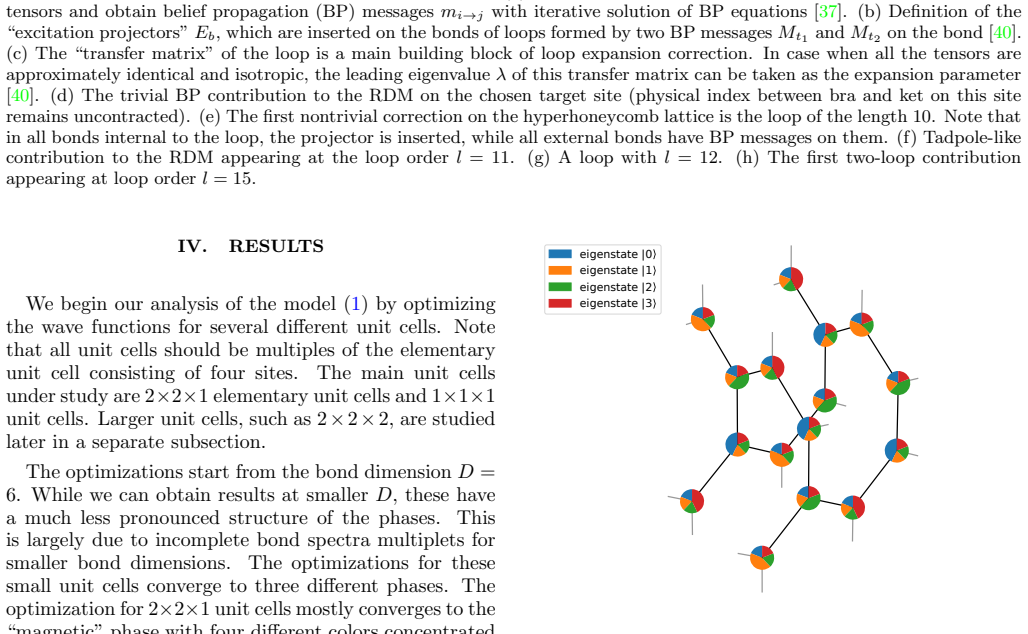
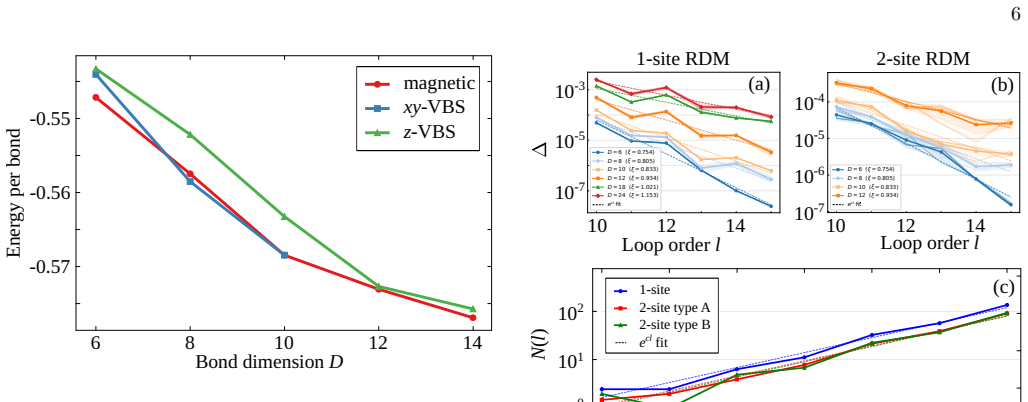
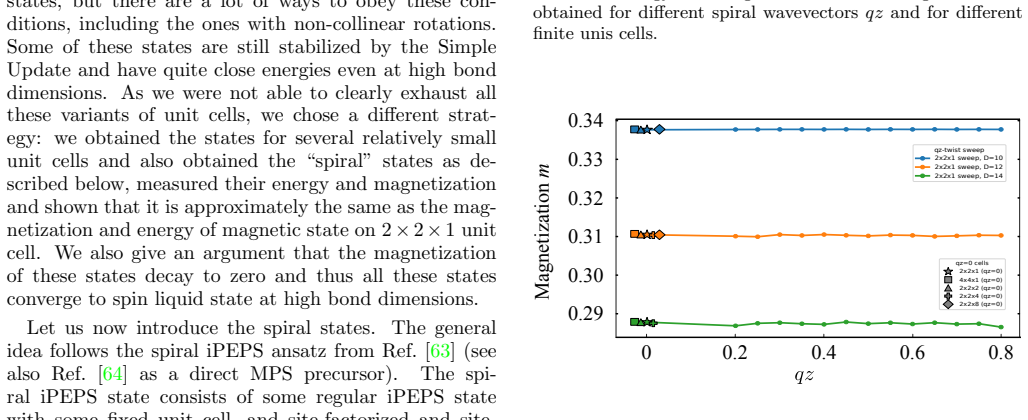
While we can obtain results at smallerD, these have a much less pronounced structure of the phases. This is largely due to incomplete bond spectra multiplets for smaller bond dimensions. The optimizations for these small unit cells converge to three different phases. The optimization for 2×2×1 unit cells mostly converges to the “magnetic” phase with four ...
2023
-
[2]
A. V. Gorshkov, M. Hermele, V. Gurarie, C. Xu, P. S. Julienne, J. Ye, P. Zoller, E. Demler, M. D. Lukin, and A. M. Rey, Two-orbital SU(N) magnetism with ultracold alkaline-earth atoms, Nat. Phys.6, 289 (2010)
2010
-
[3]
M. A. Cazalilla, A. F. Ho, and M. Ueda, Ultracold gases of ytterbium: ferromagnetism and Mott states in an SU(6) Fermi system, New J. Phys.11, 103033 (2009)
2009
-
[4]
M. A. Cazalilla and A. M. Rey, Ultracold Fermi gases with emergent SU(N) symmetry, Rep. Progr. Phys.77, 124401 (2014)
2014
-
[5]
Hermele, V
M. Hermele, V. Gurarie, and A. M. Rey, Mott insulators of ultracold fermionic alkaline earth atoms: undercon- strained magnetism and chiral spin liquid, Phys. Rev. Lett.103, 135301 (2009)
2009
-
[6]
S. Taie, R. Yamazaki, S. Sugawa, and Y. Takahashi, An SU(6) Mott insulator of an atomic Fermi gas realized by large-spin Pomeranchuk cooling, Nat. Phys.8, 825 (2012)
2012
-
[7]
Scazza, C
F. Scazza, C. Hofrichter, M. H¨ ofer, P. C. De Groot, I. Bloch, and S. F¨ olling, Observation of two-orbital spin- exchange interactions with ultracold SU(N)-symmetric fermions, Nat. Phys.10, 779 (2014)
2014
-
[8]
Zhang, M
X. Zhang, M. Bishof, S. L. Bromley, C. V. Kraus, M. S. Safronova, P. Zoller, A. M. Rey, and J. Ye, Spectroscopic observation of SU(N)-symmetric interactions in Sr orbital magnetism, Science345, 1467 (2014)
2014
-
[9]
Pagano, M
G. Pagano, M. Mancini, G. Cappellini, P. Lombardi, F. Sch¨ afer, H. Hu, X.-J. Liu, J. Catani, C. Sias, M. Ingus- cio, and L. Fallani, A one-dimensional liquid of fermions with tunable spin, Nat. Phys.10, 198 (2014)
2014
-
[10]
K. I. Kugel and D. I. Khomskii, The Jahn-Teller ef- fect and magnetism: transition metal compounds, Soviet Physics Uspekhi25, 231 (1982)
1982
-
[11]
A. M. Ole´ s, Spin-orbital physics in transition metal ox- ides, Acta Physica Polonica A115, 36 (2009)
2009
-
[12]
G. Chen, R. Pereira, and L. Balents, Exotic phases in- duced by strong spin-orbit coupling in ordered double perovskites, Phys. Rev. B82, 174440 (2010)
2010
-
[13]
Romh´ anyi, L
J. Romh´ anyi, L. Balents, and G. Jackeli, Spin-orbit dimers and noncollinear phases ind 1 cubic double per- ovskites, Phys. Rev. Lett.118, 217202 (2017)
2017
-
[14]
W. M. H. Natori, E. C. Andrade, and R. G. Pereira, SU(4)-symmetric spin-orbital liquids on the hyperhoney- comb lattice, Phys. Rev. B98, 195113 (2018)
2018
-
[15]
M. G. Yamada, M. Oshikawa, and G. Jackeli, Emergent SU(4) symmetry inα-ZrCl 3 and crystalline spin-orbital liquids, Phys. Rev. Lett.121, 097201 (2018)
2018
-
[16]
Wu, Mott made easy, Nat
C. Wu, Mott made easy, Nat. Phys.9, 73 (2013)
2013
-
[17]
J. I. Cirac, D. P´ erez-Garc´ ıa, N. Schuch, and F. Ver- straete, Matrix product states and projected entangled pair states: Concepts, symmetries, theorems, Reviews of Modern Physics93, 045003 (2021), arXiv:2011.12127
arXiv 2021
-
[18]
R. Or´ us, A practical introduction to tensor net- works: Matrix product states and projected entan- gled pair states, Annals of Physics349, 117 (2014), arXiv:1306.2164
Pith/arXiv arXiv 2014
-
[19]
R. Or´ us, Tensor networks for complex quantum systems, Nature Reviews Physics1, 538 (2019), arXiv:1812.04011
arXiv 2019
-
[20]
M. C. Ba˜ nuls, Tensor network algorithms: A route map, Annual Review of Condensed Matter Physics14, 173 (2023)
2023
-
[21]
U. Schollw¨ ock, The density-matrix renormalization group in the age of matrix product states, Annals of Physics 326, 96 (2011), arXiv:1008.3477. 11
Pith/arXiv arXiv 2011
-
[22]
P. Corboz, K. Penc, F. Mila, and A. M. L¨ auchli, Sim- plex solids in SU(N) heisenberg models on the kagome and checkerboard lattices, Physical Review B86, 041106 (2012), arXiv:1204.6682
Pith/arXiv arXiv 2012
-
[23]
P. Corboz, M. Lajk´ o, K. Penc, F. Mila, and A. M. L¨ auchli, Competing states in the SU(3) heisenberg model on the honeycomb lattice: Plaquette valence-bond crys- tal versus dimerized color-ordered state, Physical Review B87, 195113 (2013), arXiv:1302.1108
Pith/arXiv arXiv 2013
-
[24]
P. Corboz, M. Lajk´ o, A. M. L¨ auchli, K. Penc, and F. Mila, Spin-orbital quantum liquid on the honey- comb lattice, Physical Review X2, 041013 (2012), arXiv:1207.6029
Pith/arXiv arXiv 2012
-
[25]
P. Nataf, M. Lajk´ o, P. Corboz, A. M. L¨ auchli, K. Penc, and F. Mila, SU(6) heisenberg model on the honeycomb lattice: Competition between plaquette and chiral order, Physical Review B93, 201113 (2016), arXiv:1601.00959
Pith/arXiv arXiv 2016
-
[26]
B. Bauer, P. Corboz, A. M. L¨ auchli, L. Messio, K. Penc, M. Troyer, and F. Mila, Three-sublattice order in the SU(3) heisenberg model on the square and trian- gular lattice, Physical Review B85, 125116 (2012), arXiv:1112.1100
Pith/arXiv arXiv 2012
-
[27]
Y. Xu, S. Capponi, J.-Y. Chen, L. Vanderstraeten, J. Hasik, A. H. Nevidomskyy, M. Mambrini, K. Penc, and D. Poilblanc, Phase diagram of the chiral SU(3) an- tiferromagnet on the kagome lattice, Physical Review B 108, 195153 (2023), arXiv:2306.16192
arXiv 2023
-
[28]
P. Corboz, A. M. L¨ auchli, K. Penc, M. Troyer, and F. Mila, Simultaneous dimerization and SU(4) symmetry breaking of 4-color fermions on the square lattice, Physi- cal Review Letters107, 215301 (2011), arXiv:1108.2857
Pith/arXiv arXiv 2011
- [29]
-
[30]
P. C. G. Vlaar and P. Corboz, Simulation of three- dimensional quantum systems with projected entangled- pair states, Physical Review B103, 205137 (2021)
2021
-
[31]
I. Lukin and A. Sotnikov, Single-layer tensor network ap- proach for three-dimensional quantum systems, Physical Review B110, 064422 (2024), arXiv:2405.01489
arXiv 2024
-
[32]
I. Lukin and A. Sotnikov, Dimerization in the SU(4) heisenberg model on the cubic lattice: ipeps study, arXiv preprint (2025), arXiv:2510.00284
arXiv 2025
-
[33]
J. Dziarmaga, Monte carlo sampling from a projected entangled-pair state in simulations of quantum anneal- ing in the three dimensional random ising model, arXiv preprint (2026), arXiv:2603.16509
arXiv 2026
-
[34]
S. S. Jahromi and R. Or´ us, Universal tensor-network al- gorithm for any infinite lattice, Physical Review B99, 195105 (2019), arXiv:1808.00680
Pith/arXiv arXiv 2019
-
[35]
S. S. Jahromi, R. Or´ us, D. Poilblanc, and F. Mila, Spin-1/2 kagome heisenberg antiferromagnet with strong breathing anisotropy, SciPost Physics9, 092 (2020), arXiv:1912.10756
arXiv 2020
-
[36]
S. S. Jahromi and R. Or´ us, Thermal bosons in 3d optical lattices via tensor networks, Scientific Reports10, 19051 (2020), arXiv:2005.00314
arXiv 2020
-
[37]
S. S. Jahromi, H. Yarloo, and R. Or´ us, Thermodynamics of three-dimensional kitaev quantum spin liquids via ten- sor networks, Physical Review Research3, 033205 (2021)
2021
-
[38]
J. Tindall and M. T. Fishman, Gauging tensor networks with belief propagation, SciPost Physics15, 222 (2023), arXiv:2306.17837
arXiv 2023
-
[39]
J. Tindall, M. Fishman, E. M. Stoudenmire, and D. Sels, Efficient tensor network simulation of IBM’s eagle kicked ising experiment, PRX Quantum5, 010308 (2024), arXiv:2306.14887
arXiv 2024
-
[40]
Dynamics of disordered quantum systems with two- and three-dimensional tensor networks
J. Tindall, A. F. Mello, M. Fishman, E. M. Stoudenmire, and D. Sels, Dynamics of disordered quantum systems with two- and three-dimensional tensor networks, Science 10.1126/science.adx2728 (2026), arXiv:2503.05693
work page internal anchor Pith review Pith/arXiv arXiv doi:10.1126/science.adx2728 2026
-
[41]
G. Evenbly, N. Pancotti, A. Milsted, J. Gray, and G. K.-L. Chan, Loop series expansions for tensor net- works, Physical Review Research8, 013245 (2026), arXiv:2409.03108
arXiv 2026
-
[42]
M. Chertkov and V. Y. Chernyak, Loop calculus in sta- tistical physics and information science, Physical Review E73, 065102 (2006), arXiv:cond-mat/0601487
Pith/arXiv arXiv 2006
-
[43]
M. Chertkov and V. Y. Chernyak, Loop series for dis- crete statistical models on graphs, Journal of Statisti- cal Mechanics: Theory and Experiment , P06009 (2006), arXiv:cond-mat/0603189
Pith/arXiv arXiv 2006
-
[44]
G. Park, J. Gray, and G. K.-L. Chan, Simulating quan- tum dynamics in two-dimensional lattices with tensor network influence functional belief propagation (2025), arXiv:2504.07344
arXiv 2025
-
[45]
S. Midha and Y. F. Zhang, Beyond belief propagation: Cluster-corrected tensor network contraction with expo- nential convergence (2025), arXiv:2510.02290
arXiv 2025
-
[46]
S. Midha, G. M. Sommers, J. Tindall, and D. A. Abanin, Belief propagation and tensor network expansions for many-body quantum systems: Rigorous results and fun- damental limits (2026), arXiv:2604.03228
Pith/arXiv arXiv 2026
-
[47]
J. Gray, G. Park, G. Evenbly, N. Pancotti, E. F. Kjønstad, and G. K.-L. Chan, Tensor network loop clus- ter expansions for quantum many-body problems (2025), arXiv:2510.05647
Pith/arXiv arXiv 2025
-
[48]
J. Tindall, G. M. Sommers, and H. Kappen, Contract- ing tensor networks with generalized belief propagation (2026), arXiv:2604.24760
Pith/arXiv arXiv 2026
-
[49]
A. F. Mello, E. M. Stoudenmire, and J. Tindall, Finite- temperature formation of magnetic plateaus and sim- plex liquid states on the frustrated ruby lattice (2026), arXiv:2606.07609
Pith/arXiv arXiv 2026
-
[50]
B. Bruognolo, J.-W. Li, J. von Delft, and A. Weich- selbaum, A beginner’s guide to non-Abelian iPEPS for correlated fermions, SciPost Physics Lecture Notes , 25 (2021), arXiv:2006.08289
arXiv 2021
-
[51]
H.-C. Jiang, Z.-Y. Weng, and T. Xiang, Accurate de- termination of tensor network state of quantum lattice models in two dimensions, Physical Review Letters101, 090603 (2008), arXiv:0806.3719
Pith/arXiv arXiv 2008
-
[52]
J. Jordan, R. Or´ us, G. Vidal, F. Verstraete, and J. I. Cirac, Classical simulation of infinite-size quantum lat- tice systems in two spatial dimensions, Physical Review Letters101, 250602 (2008), arXiv:cond-mat/0703788
Pith/arXiv arXiv 2008
-
[53]
H. N. Phien, J. A. Bengua, H. D. Tuan, P. Corboz, and R. Or´ us, Infinite projected entangled pair states algo- rithm improved: Fast full update and gauge fixing, Phys- ical Review B92, 035142 (2015), arXiv:1503.05345
Pith/arXiv arXiv 2015
-
[54]
P. Corboz, Variational optimization with infinite pro- jected entangled-pair states, Physical Review B94, 035133 (2016), arXiv:1605.03006
Pith/arXiv arXiv 2016
-
[55]
L. Vanderstraeten, J. Haegeman, P. Corboz, and F. Ver- straete, Gradient methods for variational optimization of projected entangled-pair states, Physical Review B94, 155123 (2016), arXiv:1606.09170. 12
Pith/arXiv arXiv 2016
-
[56]
I. V. Lukin and A. G. Sotnikov, Variational optimiza- tion of tensor-network states with the honeycomb-lattice corner transfer matrix, Physical Review B107, 054424 (2023), arXiv:2209.03428
arXiv 2023
-
[57]
Q. Yang and P. Corboz, Efficient iPEPS simulation on the honeycomb lattice via QR-based CTMRG, Physical Review B113, 085109 (2026), arXiv:2509.05090
arXiv 2026
-
[58]
H. J. Liao, Z. Y. Xie, J. Chen, Z. Y. Liu, H. D. Xie, R. Z. Huang, B. Normand, and T. Xiang, Gapless spin- liquid ground state in thes= 1/2 kagome antiferro- magnet, Physical Review Letters118, 137202 (2017), arXiv:1610.04727
Pith/arXiv arXiv 2017
-
[59]
M. Fishman, S. R. White, and E. M. Stoudenmire, The ITensor software library for tensor network calculations, SciPost Physics Codebases , 4 (2022), arXiv:2007.14822
arXiv 2022
-
[60]
Fishman, S
M. Fishman, S. R. White, and E. M. Stoudenmire, Code- base release 0.3 for ITensor, SciPost Physics Codebases , 4 (2022)
2022
-
[61]
Gray, quimb: A python package for quantum informa- tion and many-body calculations, Journal of Open Source Software3, 819 (2018)
J. Gray, quimb: A python package for quantum informa- tion and many-body calculations, Journal of Open Source Software3, 819 (2018)
2018
-
[62]
P. Corboz, P. Czarnik, G. Kapteijns, and L. Taglia- cozzo, Finite correlation length scaling with infinite pro- jected entangled-pair states, Physical Review X8, 031031 (2018), arXiv:1706.07056
Pith/arXiv arXiv 2018
-
[63]
M. Rader and A. M. L¨ auchli, Finite correlation length scaling in Lorentz-invariant gapless iPEPS wave functions, Physical Review X8, 031030 (2018), arXiv:1803.08566
Pith/arXiv arXiv 2018
-
[64]
J. Hasik and P. Corboz, Incommensurate order with translationally invariant projected entangled-pair states: Spiral states and quantum spin liquid on the anisotropic triangular lattice, Physical Review Letters133, 176502 (2024), arXiv:2311.05534
arXiv 2024
-
[65]
H. Ueda and I. Maruyama, Incommensurate matrix prod- uct state for quantum spin systems, Physical Review B 86, 064438 (2012), arXiv:1112.2075
Pith/arXiv arXiv 2012
-
[66]
E. K.-H. Lee, R. Schaffer, S. Bhattacharjee, and Y. B. Kim, Heisenberg-Kitaev model on the hyperhoney- comb lattice, Physical Review B89, 045117 (2014), arXiv:1308.6592
Pith/arXiv arXiv 2014
-
[67]
T. Takayama, A. Kato, R. Dinnebier, J. Nuss, H. Kono, L. S. I. Veiga, G. Fabbris, D. Haskel, and H. Takagi, Hy- perhoneycomb iridateβ-Li 2IrO3 as a platform for Kitaev magnetism, Physical Review Letters114, 077202 (2015), arXiv:1403.3296
Pith/arXiv arXiv 2015
-
[68]
Y. Okamoto, M. Nohara, H. Aruga-Katori, and H. Tak- agi, Spin-liquid state in the S=1/2 hyperkagome antifer- romagnet Na4Ir3O8, Physical Review Letters99, 137207 (2007), arXiv:0705.2821
Pith/arXiv arXiv 2007
-
[69]
E. J. Bergholtz, A. M. L¨ auchli, and R. Moessner, Sym- metry breaking on the three-dimensional hyperkagome lattice of Na4Ir3O8, Physical Review Letters105, 237202 (2010), arXiv:1010.1345
Pith/arXiv arXiv 2010
-
[70]
Z. Xie, J. Chen, J. Yu, X. Kong, B. Normand, and T. Xi- ang, Tensor renormalization of quantum many-body sys- tems using projected entangled simplex states, Physical Review X4, 011025 (2014), arXiv:1307.5696
Pith/arXiv arXiv 2014
-
[71]
A. Gendiar, R. Krcmar, S. Andergassen, M. Daniˇ ska, and T. Nishino, Weak correlation effects in the Ising model on triangular-tiled hyperbolic lattices, Physical Review E86, 021105 (2012), arXiv:1205.3850
Pith/arXiv arXiv 2012
-
[72]
M. Daniˇ ska and A. Gendiar, Analysis of quantum spin models on hyperbolic lattices and Bethe lattice, Journal of Physics A: Mathematical and Theoretical49, 145003 (2016), arXiv:1510.01450
Pith/arXiv arXiv 2016
discussion (0)
Sign in with ORCID, Apple, or X to comment. Anyone can read and Pith papers without signing in.