A Model for Magnetic Reconnection as the Origin of TeV Outbursts from NGC 1275
Pith reviewed 2026-06-29 03:39 UTC · model grok-4.3
The pith
Magnetic reconnection in the parsec-scale jet of NGC 1275 can produce its 2022-2023 TeV outbursts.
A machine-rendered reading of the paper's core claim, the machinery that carries it, and where it could break.
Core claim
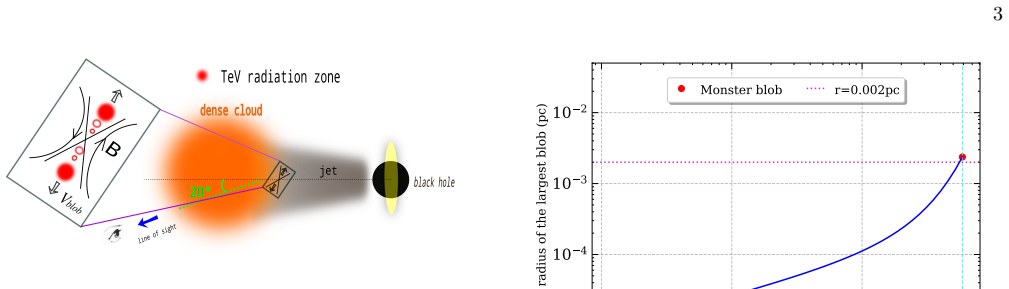
Magnetic reconnection triggered by the interaction between the jet and the ambient medium produces many plasmoids, with a large monster plasmoid serving as the primary flare region that accounts for the enhanced X-ray and TeV emission during the 2022-2023 outbursts of NGC 1275.
What carries the argument
A compact reconnection-powered region containing a monster plasmoid, added to a multi-zone stochastic-dissipation model.
If this is right
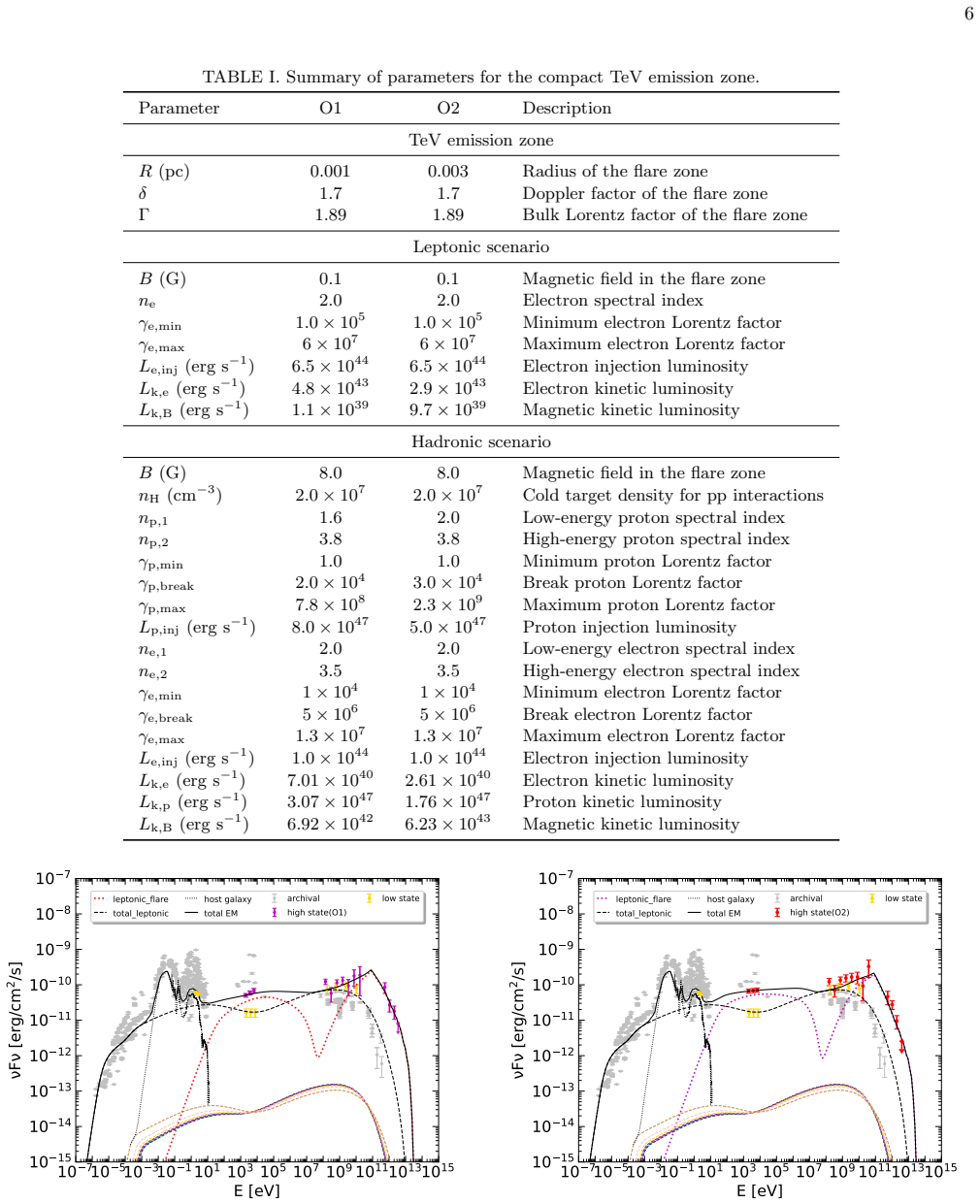
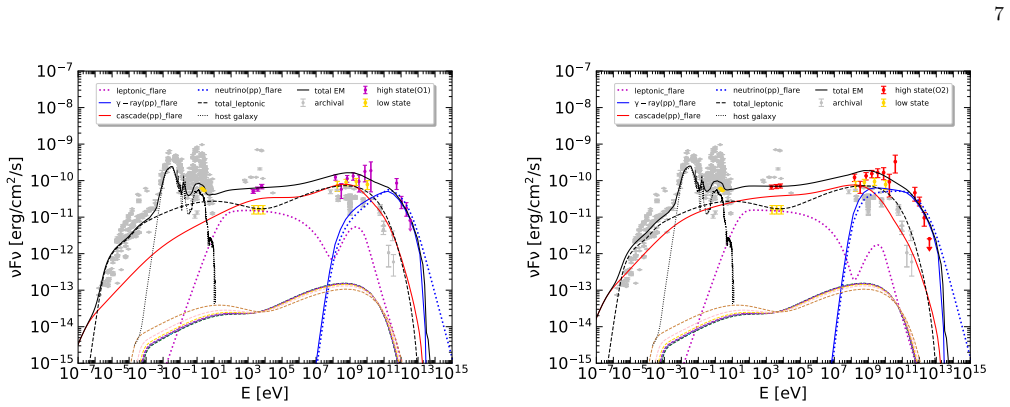
- The leptonic model explains enhanced X-ray emission as electron synchrotron radiation and TeV emission mainly as inverse-Compton radiation.
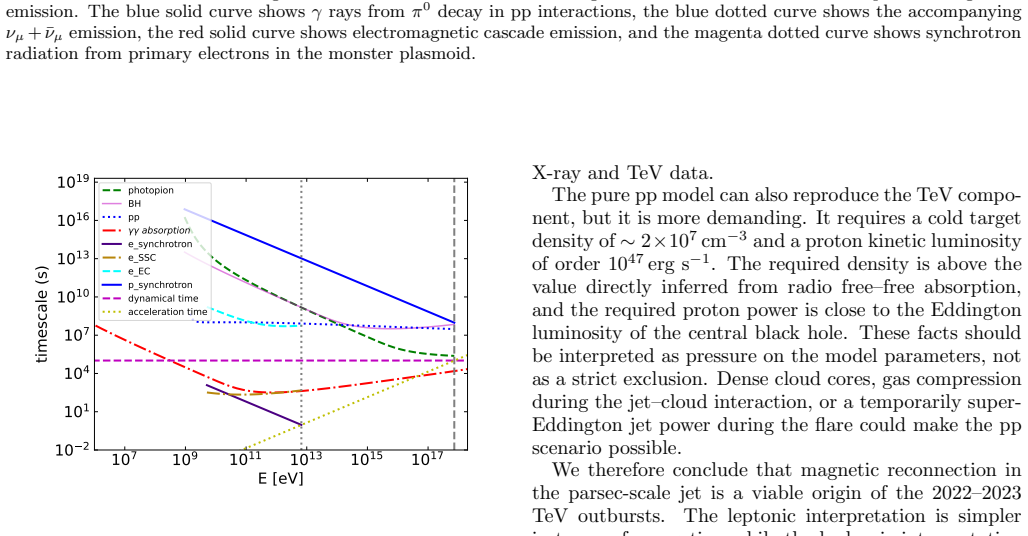
- A pure proton-proton model can produce TeV photons if dense target gas is present, but requires a compact cloud with density above values from free-free absorption and large proton power.
- Magnetic reconnection in the parsec-scale jet is a viable origin for the observed TeV activity.
- Better constraints on gas density and jet power are needed to distinguish leptonic from hadronic radiation channels.
Where Pith is reading between the lines
- The monster plasmoid acts as an efficient particle accelerator whose size and location can be constrained by the observed flare duration and spectrum.
- If similar knot deflections are seen in other sources, reconnection may be a common driver of variable high-energy emission in radio galaxies.
- Multi-wavelength monitoring that catches both the radio knot motion and the gamma-ray rise could directly test the causal link between interaction and flare.
Load-bearing premise
The sudden acceleration and deflection of the jet knot in late 2022 is caused by interaction with the ambient medium that triggers magnetic reconnection.
What would settle it
Direct measurement showing the gas density near the jet knot is too low to provide the target density needed for hadronic TeV production, or radio timing showing the knot deflection occurs after the main TeV flare onset, would rule out the model.
Figures
read the original abstract
NGC 1275 showed two TeV $\gamma$-ray outbursts between November 2022 and January 2023, as detected by the Large High Altitude Air Shower Observatory (LHAASO). The source was also active in the X-ray and GeV bands during the TeV outburst period. Very-long-baseline radio observations reported a sudden acceleration and deflection of a jet knot in late 2022, before the main TeV activity. Motivated by this sequence, we examine whether magnetic reconnection triggered by the interaction between the jet and the ambient medium can explain the TeV flares. In this picture, reconnection produces many plasmoids, and a large ``monster'' plasmoid becomes the main flare region. We model the low-state emission with a multi-zone stochastic-dissipation component and add a compact reconnection-powered region for the flaring state. We then compare leptonic and hadronic interpretations. The leptonic model explains the enhanced X-ray emission as electron synchrotron radiation and the TeV emission mainly as inverse-Compton radiation. A pure proton--proton model can also produce TeV photons if dense target gas is present, but it requires a compact cloud with a density above the values directly inferred from free--free absorption and a large proton power. These requirements are demanding, but they do not by themselves exclude the hadronic interpretation, because the gas may be compressed by the jet or may contain denser cloud cores. Our results show that magnetic reconnection in the parsec-scale jet is a viable origin of the 2022--2023 TeV activity of NGC 1275, while better constraints on the gas density and jet power are needed to distinguish between leptonic and hadronic radiation channels.
Editorial analysis
A structured set of objections, weighed in public.
Referee Report
Summary. The paper claims that magnetic reconnection triggered by jet-ambient medium interaction in the parsec-scale jet of NGC 1275 can explain the 2022-2023 TeV outbursts detected by LHAASO. A multi-zone stochastic-dissipation model reproduces the low state, while an added compact reconnection-powered region (large 'monster' plasmoid) accounts for the flaring X-ray and TeV emission. Both leptonic (electron synchrotron + inverse-Compton) and hadronic (proton-proton) channels are shown to be parameterizable to match the observed flare amplitudes and spectra, with the hadronic case requiring high target densities that are demanding but argued not to be excluded.
Significance. If the viability argument holds, the work supplies a concrete physical link between observed radio jet kinematics and high-energy flares, extending multi-zone modeling approaches to reconnection scenarios in radio galaxies. The explicit side-by-side comparison of leptonic and hadronic channels, together with the open acknowledgment that the hadronic requirements exceed free-free absorption inferences, constitutes a strength. The model does not, however, derive the flare properties from the reconnection trigger without additional parameter choices.
major comments (2)
- [Abstract and model description] Abstract and model description: the viability conclusion for both channels rests on selecting target gas density, proton power, and reconnection region compactness to reproduce the flare amplitudes and spectra. This renders the explanation consistent with the data by construction rather than an independent prediction from the reconnection trigger itself.
- [Introduction] Introduction: the assumption that the observed sudden acceleration and deflection of the jet knot in late 2022 is caused by ambient-medium interaction that triggers reconnection (with the monster plasmoid as the primary flare site) is motivated by timing but lacks a quantitative dynamical estimate of the interaction, reconnection rate, or plasmoid formation timescale needed to support the sequence.
minor comments (2)
- Notation distinguishing the multi-zone low-state components from the added reconnection region could be made more explicit to improve readability of the spectral modeling.
- A short table summarizing the adopted parameter values for the leptonic and hadronic flare models would help readers assess the required adjustments at a glance.
Simulated Author's Rebuttal
We thank the referee for the constructive comments and the recommendation for major revision. We respond to each major comment below.
read point-by-point responses
-
Referee: [Abstract and model description] Abstract and model description: the viability conclusion for both channels rests on selecting target gas density, proton power, and reconnection region compactness to reproduce the flare amplitudes and spectra. This renders the explanation consistent with the data by construction rather than an independent prediction from the reconnection trigger itself.
Authors: We agree that the model parameters (target density, proton power, compactness) are chosen to reproduce the observed flare amplitudes and spectra, so the explanation is consistent with the data by construction. This is inherent to phenomenological multi-zone emission modeling, where the aim is to demonstrate physical viability rather than make parameter-free predictions. The manuscript already highlights the demanding requirements for the hadronic channel. We will revise the abstract and model description to state more explicitly that the work shows consistency with a reconnection-powered scenario under plausible parameters, without claiming an independent prediction from the trigger alone. revision: yes
-
Referee: [Introduction] Introduction: the assumption that the observed sudden acceleration and deflection of the jet knot in late 2022 is caused by ambient-medium interaction that triggers reconnection (with the monster plasmoid as the primary flare site) is motivated by timing but lacks a quantitative dynamical estimate of the interaction, reconnection rate, or plasmoid formation timescale needed to support the sequence.
Authors: The causal link is motivated by the observed timing between the radio knot acceleration/deflection and the TeV activity. A quantitative dynamical estimate of the jet-ambient interaction, reconnection rate, and plasmoid formation timescale would require dedicated MHD simulations with poorly constrained inputs (ambient density, magnetic field). Such calculations lie outside the scope of this work, which focuses on the radiative consequences of the reconnection-powered region. We will add a sentence in the introduction acknowledging this limitation and noting it as a topic for future study. revision: partial
Circularity Check
No significant circularity detected
full rationale
The paper's central claim is that magnetic reconnection in the parsec-scale jet is a viable origin for the observed TeV activity, demonstrated by constructing a multi-zone low-state model plus a compact reconnection region and showing that both leptonic (synchrotron+IC) and hadronic (p-p) channels can be parameterized to reproduce the X-ray/TeV flare amplitudes and spectra without internal contradiction. The radio observations of jet-knot acceleration provide independent external motivation for the reconnection trigger. No derivation step reduces by construction to a fitted input renamed as prediction, self-definition, or load-bearing self-citation chain; the acknowledged demands on gas density and proton power are explicitly flagged as requiring better constraints rather than asserted as derived. The analysis remains self-contained against the stated observational benchmarks.
Axiom & Free-Parameter Ledger
free parameters (3)
- target gas density
- proton power
- reconnection region size and compactness
axioms (2)
- domain assumption Jet-ambient medium interaction triggers magnetic reconnection that forms many plasmoids including a dominant monster plasmoid
- domain assumption Multi-zone stochastic dissipation describes the low-state emission while a compact reconnection region describes the flare
Reference graph
Works this paper leans on
-
[1]
and Wang et al. [30]. The kinetic luminosity carried by particles or magnetic field in a blob is estimated as [34] Lk,i =πR 2Γ2βcUi,(3) whereU i is the comoving energy density of electrons, protons, or magnetic field fori={e, p, B}. C. Flare zone and jet–medium interaction The TeV flare zone is motivated by the radio evidence for a rapid change in the par...
2022
-
[2]
C. M. Urry and P. Padovani, Publications of the Astro- nomical Society of the Pacific107, 803 (1995), astro- ph/9506063
arXiv 1995
-
[3]
R. Blandford, D. Meier, and A. Readhead, Annu. Rev. Astron. Astrophys57, 467 (2019), 1812.06025
arXiv 2019
-
[4]
A. Konopelko, A. Mastichiadis, J. Kirk, O. C. de Jager, and F. W. Stecker, The Astrophysical Journal597, 851 (2003), astro-ph/0302049
Pith/arXiv arXiv 2003
-
[5]
M. B¨ ottcher, A. Reimer, K. Sweeney, and A. Prakash, The Astrophysical Journal768, 54 (2013), ISSN 1538- 4357, URLhttp://dx.doi.org/10.1088/0004-637X/ 768/1/54
-
[6]
Z.-R. Wang, R. Xue, D. Xiong, H.-Q. Wang, L.-M. Sun, F.-K. Peng, and J. Mao, The Astrophysical Journal Sup- plement271, 10 (2024), 2308.10200
arXiv 2024
- [7]
- [8]
-
[9]
D. Giannios, D. A. Uzdensky, and M. C. Begelman, Mon. Not. R. Astron. Soc.395, L29 (2009), 0901.1877
Pith/arXiv arXiv 2009
-
[10]
D. Giannios, Mon. Not. R. Astron. Soc.431, 355 (2013), 1211.0296
Pith/arXiv arXiv 2013
-
[11]
D. A. Uzdensky, N. F. Loureiro, and A. A. Schekochihin, Phys. Rev. Lett.105, 235002 (2010), 1008.3330
Pith/arXiv arXiv 2010
- [12]
-
[13]
Aharonian, A
F. Aharonian, A. G. Akhperjanian, A. R. Bazer- Bachi, B. Behera, M. Beilicke, W. Benbow, D. Berge, K. Bernl¨ ohr, C. Boisson, O. Bolz, et al., The Astrophysi- cal Journal664, L71 (2007), URLhttps://doi.org/10. 1086/520635
2007
-
[14]
J. Aleksi´ c, L. A. Antonelli, P. Antoranz, M. Backes, J. A. Barrio, D. Bastieri, J. Becerra Gonz´ alez, W. Bednarek, A. Berdyugin, K. Berger, et al., The Astrophysical Jour- nal Letter730, L8 (2011), 1101.4645
Pith/arXiv arXiv 2011
-
[15]
S. G. Jorstad, A. P. Marscher, P. S. Smith, V. M. Larionov, I. Agudo, M. Gurwell, A. E. Wehrle, A. L¨ ahteenm¨ aki, M. G. Nikolashvili, G. D. Schmidt, et al., The Astrophysical Journal773, 147 (2013), 1307.2522
Pith/arXiv arXiv 2013
-
[16]
M. A. Strauss, J. P. Huchra, M. Davis, A. Yahil, K. B. Fisher, and J. Tonry, The Astrophysical Journal Supple- ment83, 29 (1992)
1992
-
[17]
M. Chiaberge, A. Capetti, and A. Celotti, Astronomy and Astrophysics349, 77 (1999), astro-ph/9907064
Pith/arXiv arXiv 1999
-
[18]
J. Scharw¨ achter, P. J. McGregor, M. A. Dopita, and T. L. Beck, Mon. Not. R. Astron. Soc.429, 2315 (2013), 1211.6750
Pith/arXiv arXiv 2013
-
[19]
G. Giovannini, T. Savolainen, M. Orienti, M. Nakamura, H. Nagai, M. Kino, M. Giroletti, K. Hada, G. Bruni, Y. Y. Kovalev, et al., Nature Astronomy2, 472 (2018), 1804.02198
Pith/arXiv arXiv 2018
-
[20]
A. A. Abdo, M. Ackermann, M. Ajello, K. Asano, L. Bal- dini, J. Ballet, G. Barbiellini, D. Bastieri, B. M. Baugh- man, K. Bechtol, et al., The Astrophysical Journal699, 31 (2009), 0904.1904
Pith/arXiv arXiv 2009
-
[21]
Aleksi´ c et al., Astronomy and Astrophysics539, L2 (2012), 1112.3917
J. Aleksi´ c et al., Astronomy and Astrophysics539, L2 (2012), 1112.3917
Pith/arXiv arXiv 2012
-
[22]
Aleksi´ c et al., Astronomy and Astrophysics564, A5 (2014), 1310.8500
J. Aleksi´ c et al., Astronomy and Astrophysics564, A5 (2014), 1310.8500
Pith/arXiv arXiv 2014
-
[23]
K. L. Dutson, A. C. Edge, J. A. Hinton, M. T. Hogan, and L. Stawarz, Mon. Not. R. Astron. Soc.442, 2048 (2014), 1405.3647
Pith/arXiv arXiv 2048
-
[24]
Z. Cao, F. Aharonian, Axikegu, Y. X. Bai, Y. W. Bao, D. Bastieri, X. J. Bi, Y. J. Bi, W. Bian, A. V. Buke- vich, et al., Mon. Not. R. Astron. Soc.540, 1860 (2025), 2411.01215
arXiv 2025
-
[25]
S. Godambe, N. Mankuzhiyil, C. Borwankar, B. Ghosal, A. Tolamatti, M. Pal, P. Chandra, M. Khurana, P. Pandey, Z. A. Dar, et al., The Astrophysical Journal Letter974, L31 (2024), 2411.01823
arXiv 2024
-
[26]
J. Park, M. Kino, H. Nagai, M. Nakamura, K. Asada, M. Kam, and J. A. Hodgson, Astronomy and Astro- physics685, A115 (2024), 2311.08647
arXiv 2024
-
[27]
M. Ntshatsha, M. Boettcher, and S. Razzaque, inPro- ceedings of High Energy Astrophysics in Southern Africa 2025(2025), vol. HEASA2025 ofProceedings of Science, p. 002, 2511.21463
arXiv 2025
-
[28]
C. L. Bennett, D. Larson, J. L. Weiland, and G. Hin- shaw, The Astrophysical Journal794, 135 (2014), ISSN 1538-4357, URLhttp://dx.doi.org/10.1088/ 0004-637X/794/2/135
2014
-
[29]
R.-Y. Liu, R. Xue, Z.-R. Wang, H.-B. Tan, and M. B¨ ottcher, Mon. Not. R. Astron. Soc.526, 5054 (2023), 2309.12171
arXiv 2023
-
[30]
Z.-R. Wang, R.-Y. Liu, M. Petropoulou, F. Oikonomou, R. Xue, and X.-Y. Wang, Physical Review D105, 023005 (2022), 2112.01739
arXiv 2022
-
[31]
Z.-J. Wang, R.-Y. Liu, and X.-Y. Wang, Physical Review D112, 083016 (2025), 2509.14587
arXiv 2025
-
[32]
J. Oh, J. A. Hodgson, S. Trippe, T. P. Krichbaum, M. Kam, G. F. Paraschos, J.-Y. Kim, B. Rani, B. W. Sohn, S.-S. Lee, et al., Mon. Not. R. Astron. Soc.509, 1024 (2022), 2110.09811
arXiv 2022
-
[33]
R. C. Walker, J. D. Romney, and J. M. Benson, The Astrophysical Journal Letter430, L45 (1994)
1994
-
[34]
Y. Fujita and H. Nagai, Mon. Not. R. Astron. Soc.465, L94 (2017), 1609.04017
Pith/arXiv arXiv 2017
-
[35]
A. Celotti and G. Ghisellini, Monthly Notices of the Royal Astronomical Society385, 283 (2008), URLhttps://doi.org/10.1111%2Fj.1365-2966.2007. 12758.x
arXiv 2008
- [36]
-
[37]
K. Wada, M. Schartmann, and R. Meijerink, The Astro- physical Journal Letter828, L19 (2016), 1608.06995
Pith/arXiv arXiv 2016
-
[38]
T. Izumi, K. Wada, R. Fukushige, S. Hamamura, and K. Kohno, The Astrophysical Journal867, 48 (2018), 1809.09154
Pith/arXiv arXiv 2018
-
[39]
N. Kawakatu, K. Wada, and K. Ichikawa, The Astro- physical Journal889, 84 (2020), 1912.02408
arXiv 2020
-
[40]
S. Gao, M. Pohl, and W. Winter, The Astrophysical Journal843, 109 (2017), 1610.05306
Pith/arXiv arXiv 2017
-
[41]
R. Moderski, M. Sikora, P. S. Coppi, and F. Aharo- nian, Mon. Not. R. Astron. Soc.363, 954 (2005), astro- ph/0504388
arXiv 2005
-
[42]
F. M. Rieger, V. Bosch-Ramon, and P. Duffy, As- trophysics and Space Science309, 119 (2007), astro- ph/0610141
arXiv 2007
-
[43]
F. Tavecchio and G. Ghisellini, Mon. Not. R. Astron. Soc.386, 945 (2008), 0802.0871. 9
Pith/arXiv arXiv 2008
-
[44]
K. Cleary, C. R. Lawrence, J. A. Marshall, L. Hao, and D. Meier, The Astrophysical Journal660, 117 (2007), astro-ph/0612702
Pith/arXiv arXiv 2007
-
[45]
M. Hayashida, G. M. Madejski, K. Nalewajko, M. Sikora, A. E. Wehrle, P. Ogle, W. Collmar, S. Larsson, Y. Fukazawa, R. Itoh, et al., The Astrophysical Journal 754, 114 (2012), 1206.0745
Pith/arXiv arXiv 2012
-
[46]
S. R. Kelner and F. A. Aharonian, Physical Review D 78, 034013 (2008), 0803.0688
Pith/arXiv arXiv 2008
-
[47]
G. F. Paraschos, J.-Y. Kim, T. P. Krichbaum, and J. A. Zensus, Astronomy and Astrophysics650, L18 (2021), 2106.04918
arXiv 2021
-
[48]
J.-Y. Kim, T. P. Krichbaum, A. P. Marscher, S. G. Jorstad, I. Agudo, C. Thum, J. A. Hodgson, N. R. Mac- Donald, E. Ros, R.-S. Lu, et al., Astronomy and Astro- physics622, A196 (2019), 1811.07815. APPENDIX Here we present two figures that support the geometri- cal and kinematic arguments in the main text. Figure A1 shows the adopted three-dimensional geome...
Pith/arXiv arXiv 2019
discussion (0)
Sign in with ORCID, Apple, or X to comment. Anyone can read and Pith papers without signing in.