REVIEW 1 major objections 1 cited by
Singular Limits for Three-Dimensional Global Minimizers of Ginzburg--Landau-Type Functionals: Uniform Estimates and Singular Sets
T0 review · 1 major / 0 minor · reviewed 2026-06-29 · grok-4.3
Pith's one-line read Normalized energy measures of 3D Ginzburg-Landau minimizers converge to measures supported on line segments connecting boundary singularities.
desk verdict The paper gives uniform W^{1,q} estimates and convergence of energy measures to line segments for 3D GL minimizers with general N, but only inside the log-energy regime whose attainment by global minimizers is not shown. read the letter →
The pith
A machine-rendered reading of the paper's core claim, the machinery that carries it, and where it could break.
The reading
What carries the argument
The normalized energy measure, which converges to a rectifiable measure supported on line segments whose singular set solves the homotopical Plateau problem.
What would settle it
A sequence of global minimizers whose energy grows logarithmically with epsilon but whose normalized energy measures fail to converge to a measure supported on line segments connecting the prescribed boundary singularities.
Extended reading notes
Core claim
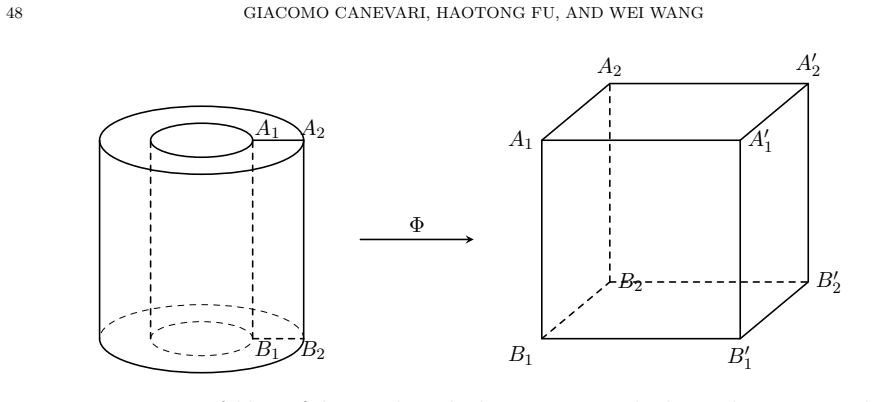
We show that the normalized energy measures converge, up to a subsequence, to a measure supported on a finite union of closed line segments connecting prescribed singularities on the boundary. The limit map is a harmonic map valued locally by minimizing N away from this singular set. We also establish uniform W^{1,q}-estimates with q in (1,2) and uniform potential estimates for minimizers, independent of the parameter epsilon. Finally, we prove that the singular set of the limiting measure solves the homotopical Plateau problem in codimension 2.
Load-bearing premise
The energy of the global minimizers grows at a logarithmic rate with respect to the small parameter epsilon.
Editorial analysis
A structured set of objections, weighed in public.
Referee Report
Summary. The manuscript studies the asymptotic behavior of global minimizers of Ginzburg-Landau-type functionals with general compact vacuum manifold N on bounded domains in R^3, restricted to the regime where the energy grows at a logarithmic rate in 1/ε. It claims that normalized energy measures converge (up to subsequence) to a measure supported on a finite union of closed line segments connecting prescribed boundary singularities; the limit map is harmonic and locally N-minimizing away from this set. The paper also claims uniform W^{1,q} estimates (q in (1,2)) and uniform potential estimates independent of ε, and that the singular set of the limiting measure solves the homotopical Plateau problem in codimension 2.
Significance. If the results hold, the work advances the analysis of singular limits for 3D Ginzburg-Landau models with general targets by supplying ε-independent estimates and linking the limiting singular set to a codimension-2 geometric variational problem. The uniform W^{1,q} and potential bounds, when valid, would be a concrete technical contribution usable in related regularity and convergence arguments.
major comments (1)
- [Abstract, §1] Abstract and §1 (regime statement): all convergence, limit-map, and estimate claims are derived under the assumption that the energy of the global minimizers grows exactly like log(1/ε). The manuscript does not appear to contain an independent proof that global minimizers attain this scaling for the given boundary data; if the minimal energy is o(log(1/ε)) or ω(log(1/ε)), the regime is empty and the stated results do not apply to the objects under study. This assumption is load-bearing for every central claim.
Simulated Author's Rebuttal
We thank the referee for the careful reading of the manuscript and for highlighting this important point about the energy regime. We address the comment below.
read point-by-point responses
-
Referee: [Abstract, §1] Abstract and §1 (regime statement): all convergence, limit-map, and estimate claims are derived under the assumption that the energy of the global minimizers grows exactly like log(1/ε). The manuscript does not appear to contain an independent proof that global minimizers attain this scaling for the given boundary data; if the minimal energy is o(log(1/ε)) or ω(log(1/ε)), the regime is empty and the stated results do not apply to the objects under study. This assumption is load-bearing for every central claim.
Authors: We agree that every stated result is conditional on the global minimizers satisfying E_ε(u_ε) ∼ log(1/ε). The paper analyzes the singular limit precisely in this regime (as indicated by the title and abstract), which arises when the boundary data and target manifold N induce a topological obstruction that forces at least logarithmic energy. We do not provide, nor claim to provide, a general lower bound establishing that the minimal energy is always of order log(1/ε) for arbitrary boundary data; such a lower bound is a separate question that depends on the homotopy class of the boundary map and is outside the scope of the present work. We will revise the abstract and the opening paragraphs of §1 to state the assumption more explicitly and to note that the results apply to global minimizers whose energy lies in this scaling regime. revision: partial
Circularity Check
No circularity; analysis is conditional on an explicit regime assumption
full rationale
The paper states its setting as the regime where the energy of global minimizers grows at a logarithmic rate with respect to ε. All stated results (convergence of normalized energy measures to a 1-rectifiable measure on line segments, limit map being harmonic and N-minimizing off the set, uniform W^{1,q} and potential estimates, and the singular set solving the homotopical Plateau problem) are derived under this scaling. No load-bearing step reduces by definition, by fitted input renamed as prediction, or by self-citation chain to the input itself. The regime is an external assumption of the problem class rather than a quantity proved inside the derivation and then reused. The provided abstract and description contain no equations or citations that exhibit the forbidden patterns.
Assumptions & free parameters
Cite this review
Pith. "Pith review of Singular Limits for Three-Dimensional Global Minimizers of Ginzburg--Landau-Type Functionals: Uniform Estimates and Singular Sets." pith.science (2026). https://pith.science/paper/Z2JFFDD7
@misc{pith2026260627691,
  author       = {Pith},
  title        = {Pith review of: Singular Limits for Three-Dimensional Global Minimizers of Ginzburg--Landau-Type Functionals: Uniform Estimates and Singular Sets},
  year         = {2026},
  howpublished = {\url{https://pith.science/paper/Z2JFFDD7}},
  note         = {Machine review of arXiv:2606.27691}
}
abstract
We study the asymptotic behavior of global minimizers of a Ginzburg--Landau-type functional with general compact vacuum manifold $\mathcal{N}$ on bounded domains in $\mathbb{R}^3$, in the regime where the energy grows at a logarithmic rate. We show that the normalized energy measures converge, up to a subsequence, to a measure supported on a finite union of closed line segments connecting prescribed singularities on the boundary. The limit map is a harmonic map valued locally by minimizing $\mathcal{N}$ away from this singular set. We also establish uniform $W^{1,q}$-estimates with $ q\in(1,2) $ and uniform potential estimates for minimizers, independent of the parameter $\varepsilon$. Finally, we prove that the singular set of the limiting measure solves the homotopical Plateau problem in codimension $2$.
Figures
Forward citations
Cited by 1 Pith paper
-
On the absence of point defects in biaxial Landau--de Gennes models
Biaxial Landau-de Gennes local minimizers have no interior point defects in the small-elastic-constant limit.
Reference graph
Works this paper leans on
-
[1]
W. K. Allard and F. J. jun. Almgren. The structure of stationary one dimensional varifolds with positive density. Invent. Math., 34:83–97, 1976
1976
-
[2]
Arroyo-Rabasa, G
A. Arroyo-Rabasa, G. De Philippis, J. Hirsch, and F. Rindler. Dimensional estimates and rectifiability for measures satisfying linear PDE constraints.Geom. Funct. Anal., 29(3):639–658, 2019
2019
-
[3]
Bethuel, H
F. Bethuel, H. Br´ ezis, and F. H´ elein. Asymptotics for the minimization of a Ginzburg-Landau functional.Calc. Var. Partial Differ. Equ., 1(2):123–148, 1993
1993
-
[4]
Bethuel, H
F. Bethuel, H. Br´ ezis, and G. Orlandi. Asymptotics for the Ginzburg-Landau equation in arbitrary dimensions. J. Funct. Anal., 186(2):432–520, 2001
2001
-
[5]
Bethuel, G
F. Bethuel, G. Orlandi, and D. Smets. Improved estimates for the Ginzburg-Landau equation: the elliptic case. Ann. Sc. Norm. Super. Pisa, Cl. Sci. (5), 4(2):319–355, 2005
2005
-
[6]
Bourgain, H
J. Bourgain, H. Br´ ezis, and P. Mironescu.H 1/2 maps with values into the circle: minimal connections, lifting, and the Ginzburg-Landau equation.Publ. Math., Inst. Hautes ´Etud. Sci., 99:1–115, 2004
2004
-
[7]
Bulanyi, J
B. Bulanyi, J. Van Schaftingen, and B. Van Vaerenbergh. Limiting behavior of minimizingp-harmonic maps in 3d aspgoes to 2 with finite fundamental group.Arch. Ration. Mech. Anal., 249(3):103, 2025. Id/No 29
2025
-
[8]
Canevari
G. Canevari. Biaxiality in the asymptotic analysis of a 2D Landau-de Gennes model for liquid crystals.ESAIM, Control Optim. Calc. Var., 21(1):101–137, 2015
2015
Show all 36 references
-
[9]
Canevari
G. Canevari. Line defects in the small elastic constant limit of a three-dimensional Landau-de Gennes model. Arch. Ration. Mech. Anal., 223(2):591–676, 2017
2017
-
[10]
Canevari and G
G. Canevari and G. Orlandi. Topological singular set of vector-valued maps. II:γ-convergence for Ginzburg- Landau type functionals.Arch. Ration. Mech. Anal., 241(2):1065–1135, 2021
2021
-
[11]
Canevari, G
H. Canevari, G. Fu and W. Wang. Asymptotics of minimizers for ginzburg–landau-type functionals in high dimensions. Preprint, arXiv:2605.04442 [math.AP] (2026), 2026
2026 arXiv
-
[12]
Contreras and X
A. Contreras and X. Lamy. Singular perturbation of manifold-valued maps with anisotropic energy.Anal. PDE, 15(6):1531–1560, 2022
2022
-
[13]
Contreras, X
A. Contreras, X. Lamy, and R. Rodiac. On the covergence of minimizers of singular perturbation functionals. Indiana Univ. Math. J., 67(4):1665–1682, 2018
2018
-
[14]
L. C. Evans and R. F. Gariepy.Measure theory and fine properties of functions. Textb. Math. Boca Raton, FL: CRC Press, revised ed. edition, 2015
2015
-
[15]
H. Fu, H. Wang, and W. Wang. Improved convergence of Landau-de Gennes minimizers in the vanishing elasticity limit. Preprint, arXiv:2507.14955 [math.AP] (2025), 2025
2025
-
[16]
H. Fu, H. Wang, and W. Wang. Uniform estimates of Landau-de Gennes minimizers in the vanishing elasticity limit with line defects. Preprint, arXiv:2508.01811 [math.AP] (2025), 2025
2025
-
[17]
Han and F
Q. Han and F. Lin.Elliptic partial differential equations, volume 1 ofCourant Lect. Notes Math.New York, NY: Courant Institute of Mathematical Sciences; Providence, RI: American Mathematical Society (AMS), 2nd ed. edition, 2011
2011
-
[18]
Hatcher.Algebraic topology
A. Hatcher.Algebraic topology. Cambridge: Cambridge University Press, 2002
2002
-
[19]
X. Lamy. Bifurcation analysis in a frustrated nematic cell.J. Nonlinear Sci., 24(6):1197–1230, 2014
2014
-
[20]
Lin and T
F. Lin and T. Rivi` ere. Complex Ginzburg-Landau equations in high dimensions and codimension two area minimizing currents.J. Eur. Math. Soc. (JEMS), 1(3):237–311, 1999
1999
-
[21]
Lin and T
F. Lin and T. Rivi` ere. A quantization property for static Ginzburg-Landau vortices.Commun. Pure Appl. Math., 54(2):206–228, 2001
2001
-
[22]
Lin and C
F. Lin and C. Wang. Harmonic and quasi-harmonic spheres.Commun. Anal. Geom., 7(2):397–429, 1999
1999
-
[23]
Lin and C
F. Lin and C. Wang.The analysis of harmonic maps and their heat flows.Hackensack, NJ: World Scientific, 2008
2008
-
[24]
Luckhaus
S. Luckhaus. Partial H¨ older continuity for minima of certain energies among maps into a Riemannian manifold. Indiana Univ. Math. J., 37(2):349–368, 1988
1988
-
[25]
Majumdar and A
A. Majumdar and A. Zarnescu. Landau-De Gennes theory of nematic liquid crystals: the Oseen-Frank limit and beyond.Arch. Ration. Mech. Anal., 196(1):227–280, 2010
2010
-
[26]
N. D. Mermin. The topological theory of defects in ordered media.Rev. Mod. Phys., 51(3):591–648, 1979
1979
-
[27]
Monteil, R
A. Monteil, R. Rodiac, and J. Van Schaftingen. Ginzburg-landau relaxation for harmonic maps on planar domains into a general compact vacuum manifold.Arch. Ration. Mech. Anal., 242(2):875–935, 2021
2021
-
[28]
Monteil, R
A. Monteil, R. Rodiac, and J. Van Schaftingen. Renormalised energies and renormalisable singular harmonic maps into a compact manifold on planar domains.Math. Ann., 383(3-4):1061–1125, 2022
2022
-
[29]
Naber and D
A. Naber and D. Valtorta. Rectifiable-Reifenberg and the regularity of stationary and minimizing harmonic maps. InProceedings of the international conference of basic science 2024, Beijing, China, July 14–26, 2024. Volume 1, pages 210–223. Somerville, MA: International Press, ...
2024
-
[30]
Nguyen and A
L. Nguyen and A. Zarnescu. Refined approximation for minimizers of a Landau-de Gennes energy functional. Calc. Var. Partial Differ. Equ., 47(1-2):383–432, 2013
2013
-
[31]
Rivi` ere
T. Rivi` ere. Asymptotic analysis for the Ginzburg-Landau equations.Boll. Unione Mat. Ital., Sez. B, Artic. Ric. Mat. (8), 2(3):537–575, 1999
1999
-
[32]
Schoen and K
R. Schoen and K. Uhlenbeck. A regularity theory for harmonic maps.J. Differ. Geom., 17:307–335, 1982
1982
-
[33]
Simon.Lectures on geometric measure theory, volume 3 ofProc
L. Simon.Lectures on geometric measure theory, volume 3 ofProc. Cent. Math. Anal. Aust. Natl. Univ.Australian National University, Centre for Mathematical Analysis, Canberra, 1983
1983
-
[34]
M. Struwe. On the asymptotic behavior of minimizers of the Ginzburg-Landau model in 2 dimensions.Differ. Integral Equ., 7(5-6):1613–1624, 1994
1994
-
[35]
Wang and Z
W. Wang and Z. Zhang. Landau-de Gennes model with sextic potentials: asymptotic behavior of minimizers. Preprint, arXiv:2404.00677 [math.AP] (2024), 2024
2024
-
[36]
B. White. The maximum principle for minimal varieties of arbitrary codimension.Commun. Anal. Geom., 18(3):421–432, 2010. Universit`a di Verona Strada Le Grazie 15, 37134 Verona, Italy Email address:giacomo.canevari@univr.it School of Mathematical Sciences, Peking University, B...
2010
Reviewed June 29, 2026 · model on record in the stance chip above.
Discussion (0). Continue with ORCID to comment.