Fast Radio Bursts as Cosmological Probes
Pith reviewed 2026-06-29 03:46 UTC · model grok-4.3
The pith
Fast radio bursts probe the cosmological distribution of baryons, universe expansion, magnetic fields, and fundamental physics via dispersion and Faraday effects.
A machine-rendered reading of the paper's core claim, the machinery that carries it, and where it could break.
Core claim
FRBs are excellent probes of the cosmological distribution of baryons, the expansion of the Universe, magnetic fields, and minuscule effects of fundamental physics that accumulate over vast distances. Synthetic FRB catalogues are used to investigate the SKA's potential to probe the Universe's expansion rate and fundamental physics, such as the equivalence principle and the existence of massive photons. Furthermore, the catalogues enable investigation of the possibility of tracing cosmic magnetic fields and investigating different dark matter candidates.
What carries the argument
Dispersion measure arising from interactions with free electrons along the line of sight, which integrates electron column density and traces baryonic matter.
If this is right
- SKA observations of FRBs can constrain the expansion rate of the universe.
- FRB data can test the equivalence principle and the existence of massive photons.
- Faraday rotation in FRBs can trace the structure of cosmic magnetic fields.
- FRB catalogs can help distinguish among different dark matter candidates.
Where Pith is reading between the lines
- If host-galaxy contributions prove smaller than assumed, FRBs could directly locate the missing baryons in the intergalactic medium.
- Cross-correlating FRB dispersion measures with galaxy surveys might isolate redshift-dependent signals without relying solely on simulations.
- Detection of any massive-photon signature would require ruling out plasma effects at similar scales first.
Load-bearing premise
The expected FRB population can be simulated accurately enough that the resulting synthetic catalogs faithfully represent the cosmological signals SKA will measure without dominant local or host-galaxy contamination.
What would settle it
If the observed distribution of dispersion measures and source rates in actual SKA data deviates substantially from the predictions of the synthetic catalogs in ways not explained by known selection effects, the forecasts would not hold.
Figures
read the original abstract
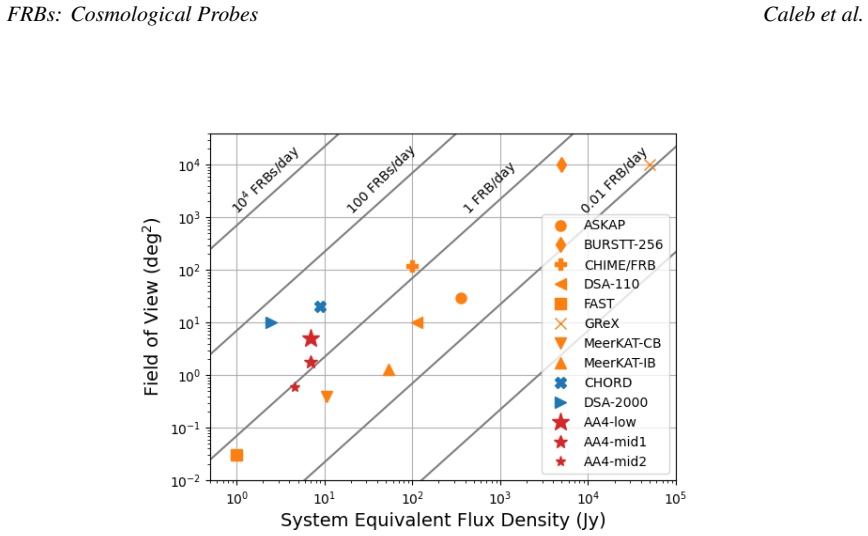
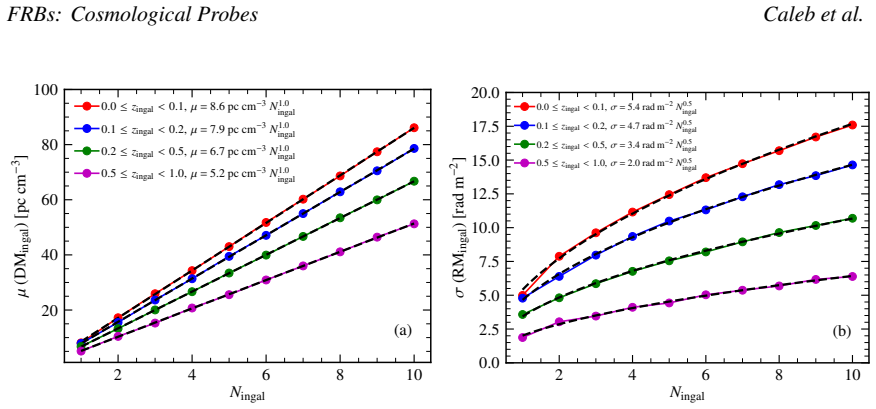
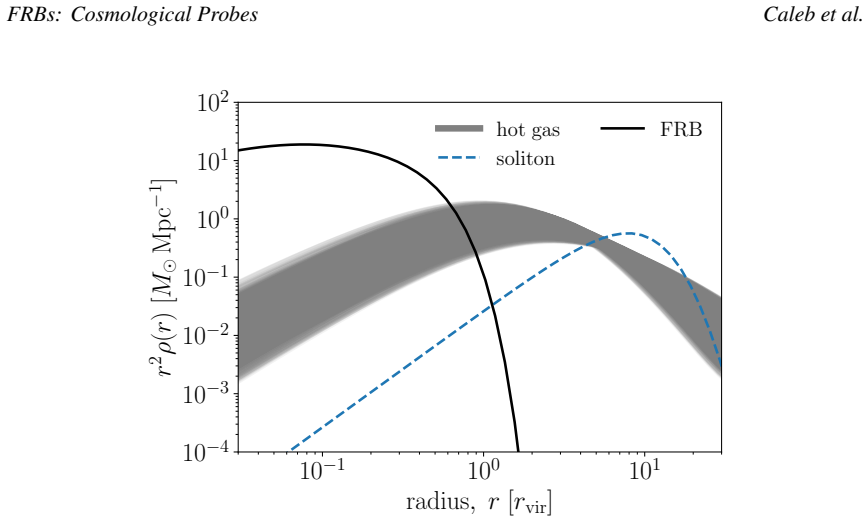
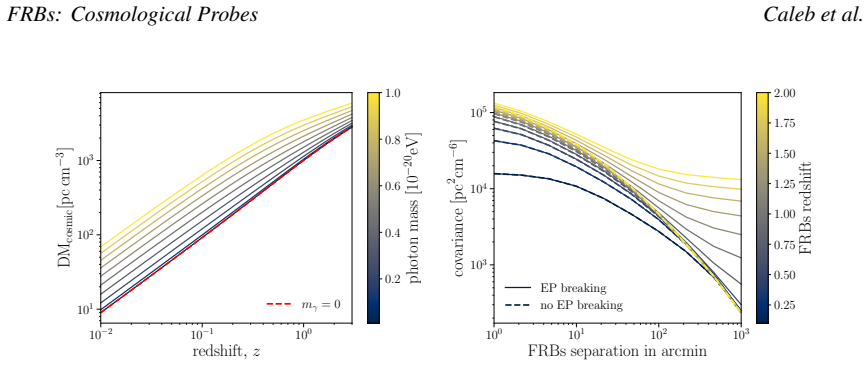
Fast radio bursts (FRBs) are brief, coherent radio pulses of extragalactic origin. They typically last from microseconds to milliseconds and have energies large enough to be visible over cosmological distances. Since FRBs interact with free electrons along their paths, the original burst is dispersed (Dispersion Measure, DM) and broadened (scattering). Furthermore, the burst's polarization is altered by Faraday rotation. Consequently, FRBs are excellent probes of the cosmological distribution of baryons, the expansion of the Universe, magnetic fields, and minuscule effects of fundamental physics that accumulate over vast distances. This chapter is the second of a trilogy of FRB chapters and discusses FRBs as a standalone probe. We first introduce the foundation of FRB observables related to those questions. Next, we lay the groundwork for forecasting SKA's potential by describing the method to simulate the expected FRB population observable with the SKA. These synthetic FRB catalogues are then used to investigate the SKA's potential to probe the Universe's expansion rate and fundamental physics, such as the equivalence principle and the existence of massive photons. Furthermore, we investigate the possibility of tracing cosmic magnetic fields and investigating different dark matter candidates.
Editorial analysis
A structured set of objections, weighed in public.
Referee Report
Summary. The manuscript introduces FRB observables (DM, scattering, RM) as probes of baryon distribution, expansion history, magnetic fields and fundamental physics; it then describes a method to simulate the SKA-observable FRB population and uses the resulting synthetic catalogs to forecast SKA constraints on the expansion rate, equivalence principle, massive photons, cosmic magnetic fields and dark-matter candidates.
Significance. If the synthetic catalogs accurately isolate cosmological signals, the chapter would supply concrete SKA forecast benchmarks that synthesize existing literature on FRB observables and population modeling.
major comments (1)
- [Simulation method (post-abstract description of synthetic catalog generation)] The central forecasts for SKA constraints on expansion history, equivalence principle, massive photons and magnetic fields rest on the fidelity of the simulated FRB catalogs. The manuscript does not demonstrate that the assumed redshift, luminosity and host-galaxy distributions have been validated against the current observed FRB sample so that host and local contributions remain sub-dominant to the cosmological terms that SKA will actually measure.
minor comments (2)
- Clarify which parts of the simulation pipeline are taken from prior literature and which steps constitute new implementation choices for this chapter.
- Ensure that any quantitative forecast results are accompanied by explicit statements of the input assumptions (e.g., host DM distribution parameters) so readers can assess sensitivity.
Simulated Author's Rebuttal
We thank the referee for their thoughtful review and for highlighting the importance of validating the simulated FRB population against existing observations. We address the single major comment below and have revised the manuscript to strengthen the presentation of the simulation methodology.
read point-by-point responses
-
Referee: The central forecasts for SKA constraints on expansion history, equivalence principle, massive photons and magnetic fields rest on the fidelity of the simulated FRB catalogs. The manuscript does not demonstrate that the assumed redshift, luminosity and host-galaxy distributions have been validated against the current observed FRB sample so that host and local contributions remain sub-dominant to the cosmological terms that SKA will actually measure.
Authors: We agree that explicit validation against the observed sample is essential for the credibility of the forecasts. The input distributions in Section 3 are drawn from published analyses of the CHIME/FRB and ASKAP catalogs (redshift evolution tied to the cosmic star-formation rate, luminosity function from the latest fluence-complete samples, and host DM contributions calibrated on the 20+ localized FRBs with spectroscopic redshifts). However, the original text did not include a direct side-by-side comparison. We have therefore added a new subsection (3.4) that (i) overlays the simulated redshift, luminosity, and excess-DM distributions on the current observed sample and (ii) quantifies the fractional contribution of host/local terms as a function of redshift for the SKA-detectable population, showing that cosmological terms dominate above z≈0.5. This revision directly addresses the referee’s concern while preserving the original simulation framework. revision: yes
Circularity Check
No circularity: review chapter draws observables and simulation methods from external literature
full rationale
The paper is explicitly a review chapter that introduces FRB observables (DM, scattering, RM) and the method for generating synthetic FRB catalogs from prior literature. No derivation chain within the text reduces a claimed prediction or result to a quantity defined or fitted inside the same work; forecasts for SKA constraints are presented as applications of established simulation techniques rather than self-contained derivations. The central claims rest on external references for the underlying models, satisfying the condition for a self-contained review without load-bearing self-definition or fitted-input renaming.
Axiom & Free-Parameter Ledger
axioms (2)
- domain assumption FRBs are of extragalactic origin and their observed dispersion measure is dominated by the integrated electron column along the line of sight.
- domain assumption The FRB population statistics and host-galaxy contributions can be modeled sufficiently well to produce synthetic catalogs whose cosmological signals match future SKA observations.
Reference graph
Works this paper leans on
-
[1]
2026 ,publisher =
Manisha Caleb and author2 and author3 and author4 and author5 ,title =. 2026 ,publisher =
2026
-
[2]
Curtin and author2 and author3 and author4 and author5 ,title =
Alice P. Curtin and author2 and author3 and author4 and author5 ,title =. 2026 ,publisher =
2026
-
[3]
Fast Radio Bursts as Cosmological Probes , eprint =
Caleb, Manisha and Fortunato, J\´. Fast Radio Bursts as Cosmological Probes , eprint =. doi:, journal =
-
[4]
and Gawro\´
Curtin, Alice P. and Gawro\´. The astrophysics of fast radio bursts , eprint =. doi:, journal =
-
[5]
BURSTT: Bustling Universe Radio Survey Telescope in Taiwan. , keywords =. doi:10.1088/1538-3873/ac8f71 , archivePrefix =. 2206.08983 , primaryClass =
-
[6]
CRAFTS for Fast Radio Bursts: Extending the Dispersion-Fluence Relation with New FRBs Detected by FAST. , keywords =. doi:10.3847/2041-8213/abe7f0 , archivePrefix =. 2102.10546 , primaryClass =
-
[7]
Asking Fast Radio Bursts for More than Reionization History. arXiv e-prints , keywords =. doi:10.48550/arXiv.2409.03255 , archivePrefix =. 2409.03255 , primaryClass =
-
[8]
Revealing the cosmic reionization history with fast radio bursts in the era of Square Kilometre Array. , keywords =. doi:10.1093/mnras/stab186 , archivePrefix =. 2101.08798 , primaryClass =
-
[9]
Detecting helium reionization with fast radio bursts. , keywords =. doi:10.1103/PhysRevD.101.103019 , archivePrefix =. 2001.11517 , primaryClass =
-
[10]
Forecasts for Helium Reionization Detection with Fast Radio Bursts in the Era of Square Kilometre Array. , keywords =. doi:10.3847/1538-4357/ad82e4 , archivePrefix =. 2409.01543 , primaryClass =
-
[11]
Stellar Mass Dispersion Measure Correlations Constrain Baryonic Feedback in Fast Radio Burst Host Galaxies. , keywords =. doi:10.3847/2041-8213/ae044d , archivePrefix =. 2507.16816 , primaryClass =
-
[12]
The DSA-2000 -- A Radio Survey Camera
The DSA-2000 A Radio Survey Camera. , year = 2019, volume =. doi:10.48550/arXiv.1907.07648 , archivePrefix =. 1907.07648 , primaryClass =
work page internal anchor Pith review Pith/arXiv arXiv doi:10.48550/arxiv.1907.07648 2000
-
[13]
Canadian Long Range Plan for Astronomy and Astrophysics White Papers , year = 2019, volume =
The Canadian Hydrogen Observatory and Radio-transient Detector (CHORD). Canadian Long Range Plan for Astronomy and Astrophysics White Papers , year = 2019, volume =. doi:10.5281/zenodo.3765414 , archivePrefix =. 1911.01777 , primaryClass =
-
[14]
Two-screen scattering in CRAFT FRBs. MNRAS , keywords =. doi:10.1093/mnras/stad2631 , archivePrefix =. 2305.11477 , primaryClass =
-
[15]
The Open Journal of Astrophysics , keywords =
An analytical model for the dispersion measure of Fast Radio Burst host galaxies. The Open Journal of Astrophysics , keywords =. doi:10.33232/001c.143819 , archivePrefix =. 2411.17682 , primaryClass =
-
[16]
The Large Dispersion and Scattering of FRB 20190520B Are Dominated by the Host Galaxy. , keywords =. doi:10.3847/1538-4357/ac6504 , archivePrefix =. 2202.13458 , primaryClass =
-
[17]
Scintillometry of fast radio bursts: Resolution effects in two-screen models. , keywords =. doi:10.1051/0004-6361/202554202 , archivePrefix =. 2505.04576 , primaryClass =
-
[18]
Galactic and Intergalactic Magnetic Fields
-
[19]
doi:10.1017/9781139046657 , adsurl =
Astrophysical Magnetic Fields: From Galaxies to the Early Universe. doi:10.1017/9781139046657 , adsurl =
-
[20]
The Protogalactic Origin for Cosmic Magnetic Fields
The Protogalactic Origin for Cosmic Magnetic Fields. , keywords =. doi:10.1086/303987 , archivePrefix =. astro-ph/9607141 , primaryClass =
work page internal anchor Pith review Pith/arXiv arXiv doi:10.1086/303987
-
[21]
The origin, evolution and signatures of primordial magnetic fields
The origin, evolution and signatures of primordial magnetic fields. Reports on Progress in Physics , keywords =. doi:10.1088/0034-4885/79/7/076901 , archivePrefix =. 1504.02311 , primaryClass =
work page internal anchor Pith review Pith/arXiv arXiv doi:10.1088/0034-4885/79/7/076901
-
[22]
Seed magnetic fields in turbulent small-scale dynamos. , keywords =. doi:10.1093/mnras/staa2978 , archivePrefix =. 2009.12024 , primaryClass =
-
[23]
Magnetic Fields in Spiral Galaxies
Magnetic fields in spiral galaxies. , keywords =. doi:10.1007/s00159-015-0084-4 , archivePrefix =. 1509.04522 , primaryClass =
work page internal anchor Pith review Pith/arXiv arXiv doi:10.1007/s00159-015-0084-4
-
[24]
Magnetic Fields in the Milky Way
Magnetic Fields in the Milky Way. Magnetic Fields in Diffuse Media , year = 2015, editor =. doi:10.1007/978-3-662-44625-6_17 , archivePrefix =. 1406.0283 , primaryClass =
work page internal anchor Pith review Pith/arXiv arXiv doi:10.1007/978-3-662-44625-6_17 2015
-
[25]
Magnetic fields in the multiphase interstellar medium of the Milky Way: turbulent kinetic and magnetic energy density relation. , keywords =. doi:10.1093/mnras/staf520 , archivePrefix =. 2503.23634 , primaryClass =
-
[26]
doi:10.1007/978-94-009-2835-0 , adsurl =
Magnetic Fields of Galaxies. doi:10.1007/978-94-009-2835-0 , adsurl =
-
[27]
Astrophysical magnetic fields and nonlinear dynamo theory
Astrophysical magnetic fields and nonlinear dynamo theory. , keywords =. doi:10.1016/j.physrep.2005.06.005 , archivePrefix =. astro-ph/0405052 , primaryClass =
work page internal anchor Pith review Pith/arXiv arXiv doi:10.1016/j.physrep.2005.06.005 2005
-
[28]
Journal of Plasma Physics , keywords =
Dynamo theories. Journal of Plasma Physics , keywords =. doi:10.1017/S0022377819000539 , archivePrefix =. 1903.07829 , primaryClass =
-
[29]
Simulations of small-scale turbulent dynamo
Simulations of the Small-Scale Turbulent Dynamo. , keywords =. doi:10.1086/422547 , archivePrefix =. astro-ph/0312046 , primaryClass =
work page internal anchor Pith review Pith/arXiv arXiv doi:10.1086/422547
-
[30]
Simulations of nonhelical hydromagnetic turbulence
Simulations of nonhelical hydromagnetic turbulence. , keywords =. doi:10.1103/PhysRevE.70.016308 , archivePrefix =. astro-ph/0307059 , primaryClass =
work page internal anchor Pith review Pith/arXiv arXiv doi:10.1103/physreve.70.016308
-
[31]
Physical Review Fluids , keywords =
Saturation mechanism of the fluctuation dynamo at Pr _ M 1. Physical Review Fluids , keywords =. doi:10.1103/PhysRevFluids.5.043702 , archivePrefix =. 2003.07997 , primaryClass =
-
[32]
The supernova-regulated ISM. II. The mean magnetic field
The supernova-regulated ISM - II. The mean magnetic field. , keywords =. doi:10.1093/mnrasl/sls042 , archivePrefix =. 1206.6784 , primaryClass =
work page internal anchor Pith review Pith/arXiv arXiv doi:10.1093/mnrasl/sls042
-
[33]
Physical Review Fluids , keywords =
Saturation mechanism of the fluctuation dynamo in supersonic turbulent plasmas. Physical Review Fluids , keywords =. doi:10.1103/PhysRevFluids.6.103701 , archivePrefix =. 2109.11698 , primaryClass =
-
[34]
The Small-scale Dynamo in a Multiphase Supernova-driven Medium. , keywords =. doi:10.3847/1538-4357/acac20 , archivePrefix =. 2210.04460 , primaryClass =
-
[35]
Faraday Rotation from Magnesium II Absorbers towards Polarized Background Radio Sources
Faraday Rotation from Magnesium II Absorbers toward Polarized Background Radio Sources. , keywords =. doi:10.1088/0004-637X/795/1/63 , archivePrefix =. 1406.2526 , primaryClass =
work page internal anchor Pith review Pith/arXiv arXiv doi:10.1088/0004-637x/795/1/63
-
[36]
Magnetic fields in elliptical galaxies: using the Laing-Garrington effect in radio galaxies and polarized emission from background radio sources. , keywords =. doi:10.1093/mnras/stab2500 , archivePrefix =. 2108.12793 , primaryClass =
-
[37]
Constraints on large-scale magnetic fields in the intergalactic medium using cross-correlation methods. , keywords =. doi:10.1093/mnras/stab564 , archivePrefix =. 2102.11312 , primaryClass =
-
[38]
Role of Intervening Mg II Absorbers on the Rotation Measure and Fractional Polarization of the Background Quasars. , keywords =. doi:10.3847/1538-4357/ab6bd5 , archivePrefix =. 1710.10396 , primaryClass =
-
[39]
Strong magnetic fields in normal galaxies at high redshifts
Strong magnetic fields in normal galaxies at high redshift. , keywords =. doi:10.1038/nature07105 , archivePrefix =. 0807.3347 , primaryClass =
work page internal anchor Pith review Pith/arXiv arXiv doi:10.1038/nature07105
-
[40]
Detection of microgauss coherent magnetic fields in a galaxy five billion years ago
Detection of microgauss coherent magnetic fields in a galaxy five billion years ago. Nature Astronomy , keywords =. doi:10.1038/s41550-017-0218-x , archivePrefix =. 1708.07844 , primaryClass =
work page internal anchor Pith review Pith/arXiv arXiv doi:10.1038/s41550-017-0218-x
-
[41]
The halo magnetic field of a spiral galaxy at z=0.414. arXiv e-prints , keywords =. doi:10.48550/arXiv.2507.12542 , archivePrefix =. 2507.12542 , primaryClass =
-
[42]
Magnetizing the circumgalactic medium of disc galaxies. , keywords =. doi:10.1093/mnras/staa2530 , archivePrefix =. 1911.11163 , primaryClass =
-
[43]
The effect of magnetic fields on properties of the circumgalactic medium. , keywords =. doi:10.1093/mnras/staa3938 , archivePrefix =. 2008.07537 , primaryClass =
-
[44]
Fast Radio Bursts as Probes of Magnetic Fields in the Intergalactic Medium
Fast Radio Bursts as Probes of Magnetic Fields in the Intergalactic Medium. , keywords =. doi:10.3847/0004-637X/824/2/105 , archivePrefix =. 1602.03235 , primaryClass =
work page internal anchor Pith review Pith/arXiv arXiv doi:10.3847/0004-637x/824/2/105
-
[45]
Fast radio burst dispersion measures and rotation measures and the origin of intergalactic magnetic fields. , keywords =. doi:10.1093/mnras/stz2033 , archivePrefix =. 1907.09650 , primaryClass =
-
[46]
Redshift estimates for fast radio bursts and implications on intergalactic magnetic fields. , keywords =. doi:10.1093/mnras/staa2572 , archivePrefix =. 2008.10536 , primaryClass =
-
[47]
Dispersion and rotation measures from fast radio burst (FRB) host galaxies based on the TNG50 simulation. , keywords =. doi:10.1051/0004-6361/202347459 , archivePrefix =. 2407.16748 , primaryClass =
-
[48]
Understanding gas mixing in the circumgalactic medium. , keywords =. doi:10.1093/mnras/staf1066 , archivePrefix =. 2505.21980 , primaryClass =
-
[49]
Structure functions with higher-order stencils as a probe to separate small- and large-scale magnetic fields. , keywords =. doi:10.1093/mnras/stae1935 , archivePrefix =. 2408.04156 , primaryClass =
-
[50]
A New Limit on Intergalactic Magnetic Fields on Subkiloparsec Scales from Fast Radio Bursts. , keywords =. doi:10.3847/2041-8213/acc3a1 , archivePrefix =. 2301.08259 , primaryClass =
-
[51]
The magnetic field and turbulence of the cosmic web measured using a brilliant fast radio burst
The magnetic field and turbulence of the cosmic web measured using a brilliant fast radio burst. Science , keywords =. doi:10.1126/science.aaf6807 , archivePrefix =. 1611.05758 , primaryClass =
work page internal anchor Pith review Pith/arXiv arXiv doi:10.1126/science.aaf6807
-
[52]
Cosmological Magnetic Fields: Their Generation, Evolution and Observation
Cosmological magnetic fields: their generation, evolution and observation. , keywords =. doi:10.1007/s00159-013-0062-7 , archivePrefix =. 1303.7121 , primaryClass =
work page internal anchor Pith review Pith/arXiv arXiv doi:10.1007/s00159-013-0062-7
-
[53]
The First Magnetic Fields. , keywords =. doi:10.1007/s11214-011-9833-5 , archivePrefix =. 1109.4052 , primaryClass =
work page internal anchor Pith review Pith/arXiv arXiv doi:10.1007/s11214-011-9833-5
-
[54]
Faraday Rotation Measure Synthesis
Faraday rotation measure synthesis. , keywords =. doi:10.1051/0004-6361:20052990 , archivePrefix =. astro-ph/0507349 , primaryClass =
work page internal anchor Pith review Pith/arXiv arXiv doi:10.1051/0004-6361:20052990
-
[55]
The Structure of the Milky Way's Hot Gas Halo
The Structure of the Milky Way's Hot Gas Halo. , keywords =. doi:10.1088/0004-637X/770/2/118 , archivePrefix =. 1305.2430 , primaryClass =
work page internal anchor Pith review Pith/arXiv arXiv doi:10.1088/0004-637x/770/2/118
-
[56]
A Correlation Between FRB Dispersion Measure and Foreground Large-Scale Structure. arXiv e-prints , keywords =. doi:10.48550/arXiv.2506.04186 , archivePrefix =. 2506.04186 , primaryClass =
-
[57]
Column Density, Kinematics, and Thermal State of Metal-bearing Gas within the Virial Radius of z 2 Star-forming Galaxies in the Keck Baryonic Structure Survey. , keywords =. doi:10.3847/1538-4357/ab4255 , archivePrefix =. 1903.00004 , primaryClass =
-
[58]
Refractive lensing of scintillating FRBs by subparsec cloudlets in the multiphase CGM. PNAS , keywords =. doi:10.1073/pnas.2406783121 , archivePrefix =. 2309.07256 , primaryClass =
-
[59]
Microphysics of Circumgalactic Turbulence Probed by Fast Radio Bursts and Quasars. , keywords =. doi:10.3847/1538-4357/ade0bc , archivePrefix =. 2503.02329 , primaryClass =
-
[60]
Radio wave scattering by circumgalactic cool gas clumps
Radio wave scattering by circumgalactic cool gas clumps. MNRAS , keywords =. doi:10.1093/mnras/sty2948 , archivePrefix =. 1811.10876 , primaryClass =
work page internal anchor Pith review Pith/arXiv arXiv doi:10.1093/mnras/sty2948
-
[61]
A Characteristic Scale for Cold Gas
A characteristic scale for cold gas. MNRAS , keywords =. doi:10.1093/mnras/stx2687 , archivePrefix =. 1610.01164 , primaryClass =
work page internal anchor Pith review Pith/arXiv arXiv doi:10.1093/mnras/stx2687
-
[62]
Key Physical Processes in the Circumgalactic Medium. , keywords =. doi:10.1146/annurev-astro-052920-125203 , archivePrefix =. 2301.10253 , primaryClass =
-
[63]
The Circumgalactic Medium. , keywords =. doi:10.1146/annurev-astro-091916-055240 , archivePrefix =. 1709.09180 , primaryClass =
work page internal anchor Pith review Pith/arXiv arXiv doi:10.1146/annurev-astro-091916-055240
-
[64]
Anticipated Performance of the Square Kilometre Array -- Phase 1 (SKA1). arXiv e-prints , keywords =. doi:10.48550/arXiv.1912.12699 , archivePrefix =. 1912.12699 , primaryClass =
-
[65]
2015 , publisher=
Advancing Astrophysics with the Square Kilometre Array (AASKA14) , author=. 2015 , publisher=
2015
-
[66]
Ryder, S. D. and Bannister, K. W. and Bhandari, S. and Deller, A. T. and Ekers, R. D. and Glowacki, M. and Gordon, A. C. and Gourdji, K. and James, C. W. and Kilpatrick, C. D. and Lu, W. and Marnoch, L. and Moss, V. A. and Prochaska, J. X. and Qiu, H. and Sadler, E. M. and Simha, S. and Sammons, M. W. and Scott, D. R. and Tejos, N. and Shannon, R. M. , jo...
-
[68]
, title =. 2022 , month = aug, number =. arXiv , doi =:2201.07869 , groups =
arXiv 2022
- [69]
-
[70]
Shannon, R. M. and Bannister, K. W. and Bera, A. and Bhandari, S. and Day, C. K. and Deller, A. T. and Dial, T. and Dobie, D. and Ekers, R. D. and Fong, W. f. and Glowacki, M. and Gordon, A. C. and Gourdji, K. and Jaini, A. and James, C. W. and Kumar, P. and Mahony, E. K. and Marnoch, L. and Muller, A. R. and Prochaska, J. X. and Qiu, H. and Ryder, S. D. ...
- [71]
-
[72]
Law, C. J. and Sharma, K. and Ravi, V. and Chen, G. and Catha, M. and Connor, L. and Faber, J. T. and Hallinan, G. and Harnach, C. and Hellbourg, G. and Hobbs, R. and Hodge, D. and Hodges, M. and Lamb, J. W. and Rasmussen, P. and Sherman, M. B. and Shi, J. and Simard, D. and Squillace, R. and Weinreb, S. and Woody, D. P. and Yadlapalli, N. , journal =. De...
-
[73]
Trudu, M. and Possenti, A. and Pilia, M. and Bailes, M. and Keane, E. F. and Kramer, M. and Balakrishnan, V. and Bhandari, S. and Bhat, N. D. R. and Burgay, M. and Cameron, A. and Champion, D. J. and Jameson, A. and Johnston, S. and Keith, M. J. and Levin, L. and Ng, C. and Sengar, R. and Tiburzi, C. , journal =. Eighteen new fast radio bursts in the High...
-
[75]
Thornton, D. and Stappers, B. and Bailes, M. and Barsdell, B. and Bates, S. and Bhat, N. D. R. and Burgay, M. and Burke-Spolaor, S. and Champion, D. J. and Coster, P. and D'Amico, N. and Jameson, A. and Johnston, S. and Keith, M. and Kramer, M. and Levin, L. and Milia, S. and Ng, C. and Possenti, A. and van Straten, W. , journal =. A Population of Fast Ra...
-
[76]
Tanseri, Isabelle and Hagstotz, Steffen and Vagnozzi, Sunny and Giusarma, Elena and Freese, Katherine. Updated neutrino mass constraints from galaxy clustering and CMB lensing-galaxy cross-correlation measurements. JHEAp. 2022. doi:10.1016/j.jheap.2022.07.002. arXiv:2207.01913
-
[77]
Constraining baryonic feedback and cosmology with weak-lensing, X-ray, and kinematic Sunyaev-Zeldovich observations. , keywords =. doi:10.1093/mnras/stac1493 , archivePrefix =. 2110.02228 , primaryClass =
-
[78]
Core Cosmology Library: Precision Cosmological Predictions for LSST. , keywords =. doi:10.3847/1538-4365/ab1658 , archivePrefix =. 1812.05995 , primaryClass =
-
[79]
Quantifying baryon effects on the matter power spectrum and the weak lensing shear correlation
Quantifying baryon effects on the matter power spectrum and the weak lensing shear correlation. , keywords =. doi:10.1088/1475-7516/2019/03/020 , archivePrefix =. 1810.08629 , primaryClass =
work page internal anchor Pith review Pith/arXiv arXiv doi:10.1088/1475-7516/2019/03/020 2019
-
[80]
A new method to quantify the effects of baryons on the matter power spectrum
A new method to quantify the effects of baryons on the matter power spectrum. , keywords =. doi:10.1088/1475-7516/2015/12/049 , archivePrefix =. 1510.06034 , primaryClass =
work page internal anchor Pith review Pith/arXiv arXiv doi:10.1088/1475-7516/2015/12/049 2015
-
[81]
Emulation of baryonic effects on the matter power spectrum and constraints from galaxy cluster data. , keywords =. doi:10.1088/1475-7516/2021/12/046 , archivePrefix =. 2108.08863 , primaryClass =
-
[82]
From Milky Way-like groups to massive clusters
The hot gas mass fraction in halos. From Milky Way-like groups to massive clusters. arXiv e-prints , keywords =. doi:10.48550/arXiv.2411.16555 , archivePrefix =. 2411.16555 , primaryClass =
discussion (0)
Sign in with ORCID, Apple, or X to comment. Anyone can read and Pith papers without signing in.