REVIEW 3 minor 84 references
Robust and Scalable Sure Screening of Fixed effects in Ultrahigh-dimensional Linear Mixed Models
T0 review · 0 major / 3 minor · reviewed 2026-06-29 · grok-4.3
Pith's one-line read DPD-SISP retains all relevant fixed effects with high probability in ultrahigh-dimensional linear mixed models even under contamination.
desk verdict DPD-SISP gives a proxy-transform plus DPD screening method for fixed effects in ultrahigh-dim LMMs when random effects are known, with sure-screening claims and robustness analysis. read the letter →
The pith
A machine-rendered reading of the paper's core claim, the machinery that carries it, and where it could break.
The reading
What carries the argument
Proxy-based transformation that decouples random-effects dependence, followed by minimum density power divergence marginal utilities for ranking covariates.
What would settle it
A dataset with known random effects, contaminated observations, and at least one relevant fixed effect that DPD-SISP consistently fails to retain across repeated samples.
Extended reading notes
Core claim
The DPD-SISP procedure, constructed from a proxy transformation followed by minimum density power divergence marginal utilities, satisfies the sure screening property: every relevant fixed-effect covariate is retained with probability at least 1 minus a term that decays exponentially in sample size, under conditions that permit non-Gaussian errors and dimensionality that grows faster than any polynomial in the sample size. The same construction also delivers bounded influence functions and positive breakdown points, confirming robustness to contamination.
Load-bearing premise
The random effects are treated as known, which is required for the proxy transformation to remove their induced dependence.
Editorial extensions
If this is right
- All relevant fixed effects are retained with exponentially high probability under general error distributions.
- The procedure remains stable under data contamination and model misspecification.
- It extends directly to conditional screening that incorporates prior information and to iterative refinement that reduces correlation masking.
- Post-screening robust estimation of the retained fixed effects is feasible within the same framework.
Reading between the lines
- If random effects can be estimated accurately from a pilot fit, the transformation step may still be usable in practice.
- The same divergence-based utilities could be paired with other dependence-removing transformations in models beyond linear mixed effects.
- Iterative refinement steps may also improve performance when covariates exhibit strong multicollinearity even without random effects.
Editorial analysis
A structured set of objections, weighed in public.
Referee Report
Summary. The manuscript proposes the DPD-SISP procedure for sure screening of fixed-effects covariates in ultrahigh-dimensional linear mixed models under the assumption of known random effects. A proxy-based transformation decouples the dependence induced by random effects, after which marginal utilities are constructed via minimum density power divergence to achieve robustness to contamination and misspecification. The central theoretical result is that DPD-SISP retains all relevant covariates with exponentially high probability under general conditions that allow non-Gaussian errors and nonpolynomial growth of dimensionality. The paper also supplies influence-function and breakdown-point analyses, extensions to conditional screening and iterative refinement, post-screening estimation, simulation studies, and an application to ADNI2 longitudinal data.
Significance. If the stated exponential-probability bounds and robustness properties hold under the given conditions, the work supplies a scalable, theoretically grounded screening method that directly addresses contamination and random-effects dependence in LMMs. The combination of sure-screening guarantees, explicit robustness metrics, and practical extensions (conditional screening, iteration) would be a useful addition to the ultrahigh-dimensional screening literature, particularly for longitudinal or clustered data applications.
minor comments (3)
- [Introduction / Abstract] The abstract and introduction repeatedly emphasize the 'known random effects' setting; a brief discussion of the practical consequences when random effects must be estimated (e.g., plug-in estimation error propagating into the proxy transformation) would strengthen the scope statement.
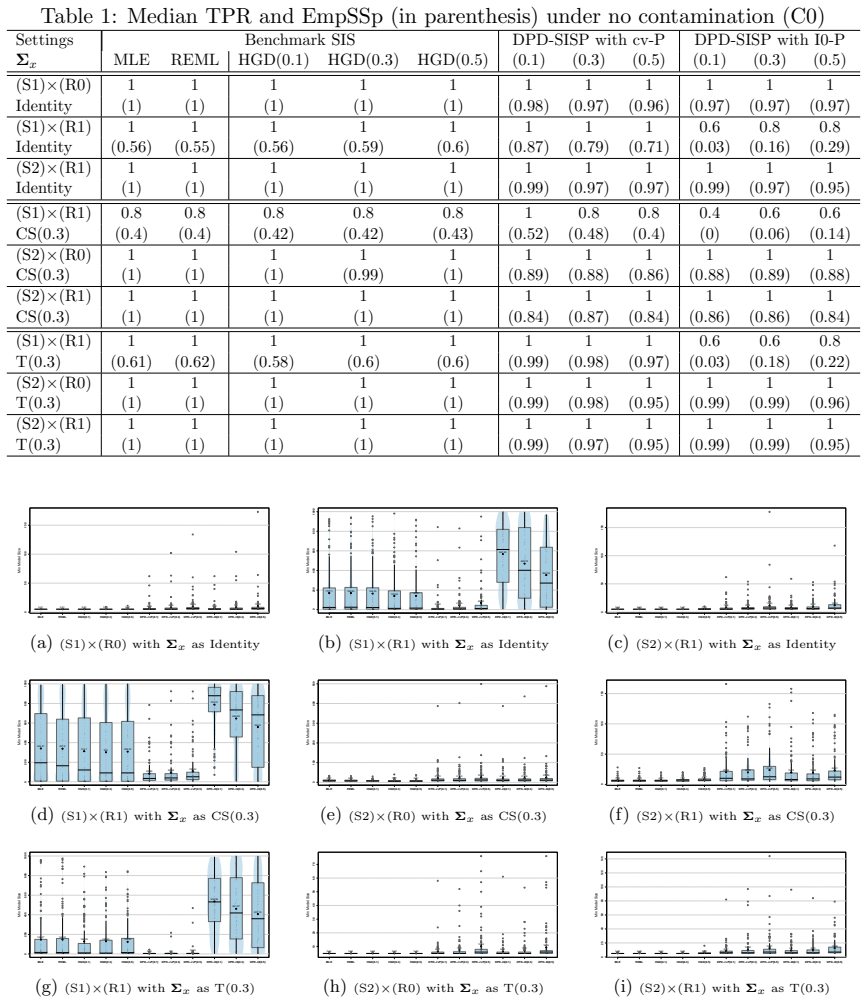
- [Simulation studies] Simulation tables should explicitly report the exact contamination fractions, the growth rate p/n, and the achieved sure-screening probability across replications so that readers can directly compare the exponential-probability claim with finite-sample behavior.
- [Method / Notation] Notation for the density-power-divergence tuning parameter and the proxy transformation matrix should be introduced once with a single consistent symbol and then used uniformly; occasional redefinition risks confusion in the theoretical sections.
Simulated Author's Rebuttal
We thank the referee for the positive assessment of our manuscript proposing the DPD-SISP procedure for robust sure screening of fixed effects in ultrahigh-dimensional linear mixed models. The recommendation for minor revision is appreciated, and we will incorporate improvements to enhance clarity, presentation, and any minor points raised.
Circularity Check
No significant circularity detected
full rationale
The paper's central claims consist of theoretical sure-screening guarantees for DPD-SISP under explicitly stated conditions (known random effects, proxy transformation, minimum density-power-divergence utilities). These are presented as derived results with exponential probability bounds, allowing non-Gaussian errors and ultrahigh dimensionality, rather than any fitted parameter being relabeled as a prediction. No self-citations, ansatzes, or uniqueness theorems are invoked in the provided text to support the load-bearing steps, and the derivation chain remains independent of its own outputs.
Assumptions & free parameters
free parameters (1)
- DPD tuning parameter
assumptions (2)
- domain assumption Random effects are known
- domain assumption General conditions allowing non-Gaussian errors and nonpolynomial dimensionality growth
Cite this review
Pith. "Pith review of Robust and Scalable Sure Screening of Fixed effects in Ultrahigh-dimensional Linear Mixed Models." pith.science (2026). https://pith.science/paper/UTN4ZVLJ
@misc{pith2026260627789,
  author       = {Pith},
  title        = {Pith review of: Robust and Scalable Sure Screening of Fixed effects in Ultrahigh-dimensional Linear Mixed Models},
  year         = {2026},
  howpublished = {\url{https://pith.science/paper/UTN4ZVLJ}},
  note         = {Machine review of arXiv:2606.27789}
}
read the original abstract
In modern applications of linear mixed models, the number of candidate fixed-effects covariates can grow exponentially with the sample size, while dependence induced by random effects and possible data contamination pose substantial challenges for existing variable screening methods. We propose a robust and computationally efficient sure screening procedure for identifying relevant fixed-effects covariates in ultrahigh-dimensional linear mixed models with known random effects. The proposed method leverages a proxy-based transformation to decouple dependence induced by random effects, enabling screening via marginal analysis in a transformed regression model. Robustness is achieved by constructing marginal utilities based on minimum density power divergence, yielding stability under data contamination and model misspecification without sacrificing scalability. The resulting procedure, termed DPD-SISP, is shown to retain all relevant covariates (sure screening property) with exponentially high probability under general conditions, allowing for non-Gaussian errors and nonpolynomial growth of dimensionality. In addition, DPD-SISP exhibits strong robustness properties supported by influence function and breakdown point analyses. The framework is further extended to incorporate prior information through conditional screening, mitigate correlation-induced masking via iterative refinement, and enable robust post-screening estimation of fixed effects. Extensive simulation studies demonstrate competitive performance of DPD-SISP under ideal settings and substantial gains in stability under data contamination. Its practical utility is illustrated through an application to high-dimensional longitudinal data from the ADNI2 study. The proposed framework thus provides a unified, robust, and scalable approach for variable screening in ultrahigh-dimensional linear mixed models.
Figures


Figures from the paper (3 more)


Reference graph
Works this paper leans on
-
[1]
and Yohai, V
Agostinelli, C. and Yohai, V. J. (2016). Composite robust estimators for linear mixed models. Journal of the American Statistical Association , 111(516):1764--1774
2016
-
[2]
and Shang, J
Alabiso, A. and Shang, J. (2023). High-dimensional linear mixed model selection by partial correlation. Communications in Statistics-Theory and Methods , 52(18):6355--6380
2023
-
[3]
and Tang, N
Bai, Y. and Tang, N. (2026). Model-free feature screening for ultrahigh dimensional data with responses missing not at random. Journal of Multivariate Analysis , page 105605
2026
-
[4]
Barut, E., Fan, J., and Verhasselt, A. (2016). Conditional sure independence screening. Journal of the American Statistical Association , 111(515):1266--1277
2016
-
[5]
Basu, A., Ghosh, A., and Pardo, L. (2026). Statistical Inference based on the Density Power Divergence: The Robustness Perspective . Chapman and Hall/CRC
2026
-
[6]
R., Hjort, N
Basu, A., Harris, I. R., Hjort, N. L., and Jones, M. (1998). Robust and efficient estimation by minimising a density power divergence. Biometrika , 85(3):549--559
1998
-
[7]
Basu, A., Shioya, H., and Park, C. (2011). Statistical inference: the minimum distance approach . CRC press
2011
-
[8]
independent components
Bell, A. J. and Sejnowski, T. J. (1997). The “independent components” of natural scenes are edge filters. Vision research , 37(23):3327--3338
1997
Show all 84 references
-
[9]
Bradic, J., Claeskens, G., and Gueuning, T. (2020). Fixed effects testing in high-dimensional linear mixed models. Journal of the American Statistical Association , 115(532):pp. 1835--1850
2020
-
[10]
Bratsberg, A., Ghosh, A., and Thoresen, M. (2024). Conditional variable screening for ultra-high dimensional longitudinal data with time interactions. Biometrical Journal , 66(8):e70005
2024
-
[11]
Bratsberg, A., Thoresen, M., and Ghosh, A. (2025). Exponential consistency of m-estimators in generalized linear mixed models. Journal of Statistical Planning and Inference , 235:106222
2025
-
[12]
G., Fr \"o lich, L., Hausner, L., Minthon, L., Hansson, O., Wallin, A., Zetterberg, H., Blennow, K., et al
Brinkmalm, A., Brinkmalm, G., Honer, W. G., Fr \"o lich, L., Hausner, L., Minthon, L., Hansson, O., Wallin, A., Zetterberg, H., Blennow, K., et al. (2014). Snap-25 is a promising novel cerebrospinal fluid biomarker for synapse degeneration in alzheimer’s disease. Molecular neu...
2014
-
[13]
Chen, J., Yang, X., Dai, J., and Li, Y. (2025). Model-free feature screening based on data aggregation for ultra-high-dimensional longitudinal data. Stats , 8(4):99
2025
-
[14]
Chu, W. (2016). Feature Screening for Ultra-High Dimensional Longitudinal Data . The Pennsylvania State University
2016
-
[15]
and Victoria-Feser, M.-P
Copt, S. and Victoria-Feser, M.-P. (2006). High-breakdown inference for mixed linear models. Journal of the American Statistical Association , 101(473):292--300
2006
-
[16]
and Karran, E
De Strooper, B. and Karran, E. (2016). The cellular phase of alzheimer’s disease. Cell , 164(4):603--615
2016
-
[17]
Demidenko, E. (2013). Mixed models: theory and applications with R . John Wiley & Sons
2013
-
[18]
and Li, R
Fan, J. and Li, R. (2001). Variable selection via nonconcave penalized likelihood and its oracle properties. Journal of the American statistical Association , 96(456):1348--1360
2001
-
[19]
and Lv, J
Fan, J. and Lv, J. (2008). Sure independence screening for ultrahigh dimensional feature space. Journal of the Royal Statistical Society Series B: Statistical Methodology , 70(5):849--911
2008
-
[20]
and Li, R
Fan, Y. and Li, R. (2012). Variable selection in linear mixed effects models. Annals of statistics , 40(4):2043
2012
-
[21]
Fan, Y., Qin, G., and Zhu, Z. Y. (2014). Robust variable selection in linear mixed models. Communications in Statistics-Theory and Methods , 43(21):4566--4581
2014
-
[22]
F., Folstein, S
Folstein, M. F., Folstein, S. E., and McHugh, P. R. (1975). Mini-mental state. Journal of psychiatric research , 12(3):189--198
1975
-
[23]
Garcia, R. R. d. O. (2021). A robust lasso regression for linear mixed-effects models with diagnostic analysis . PhD thesis, Universidade de S \ A o Paulo
2021
-
[24]
and Basu, A
Ghosh, A. and Basu, A. (2013). Robust estimation for independent non-homogeneous observations using density power divergence with applications to linear regression. Electronic Journal of Statistics , 7:2420--2456
2013
-
[25]
Ghosh, A., Jaenada, M., and Pardo, L. (2024). Robust adaptive variable selection in ultra-high dimensional linear regression models. Journal of Statistical Computation and Simulation , 94(3):571--603
2024
-
[26]
and Majumdar, S
Ghosh, A. and Majumdar, S. (2020). Ultrahigh-dimensional robust and efficient sparse regression using non-concave penalized density power divergence. IEEE Transactions on Information Theory , 66(12):7812--7827
2020
-
[27]
Ghosh, A., Ponzi, E., Sandanger, T., and Thoresen, M. (2023). Robust sure independence screening for nonpolynomial dimensional generalized linear models. Scandinavian Journal of Statistics , 50(3):1232--1262
2023
-
[28]
and Thoresen, M
Ghosh, A. and Thoresen, M. (2018). Non-concave penalization in linear mixed-effect models and regularized selection of fixed effects. AStA Advances in Statistical Analysis , 102(2):179--210
2018
-
[29]
and Thoresen, M
Ghosh, A. and Thoresen, M. (2021). A robust variable screening procedure for ultra-high dimensional data. Statistical Methods in Medical Research , 30(8):1816--1832
2021
-
[30]
Gorstein, E., Aghdam, R., and Sol \' s-Lemus, C. (2025). Highdimmixedmodels. jl: Robust high-dimensional mixed-effects models across omics data. PLOS Computational Biology , 21(1):e1012143
2025
-
[31]
Guo, W., Xie, J., Wang, B., Chen, W., Lu, X., Chaudhary, V., and Tatsuoka, C. (2026). Robust ultra-high-dimensional variable selection with correlated structure using group testing. arXiv preprint arXiv:2602.07258
2026
-
[32]
He, Y., Zhang, L., Ji, J., and Zhang, X. (2019). Robust feature screening for elliptical copula regression model. Journal of Multivariate Analysis , 173:568--582
2019
-
[33]
T., Carson, M
Heneka, M. T., Carson, M. J., El Khoury, J., Landreth, G. E., Brosseron, F., Feinstein, D. L., Jacobs, A. H., Wyss-Coray, T., Vitorica, J., Ransohoff, R. M., et al. (2015). Neuroinflammation in alzheimer's disease. The Lancet Neurology , 14(4):388--405
2015
-
[34]
Jana, S., Roy, S., Basu, A., and Ghosh, A. (2025). Asymptotic breakdown point analysis of the minimum density power divergence estimator under independent non-homogeneous setups. arXiv preprint arXiv:2508.12426
2025
-
[35]
Jiang, J. (2019). Robust mixed model analysis . World Scientific
2019
-
[36]
Jiang, Y., Huang, X., Tan, J., and Jiang, R. (2025). Robust feature screening via grothendieck’s correlation with fdr control. Statistics and Computing , 35(5):141
2025
-
[37]
Kessy, A., Lewin, A., and Strimmer, K. (2018). Optimal whitening and decorrelation. The American Statistician , 72(4):309--314
2018
-
[38]
Koller, M. (2016). robustlmm: an r package for robust estimation of linear mixed-effects models. Journal of statistical software , 75:1--24
2016
-
[39]
V., Fazio, A., Shin, M., Kosodo, Y., Cani, I., et al
Koufi, F.-D., Neri, I., Ramazzotti, G., Rusciano, I., Mongiorgi, S., Marvi, M. V., Fazio, A., Shin, M., Kosodo, Y., Cani, I., et al. (2023). Lamin b1 as a key modulator of the developing and aging brain. Frontiers in Cellular Neuroscience , 17:1263310
2023
-
[40]
Lai, P., Liang, W., Wang, F., and Zhang, Q. (2020). Feature screening of quadratic inference functions for ultrahigh dimensional longitudinal data. Journal of Statistical Computation and Simulation , 90(14):2614--2630
2020
-
[41]
Laird, N. M. and Ware, J. H. (1982). Random-effects models for longitudinal data. Biometrics , pages 963--974
1982
-
[42]
Li, G., Peng, H., Zhang, J., and Zhu, L. (2012a). Robust rank correlation based screening. The Annals of Statistics , pages 1846--1877
-
[43]
Li, R., Zhong, W., and Zhu, L. (2012b). Feature screening via distance correlation learning. Journal of the American Statistical Association , 107(499):1129--1139
-
[44]
T., and Li, H
Li, S., Cai, T. T., and Li, H. (2022). Inference for high-dimensional linear mixed-effects models: A quasi-likelihood approach. Journal of the American Statistical Association , 117(540):1835--1846
2022
-
[45]
and Xu, C
Li, X. and Xu, C. (2024). Feature screening with conditional rank utility for big-data classification. Journal of the American Statistical Association , 119(546):1385--1395
2024
-
[46]
Li, Y., Li, R., Qin, Y., Lin, C., and Yang, Y. (2021). Robust group variable screening based on maximum lq-likelihood estimation. Statistics in Medicine , 40(30):6818--6834
2021
-
[47]
Li, Y., Liu, H., and Li, R. (2023). Study of bayesian variable selection method on mixed linear regression models. Plos one , 18(3):e0283100
2023
-
[48]
X., Wang, N., Zhou, L., and Zhu, J
Li, Y., Wang, S., Song, P. X., Wang, N., Zhou, L., and Zhu, J. (2018). Doubly regularized estimation and selection in linear mixed-effects models for high-dimensional longitudinal data. Statistics and its Interface , 11(4):721
2018
-
[49]
Long, J. M. and Holtzman, D. M. (2019). Alzheimer disease: an update on pathobiology and treatment strategies. Cell , 179(2):312--339
2019
-
[50]
and B \"u hlmann, P
Meinshausen, N. and B \"u hlmann, P. (2010). Stability selection. Journal of the Royal Statistical Society Series B: Statistical Methodology , 72(4):417--473
2010
-
[51]
and Weihl, C
Meyer, H. and Weihl, C. C. (2014). The vcp/p97 system at a glance: connecting cellular function to disease pathogenesis. Journal of cell science , 127(18):3877--3883
2014
-
[52]
and Xiong, S
Mu, W. and Xiong, S. (2014). Some notes on robust sure independence screening. Journal of Applied Statistics , 41(10):2092--2102
2014
-
[53]
G., Weiner, M
Mueller, S. G., Weiner, M. W., Thal, L. J., Petersen, R. C., Jack, C., Jagust, W., Trojanowski, J. Q., Toga, A. W., and Beckett, L. (2005a). The alzheimer's disease neuroimaging initiative. Neuroimaging Clinics , 15(4):869--877
-
[54]
G., Weiner, M
Mueller, S. G., Weiner, M. W., Thal, L. J., Petersen, R. C., Jack, C. R., Jagust, W., Trojanowski, J. Q., Toga, A. W., and Beckett, L. (2005b). Ways toward an early diagnosis in alzheimer’s disease: the alzheimer’s disease neuroimaging initiative (adni). Alzheimer's & Dementia...
-
[55]
C., Schumacher, F
Oliveira, D. C., Schumacher, F. L., and Lachos, V. H. (2023). The use of the em algorithm for regularization problems in high-dimensional linear mixed-effects models. Statistical Methods in Medical Research , page 09622802251399913
2023
-
[56]
Pinheiro, J. C. and Bates, D. M. (2000). Mixed-effects models in S and S-PLUS . Springer
2000
-
[57]
C., Liu, C., and Wu, Y
Pinheiro, J. C., Liu, C., and Wu, Y. N. (2001). Efficient algorithms for robust estimation in linear mixed-effects models using the multivariate t distribution. Journal of Computational and Graphical Statistics , 10(2):249--276
2001
-
[58]
P., Safran, M., and Lancet, D
Rappaport, N., Twik, M., Plaschkes, I., Nudel, R., Iny Stein, T., Levitt, J., Gershoni, M., Morrey, C. P., Safran, M., and Lancet, D. (2017). Malacards: an amalgamated human disease compendium with diverse clinical and genetic annotation and structured search. Nucleic acids re...
2017
-
[59]
Richardson, A. M. and Welsh, A. H. (1995). Robust restricted maximum likelihood in mixed linear models. Biometrics , pages 1429--1439
1995
-
[60]
Rohart, F., San-Cristobal, M., and Laurent, B. (2013). Fixed effects selection in high dimensional linear mixed models. arXiv preprint arXiv:1301.6365
2013 arXiv
-
[61]
Roy, S., Sarkar, S., Dutta, S., and Ghosh, A. K. (2024). On exact feature screening in ultrahigh-dimensional binary classification. Journal of Computational and Graphical Statistics , 33(2):448--462
2024
-
[62]
F., and Greven, S
R \"u gamer, D., Baumann, P. F., and Greven, S. (2022). Selective inference for additive and linear mixed models. Computational Statistics & Data Analysis , 167:107350
2022
-
[63]
Saraceno, G., Ghosh, A., Basu, A., and Agostinelli, C. (2024). Robust estimation of fixed effect parameters and variances of linear mixed models: the minimum density power divergence approach. AStA Advances in Statistical Analysis , 108(1):127--157
2024
-
[64]
Scheipl, F. (2011). spikeslabgam: Bayesian variable selection, model choice and regularization for generalized additive mixed models in r. Journal of statistical software , 43:1--24
2011
-
[65]
Schelldorfer, J., B \"u hlmann, P., and van de Geer, S. (2011). Estimation for high-dimensional linear mixed-effects models using l (1)-penalization. Scandinavian Journal of Statistics , 38(2):197--214
2011
-
[66]
Stelzer, G., Plaschkes, I., Oz-Levi, D., Alkelai, A., Olender, T., Zimmerman, S., Twik, M., Belinky, F., Fishilevich, S., Nudel, R., et al. (2016a). Varelect: the phenotype-based variation prioritizer of the genecards suite. BMC genomics , 17(Suppl 2):444
-
[67]
I., Nudel, R., Lieder, I., Mazor, Y., et al
Stelzer, G., Rosen, N., Plaschkes, I., Zimmerman, S., Twik, M., Fishilevich, S., Stein, T. I., Nudel, R., Lieder, I., Mazor, Y., et al. (2016b). The genecards suite: from gene data mining to disease genome sequence analyses. Current protocols in bioinformatics , 54(1):1--30
-
[68]
K., and Welsh, A
Sugasawa, S., Hui, F. K., and Welsh, A. H. (2025). Robust linear mixed models using hierarchical gamma-divergence. Journal of Computational and Graphical Statistics , pages 1--14
2025
-
[69]
ADNIMERGE: Alzheimer's Disease Neuroimaging Initiative
the ADNI team (2023). ADNIMERGE: Alzheimer's Disease Neuroimaging Initiative . R package version 0.0.1
2023
-
[70]
Wang, T., Zheng, L., Li, Z., and Liu, H. (2017). A robust variable screening method for high-dimensional data. Journal of Applied Statistics , 44(10):1839--1855
2017
-
[71]
Wang, Y.-G., Lin, X., and Zhu, M. (2005). Robust estimating functions and bias correction for longitudinal data analysis. Biometrics , 61(3):684--691
2005
-
[72]
W., Veitch, D
Weiner, M. W., Veitch, D. P., Aisen, P. S., Beckett, L. A., Cairns, N. J., Green, R. C., Harvey, D., Jack, C. R., Jagust, W., Liu, E., et al. (2013). The alzheimer's disease neuroimaging initiative: a review of papers published since its inception. Alzheimer's & Dementia , 9(5...
2013
-
[73]
T., Welch, K
West, B. T., Welch, K. B., and Galecki, A. T. (2022). Linear mixed models: a practical guide using statistical software . Chapman and Hall/CRC
2022
-
[74]
Williams, J., Xu, S., and Ferreira, M. A. (2023). Bgwas: Bayesian variable selection in linear mixed models with nonlocal priors for genome-wide association studies. BMC bioinformatics , 24(1):194
2023
-
[75]
Yan, L., Zhang, X., Lan, Z., Bandyopadhyay, D., Wu, Y., Initiative, A. D. N., et al. (2025). Variable screening and spatial smoothing in fr \'e chet regression with application to diffusion tensor imaging. The Annals of Applied Statistics , 19(1):655--679
2025
-
[76]
Yang, M. (2020). Bayesian mixed effects model with variable selection. Biostatistics and Biometrics Open Access Journal , 10(2):27--29
2020
-
[77]
Yang, M., Wang, M., and Dong, G. (2020). Bayesian variable selection for mixed effects model with shrinkage prior. Computational Statistics , 35(1)
2020
-
[78]
Yang, Y., Zhao, P., and Wu, D. (2024). Robust variable selection with exponential squared loss for linear mixed-effects models. Metrika , pages 1--27
2024
-
[79]
and Tang, N
Yi, J. and Tang, N. (2022). Variational bayesian inference in high-dimensional linear mixed models. Mathematics , 10(3):463
2022
-
[80]
Yu, H., Wang, Y., and Zeng, D. (2023). A general framework of nonparametric feature selection in high-dimensional data. Biometrics , 79(2):951--963
2023
-
[81]
Zgodic, A., Bai, R., Zhang, J., Olejua, P., and McLain, A. C. (2025). Sparse high-dimensional linear mixed modeling with a partitioned empirical bayes ecm algorithm. Statistics and Computing , 35(4):109
2025
-
[82]
Zhang, Y. (2019). Variable screening and graphical modeling for ultra-high dimensional longitudinal data
2019
-
[83]
J., Murray, C
Zheng, P., Barber, R., Sorensen, R. J., Murray, C. J., and Aravkin, A. Y. (2021). Trimmed constrained mixed effects models: formulations and algorithms. Journal of Computational and Graphical Statistics , 30(3):544--556
2021
-
[84]
E., and Taglialatela, G
Zolochevska, O., Bjorklund, N., Woltjer, R., Wiktorowicz, J. E., and Taglialatela, G. (2018). Postsynaptic proteome of non-demented individuals with alzheimer’s disease neuropathology. Journal of Alzheimer’s Disease , 65(2):659--682
2018
Reviewed June 29, 2026 · model on record in the stance chip above.
Discussion (0). Continue with ORCID to comment.