Effect of an aligned current on the stability of oscillatory incompressible flow past a circular cylinder
Pith reviewed 2026-06-29 03:03 UTC · model grok-4.3
The pith
A steady current with m > 0.5 introduces period-doubling bifurcations in oscillatory flow past a cylinder and produces a re-stabilization region at high m.
A machine-rendered reading of the paper's core claim, the machinery that carries it, and where it could break.
Core claim
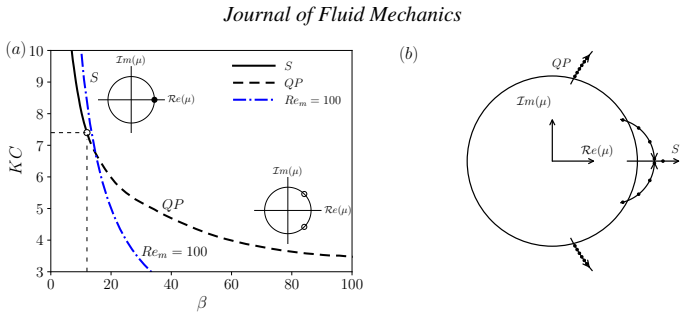
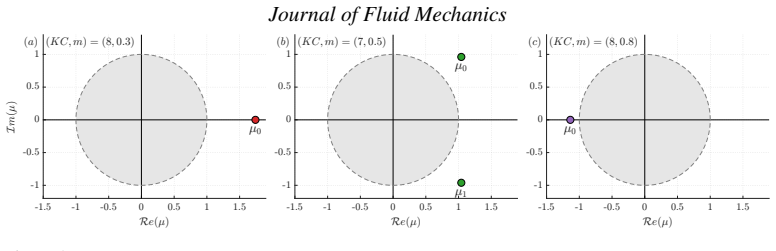
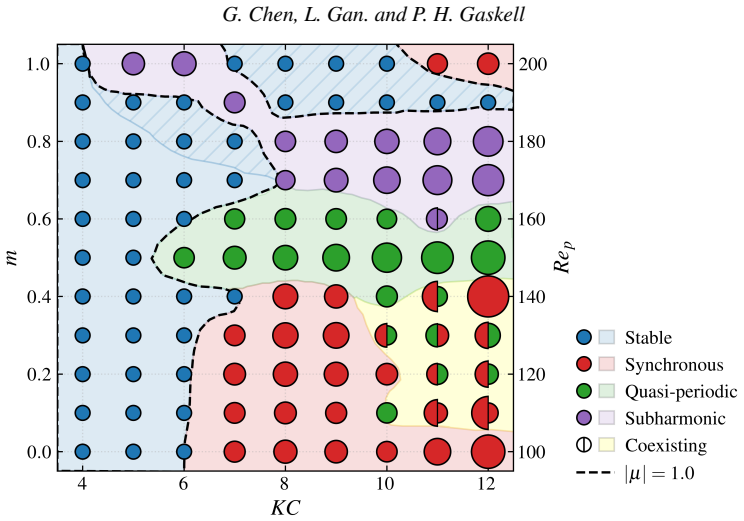
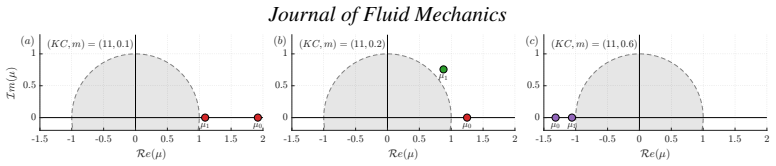
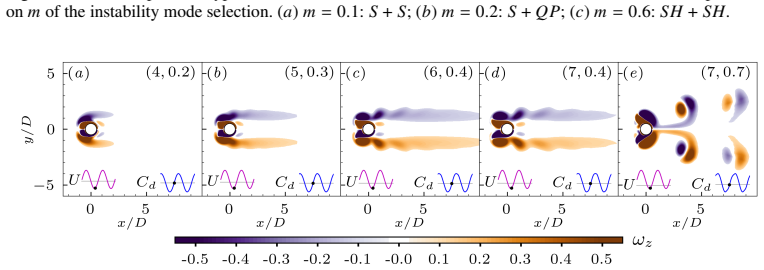
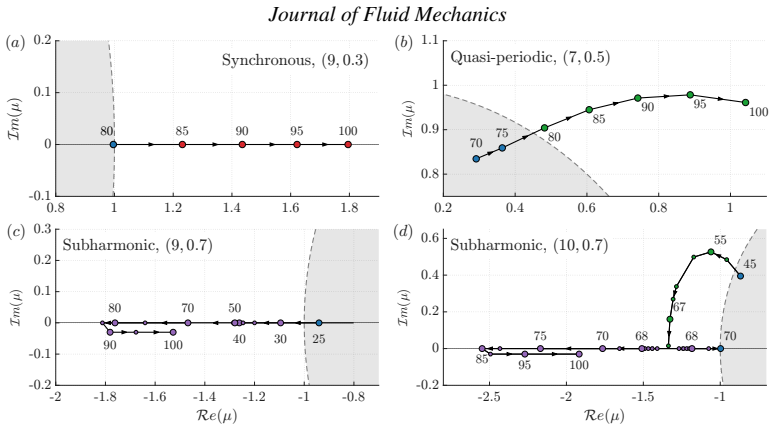
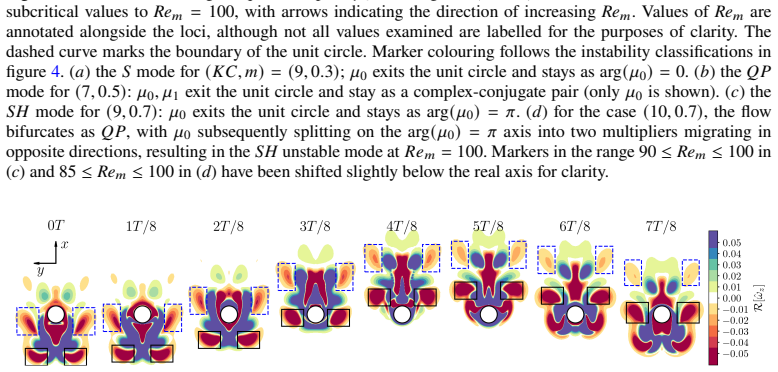
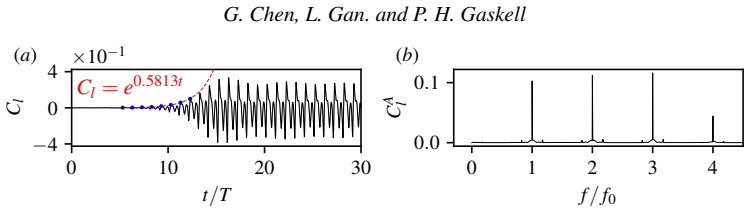
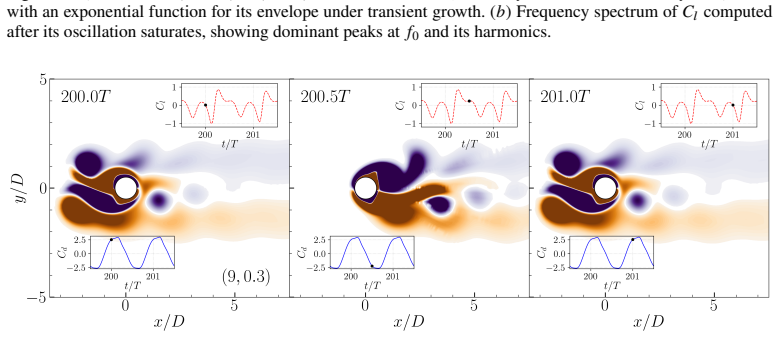
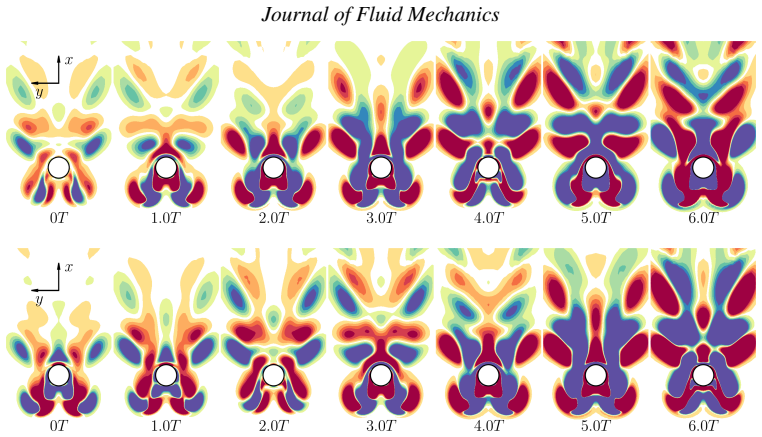
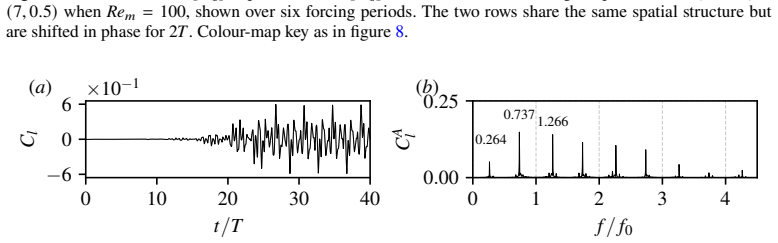
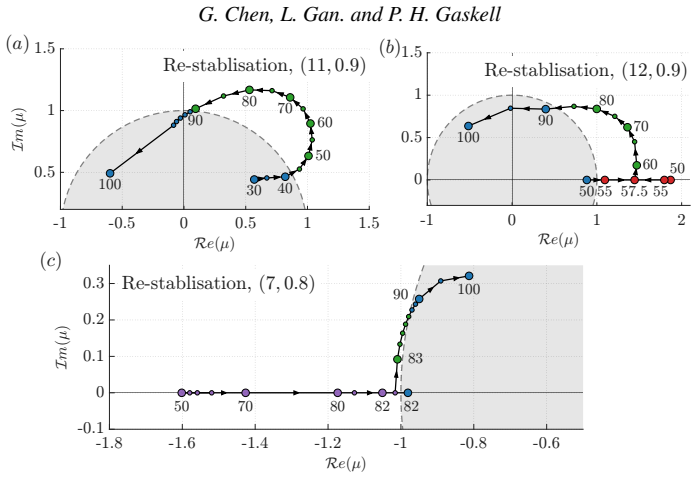
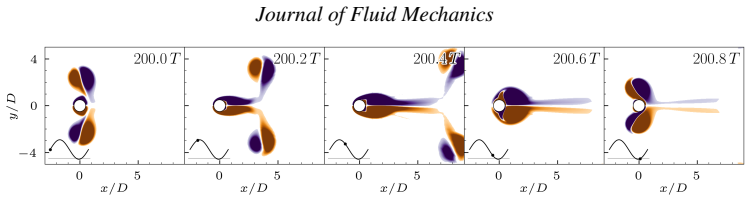
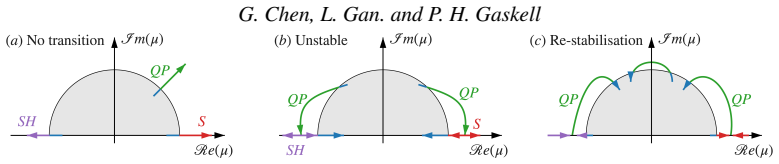
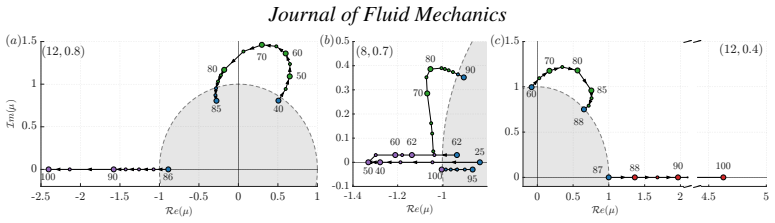
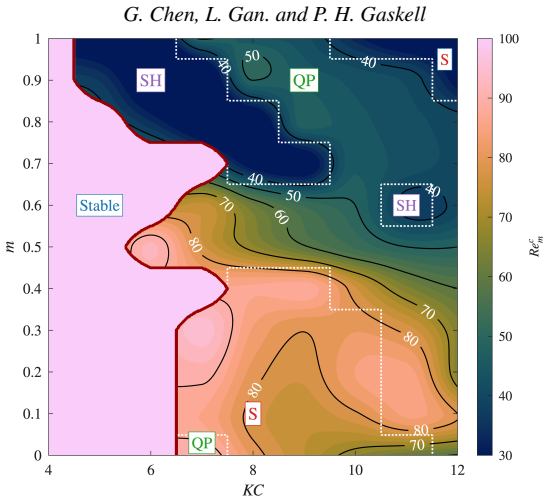
Within the two-dimensional Floquet framework a steady current component with m > 0.5 produces a period-doubling subharmonic bifurcation that does not occur for m = 0. For Re_m = 100 the neutral stability boundary in (KC, m) space is strongly non-monotonic, separating regions of intrinsic stability from single-mode instability and containing a re-stabilization band beyond m ≈ 0.9 where the flow recovers a Z2-symmetric state at peak Reynolds number ≈ 190 despite both forcing components being individually supercritical; a separate regime permits coexistence of two distinct unstable modes.
What carries the argument
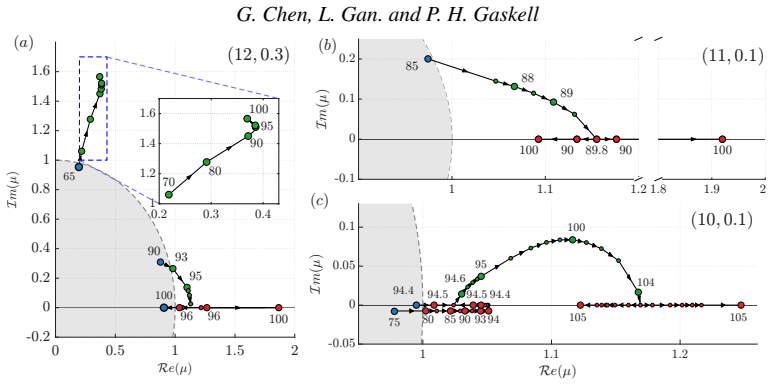
Two-dimensional Floquet stability analysis that tracks the loci of leading multipliers in (KC, m) parameter space to identify synchronous, quasi-periodic, and subharmonic bifurcation modes.
If this is right
- The neutral stability curve in (KC, m) space becomes strongly non-monotonic once m exceeds 0.5.
- A sub-region of mode re-stabilization appears for m greater than approximately 0.9, recovering Z2 symmetry at peak Reynolds number near 190.
- A distinct parameter regime permits simultaneous instability of two modes of different type.
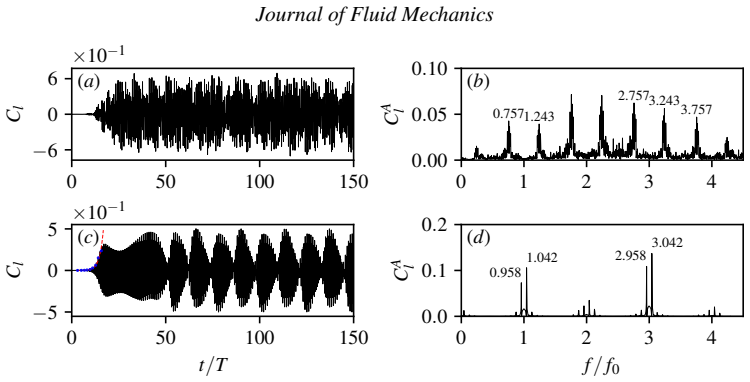
- Direct numerical simulations confirm that the linear Floquet predictions correctly forecast the saturated nonlinear state when only one mode is unstable.
Where Pith is reading between the lines
- The reported re-stabilization may be sensitive to spanwise perturbations that commonly appear in cylinder wakes at these Reynolds numbers.
- The non-monotonic stability boundary could be used to select operating conditions that suppress vortex-induced forces in combined wave-current environments.
- Repeating the Floquet scan at lower Re_m would test whether the period-doubling threshold remains near m = 0.5 when the flow is closer to the onset of instability.
Load-bearing premise
The entire stability diagram is obtained under the assumption that the flow remains strictly two-dimensional.
What would settle it
A three-dimensional simulation or experiment that shows the re-stabilization band disappearing or shifting to a different m value at the same peak Reynolds number would falsify the reported two-dimensional bifurcation loci.
Figures
read the original abstract
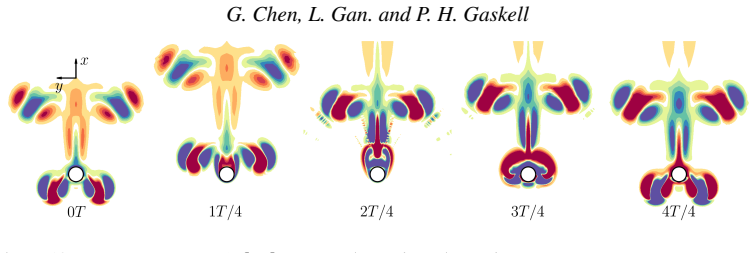
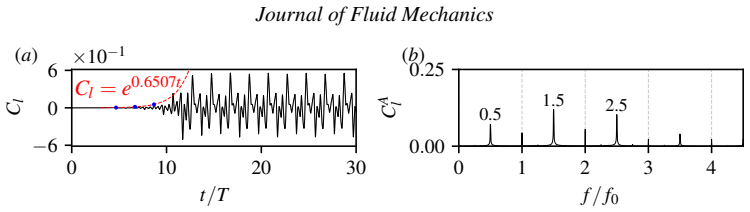
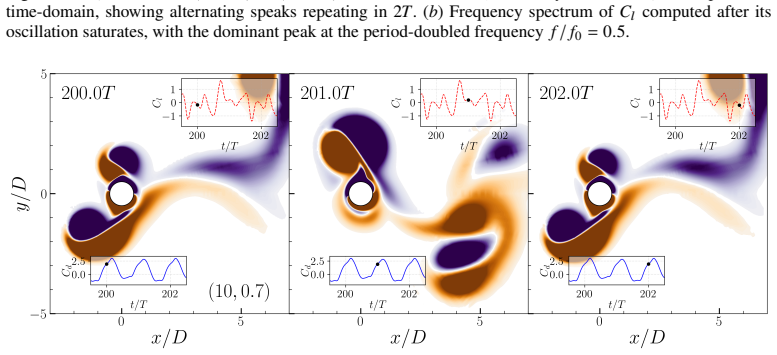
The stability of incompressible flow past a circular cylinder under collinear steady and oscillatory forcing is investigated within a two-dimensional Floquet framework. The flow is parameterised by the Keulegan-Carpenter number $KC \in [4,12]$, the steady-to-oscillatory velocity ratio $m \in [0,1]$, and the oscillatory Reynolds number $Re_m \in [20,100]$. The loci of the leading Floquet multipliers, and hence case-specific bifurcation modes, are examined by progressively reducing $Re_m$ to subcritical values for prescribed $m$. A steady current with $m > 0.5$ gives rise to a period-doubling subharmonic bifurcation that does not occur in purely oscillatory flow, where only synchronous and quasi-periodic modes arise. For $Re_m = 100$, three key features are discernible. First, the neutral stability curve in $(KC,m)$ space is strongly non-monotonic in $m$, separating intrinsically stable regions from those with single unstable modes; a sub-region of striking mode re-stabilisation appears beyond $m \approx 0.9$, where the flow recovers a $Z_2$-symmetric state at peak Reynolds number $\approx 190$, despite the steady and oscillatory components each being individually unstable. Second, a distinct regime supports the coexistence of two unstable modes of different types. Third, complementary direct numerical simulations show that, for a single unstable mode, the linear analysis successfully predicts the saturated nonlinear state even when $Re_m = 100$ substantially exceeds the critical Reynolds number, whereas under mode coexistence the quasi-periodic attractor tends to dominate the developed dynamics.
Editorial analysis
A structured set of objections, weighed in public.
Referee Report
Summary. The paper examines the two-dimensional stability of incompressible flow past a circular cylinder under collinear steady and oscillatory forcing, parameterized by KC ∈ [4,12], m ∈ [0,1], and Re_m ∈ [20,100]. Using Floquet analysis, it identifies a period-doubling subharmonic bifurcation for m > 0.5 (absent in purely oscillatory flow), a strongly non-monotonic neutral curve in (KC,m) space at Re_m=100 with a re-stabilization region beyond m≈0.9 that recovers Z2 symmetry at peak Re≈190 despite individual component instability, a regime of coexisting unstable modes, and consistency between linear predictions and 2D DNS for single-mode cases.
Significance. If the 2D results hold, the non-monotonic neutral curve and re-stabilization phenomenon would provide new insight into the interaction between steady and oscillatory wake instabilities, including mode coexistence. The use of Floquet multipliers to track bifurcation loci and complementary DNS for nonlinear saturation are strengths, but the strictly 2D scope limits applicability given known 3D onsets near Re=190.
major comments (2)
- [Abstract] Abstract and § on numerical methods: the re-stabilization claim (recovery of Z2-symmetric state at peak Re≈190 for m≳0.9) occurs precisely where the steady-cylinder mode-A instability onsets (Re_crit≈190). The analysis is confined to a strictly two-dimensional Floquet framework with 2D DNS; no discussion or test addresses whether 3D perturbations would destroy the reported re-stabilization or alter the neutral curve in this window.
- [Abstract] Abstract: the statement that 'the linear analysis successfully predicts the saturated nonlinear state' for single-mode cases at Re_m=100 rests on DNS whose discretization, domain size, grid-convergence, and error estimates are not supplied, leaving the quantitative support for the bifurcation loci and re-stabilization only partially verifiable.
minor comments (1)
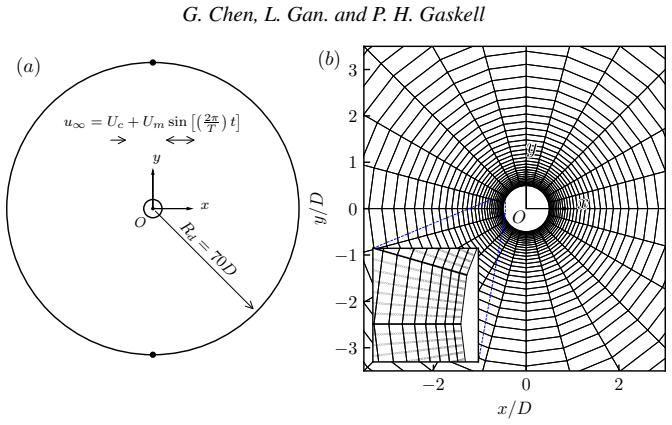
- The parameter ranges and the precise definition of the base flow (steady plus oscillatory components) should be stated explicitly in the introduction or methods section for reproducibility.
Simulated Author's Rebuttal
We thank the referee for their detailed and constructive review. We address each major comment below and will incorporate revisions to improve clarity and completeness while respecting the two-dimensional scope of the study.
read point-by-point responses
-
Referee: [Abstract] Abstract and § on numerical methods: the re-stabilization claim (recovery of Z2-symmetric state at peak Re≈190 for m≳0.9) occurs precisely where the steady-cylinder mode-A instability onsets (Re_crit≈190). The analysis is confined to a strictly two-dimensional Floquet framework with 2D DNS; no discussion or test addresses whether 3D perturbations would destroy the reported re-stabilization or alter the neutral curve in this window.
Authors: We agree that the re-stabilization occurs near the known onset of three-dimensional mode-A instability for a steady cylinder and that our work employs a strictly two-dimensional Floquet analysis together with 2D DNS. The manuscript does not examine three-dimensional perturbations. In revision we will add an explicit discussion of this limitation in the conclusions, stating that the reported neutral curve and re-stabilization are two-dimensional results and that three-dimensional effects could modify the stability boundaries near Re≈190. The non-monotonic neutral curve and period-doubling bifurcation remain valid findings within the two-dimensional framework. revision: yes
-
Referee: [Abstract] Abstract: the statement that 'the linear analysis successfully predicts the saturated nonlinear state' for single-mode cases at Re_m=100 rests on DNS whose discretization, domain size, grid-convergence, and error estimates are not supplied, leaving the quantitative support for the bifurcation loci and re-stabilization only partially verifiable.
Authors: The referee correctly notes that the manuscript omits detailed DNS parameters. We will revise the numerical-methods section (and, if space permits, the abstract) to include domain size, grid resolution, convergence tests, and error estimates for the direct numerical simulations, thereby strengthening the quantitative support for the comparison between linear predictions and nonlinear saturation. revision: yes
- Whether three-dimensional perturbations would destroy the reported re-stabilization or alter the neutral curve cannot be answered without performing three-dimensional stability analysis, which lies outside the present two-dimensional study.
Circularity Check
No circularity: numerical Floquet analysis is self-contained
full rationale
The paper performs stability analysis via direct numerical solution of the 2D incompressible Navier-Stokes equations and computation of Floquet multipliers for the time-periodic base flow. No analytic derivations, fitted parameters renamed as predictions, or self-citation chains are present that reduce any claimed bifurcation locus or re-stabilization region to its own inputs by construction. The reported neutral curves, period-doubling modes for m>0.5, and non-monotonic behavior in (KC,m) space are outputs of the numerical eigenvalue problem, not tautological redefinitions. Complementary DNS are used only for nonlinear saturation checks and do not alter the linear stability results. This is the standard, non-circular workflow for such hydrodynamic stability studies.
Axiom & Free-Parameter Ledger
axioms (2)
- standard math Incompressible Navier-Stokes equations govern the flow
- domain assumption Flow remains strictly two-dimensional
Reference graph
Works this paper leans on
-
[1]
Abramowitz and I
M. Abramowitz and I. Stegun , title =
-
[2]
Barker and D
T. Barker and D. G. Schaeffer and P. Boh\'orquez and J. M. N. T. Gray , title =. J. Fluid. Mech. , year =
-
[3]
Batchelor , title =
G.K. Batchelor , title =. J. Fluid Mech. , year =
-
[4]
A. V. Briukhanov and S. S. Grigorian and S. M. Miagkov and M. Y. Plam and I. E. Shurova and M. E. Eglit and Y. L. Yakimov , title =. Physics of Snow and Ice, Proceedings of the International Conference on Low Temperature Science , volume =
-
[5]
Brownell and L.K
C.J. Brownell and L.K. Su , title =. AIAA Paper 2004-2335 , year =
2004
-
[6]
Brownell and L.K
C.J. Brownell and L.K. Su , title =. AIAA Paper 2007-1314 , year =
2007
-
[7]
Dennis , title =
S.C.R. Dennis , title =. Ninth Intl Conf. on Numerical Methods in Fluid Dynamics , publisher =. 1985 , editor =
1985
-
[8]
Formation of levees, troughs and elevated channels by avalanches on erodible slopes , author =. J. Fluid Mech. , volume =
-
[9]
Hwang and E.O
L.-S. Hwang and E.O. Tuck , title =. J. Fluid Mech. , year =
-
[10]
and Saut, Jean Claude , title =
Joseph, Daniel D. and Saut, Jean Claude , title =. Theoretical and Computational Fluid Dynamics , publisher=
-
[11]
Worster , title =
M.G. Worster , title =. Interactive dynamics of convection and solidification , publisher =. 1992 , editor =
1992
-
[12]
Koch , title =
W. Koch , title =. J. Sound Vib. , year =
-
[13]
Lee , title =
J.-J. Lee , title =. J. Fluid Mech. , year =
-
[14]
Linton and D.V
C.M. Linton and D.V. Evans , title =. Phil.\ Trans.\ R. Soc.\ Lond. , year =
-
[15]
Martin , title =
P.A. Martin , title =. 1980 , journal =
1980
-
[16]
Rogallo , title =
R.S. Rogallo , title =
-
[17]
Ursell , title =
F. Ursell , title =. 1950 , journal =
1950
-
[18]
On the oscillations Near and at resonance in open pipes , year =
L. On the oscillations Near and at resonance in open pipes , year =. J. Engng Maths , volume =
-
[19]
Miller , title =
P.L. Miller , title =. 1991 , address =
1991
-
[20]
Camera Calibration Toolbox for Matlab , howpublished =
Bouguet, J.-Y , year=. Camera Calibration Toolbox for Matlab , howpublished =
-
[21]
and Sheridan, John and Blackburn, H.M
Elston, John R. and Sheridan, John and Blackburn, H.M. , number =. 2004 , journal =. doi:10.1016/j.euromechflu.2003.05.002 , issn =
-
[22]
and Blackburn, H
Elston, John R. and Blackburn, H. M. and Sheridan, John , doi =. Journal of Fluid Mechanics , number =
-
[23]
Blackburn, H. M. and Marques, F. and Lopez, J. M. , doi =. Journal of Fluid Mechanics , pages =
-
[24]
doi:10.1007/978-1-4612-0997-3 , isbn =
Iooss, G. doi:10.1007/978-1-4612-0997-3 , isbn =
-
[25]
Journal of Fluid Mechanics , pages =
Xiong, Chengwang and Cheng, Liang and Tong, Feifei and An, Hongwei , doi =. Journal of Fluid Mechanics , pages =
-
[26]
Journal of Fluid Mechanics , month =
Xiong, Chengwang and Cheng, Liang and Tong, Feifei and An, Hongwei , doi =. Journal of Fluid Mechanics , month =
-
[27]
Journal of Fluid Mechanics , month =
Ren, Chengjiao and Cheng, Liang and Tong, Feifei and Xiong, Chengwang and Chen, Tingguo , doi =. Journal of Fluid Mechanics , month =
-
[28]
Journal of Fluid Mechanics , pages =
Ju, Xiaoying and An, Hongwei and Cheng, Liang and Tong, Feifei , doi =. Journal of Fluid Mechanics , pages =
-
[29]
Cantwell, C. D. and Moxey, D. and Comerford, A. and Bolis, A. and Rocco, G. and Mengaldo, G. and. Computer Physics Communications , month =. doi:10.1016/j.cpc.2015.02.008 , issn =
-
[30]
Barkley, Dwight and Henderson, Ronald D. , doi =. Journal of Fluid Mechanics , pages =
-
[31]
and Bakmis, C
Sarpkaya, T. and Bakmis, C. and Storm, M. A. , isbn =. Proceedings of the Annual Offshore Technology Conference , number =
-
[32]
Honji, H. , doi =. Journal of Fluid Mechanics , pages =
-
[33]
Blackburn, H. M. and Lopez, J. M. , doi =. Journal of Fluid Mechanics , pages =
-
[34]
and Lopez, J
Marques, F. and Lopez, J. M. and Blackburn, H. M. , doi =. Physica D: Nonlinear Phenomena , number =
-
[35]
Karniadakis, George Em and Israeli, Moshe and Orszag, Steven A. , doi =. Journal of Computational Physics , number =
-
[36]
and Minear, R
Anagnostopoulos, P. and Minear, R. , doi =. Applied Ocean Research , number =
-
[37]
Zhou, C. Y. and Graham, J. M.R. , doi =. Journal of Fluids and Structures , month =
-
[38]
Applied Ocean Research , month =
Konstantinidis, Efstathios and Bouris, Demetri , doi =. Applied Ocean Research , month =
-
[39]
and Sherwin, S
Blackburn, Hugh M. and Sherwin, S. J. , doi =. Journal of Computational Physics , number =
-
[40]
Journal of Fluid Mechanics , mendeley-groups =
D. Journal of Fluid Mechanics , mendeley-groups =. doi:10.1017/S002211209800860X , issn =
-
[41]
Journal of Fluid Mechanics , mendeley-groups =
Zhao, Ming and Cheng, Liang , doi =. Journal of Fluid Mechanics , mendeley-groups =
-
[42]
Journal of Fluid Mechanics , mendeley-groups =
Tong, Feifei and Cheng, Liang and Zhao, Ming , doi =. Journal of Fluid Mechanics , mendeley-groups =
-
[43]
Williamson, C. H.K. , doi =. Journal of Fluid Mechanics , number =
-
[44]
and Zhang, R
Li, Y. and Zhang, R. and Shock, R. and Chen, H. , doi =. European Physical Journal: Special Topics , number =
-
[45]
Journal of Fluid Mechanics , mendeley-groups =
Chen, Weilin and Ji, Chunning and Alam, Md Mahbub and Williams, John and Xu, Dong , doi =. Journal of Fluid Mechanics , mendeley-groups =
-
[46]
and Bearman, P
Tatsuno, M. and Bearman, P. W. , doi =. Journal of Fluid Mechanics , month =
-
[47]
Jackson, C. P. , doi =. Journal of Fluid Mechanics , pages =
-
[48]
and Boyer, L
Mathis, C. and Boyer, L. , doi =. Journal of Fluid Mechanics , pages =
-
[49]
doi:10.1017/jfm.2025.10469 , issn =
Journal of Fluid Mechanics , month =. doi:10.1017/jfm.2025.10469 , issn =
-
[50]
Frantz, R. A.S. and Loiseau, J. Ch and Robinet, J. Ch , doi =. Applied Mechanics Reviews , month =. arXiv , arxivId =:2301.12940 , issn =
-
[51]
Karniadakis, George Em and Triantafyllou, George S. , doi =. Journal of Fluid Mechanics , month =
-
[52]
Telionis, Demetri P. , booktitle =. doi:10.1007/978-3-642-88567-9 , isbn =
-
[53]
and Balabani, S
Konstantinidis, E. and Balabani, S. and Yianneskis, M. , doi =. Journal of Fluids and Structures , number =
-
[54]
Physics of Fluids , number =
Lu, Liang and Papadakis, George , doi =. Physics of Fluids , number =
-
[55]
and Wiesenfeld, Kurt , doi =
Swift, James W. and Wiesenfeld, Kurt , doi =. Physical Review Letters , month =
-
[56]
Mutlu and Freds
Sumer, B. Mutlu and Freds. Hydrodynamics around Cylindrical Structures (Revised Edition) , doi =
-
[57]
Journal of fluids and structures , volume=
Hysteresis in the forced Stuart--Landau equation: application to vortex shedding from an oscillating cylinder , author=. Journal of fluids and structures , volume=. 2001 , publisher=
2001
-
[58]
International Journal of Bifurcation and Chaos , volume=
Complex dynamics in multistable systems , author=. International Journal of Bifurcation and Chaos , volume=. 2008 , publisher=
2008
-
[59]
Physics Reports , volume=
Control of multistability , author=. Physics Reports , volume=. 2014 , publisher=
2014
-
[60]
Journal of Fluid Mechanics , pages =
Tong, Feifei F and Cheng, Liang and Xiong, Chengwang W and Draper, Scott and An, Hongwei W and Lou, Xiaofan F , doi =. Journal of Fluid Mechanics , pages =
-
[61]
Journal of Fluid Mechanics , pages =
An, Hongwei and Cheng, Liang and Zhao, Ming , doi =. Journal of Fluid Mechanics , pages =
-
[62]
Coastal Engineering , number =
Tang, Guoqiang and Cheng, Liang and Lu, Lin and Teng, Yunfei and Zhao, Ming and An, Hongwei , doi =. Coastal Engineering , number =
-
[63]
Physics of Fluids , mendeley-groups =
Tong, Feifei and Cheng, Liang and Zhao, Ming and Zhou, Tongming and Chen, Xiao-Bo Bo , doi =. Physics of Fluids , mendeley-groups =
-
[64]
and Henningson, Dan S
Schmid, Peter J. and Henningson, Dan S. , address =. Stability and transition in shear flows , year =. Stability and transition in shear flows , isbn =
-
[65]
Barkley, D. , doi =. Europhysics Letters , number =
-
[66]
Chen, Geng and Gan, Lian and Gaskell, Philip H. , doi =. Ocean Engineering , number =
-
[67]
Journal of the ACM (JACM) , number =
Akima, Hiroshi , doi =. Journal of the ACM (JACM) , number =
-
[68]
Journal of Fluid Mechanics , pages =
Sipp, Denis and Lebedev, Anton , doi =. Journal of Fluid Mechanics , pages =
discussion (0)
Sign in with ORCID, Apple, or X to comment. Anyone can read and Pith papers without signing in.