REVIEW 2 major objections 2 minor 1 cited by
PRONE: Petrov-Galerkin Operator Learning Unifies DMD, SINDy & Koopmanism
T0 review · 2 major / 2 minor · reviewed 2026-06-29 · grok-4.3
Pith's one-line read PRONE unifies DMD, SINDy, Koopman regression and related methods as variants of one Petrov-Galerkin construction using distinct trial and test dictionaries.
desk verdict PRONE gives a clean asymmetric Petrov-Galerkin framing that unifies DMD/SINDy-style methods under one regression and switches to singular modes, with a claimed L2 convergence result that still hinges on dictionary choice. read the letter →
The pith
A machine-rendered reading of the paper's core claim, the machinery that carries it, and where it could break.
The reading
What carries the argument
The asymmetric regression Psi(X)K approx Phi(Y) with distinct trial and test dictionaries that enables singular modes instead of eigenmodes.
What would settle it
Finding a dynamical system where no choice of distinct dictionaries yields a predictor that outperforms standard methods or violates the claimed L2 convergence.
Extended reading notes
Core claim
By posing the problem as finding K such that Psi(X)K approximates Phi(Y) with separate dictionaries Psi and Phi, the paper unifies multiple operator learning techniques under one construction. Dropping the self-mapping requirement allows singular modes to identify captured observables, their projected futures, and coupling strengths. The limiting projected operator is identified and L2 convergence of the nonlinear predictor is proved.
Load-bearing premise
Suitable distinct trial and test dictionaries can be chosen so that the regression captures the essential dynamics of the system.
Editorial extensions
If this is right
- Different methods arise from choices of dictionaries, weights, and constraints in the same linear algebra setup.
- Singular modes replace eigenmodes as the natural objects for analysis.
- The nonlinear predictor converges in L2 norm to the true dynamics.
- Performance exceeds that of DeepONets, FNOs, and reservoir computers with fewer parameters in tested systems.
Reading between the lines
- If the unification holds, researchers could systematically explore new dictionary pairs to improve predictions in specific applications.
- The emphasis on singular modes suggests that dimension reduction in dynamics should focus on observable-future couplings rather than invariant subspaces.
- Testing on additional benchmarks would confirm whether the parameter efficiency generalizes beyond the presented examples.
Editorial analysis
A structured set of objections, weighed in public.
Referee Report
Summary. The paper proposes PRONE (Petrov-Galerkin Operator Learning), a regression framework based on Ψ(X)K ≈ Φ(Y) with distinct trial and test dictionaries. It unifies DMD, EDMD, SINDy, Koopman regression, sparse regression, and low-rank regression as special cases differing only in dictionary choice, weights, and constraints. By dropping the self-mapping requirement on the finite model, the approach replaces eigenmodes with singular modes, identifies the limiting projected operator, proves L² convergence of the resulting nonlinear predictor, and reports numerical outperformance over DeepONets, FNOs, and reservoir computers on chaotic maps, the double gyre, a pitching-airfoil wake, and Lorenz-63, using considerably fewer parameters.
Significance. If the unification, singular-mode construction, and L² convergence hold under the stated conditions, the work supplies a coherent linear-algebraic perspective that clarifies the role of trial versus test spaces across existing operator-learning methods and offers a low-parameter alternative to neural operators for prediction, statistics, and dimension reduction in data-driven dynamics.
major comments (2)
- [§3] §3 (Convergence theorem): the L² convergence of the nonlinear predictor is proved under the assumption that suitable distinct trial and test dictionaries exist such that the one-step regression captures essential dynamics without self-mapping; the manuscript must state explicit conditions on the dictionaries or the data measure that guarantee the iterated predictor remains consistent, because this premise is load-bearing for both the singular-mode replacement and the convergence claim.
- [§2.2] §2.2 (Unification): the statement that SINDy and sparse regression are recovered as special cases of Ψ(X)K ≈ Φ(Y) requires an explicit reduction showing how the SINDy sparsity constraint and dictionary choice map onto the Petrov-Galerkin form; without this mapping the unification claim remains formal rather than operational.
minor comments (2)
- [Table 1] Table 1 (method comparison): add a column indicating the precise choice of trial and test dictionaries used for each listed method to make the unification immediately verifiable.
- [§4] §4 (Numerical examples): report the exact dimensions of the trial and test dictionaries and the singular-value truncation threshold for each experiment so that the parameter-count advantage can be reproduced.
Simulated Author's Rebuttal
We thank the referee for the careful reading and constructive comments on the manuscript. We respond point-by-point to the major comments below.
read point-by-point responses
-
Referee: [§3] §3 (Convergence theorem): the L² convergence of the nonlinear predictor is proved under the assumption that suitable distinct trial and test dictionaries exist such that the one-step regression captures essential dynamics without self-mapping; the manuscript must state explicit conditions on the dictionaries or the data measure that guarantee the iterated predictor remains consistent, because this premise is load-bearing for both the singular-mode replacement and the convergence claim.
Authors: We agree that the convergence result would benefit from explicit sufficient conditions. In the revised manuscript we will insert a remark immediately after the statement of the L² convergence theorem that lists two concrete requirements: (i) the linear span of the combined trial and test dictionaries is dense in L²(μ), where μ is the invariant measure of the underlying dynamical system, and (ii) the training data are sampled from an ergodic measure so that the empirical one-step operator converges to the true projected operator in the appropriate operator norm. These conditions ensure that the singular-mode predictor remains consistent under iteration. The core proof strategy is unchanged; only the hypotheses are made fully explicit. revision: yes
-
Referee: [§2.2] §2.2 (Unification): the statement that SINDy and sparse regression are recovered as special cases of Ψ(X)K ≈ Φ(Y) requires an explicit reduction showing how the SINDy sparsity constraint and dictionary choice map onto the Petrov-Galerkin form; without this mapping the unification claim remains formal rather than operational.
Authors: We accept that an operational reduction is required. In the revised §2.2 we will add a short derivation that recovers SINDy exactly: set the trial and test dictionaries to be identical (Ψ = Φ, e.g., a polynomial basis), replace the unweighted Frobenius norm by a weighted norm whose weight matrix encodes the L¹ penalty on the entries of K, and solve the resulting constrained least-squares problem. The same construction recovers the sparse-regression variant by choosing an appropriate diagonal weighting matrix. The paragraph will contain the explicit matrix equations that demonstrate the reduction. revision: yes
Circularity Check
No circularity: new regression framework and convergence proof are independent of inputs
full rationale
The paper defines PRONE via the regression Ψ(X)K ≈ Φ(Y) with distinct dictionaries, shows existing methods as special cases by dictionary choice, drops the self-mapping requirement to motivate singular modes, and claims an L2 convergence proof for the nonlinear predictor. None of these steps reduce by construction to a fitted parameter, self-citation chain, or renamed input; the central claims rest on the new asymmetric construction and the stated proof rather than tautological re-expression of the data or prior author results. The provided abstract and context contain no load-bearing self-citation or definitional loop.
Assumptions & free parameters
assumptions (1)
- standard math Standard finite-dimensional linear algebra applies to the regression Psi(X)K approx Phi(Y)
invented entities (1)
-
singular modes
Cite this review
Pith. "Pith review of PRONE: Petrov-Galerkin Operator Learning Unifies DMD, SINDy & Koopmanism." pith.science (2026). https://pith.science/paper/R6WAMTT2
@misc{pith2026260627982,
  author       = {Pith},
  title        = {Pith review of: PRONE: Petrov-Galerkin Operator Learning Unifies DMD, SINDy & Koopmanism},
  year         = {2026},
  howpublished = {\url{https://pith.science/paper/R6WAMTT2}},
  note         = {Machine review of arXiv:2606.27982}
}
abstract
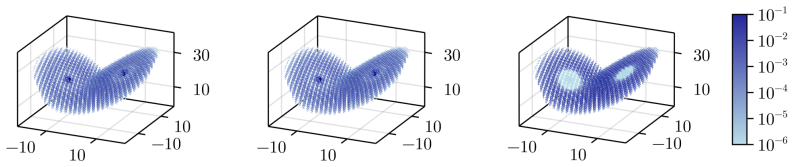
Data-driven dynamics often asks how to linearize a nonlinear system. We ask instead: which observables should be advanced, and where should their futures live? This leads to Petrov Regression Of Nonlinear Evolution (PRONE), a Petrov--Galerkin regression framework based on $ \Psi(\mathbf{X})K \approx \Phi(\mathbf{Y}), $ with distinct trial and test dictionaries. In this form, DMD, EDMD, SINDy, Koopman regression, sparse regression, and low-rank regression become variants of one construction: different dictionaries, weights, and constraints. We keep the linear algebra of Koopman learning, but drop the artificial requirement that a finite model map a dictionary into itself. With this asymmetry, eigenmodes are no longer the right objects. Instead, we use singular modes, which identify the observable combinations captured by the data, their projected futures, and the strength of the coupling between the two spaces. We identify the limiting projected operator and prove $L^2$ convergence of the resulting nonlinear predictor. We give examples from chaotic maps, the double gyre, a pitching-airfoil wake, and Lorenz--63, where PRONE outperforms DeepONets, Fourier neural operators, and reservoir computers with considerably fewer parameters. These examples show the same message: lift once, regress once, and let the singular structure reveal statistics, transport, prediction, and dimension.
Figures


Figures from the paper (8 more)




Forward citations
Cited by 1 Pith paper
-
Weak-form Extended Dynamic Mode Decomposition
WEDMD uses compactly supported test functions and a generalized eigenvalue problem to approximate Koopman generator eigenpairs directly from noisy time-series data, avoiding derivative estimation.
Reference graph
Works this paper leans on
-
[1]
Optimization with sparsity-inducing penalties, 2011
Francis Bach, Rodolphe Jenatton, Julien Mairal, and Guillaume Obozinski. Optimization with sparsity-inducing penalties, 2011
2011
-
[2]
Colbrook, and Gustav Conradie
Nicolas Boull´ e, Matthew J. Colbrook, and Gustav Conradie. Convergent methods for koopman operators on reproducing kernel hilbert spaces, 2025
2025
-
[3]
John P. Boyd. A comparison of numerical algorithms for fourier extension of the first, second, and third kinds.Journal of Computational Physics, 178(1):118–160, 2002
2002
-
[4]
Brunton, Marko Budiˇ si´ c, Eurika Kaiser, and J
Steven L. Brunton, Marko Budiˇ si´ c, Eurika Kaiser, and J. Nathan Kutz. Modern koopman theory for dynamical systems.SIAM Review, 64(2):229–340, 2022
2022
-
[5]
Brunton, Joshua L
Steven L. Brunton, Joshua L. Proctor, and J. Nathan Kutz. Discovering governing equations from data by sparse identification of nonlinear dynamical systems.Proceedings of the National Academy of Sciences, 113(15):3932–3937, March 2016
2016
-
[6]
Brunton, Joshua L
Steven L. Brunton, Joshua L. Proctor, and J. Nathan Kutz. Sparse identification of nonlinear dynamics with control (SINDYc).IFAC-PapersOnLine, 49(18):710–715, 2016
2016
-
[7]
Colbrook
Matthew J. Colbrook. The mpEDMD algorithm for data-driven computations of measure- preserving dynamical systems.SIAM Journal on Numerical Analysis, 61(3):1585–1608, 2023
2023
-
[8]
Colbrook
Matthew J. Colbrook. Infinite-dimensional spectral computation. Being reviewed, 2026
2026
Show all 29 references
-
[9]
Colbrook, Lorna J
Matthew J. Colbrook, Lorna J. Ayton, and M´ at´ e Sz˝ oke. Residual dynamic mode decomposi- tion: robust and verified koopmanism.Journal of Fluid Mechanics, 955:A21, 2023
2023
-
[10]
Colbrook, Catherine Drysdale, and Andrew Horning
Matthew J. Colbrook, Catherine Drysdale, and Andrew Horning. Rigged dynamic mode de- composition: Data-driven generalized eigenfunction decompositions for koopman operators. SIAM Journal on Applied Dynamical Systems, 24(2):1150–1190, 2025. 21
2025
-
[11]
Colbrook, Igor Mezi´ c, and Alexei Stepanenko
Matthew J. Colbrook, Igor Mezi´ c, and Alexei Stepanenko. Limits and powers of koopman learning, 2024
2024
-
[12]
Colbrook and Alex Townsend
Matthew J. Colbrook and Alex Townsend. Rigorous data-driven computation of spectral properties of koopman operators for dynamical systems.Communications on Pure and Applied Mathematics, 77(1):221–283, 2024
2024
-
[13]
Brunton, and Matthew J
Gustav Conradie, Nicolas Boull´ e, Jean-Christophe Loiseau, Steven L. Brunton, and Matthew J. Colbrook. Trustworthy koopman operator learning: Invariance diagnostics and error bounds, 2026
2026
-
[14]
Estimating long-term behavior of periodically driven flows without trajectory integration.Nonlinearity, 30(5):1948, apr 2017
Gary Froyland and P´ eter Koltai. Estimating long-term behavior of periodically driven flows without trajectory integration.Nonlinearity, 30(5):1948, apr 2017
1948
-
[15]
Graduate Texts in Mathematics
Loukas Grafakos.Classical Fourier Analysis. Graduate Texts in Mathematics. Springer, New York, NY, 3 edition, July 2014
2014
-
[16]
Colbrook
Kelan Gray, Finlay Brown, Nicolas Boull´ e, and Matthew J. Colbrook. Deep embedded multi- plicative DMD for algebra-preserving koopman learning, 2026
2026
-
[17]
B. O. Koopman. Hamiltonian systems and transformation in hilbert space.Proceedings of the National Academy of Sciences of the United States of America, 17(5):315–318, 1931
1931
-
[18]
On convergence of extended dynamic mode decomposition to the koopman operator.Journal of Nonlinear Science, 28(2):687–710, 2018
Milan Korda and Igor Mezi´ c. On convergence of extended dynamic mode decomposition to the koopman operator.Journal of Nonlinear Science, 28(2):687–710, 2018
2018
-
[19]
Nathan Kutz, Steven L
J. Nathan Kutz, Steven L. Brunton, Bingni W. Brunton, and Joshua L. Proctor.Dynamic Mode Decomposition: Data-Driven Modeling of Complex Systems. Society for Industrial and Applied Mathematics, Philadelphia, 2016
2016
-
[20]
Applied Mathematical Sciences
Andrzej Lasota and Michael C Mackey.Chaos, fractals, and noise. Applied Mathematical Sciences. Springer, New York, NY, 2 edition, November 2013
2013
-
[21]
Spectral properties of dynamical systems, model reduction and decompositions
Igor Mezi´ c. Spectral properties of dynamical systems, model reduction and decompositions. Nonlinear Dynamics, 41(1–3):309–325, 2005
2005
-
[22]
Rowley, Igor Mezi´ c, Shervin Bagheri, Philipp Schlatter, and Dan S
Clarence W. Rowley, Igor Mezi´ c, Shervin Bagheri, Philipp Schlatter, and Dan S. Henningson. Spectral analysis of nonlinear flows.Journal of Fluid Mechanics, 641:115–127, 2009
2009
-
[23]
Peter J. Schmid. Dynamic mode decomposition of numerical and experimental data.Journal of Fluid Mechanics, 656:5–28, 2010
2010
-
[24]
Low-Reynolds-number pitching airfoil direct numerical sim- ulations, 2022
Aaron Towne and Scott Dawson. Low-Reynolds-number pitching airfoil direct numerical sim- ulations, 2022
2022
-
[25]
Spectra and pseudospectra
Lloyd N Trefethen. Spectra and pseudospectra. InThe Graduate Student’s Guide to Numerical Analysis ’98, Springer Series in Computational Mathematics, pages 217–250. Springer Berlin Heidelberg, Berlin, Heidelberg, 1999
1999
-
[26]
Tu, Clarence W
Jonathan H. Tu, Clarence W. Rowley, Dirk M. Luchtenburg, Steven L. Brunton, and J. Nathan Kutz. On dynamic mode decomposition: Theory and applications.Journal of Computational Dynamics, 1(2):391–421, 2014. 22
2014
-
[27]
Pointwise and uniform convergence of fourier extensions, 2019
Marcus Webb, Vincent Copp´ e, and Daan Huybrechs. Pointwise and uniform convergence of fourier extensions, 2019
2019
-
[28]
Williams, Ioannis G
Matthew O. Williams, Ioannis G. Kevrekidis, and Clarence W. Rowley. A data–driven ap- proximation of the koopman operator: Extending dynamic mode decomposition.Journal of Nonlinear Science, 25(6):1307–1346, June 2015
2015
-
[29]
Williams, Clarence W
Matthew O. Williams, Clarence W. Rowley, and Ioannis G. Kevrekidis. A kernel-based ap- proach to data-driven koopman spectral analysis, 2015. A Analytic Computations of Singular Modes for Cat Map We consider the inverse Arnold cat map F −1 x y = ...
2015
Reviewed June 29, 2026 · model on record in the stance chip above.
Discussion (0). Continue with ORCID to comment.