Diagonal Kenney-Laub Rational Approximation to the Overlap Operator using Wilson and Brillouin Kernel
Pith reviewed 2026-06-29 02:04 UTC · model grok-4.3
The pith
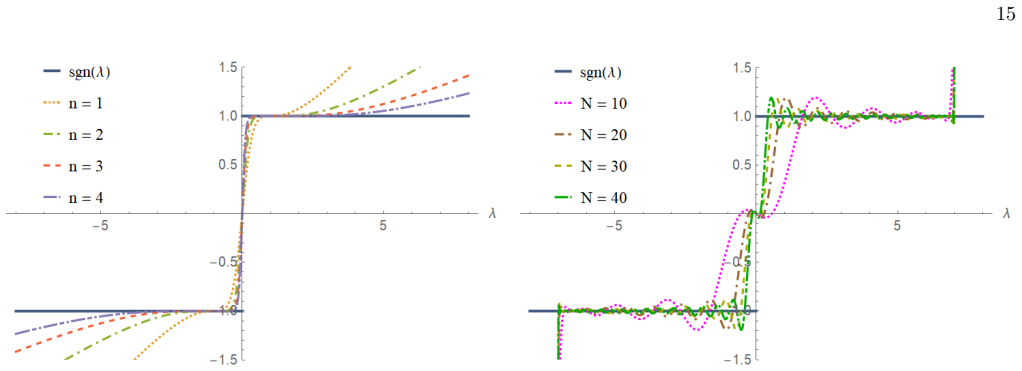
Diagonal Kenney-Laub iterates give a more efficient approximation to the overlap Dirac operator sign function than Chebyshev polynomials.
A machine-rendered reading of the paper's core claim, the machinery that carries it, and where it could break.
Core claim
Diagonal Kenney-Laub iterates can be used to approximate the matrix sign function in the overlap operator formulation, resulting in improved chiral symmetry and computational efficiency compared to the Chebyshev approach when implemented with Wilson or Brillouin kernels.
What carries the argument
The diagonal Kenney-Laub iterates applied to the sign function approximation, expressed through partial fraction decomposition.
If this is right
- KL iterates reduce the violation of the Ginsparg-Wilson relation for given approximation order.
- The critical bare quark mass shows improved behavior with rising order.
- The method applies equally to Wilson and Brillouin kernel operators.
- Partial fraction form enables practical and efficient implementation without spectral preprocessing.
Where Pith is reading between the lines
- The approach may lower the overall cost of overlap fermion calculations in full QCD simulations.
- Similar iterates could be tested in other contexts requiring accurate sign function approximations.
- Scaling studies on larger volumes would clarify whether the efficiency gains persist.
Load-bearing premise
The advantages observed in a proof-of-concept on quenched lattices at one beta value hold more generally.
What would settle it
Demonstrating that Chebyshev polynomials achieve comparable or superior Ginsparg-Wilson preservation at equivalent computational cost on the same or finer lattices.
Figures
read the original abstract
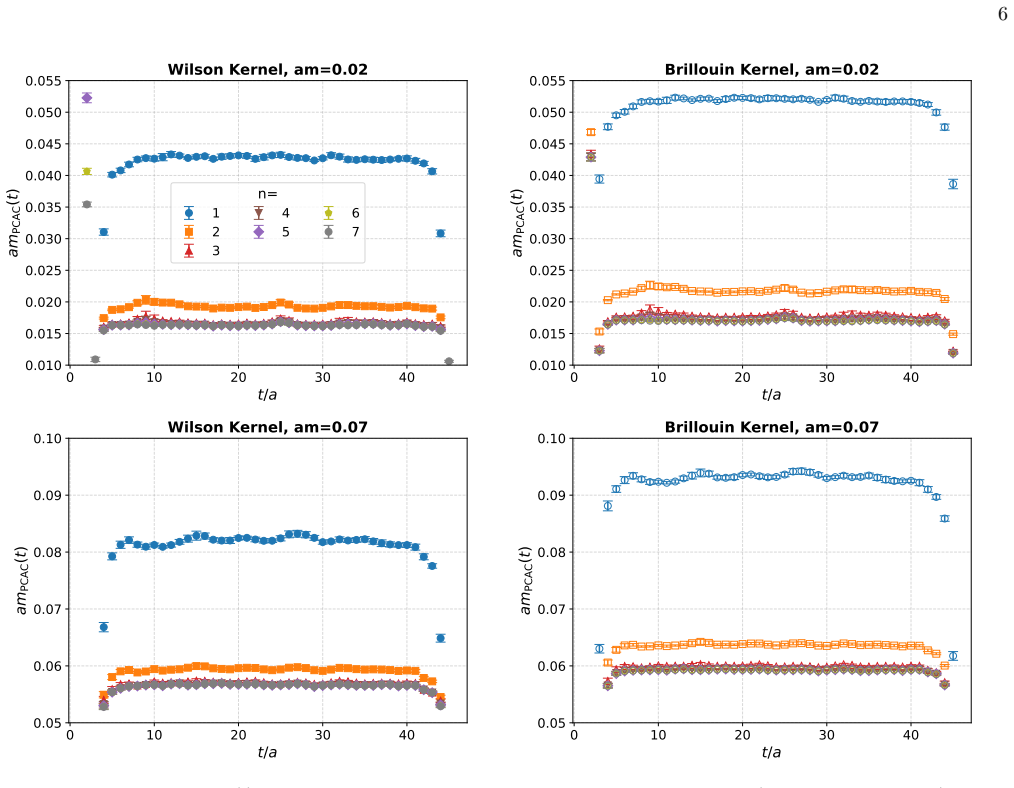
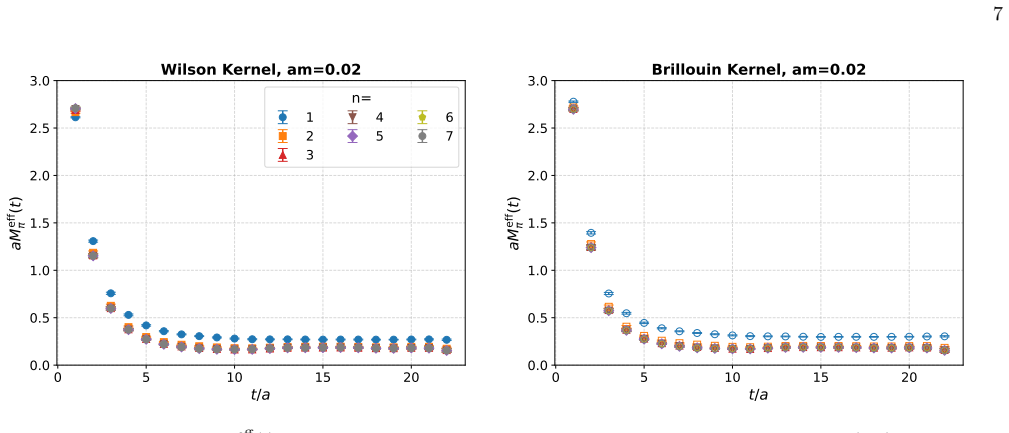
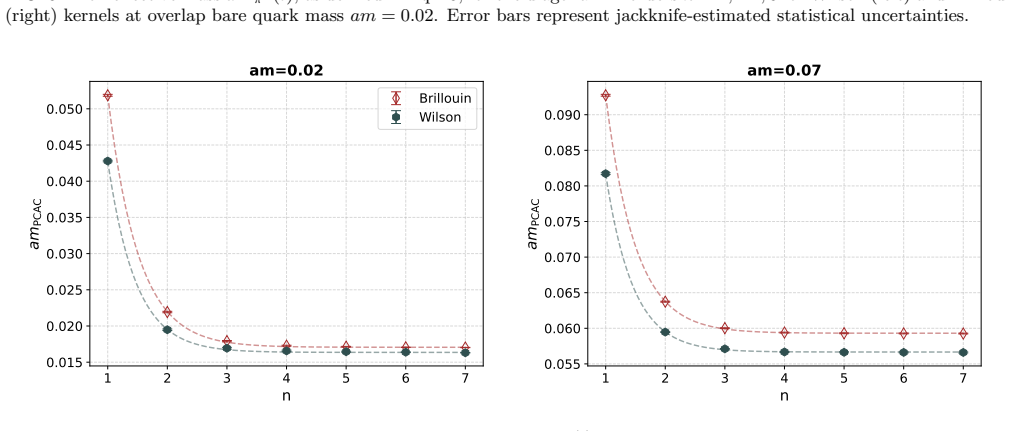
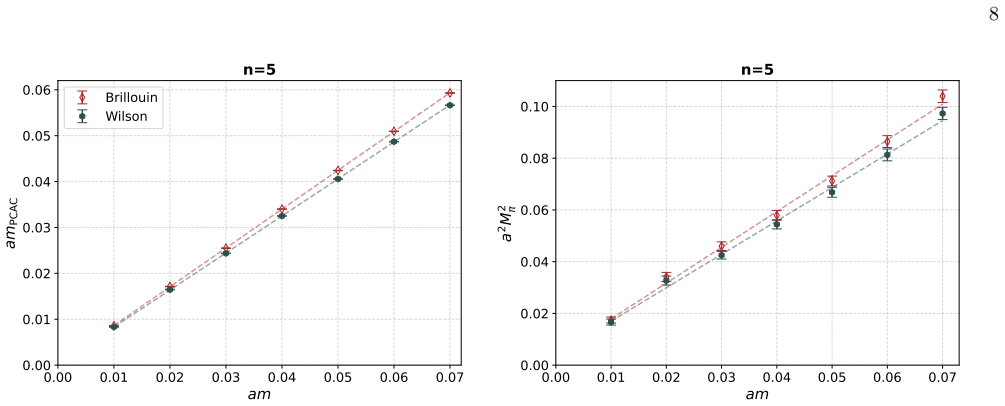
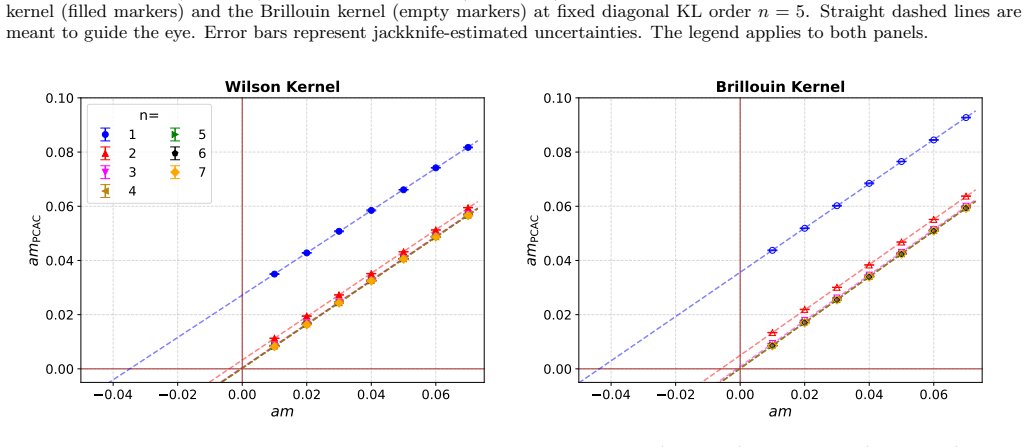
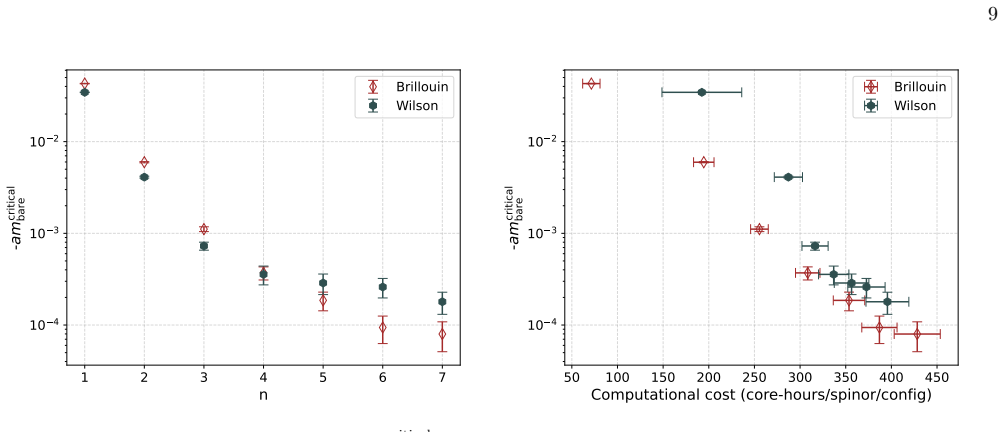
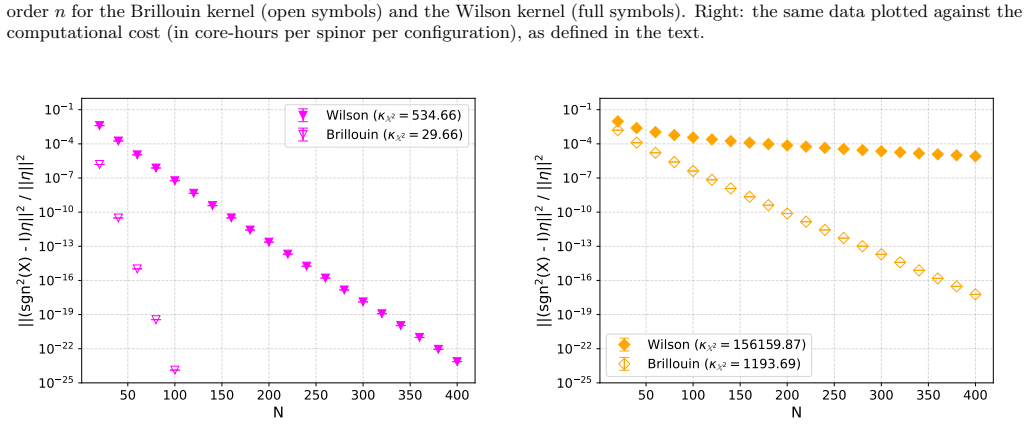
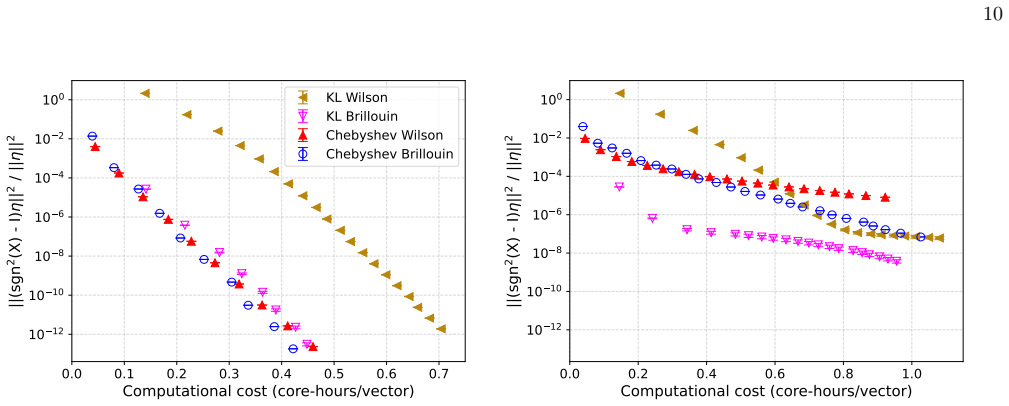
We propose a formulation of the overlap Dirac operator in lattice QCD that employs diagonal Kenney-Laub (KL) iterates to approximate the matrix sign function. KL iterates require no prior spectral information about the kernel operator and, when expressed via their partial fraction decomposition, offer a practical and efficient approximation scheme. We evaluate this approach in a proof-of-concept implementation using quenched lattices at $\beta=6.2$ and two Dirac operator discretizations as a kernel, namely the Wilson and the Brillouin operators. By examining the approximate overlap operator's violation of the Ginsparg-Wilson relation and the critical bare quark mass for increasing approximation order, we find that KL iterates deliver enhanced chiral symmetry preservation and computational efficiency compared to the Chebyshev polynomial approach.
Editorial analysis
A structured set of objections, weighed in public.
Referee Report
Summary. The paper proposes a formulation of the overlap Dirac operator using diagonal Kenney-Laub iterates to approximate the matrix sign function, requiring no prior spectral information. It presents a proof-of-concept numerical evaluation on quenched SU(3) lattices at β=6.2 with Wilson and Brillouin kernels, comparing Ginsparg-Wilson relation violation and critical bare quark mass against Chebyshev polynomial approximations for increasing orders, and claims improved chiral symmetry preservation and computational efficiency.
Significance. If the reported advantages in approximation quality and efficiency are confirmed more broadly, the approach could provide a practical, parameter-free rational approximation scheme for overlap fermions that avoids spectral preconditioning steps common in other methods.
major comments (1)
- [Numerical results (as summarized in the abstract)] The central claim that KL iterates deliver enhanced chiral symmetry preservation and efficiency rests on comparisons performed exclusively on quenched ensembles at a single coupling (β=6.2). Spectral properties of the kernel operator can change with dynamical fermions or different β, so the observed gains may not persist; additional tests across a wider range of parameters are needed to support the generality of the conclusion.
Simulated Author's Rebuttal
We thank the referee for their careful reading of the manuscript and for highlighting the scope of the numerical results. We address the major comment below.
read point-by-point responses
-
Referee: The central claim that KL iterates deliver enhanced chiral symmetry preservation and efficiency rests on comparisons performed exclusively on quenched ensembles at a single coupling (β=6.2). Spectral properties of the kernel operator can change with dynamical fermions or different β, so the observed gains may not persist; additional tests across a wider range of parameters are needed to support the generality of the conclusion.
Authors: We agree that the numerical evidence is restricted to quenched SU(3) ensembles at β=6.2, as stated in the abstract and Section 3 where the work is explicitly described as a proof-of-concept. All comparisons between KL iterates and Chebyshev polynomials are performed on identical configurations and kernels, so the reported improvements in Ginsparg-Wilson violation and critical mass are internally consistent within this setting. The manuscript does not claim universality beyond these ensembles. We will add a clarifying paragraph in the conclusions emphasizing the limited parameter range explored and the desirability of future tests with dynamical fermions and varied β. However, performing such additional simulations lies outside the present scope. revision: partial
- Additional numerical tests on dynamical fermion ensembles and at different values of β to establish broader generality of the observed advantages.
Circularity Check
No circularity: claims rest on direct numerical measurements on external lattices
full rationale
The paper proposes diagonal Kenney-Laub iterates for sign-function approximation in the overlap operator and reports a proof-of-concept numerical study on quenched SU(3) lattices at β=6.2 using Wilson and Brillouin kernels. Comparisons of Ginsparg-Wilson violation and critical bare quark mass versus approximation order are obtained by explicit computation on those ensembles and contrasted with Chebyshev results; these are independent measurements, not quantities fitted to the target observables or defined in terms of the claimed improvements. No self-citations, uniqueness theorems, or ansatze are invoked as load-bearing steps in the abstract or described evaluation. The derivation chain consists of a standard rational approximation followed by lattice measurements whose outcomes are not forced by construction from the inputs.
Axiom & Free-Parameter Ledger
Reference graph
Works this paper leans on
-
[1]
Neuberger, Exactly massless quarks on the lattice, Physics Letters B417, 141 (1998), hep-lat/9707022
H. Neuberger, Exactly massless quarks on the lattice, Physics Letters B417, 141 (1998), hep-lat/9707022
Pith/arXiv arXiv 1998
-
[2]
H. Neuberger, More about exactly massless quarks on the lattice, Physics Letters B427, 353 (1998), hep- lat/9801031
arXiv 1998
-
[3]
H. Neuberger, A Practical Implementation of the Overlap Dirac Operator, Physical Review Letters81, 4060 (1998), hep-lat/9806025
Pith/arXiv arXiv 1998
-
[4]
P. H. Ginsparg and K. G. Wilson, A remnant of chiral symmetry on the lattice, Physical Review D25, 2649 (1982)
1982
-
[5]
M. L¨ uscher, Exact chiral symmetry on the lattice and the ginsparg-wilson relation, Physics Letters B428, 342 (1998), hep-lat/9802011
Pith/arXiv arXiv 1998
-
[6]
L. D. Debbio and C. Pica, Topological susceptibility from the overlap, Journal of High Energy Physics (2003), hep- lat/0309145
arXiv 2003
-
[7]
P. A. Boyle, L. Del Debbio, A. J¨ uttner, A. Khamseh, F. Sanfilippo, and J. T. Tsang, The decay constantsf D andf Ds in the continuum limit ofN f =2+1domain wall lattice QCD, JHEP12(12), 008, arXiv:1701.02644 [hep-lat]
-
[8]
M. Luscher, S. Sint, R. Sommer, and P. Weisz, Chiral symmetry and O(a) improvement in lattice QCD, Nucl. Phys. B478, 365 (1996), hep-lat/9605038
Pith/arXiv arXiv 1996
-
[9]
R. G. Edwards, U. M. Heller, and R. Narayanan, A study of practical implementations of the overlap Dirac op- erator in four dimensions, Nuclear Physics B540, 457 (1999), hep-lat/9807017
Pith/arXiv arXiv 1999
-
[10]
J. van den Eshof, A. Frommer, T. Lippert, K. Schilling and H. A. van der Vorst, Numerical methods for the QCD overlap operator. I. Sign-function and error bounds, Computer Physics Communications146, 203 (2002), hep-lat/0202025
Pith/arXiv arXiv 2002
-
[11]
A. Kennedy, Approximation theory for matrices, Nuclear Physics B - Proceedings Supplements128, 107 (2004), hep-lat/0402037
Pith/arXiv arXiv 2004
-
[12]
T. A. DeGrand (MILC), A Variant approach to the overlap action, Phys. Rev. D63, 034503 (2000), hep- lat/0007046
arXiv 2000
-
[13]
Bietenholz, Convergence rate and locality of improved overlap fermions, Nucl
W. Bietenholz, Convergence rate and locality of improved overlap fermions, Nucl. Phys. B644, 223 (2002), hep- lat/0204016
arXiv 2002
-
[14]
H. Ikeda and S. Hashimoto, O(a 2) improvement of the overlap-Dirac operator, PoSLA T2009, 082 (2009), arXiv:0912.4119 [hep-lat]
Pith/arXiv arXiv 2009
-
[15]
S. Durr and G. Koutsou, Brillouin improvement for Wilson fermions, Phys. Rev. D83, 114512 (2011), arXiv:1012.3615 [hep-lat]
Pith/arXiv arXiv 2011
-
[16]
Y.-G. Cho, S. Hashimoto, A. J¨ uttner, T. Kaneko, M. Marinkovic, J.-I. Noaki, and J. T. Tsang, Improved lattice fermion action for heavy quarks, JHEP2015(5), 72, arXiv:1504.01630 [hep-lat]
-
[17]
A. Alexandru, M. Lujan, C. Pelissier, B. Gamari, and F. X. Lee, Efficient implementation of the overlap op- erator on multi-GPUs, in2011 Symposium on Ap- plication Accelerators in High-Performance Computing (SAAHPC’11), IEEE Nucl.Sci.Symp.Conf.Rec. (2011) pp. 123–130, arXiv:1106.4964 [hep-lat]
Pith/arXiv arXiv 2011
-
[18]
J. Brannick, A. Frommer, K. Kahl, B. Leder, M. Rottmann, and A. Strebel, Multigrid Precondition- ing for the Overlap Operator in Lattice QCD, Numer. Math.132, 463 (2016), arXiv:1410.7170 [hep-lat]
Pith/arXiv arXiv 2016
-
[19]
S. Durr and G. Koutsou, On the suitability of the Brillouin action as a kernel to the overlap procedure, arXiv:1701.00726 [hep-lat]
- [20]
-
[21]
A. Frommer, B. N¨ ockel, S. G¨ usken, T. Lippert, and K. Schilling, Many Masses on one Stroke: Economic Computation of Quark Propagators, International Jour- nal of Modern Physics C6, 627 (1995), hep-lat/9504020
Pith/arXiv arXiv 1995
-
[22]
Jegerlehner, Krylov space solvers for shifted linear sys- tems, hep-lat/9612014
B. Jegerlehner, Krylov space solvers for shifted linear sys- tems, hep-lat/9612014
-
[23]
C. S. Kenney and A. J. Laub, A hyperbolic tangent iden- tity and the geometry of pad´ e sign function iterations, Numerical Algorithms7, 111 (1994)
1994
-
[24]
Albaneseet al.(APE), Glueball Masses and String Tension in Lattice QCD, Phys
M. Albaneseet al.(APE), Glueball Masses and String Tension in Lattice QCD, Phys. Lett. B192, 163 (1987)
1987
-
[25]
N. Cundy, A. D. Kennedy, and A. Schafer, A lattice Dirac operator for QCD with light dynamical quarks, Nucl. Phys. B845, 30 (2011), arXiv:1010.5629 [hep-lat]
Pith/arXiv arXiv 2011
-
[26]
J¨ ulich Supercomputing Centre, JURECA: Data Centric and Booster Modules implementing the Modular Super- computing Architecture at J¨ ulich Supercomputing Cen- tre, Journal of large-scale research facilities7(2021)
2021
-
[27]
Neuberger, Bounds on the wilson dirac operator, Physical Review D61, 085015 (1999), hep-lat/9911004
H. Neuberger, Bounds on the wilson dirac operator, Physical Review D61, 085015 (1999), hep-lat/9911004
Pith/arXiv arXiv 1999
-
[28]
S. Durr, G. Koutsou, and T. Lippert, Meson and Baryon dispersion relations with Brillouin fermions, Phys. Rev. D86, 114514 (2012), arXiv:1208.6270 [hep-lat]
Pith/arXiv arXiv 2012
-
[29]
S. Durr, Portable CPU implementation of Wilson, Bril- louin and Susskind fermions in lattice QCD, Comput. Phys. Commun.282, 108555 (2023), arXiv:2112.14640 [hep-lat]
arXiv 2023
-
[30]
Kenney and A
C. Kenney and A. J. Laub, Rational Iterative Methods for the Matrix Sign Function, SIAM Journal on Matrix Analysis and Applications12, 273 (1991)
1991
-
[31]
Higham,Functions of Matrices: Theory and Compu- tation(Society for Industrial and Applied Mathematics, 2008)
N. Higham,Functions of Matrices: Theory and Compu- tation(Society for Industrial and Applied Mathematics, 2008)
2008
-
[32]
Press,Numerical Recipes 3rd Edition: The Art of Sci- entific Computing(Cambridge University Press, 2007)
W. Press,Numerical Recipes 3rd Edition: The Art of Sci- entific Computing(Cambridge University Press, 2007)
2007
discussion (0)
Sign in with ORCID, Apple, or X to comment. Anyone can read and Pith papers without signing in.