Decentralized Stability of IBR-dominated Power Grids Using Block Diagonal Dominance
Pith reviewed 2026-06-29 03:18 UTC · model grok-4.3
The pith
A block diagonal dominance criterion certifies decentralized small-signal stability and decay rates in IBR-dominated power grids.
A machine-rendered reading of the paper's core claim, the machinery that carries it, and where it could break.
Core claim
The block diagonal dominance criterion applied to a suitably partitioned system matrix provides a sufficient condition for stability and a prescribed decay rate in IBR-dominated grids, allowing decentralized compliance checks for new IBR connections.
What carries the argument
The block diagonal dominance (BDD) criterion on a partitioned system matrix, which generalizes strict diagonal dominance and certifies stability plus decay rate via dominance conditions on the blocks.
If this is right
- Each IBR can be evaluated locally against the BDD condition to decide whether it can connect without destabilizing the grid.
- The criterion guarantees a minimum decay rate, which directly bounds the maximum settling time of IBR-induced oscillations.
- Stability certification remains valid for arbitrary network topologies and arbitrary internal IBR models.
- The method scales to large grids because the checks do not require centralized computation or full system knowledge.
Where Pith is reading between the lines
- Operators could embed the BDD test in interconnection standards so new resources are approved or rejected on the basis of local measurements alone.
- The same partitioning idea might apply to stability assessment in other large-scale networked dynamical systems that possess natural block structure.
- If the BDD margin can be computed from online data, it could support real-time monitoring of how close a grid is to losing the certified decay rate.
Load-bearing premise
The power grid and IBR dynamics admit a block partitioning of the system matrix such that the block diagonal dominance condition is both applicable and sufficient to certify stability and decay rate.
What would settle it
A concrete counterexample grid where the BDD condition holds for the chosen block partition but the closed-loop eigenvalues include at least one with positive real part.
Figures



read the original abstract
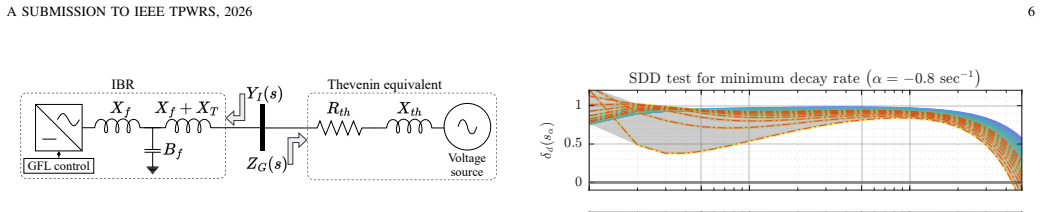
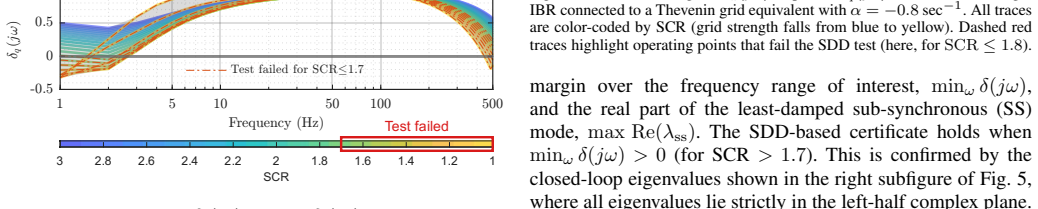
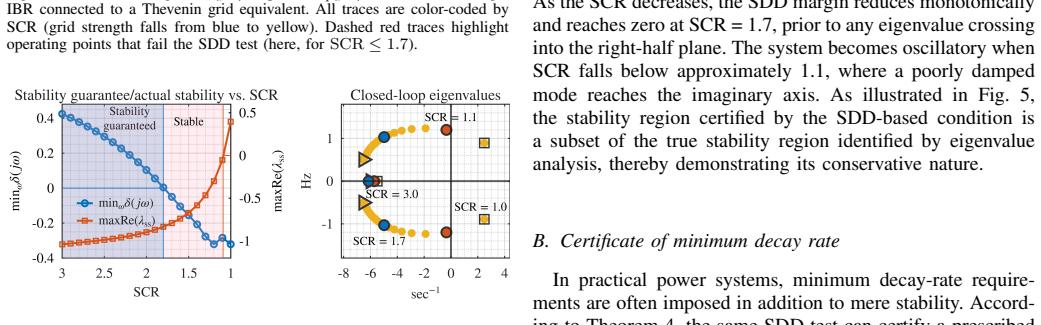
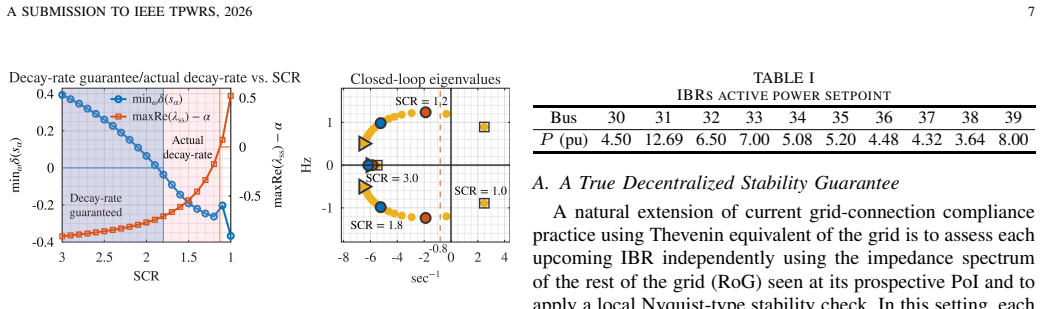
The growing penetration of inverter-based resources (IBRs) necessitates stability assessment methods that are scalable, decentralized, and model-agnostic. This paper develops a block diagonal dominance (BDD) criterion for decentralized small-signal stability of IBR-dominated power grids. The proposed approach forms the basis for an enhanced IBR connection compliance condition from a small-signal stability perspective that can be evaluated locally for IBRs to be connected to the grid. The proposed approach is shown to be much less conservative than strict diagonal dominance (SDD). Beyond mere stability, we ensure a minimum decay rate or maximum settling time for IBR-induced oscillation. Crucially, these are achieved without imposing restrictive assumptions on network or IBR models. The framework therefore, offers a practical and theoretically grounded basis for decentralized stability certificate of IBR-dominated power grids.
Editorial analysis
A structured set of objections, weighed in public.
Referee Report
Summary. The paper develops a block diagonal dominance (BDD) criterion for decentralized small-signal stability assessment of IBR-dominated power grids. It claims this yields an enhanced local IBR connection compliance test that is less conservative than strict diagonal dominance (SDD), guarantees a minimum decay rate (or maximum settling time) for IBR-induced oscillations, and requires no restrictive assumptions on network topology or IBR internal models.
Significance. If the central claims are rigorously established, the work would provide a scalable, topology-independent tool for local stability certification in high-IBR grids, extending beyond conservative SDD methods while also bounding transient performance. This addresses a practical need for decentralized compliance criteria without global model knowledge.
major comments (2)
- Abstract: The claims that the BDD criterion 'works', is less conservative than SDD, guarantees decay rates, and requires no restrictive assumptions are asserted without derivation, proof outline, numerical validation, or comparison data. This prevents any evaluation of the mathematical support for the central claim.
- The sufficiency of BDD for stability and decay-rate certification (via vertical shift of eigenvalues) relies on a block partitioning of the closed-loop system matrix (presumably one block per IBR plus network) such that row/column sum conditions on off-block norms hold. Standard results (e.g., Feingold-Varga) require these norms to be bounded; for arbitrary network admittance matrices the inter-block terms are dense and topology-dependent, so the local compliance test must explicitly justify why the chosen partitioning remains dominant without global knowledge.
Simulated Author's Rebuttal
We thank the referee for the detailed and constructive report. We address each major comment below and indicate where revisions will be made to strengthen the presentation.
read point-by-point responses
-
Referee: Abstract: The claims that the BDD criterion 'works', is less conservative than SDD, guarantees decay rates, and requires no restrictive assumptions are asserted without derivation, proof outline, numerical validation, or comparison data. This prevents any evaluation of the mathematical support for the central claim.
Authors: We agree the abstract is highly condensed. In the revised version we will expand it to include a one-sentence outline of the derivation (application of the block-diagonal dominance theorem to the closed-loop admittance matrix), a reference to the eigenvalue-shift argument for the decay-rate guarantee, and explicit mention of the numerical comparisons with strict diagonal dominance that appear in Section V. The full proofs remain in Sections III–IV. revision: yes
-
Referee: The sufficiency of BDD for stability and decay-rate certification (via vertical shift of eigenvalues) relies on a block partitioning of the closed-loop system matrix (presumably one block per IBR plus network) such that row/column sum conditions on off-block norms hold. Standard results (e.g., Feingold-Varga) require these norms to be bounded; for arbitrary network admittance matrices the inter-block terms are dense and topology-dependent, so the local compliance test must explicitly justify why the chosen partitioning remains dominant without global knowledge.
Authors: The partitioning places each IBR (including its internal states) in its own diagonal block; the network dynamics appear only in the off-block columns. The row-sum dominance condition is expressed using the local IBR transfer function and an upper bound on the network admittance magnitude at the point of connection. This bound is obtained from the Thevenin equivalent impedance seen by the IBR, which can be measured or estimated locally without knowledge of the full topology. We will add a dedicated paragraph in Section IV clarifying this local computation and its independence from global network data. revision: yes
Circularity Check
No circularity: derivation applies standard block-diagonal dominance theorems to a partitioned system matrix without reduction to inputs or self-citations.
full rationale
The provided abstract and context present the BDD criterion as derived from properties of the closed-loop system matrix under a block partitioning, with sufficiency for stability and decay rate following from existing dominance results (e.g., generalizations of Feingold-Varga). No equations or steps reduce the claimed local compliance condition to a fitted parameter, a self-referential definition, or a load-bearing self-citation chain. The block-partitioning premise is stated as an assumption on the model class rather than constructed from the stability conclusion itself, leaving the central claim independent of its own outputs.
Axiom & Free-Parameter Ledger
axioms (2)
- domain assumption Small-signal linearization of the power system dynamics around an equilibrium point yields a valid model for stability analysis.
- domain assumption The overall system matrix can be partitioned into blocks corresponding to IBRs and network components such that BDD conditions can be checked locally.
Reference graph
Works this paper leans on
-
[1]
Definition and classification of power system stability – revisited & extended,
N. Hatziargyriou, J. Milanovic, C. Rahmannet al., “Definition and classification of power system stability – revisited & extended,”IEEE Transactions on Power Systems, vol. 36, no. 4, pp. 3271–3281, 2021. A SUBMISSION TO IEEE TPWRS, 2026 10
2021
-
[2]
Real-world subsynchronous oscillation events in power grids with high penetrations of inverter-based resources,
Y . Cheng, L. Fan, J. Roseet al., “Real-world subsynchronous oscillation events in power grids with high penetrations of inverter-based resources,” IEEE Transactions on Power Systems, vol. 38, no. 1, pp. 316–330, 2023
2023
-
[3]
High inverter-based resource integration: The experience of five system operators,
N. Modi, M. V . Escudero, K. Aramakiet al., “High inverter-based resource integration: The experience of five system operators,”IEEE Power and Energy Magazine, vol. 22, no. 2, pp. 78–88, 2024
2024
-
[4]
N. W. Miller. (2024) Diagnosis and mitigation of observed oscillations in ibr-dominant power systems: A practical guide. [Online]. Available: https://www.esig.energy/wp-content/uploads/2024/08/ESIG-Oscillation s-Guide-2024.pdf
2024
-
[5]
(2025) Guidance on oscillation assessment for inverter based resources (IBRs) - version 2
NESO. (2025) Guidance on oscillation assessment for inverter based resources (IBRs) - version 2. [Online]. Available: https: //www.neso.energy/document/368341/download
2025
-
[6]
(2025) Inverter-based resource controller design using frequency scanning techniques
AEMO. (2025) Inverter-based resource controller design using frequency scanning techniques. [Online]. Available: https://www.aemo.com.au/-/ media/files/initiatives/frequency-scanning/inverter-based-resource-contr oller-design-using-frequency-scanning-techniques--november-2025.pdf
2025
-
[7]
R. A. Horn and C. R. Johnson,Matrix Analysis. Cambridge University Press, 1985
1985
-
[8]
H. H. Rosenbrock,Computer-aided Control System Design. Academic Press, 1974
1974
-
[9]
Dynamic stability analysis and control of power system based on nyquist array theory,
S. Xu, H. Sun, S. Fanget al., “Dynamic stability analysis and control of power system based on nyquist array theory,” in2020 IEEE Power & Energy Society General Meeting (PESGM), 2020, pp. 1–5
2020
-
[10]
S. Shah. (2023) Grid impedance scan tool (GIST): Software for stability analysis of IBR power systems. [Online]. Available: https://docs.nrel.gov/docs/fy23osti/86112.pdf
2023
-
[11]
Rational approximation of frequency domain responses by vector fitting,
B. Gustavsen and A. Semlyen, “Rational approximation of frequency domain responses by vector fitting,”IEEE Transactions on Power Delivery, vol. 14, no. 3, pp. 1052–1061, 1999
1999
-
[12]
Gain and phase: Decentralized stability conditions for power electronics-dominated power systems,
L. Huang, D. Wang, X. Wanget al., “Gain and phase: Decentralized stability conditions for power electronics-dominated power systems,” IEEE Transactions on Power Systems, vol. 39, no. 6, pp. 7240–7256, 2024
2024
-
[13]
Geometric decentralized stability certificate for power systems based on projecting DW shells,
L. Huang, L. Luo, R. Lenget al., “Geometric decentralized stability certificate for power systems based on projecting DW shells,”arXiv preprint arXiv:2508.17033, 2025. [Online]. Available: https://arxiv.org/abs/2508.17033
-
[14]
Decentralized Parametric Stability Certificates for Grid-Forming Converter Control
V . H ¨aberle, X. He, L. Huanget al., “Decentralized parametric stability certificates for grid-forming converter control,”arXiv preprint arXiv:2503.05403, 2025. [Online]. Available: https://arxiv.org/abs/2503 .05403
work page internal anchor Pith review Pith/arXiv arXiv 2025
-
[15]
Decentralized stability rules for microgrids,
P. V orobev, S. Chevalier, and K. Turitsyn, “Decentralized stability rules for microgrids,” in2019 American Control Conference (ACC), 2019, pp. 2596–2601
2019
-
[16]
A. Gorbunov, Y . Chen, P. V orobevet al., “Dynamic passivity multipliers for plug-and-play stability certificates of converter- dominated grids,”arXiv preprint arXiv:2602.09150, 2026. [Online]. Available: https://arxiv.org/abs/2602.09150
-
[17]
C. A. Desoer and M. Vidyasagar,Feedback Systems. Society for Industrial and Applied Mathematics, 2009
2009
-
[18]
Block diagonally dominant matrices and generalizations of the gerschgorin circle theorem,
D. G. Feingold and R. S. Varga, “Block diagonally dominant matrices and generalizations of the gerschgorin circle theorem,”Pacific Journal of Mathematics, vol. 12, no. 4, pp. 1241–1250, 1962
1962
-
[19]
R. S. Varga,Ger ˇsgorin and his circles, ser. Springer Series in Compu- tational Mathematics. Springer Verlag, 2004, vol. 36
2004
-
[20]
Benchmark systems for small-signal stability analysis and control,
C. Canizares, T. Fernandes, E. Geraldiet al., “Benchmark systems for small-signal stability analysis and control,” IEEE Power and Energy Society (PES) Project Report, 2015, pp. 67–70
2015
-
[21]
EMT−RMS Modeling Trade-Off for IBR-Driven Sub-Synchronous Oscillations,
M. S. Javaid, B. Chaudhuri, F. Tenget al., “EMT−RMS Modeling Trade-Off for IBR-Driven Sub-Synchronous Oscillations,”IEEE Trans- actions on Power Systems, vol. 41, no. 1, pp. 425–437, 2026
2026
-
[22]
How many grid-forming converters do we need? a perspective from small signal stability and power grid strength,
H. Xin, C. Liu, X. Chenet al., “How many grid-forming converters do we need? a perspective from small signal stability and power grid strength,”IEEE Transactions on Power Systems, vol. 40, no. 1, pp. 623– 635, 2025
2025
-
[23]
Yazdani and R
A. Yazdani and R. Iravani,Voltage-sourced converters in power systems : modeling, control, and applications. Hoboken, New Jersey: IEEE Press/John Wiley, 2010. APPENDICES Appendix A: Proof of Theorem 5.By contradiction, assumeMis singular. There exists non-zerov∈C n, such thatM v= 0. Partitionvaccording to the blocks inM, i.e.v ′ = [v ′ 1, v′ 2, . . . , v′...
2010
discussion (0)
Sign in with ORCID, Apple, or X to comment. Anyone can read and Pith papers without signing in.