A robust mixed finite element formulation for third medium contact
Pith reviewed 2026-06-29 03:24 UTC · model grok-4.3
The pith
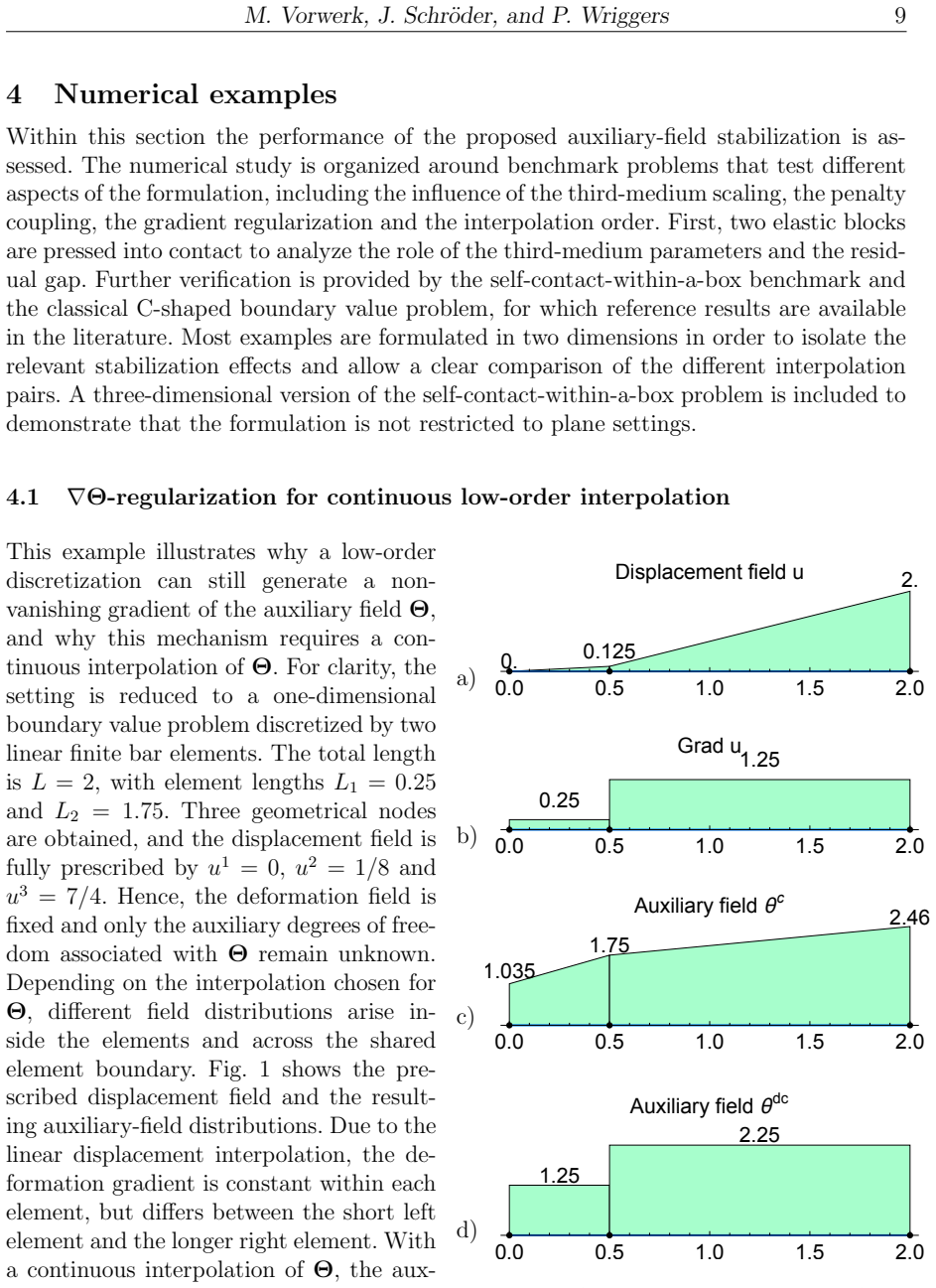
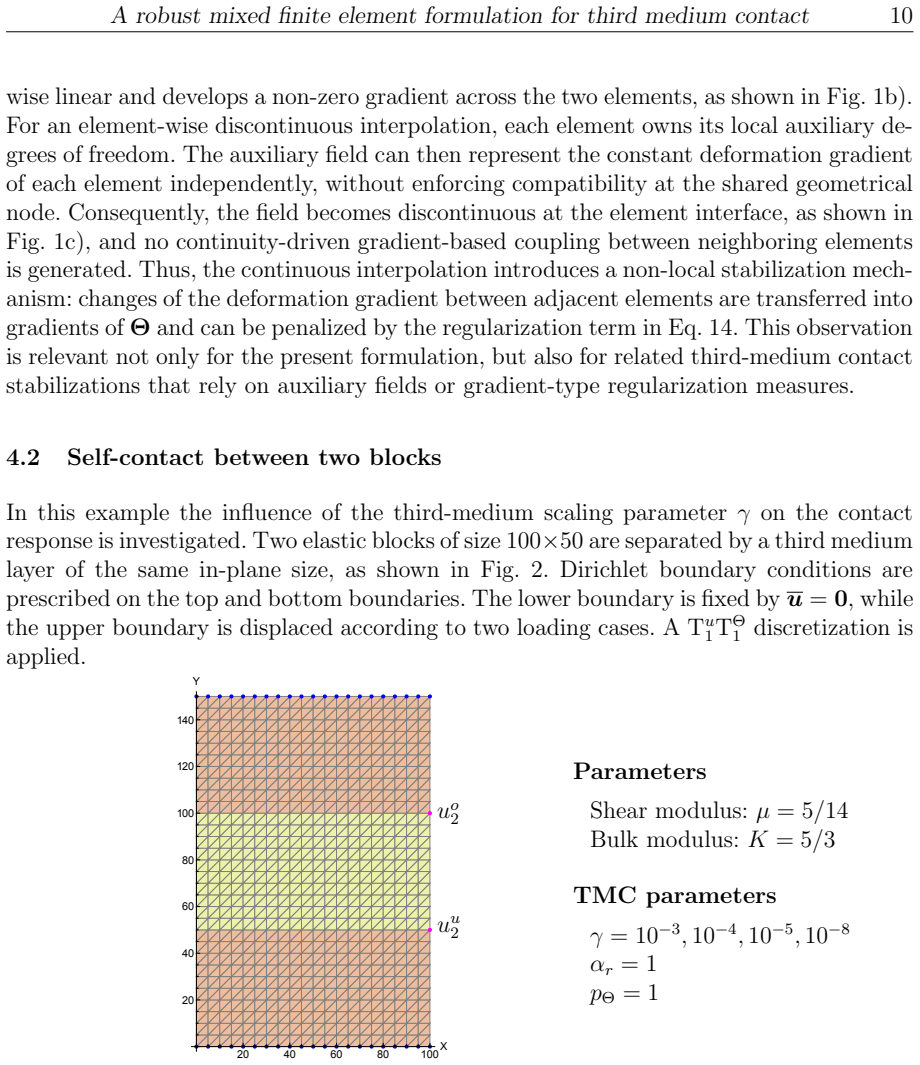
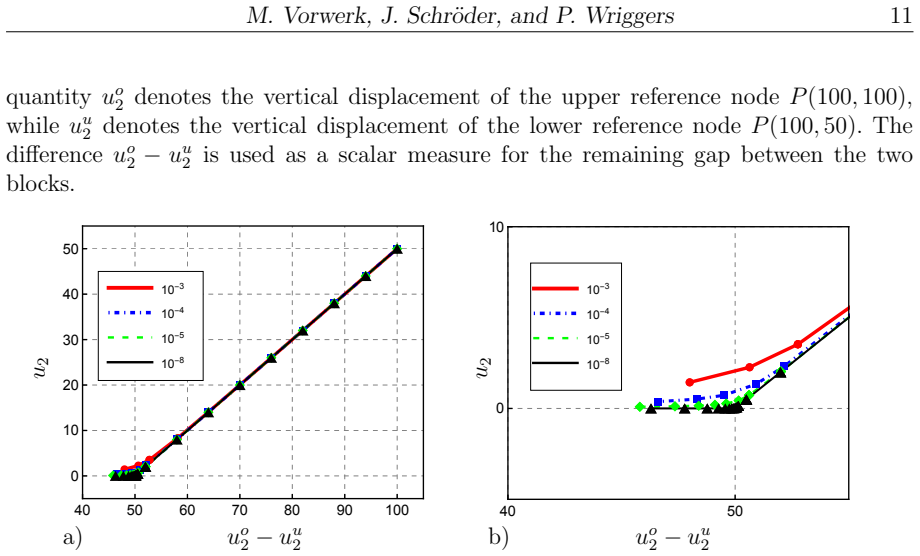
Continuous low-order auxiliary fields stabilize third medium contact even with first-order displacement elements.
A machine-rendered reading of the paper's core claim, the machinery that carries it, and where it could break.
Core claim
Treating a deformation-gradient-like field as an independent unknown in the third medium, coupled by penalty to the physical deformation gradient and regularized by a gradient contribution acting on the auxiliary field, yields stable third medium contact simulations that do not require higher displacement derivatives and remain effective with low-order displacement approximations.
What carries the argument
Auxiliary deformation-gradient-like field treated as independent unknown with penalty coupling to the physical deformation gradient and gradient regularization on the auxiliary field.
If this is right
- Continuous low-order auxiliary fields suffice for stabilization when the displacement field is approximated by first-order finite elements.
- Element-wise discontinuous auxiliary fields remain local to each element and can be eliminated by static condensation without increasing the global system size.
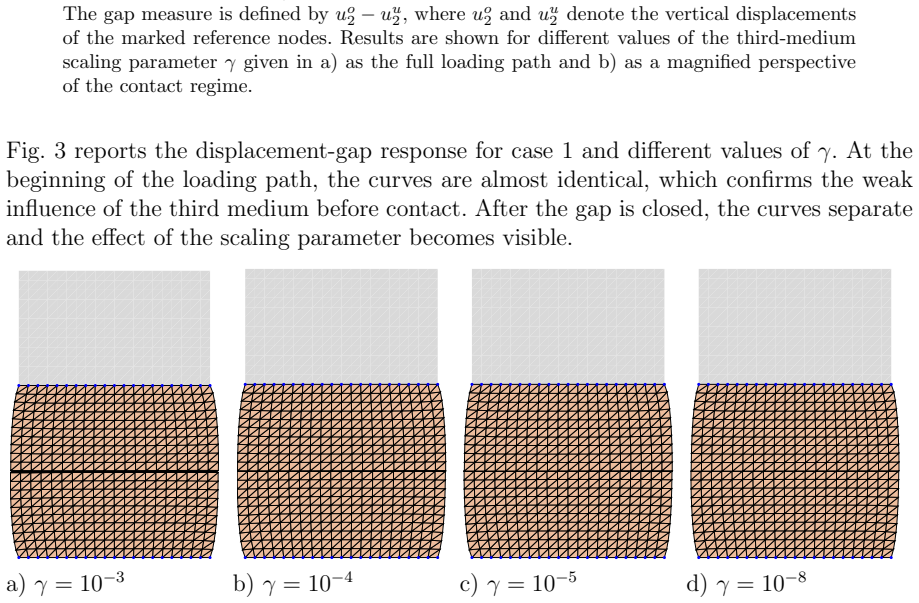
- The formulation remains effective under progressive self-contact and severe third-medium compression.
Where Pith is reading between the lines
- The local condensation option for discontinuous fields may preserve computational efficiency when scaling to large three-dimensional problems.
- Avoiding explicit higher derivatives could simplify integration of third medium contact into existing low-order finite element libraries.
Load-bearing premise
The penalty coupling of the auxiliary field to the physical deformation gradient together with the gradient regularization on the auxiliary field is sufficient to eliminate instabilities in the third medium across the tested benchmarks without introducing new numerical artifacts.
What would settle it
A large-deformation self-contact benchmark in which instabilities or new artifacts appear in the third medium despite the introduction of the continuous low-order auxiliary field and its penalty-gradient regularization.
Figures
read the original abstract
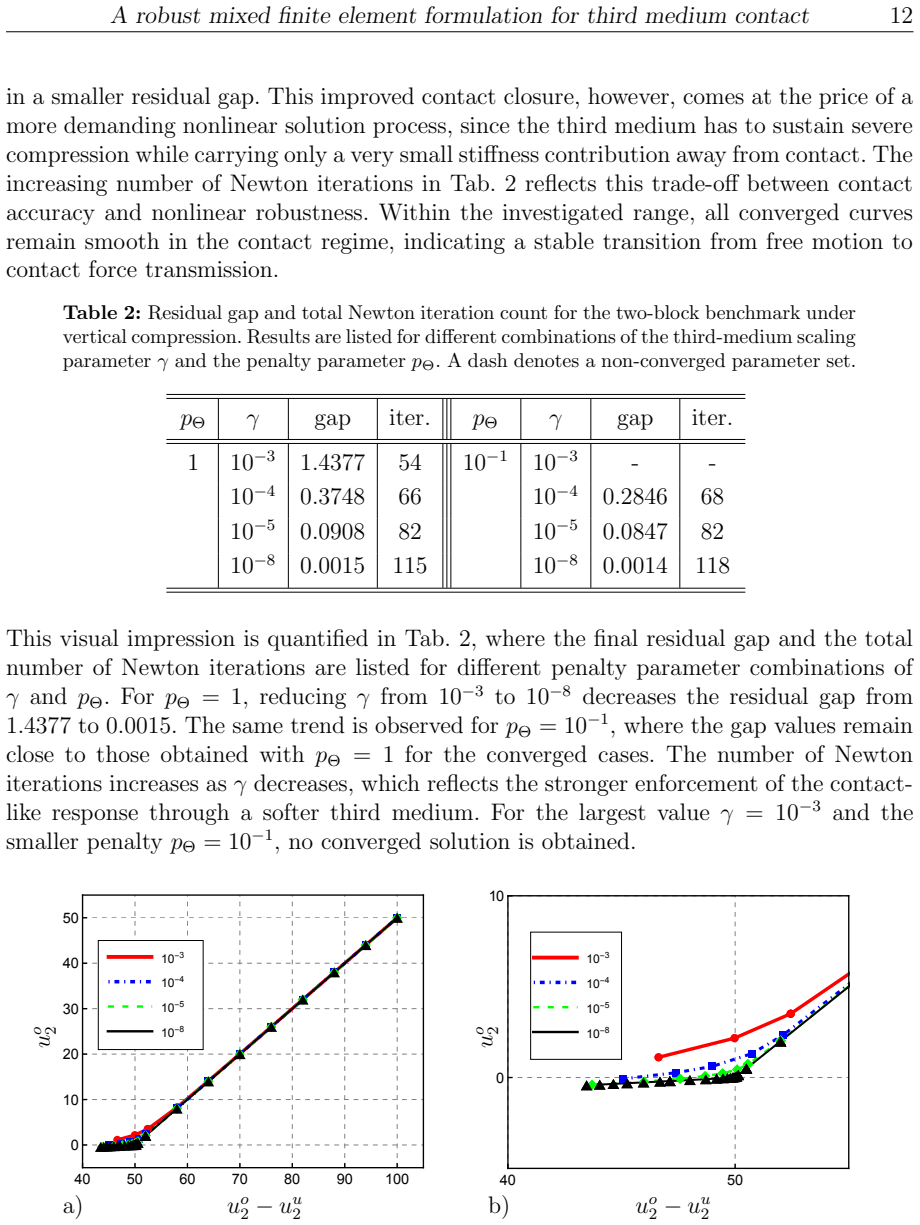
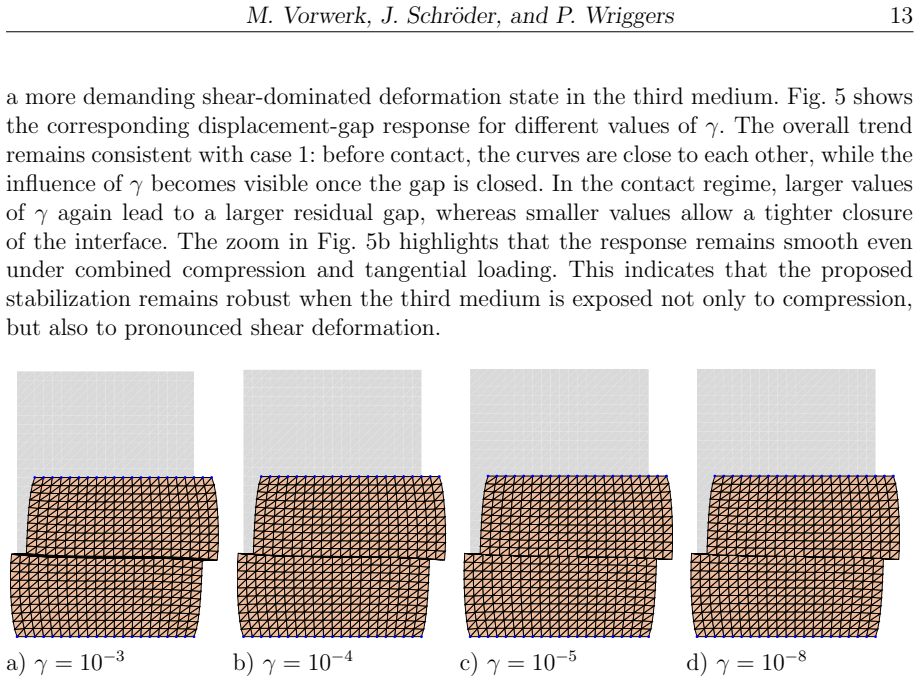
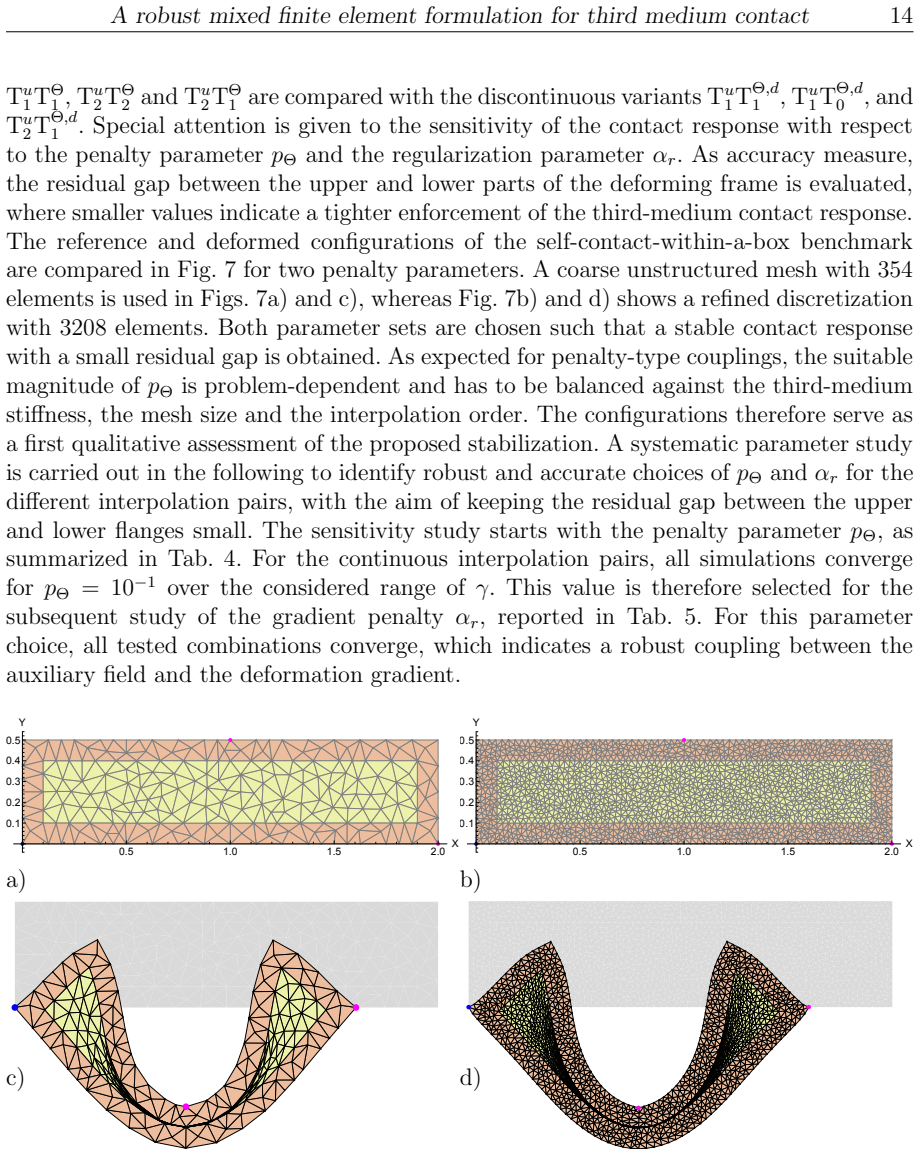
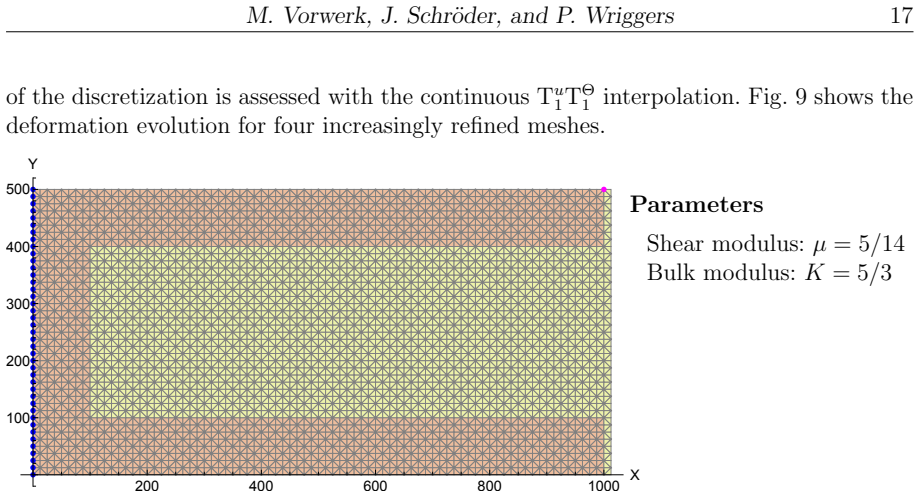
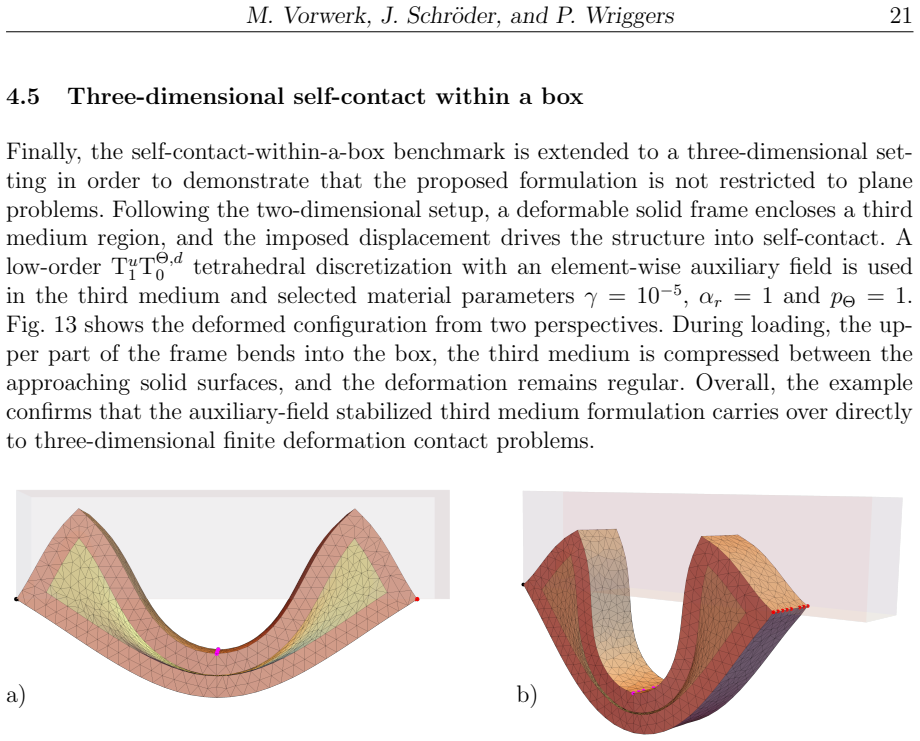
Third medium contact provides a smooth continuum alternative to classical contact algorithms by replacing explicit contact constraints with a highly compliant fictitious medium. In this work, an auxiliary-field stabilization is introduced in which a deformation-gradient-like field is treated as an independent unknown in the third medium and coupled to the physical deformation gradient by a penalty term. A gradient contribution acting on the auxiliary field provides the regularization mechanism without requiring a direct evaluation of higher displacement derivatives. Linear and quadratic interpolation spaces are investigated, including continuous and element-wise discontinuous auxiliary-field approximations. The numerical results show that continuous low-order auxiliary fields provide an effective gradient-type stabilization of the third medium, even when the displacement field is approximated by first-order finite elements. For element-wise discontinuous auxiliary fields, the additional unknowns remain local to each element and can be eliminated locally by static condensation, so that the global system does not necessarily contain additional auxiliary degrees of freedom. Benchmark problems involving large deformation, progressive self-contact and severe third-medium compression are used to assess the formulation.
Editorial analysis
A structured set of objections, weighed in public.
Referee Report
Summary. The paper introduces a mixed finite-element formulation for third-medium contact in which a deformation-gradient-like auxiliary field is introduced as an independent unknown within the fictitious medium and coupled to the physical deformation gradient by a penalty term; a gradient regularization is applied directly to the auxiliary field. Continuous and element-wise discontinuous approximations are considered for both linear and quadratic spaces. Numerical experiments on large-deformation, progressive self-contact and severe-compression benchmarks indicate that continuous low-order auxiliary fields stabilize the third medium effectively even when the displacement field is discretized with first-order elements; discontinuous auxiliary fields can be eliminated by static condensation.
Significance. If the reported stabilization holds under the stated penalty and regularization choices, the formulation supplies a practical continuum-based route to contact that avoids explicit constraint enforcement and higher-order displacement derivatives. The observation that low-order continuous auxiliary fields suffice with first-order displacements is computationally attractive and could simplify implementation in existing low-order codes. The local condensation property for discontinuous fields is a further implementation advantage.
minor comments (3)
- The abstract states that continuous low-order auxiliary fields 'provide an effective gradient-type stabilization' but does not indicate the range of penalty parameters over which this holds or whether any post-hoc tuning was required; a brief statement in §4 or §5 on parameter sensitivity would strengthen the claim.
- The description of the auxiliary-field interpolation spaces ('linear and quadratic') is not accompanied by the corresponding polynomial degrees for the displacement field in the same sentence; clarifying the exact combination tested in each benchmark (e.g., P1 displacement + P1 continuous auxiliary) would improve readability.
- No mention is made of the precise form of the gradient regularization term (e.g., whether it is the full gradient of the auxiliary field or a projected version); adding the weak-form expression in §3 would eliminate ambiguity.
Simulated Author's Rebuttal
We thank the referee for the positive summary of our work on auxiliary-field stabilization in mixed finite elements for third medium contact and for recommending minor revision. No specific major comments were raised in the report.
Circularity Check
No significant circularity identified
full rationale
The provided abstract and context present the auxiliary-field stabilization as a direct extension of standard mixed finite-element methods, with the central claim (effectiveness of continuous low-order auxiliary fields for gradient-type regularization) resting on the formulation's penalty coupling and gradient term rather than any self-definitional reduction, fitted prediction, or load-bearing self-citation. No equations, ansatzes, or uniqueness theorems are quoted that collapse to the paper's own inputs by construction. The derivation chain is therefore self-contained against external benchmarks of mixed FE theory.
Axiom & Free-Parameter Ledger
free parameters (1)
- penalty parameter for auxiliary-field coupling
axioms (1)
- standard math Standard assumptions of finite element discretization, continuum mechanics, and penalty regularization hold for the mixed formulation.
invented entities (1)
-
auxiliary deformation-gradient-like field
no independent evidence
Reference graph
Works this paper leans on
-
[1]
Wriggers.Computational Contact Mechanics
P. Wriggers.Computational Contact Mechanics. Springer, Berlin, Heidelberg, 2 edition, 2006. doi: 10.1007/978-3-540-32609-0
-
[2]
T.A. Laursen.Computational Contact and Impact Mechanics: Fundamentals of Modeling Interfa- cial Phenomena in Nonlinear Finite Element Analysis. Springer, Berlin, Heidelberg, 2002. doi: 10.1007/978-3-662-04864-1
-
[3]
Yastrebov.Numerical Methods in Contact Mechanics
V.A. Yastrebov.Numerical Methods in Contact Mechanics. Wiley, London, 2013. ISBN 9781848215191. doi: 10.1002/9781118647974
-
[4]
Rus and M.T
D. Rus and M.T. Tolley. Design, fabrication and control of soft robots.Nature, 521(7553):467–475,
-
[5]
doi: 10.1038/nature14543. M. Vorwerk, J. Schr¨ oder, and P. Wriggers23
-
[6]
A.H. Frederiksen, O. Sigmund, and K. Poulios. Topology optimization of self-contacting structures. Computational Mechanics, 73:967–981, 2024. doi: 10.1007/s00466-023-02396-7
-
[7]
doi:10.1016/j.cma.2003.10.010 Sharpa Robotics
M.A. Puso and T.A. Laursen. A mortar segment-to-segment contact method for large deformation solid mechanics.Computer Methods in Applied Mechanics and Engineering, 193(6–8):601–629, 2004. doi: 10.1016/j.cma.2003.10.010
-
[8]
R.A. Sauer and L. De Lorenzis. A computational contact formulation based on surface po- tentials.Computer Methods in Applied Mechanics and Engineering, 253:369–395, 2013. doi: 10.1016/j.cma.2012.09.002
-
[9]
G.L. Bluhm, O. Sigmund, and K. Poulios. Internal contact modeling for finite strain topology optimization.Computational Mechanics, 67:1099–1114, 2021. doi: 10.1007/s00466-021-01974-x
-
[10]
P. Wriggers, J. Korelc, and P. Junker. A third medium approach for contact using first and second order finite elements.Computer Methods in Applied Mechanics and Engineering, 436:117740, 2025. doi: 10.1016/j.cma.2025.117740
-
[11]
P. Wriggers, J. Schr¨ oder, and A. Schwarz. A finite element method for contact using a third medium. Computational Mechanics, 52:837–847, 2013. doi: 10.1007/s00466-013-0848-5
-
[12]
T. Bog, N. Zander, S. Kollmannsberger, and E. Rank. Normal contact with high order finite elements and a fictitious contact material.Computers and Mathematics with Applications, 70:1370–1390, 2015. doi: 10.1016/j.camwa.2015.04.020
-
[13]
R. Kruse, N. Nguyen-Thanh, P. Wriggers, and L. De Lorenzis. Isogeometric frictionless contact analysis with the third medium method.Computational Mechanics, 62:1009–1021, 2018. doi: 10.1007/s00466-018-1547-z
-
[14]
J. Huang, N. Nguyen-Thanh, and K. Zhou. An isogeometric-meshfree coupling approach for contact problems by using the third medium method.International Journal of Mechanical Sciences, 148: 327–336, 2018. doi: 10.1016/j.ijmecsci.2018.08.031
-
[15]
G. L. Bluhm, O. Sigmund, and K. Poulios. Inverse design of mechanical springs with tailored nonlinear elastic response utilizing internal contact.International Journal of Non-Linear Mechanics, 157:104552, 2023. doi: 10.1016/j.ijnonlinmec.2023.104552
-
[16]
A. Dalklint, J. Alexandersen, A.H. Frederiksen, K. Poulios, and O. Sigmund. Topology optimization of contact-aided thermo-mechanical regulators.International Journal for Numerical Methods in Engineering, 126(2):e7661, 2025. doi: 10.1002/nme.7661
-
[17]
A.H. Frederiksen, O. Rokoˇ s, K. Poulios, O. Sigmund, and M.G.D. Geers. Adding friction to third medium contact: A crystal plasticity inspired approach.Computer Methods in Applied Mechanics and Engineering, 432:117412, 2024. doi: 10.1016/j.cma.2024.117412
-
[18]
A.H. Frederiksen, A. Dalklint, O. Sigmund, and K. Poulios. Improved third medium formulation for 3D topology optimization with contact.Computer Methods in Applied Mechanics and Engineering, 436:117595, 2025. doi: 10.1016/j.cma.2024.117595
-
[19]
O. Faltus, M. Amato, and M. Hor´ ak. Deformation gradient averaging regularization for third medium contact.Computer Methods in Applied Mechanics and Engineering, 458:119072, 2026. doi: 10.1016/j.cma.2026.119072
-
[20]
V. Dahlberg, F. Sj¨ ovall, A. Dalklint, and M. Wallin. A rotation-based approach to third medium contact regularization.Computer Methods in Applied Mechanics and Engineering, 453:118801, 2026. doi: 10.1016/j.cma.2026.118801
-
[21]
In: Bue, A.D., Canton, C., Pont-Tuset, J., Tommasi, T
P. Wriggers, J. Korelc, and BB. Xu. Third medium contact: An overview. In Y. Bazilevs and K. Takizawa, editors,Advances in Computational Fluid-Structure Interaction and Flow Simulation. Modeling and Simulation in Science, Engineering and Technology, Springer, 2026. doi: 10.1007/978- 3-032-25894-6 15. A robust mixed finite element formulation for third med...
-
[22]
P. Wriggers. A third medium approach for thermo-mechanical contact based on low order ansatz spaces.Finite Elements in Analysis and Design, 255:104522, 2026. doi: 10.1016/j.finel.2026.104522
-
[23]
B.-B. Xu and P. Wriggers. Stabilization-free virtual element method for 2D third medium contact.Computer Methods in Applied Mechanics and Engineering, 450:118611, 2026. doi: 10.1016/j.cma.2025.118611
-
[24]
B.-B. Xu, T. Xue, and P. Wriggers. Three-dimensional third medium contact model for hyperelastic contact and pneumatically actuated systems.Journal of the Mechanics and Physics of Solids, 213: 106617, 2026. doi: 10.1016/j.jmps.2026.106617
-
[25]
M. von Zabiensky, D.R. Jantos, and P. Junker. A fast and robust third medium contact approach using the neighbored element method.Finite Elements in Analysis and Design, 255:104489, 2026. doi: 10.1016/j.finel.2025.104489
-
[26]
O. Faltus, M. Hor´ ak, M. Doˇ sk´ aˇ r, and O. Rokoˇ s. Third medium finite element contact formulation for pneumatically actuated systems.Computer Methods in Applied Mechanics and Engineering, 431: 117262, 2024. doi: 10.1016/j.cma.2024.117262
-
[27]
P. Wriggers, J. Korelc, and P. Junker. First order finite element formulations for third medium contact.Computational Mechanics, 76:829–845, 2025. doi: 10.1007/s00466-025-02628-y. M. Vorwerk, J. Schr¨ oder, and P. Wriggers25 A Appendix T able 4:Residual gap, total Newton iteration count and achieved load parameter for the self-contact-within-a-box benchma...
discussion (0)
Sign in with ORCID, Apple, or X to comment. Anyone can read and Pith papers without signing in.