REVIEW 2 major objections 2 minor 90 references
Improved Energy Stable Symmetric Gauss-Seidel Projection Method for Micromagnetics Simulations
T0 review · 2 major / 2 minor · reviewed 2026-06-29 · grok-4.3
Pith's one-line read A two-pass symmetric Gauss-Seidel iteration guarantees discrete energy stability in micromagnetic projection methods.
desk verdict A modest symmetric tweak to an existing Gauss-Seidel projection scheme for micromagnetics that claims better discrete energy stability but leaves the full-system proof thin. read the letter →
The pith
A machine-rendered reading of the paper's core claim, the machinery that carries it, and where it could break.
The reading
What carries the argument
The two-pass symmetric Gauss-Seidel iteration applied to the heat-diffusion subproblem, which fully incorporates the latest updated state variables to enforce the discrete energy law.
What would settle it
A simulation run with the SGSPM in which the discrete energy increases over successive time steps would show that the stability guarantee fails.
Extended reading notes
Core claim
The SGSPM adopts a two-pass symmetric Gauss-Seidel iteration, where updated information from the heat-diffusion stage is fully exploited to rigorously guarantee discrete energy stability for the full micromagnetic system while retaining first-order temporal accuracy and second-order spatial consistency.
Load-bearing premise
That performing the two-pass symmetric Gauss-Seidel iteration on the heat-diffusion subproblem by itself suffices to guarantee discrete energy stability for the entire micromagnetic system without extra limits on time-step size or material parameters.
Editorial extensions
If this is right
- The method permits stable long-time integration without artificial restrictions on time-step size.
- It remains compatible with FFT acceleration for both linear solves and stray-field computations.
- Numerical evidence indicates improved robustness when tracking magnetization motion and domain-wall propagation.
- First-order temporal and second-order spatial accuracy are preserved relative to the original single-pass scheme.
Reading between the lines
- The same two-pass idea could be tested on other projection or splitting schemes for coupled Landau-Lifshitz-type systems.
- Extensions to adaptive time-stepping or higher-order integrators might preserve the energy bound while increasing efficiency.
- Performance on three-dimensional or geometrically complex domains would clarify whether the stability gain scales beyond the reported tests.
Signed reviews
Editorial analysis
A structured set of objections, weighed in public.
Referee Report
Summary. The paper proposes the symmetric Gauss-Seidel projection method (SGSPM) as an improvement to the standard Gauss-Seidel projection method (GSPM) for the Landau-Lifshitz-Gilbert equation in micromagnetics. It retains first-order temporal and second-order spatial accuracy, incorporates FFT acceleration for linear solves and stray-field evaluation, and claims that replacing the single-sided Gauss-Seidel sweep with a two-pass symmetric iteration on the heat-diffusion subproblem rigorously guarantees discrete energy stability without time-step restrictions. Numerical tests on magnetization dynamics and domain-wall motion are presented to illustrate improved stability.
Significance. An unconditionally energy-stable first-order scheme for the full micromagnetic system (including nonlocal stray-field, anisotropy, and |m|=1 projection) would be a useful addition to the literature on structure-preserving integrators for LLG. The numerical examples provide some evidence of practical robustness, but the absence of a complete discrete energy law that closes for the coupled nonlinear terms limits the immediate impact.
major comments (2)
- [Abstract, §3] The central stability claim (abstract and §3) asserts that the two-pass symmetric Gauss-Seidel iteration on the heat-diffusion subproblem alone produces a discrete energy law bounding the full scheme. No derivation is supplied that controls the stray-field term (evaluated via FFT), the anisotropy contribution, or the Lagrange-multiplier projection step; these are treated as perturbations without an explicit estimate showing they do not destroy the dissipation bound.
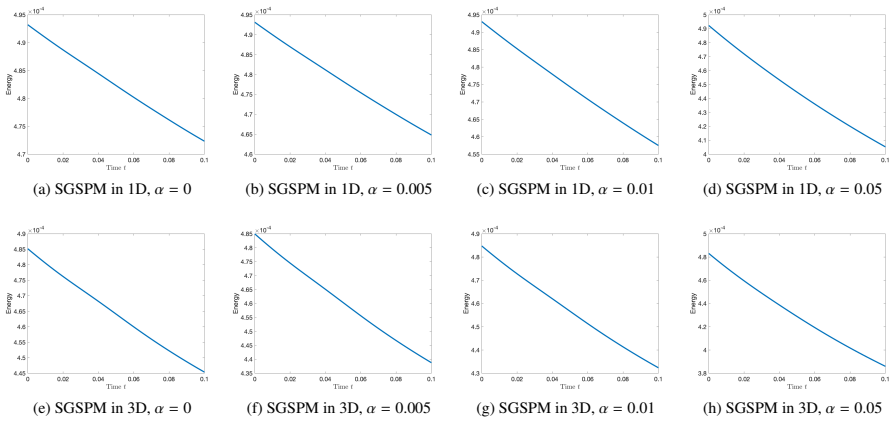
- [§4] §4 (numerical experiments) reports improved stability but supplies no quantitative verification of the discrete energy law (e.g., plots of the discrete energy decay or comparison against the continuous energy dissipation identity). Without such checks, the numerical evidence cannot confirm that the claimed rigorous guarantee holds for the full system.
minor comments (2)
- [§2] Notation for the symmetric iteration (forward and backward sweeps) is introduced without an explicit algorithmic listing or pseudocode; a compact algorithm box would improve clarity.
- [§2.2] The spatial discretization order is stated as second-order, but the finite-difference stencil and boundary conditions for the stray-field computation are not detailed; a short paragraph on consistency would help.
Simulated Author's Rebuttal
We thank the referee for the careful reading and constructive feedback on our manuscript. We address each major comment below and indicate the revisions we will incorporate.
read point-by-point responses
-
Referee: [Abstract, §3] The central stability claim (abstract and §3) asserts that the two-pass symmetric Gauss-Seidel iteration on the heat-diffusion subproblem alone produces a discrete energy law bounding the full scheme. No derivation is supplied that controls the stray-field term (evaluated via FFT), the anisotropy contribution, or the Lagrange-multiplier projection step; these are treated as perturbations without an explicit estimate showing they do not destroy the dissipation bound.
Authors: Section 3 derives the unconditional discrete energy dissipation for the symmetric two-pass Gauss-Seidel iteration applied to the heat-diffusion subproblem, which is the key improvement over standard GSPM. The stray-field (via FFT), anisotropy, and projection steps are treated identically to the original GSPM, where prior analysis already shows they contribute non-positively or conservatively to the energy balance. To address the request for explicit closure, we will add a short paragraph in the revised §3 that assembles the full discrete energy law by combining the new heat-diffusion estimate with the standard bounds on the remaining terms. revision: yes
-
Referee: [§4] §4 (numerical experiments) reports improved stability but supplies no quantitative verification of the discrete energy law (e.g., plots of the discrete energy decay or comparison against the continuous energy dissipation identity). Without such checks, the numerical evidence cannot confirm that the claimed rigorous guarantee holds for the full system.
Authors: We agree that direct numerical verification of the energy law would strengthen the presentation. In the revised §4 we will add plots of the discrete energy versus time for both the magnetization dynamics and domain-wall examples, together with a brief comparison to the expected dissipation rate, thereby providing quantitative confirmation that the full scheme respects the theoretical bound. revision: yes
Circularity Check
No circularity: stability claim follows directly from the algorithmic modification without reduction to inputs
full rationale
The paper presents SGSPM as a direct modification of GSPM via a two-pass symmetric Gauss-Seidel iteration on the heat-diffusion subproblem, with the discrete energy stability asserted to follow from full exploitation of updated information in that stage. The abstract and description contain no self-citations that bear the load of the central claim, no fitted parameters renamed as predictions, no self-definitional loops, and no imported uniqueness theorems. The derivation chain is therefore self-contained: the stability guarantee is positioned as a consequence of the iteration change itself rather than presupposing the result.
Assumptions & free parameters
Cite this review
Pith. "Pith review of Improved Energy Stable Symmetric Gauss-Seidel Projection Method for Micromagnetics Simulations." pith.science (2026). https://pith.science/paper/6W6AUUVN
@misc{pith2026260628113,
  author       = {Pith},
  title        = {Pith review of: Improved Energy Stable Symmetric Gauss-Seidel Projection Method for Micromagnetics Simulations},
  year         = {2026},
  howpublished = {\url{https://pith.science/paper/6W6AUUVN}},
  note         = {Machine review of arXiv:2606.28113}
}
read the original abstract
The Gauss-Seidel projection method (GSPM) constitutes an efficient and numerically stable numerical framework for micromagnetic simulations of ferromagnetic media. This scheme attains first-order temporal accuracy and second-order spatial accuracy. Fast Fourier transform (FFT) techniques can be incorporated to accelerate both the solution of the arising linear algebraic systems and the evaluation of stray magnetic fields. The conventional GSPM relies on a single-sided Gauss-Seidel iteration, which leverages the latest updated state variables associated with the heat-diffusion subproblem. In this work, we develop a symmetric Gauss-Seidel projection method (SGSPM) that retains first-order temporal accuracy and second-order spatial consistency. The proposed symmetric variant exhibits superior stability properties relative to the standard GSPM. Specifically, SGSPM adopts a two-pass symmetric Gauss-Seidel iteration, where updated information from the heat-diffusion stage is fully exploited to rigorously guarantee discrete energy stability. We validate the performance of the devised scheme through numerical investigations of magnetization dynamic evolution and magnetic domain-wall propagation. Numerical evidence demonstrates that the improved symmetric scheme delivers enhanced stability for capturing magnetization motion dynamics.
Figures


Figures from the paper (18 more)




Reference graph
Works this paper leans on
-
[1]
Abert and G
C. Abert and G. Hrkac and M. Page and D. Praetorius and M. Ruggeri and D. Suess , journal=. Spin-polarized transport in ferromagnetic multilayers: an unconditionally convergent
-
[2]
Alouges and P
F. Alouges and P. Jaisson , journal=. Convergence of a finite element discretization for the. 2006 , publisher=
2006
-
[3]
Alouges and E
F. Alouges and E. Kritsikis and J. Steiner and J. Toussaint , journal=. A convergent and precise finite element scheme for. 2014 , publisher=
2014
-
[4]
Alouges and E
F. Alouges and E. Kritsikis and J. Toussaint , journal=. A convergent finite element approximation for. 2012 , publisher=
2012
-
[5]
Alouges and A
F. Alouges and A. Soyeur , journal=. On global weak solutions for. 1992 , publisher=
1992
-
[6]
Bartels and J
S. Bartels and J. Ko and A. Prohl , journal=. Numerical analysis of an explicit approximation scheme for the
-
[7]
Baskaran and J
A. Baskaran and J. Lowengrub and C. Wang and S. Wise , title=. SIAM J. Numer. Anal. , year=
-
[8]
Carbou and P
G. Carbou and P. Fabrie , journal=. Regular solutions for. 2001 , publisher=
2001
Show all 90 references
-
[9]
Chen and C
J. Chen and C. Wang and C. Xie , title=. Appl. Numer. Math. , year=
-
[10]
Chen and Y
W. Chen and Y. Liu and C. Wang and S.M. Wise , title=. Math. Comp. , year=
-
[11]
Chen and C
W. Chen and C. Wang and S. Wang and X. Wang and S.M. Wise , title=. J. Sci. Comput. , year=
-
[12]
Ciarlet , year=
P.G. Ciarlet , year=
-
[13]
I. Cimr. Error estimates for a semi-implicit numerical scheme solving the. IMA J. Numer. Anal. , volume=. 2005 , publisher=
2005
-
[14]
I. Cimr. A survey on the numerics and computations for the. Arch. Comput. Methods Eng. , volume=. 2008 , publisher=
2008
-
[15]
Convergence result for the constraint preserving mid-point scheme for micromagnetism , author=. J. Comput. Appl. Math. , volume=. 2009 , publisher=
2009
-
[16]
I. Cimr. An iterative approximation scheme for the. J. Comput. Appl. Math. , volume=. 2004 , publisher=
2004
-
[17]
Di Fratta and C.M
G. Di Fratta and C.M. Pfeiler and D. Praetorius and M. Ruggeri and B. Stiftner , journal=. Linear second-order
-
[18]
Feischl and T
M. Feischl and T. Thanh , journal=. The Eddy Current-
-
[19]
Gao , journal=
H. Gao , journal=. Optimal Error Estimates of a Linearized. 2014 , publisher=
2014
-
[20]
C.J. Garc. Improved. J. Comput. Phys. , volume=
-
[21]
Girault and P.A
V. Girault and P.A. Raviart , year=. Finite Element Methods for
-
[22]
Guan and C
Z. Guan and C. Wang and S.M. Wise , title=. Numer. Math. , year=
-
[23]
Guan and J.S
Z. Guan and J.S. Lowengrub and C. Wang and S.M. Wise , title=. J. Comput. Phys. , year=
-
[24]
Guan and J.S
Z. Guan and J.S. Lowengrub and C. Wang , title=. Math. Methods Appl. Sci. , year=
-
[25]
Guo and M
B. Guo and M. Hong , journal=. The. 1993 , publisher=
1993
-
[26]
Jeong and J
D. Jeong and J. Kim , journal=. A. 2010 , publisher=
2010
-
[27]
An accurate and robust numerical method for micromagnetics simulations , author=. Curr. Appl. Phys. , volume=. 2014 , publisher=
2014
-
[28]
Kim and K
E. Kim and K. Lipnikov , journal=. The mimetic finite difference method for the
-
[29]
Krishnaprasad and X
P. Krishnaprasad and X. Tan , journal=. 2001 , publisher=
2001
-
[30]
Beyond first-order finite element schemes in micromagnetics , author=. J. Comput. Phys. , volume=. 2014 , publisher=
2014
-
[31]
SIAM Rev
Recent developments in the modeling, analysis, and numerics of ferromagnetism , author=. SIAM Rev. , volume=. 2006 , publisher=
2006
-
[32]
On the theory of the dispersion of magnetic permeability in ferromagnetic bodies , author=. Phys. Z. Sowjet. , volume=
-
[33]
2006 , publisher=
Concepts in spin electronics , author=. 2006 , publisher=
2006
-
[34]
Computational micromagnetism , author=
-
[35]
Romeo and G
A. Romeo and G. Finocchio and M. Carpentieri and L. Torres and G. Consolo and B. Azzerboni , journal=. A numerical solution of the magnetization reversal modeling in a permalloy thin film using fifth order. 2008 , publisher=
2008
-
[36]
Serpico and I.D
C. Serpico and I.D. Mayergoyz and G. Bertotti , journal=. Numerical technique for integration of the. 2001 , publisher=
2001
-
[37]
2009 , doi=
Nanomagnetism and spintronics , author=. 2009 , doi=
2009
-
[38]
Visintin , journal=
A. Visintin , journal=. On
-
[39]
Wang and C.J
X. Wang and C.J. Garc\'. A. J. Comput. Phys. , volume=. 2001 , publisher=
2001
-
[40]
W. E and X. Wang , journal=. Numerical methods for the. 2001 , publisher=
2001
-
[41]
Wang and S.M
C. Wang and S.M. Wise , title=. SIAM J. Numer. Anal. , year=
-
[42]
Wise and C
S.M. Wise and C. Wang and J. Lowengrub , title=. SIAM J. Numer. Anal. , year=
-
[43]
Yamada and N
H. Yamada and N. Hayashi , journal=. Implicit solution of the
-
[44]
Existence and uniqueness of smooth solution for system of ferromagnetic chain , author=. Sci. China Ser. A. Math. , volume=
-
[45]
Nonlinear magnetization dynamics under circularly polarized field , author=. Phys. Rev. Lett. , volume=. 2001 , publisher=
2001
-
[46]
d'Aquino and C
M. d'Aquino and C. Serpico and G. Miano , journal=. Geometrical integration of. 2005 , publisher=
2005
-
[47]
Melcher , journal=
C. Melcher , journal=. Global solvability of the. 2012 , publisher=
2012
-
[48]
Nonlinear elliptic boundary value problems , author=. Bull. A.M.S. , volume=
-
[49]
Minty , journal=
G. Minty , journal=. On a monotonicity method for the solution of non-linear equations in
-
[50]
Wang and J.-G
C. Wang and J.-G. Liu , title=. Math. Comp. , volume=
-
[51]
Samelson and R
R. Samelson and R. Temam and C. Wang and S. Wang , title=. SIAM J. Numer. Anal. , volume=
-
[52]
Wang and J.-G
C. Wang and J.-G. Liu and H. Johnston , title=. Numer. Math. , volume=
-
[53]
Chen and C.J
J. Chen and C.J. Garc\'. A mean-field model of spin dynamics in multilayered ferromagnetic media , YEAR =. Multiscale Model. Simul. , VOLUME =
-
[54]
Xie and C.J
C. Xie and C.J. Garc\'. Second-order semi-implicit methods for micromagnetics simulations , journal=
-
[55]
Gilbert , journal =
T.L. Gilbert , journal =. 1955 , note =
1955
-
[56]
Armour Research Foundation of Illinois Institute of Technology , address=
Anomalous rotational damping in ferromagnetic sheets , author=. Armour Research Foundation of Illinois Institute of Technology , address=. 1955 , note=
1955
-
[57]
Micromagnetics and Recording Materials , author=
-
[58]
Miranda and A.B
I. Miranda and A.B. Klautau and A. Bergman and D. Thonig and H. Petrilli and O. Eriksson , year=. Mechanisms behind large
-
[59]
Sakuma , journal=
A. Sakuma , journal=. First-principles study of the. 2015 , volume=
2015
-
[60]
and Xia, K
Tang, H. and Xia, K. , journal =. Gilbert Damping Parameter in. 2017 , publisher =. doi:10.1103/PhysRevApplied.7.034004 , url =
2017 doi
-
[61]
Budhathoki and A
S. Budhathoki and A. Sapkota and K.M. Law and B. Nepal and S. Ranjit and S. Kc and T. Mewes and A. Hauser , journal=. Low. 2020 , volume=
2020
-
[62]
Lattery and D
D.M. Lattery and D. Zhang and J. Zhu and X. Hang and J. Wang and X. Wang , journal=. Low. 2018 , volume=. doi:10.1038/s41598-018-31642-9 , pages=
2018 doi
-
[63]
Weber and D
R. Weber and D. Han and I. Boventer and S. Jaiswal and R. Lebrun and G. Jakob and M. Kl. Gilbert damping of. J. Phys. D , year=
-
[64]
Tanaka and S
T. Tanaka and S. Kashiwagi and Y. Otsuka and Y. Nozaki and Y. Hong and K. Matsuyama , journal=. Microwave-Assisted Magnetization Reversal of Exchange-Coupled Composite Nanopillar With Large. 2014 , volume=
2014
-
[65]
and Zeng, F
Li, Y. and Zeng, F. and Zhang, S. S.-L. and Shin, H. and Saglam, H. and Karakas, V. and Ozatay, O. and Pearson, J.E. and Heinonen, O.G. and Wu, Y. and Hoffmann, A. and Zhang, W. , journal =. Giant Anisotropy of. 2019 , month =. doi:10.1103/PhysRevLett.122.117203 , url =
2019 doi
-
[66]
Influence of a transport current on magnetic anisotropy in gyrotropic ferromagnets , author =. Phys. Rev. B , volume =. 2009 , publisher =. doi:10.1103/PhysRevB.80.134403 , url =
2009 doi
-
[67]
Thonig and J
D. Thonig and J. Henk , journal=. 2014 , volume=
2014
-
[68]
Steiauf and J
D. Steiauf and J. Seib and M. Faehnle and K. Gilmore and M. Stiles , journal=. Anisotropic damping of the magnetization dynamics in. 2010 , volume=
2010
-
[69]
Akrivis and M
G. Akrivis and M. Feischl and B. Kov\'acs and C. Lubich , journal=. Higher-order linearly implicit full discretization of the. 2021 , pages =
2021
-
[70]
An , journal=
R. An , journal=. Optimal Error Estimates of Linearized. 2016 , volume=
2016
-
[71]
Li and C
P. Li and C. Xie and R. Du and J. Chen and X. Wang , journal=. Two improved. 2020 , volume=
2020
-
[72]
1996 , pages=
Evolution problems in geometry and mathematical physics , author=. 1996 , pages=
1996
-
[73]
Cai and J
Y. Cai and J. Chen and C. Wang and C. Xie , journal=. Error estimates on a second order method for. 2021 , note=
2021
-
[74]
1963 , publisher=
Micromagnetics , author=. 1963 , publisher=
1963
-
[75]
Zhang and M
D. Zhang and M. Li and L. Jin and C. Li and Y. Rao and X. Tang and H. Zhang , journal=. Extremely Large Magnetization and. 2020 , volume=
2020
-
[76]
The Influence of s-d Exchange on Relaxation of Magnons in Metals , author=. Phys. Stat. Solidi B-basic Solid Stat. Phys. , year=
-
[77]
IEEE Trans
Theory of the magnetic damping constant , author=. IEEE Trans. Magn. , year=
-
[78]
Electric-field control of spin dynamics during magnetic phase transitions , author=. Sci. Adv. , year=
-
[79]
Li and Z
P. Li and Z. Ma and R. Du and J. Chen , year=
-
[80]
2025 , eprint=
Enhancing Micromagnetics Simulations with a Third-Order Semi-Implicit Projection Method , author=. 2025 , eprint=
2025
-
[81]
2025 , eprint=
Efficient And Stable Third-order Method for Micromagnetics Simulations , author=. 2025 , eprint=
2025
-
[82]
and Shen, J
Cheng, Q. and Shen, J. , volume=. Length Preserving Numerical Schemes for. SIAM Journal on Scientific Computing , publisher=. 2023 , month=. doi:10.1137/22m1501143 , number=
2023 doi
-
[83]
2006 , month=
An overview of projection methods for incompressible flows , author=. 2006 , month=. doi:10.1016/j.cma.2005.10.010 , journal=
2006 doi
-
[84]
and Zheng, N
Li, X. and Zheng, N. and Shen, J. , url=. On a class of higher-order length preserving and energy decreasing. 2024 , month=. doi:10.48550/ARXIV.2404.08902 , publisher=
2024 doi
-
[85]
Journal of Computational and Applied Mathematics , volume =
A. Journal of Computational and Applied Mathematics , volume =. 2010 , issn =. doi:https://doi.org/10.1016/j.cam.2010.01.002 , url =
2010 doi
-
[86]
An, R. , doi=. Optimal Error Estimates of Linearized. J. Sci. Comput. , year=
-
[87]
Enhanced Second-Order
Li, Panchi and Wang, Xiao-Ping , journal=. Enhanced Second-Order
-
[88]
Pulsed laser deposition of epitaxial yttrium iron garnet films with low
Onbasli, MC and Kehlberger, Andreas and Kim, Dong Hun and Jakob, Gerhard and Kl. Pulsed laser deposition of epitaxial yttrium iron garnet films with low. Apl Materials , volume=. 2014 , publisher=
2014
-
[89]
Nature Physics , volume=
Ultra-low magnetic damping of a metallic ferromagnet , author=. Nature Physics , volume=. 2016 , publisher=
2016
-
[90]
Science Advances , volume=
Ultralow magnetic damping of a common metallic ferromagnetic film , author=. Science Advances , volume=. 2021 , publisher=
2021
Reviewed June 29, 2026 · model on record in the stance chip above.
Discussion (0). Continue with ORCID to comment.