REVIEW 3 major objections 6 minor 8 references
Experimental Design When N Equals One
T0 review · 3 major / 6 minor · reviewed 2026-07-12 · grok-4.5
Pith's one-line read Optimal N-of-1 designs depend on the target effect: Bernoulli is often best; cumulative effects want longer treatment blocks.
desk verdict Solid model-based design theory for N-of-1 trials: clean large-T optima for switch rates and block lengths under a linear impulse-response model, with a real minimax justification for Bernoulli(1/2). read the letter →
The pith
A machine-rendered reading of the paper's core claim, the machinery that carries it, and where it could break.
The reading
What carries the argument
The asymptotic design objective L_asy = wᵀ(EΣ)⁻¹w, where Σ is the Gram matrix of the lagged treatment vectors under a Markov assignment process; closed-form moments of that process reduce design choice to optimization over two scalar parameters (switching rates or block length).
What would settle it
Simulate or re-analyze a long single-unit series whose true carryover is infinite or non-additive, optimize the proposed Markov designs for a cumulative target under the finite-order model, and check whether the resulting variance is smaller than that of Bernoulli or regular switchback designs; systematic under-performance would refute the optimality claims.
Extended reading notes
Core claim
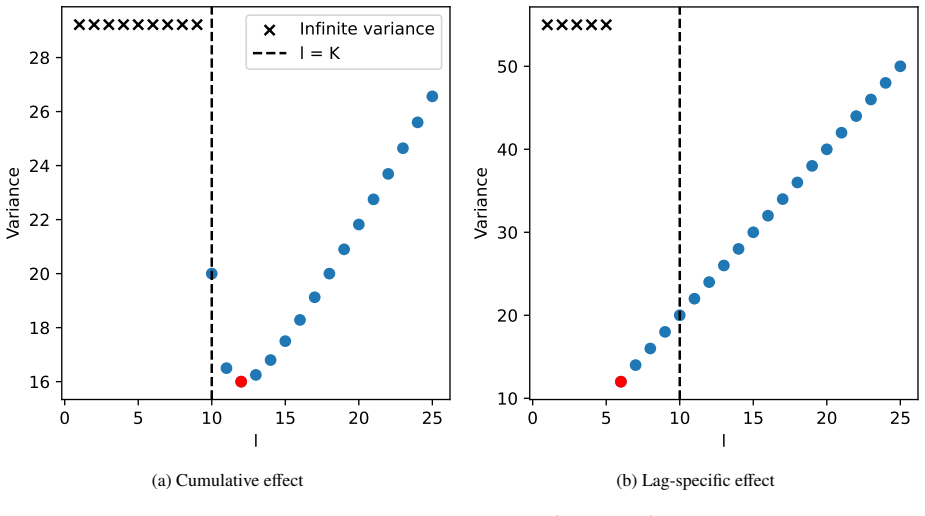
Under a finite-order additive impulse-response model, the large-horizon optimal random-switch design has equal switching probabilities satisfying an explicit quadratic equation in the estimand weights, reducing to independent Bernoulli(1/2) for lag-specific and robust targets; the optimal cycle-switch block length is approximately K−1+√(K−1) for truncated cumulative effects and exactly K for robust designs.
Load-bearing premise
Outcomes are generated by a finite-order additive impulse-response model whose errors are independent of the entire treatment path, so that design quality collapses to the expected Gram matrix of lagged treatments.
Editorial analysis
A structured set of objections, weighed in public.
Referee Report
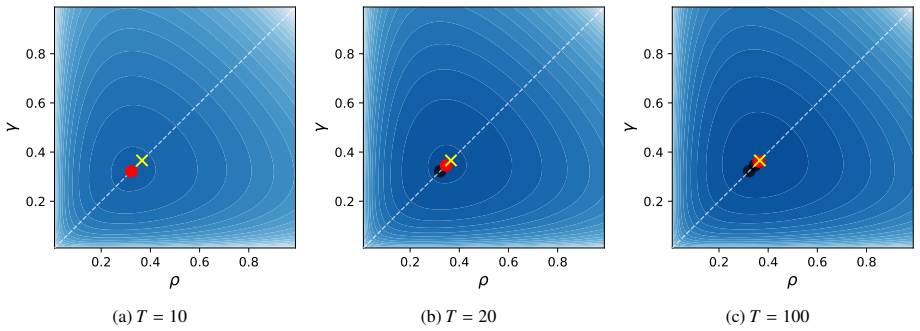
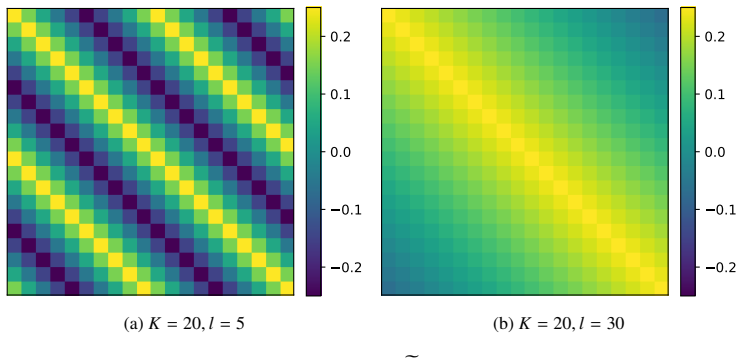
Summary. The paper studies optimal design for N-of-1 (time-series) experiments under a finite-order linear impulse-response model. Treatment paths are modeled as Markov chains with (possibly time-varying) transition matrices, recovering independent Bernoulli, regular switchback, and deterministic designs as special cases. The design objective is the asymptotic OLS variance of linear functionals of lag coefficients, L_asy = w^T (E Σ)^{-1} w, optimized either for a single estimand or in a minimax (E-optimal) sense. For two structured subclasses—random-switch designs (homogeneous transitions with stationary start) and cycle-switch designs (deterministic period-l alternation)—the authors derive large-T optimal parameters: random-switch optima satisfy ρ★=γ★ and a quadratic FOC in the weights w (Theorem 4.2), with ρ★=γ★=1/2 for lag-specific and robust targets (Example 4.3, Theorem 4.6); cycle-switch optima give block lengths ≈K−1+√(K−1) for truncated cumulative effects and l★=K for robust designs when K is even (Corollaries 5.6–5.7, Theorem 5.8). Simulations compare the proposed designs to Bernoulli and optimal regular switchback under correct specification and several misspecifications.
Significance. Under the stated model the contribution is solid and practically useful. The Markov parametrization unifies common N-of-1 designs; the large-T characterizations give clear, estimand-dependent design rules; and the robust random-switch result rigorously supports the widespread use of i.i.d. Bernoulli(1/2). Strengths include explicit moment formulas (Proposition 2.5, Lemmas B.2–B.3), KMS spectral analysis with argmin continuity for finite-T → limit optimizers, closed-form cycle-switch inverses via a Laplacian-plus-rank-one form, and a design-based interpretation of OLS in Appendix D that connects to Lin and Ding (2025). The scope is model-conditional (finite additive carryover, exogenous i.i.d. errors), which the authors flag and partially probe in Section 6.2; within that scope the optimality claims appear internally consistent and of clear interest for clinical and online experimentation.
major comments (3)
- Definition 3.6 / Algorithm 1: design selection optimizes the surrogate L_asy = w^T (E Σ)^{-1} w, while finite-sample performance is evaluated with the exact Monte Carlo quantity w^T E(Σ^{-1}) w (Section 6). The paper notes asymptotic equivalence and the Jensen gap, but does not check whether the two criteria rank candidate designs the same way at the finite T used in simulations (T as small as 20). A short verification—e.g., that the grid argmin of L_asy coincides with that of the Monte Carlo exact variance for the W classes in Figure 5—would make the finite-sample claims load-bearing rather than optimistic.
- Theorem 5.8 states the robust cycle-switch optimum only for even K. The proof uses the anti-periodic Laplacian spectrum and the eigenvalue at r=K/2. The manuscript should either extend the argument to odd K (the same corner solution l★=K is plausible) or explicitly restrict the robust cycle-switch claim and note the odd-K case as open, so that the “complete” large-T theory advertised in the abstract is accurate.
- Section 4.1 excludes estimands with w_k = w_{k+1} or w_k = −w_{k+1} for all k (including the full cumulative effect) from the random-switch FOC, pushing optima to the boundary ρ=γ=0, which the authors correctly flag as practically ill-behaved. Cycle-switch then covers these cases. The informal summary in Table 1 and the abstract’s claim of a complete theory for both classes should state more clearly that random-switch theory is interior-only and that cumulative-type targets are resolved only in the cycle-switch class (and via the truncated cumulative Corollary 5.6 rather than the pure all-ones vector).
minor comments (6)
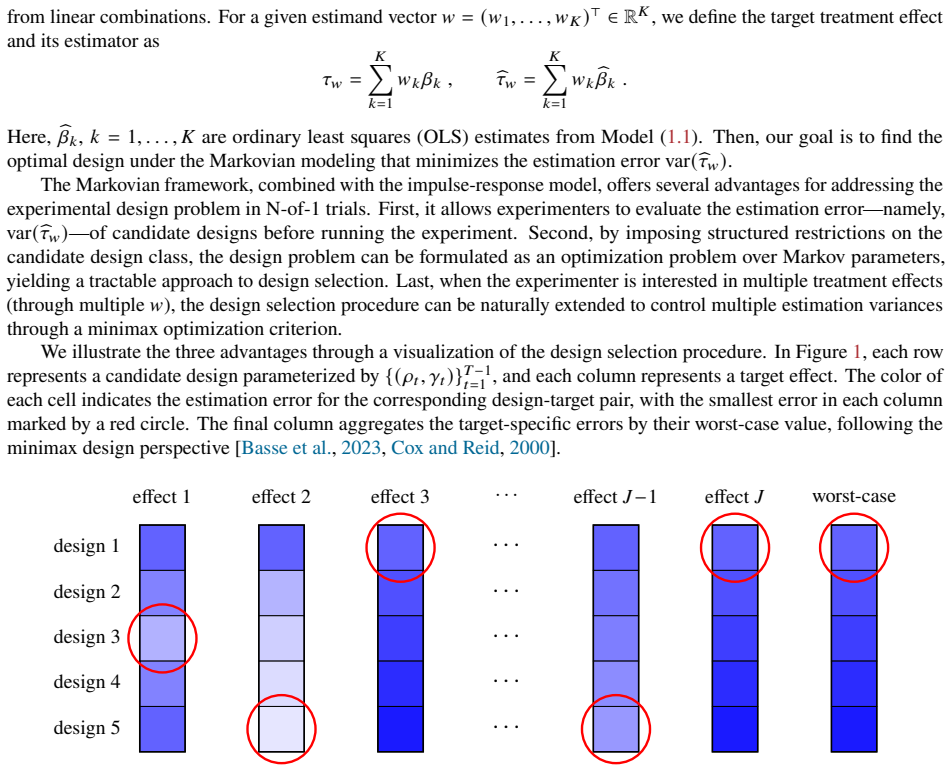
- Figure 1 is schematic only; a short caption note that colors are illustrative (not computed from a real design grid) would avoid confusion with the later numerical figures.
- In Definition 4.1 the convention ρ/(ρ+γ)=1/2 when ρ=γ=0 is stated in a footnote; it would help to put it in the main text, since that boundary appears repeatedly in the cumulative discussion.
- Corollary 5.6 treats truncated cumulative effects w=(1,…,1,0,…,0); a one-sentence remark on how the pure cumulative w=1_K differs (identifiability under l<K, boundary term B(w)) would close the gap left by the Section 4 exclusion.
- Section 6.2, Panel A: cycle-switch shows large bias under an unmodeled log(t) trend. The text correctly prefers random-switch for robustness, but a brief note on whether pre-detrending (Remark 3.1) would restore cycle-switch performance would strengthen the practical guidance.
- Typos / polish: “remains to be elucidated” (p. 2) → “remains unclear”; arXiv date line and “July 7, 2026” are fine for a preprint but should be cleaned for journal submission; ensure consistent notation T_eff vs T−K+1 throughout.
- Related work: a short pointer to classical crossover / carryover design literature in biostatistics (beyond g-methods) would help clinical readers place the cycle-switch recommendations.
Circularity Check
No significant circularity: optimality theorems minimize a stated design objective under an explicit linear model; FOCs and block-length optima are derived, not fitted or definitionally forced.
full rationale
The paper defines a Markov design class, adopts the finite-order impulse-response model (3.1), and takes the asymptotic surrogate L_asy = w^T(EΣ)^{-1}w (Definition 3.6) as the design objective. Theorems 4.2 and 4.6 then characterize large-T minimizers of that objective over random-switch (ρ,γ) via the closed-form EΣ (Lemma B.3) and the spectral structure of the Kac–Murdock–Szegő matrix; Corollaries 5.6–5.7 and Theorem 5.8 do the same for cycle-switch block length l via the explicit inverse eΣ^{-1} = l L_K + (l/(l−K+1))vv^T (Lemma C.2). These are standard first-order / spectral arguments under a declared criterion, not self-definitional identities or fitted quantities re-labeled as predictions. Self-citations (Liang & Recht 2025; Guo et al. 2026) supply model motivation and related design literature; the load-bearing algebra is self-contained in Appendices B–C and does not import uniqueness theorems or ansätze that force the stated optima. Simulations (Section 6) evaluate the derived designs rather than calibrate them. Scope is model-conditional (Eq. 3.1), which is a correctness/assumption issue, not circularity.
Assumptions & free parameters
free parameters (3)
- lag order K
- boundary exclusion δ for random-switch
- candidate design grid / discrete l set
assumptions (5)
- domain assumption Finite-order additive impulse-response model with i.i.d. Gaussian errors independent of treatment (Eq. 3.1)
- domain assumption Treatment path is a (possibly time-inhomogeneous) two-state Markov chain (Definition 2.1)
- ad hoc to paper Asymptotic design objective L_asy = w^T (EΣ)^{-1} w is a valid surrogate for estimation variance (Definition 3.6, Jensen bound)
- standard math Large-T regime with K fixed; stationary initialization for random-switch (Definition 4.1)
- domain assumption Non-anticipation and finite carryover of potential outcomes when giving design-based interpretation (Assumptions D.1–D.2)
invented entities (2)
-
random-switch design class (constant transition matrix with stationary start)
-
cycle-switch design class (deterministic period-l alternation)
Cite this review
Pith. "Pith review of Experimental Design When N Equals One." pith.science (2026). https://pith.science/paper/QPEA647M
@misc{pith2026260628200,
  author       = {Pith},
  title        = {Pith review of: Experimental Design When N Equals One},
  year         = {2026},
  howpublished = {\url{https://pith.science/paper/QPEA647M}},
  note         = {Machine review of arXiv:2606.28200}
}
abstract
N-of-1 trials, or time-series experiments, are widely used in clinical research and online platforms. Yet the theoretically optimal design for estimating many treatment effects remains unclear. We propose a simple Markovian framework for experimental design in which the treatment assignment process is governed by possibly time-varying transition matrices. This formulation encompasses many existing N-of-1 designs and provides a principled way to control temporal dependence in treatment assignment through Markov transition probabilities. Under a finite-order impulse-response model, we formulate the design objective as minimizing the estimation error of ordinary least squares estimators for target treatment effects, and propose practical design optimization procedures. To characterize the optimal temporal structure, we focus on two structured design classes, random-switch and cycle-switch designs, and establish a complete large-$T$ asymptotic theory for the optimal designs in both classes. Our results justify the robustness of i.i.d. Bernoulli designs in N-of-1 trials and quantify how the optimal design depends on the target estimand, including cumulative and lag-specific treatment effects. Simulations demonstrate the effectiveness and robustness of the proposed designs across multiple scenarios.
Figures
Figures from the paper (2 more)
Reference graph
Works this paper leans on
-
[1]
doi: 10.23637/rothamsted.8v61q. C. W. Granger. Investigating causal relations by econometric models and cross-spectral methods.Econometrica, 37(3): 424–438,
- [2]
-
[3]
Engl. transl. by D. M. Dabrowska and T. P. Speed (1990), Statist. Sci., 5, 465–472. J. R. Norris.Markov chains. Cambridge university press,
1990
- [4]
-
[5]
In the𝜌=𝛾=0 case and P(𝑍 1 =1)=𝛼, we have𝑍 1 =· · ·=𝑍 𝑇 and E Σ𝑖 𝑗 =𝛼− 1 𝑇 2 eff 𝑇 2 eff𝛼=0
−2𝑞 𝑑+1 +𝑞 𝑇eff−𝑑+1 +𝑞 𝑇eff+𝑑+1 (1−𝑞) 2 , 𝑑=𝑗−𝑖 . In the𝜌=𝛾=0 case and P(𝑍 1 =1)=𝛼, we have𝑍 1 =· · ·=𝑍 𝑇 and E Σ𝑖 𝑗 =𝛼− 1 𝑇 2 eff 𝑇 2 eff𝛼=0. One can verify by L ’Hˆopital’s rule that this value corresponds to the left limit of the expression derived above, since lim 𝑞→1− E Σ𝑖 𝑗 =0. □ (Proof of Theorem 4.2).Define the feasible region in (4.1) to be Θ 𝛿 =...
1953
-
[6]
Since 𝑞 is uniformly bounded away from 1 on Θ 𝛿, there exists a constant 𝐶 <∞ such that, uniformly over (𝜌, 𝛾) ∈Θ 𝛿 and 1≤𝑖, 𝑗≤𝐾, |𝑅 𝑖 𝑗,𝑇 (𝑞)| ≤𝐶𝑇 eff
−2𝑞 𝑑+1 +𝑞 𝑇eff−𝑑+1 +𝑞 𝑇eff+𝑑+1 (1−𝑞) 2 . Since 𝑞 is uniformly bounded away from 1 on Θ 𝛿, there exists a constant 𝐶 <∞ such that, uniformly over (𝜌, 𝛾) ∈Θ 𝛿 and 1≤𝑖, 𝑗≤𝐾, |𝑅 𝑖 𝑗,𝑇 (𝑞)| ≤𝐶𝑇 eff . Therefore, sup (𝜌,𝛾) ∈Θ 𝛿 ∥E Σ−𝛼(1−𝛼)Σ 𝐾 (𝑞) ∥ →0, where Σ𝐾 (𝑞) is the 𝐾×𝐾 Kac–Murdock–Szego (KMS) matrix [Kac et al., 1953] with Σ𝐾 ,𝑖 𝑗(𝑞)=𝑞 |𝑖−𝑗| . By the spe...
1953
-
[7]
Therefore, we have 1⊤ 𝐾 𝐷 −1 𝐾 1𝐾 = 2 𝐾−1 , 𝐷 −1 𝐾 1𝐾 = 1 (𝐾−1) 𝑣
0 1 2 − 𝐾−2 2𝐾−2 ª®®®®®®®®®®® ¬ . Therefore, we have 1⊤ 𝐾 𝐷 −1 𝐾 1𝐾 = 2 𝐾−1 , 𝐷 −1 𝐾 1𝐾 = 1 (𝐾−1) 𝑣 . and the inverse ofeΣsimplifies to 𝑙 𝐿𝐾 + 𝑙 𝑙−𝐾+1 𝑣𝑣 ⊤ . The𝐾=2 case can be analyzed in a similar way using the fact that𝐷 2 = 0 1 1 0 =𝐷 −1 2 .□ C.1 Analysis of Targeted Design Optimization We introduce a few key lemmas that are used in the main proofs. T...
2025
-
[8]
, 𝐾 , define the design-induced conditional-outcome contrast 𝐶𝑡 ,𝑘 = E 𝑌 obs 𝑡 |𝑍 𝑡−𝑘+1 =1 − E 𝑌 obs 𝑡 |𝑍 𝑡−𝑘+1 =0
For each𝑡 and 𝑘=1, . . . , 𝐾 , define the design-induced conditional-outcome contrast 𝐶𝑡 ,𝑘 = E 𝑌 obs 𝑡 |𝑍 𝑡−𝑘+1 =1 − E 𝑌 obs 𝑡 |𝑍 𝑡−𝑘+1 =0 . 34 Then, the vector𝐶 𝑇 is defined as 𝐶𝑡 =(𝐶 𝑡 ,1, . . . , 𝐶𝑡 ,𝐾)⊤, 𝐶 𝑇 = 1 𝑇eff 𝑇∑︁ 𝑡=𝐾 𝐶𝑡 . Intuitively, Σ𝐾 (𝑞) captures the limiting sample covariance of the lagged treatment vector, as analyzed in Section B. The ...
2025
Reviewed July 12, 2026 · model on record in the stance chip above.
Discussion (0). Continue with ORCID to comment.