The Role of Scintillation in Detecting HI Absorption in FRB Spectra
Pith reviewed 2026-06-29 02:27 UTC · model grok-4.3
The pith
The 21-cm HI absorption line in FRB spectra is detectable when scintillation decorrelation bandwidth differs markedly from absorption width, but requires stacking at least 1000 bursts for 5 sigma significance under combined scintillation an
A machine-rendered reading of the paper's core claim, the machinery that carries it, and where it could break.
Core claim
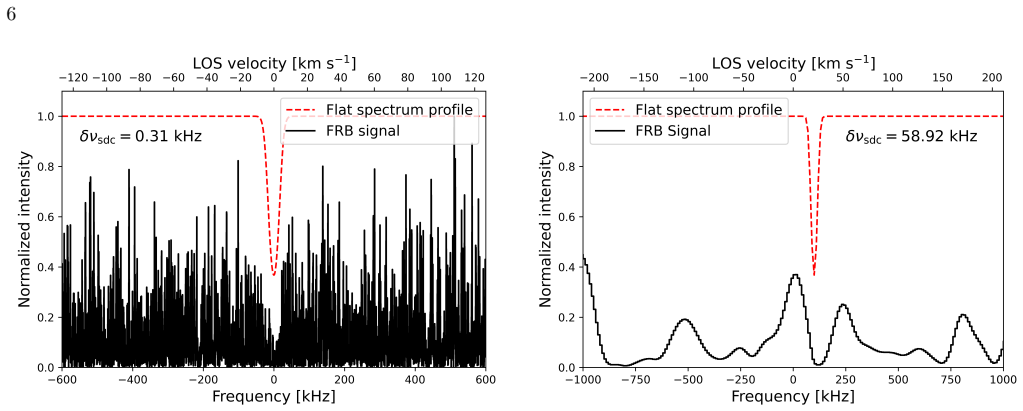
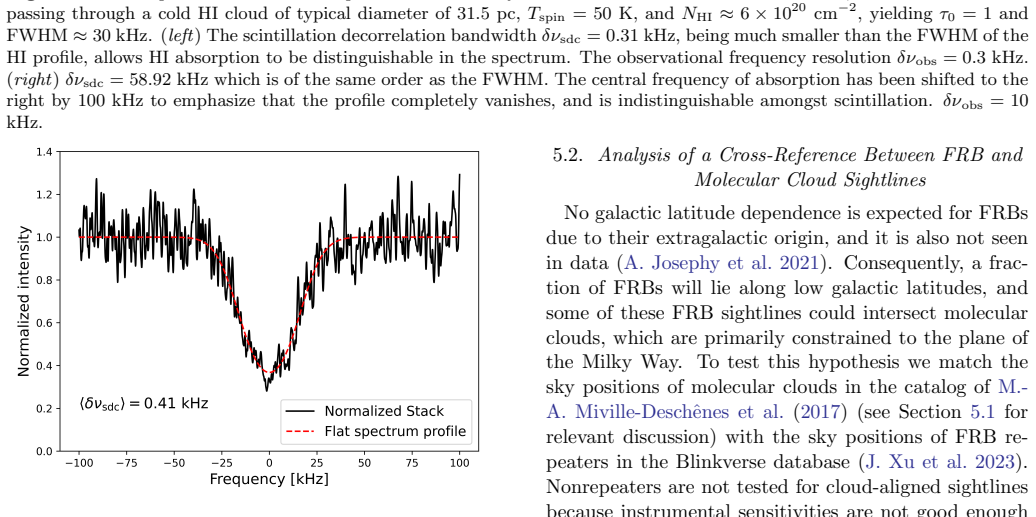
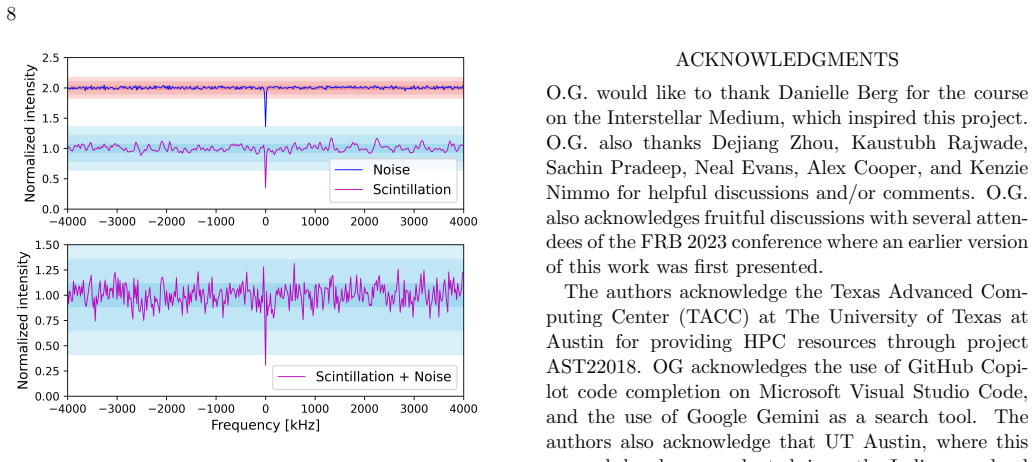
The absorption profile is detectable in a scintillation-dominated high signal-to-noise spectrum if the scintillation decorrelation bandwidth differs significantly in scale from the width of the absorption profile. Active repeaters also enable favorable conditions as the absorption signal improves when repeat bursts are stacked, provided they are separated in time by more than the diffractive scintillation timescale. For currently operating and planned sensitive telescopes, the presence of both scintillation and noise requires ≳1000 bursts to be stacked to detect the HI absorption line at a 5σ significance.
What carries the argument
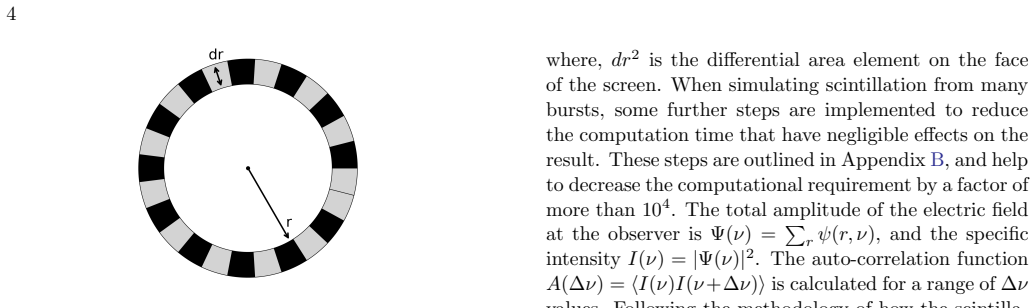
An efficient simulation of diffractive scintillation produced by an FRB passing through a thin scattering screen, which imposes frequency-dependent flux modulations that can mask or reveal the absorption feature depending on relative bandwidth scales.
If this is right
- Repeat bursts separated by more than the diffractive scintillation timescale allow the absorption signal to improve upon stacking because flux modulations remain uncorrelated.
- The sightline to FRB 20180916B may intersect a Galactic molecular cloud, providing a concrete target for HI absorption searches.
- Detector sensitivity improvements would extend the method to HI clouds in host galaxies, intervening systems, or high-redshift minihalos.
- When scintillation decorrelation bandwidth matches absorption width, the line remains undetectable even in high signal-to-noise single-burst spectra.
Where Pith is reading between the lines
- If real scattering involves multiple or thick screens rather than a single thin screen, the detectability conditions and required stacking numbers would shift.
- Cross-referencing more repeating FRB positions with molecular cloud catalogs could identify additional high-probability sightlines without new observations.
- The same relative-scale criterion might apply to other narrow spectral features in FRB data, such as molecular lines, if their widths also differ from scintillation scales.
Load-bearing premise
The model assumes diffractive scintillation arises from FRB passage through a thin scattering screen.
What would settle it
A detection of the 21-cm absorption line at 5 sigma significance after stacking substantially fewer than 1000 bursts from a repeating FRB whose scintillation decorrelation bandwidth is known to differ from the absorption width would falsify the derived stacking requirement.
Figures
read the original abstract
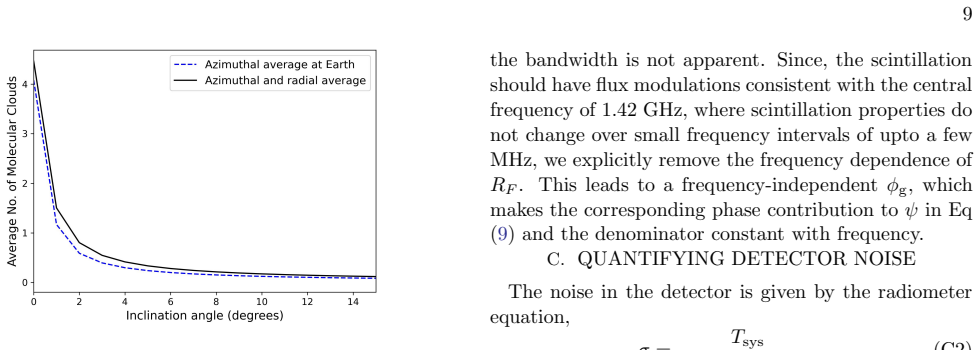
The 21-cm absorption line of neutral hydrogen has been a long hypothesized observational feature of the spectra of Fast Radio Bursts (FRBs). The difficulties associated with detector noise in extracting HI absorption have been previously studied. We test the role that scintillation plays in the HI absorption line's detectability, and characterize the regimes where a realistic FRB may yield the 21-cm line. We build an efficient model to simulate diffractive scintillation arising from FRB passage through a thin scattering screen. We find that the absorption profile is detectable in a scintillation-dominated high signal-to-noise spectrum if the scintillation decorrelation bandwidth differs significantly in scale from the width of the absorption profile. Active repeaters also enable favorable conditions as the absorption signal improves when repeat bursts are stacked. Repeat bursts must be separated in time by more than the diffractive scintillation timescale, otherwise flux modulations with frequency are correlated. By cross-referencing repeating FRB positions with an observational catalog of Milky Way molecular clouds detected in CO, we find that the sightline to FRB 20180916B may intersect a Galactic molecular cloud. For currently operating and planned sensitive telescopes, the presence of both scintillation and noise requires $\gtrsim 1000$ bursts to be stacked to detect the HI absorption line at a $5\sigma$ significance. Improvement in detector sensitivities will help probe HI clouds intersected by FRBs in the host or intervening galaxies, or in high-redshift minihalos.
Editorial analysis
A structured set of objections, weighed in public.
Referee Report
Summary. The manuscript develops an efficient simulation model of diffractive scintillation arising from FRB passage through a single thin scattering screen. It reports that the 21-cm HI absorption profile is detectable in high-S/N spectra when the scintillation decorrelation bandwidth differs significantly in scale from the absorption line width, that stacking of repeat bursts (separated by more than the diffractive timescale) improves the signal, and that ≳1000 bursts are required to reach 5σ significance in the presence of both scintillation and noise for current and planned telescopes. It also identifies a possible Galactic molecular cloud intersection for FRB 20180916B via CO catalog cross-reference.
Significance. If the thin-screen model is applicable, the work supplies a concrete, simulation-based estimate of the burst-stacking requirement and identifies scale-separation conditions that could guide future HI absorption searches. The efficient thin-screen implementation and the numerical threshold constitute useful quantitative outputs for observational planning.
major comments (2)
- [Abstract] Abstract and model description: the central claim that ≳1000 bursts must be stacked for 5σ detection is derived entirely from the single thin-screen diffractive scintillation simulation; the abstract and model section provide no validation against observed FRB scintillation parameters, no error analysis on the decorrelation bandwidth, and no data-exclusion criteria, so the robustness of the numerical threshold cannot be assessed.
- [Abstract] Abstract: the scale-separation detectability condition and the stacking requirement both rest on the assumption that diffractive scintillation arises from a single thin screen; if propagation occurs through multiple screens or a thick medium the frequency correlation function and the number of independent realizations change, rendering the reported conditions inapplicable, yet no verification of the thin-screen regime for the cited sightlines (including FRB 20180916B) is supplied.
minor comments (2)
- [Abstract] The abstract states that repeat bursts improve the absorption signal when separated by more than the diffractive timescale, but does not quantify the improvement factor or show the corresponding simulation output.
- [Abstract] Cross-reference with the CO molecular-cloud catalog is mentioned but no table, selection criteria, or uncertainty on the intersection probability for FRB 20180916B is provided.
Simulated Author's Rebuttal
We thank the referee for their constructive comments on our manuscript. We address each major comment point by point below, clarifying the scope of our simulation study while agreeing to revisions that improve transparency about model assumptions.
read point-by-point responses
-
Referee: [Abstract] Abstract and model description: the central claim that ≳1000 bursts must be stacked for 5σ detection is derived entirely from the single thin-screen diffractive scintillation simulation; the abstract and model section provide no validation against observed FRB scintillation parameters, no error analysis on the decorrelation bandwidth, and no data-exclusion criteria, so the robustness of the numerical threshold cannot be assessed.
Authors: Our work is a simulation study that derives the ≳1000-burst threshold under the assumptions of the single thin-screen diffractive scintillation model; it does not claim empirical robustness beyond those assumptions. The abstract and model section will be revised to state this explicitly and to reference typical observed decorrelation bandwidth values from the FRB literature for context. A quantitative error analysis on the decorrelation bandwidth or data-exclusion criteria would require fitting to specific observational datasets, which lies outside the scope of this theoretical simulation paper. revision: partial
-
Referee: [Abstract] Abstract: the scale-separation detectability condition and the stacking requirement both rest on the assumption that diffractive scintillation arises from a single thin screen; if propagation occurs through multiple screens or a thick medium the frequency correlation function and the number of independent realizations change, rendering the reported conditions inapplicable, yet no verification of the thin-screen regime for the cited sightlines (including FRB 20180916B) is supplied.
Authors: The reported scale-separation condition and stacking requirement are derived specifically within the single thin-screen model, which is a standard approximation but not universally applicable. We will revise the abstract and discussion to state this limitation clearly and to note the conditions under which the thin-screen regime is expected to hold. The CO catalog cross-match for FRB 20180916B is presented only as identifying a possible target; we supply no verification of the thin-screen regime for any sightline, as that would require dedicated multi-frequency observations not performed here. revision: yes
Circularity Check
No circularity: simulation outputs under explicit thin-screen model
full rationale
The paper constructs an efficient simulation of diffractive scintillation through a thin scattering screen and derives detectability conditions (scale separation between decorrelation bandwidth and absorption width) plus stacking requirements (≳1000 bursts) as direct outputs of that model. No steps reduce by construction to fitted inputs, self-definitions, or load-bearing self-citations; the thin-screen assumption is stated explicitly rather than smuggled via citation. Results are simulation-driven and falsifiable against external scintillation data, yielding a self-contained analysis.
Axiom & Free-Parameter Ledger
axioms (1)
- domain assumption Diffractive scintillation arises from FRB passage through a thin scattering screen
Reference graph
Works this paper leans on
-
[1]
G., & Manchester, R
Ables, J. G., & Manchester, R. N. 1976, A&A, 50, 177
1976
-
[2]
Balzan, J. C. F., Bera, A., James, C. W., & Meyers, B. 2026, arXiv e-prints, arXiv:2601.19254, doi: 10.48550/arXiv.2601.19254
work page internal anchor Pith review Pith/arXiv arXiv doi:10.48550/arxiv.2601.19254 2026
-
[3]
2020, MNRAS, 498, 651, doi: 10.1093/mnras/staa2489
Beniamini, P., & Kumar, P. 2020, MNRAS, 498, 651, doi: 10.1093/mnras/staa2489
-
[4]
Wharton, R. S. 2023, MNRAS, 524, 3303, doi: 10.1093/mnras/stad2009
-
[5]
1959, Principles of Optics Electromagnetic Theory of Propagation, Interference and Diffraction of Light
Born, M., & Wolf, E. 1959, Principles of Optics Electromagnetic Theory of Propagation, Interference and Diffraction of Light
1959
-
[6]
Braun, R., Bonaldi, A., Bourke, T., Keane, E., & Wagg, J. 2019, arXiv e-prints, arXiv:1912.12699, doi: 10.48550/arXiv.1912.12699
-
[7]
S., Stolle-McAllister, G., Jorgenson, R
Chittidi, J. S., Stolle-McAllister, G., Jorgenson, R. A., et al. 2023, arXiv e-prints, arXiv:2304.10377, doi: 10.48550/arXiv.2304.10377 10 T able 1.Number of stacked bursts required for 5σHI absorption detection withτ 0 = 1 through different telescopes. TelescopeT sys (K)G(K/Jy) SEFD (Jy) # Bursts FAST 22 16.1 1.36∼1000 SKA1-MID - - 3∼3000 GBT 16.5 2 8.25...
-
[8]
Cordes, J. M., & Chatterjee, S. 2019, ARA&A, 57, 417, doi: 10.1146/annurev-astro-091918-104501
-
[9]
NE2001.I. A New Model for the Galactic Distribution of Free Electrons and its Fluctuations
Cordes, J. M., & Lazio, T. J. W. 2002, arXiv e-prints, astro, doi: 10.48550/arXiv.astro-ph/0207156
work page internal anchor Pith review Pith/arXiv arXiv doi:10.48550/arxiv.astro-ph/0207156 2002
-
[10]
The Milky Way in Molecular Clouds: A New Complete CO Survey
Dame, T. M., Hartmann, D., & Thaddeus, P. 2001, ApJ, 547, 792, doi: 10.1086/318388
work page internal anchor Pith review doi:10.1086/318388 2001
-
[11]
2015, MNRAS, 451, L75, doi: 10.1093/mnrasl/slv065
Fender, R., & Oosterloo, T. 2015, MNRAS, 451, L75, doi: 10.1093/mnrasl/slv065
-
[12]
Furlanetto, S. R., & Loeb, A. 2002, ApJ, 579, 1, doi: 10.1086/342757
-
[13]
Glowacki, M., Lee-Waddell, K., Deller, A. T., et al. 2023, ApJ, 949, 25, doi: 10.3847/1538-4357/acc1e3
-
[14]
Gupta, O., Beniamini, P., Kumar, P., & Finkelstein, S. L. 2025, ApJ, 986, 100, doi: 10.3847/1538-4357/add14c
-
[15]
Hamidouche, M., & Lestrade, J. F. 2007, A&A, 468, 193, doi: 10.1051/0004-6361:20041285
-
[16]
2022, ApJL, 940, L34, doi: 10.3847/2041-8213/ac9f39
Hatsukade, B., Hashimoto, T., Niino, Y., & Hsu, T.-Y. 2022, ApJL, 940, L34, doi: 10.3847/2041-8213/ac9f39
-
[17]
Heyer, M. H., & Brunt, C. M. 2004, ApJL, 615, L45, doi: 10.1086/425978
-
[18]
2023, MNRAS, 519, 2030, doi: 10.1093/mnras/stac3655
Hsu, T.-Y., Hashimoto, T., Hatsukade, B., et al. 2023, MNRAS, 519, 2030, doi: 10.1093/mnras/stac3655
-
[19]
Jeffreson, S. M. R., Sun, J., & Wilson, C. D. 2022, MNRAS, 515, 1663, doi: 10.1093/mnras/stac1874
-
[20]
2020, Research in Astronomy and Astrophysics, 20, 064, doi: 10.1088/1674-4527/20/5/64
Jiang, P., Tang, N.-Y., Hou, L.-G., et al. 2020, Research in Astronomy and Astrophysics, 20, 064, doi: 10.1088/1674-4527/20/5/64
-
[21]
Jing, W. C., Han, J. L., Hong, T., et al. 2023, MNRAS, 523, 4949, doi: 10.1093/mnras/stad1782
-
[22]
Josephy, A., Chawla, P., Curtin, A. P., et al. 2021, ApJ, 923, 2, doi: 10.3847/1538-4357/ac33ad
-
[23]
Konijn, D. C., Hewitt, D. M., Hessels, J. W. T., et al. 2024, MNRAS, 534, 3331, doi: 10.1093/mnras/stae2296
-
[24]
Kumar, P., Beniamini, P., Gupta, O., & Cordes, J. M. 2024, MNRAS, 527, 457, doi: 10.1093/mnras/stad3010
-
[25]
Liszt, H. S., & Gerin, M. 2016, A&A, 585, A80, doi: 10.1051/0004-6361/201527273
-
[26]
Main, R. A., Hilmarsson, G. H., Marthi, V. R., et al. 2022, MNRAS, 509, 3172, doi: 10.1093/mnras/stab3218
-
[27]
Marcote, B., Nimmo, K., Hessels, J. W. T., et al. 2020, Nature, 577, 190, doi: 10.1038/s41586-019-1866-z
-
[28]
2016, MNRAS, 460, L25, doi: 10.1093/mnrasl/slw068 Miville-Deschˆ enes, M.-A., Murray, N., & Lee, E
Margalit, B., & Loeb, A. 2016, MNRAS, 460, L25, doi: 10.1093/mnrasl/slw068 Miville-Deschˆ enes, M.-A., Murray, N., & Lee, E. J. 2017, ApJ, 834, 57, doi: 10.3847/1538-4357/834/1/57
-
[29]
Narayan, R. 1992, Philosophical Transactions of the Royal Society of London Series A, 341, 151, doi: 10.1098/rsta.1992.0090
-
[30]
Nimmo, K., Hessels, J. W. T., Kirsten, F., et al. 2022, Nature Astronomy, 6, 393, doi: 10.1038/s41550-021-01569-9
-
[31]
2025, Nature, 637, 48, doi: 10.1038/s41586-024-08297-w
Nimmo, K., Pleunis, Z., Beniamini, P., et al. 2025, Nature, 637, 48, doi: 10.1038/s41586-024-08297-w
-
[32]
NE2025: An Updated Electron Density Model for the Galactic Interstellar Medium
Ocker, S. K., & Cordes, J. M. 2026, arXiv e-prints, arXiv:2602.11838, doi: 10.48550/arXiv.2602.11838 Os lowski, S., Shannon, R. M., Ravi, V., et al. 2019, MNRAS, 488, 868, doi: 10.1093/mnras/stz1751
work page internal anchor Pith review Pith/arXiv arXiv doi:10.48550/arxiv.2602.11838 2026
-
[33]
Ould-Boukattine, O. S., Chawla, P., Hessels, J. W. T., et al. 2026, MNRAS, 545, staf1937, doi: 10.1093/mnras/staf1937
-
[34]
2021, Nature, 596, 505, doi: 10.1038/s41586-021-03724-8 Pradeep E
Pastor-Marazuela, I., Connor, L., van Leeuwen, J., et al. 2021, Nature, 596, 505, doi: 10.1038/s41586-021-03724-8 Pradeep E. T., S., Sprenger, T., Wucknitz, O., Main, R. A., & Spitler, L. G. 2025, arXiv e-prints, arXiv:2505.04576, doi: 10.48550/arXiv.2505.04576
-
[35]
2026, arXiv e-prints, arXiv:2602.10328
Roxburgh, H., Glowacki, M., Bera, A., & James, C. 2026, arXiv e-prints, arXiv:2602.10328. https://arxiv.org/abs/2602.10328
Pith/arXiv arXiv 2026
-
[36]
R., Beuther, H., Bihr, S., et al
Rugel, M. R., Beuther, H., Bihr, S., et al. 2018, A&A, 618, A159, doi: 10.1051/0004-6361/201731872 11
-
[37]
Ryden, B. S., & Pogge, R. W. 2021, Interstellar and intergalactic medium, doi: 10.1017/9781108781596
-
[38]
Sammons, M. W., Deller, A. T., Glowacki, M., et al. 2023, MNRAS, 525, 5653, doi: 10.1093/mnras/stad2631
-
[39]
Scott, D. R., Dial, T., Bera, A., et al. 2025, arXiv e-prints, arXiv:2505.17497, doi: 10.48550/arXiv.2505.17497
-
[40]
M., Rankin, J., & Boriakoff, V
Weisberg, J. M., Rankin, J., & Boriakoff, V. 1980, A&A, 88, 84
1980
-
[41]
M., Stanimirovi´ c, S., Xilouris, K., et al
Weisberg, J. M., Stanimirovi´ c, S., Xilouris, K., et al. 2008, ApJ, 674, 286, doi: 10.1086/523345
-
[42]
Xu, H., Niu, J. R., Chen, P., et al. 2022, Nature, 609, 685, doi: 10.1038/s41586-022-05071-8
-
[43]
2023, Universe, 9, 330, doi: 10.3390/universe9070330
Xu, J., Feng, Y., Li, D., et al. 2023, Universe, 9, 330, doi: 10.3390/universe9070330
-
[44]
2025, arXiv e-prints, arXiv:2507.14707, doi: 10.48550/arXiv.2507.14707
Zhang, J.-S., Wang, T.-C., Wang, P., et al. 2025, arXiv e-prints, arXiv:2507.14707, doi: 10.48550/arXiv.2507.14707
-
[45]
2022, Research in Astronomy and Astrophysics, 22, 124002, doi: 10.1088/1674-4527/ac98f7
Zhang, Y.-K., Wang, P., Feng, Y., et al. 2022, Research in Astronomy and Astrophysics, 22, 124002, doi: 10.1088/1674-4527/ac98f7
-
[46]
2023, ApJ, 955, 142, doi: 10.3847/1538-4357/aced0b
Zhang, Y.-K., Li, D., Zhang, B., et al. 2023, ApJ, 955, 142, doi: 10.3847/1538-4357/aced0b
-
[47]
Zhou, D. J., Han, J. L., Jing, W. C., et al. 2023, MNRAS, 526, 2657, doi: 10.1093/mnras/stad2769
discussion (0)
Sign in with ORCID, Apple, or X to comment. Anyone can read and Pith papers without signing in.