Stochastic Variability of Binary Accretion
Pith reviewed 2026-06-30 01:24 UTC · model grok-4.3
The pith
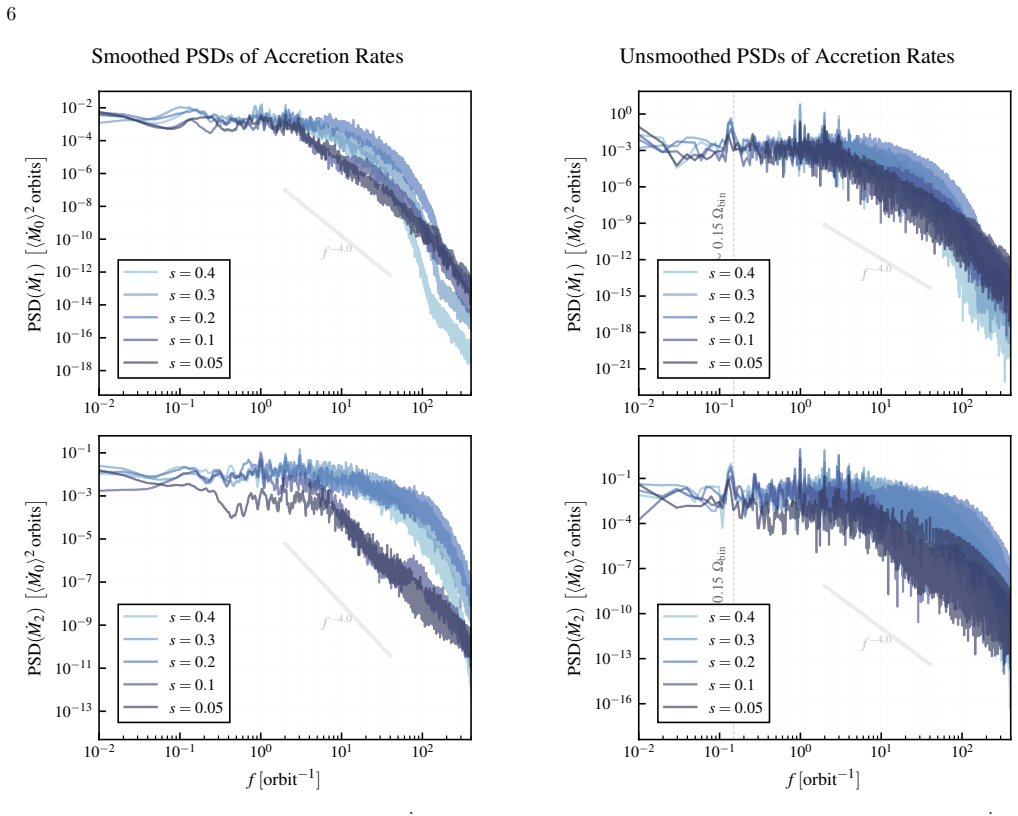
Unequal-mass binary black hole accretion produces a broken power-law accretion rate PSD breaking near five times the orbital frequency.
A machine-rendered reading of the paper's core claim, the machinery that carries it, and where it could break.
Core claim
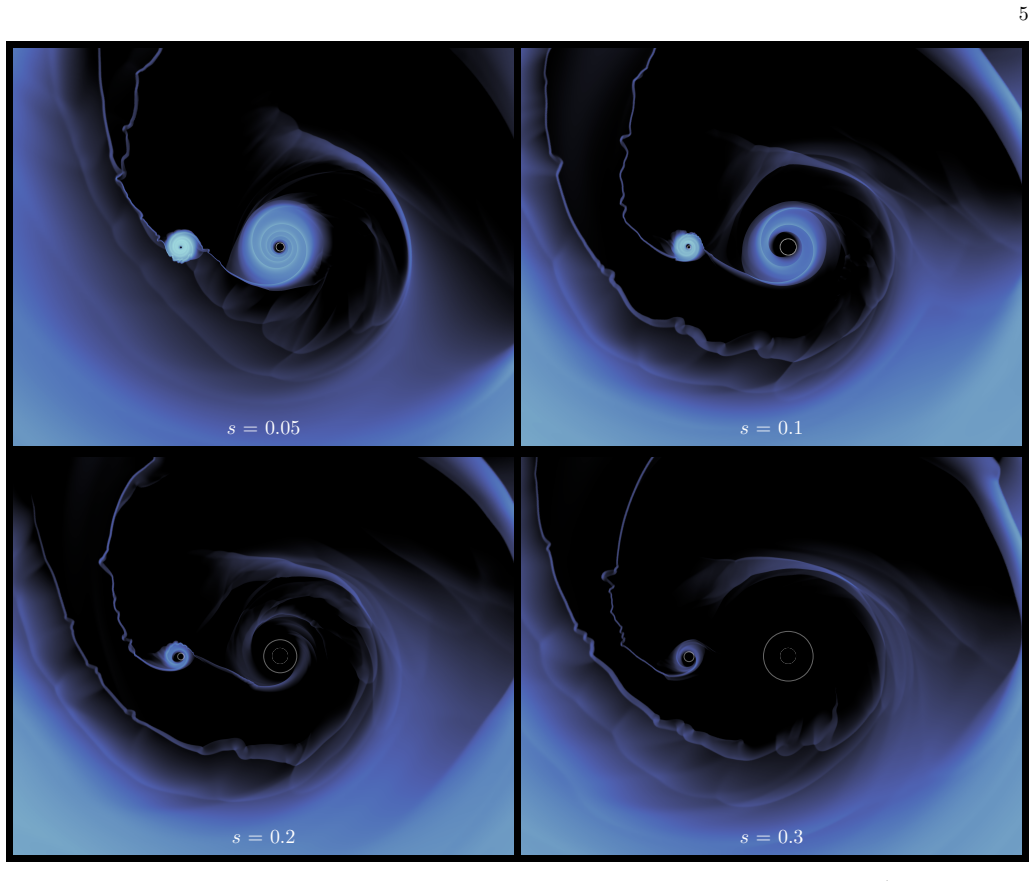
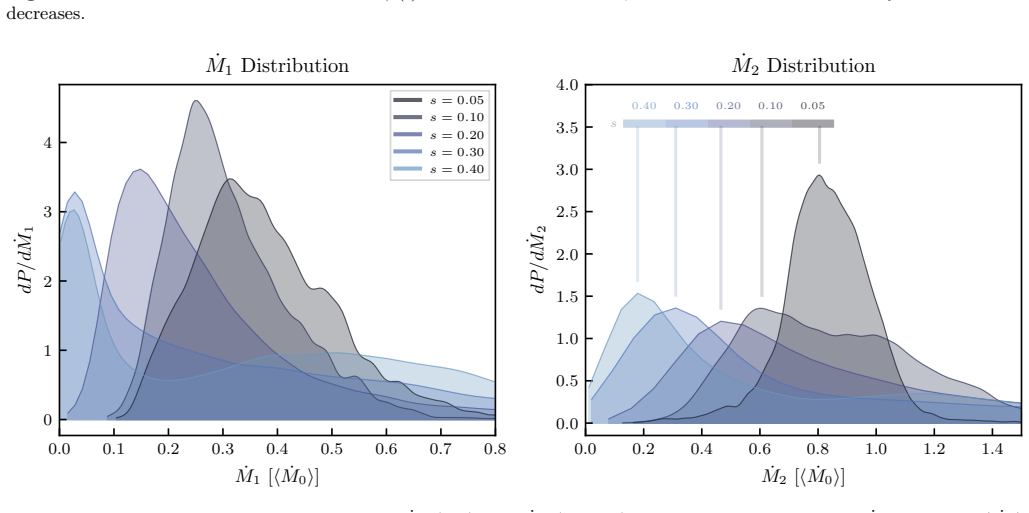
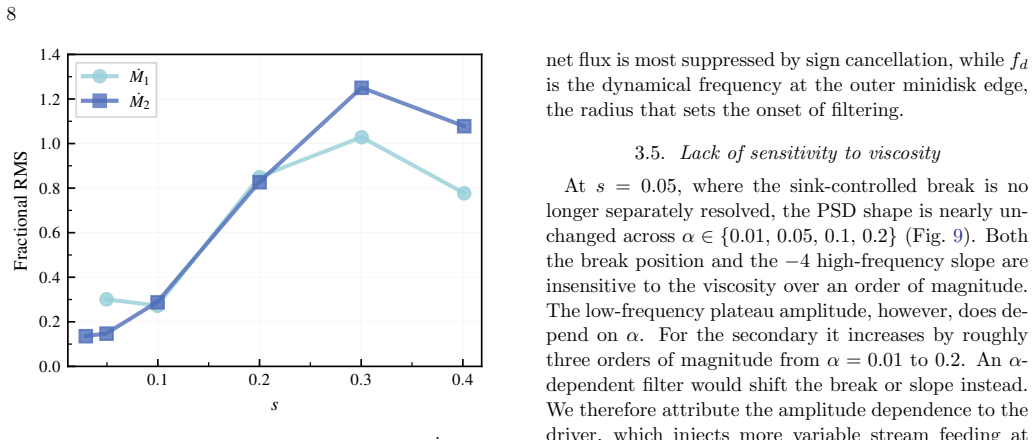
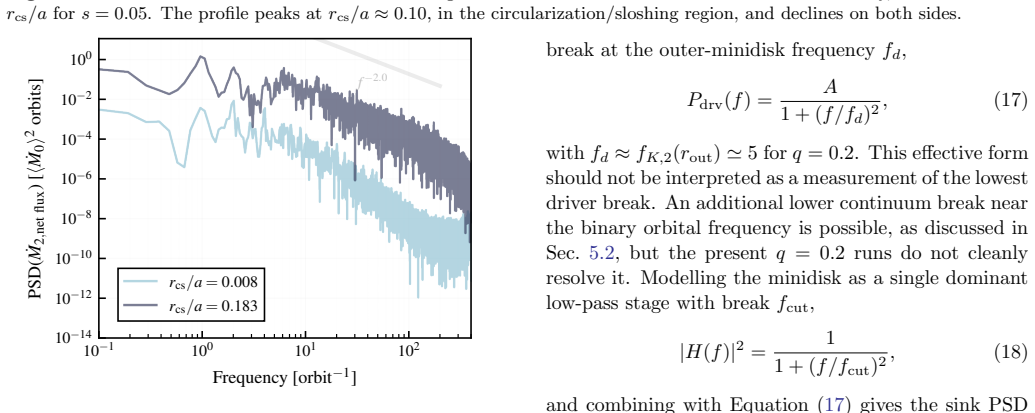
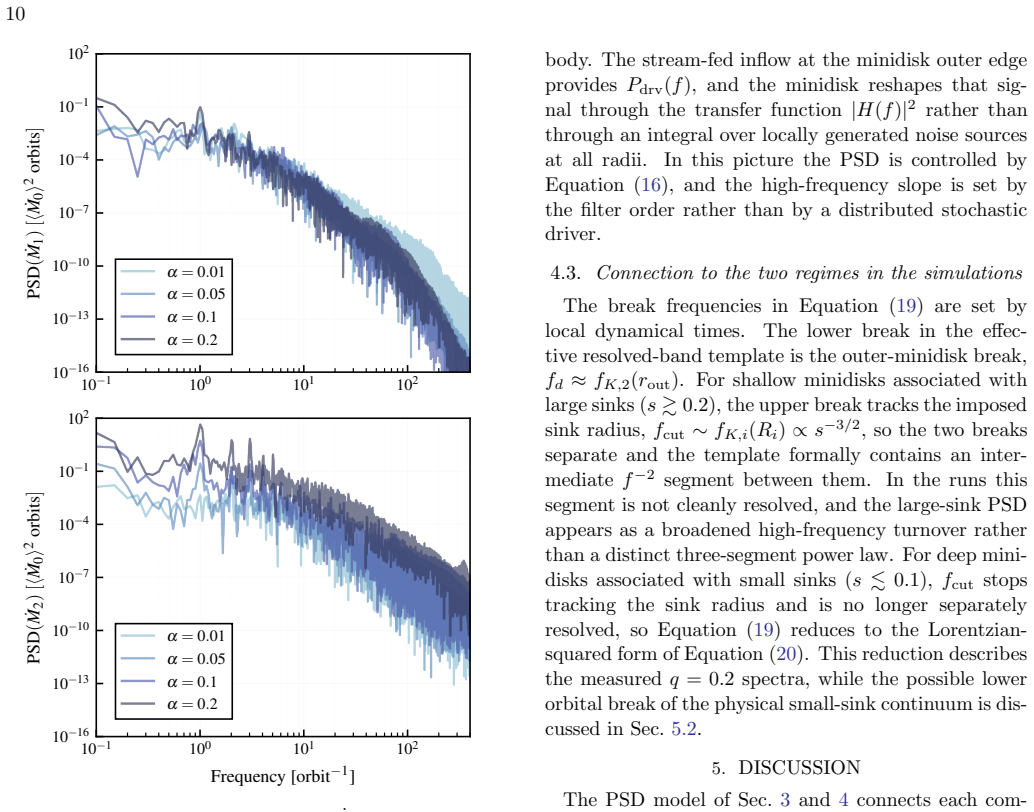
The continuum PSD is a broken power-law, transitioning from flat (white noise) to a slope of -4 at a break frequency generically ~5 times the binary orbital frequency. This form is expected when delivery of gas from the circumbinary disk to the individual minidisks is a damped random walk with correlation time equal to binary orbital period and the minidisks function as low-pass filters acting at the Kepler frequency of the outer edge of the smaller black hole's minidisk; numerical evidence supports both. The broken power-law PSD is attained in the limit where the secondary black hole is much smaller than its minidisk, realized numerically by a sufficiently small sink region.
What carries the argument
Damped random walk gas delivery from the circumbinary disk combined with minidisk low-pass filtering at the Kepler frequency of the smaller black hole's minidisk outer edge.
If this is right
- The broken power-law PSD offers a new observational signpost for supermassive black hole binaries in AGN that complements periodic signals.
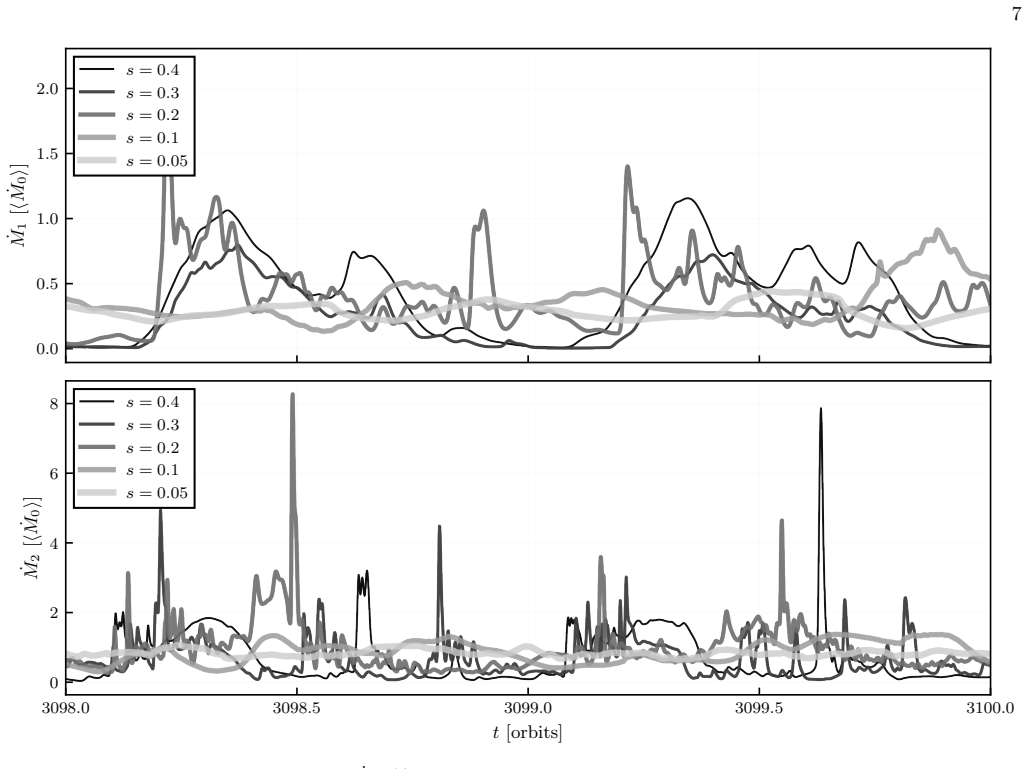
- Larger sink regions produce excess high-frequency noise and accretion spikes that should be regarded as artificial.
- The PSD shape resembles stochastic variability in ordinary AGN, inviting the conjecture that binarity could explain canonical AGN variability.
- Pulsar timing array experiments may exclude the possibility that widespread binarity produces the observed AGN variability.
Where Pith is reading between the lines
- If the mechanism holds generally, measured break frequencies in AGN PSDs could be inverted to estimate binary orbital periods.
- The result could be tested by comparing simulated PSDs against multi-band AGN light curves to search for the predicted high-frequency steepening.
- Running the same analysis on equal-mass binaries or in 3D would show whether the break location and slope -4 are robust across parameter space.
Load-bearing premise
The secondary black hole must be much smaller than its minidisk so that numerical sink regions do not introduce artificial high-frequency accretion spikes.
What would settle it
A high-resolution simulation with vanishingly small sink radius that produces accretion rate PSD lacking the transition to slope -4 at high frequencies would falsify the claim.
Figures
read the original abstract
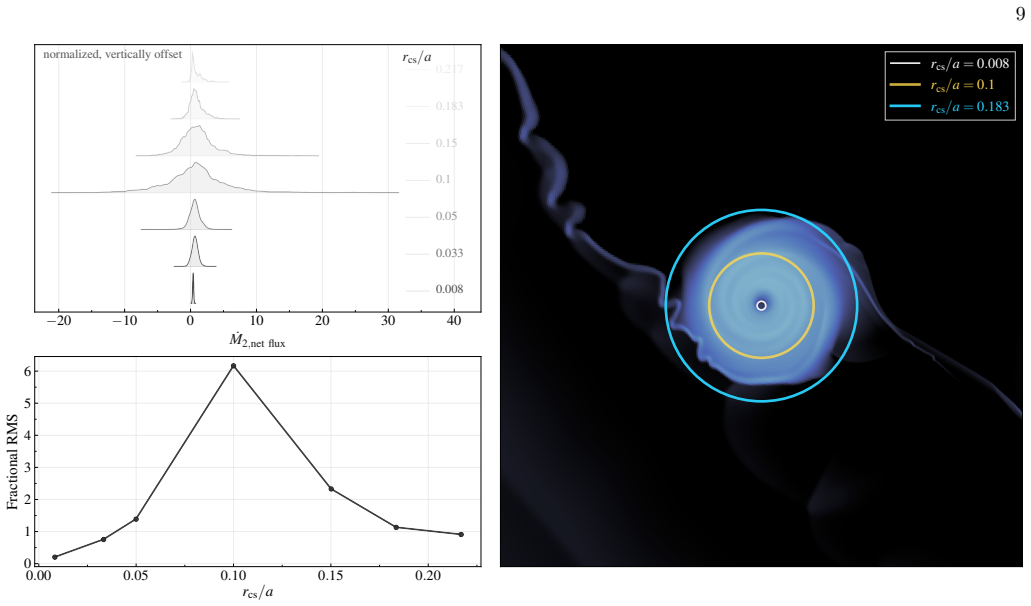
We measure the power spectral density (PSD) of the accretion rate time series in an unequal mass (q = 0.2) binary surrounded by a circumbinary gas disk, using very high-resolution 2D hydrodynamics simulations. Our aim is to identify new signposts of supermassive black hole (SMBH) binaries in active galactic nuclei (AGN), based on the shape of the continuum PSD, to complement well-studied line features in the PSD (periodicities). We find that the continuum PSD is a broken power-law, transitioning from flat (white noise) to a slope of -4 at a break frequency generically ~5 times the binary orbital frequency. This form is expected when (a) delivery of gas from the circumbinary disk to the individual "minidisks" is a damped random walk with correlation time equal to binary orbital period and (b) the minidisks function as low-pass filters acting at the Kepler frequency of the outer edge of the smaller black hole's minidisk; we show numerical evidence for both. The broken power-law PSD is attained in a limit where the secondary black hole is much smaller than its minidisk, realized numerically by a sufficiently small "sink" region; larger sinks lead to excess high-frequency noise seen as accretion rate spikes, and we argue these should be regarded as artificial when the black holes themselves are smaller than the sink regions. The broken power-law PSD is reminiscent of stochastic variability in ordinary AGN, inviting the conjecture that canonical AGN variability could result from widespread binarity, however pulsar timing experiments may exclude this possibility.
Editorial analysis
A structured set of objections, weighed in public.
Referee Report
Summary. The manuscript presents results from very high-resolution 2D hydrodynamical simulations of an unequal-mass (q=0.2) supermassive black hole binary accreting from a circumbinary disk. The central claim is that the power spectral density (PSD) of the accretion-rate time series is a broken power law that is flat at low frequencies and steepens to a slope of -4 above a break frequency generically ~5 times the binary orbital frequency. This shape is interpreted as the product of (a) damped-random-walk gas delivery from the circumbinary disk with correlation time equal to the orbital period and (b) low-pass filtering by the minidisks at the Kepler frequency of the outer edge of the secondary's minidisk; numerical evidence is provided for both mechanisms. The result holds only in the limit where the secondary black hole is much smaller than its minidisk, which is realized by using a sufficiently small sink region; larger sinks produce artificial high-frequency spikes.
Significance. If robust, the reported PSD shape supplies a new, continuum-based observational signature for SMBH binaries that complements periodic line features. The direct numerical demonstration of the damped-random-walk delivery and minidisk filtering mechanisms, obtained without fitted parameters, strengthens the physical interpretation. The resemblance to canonical AGN variability is noted, although the authors correctly flag possible tension with pulsar-timing constraints.
major comments (2)
- [discussion of sink regions] The central claim that the broken power-law PSD is attained only when the secondary is much smaller than its minidisk (and that larger sinks produce artificial spikes) is load-bearing for the result. The manuscript should therefore report the numerical ratio of sink radius to the outer radius of the secondary minidisk in the production runs and demonstrate convergence of the PSD shape with decreasing sink size.
- [results on PSD shape] The break frequency is stated to be generically ~5 times the binary orbital frequency. The manuscript should clarify whether this factor is measured directly from the simulated PSDs or derived from the combination of orbital period and outer-edge Kepler frequency, and whether it remains stable across the range of resolutions and sink sizes explored.
minor comments (2)
- [methods] The abstract refers to 'very high-resolution' simulations without quoting the grid resolution, cell size relative to the binary separation, or number of orbits evolved; these details belong in the methods section for reproducibility.
- [discussion] The statement that the result 'invites the conjecture that canonical AGN variability could result from widespread binarity' should be accompanied by a brief quantitative estimate of the implied binary fraction or a reference to existing limits.
Simulated Author's Rebuttal
We thank the referee for their thoughtful review and for recommending minor revision. We address the major comments point by point below.
read point-by-point responses
-
Referee: [discussion of sink regions] The central claim that the broken power-law PSD is attained only when the secondary is much smaller than its minidisk (and that larger sinks produce artificial spikes) is load-bearing for the result. The manuscript should therefore report the numerical ratio of sink radius to the outer radius of the secondary minidisk in the production runs and demonstrate convergence of the PSD shape with decreasing sink size.
Authors: We agree that explicitly reporting the sink-to-minidisk radius ratio will strengthen the manuscript. Our production runs use a sink radius that is a small fraction of the secondary minidisk's outer radius, consistent with the limit discussed. We will add the specific numerical ratio to the methods section. For convergence, the manuscript already contrasts results with larger sinks showing artificial spikes, but to fully address this, we will include a statement on the stability of the PSD shape for the smallest sinks used, based on our existing simulation suite. revision: yes
-
Referee: [results on PSD shape] The break frequency is stated to be generically ~5 times the binary orbital frequency. The manuscript should clarify whether this factor is measured directly from the simulated PSDs or derived from the combination of orbital period and outer-edge Kepler frequency, and whether it remains stable across the range of resolutions and sink sizes explored.
Authors: The factor of approximately 5 is measured directly from the PSDs in our simulations. It arises from the combination of the damped random walk correlation time (equal to the orbital period) and the filtering at the Kepler frequency of the minidisk outer edge, but the specific numerical value is obtained from fitting the simulated PSDs. We will clarify this distinction in the revised text. The break frequency remains stable across the resolutions and sink sizes where the broken power-law form is attained (i.e., sufficiently small sinks), as shown in our figures; we will add an explicit statement to this effect. revision: yes
Circularity Check
No significant circularity
full rationale
The paper's central result is obtained by direct measurement of the PSD from time series produced by high-resolution 2D hydrodynamics simulations of an unequal-mass binary. The broken power-law form, break frequency, and supporting behaviors (damped random walk delivery with orbital-period correlation time; minidisk low-pass filtering at outer-edge Kepler frequency) are all extracted from the same simulation data rather than fitted to a subset and then re-predicted, or derived from self-referential equations. No load-bearing self-citations, uniqueness theorems, or ansatzes imported from prior author work appear in the provided text. The derivation chain is therefore self-contained and independent of its own inputs.
Axiom & Free-Parameter Ledger
axioms (2)
- domain assumption The hydrodynamics equations govern the gas flow in the circumbinary disk and minidisks.
- domain assumption The sink regions approximate the black holes' accretion.
Reference graph
Works this paper leans on
-
[1]
Agazie, G., Anumarlapudi, A., Archibald, A. M., et al. 2023, ApJL, 951, L8, doi: 10.3847/2041-8213/acdac6
-
[2]
2018, MNRAS, 476, 2501, doi: 10.1093/mnras/sty413 Ar´ evalo, P., Churazov, E., Lira, P., et al
Bloemen, S. 2018, MNRAS, 476, 2501, doi: 10.1093/mnras/sty413 Ar´ evalo, P., Churazov, E., Lira, P., et al. 2024, A&A, 684, A133, doi: 10.1051/0004-6361/202347080
-
[3]
Avara, M. J., Krolik, J. H., Campanelli, M., et al. 2024, ApJ, 974, 242, doi: 10.3847/1538-4357/ad5bda
-
[4]
Begelman, M. C., Blandford, R. D., & Rees, M. J. 1980, Nature, 287, 307, doi: 10.1038/287307a0
-
[5]
J., Shen, Y., Blaes, O., et al
Burke, C. J., Shen, Y., Blaes, O., et al. 2021, Science, 373, 789, doi: 10.1126/science.abg9933
-
[6]
2023, Nature Astronomy, 7, 1506, doi: 10.1038/s41550-023-02088-5
Cai, Z.-Y., & Wang, J.-X. 2023, Nature Astronomy, 7, 1506, doi: 10.1038/s41550-023-02088-5
-
[7]
Casey-Clyde, J. A., Mingarelli, C. M. F., Greene, J. E., et al. 2022, ApJ, 924, 93, doi: 10.3847/1538-4357/ac32de
-
[8]
Davis, S. W. 2025, ApJ, 991, 71, doi: 10.3847/1538-4357/adf4c9
-
[9]
2016, MNRAS, 463, 2145, doi: 10.1093/mnras/stw1838
Charisi, M., Bartos, I., Haiman, Z., et al. 2016, MNRAS, 463, 2145, doi: 10.1093/mnras/stw1838
-
[10]
Trump, J. R. 2022, MNRAS, 510, 5929, doi: 10.1093/mnras/stab3713
-
[11]
Chen, Y.-J., Zhai, S., Liu, J.-R., et al. 2024, MNRAS, 527, 12154, doi: 10.1093/mnras/stad3981
-
[12]
2025, MNRAS, 539, 1430, doi: 10.1093/mnras/staf585
Clyburn, M., & Zrake, J. 2025, MNRAS, 539, 1430, doi: 10.1093/mnras/staf585
-
[13]
Dittmann, A. J., & Ryan, G. 2022, MNRAS, 513, 6158, doi: 10.1093/mnras/stac935
-
[14]
Monthly Notices of the Royal Astronomical Society , archivePrefix = "arXiv", eprint =
Done, C., Davis, S. W., Jin, C., Blaes, O., & Ward, M. 2012, MNRAS, 420, 1848, doi: 10.1111/j.1365-2966.2011.19779.x D’Orazio, D. J., & Duffell, P. C. 2021, ApJL, 914, L21, doi: 10.3847/2041-8213/ac0621 D’Orazio, D. J., Duffell, P. C., & Tiede, C. 2024, ApJ, 977, 244, doi: 10.3847/1538-4357/ad938b D’Orazio, D. J., Haiman, Z., Duffell, P., MacFadyen, A., &
-
[15]
2016, MNRAS, 459, 2379, doi: 10.1093/mnras/stw792
Farris, B. 2016, MNRAS, 459, 2379, doi: 10.1093/mnras/stw792
-
[16]
C., D’Orazio, D., Derdzinski, A., et al
Duffell, P. C., D’Orazio, D., Derdzinski, A., et al. 2020, The Astrophysical Journal, 901, 25, doi: 10.3847/1538-4357/abab95 15
-
[17]
Eggleton, P. P. 1983, ApJ, 268, 368, doi: 10.1086/160960
-
[18]
Farris, B. D., Duffell, P., MacFadyen, A. I., & Haiman, Z. 2014, The Astrophysical Journal, 783, 134, doi: 10.1088/0004-637X/783/2/134
-
[19]
2025, MNRAS, 543, 2093, doi: 10.1093/mnras/staf1473
Fu, Y.-X., Li, Y.-R., Wang, J.-M., et al. 2025, MNRAS, 543, 2093, doi: 10.1093/mnras/staf1473
-
[20]
Candidates from continued radial velocity tests
Guo, H., Liu, X., Shen, Y., et al. 2019, MNRAS, 482, 3288, doi: 10.1093/mnras/sty2920
-
[21]
2009, ApJ, 700, 1952, doi: 10.1088/0004-637X/700/2/1952 Ivezi´ c,ˇZ., Kahn, S
Haiman, Z., Kocsis, B., & Menou, K. 2009, ApJ, 700, 1952, doi: 10.1088/0004-637X/700/2/1952 Ivezi´ c,ˇZ., Kahn, S. M., Tyson, J. A., et al. 2019, ApJ, 873, 111, doi: 10.3847/1538-4357/ab042c
-
[22]
C., Bechtold, J., & Siemiginowska, A
Kelly, B. C., Bechtold, J., & Siemiginowska, A. 2009, ApJ, 698, 895, doi: 10.1088/0004-637X/698/1/895 Koz lowski, S. 2017, A&A, 597, A128, doi: 10.1051/0004-6361/201629890
work page internal anchor Pith review doi:10.1088/0004-637x/698/1/895 2009
-
[23]
Lai, D., & Mu˜ noz, D. J. 2023, ARA&A, 61, 517, doi: 10.1146/annurev-astro-052622-022933
-
[24]
2021, MNRAS, 500, 4025, doi: 10.1093/mnras/staa3055
Liao, W.-T., Chen, Y.-C., Liu, X., et al. 2021, MNRAS, 500, 4025, doi: 10.1093/mnras/staa3055
-
[25]
2026, ApJ, 997, 316, doi: 10.3847/1538-4357/ae29a7
Lin, A., Charisi, M., & Haiman, Z. 2026, ApJ, 997, 316, doi: 10.3847/1538-4357/ae29a7
-
[26]
Lyubarskii, Y. E. 1997, MNRAS, 292, 679, doi: 10.1093/mnras/292.3.679
-
[27]
MacFadyen, A. I., & Milosavljevi´ c, M. 2008, ApJ, 672, 83, doi: 10.1086/523869
-
[28]
MacLeod, C. L., Ivezi´ c,ˇZ., Kochanek, C. S., et al. 2010, ApJ, 721, 1014, doi: 10.1088/0004-637X/721/2/1014
-
[29]
Matthews, T. A., & Sandage, A. R. 1963, ApJ, 138, 30, doi: 10.1086/147615
-
[30]
Fender, R. P. 2006, Nature, 444, 730, doi: 10.1038/nature05389
-
[31]
Mihos, J. C., & Hernquist, L. 1996, ApJ, 464, 641, doi: 10.1086/177353 Milosavljevi´ c, M., & Merritt, D. 2001, ApJ, 563, 34, doi: 10.1086/323830 Mu˜ noz, D. J., Miranda, R., & Lai, D. 2019, ApJ, 871, 84, doi: 10.3847/1538-4357/aaf867
work page internal anchor Pith review doi:10.1086/177353 1996
-
[32]
2011, ApJL, 743, L12, doi: 10.1088/2041-8205/743/1/L12
Gandhi, P. 2011, ApJL, 743, L12, doi: 10.1088/2041-8205/743/1/L12
-
[33]
Padovani, P., Alexander, D. M., Assef, R. J., et al. 2017, A&A Rv, 25, 2, doi: 10.1007/s00159-017-0102-9
-
[34]
Peters, P. C. 1964, Physical Review, 136, 1224, doi: 10.1103/PhysRev.136.B1224
-
[35]
Pringle, J. E. 1981, ARA&A, 19, 137, doi: 10.1146/annurev.aa.19.090181.001033
-
[36]
Salpeter, E. E. 1964, ApJ, 140, 796, doi: 10.1086/147973
-
[37]
Savitzky, A., & Golay, M. J. E. 1964, Analytical Chemistry, 36, 1627, doi: 10.1021/ac60214a047
-
[38]
I., & Sunyaev, R
Shakura, N. I., & Sunyaev, R. A. 1973, A&A, 24, 337
1973
-
[39]
2010, ApJ, 725, 249, doi: 10.1088/0004-637X/725/1/249
Shen, Y., & Loeb, A. 2010, ApJ, 725, 249, doi: 10.1088/0004-637X/725/1/249
-
[40]
Shi, J.-M., Krolik, J. H., Lubow, S. H., & Hawley, J. F. 2012, ApJ, 749, 118, doi: 10.1088/0004-637X/749/2/118
-
[41]
Shlosman, I., Begelman, M. C., & Frank, J. 1990, Nature, 345, 679, doi: 10.1038/345679a0
-
[42]
Siwek, M., Weinberger, R., Mu˜ noz, D. J., & Hernquist, L. 2023, MNRAS, 518, 5059, doi: 10.1093/mnras/stac3263
-
[43]
Smith, K. L., Mushotzky, R. F., Boyd, P. T., et al. 2018, ApJ, 857, 141, doi: 10.3847/1538-4357/aab88d
-
[44]
2025, ApJ, 986, 158, doi: 10.3847/1538-4357/add408
Tiwari, V., Chan, C.-H., Bogdanovi´ c, T., et al. 2025, ApJ, 986, 158, doi: 10.3847/1538-4357/add408
-
[45]
Ulrich, M.-H., Maraschi, L., & Urry, C. M. 1997, ARA&A, 35, 445, doi: 10.1146/annurev.astro.35.1.445
-
[46]
Monthly Notices of the Royal Astronomical Society , eprint =
Vaughan, S., Edelson, R., Warwick, R. S., & Uttley, P. 2003, MNRAS, 345, 1271, doi: 10.1046/j.1365-2966.2003.07042.x
-
[47]
Vaughan, S., Uttley, P., Markowitz, A. G., et al. 2016, MNRAS, 461, 3145, doi: 10.1093/mnras/stw1412
-
[48]
2022, PhRvD, 106, 103010, doi: 10.1103/PhysRevD.106.103010
Haiman, Z. 2022, PhRvD, 106, 103010, doi: 10.1103/PhysRevD.106.103010
-
[49]
2024, ApJ, 962, 76, doi: 10.3847/1538-4357/ad1a17
Haiman, Z. 2024, ApJ, 962, 76, doi: 10.3847/1538-4357/ad1a17
-
[50]
Witt, C. A., Charisi, M., Taylor, S. R., & Burke-Spolaor, S. 2022, ApJ, 936, 89, doi: 10.3847/1538-4357/ac8356
-
[51]
2025, A&A, 698, A105, doi: 10.1051/0004-6361/202452469
Yuk, H., & Dai, X. 2025, A&A, 698, A105, doi: 10.1051/0004-6361/202452469
-
[52]
2024, Sailfish: GPU-accelerated grid-based astrophysics gas dynamics code,, Astrophysics Source Code Library, record ascl:2408.004 http://ascl.net/2408.004
Zrake, J., & MacFadyen, A. 2024, Sailfish: GPU-accelerated grid-based astrophysics gas dynamics code,, Astrophysics Source Code Library, record ascl:2408.004 http://ascl.net/2408.004
2024
-
[53]
2021, ApJL, 909, L13, doi: 10.3847/2041-8213/abdd1c
Zrake, J., Tiede, C., MacFadyen, A., & Haiman, Z. 2021, ApJL, 909, L13, doi: 10.3847/2041-8213/abdd1c
discussion (0)
Sign in with ORCID, Apple, or X to comment. Anyone can read and Pith papers without signing in.