REVIEW 5 minor 44 references
Tritronqu\'ee Painlev\'e II asymptotics for the focusing nonlinear Schr\"odinger equation with nonzero boundary conditions
T0 review · 0 major / 5 minor · reviewed 2026-07-12 · grok-4.5
Pith's one-line read At the edges of modulational instability, focusing NLS waves with nonzero backgrounds are corrected by a Painlevé-II tritronquée profile of size t^{-1/3}.
desk verdict Solid completion of the Biondini–Mantzavinos asymptotic map: the missing transition layer is a plane wave plus a genuine t^{-1/3} tritronquée correction, cleanly derived. read the letter →
The pith
A machine-rendered reading of the paper's core claim, the machinery that carries it, and where it could break.
The reading
What carries the argument
A local Painlevé-II parametrix constructed from the Jimbo–Miwa Riemann–Hilbert problem for an inhomogeneous Painlevé-II equation; after double scaling near the coalescing stationary point k_c it supplies the matching data that produce the t^{-1/3} correction.
What would settle it
Numerically evolve a smooth, exponentially localized perturbation of a nonzero background whose reflection coefficient is nonzero at k_c and check whether, inside the predicted t^{-2/3} band, the difference between the solution and the plane wave scales as t^{-1/3} with a profile matching the stated tritronquée expression.
Extended reading notes
Core claim
In the double-scaling transition regions |x/t ± 4√2 q_o| ≤ C t^{-2/3}, the solution of the focusing NLS initial-value problem with nonzero boundary conditions admits the expansion q(x,t) = q_- e^{2i g_∞} + t^{-1/3} q_p(x,t) + O(t^{-2/3} log t), where the correction q_p is expressed in terms of the tritronquée solution Q(y) of the inhomogeneous Painlevé-II equation (1.5)–(1.6) with Stokes parameter ν determined by the reflection coefficient at k_c = -q_o/√2.
Load-bearing premise
The initial perturbation must decay exponentially, the scattering coefficient a(k) must have no zeros on the continuous spectrum, and the reflection coefficient must be nonzero at the critical point; if any of these fails the local model changes character.
Editorial analysis
A structured set of objections, weighed in public.
Referee Report
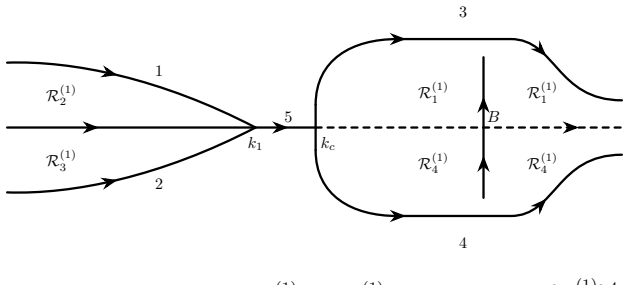
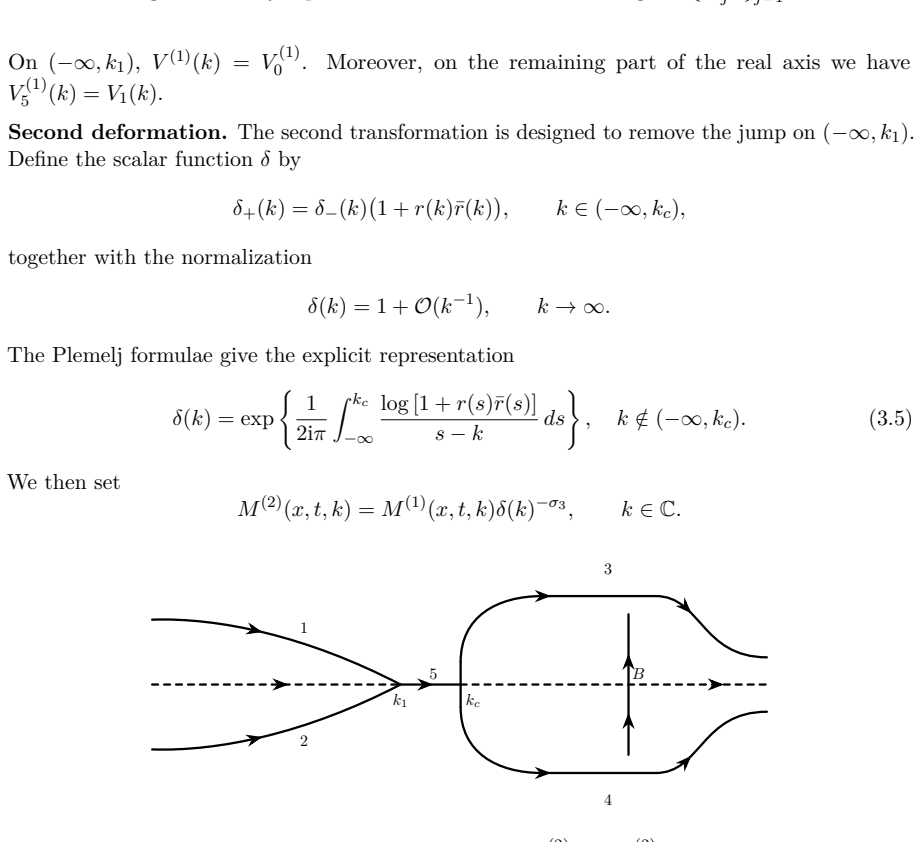
Summary. The paper derives the long-time asymptotics of the focusing NLS equation with nonzero boundary conditions in the double-scaling transition layers |x/t ± 4√2 q_o| ≤ C t^{-2/3} that separate the plane-wave and modulated elliptic-wave regions of Biondini–Mantzavinos. Under the exponential-decay condition (1.4), Assumption 2.1 (no zeros of a on the continuous spectrum), and r(k_c) ≠ 0, Theorem 1.1 states that the solution remains a plane wave to leading order, with a first correction of order t^{-1/3} whose coefficient is built from a distinguished tritronquée solution Q(y) of the inhomogeneous Painlevé-II equation (1.5)–(1.6). The argument proceeds by four exact contour deformations of the IST Riemann–Hilbert problem, construction of an outer parametrix that absorbs the branch-cut jump and a local parametrix reduced to Miller’s RH problem for the tritronquée, followed by a small-norm error problem and reconstruction of the potential.
Significance. The result completes the asymptotic description of the nonlinear stage of modulational instability for generic localized perturbations of a constant background by supplying the missing uniform transition formulae. The appearance of the same inhomogeneous Painlevé-II tritronquée that governs the far-field of rogue waves of infinite order is of independent interest and places the focusing NZBC problem in a broader Painlevé hierarchy. The derivation is parameter-free once the reflection coefficient is given: ν is read off r(k_c) and the phase g_∞ is determined by an explicit integral. The technical machinery (matching estimates, reduction to Miller’s model, L^1/L^∞ control of the error jumps) is standard but carefully executed, and the paper therefore supplies a usable, self-contained reference for future work on vector focusing systems and related NZBC problems.
minor comments (5)
- In the statement of Theorem 1.1 the factor (8√6/(9 q_o))^{1/3} multiplies both the correction term and the definition of y; a short parenthetical remark that this is the natural cubic scaling of the phase would help the reader track the constants through Sections 3–4.
- Figure 3 shows the sign chart of Re(i heta) for three values of ξ, but the contours actually used in the lens openings of Figures 4–8 are not overlaid. Adding the deformed contours to one of the panels would make the relation between the phase and the jumps more immediate.
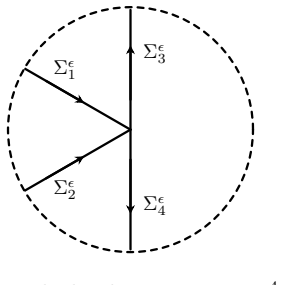
- The reduction of both local models (P− and P+) to the same Jimbo–Miwa RH problem is stated after (A.2), but the verification that G(z) contributes only exponentially small terms is left implicit. A one-sentence reference to the decay of the cubic phase on the rays of Figure 10 would close the argument.
- Several recent works on Painlevé transitions for defocusing or step-like NLS (e.g., Wang–Fan 2023, Boutet de Monvel–Lenells–Shepelsky 2025) are cited only in the concluding remarks; a brief comparison already in the introduction would better situate the inhomogeneous versus homogeneous Painlevé-II distinction.
- Typographical: the arXiv identifier in the header is 2606.29156v2; the year 2026 is presumably a placeholder and should be corrected before publication.
Circularity Check
No significant circularity: Theorem 1.1 is a standard Deift–Zhou double-scaling analysis resting on external IST and Miller’s tritronquée theory.
full rationale
The derivation chain is self-contained and non-circular. The RH formulation and plane-wave/elliptic asymptotics are taken from Biondini–Kovačič and Biondini–Mantzavinos (external); the local model is reduced by exact contour deformations and scaling (3.15) to Miller’s Jimbo–Miwa RH problem for the inhomogeneous Painlevé-II tritronquée (Appendix A, citing [5]), whose existence, uniqueness, and large-z expansion are imported as independent mathematical facts, not as prior results of the present authors. The outer parametrix, matching estimates (Lemmas 3.1, 4.3), small-norm error problem, and reconstruction of E^{(1)}_{12} are carried out explicitly in the paper; ν is read off the reflection coefficient of the given initial data, not fitted. The sole self-reference ([44], “in preparation”) appears only in the concluding remarks as motivation for future vector work and is not used in the proof of Theorem 1.1. No step reduces the claimed t^{-1/3} correction to its own inputs by definition or by a load-bearing self-citation chain.
Assumptions & free parameters
assumptions (4)
- domain assumption The inverse-scattering transform and the associated 2×2 RH problem for focusing NLS with NZBCs are well-posed under the exponential-decay condition (1.4) (Biondini–Kovačič, Biondini–Mantzavinos).
- domain assumption Assumption 2.1: a(k) ≠ 0 on C- ∪ Σ (no discrete spectrum on the continuous spectrum).
- standard math Existence, uniqueness and large-argument asymptotics of the increasing tritronquée solution of the inhomogeneous Painlevé-II equation (Miller, SIGMA 2018).
- ad hoc to paper r(k_c) ≠ 0 (Remark 1.2), ensuring the Painlevé region is non-degenerate.
Cite this review
Pith. "Pith review of Tritronqu\'ee Painlev\'e II asymptotics for the focusing nonlinear Schr\"odinger equation with nonzero boundary conditions." pith.science (2026). https://pith.science/paper/PIKUAQZP
@misc{pith2026260629156,
  author       = {Pith},
  title        = {Pith review of: Tritronqu\'ee Painlev\'e II asymptotics for the focusing nonlinear Schr\"odinger equation with nonzero boundary conditions},
  year         = {2026},
  howpublished = {\url{https://pith.science/paper/PIKUAQZP}},
  note         = {Machine review of arXiv:2606.29156}
}
abstract
We study the long-time asymptotics of the focusing nonlinear Schr\"odinger equation with nonzero boundary conditions in the transition regions between the plane-wave and modulated elliptic-wave regimes. Biondini and Mantzavinos showed that, away from the transition curves \(x=\pm 4\sqrt{2}\,q_o t\), the \((x,t)\)-half-plane decomposes, to leading order, into two plane-wave regions and a central region described by slowly modulated elliptic oscillations. However, their asymptotic formulae are not uniform near the boundaries separating these regions. The purpose of this paper is to resolve this missing boundary layer. Using a double-scaling nonlinear steepest descent analysis of the associated Riemann--Hilbert problem, we show that the leading term in each transition region is still a plane wave, while the first nontrivial correction is of order \(t^{-1/3}\). The coefficient of this correction is expressed in terms of a distinguished tritronqu\'ee solution of an inhomogeneous Painlev\'e-II equation. This Painlev\'e-II tritronqu\'ee structure is also known to appear in the asymptotic analysis of rogue waves of infinite order.
Figures


Figures from the paper (12 more)






Reference graph
Works this paper leans on
-
[1]
M. J. Ablowitz, B. Prinari, and A. D. Trubatch,Discrete and Continuous Nonlinear Schrödinger Systems, London Math. Soc. Lecture Note Ser., vol. 302, Cambridge University Press, Cambridge, 2004
2004
-
[2]
M. J. Ablowitz and H. Segur,Solitons and the Inverse Scattering Transform, SIAM Stud. Appl. Math., vol. 4, Society for Industrial and Applied Mathematics (SIAM), Philadelphia, PA, 1981
1981
-
[3]
Infeld and G
E. Infeld and G. Rowlands,Nonlinear Waves, Solitons and Chaos, 2nd ed., Cambridge University Press, Cambridge, 2000
2000
-
[4]
Sulem and P.-L
C. Sulem and P.-L. Sulem,The Nonlinear Schrödinger Equation: Self-Focusing and Wave Collapse, Appl. Math. Sci., vol. 139, Springer-Verlag, New York, 1999
1999
-
[5]
P. D. Miller, On the increasing tritronquée solutions of the Painlevé-II equation,SIGMA Symmetry Integrability Geom. Methods Appl.14(2018), Paper No. 125, 38 pp
2018
-
[6]
Biondini and D
G. Biondini and D. Mantzavinos, Long-time asymptotics for the focusing nonlinear Schrödinger equation with nonzero boundary conditions at infinity and asymptotic stage of modulational instability,Comm. Pure Appl. Math.70(2017), no. 12, 2300–2365
2017
-
[7]
Biondini, S
G. Biondini, S. Li, and D. Mantzavinos, Long-time asymptotics for the focusing nonlinear Schrödinger equation with nonzero boundary conditions in the presence of a discrete spectrum,Comm. Math. Phys.382(2021), no. 3, 1495–1577
2021
-
[8]
T. B. Benjamin, Instability of periodic wavetrains in nonlinear dispersive systems,Proc. Roy. Soc. London Ser. A299(1967), no. 1456, 59–75
1967
Show all 44 references
-
[9]
T. B. Benjamin and J. E. Feir, The disintegration of wave trains on deep water. Part 1. Theory,J. Fluid Mech.27(1967), no. 3, 417–430
1967
-
[10]
M. A. Alejo, L. Fanelli, and C. Muñoz, The Akhmediev breather is unstable,São Paulo J. Math. Sci.13(2019), no. 2, 391–401, doi:10.1007/s40863-019-00145-4
2019 doi
-
[11]
M. A. Alejo, L. Fanelli, and C. Muñoz, Review on the stability of the Peregrine and related breathers,Front. Phys.8(2020), 591995, doi:10.3389/fphy.2020.591995
2020 doi
-
[12]
Zakharov and L.A
V.E. Zakharov and L.A. Ostrovsky, Modulation instability: the beginning, Phys. D.238 (2009), 540–548. 28
2009
-
[13]
Biondini and E
G. Biondini and E. Fagerstrom, The integrable nature of modulational instability,SIAM J. Appl. Math.75(2015), 136–163
2015
-
[14]
Biondini, S
G. Biondini, S. Li, D. Mantzavinos, and S. Trillo, Universal behavior of modulationally unstable media,SIAM Rev.60(2018), 888–908
2018
-
[15]
V. E. Zakharov and A. B. Shabat, Exact theory of two-dimensional self-focusing and one-dimensional self-modulation of waves in nonlinear media,Soviet Phys. JETP34(1972), no. 1, 62–69
1972
-
[16]
Deift and X
P. Deift and X. Zhou, A steepest descent method for oscillatory Riemann–Hilbert problems. Asymptotics for the mKdV equation,Ann. of Math. (2)137(1993), no. 2, 295–368
1993
-
[17]
Biondini and G
G. Biondini and G. Kovačič, Inverse scattering transform for the focusing nonlinear Schrödinger equation with nonzero boundary conditions,J. Math. Phys.55(2014), no. 3, 031506, 24 pp
2014
-
[18]
Muñoz, Instability in nonlinear Schrödinger breathers,Proyecciones36(2017), no
C. Muñoz, Instability in nonlinear Schrödinger breathers,Proyecciones36(2017), no. 4, 653–683
2017
-
[19]
Boutet de Monvel, J
A. Boutet de Monvel, J. Lenells, and D. Shepelsky, The focusing NLS equation with step-like oscillating background: asymptotics in a transition zone,J. Differential Equations429 (2025), 747–801
2025
-
[20]
G. Li, L. Liu, and Y. Yang, Complex Painlevé type transient asymptotics of the focusing NLS equation: step-like oscillating background,J. Differential Equations465(2026), Paper No. 114216, 35 pp
2026
-
[21]
Bilman, L
D. Bilman, L. Ling, and P. D. Miller, Extreme superposition: rogue waves of infinite order and the Painlevé-III hierarchy,Duke Math. J.169(2020), no. 4, 671–760
2020
-
[22]
Bilman and P
D. Bilman and P. D. Miller,Extreme Superposition: High-Order Fundamental Rogue Waves in the Far-Field Regime,Mem. Amer. Math. Soc.300(2024), no. 1505, v+90 pp
2024
-
[23]
Boutet de Monvel, V
A. Boutet de Monvel, V. P. Kotlyarov, and D. Shepelsky, Focusing NLS equation: long-time dynamics of step-like initial data,Int. Math. Res. Not. IMRN2011(2011), no. 7, 1613–1653
2011
-
[24]
Charlier and J
C. Charlier and J. Lenells, Airy and Painlevé asymptotics for the mKdV equation,J. Lond. Math. Soc. (2)101(2020), no. 1, 194–225
2020
-
[25]
Borghese, R
M. Borghese, R. Jenkins, and K. D. T.-R. McLaughlin, Long time asymptotic behavior of the focusing nonlinear Schrödinger equation,Ann. Inst. H. Poincaré C Anal. Non Linéaire 35(2018), no. 4, 887–920
2018
-
[26]
Deift and X
P. Deift and X. Zhou, Long-time asymptotics for solutions of the NLS equation with initial data in a weighted Sobolev space,Comm. Pure Appl. Math.56(2003), no. 8, 1029–1077
2003
-
[27]
Boutet de Monvel, A
A. Boutet de Monvel, A. R. Its, and D. Shepelsky, Painlevé-type asymptotics for the Camassa–Holm equation,SIAM J. Math. Anal.42(2010), no. 4, 1854–1873
2010
-
[28]
Wang and E
Z. Wang and E. Fan, The defocusing nonlinear Schrödinger equation with a nonzero background: Painlevé asymptotics in two transition regions,Comm. Math. Phys.402 (2023), no. 3, 2879–2930
2023
-
[29]
Cuccagna and R
S. Cuccagna and R. Jenkins, On the asymptotic stability ofN-soliton solutions of the defocusing nonlinear Schrödinger equation,Comm. Math. Phys.343(2016), no. 3, 921–969. 29
2016
-
[30]
Charlier and J
C. Charlier and J. Lenells, On Boussinesq’s equation for water waves, preprint, arXiv:2204.02365
-
[31]
D.-S. Wang, D. Zhu, and X. Zhu, Genus two KdV soliton gases and their long-time asymptotics,Forum Math. Sigma14(2026), Paper No. e57, 47 pp
2026
-
[32]
Huang, D.-S
L. Huang, D.-S. Wang, and X. Zhu, Long-time asymptotics of the Tzitzéica equation on the line,Math. Ann.395(2026), no. 1, Paper No. 18
2026
-
[33]
Yang, S.-F
J.-J. Yang, S.-F. Tian, and Z.-Q. Li, The modified Camassa–Holm equation with nonzero background: soliton resolution conjecture and asymptotic stability ofN-soliton solutions, Adv. Math.484(2026), Paper No. 110552
2026
-
[34]
E. Fan, G. Li, Y. Yang, and L. Zhang, Painlevé XXXIV asymptotics for the defocusing nonlinear Schrödinger equation with a finite-genus algebro-geometric background,Math. Ann.394(2026), Paper No. 44, 58 pp
2026
-
[35]
Charlier, J
C. Charlier, J. Lenells, and D.-S. Wang, The “good” Boussinesq equation: long-time asymptotics,Anal. PDE16(2023), no. 6, 1351–1388
2023
-
[36]
Charlier and J
C. Charlier and J. Lenells, The soliton resolution conjecture for the Boussinesq equation,J. Math. Pures Appl. (9)191(2024), Paper No. 103621
2024
-
[37]
Deift, T
P. Deift, T. Kriecherbauer, K. T.-R. McLaughlin, S. Venakides, and X. Zhou, Uniform asymptotics for polynomials orthogonal with respect to varying exponential weights and applications to universality questions in random matrix theory,Comm. Pure Appl. Math. 52(1999), no. 11, 1335–1425
1999
-
[38]
Deift,Orthogonal Polynomials and Random Matrices: A Riemann–Hilbert Approach, Courant Lecture Notes in Mathematics, vol
P. Deift,Orthogonal Polynomials and Random Matrices: A Riemann–Hilbert Approach, Courant Lecture Notes in Mathematics, vol. 3, New York University, Courant Institute of Mathematical Sciences, New York; American Mathematical Society, Providence, RI, 1999
1999
-
[39]
Lenells, Matrix Riemann–Hilbert problems with jumps across Carleson contours,Monatsh
J. Lenells, Matrix Riemann–Hilbert problems with jumps across Carleson contours,Monatsh. Math.186(2018), no. 1, 111–152
2018
-
[40]
Lenells, The nonlinear steepest descent method for Riemann–Hilbert problems of low regularity,Indiana Univ
J. Lenells, The nonlinear steepest descent method for Riemann–Hilbert problems of low regularity,Indiana Univ. Math. J.66(2017), no. 4, 1287–1332
2017
-
[41]
Kraus, G
D. Kraus, G. Biondini, and G. Kovačič, The focusing Manakov system with nonzero boundary conditions,Nonlinearity28(2015), no. 9, 3101–3151
2015
-
[42]
Prinari, Inverse scattering transform for nonlinear Schrödinger systems on a nontrivial background: a survey of classical results, new developments and future directions,J
B. Prinari, Inverse scattering transform for nonlinear Schrödinger systems on a nontrivial background: a survey of classical results, new developments and future directions,J. Nonlinear Math. Phys.30(2023), no. 2, 317–383
2023
-
[43]
H. Liu, J. Shen, and X. G. Geng, Inverse scattering transformation for theN-component focusing nonlinear Schrödinger equation with nonzero boundary conditions,Lett. Math. Phys.113(2023), no. 1, Paper No. 23, 47 pp
2023
-
[44]
X. G. Geng and H. B. Zhang, Long-time asymptotics for the focusing Manakov system with nonzero boundary conditions, in preparation. 30
Reviewed July 12, 2026 · model on record in the stance chip above.
Discussion (0). Continue with ORCID to comment.