Second-Order Area/Volume-Preserving PFEMs for Surface Diffusion via Simpson--Boole Geometric Identities
Pith reviewed 2026-06-30 02:51 UTC · model grok-4.3
The pith
Second-order finite element schemes for surface diffusion preserve enclosed area and volume exactly without Lagrange multipliers.
A machine-rendered reading of the paper's core claim, the machinery that carries it, and where it could break.
Core claim
The resulting fully discrete schemes preserve the enclosed area or volume exactly, without introducing an auxiliary Lagrange multiplier for the geometric constraint, by evaluating the induced variations exactly via Simpson's rule in 2D and Boole's rule in 3D along the quadratic path.
What carries the argument
Exact geometric variation identities along a quadratic temporal interpolation path, evaluated precisely by Simpson's rule in 2D and Boole's rule in 3D on BGN-predicted auxiliary geometries.
If this is right
- The schemes achieve second-order accuracy in time while maintaining exact geometric conservation.
- They assemble directly on existing BGN-predicted auxiliary geometries and require no extra multiplier solve.
- Mesh quality remains good over long evolutions for both curves and surfaces.
- The same construction applies uniformly to 2D curves and 3D surfaces.
Where Pith is reading between the lines
- Exact conservation may reduce artificial drift in long-time geometric flows where small volume errors accumulate.
- The approach could be tested on other mean-curvature-type flows that benefit from strict area or volume preservation.
- Because it reuses BGN auxiliary geometries, the method offers a low-cost route to upgrade existing second-order codes to strict conservation.
Load-bearing premise
The geometric variation identities can be evaluated exactly by the chosen quadrature rules when the path is quadratic and the auxiliary geometries are given by the BGN predictor.
What would settle it
A closed-curve evolution simulation in which the enclosed area after one time step differs from the initial area by more than machine epsilon when the Simpson rule is applied to the quadratic path.
Figures
read the original abstract
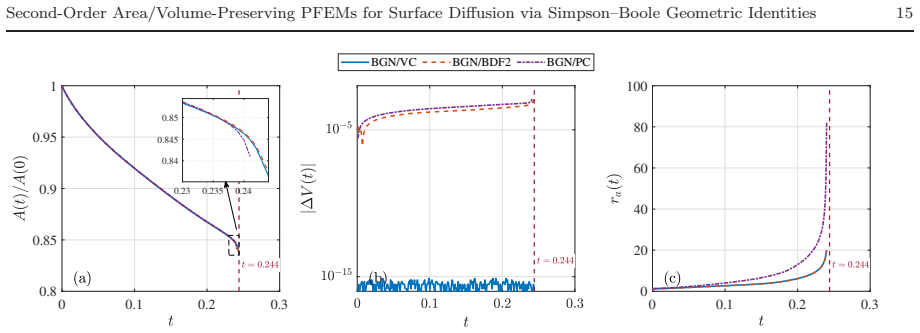
We propose second-order-in-time parametric finite element methods for surface diffusion of closed curves in two dimensions and closed surfaces in three dimensions. The construction is based on exact geometric variation identities along a quadratic temporal interpolation path. The induced area variation in 2D is evaluated exactly by Simpson's rule, while the induced volume variation in 3D is evaluated exactly by Boole's rule. The resulting fully discrete schemes preserve the enclosed area or volume exactly, without introducing an auxiliary Lagrange multiplier for the geometric constraint. They can be assembled on BGN-predicted auxiliary geometries and are therefore compatible with existing second-order BGN-type implementations. Numerical experiments demonstrate the expected second-order behavior, area/volume conservation, and good mesh quality for both curve and surface evolutions.
Editorial analysis
A structured set of objections, weighed in public.
Referee Report
Summary. The manuscript proposes second-order parametric finite element methods (PFEMs) for surface diffusion of closed curves in 2D and closed surfaces in 3D. The construction relies on exact geometric variation identities along a quadratic temporal interpolation path, with the induced area variation evaluated exactly by Simpson's rule in 2D and the volume variation by Boole's rule in 3D. This yields fully discrete schemes that preserve enclosed area or volume exactly without an auxiliary Lagrange multiplier. The methods are stated to be assemblable on BGN-predicted auxiliary geometries for compatibility with existing second-order BGN-type codes, and numerical experiments confirm the expected second-order accuracy, exact conservation, and good mesh quality.
Significance. If the exact preservation property holds as claimed, the work provides a valuable structure-preserving discretization for geometric evolution equations that avoids the computational overhead and potential ill-conditioning of Lagrange multipliers. The quadrature-based approach, which exploits the polynomial degree of the variation integrands along the quadratic path, is a clean and potentially generalizable technique. Compatibility with BGN schemes is a practical strength that could facilitate adoption in existing codes. The absence of free parameters or ad-hoc fitting in the conservation mechanism, combined with the numerical validation, strengthens the contribution to the field of geometric numerical methods.
minor comments (3)
- [Abstract] The abstract and introduction refer to 'BGN-predicted auxiliary geometries' without a brief parenthetical definition or citation on first use; this may hinder readers new to the BGN literature.
- [§5] In the numerical experiments section, mesh quality is described qualitatively as 'good'; reporting quantitative metrics such as minimum element angle or aspect-ratio histograms would make the mesh-regularity claim more precise and comparable.
- [§4] A short remark on whether the exact preservation identity remains valid under floating-point arithmetic or when the auxiliary geometry is only approximately BGN-predicted would clarify the practical robustness of the method.
Simulated Author's Rebuttal
We thank the referee for the positive assessment of the manuscript, the recognition of the structure-preserving property, and the recommendation for minor revision. No major comments were provided in the report.
Circularity Check
No significant circularity
full rationale
The derivation relies on exact geometric variation identities along a quadratic temporal interpolation path, evaluated by Simpson's rule (2D) and Boole's rule (3D), which are standard quadrature rules known to be exact for the relevant polynomial degrees (cubics and quintics). The area/volume preservation follows directly from these identities without auxiliary multipliers or fitted parameters. No self-citation chains, self-definitional steps, or renamings of known results are load-bearing for the central claim. The construction is self-contained against the stated mathematical assumptions and compatible with BGN geometries as an implementation detail, not a circular dependency.
Axiom & Free-Parameter Ledger
axioms (1)
- standard math Simpson's rule and Boole's rule evaluate the induced area/volume variations exactly along the quadratic path
Reference graph
Works this paper leans on
-
[1]
SIAM Journal on Numerical Analysis 42(2), 773–799 (2004)
B¨ ansch, E., Morin, P., Nochetto, R.H.: Surface diffusion of graphs: variational formulation, error analysis, and si mula- tion. SIAM Journal on Numerical Analysis 42(2), 773–799 (2004). DOI 10.1137/S0036142902419272
-
[2]
SIAM Journal on Numerical Analysis 61(2), 617–641 (2023)
Bao, W., Jiang, W., Li, Y.: A symmetrized parametric finite element method for anisotropic surface diffusion of closed curves. SIAM Journal on Numerical Analysis 61(2), 617–641 (2023). DOI 10.1137/22M1500575
-
[3]
SIAM Journal on Scientific Computing 45(4), A1438–A1461 (2023)
Bao, W., Li, Y.: A symmetrized parametric finite element me thod for anisotropic surface diffusion in three dimensions. SIAM Journal on Scientific Computing 45(4), A1438–A1461 (2023). DOI 10.1137/22M1472851
-
[4]
Mathematics of Computation 94(355), 2113–2149 (2025)
Bao, W., Li, Y.: A unified structure-preserving parametri c finite element method for anisotropic surface diffusion. Mathematics of Computation 94(355), 2113–2149 (2025). DOI 10.1090/mcom/4022
-
[5]
SIAM Journal on Numerical Analysis 59(5), 2775–2799 (2021)
Bao, W., Zhao, Q.: A structure-preserving parametric fini te element method for surface diffusion. SIAM Journal on Numerical Analysis 59(5), 2775–2799 (2021). DOI 10.1137/21M1406751
-
[6]
Journal of Computational Physics 222(1), 441–467 (2007)
Barrett, J.W., Garcke, H., N¨ urnberg, R.: A parametric fin ite element method for fourth order geometric evolution equations. Journal of Computational Physics 222(1), 441–467 (2007). DOI 10.1016/j.jcp.2006.07.026
-
[7]
Journal of Computational Physics 227(9), 4281–4307 (2008)
Barrett, J.W., Garcke, H., N¨ urnberg, R.: On the parametr ic finite element approximation of evolving hypersurfaces i n R3. Journal of Computational Physics 227(9), 4281–4307 (2008). DOI 10.1016/j.jcp.2007.11.023
-
[8]
In: Handbook of Numerical Analysis, vol
Barrett, J.W., Garcke, H., N¨ urnberg, R.: Parametric fini te element approximations of curvature-driven interface e volu- tions. In: Handbook of Numerical Analysis, vol. 21, pp. 275– 423. Elsevier (2020). DOI 10.1016/bs.hna.2019.05.002
-
[9]
113: Surface motio n by surface diffusion
Cahn, J.W., Taylor, J.E.: Overview no. 113: Surface motio n by surface diffusion. Acta Metallurgica et Materialia 42(4), 1045–1063 (1994). DOI 10.1016/0956-7151(94)90123-6
-
[10]
SIAM Journal on Numerical Analysis 43(3), 1112–1138 (2005)
Deckelnick, K., Dziuk, G., Elliott, C.M.: Fully discret e finite element approximation for anisotropic surface diffu sion of graphs. SIAM Journal on Numerical Analysis 43(3), 1112–1138 (2005). DOI 10.1137/S0036142903434874
-
[11]
A Second-order Structure-preserving Parametric FEM for Surface Evolution
Duan, B., Yang, Z.: A second-order structure-preservin g parametric FEM for surface evolution. arXiv preprint arXiv:2606.08293 (2026)
work page internal anchor Pith review Pith/arXiv arXiv 2026
-
[12]
Nume rische Mathematik 58(1), 603–611 (1990)
Dziuk, G.: An algorithm for evolutionary surfaces. Nume rische Mathematik 58(1), 603–611 (1990). DOI 10.1007/ BF01385643
1990
-
[13]
Mathematical Models and Methods in Applied Sciences 4(04), 589–606 (1994)
Dziuk, G.: Convergence of a semi-discrete scheme for the curve shortening flow. Mathematical Models and Methods in Applied Sciences 4(04), 589–606 (1994). DOI 10.1142/S0218202594000339
-
[14]
SIAM journal on Mathematical Analysis 33(5), 1228–1245 (2002)
Dziuk, G., Kuwert, E., Sch¨ atzle, R.: Evolution of elast ic curves in Rn: Existence and computation. SIAM journal on Mathematical Analysis 33(5), 1228–1245 (2002). DOI 10.1137/S0036141001383709
-
[15]
SIAM Journal on Mathematical Analysis 27(2), 404–423 (1996)
Elliott, C.M., Garcke, H.: On the Cahn–Hilliard equatio n with degenerate mobility. SIAM Journal on Mathematical Analysis 27(2), 404–423 (1996). DOI 10.1137/S0036141094267662
-
[16]
SIAM Journal on Sc ientific Computing 47(3), A1983–A2011 (2025)
Garcke, H., Jiang, W., Su, C., Zhang, G.: Structure-pres erving parametric finite element method for surface diffusio n based on Lagrange multiplier approaches. SIAM Journal on Sc ientific Computing 47(3), A1983–A2011 (2025). DOI 10.1137/24M1687546
-
[17]
Journal of Computational Physics 489, 112276 (2023)
Garcke, H., N¨ urnberg, R., Zhao, Q.: Structure-preserv ing discretizations of two-phase Navier–Stokes flow using fi tted and unfitted approaches. Journal of Computational Physics 489, 112276 (2023). DOI 10.1016/j.jcp.2023.112276
-
[18]
Journal of Computational Physics 514, 113220 (2024)
Jiang, W., Su, C., Zhang, G.: A second-order in time, BGN- based parametric finite element method for geometric flows of curves. Journal of Computational Physics 514, 113220 (2024). DOI 10.1016/j.jcp.2024.113220
-
[19]
SIAM Journal on Sc ientific Computing 46(5), A2874–A2898 (2024)
Jiang, W., Su, C., Zhang, G.: Stable backward differentia tion formula time discretization of BGN-based parametric finite element methods for geometric flows. SIAM Journal on Sc ientific Computing 46(5), A2874–A2898 (2024). DOI 10.1137/23M1625597
-
[20]
Journal of Computational Physics 530, 113901 (2025)
Jiang, W., Su, C., Zhang, G., Zhang, L.: Predictor-corre ctor, BGN-based parametric finite element methods for surfa ce diffusion. Journal of Computational Physics 530, 113901 (2025). DOI 10.1016/j.jcp.2025.113901
-
[21]
Journal of Ap plied Physics 28(3), 333–339 (1957)
Mullins, W.W.: Theory of thermal grooving. Journal of Ap plied Physics 28(3), 333–339 (1957). DOI 10.1063/1.1722742
-
[22]
Journal of Applied Physics 30(1), 77–83 (1959)
Mullins, W.W.: Flattening of a nearly plane solid surfac e due to capillarity. Journal of Applied Physics 30(1), 77–83 (1959). DOI 10.1063/1.1734979
-
[23]
Olshanskii, M.A., Reusken, A.: Trace finite element meth ods for PDEs on surfaces. In: Geometrically Unfitted Finite Element Methods and Applications: Proceedings of the UCL W o rkshop 2016, pp. 211–258. Springer (2018). DOI 10.1007/978-3-319-71431-8 7
-
[24]
Persson, P.O.: Mesh generation for implicit geometries . Ph.D. thesis, Massachusetts Institute of Technology (200 5)
-
[25]
Journal of Scientific Compu ting 19(1-3), 439–456 (2003)
Smereka, P.: Semi-implicit level set methods for curvat ure and surface diffusion motion. Journal of Scientific Compu ting 19(1-3), 439–456 (2003). DOI 10.1023/A:1025324613450
-
[26]
Journal of Scientific Computing 40(1-3), 375–390 (2009)
Xu, Y., Shu, C.W.: Local discontinuous Galerkin method f or surface diffusion and Willmore flow of graphs. Journal of Scientific Computing 40(1-3), 375–390 (2009). DOI 10.1007/s10915-008-9262-0
discussion (0)
Sign in with ORCID, Apple, or X to comment. Anyone can read and Pith papers without signing in.